Jump to: CRISPR/Cas as a genome editing tool • Non-editing CRISPR/Cas tools • CRISPR/Cas as a therapeutic tool • CRISPR as a lab tool for forward and reverse genetics • CRISPR limitations and workarounds • To review CRISPR as a tool • The basic research behind it all • Recommended reading • Gallery
Let’s talk about CRISPR-Cas. Where it comes from, where it stands and where it’s going. The gene editing tool CRISPR/Cas comes from bacterial immune systems. Scientists were just doing basic research, trying to study bacterial systems, and they discovered that you could actually program these specific protein sites with RNA guides that would take them to DNA targets, and then they cut the targets. And then you could use that as a tool to introduce specific changes you wanted to make. The tool has evolved so that we can make more specific changes, but it still has its challenges. So, let’s talk about where the technology stands right now, and about some of the things that are coming in the future.
I’m going to start by talking about CRISPR/Cas as a gene editing tool. And then later I will go back and talk about it as a bacterial tool. But I figure more people care about it as a gene editing tool. And so I will start with that stuff. I think it’s important that people have know what it is, know some of its limitations, and know the new stuff that’s in the works.
Warning: Most of this is from a quickly edited transcription of the video I made, so apologies for typos and extra bumbliness
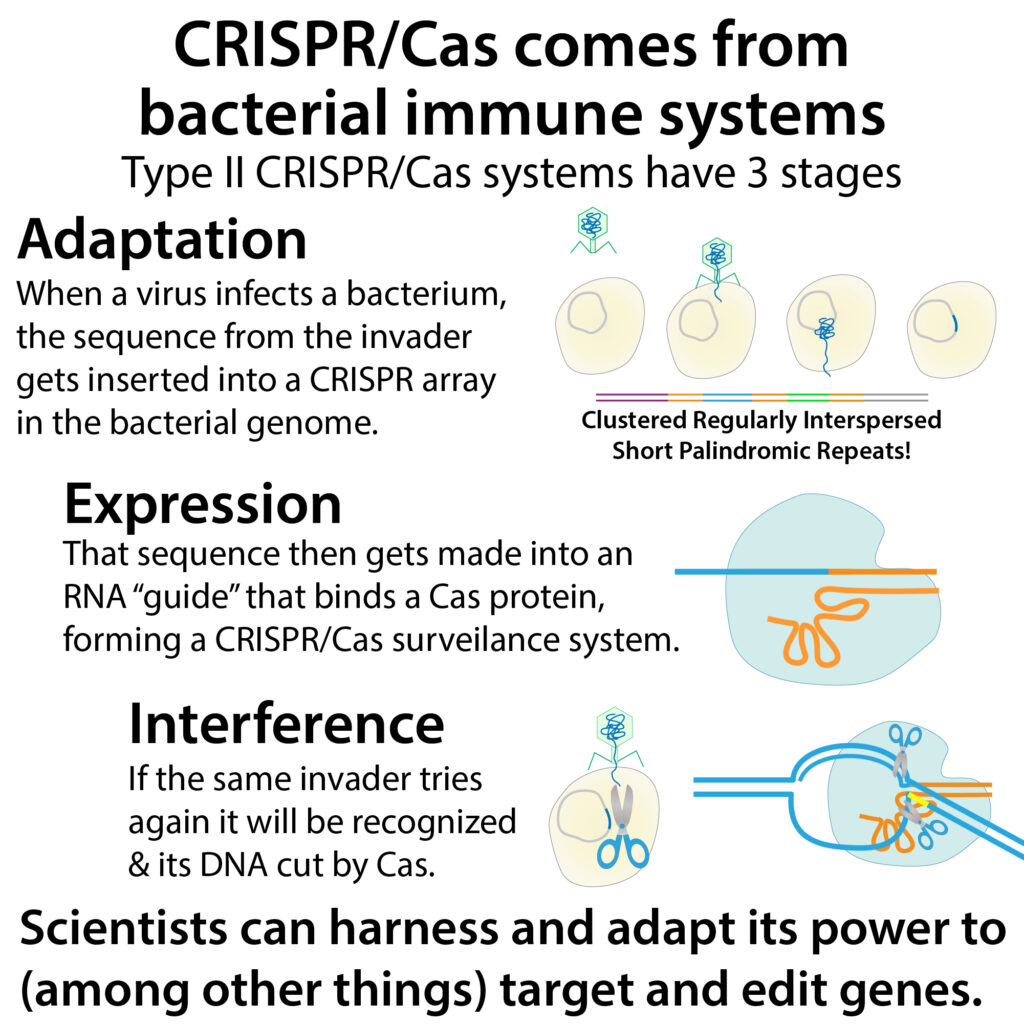
The basic, basic bottom line, it comes from this bacterial immune system. And these bacteria, they’re like okay, so this virus infected me. I want to not let that happen again. So I may take some of that viral DNA. I’m going to integrate that into my genome. And then if the virus comes to attack me, what I’m going to do is I’m going to use that sequence that came from that virus in order to recognize the virus. And the way that I’m going to do this is I’m going to have this Cas protein, which is basically a pair of DNA scissors–in jargon, it’s an double-stranded DNA-specific endonuclease. It’ll cut the DNA of the virus that infects it. How does it know where to cut? Here’s where the CRISPR guide comes in. Cas binds on to the CRISPR guide RNA that contains the sequence from that virus. The guide guides Cas to the sequence to cleave it.
CRISPR as a gene/genome editing tool
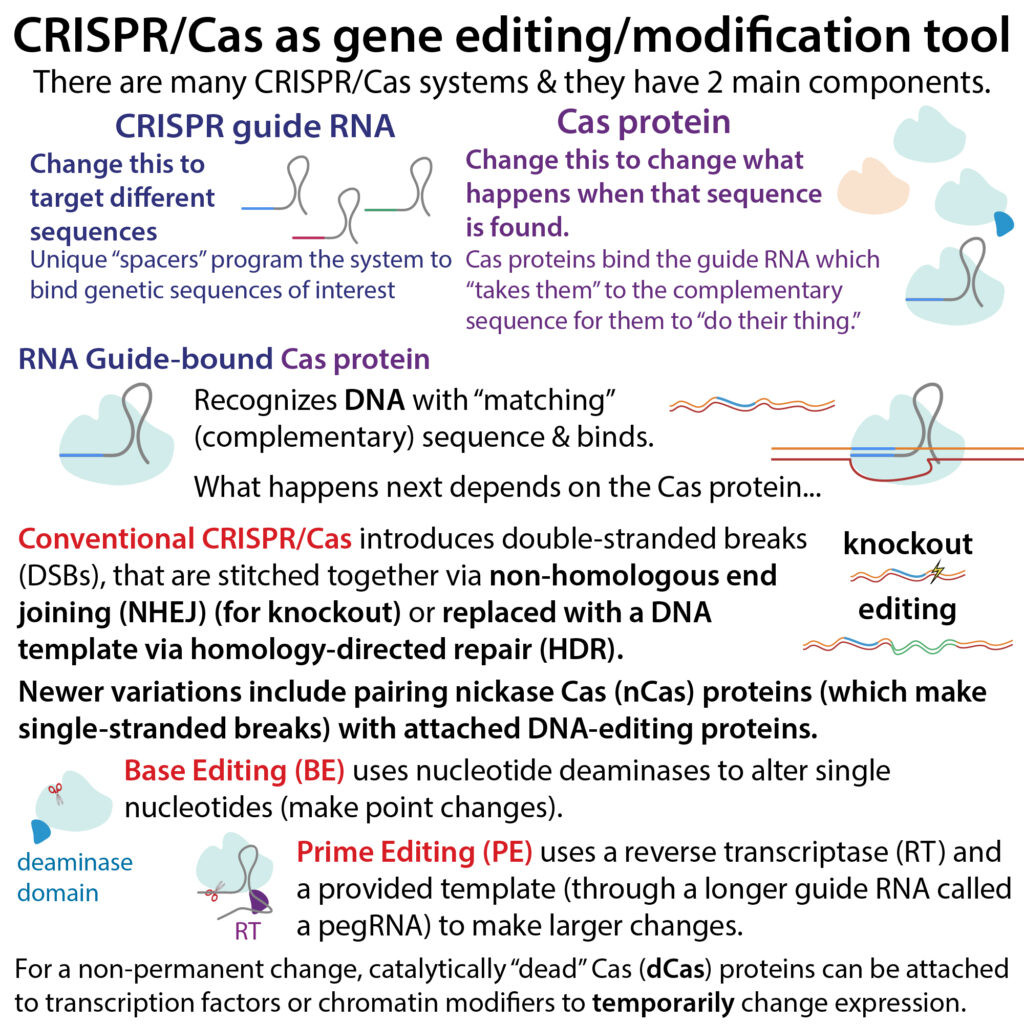
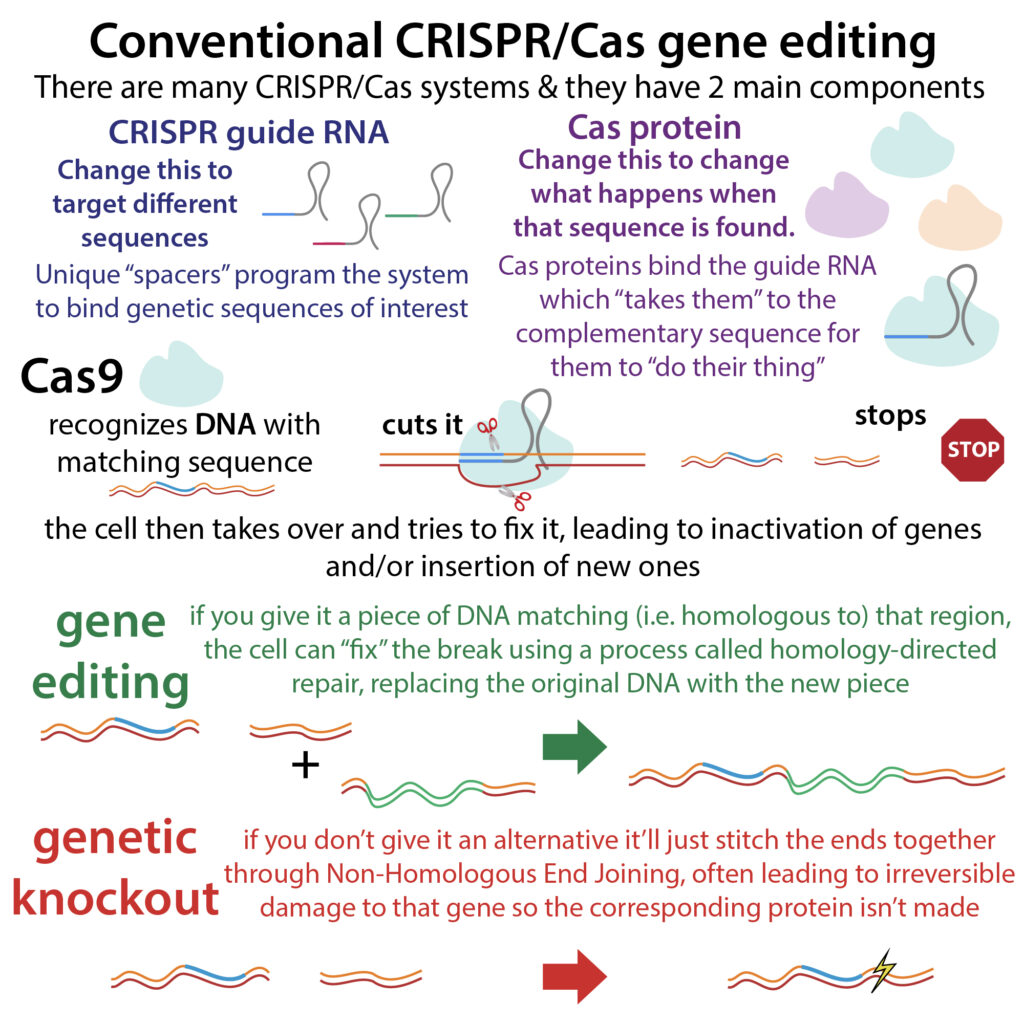
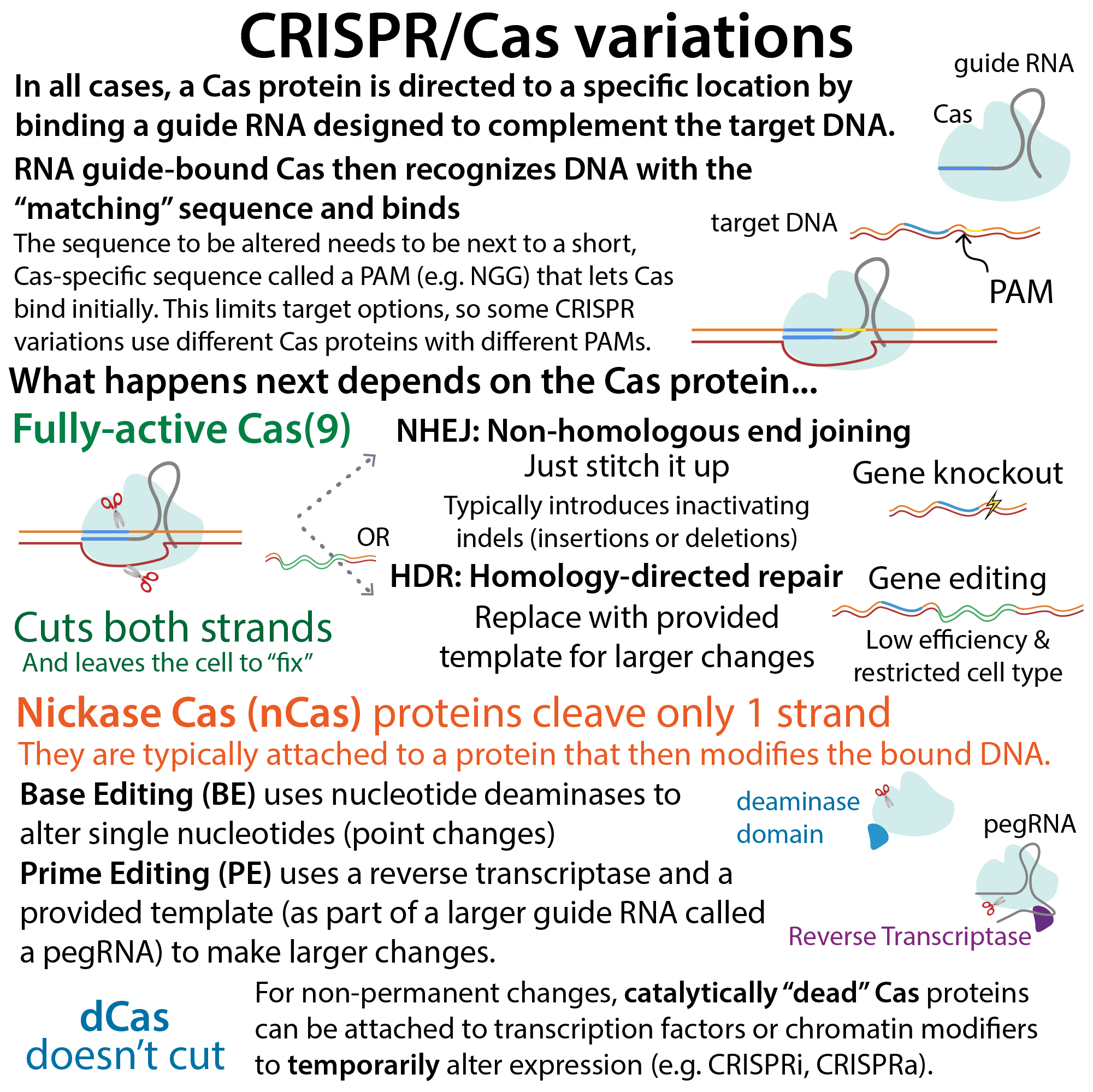
Once scientists (Jennifer Doudna, Emmanuel Chapentier, and colleagues) figured out how it worked, they showed that it can be used as a powerful gene editing tool. What we can do is we can take a Cas protein, and then we can give it a guide RNA, but instead of targeting a virus, we’re going to have it target whatever sequence of DNA we want to cut.
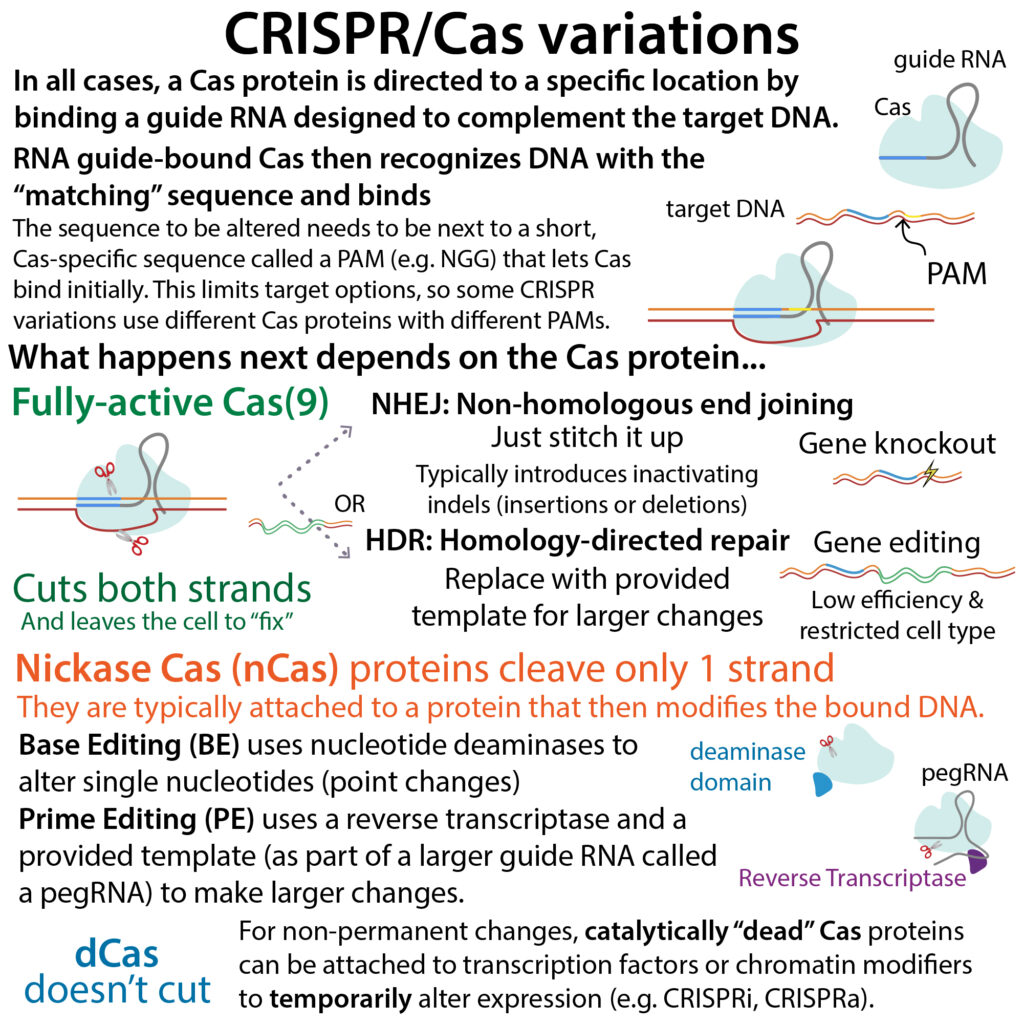
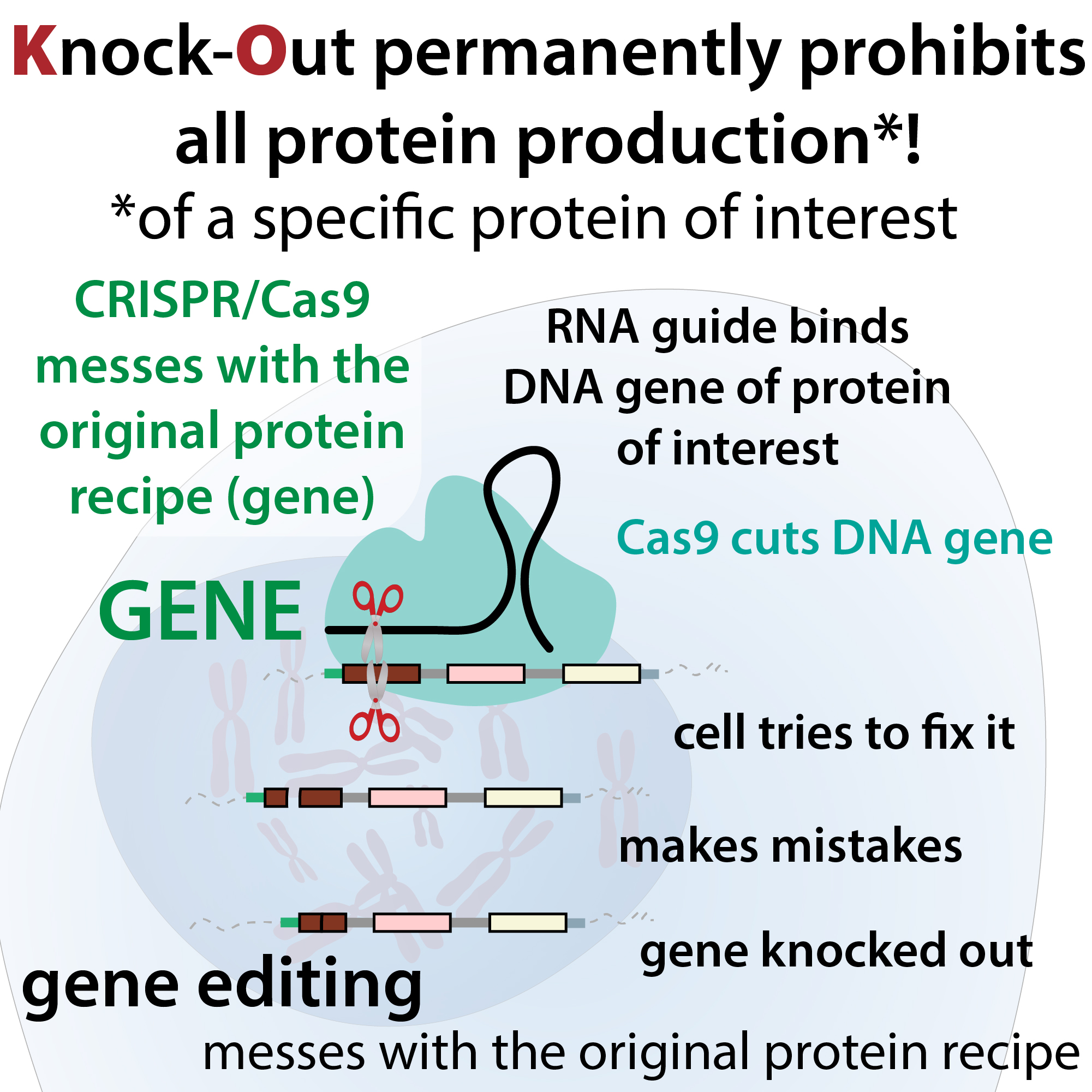
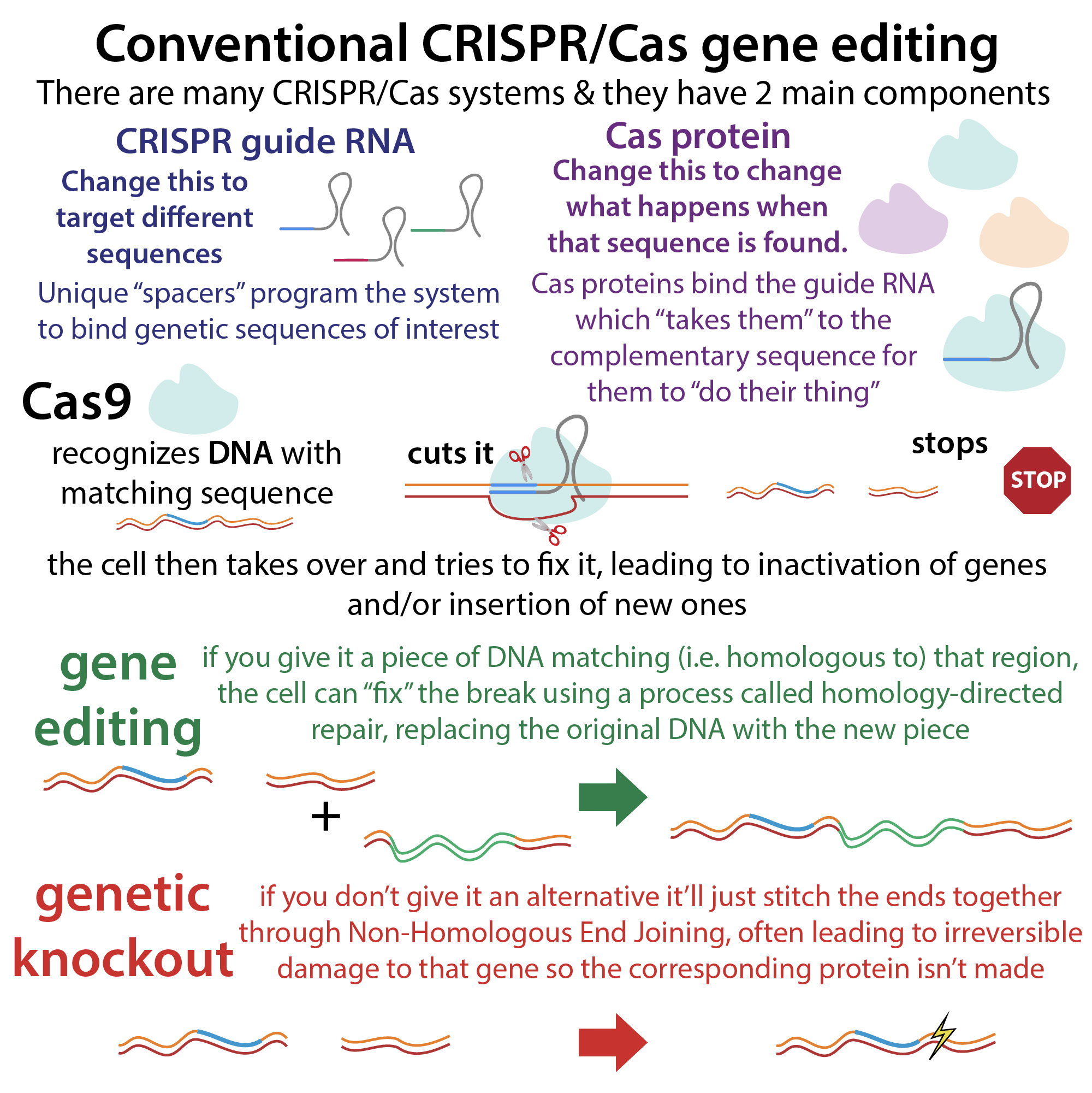
And so we give it a specific CRISPR guide RNA and a Cas protein. The guide binds the Cas protein, goes to the site and cuts it. Well, at least the “traditional” Cas protein does that. (The original system that was developed as a laboratory tool was Cas9 from a bacterium called Streptococcus pyogenes). Once it cuts both strands (making a double stranded DNA (dsDNA) break, it lets the cell take over.
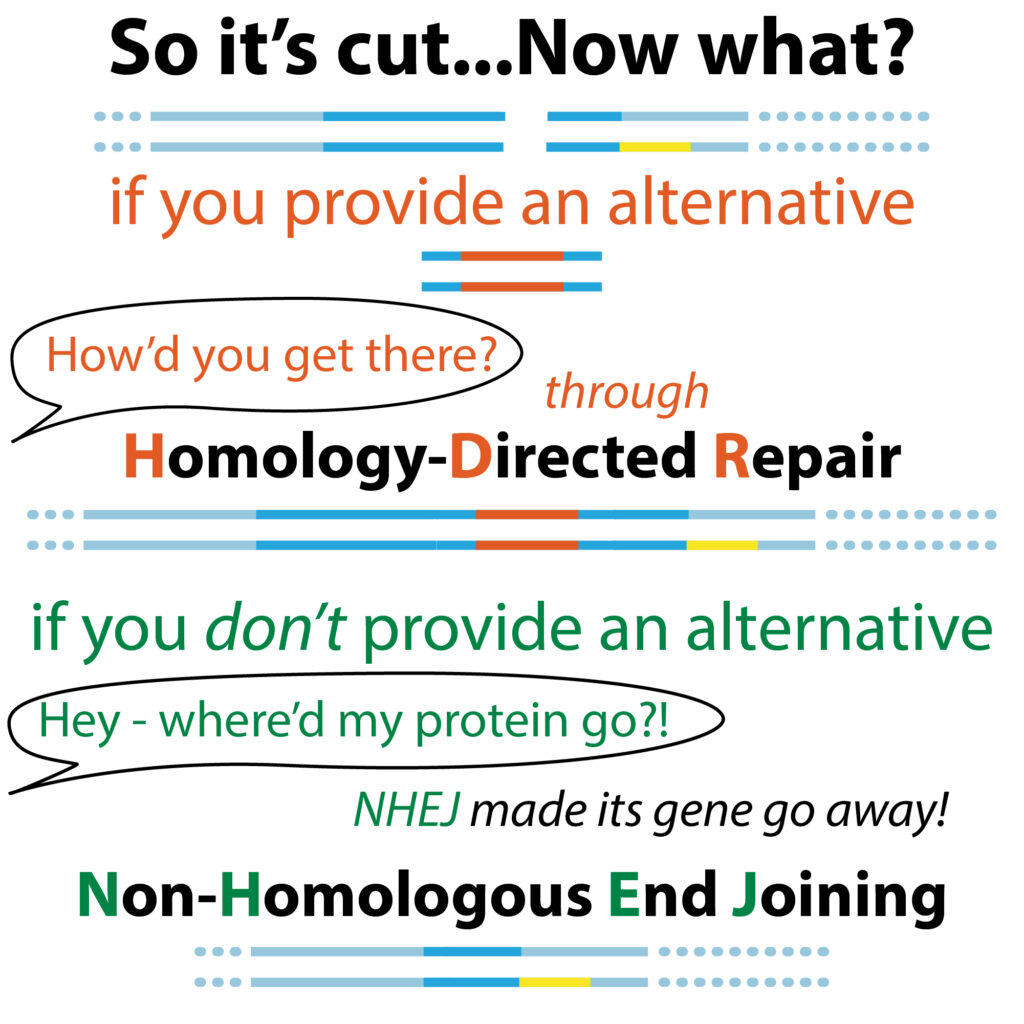
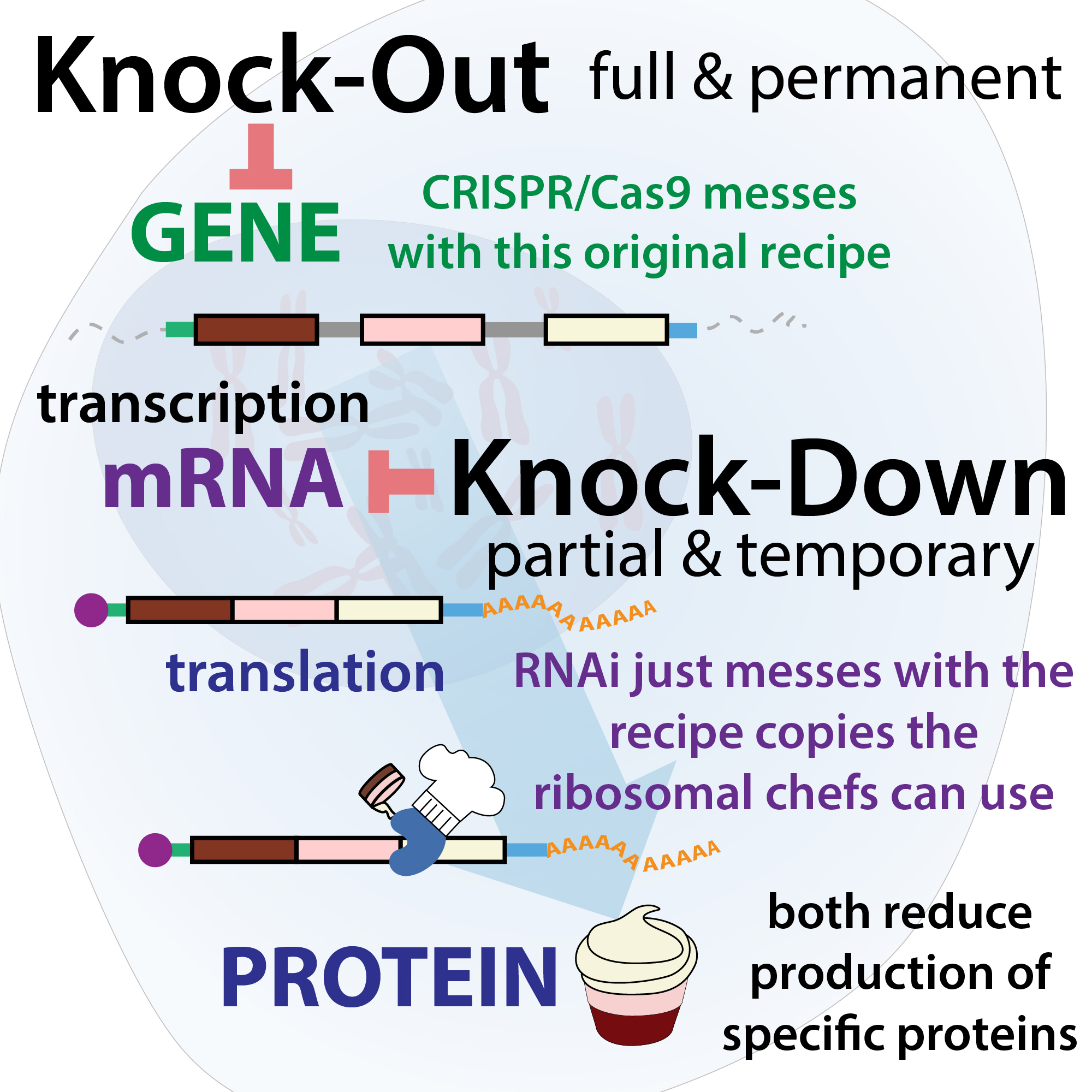
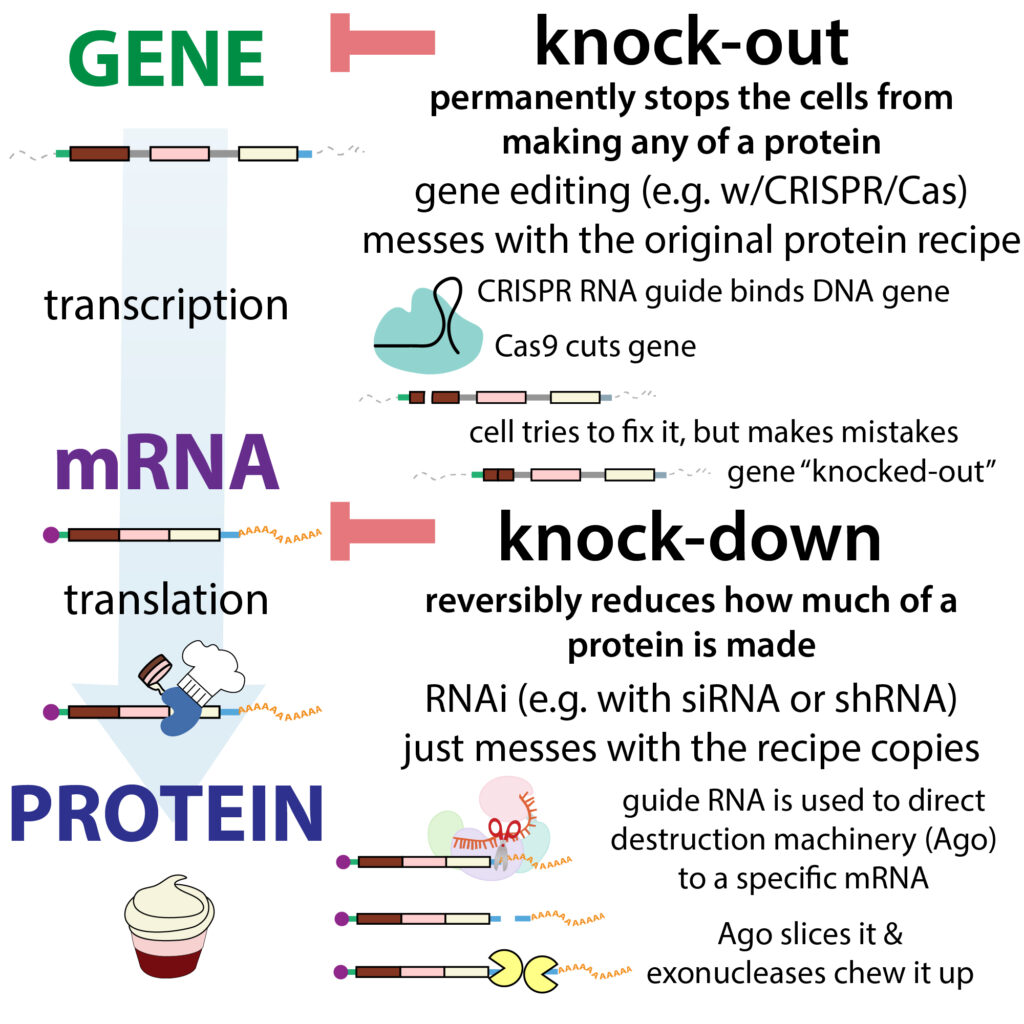
Cells hate dsDNA breaks. So, the cell is then going to kind of freak out if you don’t give it any alternative. The cell is going to do something called non-homologous end joining. Basically just kind of try to stitch those ends together. And this typically leads to what we call indels. So insertions and deletions. And this typically inactivates the gene–we get what we call a genetic knockout–functional protein is not made from this place anymore. More on knock-out and knock-down here: https://bit.ly/knockdownvsknockout
But you have to go and check that you actually made the change that you want. And so typically people do things like Western blots in order to verify that the protein is no longer being made. If you give it an alternative, you can have homology directed repair. And here you’re going to give it an alternative template. The end of that template match the cut site region problem with this.
A lot of times however you want something more than just knockout. You want to actually just make a specific change to the sequence that’s there. Maybe fix a typo in the genetic sequence. A way that you could do this is if you give it a new template to put in the place. What you can do is you can use what’s called homology directed repair. Here you provide an alternative template that has the ends of that template match the ends of the cut sites. That way through homology directed repair, the cells will be like, hey, that looks like that, and that looks like that, and let me put those together and voila, you get homology directed repair (HDR). That can work sometimes, but there are a couple of problems:
- It’s limited to certain cell types. Basically that machinery is only really active during cells that are actively dividing.
- It’s also not very efficient.
Making those double stranded cuts in the DNA can kind of make the cell freak out. And it can also lead to changes you don’t want like pieces of chromosomes getting switched, swapped and lots of things that could potentially even do, have outcomes like causing cancer if they’re in the wrong place. And so the technology has kind of been moving away from this more conventional CRISPR/Cas.
So in the lab, it’s great a lot of times. But if we want to use it for, say, therapeutics, we want something that’s more precise, something that’s more efficient and something that is we can make more a wider range of edits–introduce the Cas nickases! (nCas proteins). Nickases only cut one strand of DNA. Cas proteins can be turned into nickases by inactivating one of the 2 catalytic sites (the HNH or RuvC domain). Depending on which you inactivate, you’ll cut the strand that the guide binds to, or cut the opposite strand.
nCas proteins are typically attached (“conjugated”) to another protein, an enzyme that’s going to actually do something to modify the DNA. Because like if you make one strand, the cell’s just like, okay, I’ll just sit your back up. No big deal. But if you have something that modifies the DNA when you cut it, then you can kind of have a way to introduce changes that you want.
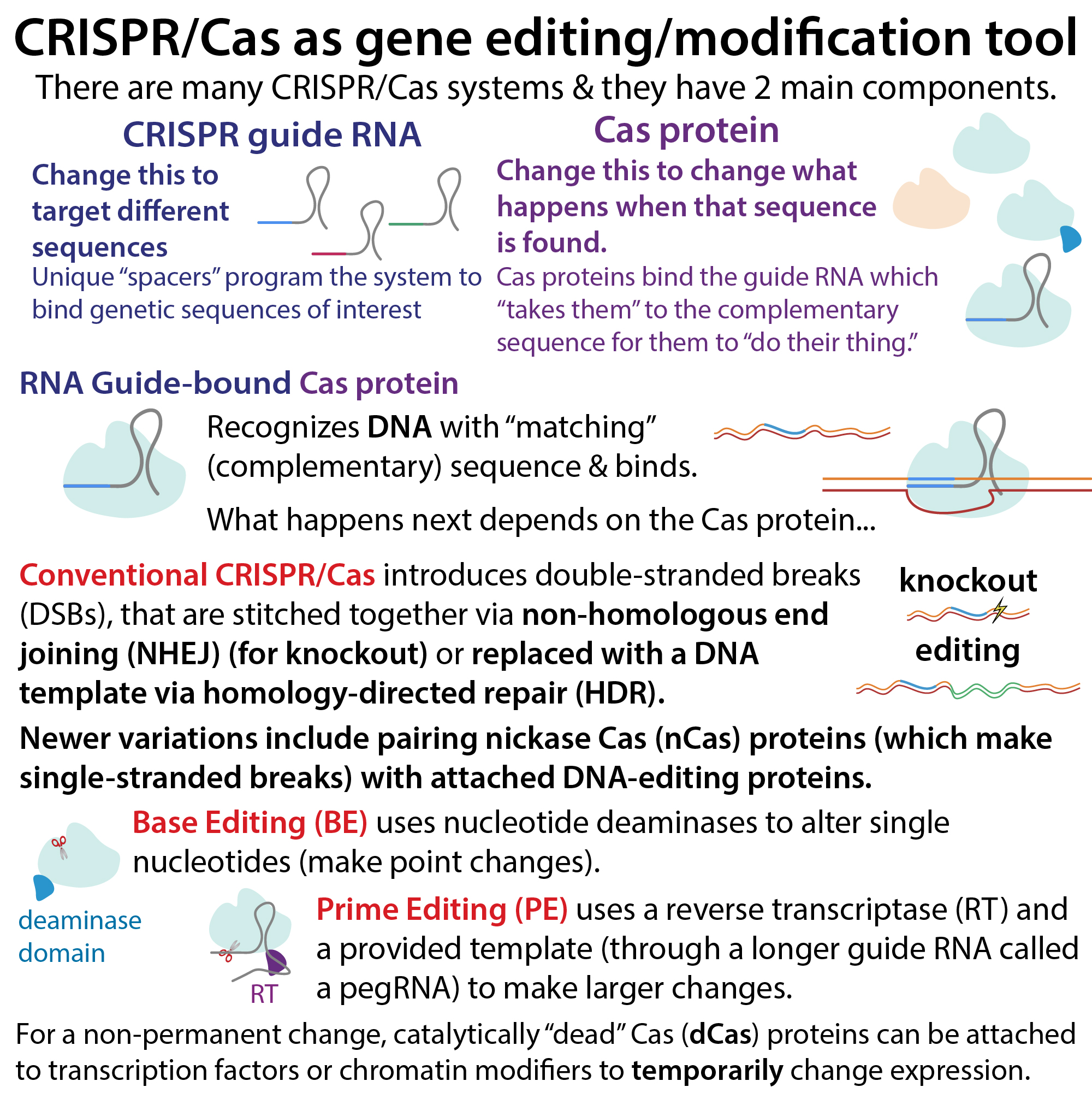
There are two main forms of this that are typically used. There’s base editing (BE) and prime editing (PE).
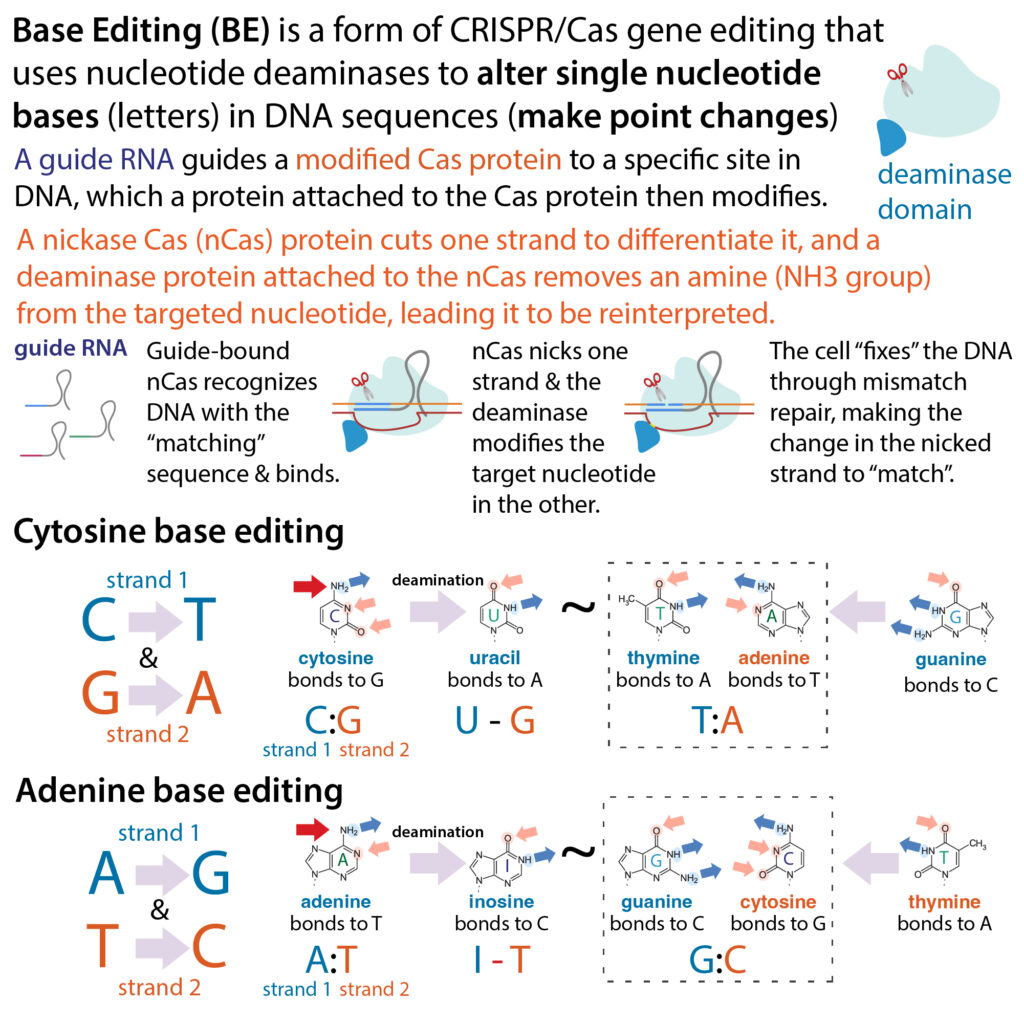
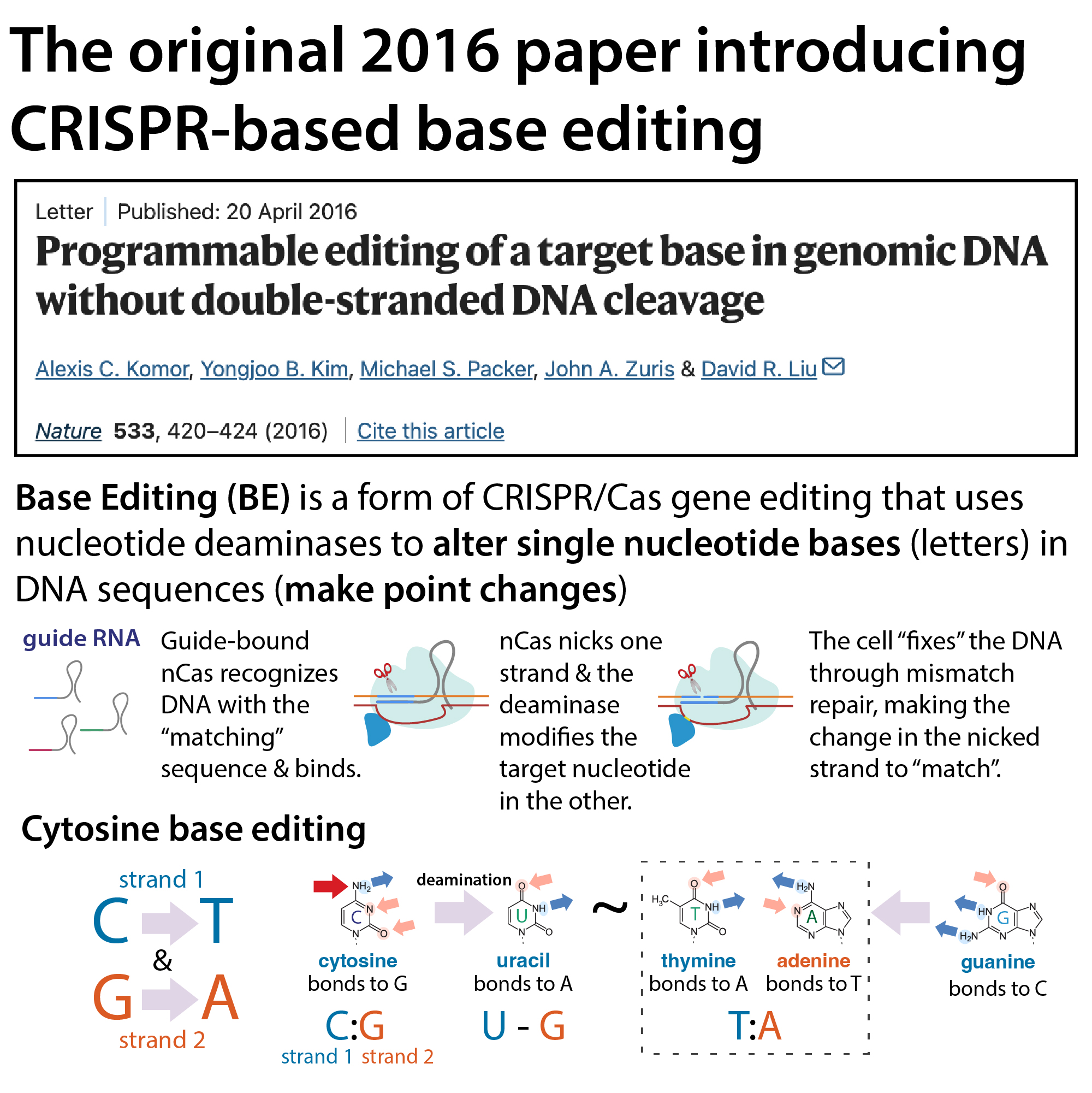
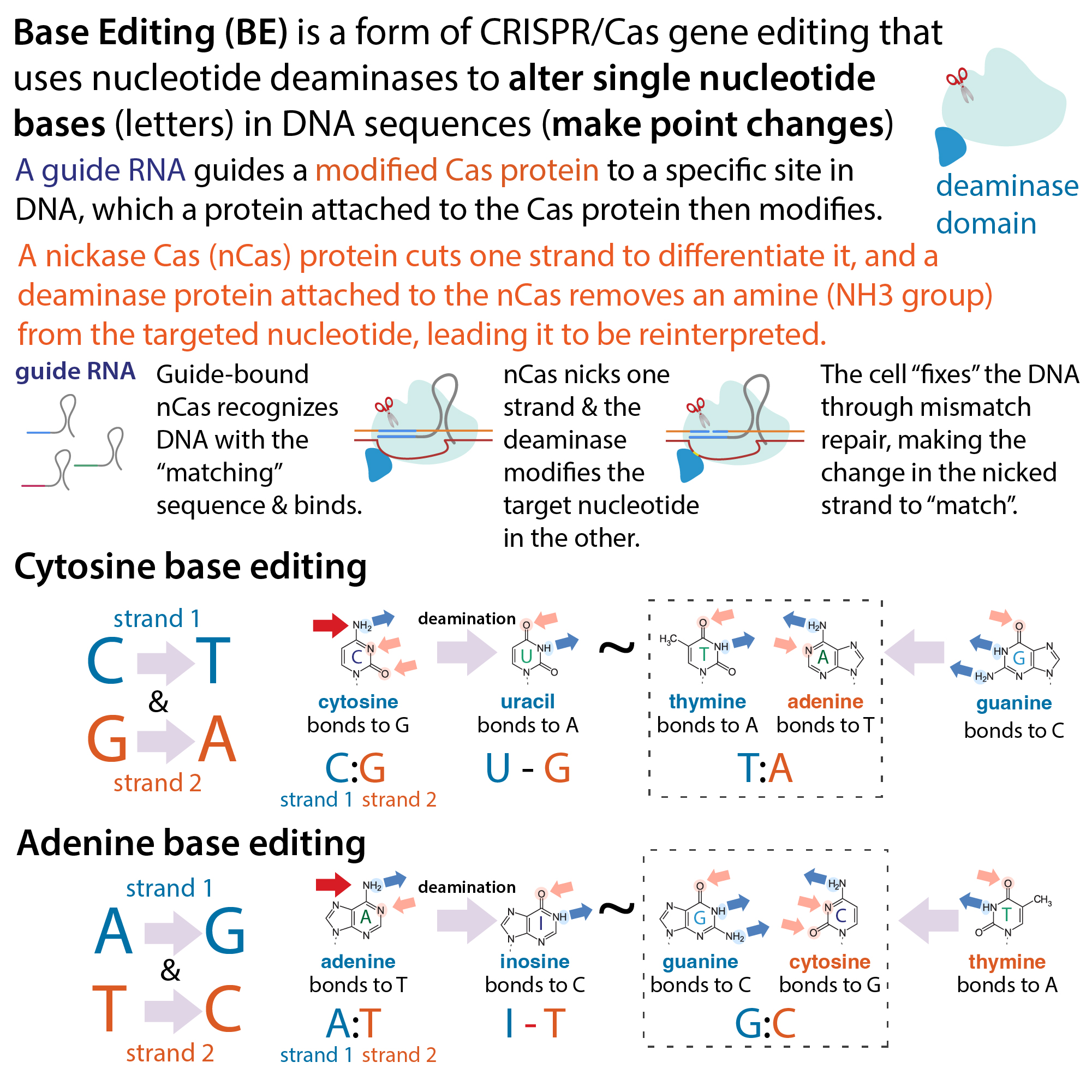
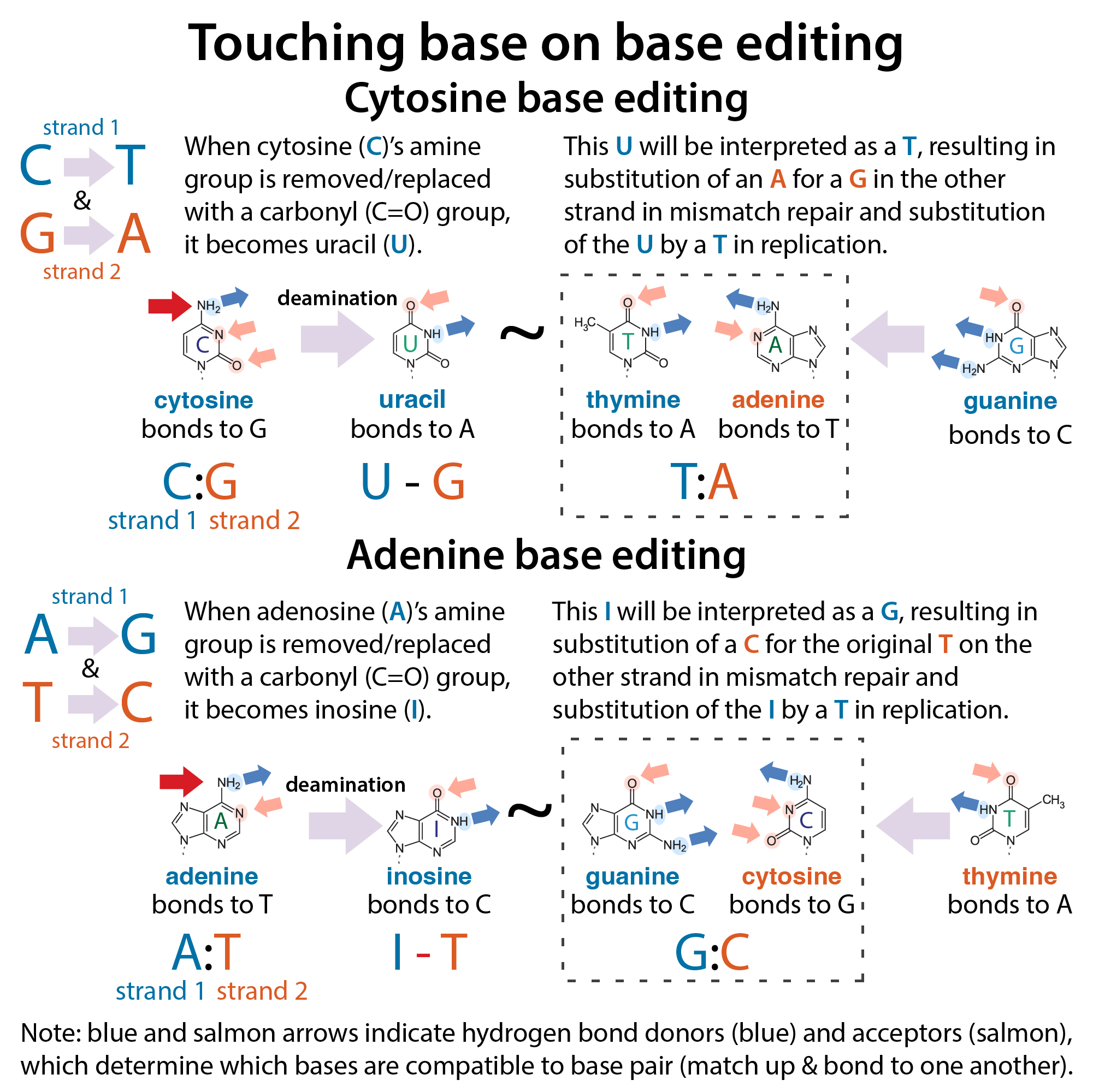
Base editing. What it does is it uses base modifiers (typically nucleotide deaminases) to alter single nucleotides to make point changes.
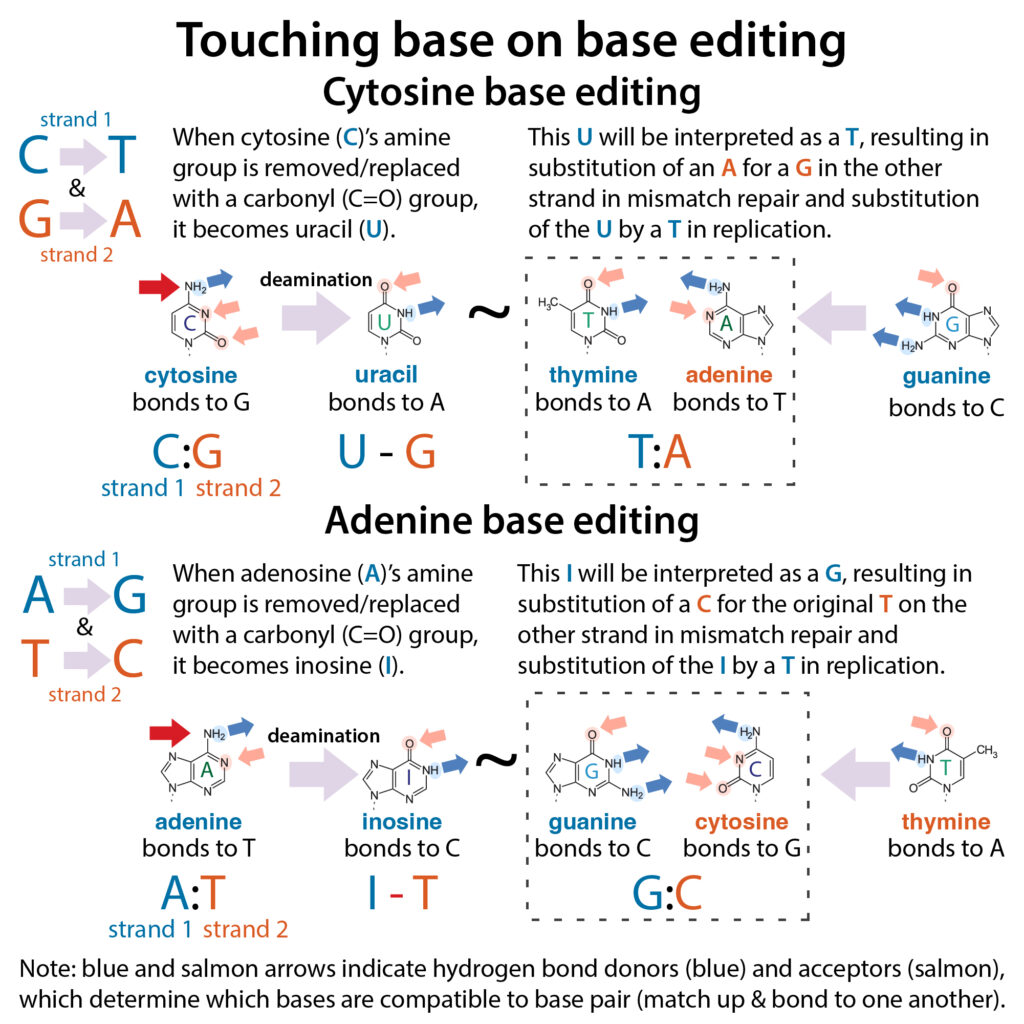
And so what this allows you to do is say, in the case of an adenine base editor, you would deaminate the adenine. That would give you hypoxanthine, which is the base for inosine that gets red as guanine. If you have cytosine and then you deaminate it, you get your cell and then in your cell, that is going to be read as thymine. And then the opposite strand, you’re going to get an adenine. And so you get both strands changed. And if you want to learn more about that I recommend the adgene blog. There are also versions, newer versions where you can also do other changes. So in addition to transitions you can do transversions.
You might be wondering why not just use a catalytic like dead cast protein for this? Why do you actually need to snip the DNA? A couple reasons one, with the catalytic, the CAS proteins, there’s less specificity because the requirements for actually cutting are going to be stricter than the requirements for binding, which is why you can get more off target effects with the dead CAS proteins.
Also, by making that net, you’re kind of differentiating the two strands. And so you have the next strand that the is going to be like oh that’s the damaged strand. So I’m going to use the strand that was just edited as a template for fixing that other strand.
Base editors are great if you just want to make a single change. So if you’re trying to correct like a point mutation, maybe the patient only has a single a single nucleotide that’s wrong in their gene. Voila. Let’s go in and fix it. But if you want a bigger change, say you want to make a large insertion or deletion? Well here you want to use something else. Introducing prime editing.
Prime editing uses a longer guide RNA called peg RNA (prime editing guide RNA) that contains a template for the sequence that you want to put in. So rather than give the insertion piece as a separate piece of DNA, you’re going to give it as part of this RNA guide. And the Cas protein is attached to a reverse transcriptase. Now when the guide binds the CAS protein and the CAS protein binds to the DNA, the reverse transcriptase part is going to be used to make a DNA copy from that RNA guide. And then that’s going to get inserted into the sequence. So a little more complicated. But you are able to then get this repair and you have the insertion or you have the deletion or whatever, whatever change you want to make, you have incorporated.
And so those are kind of the basic strategies with these new cases is that you have some sort of modifying enzyme on a CAS protein. That is in the case that it still needs a guide RNA to direct it to where you want it to go, and then the the CAS protein will take over with the whatever’s associated to that CAS protein.
There are also tools being developed to make even larger insertions–transposases and integrates associated with CRISPR, etc. There are also strategies that use a DNA polymerase editor. In those cases, similarly to prime editing, you deliver the template to where it’s needed to make the sequence to insert. But, rather than a reverse transcriptase, this one actually uses a DNA polymerase. That avoids some of the problems such as RNA templates folding up. That’s kind of one of these up and coming technologies that you might hear more about in the future.
In summary:
Main CRISPR genome editing strategies include:
- Conventional – Cas makes double-stranded DNA (dsDNA) break & leaves cell to fix
- NHEJ: Non-Homologous End Joining stitches the pieces together
- Typically causes “uncontrolled” insertions & deletions (indwells) leading to gene inactivation/“knockout”
- HDR: Homology-Directed Repair swaps in an alternative template with ends that match the cut site region
- Inefficient and limited mainly to actively-replicating cells
- NHEJ: Non-Homologous End Joining stitches the pieces together
- “Second generation” CRISPR/Cas genome editing systems use a nickase Cas that makes a ssDNA break and is attached to a DNA-modifying enzyme
- Base editing: Alters a single nucleotide base for point mutations
- Typically through a deaminase domain
- Prime editing: Sticks in a new/alternate sequence provided as part of an extended guide RNA called a pegRNA (prime editing guide RNA)
- Uses an attached reverse transcriptase (RT) to make a DNA copy of the pegRNA-provided template
- Base editing: Alters a single nucleotide base for point mutations
Non-editing CRISPR/Cas tools
The strategies that we talked about above are all for genome editing–they’re editing the actual DNA, which means that the cells that are made from that cell will be will be modified. Now, if you’re just editing cells in your body other than your germ cells. So not so not your sperm, not your eggs, those cells, well, the cells that come from those cells. So when that cell like replicates, the cells that are derived from it will also have that modification and that. So how that modification for the rest of its life, however, like the next generation, those changes won’t get passed on. If you do germline editing, then those changes would get passed on.
But, sometimes you don’t want that permanent change. And so you want to make something more temporary either for safety concerns or just because you don’t need a permanent change. And so there are tools that you can use that you can basically use a catalytically inactivated or dead CAS.
And so you see this referred to as dCas. It doesn’t cut–it doesn’t have scissors. But it still has the ability to bind the guide RNA, which then has the ability to take it to the target DNA. You can then if you have that CAS protein, that dead CAS protein attached to something, you can go ahead and you can make these temporary changes.
Some of the changes that can happen are to allow for transcriptional regulation, the transcription factors or genetic epigenetic changes through chromatin remodelers. So we talk about epigenetic EPI over or above. And so this is changes to like modifications to the DNA and the way the DNA is wound that allows for differences in the expression of the gene without changing the actual underlying nucleotide sequence.
Some of the acronyms associated with this sort of temporary changes are CRISPRi, CRISPR inactivation, CRISPRa, CRISPR activation. These are going to target transcription factors to the site. There’s CRISPRon and CRISPRoff. These modify the chromatin. So let me talk really quickly about this. And you can find more here: https://bit.ly/transcriptional_reg
You have a lot of DNA like a lot, lot, lot of DNA. In order for it to fit in your cells, it has to be tightly wound around little proteins called histones. And this is what we call chromatin when we have this DNA wound around these histone proteins, in order to actually get into the DNA to transcribe it (i.e. makeRNA copies that can then be used for translation, where ribosomes make proteins based on its instructions).
To make protein from it, you need to actually get access, which means you need to unwind those little coils. And the way that it happens is that you have chromatin remodelers that can go and actually move those nucleosomes, move the DNA wound around the system, kind of move it out of the way so that the machinery, the transcription machinery can get in there.
And so you can have chromatin remodelers that actually go and change the proteins, the histone proteins. You can do things like methylation. And the methylation often is associated with silencing of a gene. And then the acetylation which basically is associated with activation. It’s not quite so simple. But when you activate it you are basically neutralizing the histone proteins positive charge. And that positive charge was helping it stay tightly wound around the negatively charged DNA. And so the modifications can then make the DNA open up. Once the DNA is opened up, then you still often need transcription factors–proteins that come and help recruit the machinery to do the transcription.
So, transcription factors are these proteins that come and help the RNA polymerase bind where it’s supposed to bind or prevent it from binding where it needs to bind. And then the chromatin remodelers are actually kind of give it space. Both of these can be used as strategies to alter the gene expression. That’s not altering the actual DNA sequence itself. And so that means that changes that can be passed on a little more. But the when you’re just having things like transcription factors, that is more of a more of a temporary cell restricted thing.
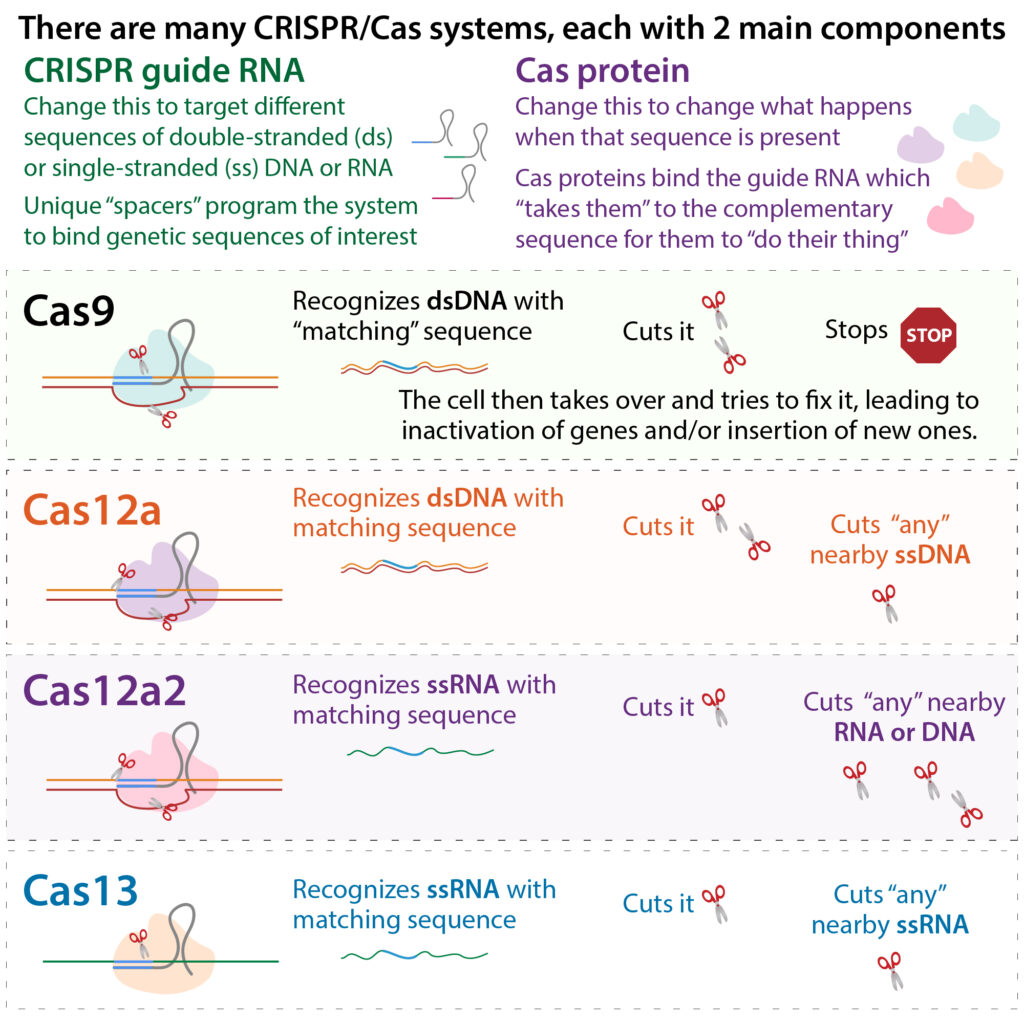
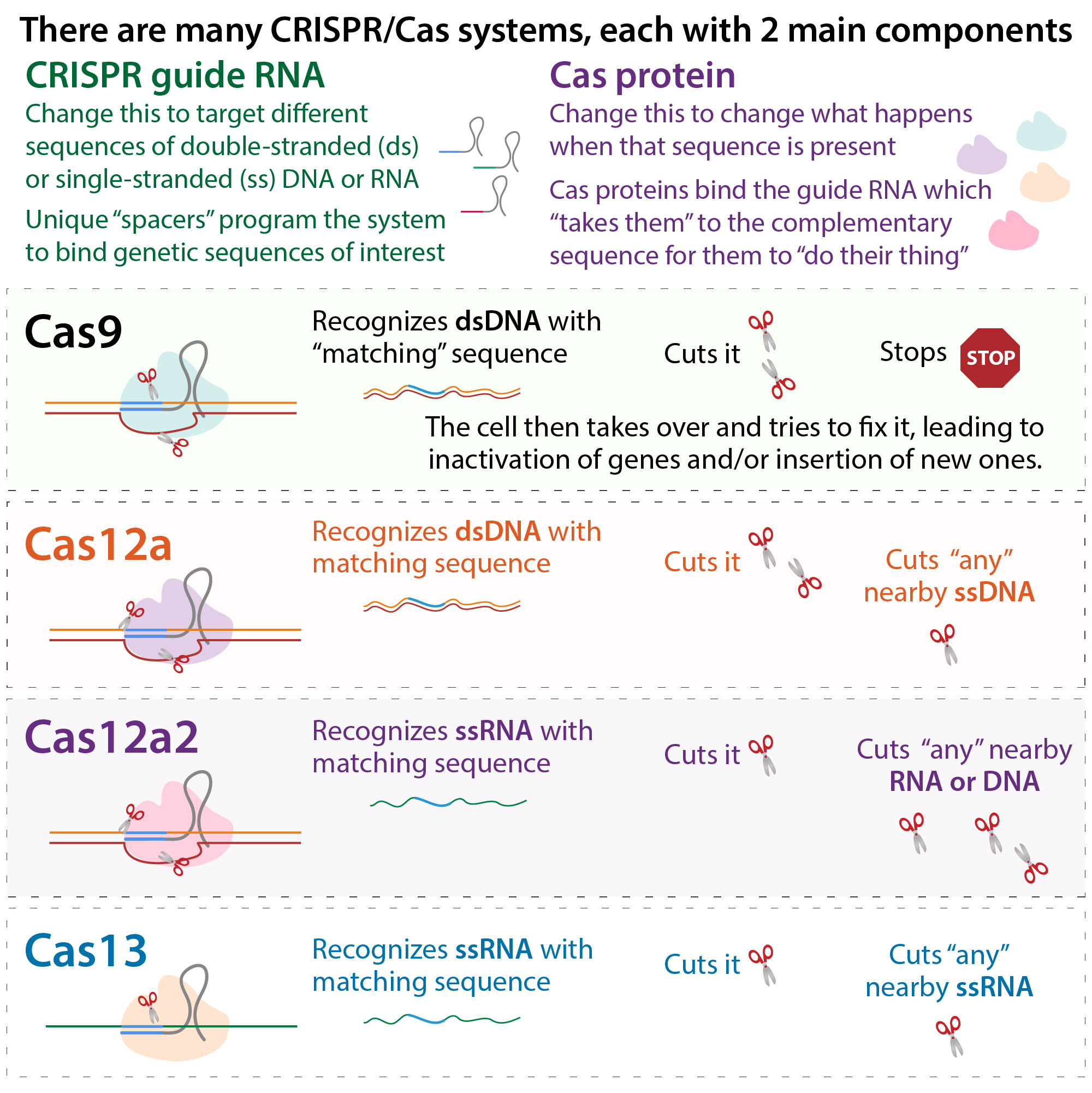
In addition to changing the gene expression, changing the sequences of the DNA, there are also different Cas versions. Some of them, like Cas13 & Cas7-11 can actually be used to target RNA for modification.
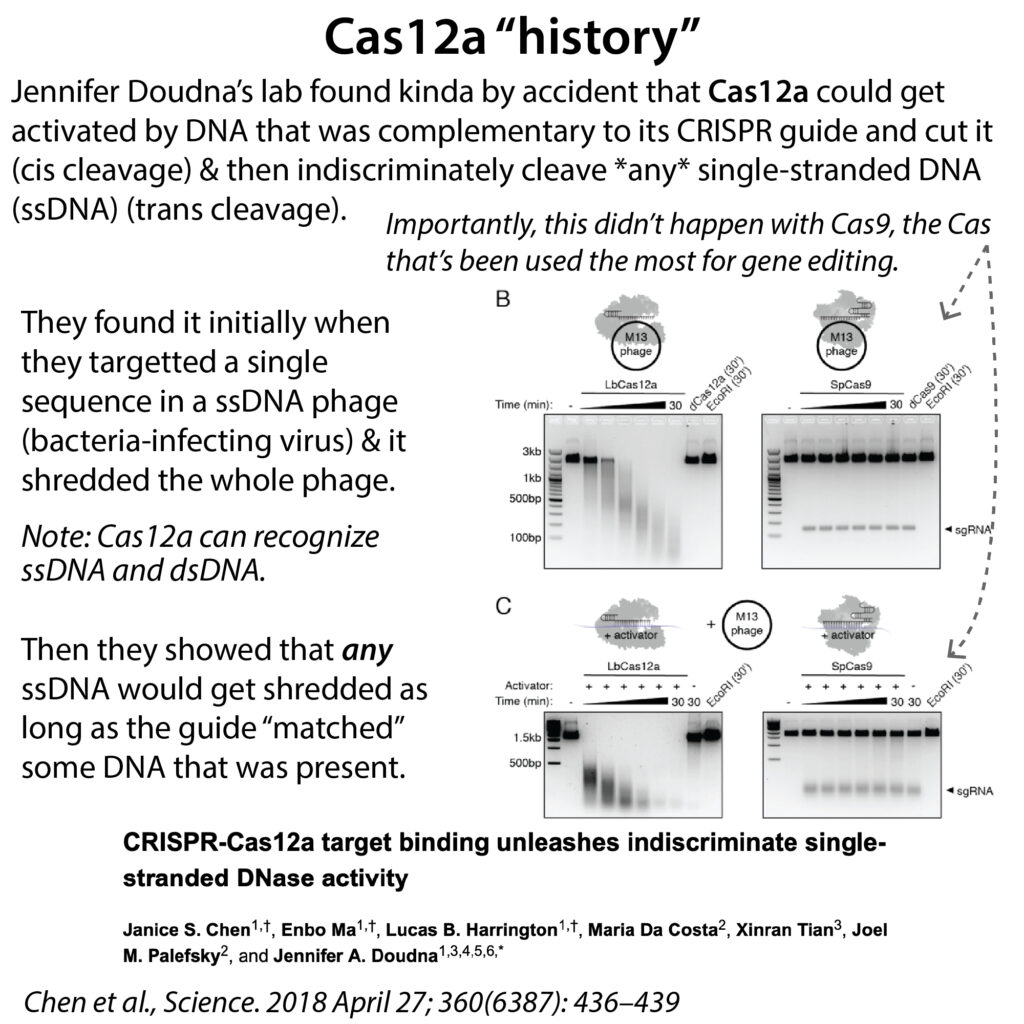
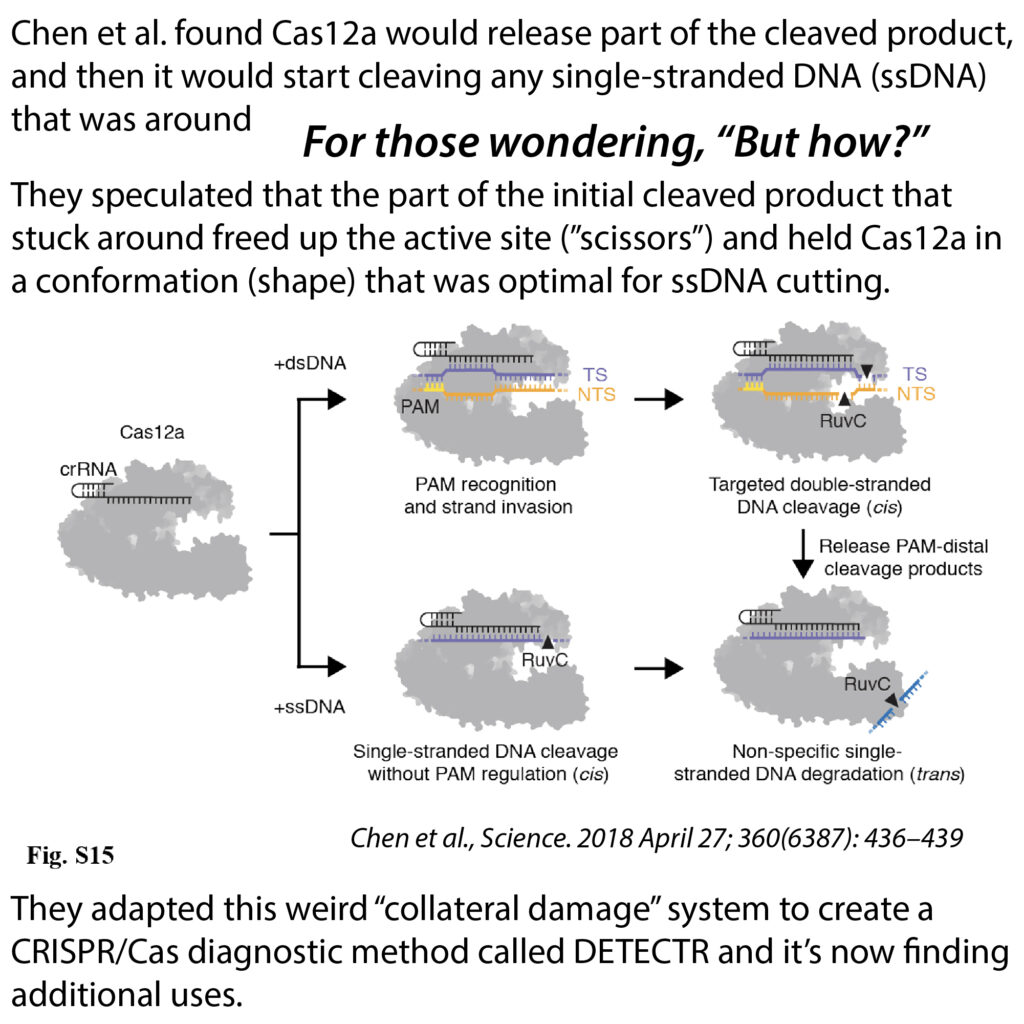
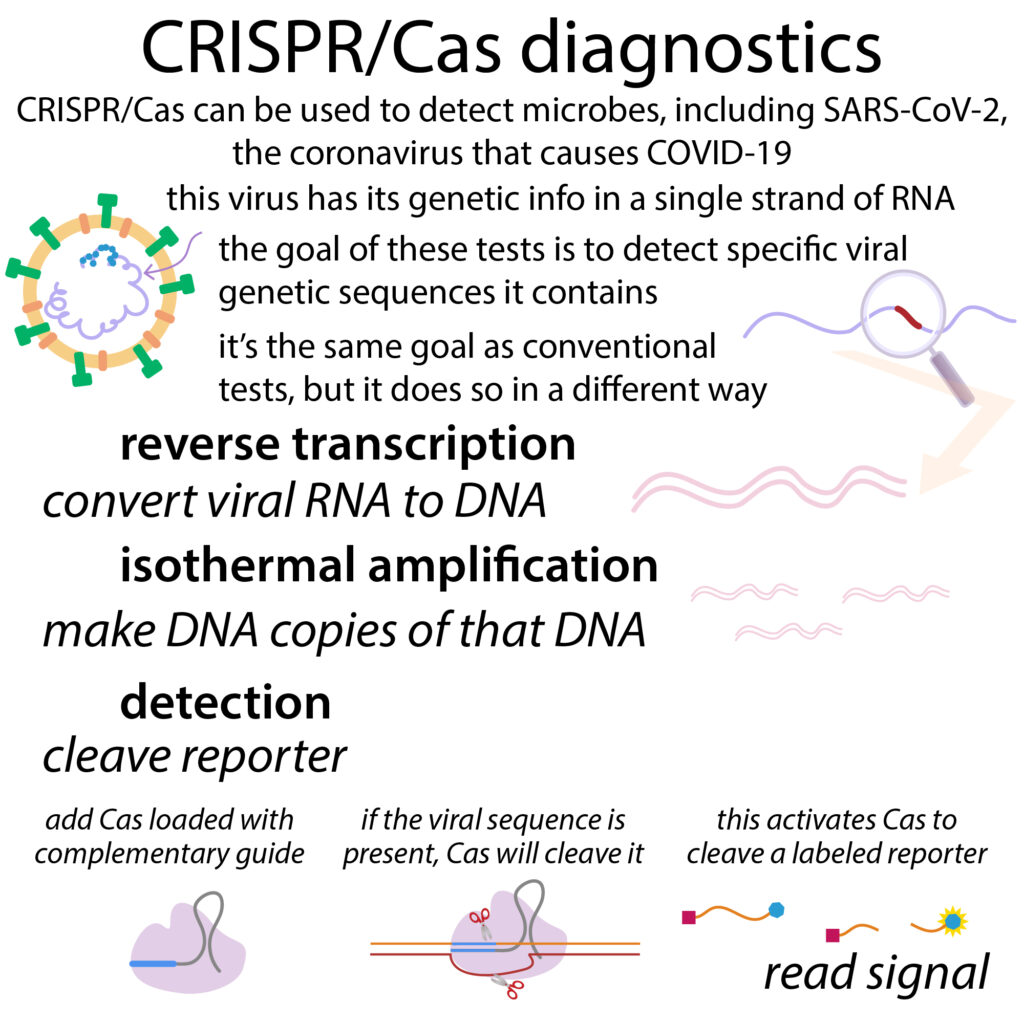
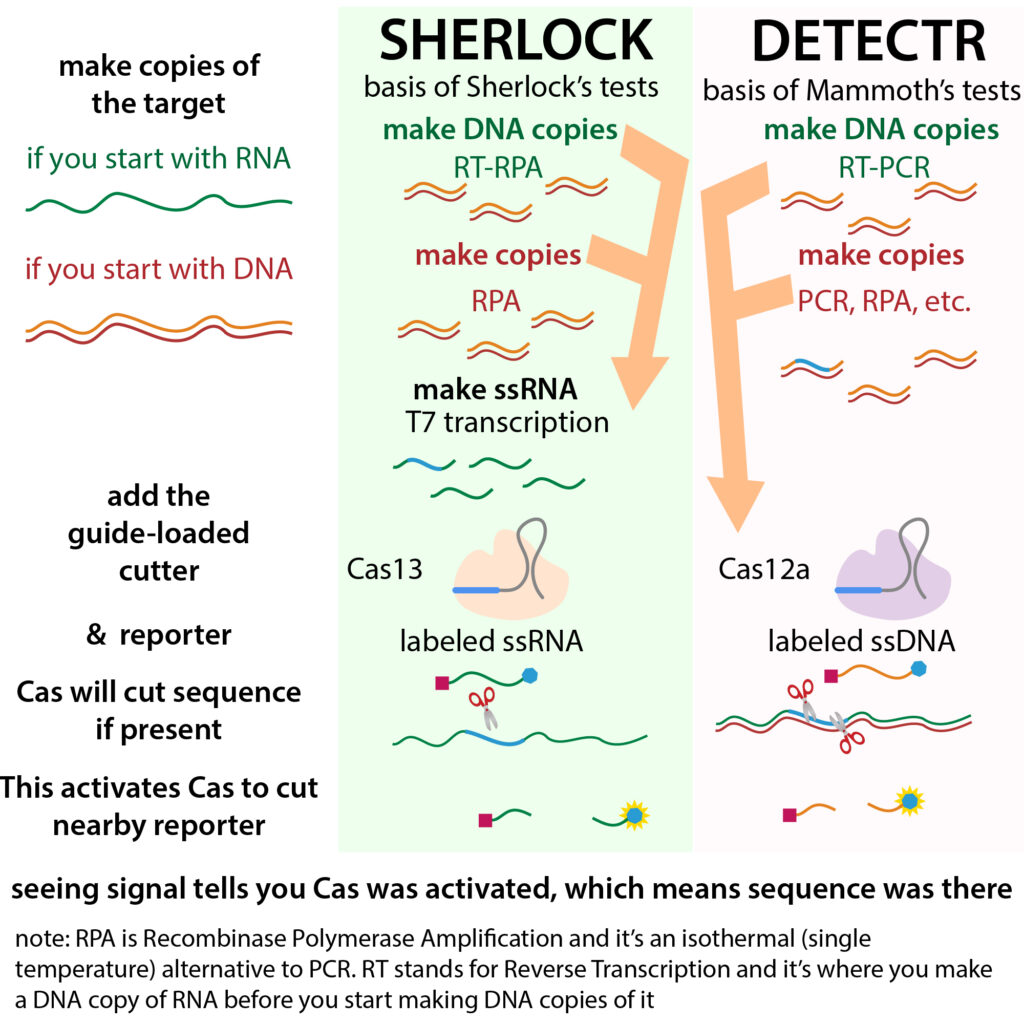
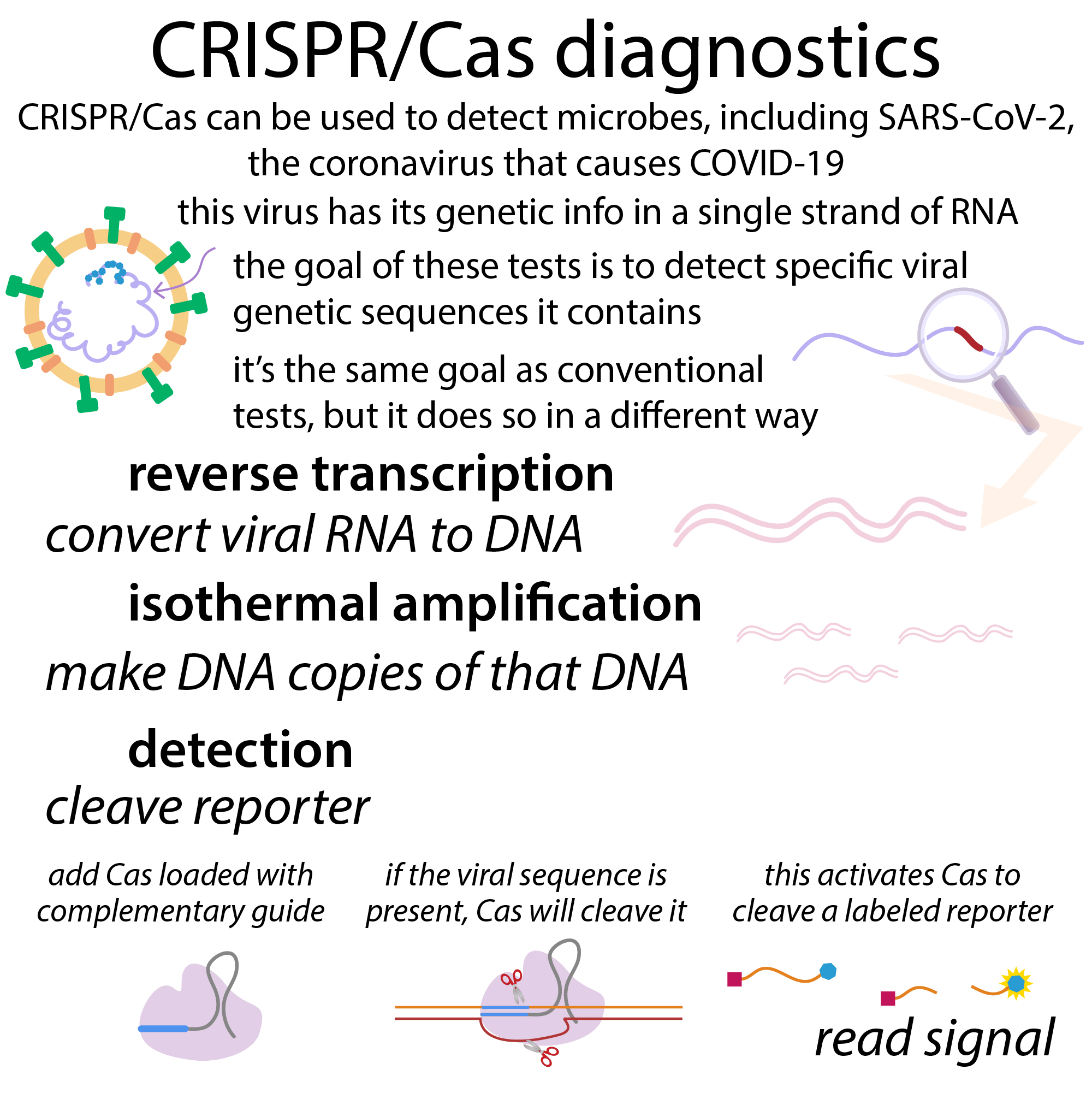
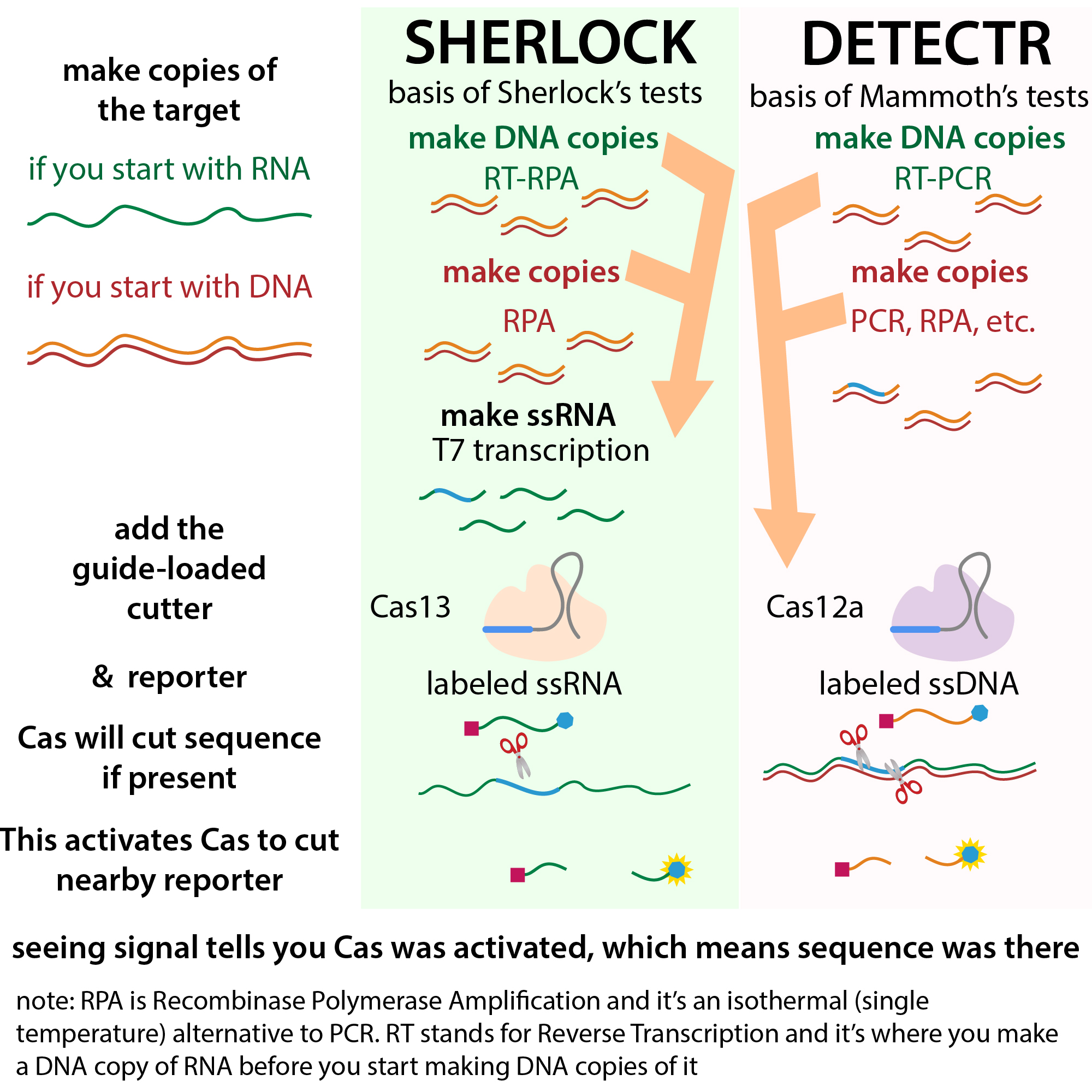
There are also techniques that we can use to use CRISPR/Cas for diagnostics. It alked a little about this during during the times when things were really bad with Covid. And people are trying to find quick, easy ways to test for the presence of the virus. Basically, you can use CAS proteins that get activated to cleave reporter RNAs by binding to targeted sequences. So you can use reverse transcription to make DNA from the RNA to make copies of the DNA. And then the Cas protein will go in. It’ll bind to that DNA copy of that viral RNA and cleave it. And this will then once it cleaves, it kind of gets the Cas protein in this activated state. Then it can go and cleave a report labeled reporter. It’s going to be used to test for the presence of a virus. It can also be used to test for other the presence of other nucleotide sequences. More here: http://bit.ly/crisprdiagnostics
Cas12a2, which gets activated by specific ssRNA sequences and then enacts collateral damage on *any* nearby ssRNA, ssDNA, or dsDNA is also being pursued as an approach to selectively kill cancer cells by using guide RNAs that target mRNA transcripts containing tumor-specific mutations and/or transcripts of genes that are overexpressed (used way more than usual) in cancer cells. And/or to target cells infected with viruses or cells that haven’t been edited (to isolate edited cells). For more, see Zeng et al. and Scholz et al., both Nature 2026 (full citations for these and other articles at the bottom of the page).
To summarize:
CRISPR isn’t just for genome editing anymore:
- Enzymes can be attached to catalytically-inactivated (“dead”) Cas proteins to allow for things like:
- Transcriptional regulation
- via transcription factors and/or epigenetic changes through chromatin remodelers
- CRISPRi, CRISPRa, CRISPRon, CRISPRoff
- via transcription factors and/or epigenetic changes through chromatin remodelers
- Transcriptional regulation
- Cas variants (e.g. Cas13, Cas7-11) can be used to target RNA for modification &/or inhibition
- CRISPR/Cas can be used for diagnostic purposes – Cas proteins can get activated to cleave reporter RNAs by binding to targeted sequences (such as viral sequences)

CRISPR/Cas as a therapeutic tool
Those are less commonly discussed–now let’s talk more about what you probably are more used to hearing about. And so that’s CRISPR used for gene editing to cure diseases.
The other day I did a video about the world’s first patient treated with personalized CRISPR gene editing therapy. Basically, this baby had this metabolic disorder called CPS-1 one deficiency. They had this problem with this enzyme in the urea cycle. And the cycle is used by your body to remove of amino groups safely without having the buildup of ammonia.
And so when you don’t have this protein, you build up ammonia that damages the brain. Bad stuff. The doctors were actually able to go and correct this error in the DNA of this baby that was causing this disease using base editing, and this was a breakthrough because it was developed specifically for that baby’s particular mutation. It’s a really rare disease, and they were able to develop this treatment designed specifically for that baby.
More here: YouTube: https://youtu.be/1pSInDZ3rN4 , blog: https://thebumblingbiochemist.com/365-days-of-science/cps1crispr/
Musunuru, K. . . . Ahrens-Nicklas, R. C. et al. Patient-Specific In Vivo Gene Editing to Treat a Rare Genetic Disease. N Engl J Med 2025. https://doi.org/10.1056/nejmoa2504747.
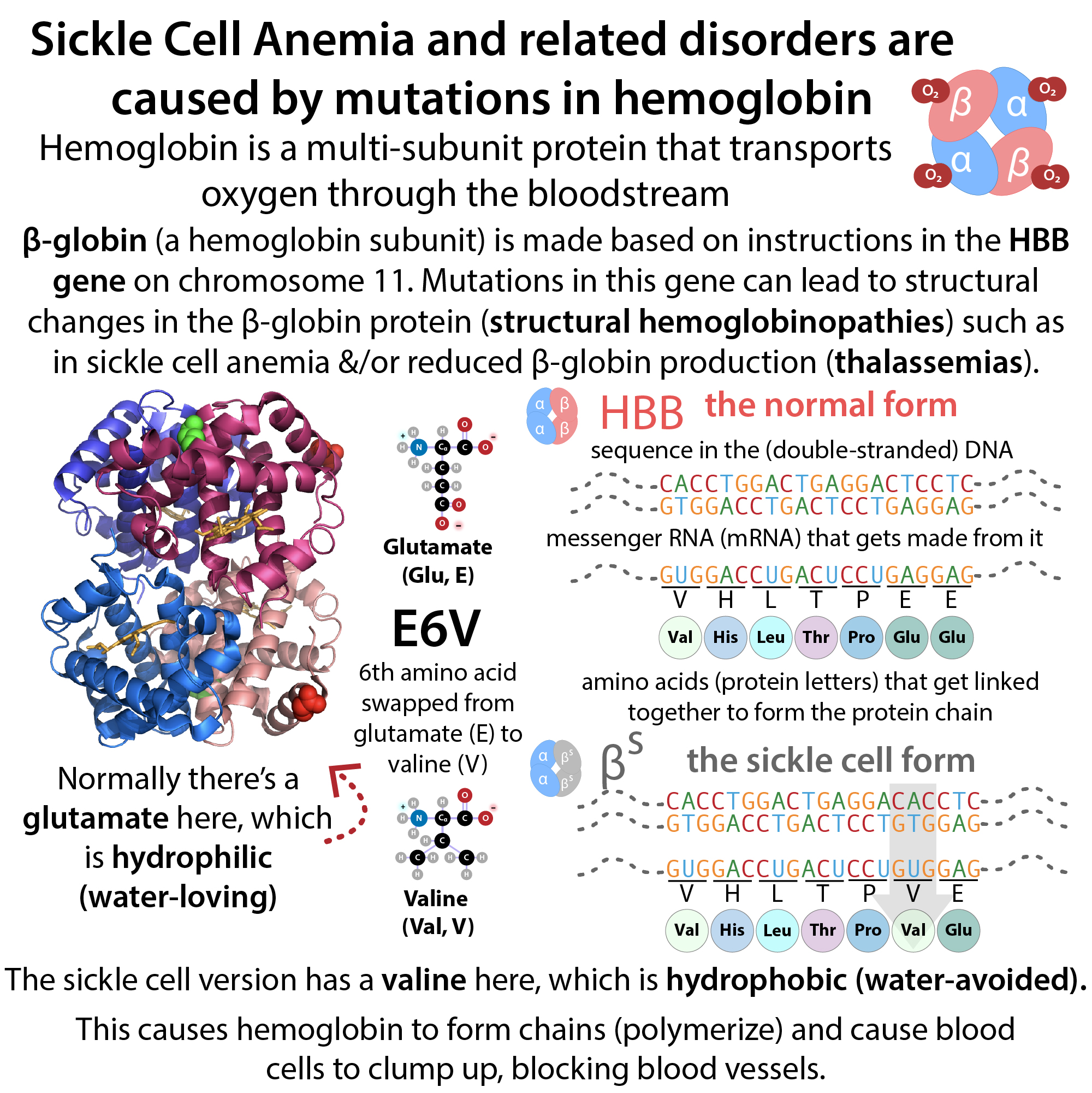
You might have also heard about a slightly-more generally applicable CRISPR treatment for sickle cell disease and beta thalassemia. These are disorders of hemoglobin, which is the protein that transports oxygen through the bloodstream. And so when people have mutations in this protein, they can’t transport oxygen efficiently.
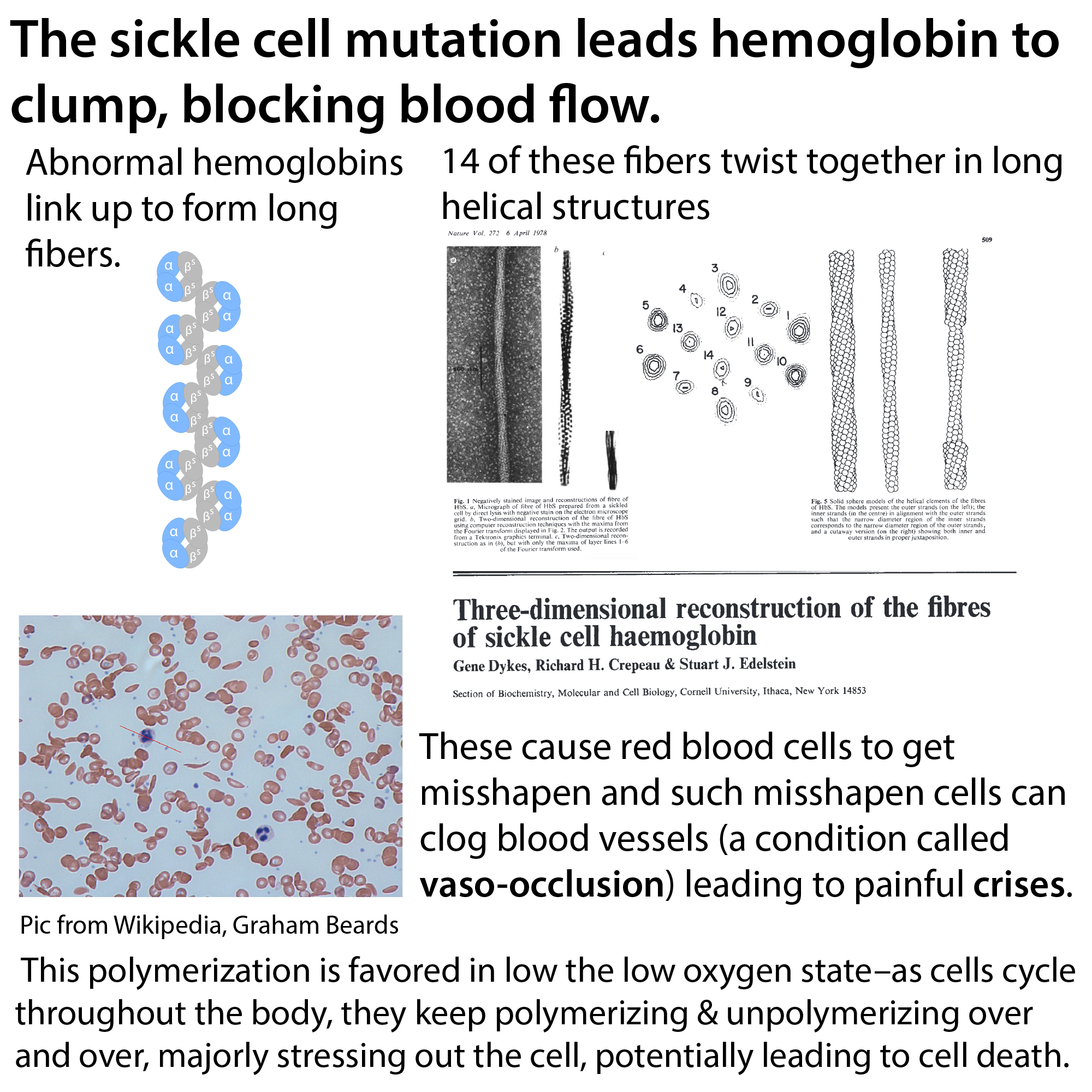
In the case of sickle cell anemia, there’s a mutation in the hemoglobin protein that actually causes it to stick together. And that causes the cells to get misshapen and sickle shapes. And those then get caught in the blood vessels and cut off the blood flow. And so that leads to painful sickle cell crises.
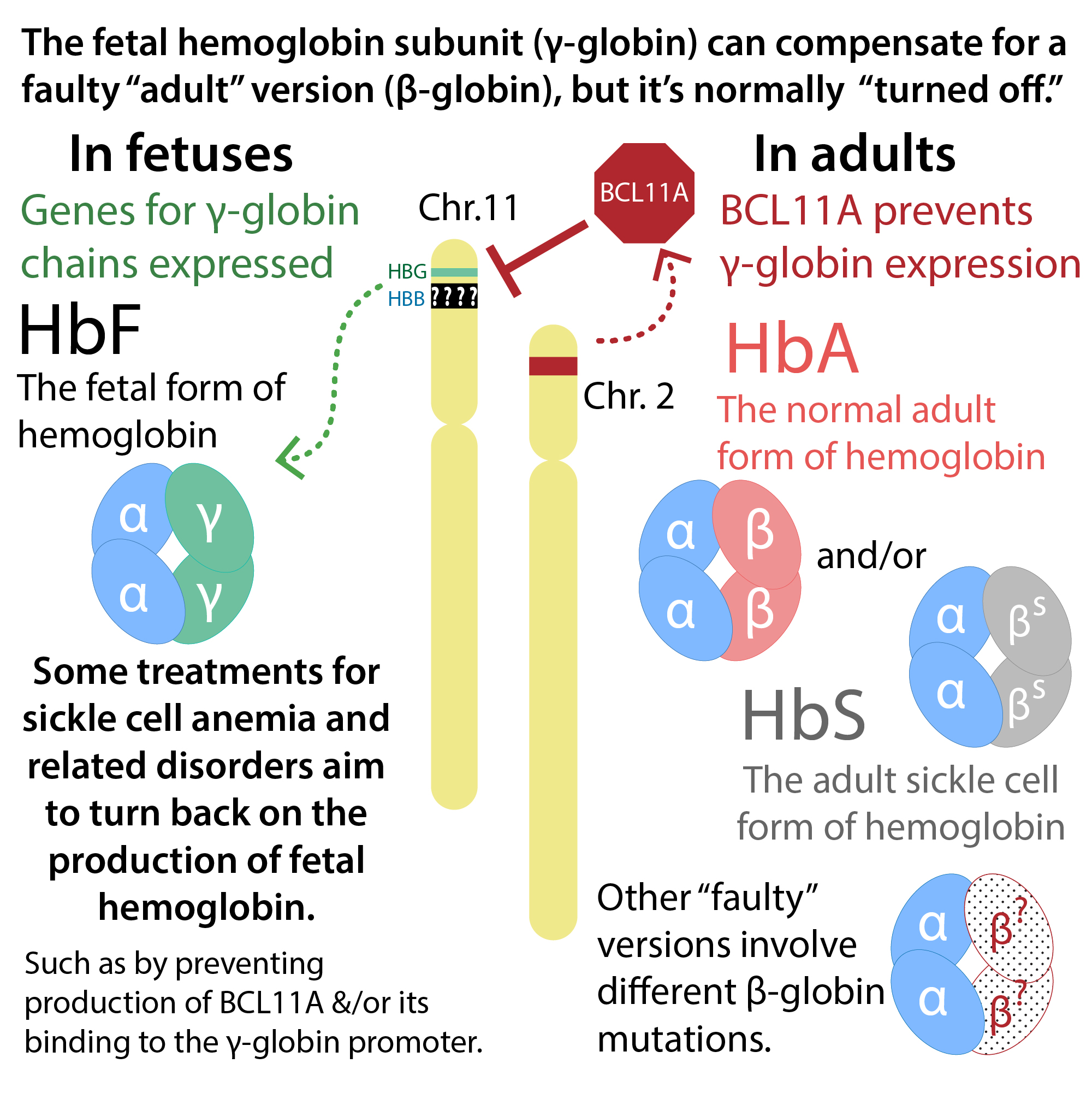
Your body actually has multiple forms of hemoglobin. There’s a fetal form and an adult form. The fetal form has different properties that make it better for allowing the fetus to grab as much oxygen as it can from the blood that the mom’s already taken oxygen out of.
Fetal hemoglobin stops getting made after birth when the adult form kicks in, however, all the cells still have instructions for making that fetal one. So scientists can use CRISPR/Cas to get the fetal form expressed in patients with faulty adult hemoglobin genes. And the way that they do this is by preventing an inhibitor (BCL11A) from binding to the sequence for the fetal hemoglobin. That allows the fetal hemoglobin to be made even in these adults, restoring hemoglobin function. More here: http://bit.ly/sicklecelldiseases
That’s an example of ex vivo treatment where you’re removing the cells from the patients, altering them and then putting them back in. You’re able to do this with blood disorders because you can take out bone marrow, fix the bone marrow, put the bone marrow back in. The bone marrow is where the blood cells come from. And so now the blood cells that could make will have them alterations.
You can also do this with strategies for treating, say, cancer. You take cells from the patients like immune cells from the patient. And you alter them so that they target the cancer. And then you put them back in the patient. And then those cells, those immune cells will go and fight the cancer. So you might have heard of like CAR-T therapy, that sort of thing.
In the case of the baby with the CPS-1 deficiency that was actually happening in vivo. And so they were actually going and treating the baby by giving it the CRISPR-Cas machinery that then targeted the liver and allowed for the changes to be made inside of the baby without having to take out any cells, without having to do any bone marrow transplant, all this stuff.
The liver is a site that’s kind of like more easy to target for reasons including that your liver has receptors for lipoproteins and things that aid in LNP intake. Your liver is also kind of like where things go as a first stop–a detox center of sorts And so it’s easier to target things to liver. You can also target things like the eyes. So some some CRISPR-Cas treatments have been used for like the eye because you can basically just inject things in there. And it’s got barriers that are going to prevent it from making too widespread of changes in other cells, but other tissues are harder to target.
Targeting is one of the things that is a is one of those problems with CRISPR that needs to be addressed. And so people are looking into things like, can we add little proteins on the outside of these nanoparticles that then will direct it to specific tissues. So maybe they do antibodies or things like this.
But in the case of this baby with the CBS one deficiency, because the problem was in the liver, they were able to give out these lipid nanoparticles (LNPs) that contained the mRNA for making the CAS protein. Typically the RNA is delivered rather than the protein, allowing the cells to make more of the protein than you could if you were just trying to stuff in the protein. And the RNA can be more stable because you could do modifications and things and it’s easier to sneak in. The LNPs also the guide RNA and then the lipid nanoparticle. More about delivery in a bit.
CRISPR as a lab tool for forward and reverse genetics
All of that was kind of in vivo or ex vivo as opposed to in vitro. in vitro is not in a living organism. Instead it’s in the test tube or cells or though some people call like cells are kind of like an intermediate zone. And so for bacteria cell is in vivo. Sometimes people refer to thinks like in cellulo or in culture. The basic idea is though it’s not in a living organism.
In vitro/in cells, people often use CRISPR screens to see what genes are important for what. This can involve CRISPR screening via either permanent like knockout or with something like CRISPRi or CRISPRa, where you’re in activating or activating the gene. The CRISPRi is good if you’re wanting to test for effects on essential genes. So if you knocked it out, the cells would just die. But what happens if you inactivate it or you inactivate that specific time?
In CRISPR screening, what you do is you have a big library, so big collection of RNAs, and you infect cells with them, or you get those in the cell somehow each cell gets a different one of these guide RNAs. You then do some sort of test, like maybe you’re seeing if they’re surviving, maybe if they resist a drug, maybe what? Just trying to see what effects it has. And then you go and you look at which of the cells have a trait that you’re looking for or don’t have a trait that you’re looking for. And then you can go and sequence the guide RNAs from those cells in order to see where the what, which guide it was that caused the thing.
The basic workflow of CRISPR/Cas screens:
- 1. Take a large collection (library) of CRISPR guides (sgRNAs) targeting each gene
- You typically include multiple guides per gene for most confident results
- 2. Put one guide in each cell–now each cell can direct Cas machinery to a different gene
- This is often done using lentiviruses
- 3. See which cells have some feature and/or survived (positive screen) or have lost some feature and/or died (negative screen)
- 4. Sequence the guides in the cells with and/or without that feature to see which genes were being targeted in them
- Positive screen: Which guides are in the positive and/or surviving cells?
- Negative screen: Which guides are depleted/underrepresented in the positive and/or surviving cells
- 5. Importantly, follow up with additional experiments to confirm the results and find out more!
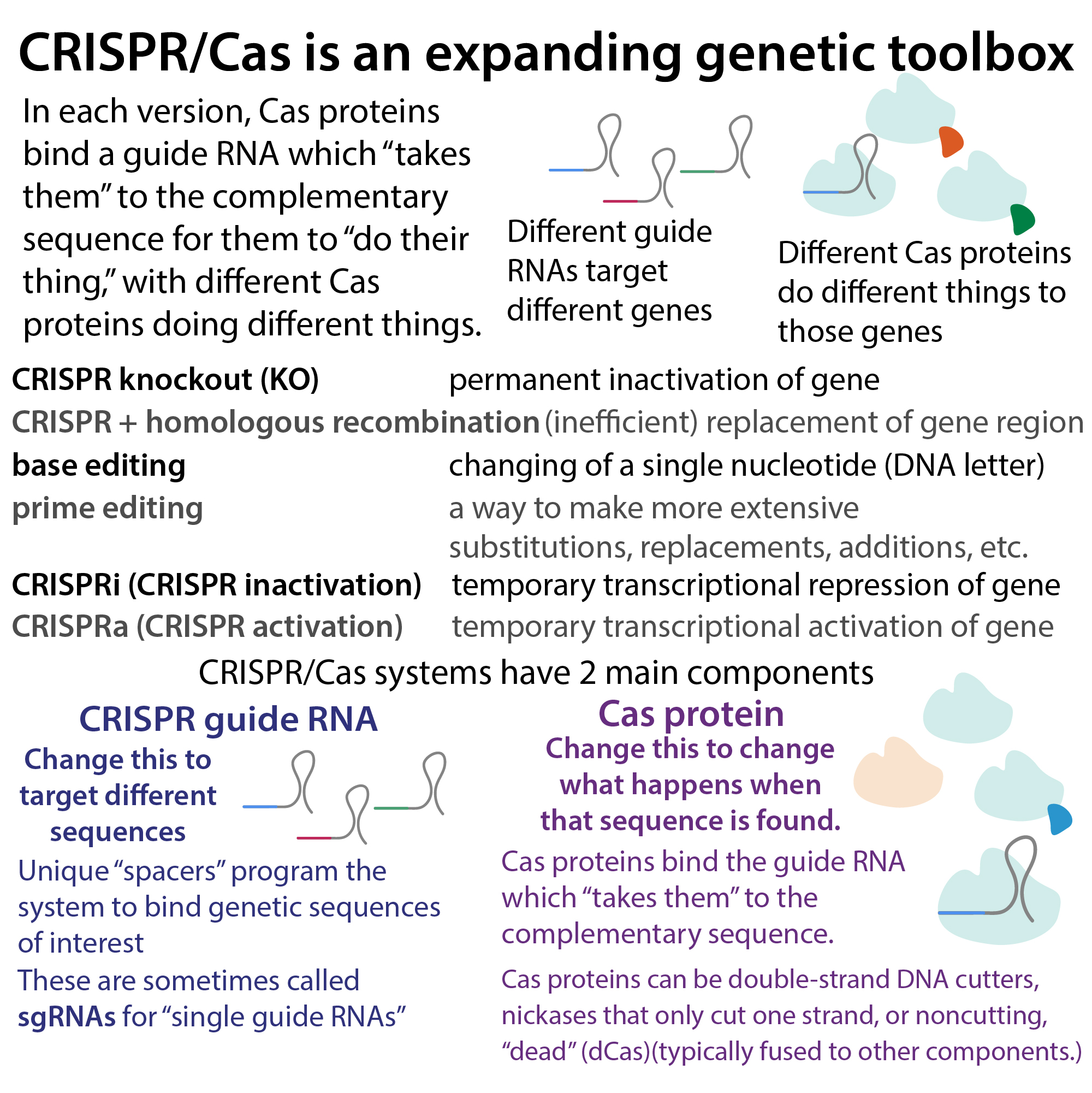
There are different types of CRISPR/Cas systems that can be used. In each, Cas proteins bind a guide RNA which “takes them” to the complementary sequence for them to “do their thing,” with different Cas proteins doing different things. Different guides target different things and different Cas proteins do different things to those genes.
- CRISPR knockout (KO): permanent inactivation of genes (typically via DNA cleavage & sloppy repair)
- CRISPRi (CRISPR inactivation): temporary transcriptional repression of gene
- Compared to KO, can be especially useful for essential genes and/or to mimic effects of medications
- CRISPRa (CRISPR activation): temporary transcriptional activation of gene
- Good for things like figuring out which genes are important for certain processes

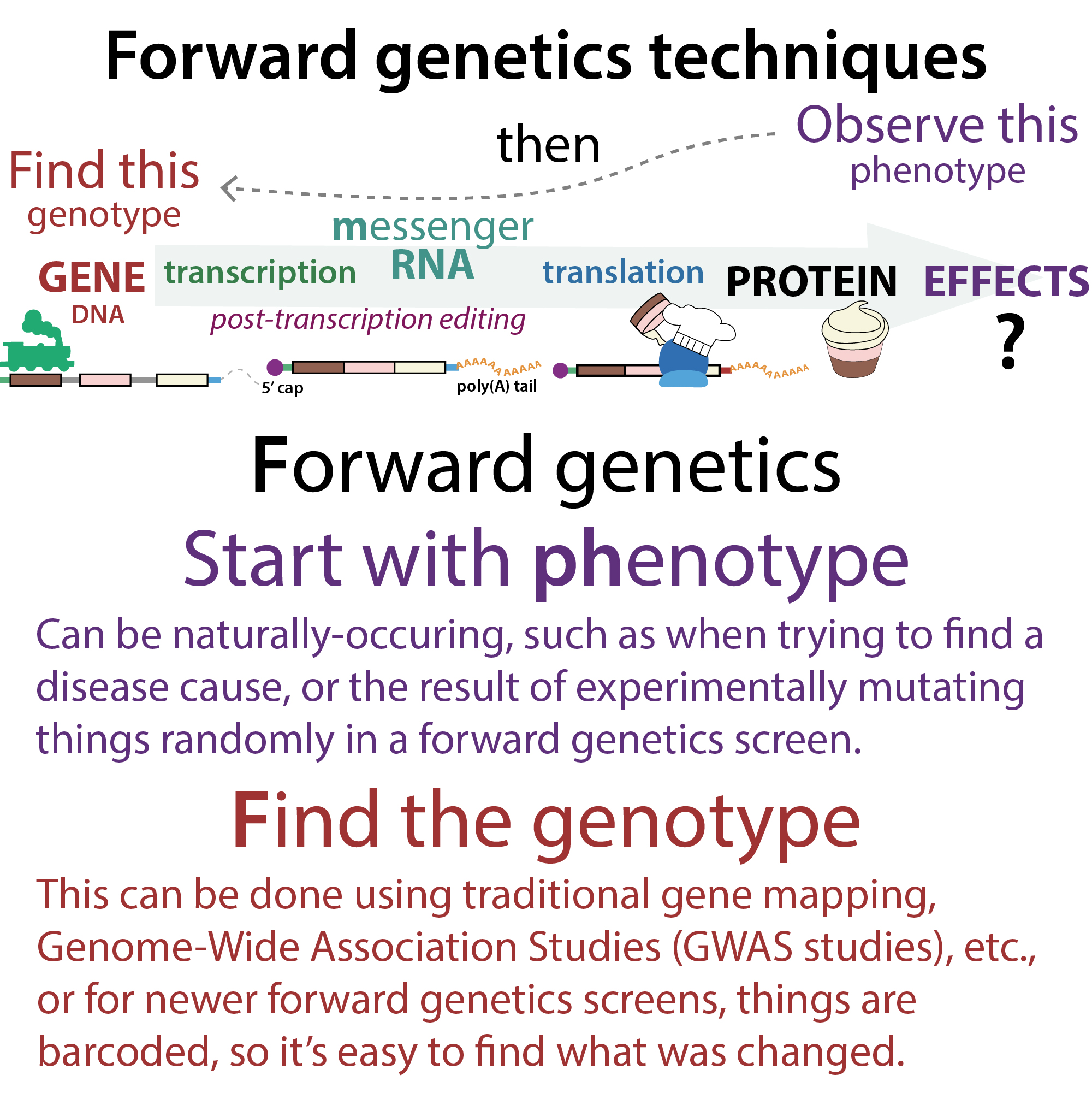
CRISPR can be used for both reverse and for genetics. With reverse genetics, we change a gene and observe the effects of the phenotype. In contrast, in forward genetics, we observe a phenotype and then find the responsible gene.
In the case of CRISPR screens, we’re using for genetics because we are we’re making the changes to the gene but not in a specific way. And we’re observing some phenomenon that comes from a change that we made. And then going to find what that change actually was.
We can also use reverse genetic techniques where we know what change we want to make, and then we want to see what effects it has. This can be great for making things like mouse models or even tissue models, all these things that are more realistic than just working purely in vitro.
What you can do is you can use CRISPR/Cas editing in order to knock out (i.e. permanently inactivate) a gene. Or we can knock in where we stick a gene in its place. And so both of these can be used to do things like make mouse models or make cellular models.
In one variation, you can take, say, skin cells from a patient and you can convert them into what we call induced pluripotent stem cells or IPSCs. You can make changes to these patient-derived cells, and then coax them into differentiating (maturing) into different cell types. Then you’ll have patient derived cells that have a change that you would like study and look to see the effects that say these changes might have in different tissues.


CRISPR limitations and workarounds
CRISPR is not without its limitations. So let’s talk about some of the challenges, the main challenges. I link to a great review article at the end, but I summarize it like this:
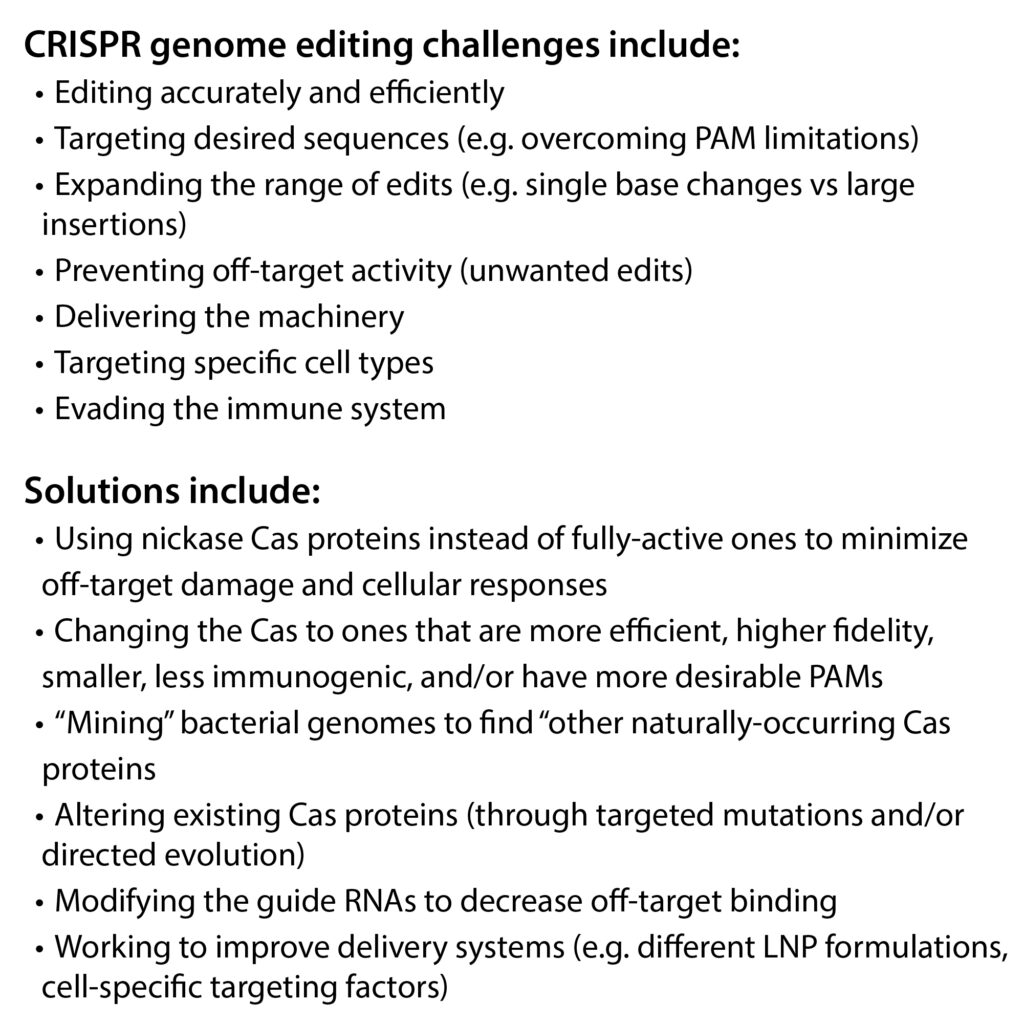
CRISPR genome editing challenges include:
- Editing accurately and efficiently
- Targeting desired sequences (e.g. overcoming PAM limitations)
- Expanding the range of edits (e.g. single base changes vs large insertions)
- Preventing off-target activity (unwanted edits)
- Delivering the machinery
- Targeting specific cell types
- Evading the immune system
The four main categories of limitations that article points out are specificity, targeting scope, controlling editing outcomes, and deliveries. Basically, we want our editing to be accurate and efficient. We want to prevent off target activity. And we want to be able to target any sequence that we want. But something called a PAM (protospacer adjacent motif) likes to get in the way, as we’ll discuss. We also want to be able to expand the range of edits we can do. We want to do single base changes as well as largest insertions. And we want to be efficient. So we want to target all the cells basically, or at least all the cells that we want to target, which gets back to targeting specific cell types.
Finally, we want to be able to deliver that machinery, and we need to do so without triggering the immune system. So those are some of the challenges. And we’ll talk more about these and more about the solutions. Part of the solutions comes from remembering that CRISPR-Cas forms around bacterial immune system, the CRISPR/Cas system, originally used in the lab and still most often used is the CRISPR/Cas9 system from Streptococcus pyogenes, but other bacteria also have CRISPR-Cas systems. And so if we want to make different changes, we can do things like turn to different CRISPR protein, Cas systems and look to different Cas proteins.
We can mine the bacterial genomes to find naturally occurring CAS proteins, or we can alter existing CAS proteins. This can be directed through targeted mutations: look at the sequence, look at the structure, try to make predict what mutations would make changes that you want. There’s also directed evolution, where you do sort of random mutagenesis in the lab while monitoring or screening for a desired outcome. The changes that are already being used are many things like using the Cas proteins and so the fully active ones to minimize off target damage.
Specificity
In terms of specificity. It’s really important that the editing is specific. We don’t want that off target editing activity that can be catastrophic. It can cause cancer and it can cause other problems. And so testing for off target activity is a huge, huge, huge deal. Scientists often have to screen a lot of different guides in order to find the best ones to use. You can also do things like modify the guide RNA to decrease off target binding.
Going back to that baby with the CPS-1 deficiency, they use a tiling approach to test guide RNA spanning the region of the mutation that they have in the baby’s gene, that then they wanted to correct. And then they went and tested them all for what proportion of the cells actually got the edit you want, as well as off target activity. Was it making changes elsewhere?
They used a variety of methods. They prioritized sites that were likely to be to be off targets based on matching similar sequences. And then they actually went in, generated cell lines and did all this testing and in order to be able to show how specific the treatment was. So lots of work goes into making sure you don’t have off target activity because it can be so catastrophic. One challenge is that not all sequences can be targeted easily. And so this gets back to the targeting scope.
Targeting scope–aka damn the PAM…
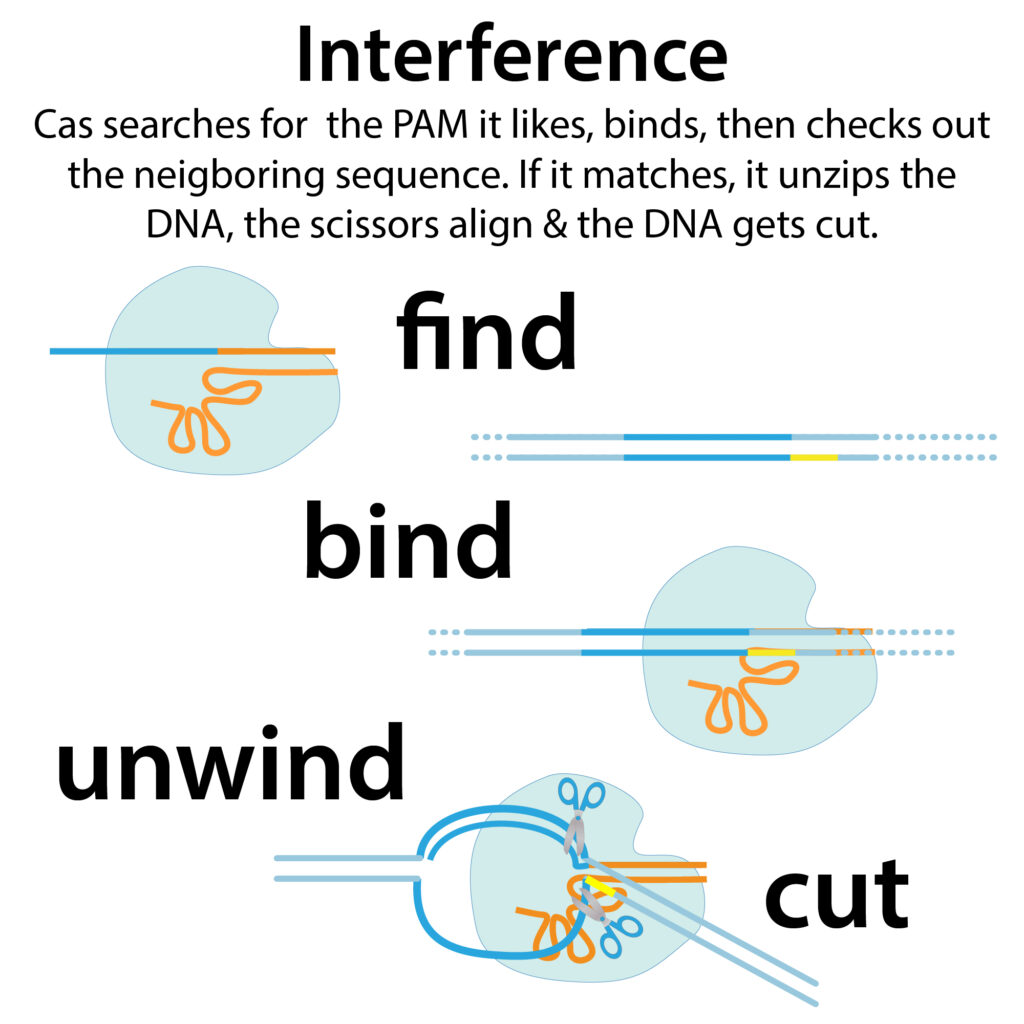
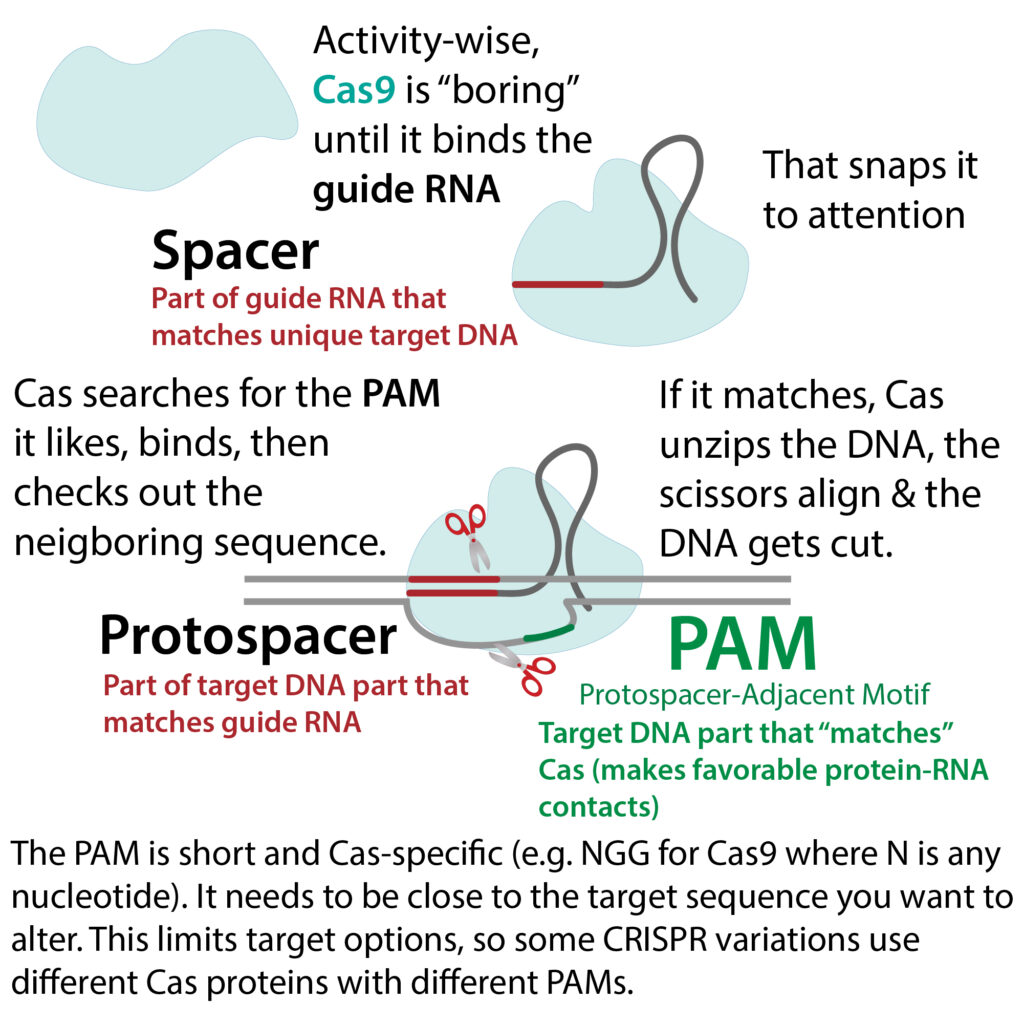
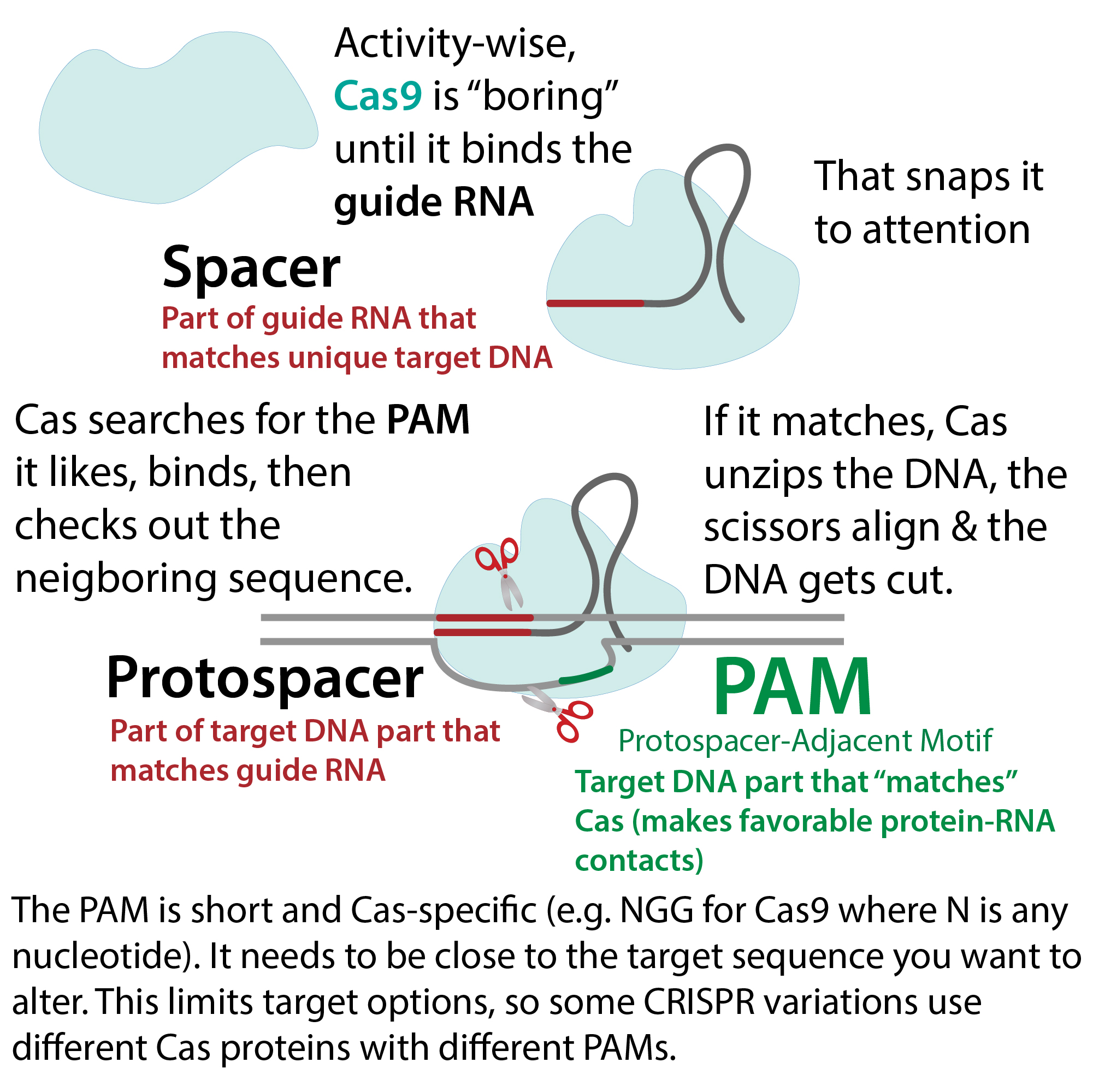
I’ll get more to this when I talk about the bacterial origins, but the protospacer is the part of the target DNA that matches the guide RNA, and more specifically, it matches the spacer part of the guide RNA, which is the unique part of the guide RNA. Cas9 is a pretty boring protein until it binds to that, to that guide RNA, then that kind of snaps the protein into attention casting goes and it uses it kind of hops along looking for that PAM. If it finds that PAM, that protospacer adjacent motif, which is a part of the target DNA that “matches” the CAS protein (has favorable interactions with the protein), it’ll bind and unwind the DNA and then it’ll cut the DNA.
The PAM sequence is specific for the CAS protein. In the case of this Streptococcus pyogenes Cas9 it’s NGG. where n is any nucleotide. So anything and then two G’s. So it’s a pretty it’s a pretty generic sequence. It’s found fairly frequently throughout the genome. But if you’re in like an AT rich region then you’re not going to have a PAM nearby.
Which is a problem, because you need to have that PAM nearby in order for the edits to be made. So people have turned to different natural Cas proteins with different PAM preferences (remember, the PAM sequence is making favorable interactions with the Cas protein. So if you change the Cas protein, you’ll change what sequence it likes in terms of its PAM).
You can also make changes to the Cas protein itself to change its specificity more often. It’s kind of like relax the specificity, but relaxing the specificity then increases the risk of off target activity. And so that could be a problem.
Control and efficiency
The edits need to be controlled, predictable and efficient. When you make those double stranded breaks, you’re basically just saying to the cell, okay, take over now. And trusting that the cell can do it. Well, there’s problems with this… One, is that that if you don’t provide an alternative, you’re just allowing it to stitch things together. It’s unpredictable how much it’s going to insert, how much it’s going to delete all these things because it’s going to go and it’ll kind of alter the ends and try to do its best to to fix things.
But it can’t really do it all well. And so you’re going to end up with kind of unpredictable changes. If you give an alternative you can have that homologous replacement. But that’s not very efficient. It’s restricted to a certain cell types. And it can also introduce unwanted mutations during the process. When it’s doing that, fixing solutions to try to kind of make it more efficient or to inhibit the non-homologous end joining.
So, you can inhibit it from just stitching together things and trying to encourage it to do the homologous recombination with methods such as tethered repair templates and controlling the cell cycle. So, that is, you put it in in the phase at which the cell is actively dividing, that sort of thing, as well as turning to these nickases that are able to just cut a single strand and then make these specific changes, because you’re only cutting a single change, you’re less likely to have these uncontrolled outcomes, but you still have to worry about the efficiency of the outcomes that you do want.
So is it making the changes that you do want? Not only is it not making changes that you don’t want, because if you stick something in that doesn’t do anything well, you’re not going to make changes that you don’t want, but you’re also not going to have any changes that you do want.
Delivery
In order to have any changes, you have to actually get this machinery into cells, and that can be a challenge that that machinery is typically delivered as RNA, and so that the cells are basically going to have to make the Cas protein itself. And so you give the cells the messenger RNA for making the Cas protein as well as the guide RNA. And then you have some sort of encapsulating method that allows it to get into the cells.
There are challenges with this. One is that the RNA is big. And sometimes, what you want to do is you want to actually integrate the machinery for making the Cas protein in the cells, like when you’re doing things in the lab, when you have those long sequences, that can be a challenge. And so some of the optimization has been trying to find CAS proteins that are actually smaller. They have shorter mRNAs and shorter DNA genes that can then be delivered more efficiently.
With any of these, however, you still need to be able to get the genetic information into the cells. And so when we talk about getting genetic info into cells, we call that transfection. If you work in a lab, you probably do things when you’re sticking plasmids into bacterial cells. We often refer to that as transformation. We don’t want to use that term when we talk about human cells and things because it has different connotations, so we typically just use this word transfection.
In the lab you might be doing things when you’re working with bacterial cells and doing harsh things like heat shocked with chemically competent cells. Laboratory methods for delivering genetic information into mammalian cells and things often use electroporation, where you’re using electric charge to get the get the charge DNA into the cell. Both of those are kind of more laboratory techniques in the body. We typically use things like lipid nanoparticles (LNPs) or viral delivery methods.
Often these formulations for these lipid nanoparticles have special ionizable lipids that, when they get swallowed into the cell in endosomes, the pH changes in the endosomes allows for the lipids to kind of change their interactions and allows the RNA to get out. So really cool formulations. And that’s another room that that those advances in all the time.
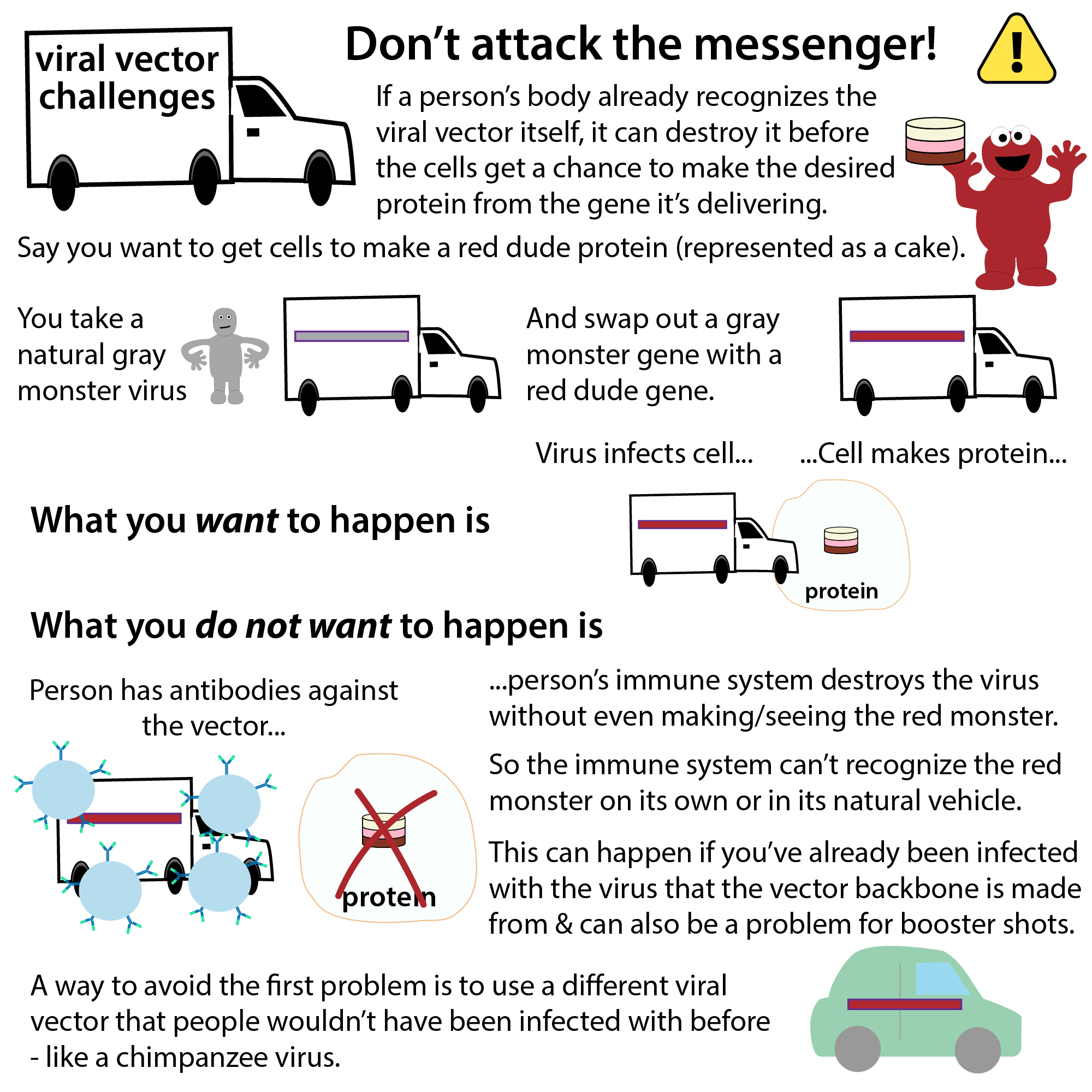
They’re also viral delivery methods. And so viruses are really good at getting genetic information into cells. And so we can take advantage of that in order to stick information that we want into a viral kind of coating and then stick that into cells.There are problems, however, because the body might recognize the virus as a virus and attack the virus and not allow the mRNA to actually make the Cas protein and make all that stuff, there’s also problems, even if the body doesn’t recognize it as a virus the first time. If you try to give another dose, well, then it’s going to recognize it.
And so more of these lipid nanoparticle strategies, things like that is typically the way that things are going. But you might see things that use adeno-associated viruses (AAV’s) or something that depends on what kind of cell types you’re trying to target and what your goals are. There’s all sorts of things. And so it’s complicated as most things are when you’re talking about biochem chemistry, when you’re talking about things, especially in biological systems.
To review…
CRISPR genome editing challenges include:
- Editing accurately and efficiently
- Targeting desired sequences (e.g. overcoming PAM limitations)
- Expanding the range of edits (e.g. single base changes vs large insertions)
- Preventing off-target activity (unwanted edits)
- Delivering the machinery
- Targeting specific cell types
- Evading the immune system
Solutions include:
- Using nickase Cas proteins instead of fully-active ones to minimize off-target damage and cellular responses
- Changing the Cas to ones that are more efficient, higher fidelity, smaller, less immunogenic, and/or have more desirable PAMs
- “Mining” bacterial genomes to find new naturally-occurring Cas proteins
- Altering existing Cas proteins (through targeted mutations and/or directed evolution)
- Modifying the guide RNAs to decrease off-target binding
- Working to improve delivery systems (e.g. different LNP formulations, cell-specific targeting factors)


To review CRISPR as a tool
aBottom line, CRISPR/Cas is a powerful gene editing tool along with other things, it uses a guide RNA that binds to a CAS protein, directs that CAS protein to a DNA, and then the CAS protein takes over. You can use different CAS proteins to have different effects.
Conventional CRISPR/Case uses Cas9, which cuts both strands of the DNA and leaves the cell to fix things. If you don’t provide an alternative, you typically get knocked out where the gene is basically inactivated. If you give it an alternative, you can have something called homology directed repair that allows for gene editing. However, both of these strategies have issues and they’re not very efficient.
More recent strategies use nickase Cas9 (nCas) proteins, where they basically make a cut to a single strand and then are associated with an enzyme that makes a modification to the DNA.
In base editing (BE), you’re changing a single nucleotide to make a point change, typically with a damages. With prime editing (PE), you use reverse transcriptase and to provide a template to make larger changes. Unlike in the case of your conventional like gene editing through homology to repair. However, this template is coming from the guide RNA itself, not from an external piece of DNA.
If you want non-permanent changes, you can also use catalytically-dead (dCas) proteins attached to things like transcription factors or chromatin modifiers that allow you to temporarily change expression. You want to change what sequence is targeted, you change the guide RNA, and if you want to change what happens, you change the CAS protein. In addition to gene editing, you can also do transcriptional regulation.
You can target RNA with specific Cases, and you can do things like use CRISPR as a diagnostic tool.
There are, however, challenges. These include trying to make edits that are accurate and efficient, targeting to every sequence that we want. So overcoming some of those issues with needing to be next to the Pam, delivering the machinery, evading the immune system. And so there’s lots of different strategies and I’ll provide you with links to resources that do a great job explaining all this.
There’s a lot more coming down the pipeline. And so I encourage you to check out those free papers. None of this could have happened, however, without the original basic research…
The basic research behind it all
When we talk about basic research, it’s not that we’re saying it’s simple. It’s often very, very complicated, but it’s as opposed to applied or translational research where you’re doing the research for a specific aim, a specific end goal, some sort of application of what you learn. Basic research, on the other hand, is kind of you’re more trying to discover something, then apply something to the hope that what you discover can be applied in some fashion. So basic research is by no means wasteful. It can lead to really important translational applications.
And so let’s talk about where CRISPR/Cas came from. And so we’ll go all the way back to where it came from in bacteria. But let’s talk first about kind of how it was discovered.
I recommend the 2014 review article by Jennifer Doudna and Emmanuelle Charpentier I link to at the end: they won the Nobel Prize for discovering CRISPR/Cas and developing it as a gene editing tool and their paper has a nice chart of the discoveries leading up to their really fundamental 2012 Science article.
It also shows what alternatives were available at the time. Before CRISPR, people still were interested in genome editing. Scientists found that if you made double stranded breaks in cells, the cells could fix things and it could even stick in new genes. And so that was kind of some of the earliest work.
Then they wanted to see, okay, well, how can we make breaks in specific locations. And so there were things called zinc fingers and TALENs. You might have heard about those. Those were proteins that were nucleases. So they could cut the DNA, but they didn’t use nucleic acid guides. They just relied on the protein sequence complement during the DNA sequence. And so they were hard to develop and they much less efficient. All these sorts of problems. But it was an early gene editing strategy.
CRISPR/Cas kind of came on the scene and everything changed because now you can make changes a lot more targeted, a lot more simply because, rather than having to engineer a whole protein, you just had to change the RNA sequence of the guide. Again, we saw there’s a bunch of challenges, but it’s still able to do things.
Scientists before Doudna and Charpentier discovered CRISPR sequences, and then they discovered that it was actually a bacterial immune system. And then Doudna and Charpentier worked out the details and discovered that you could harness it as a tool for gene editing. One of the main discoveries that they made was kind that you can make a single guide RNA that could target specific sequences. Their 2012 article where they show that part is open-access and I will link to it at the end.
In order to really appreciate it, however, we need to go back to the very, very beginning, or at least the beginning of the completed system of these bacteria. Note: when we talk about Crispr CAS, we’re often talking about type II CRISPR/Cas systems, but there are others too.
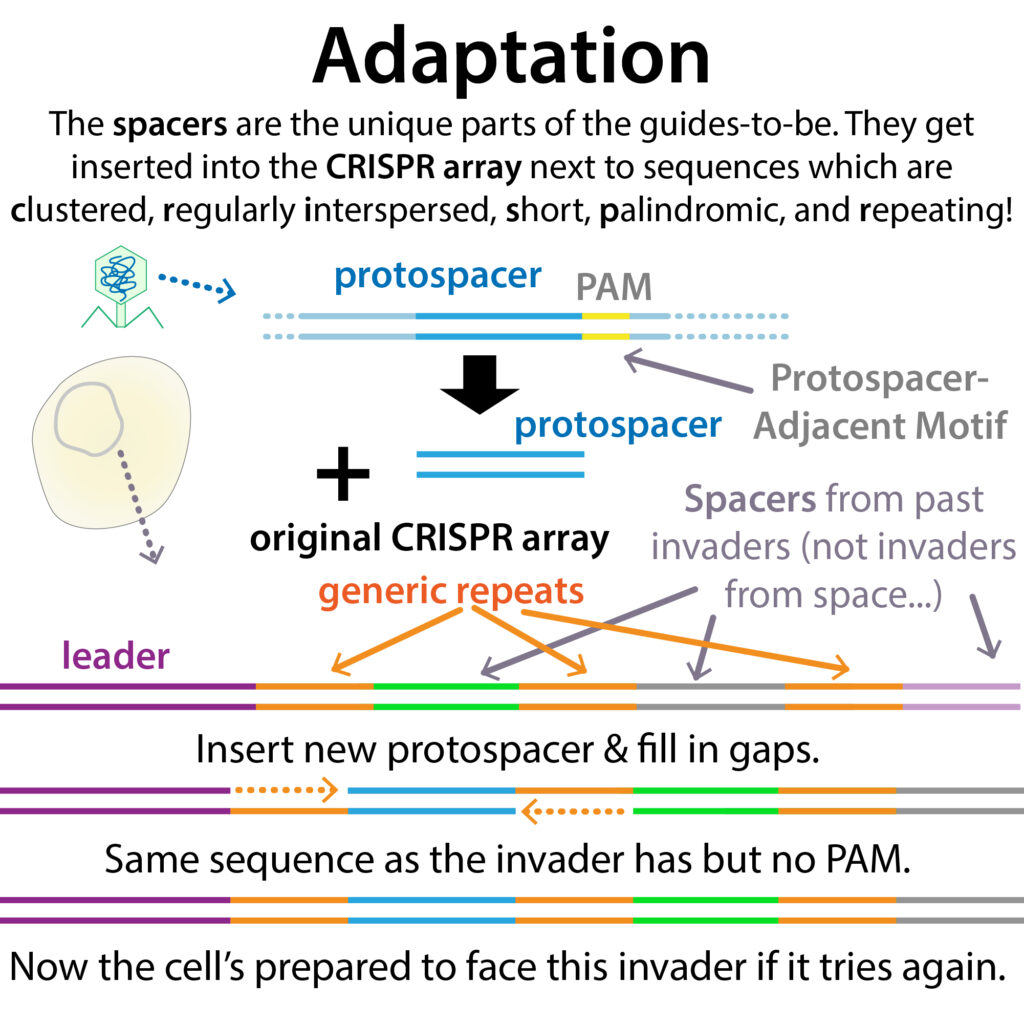
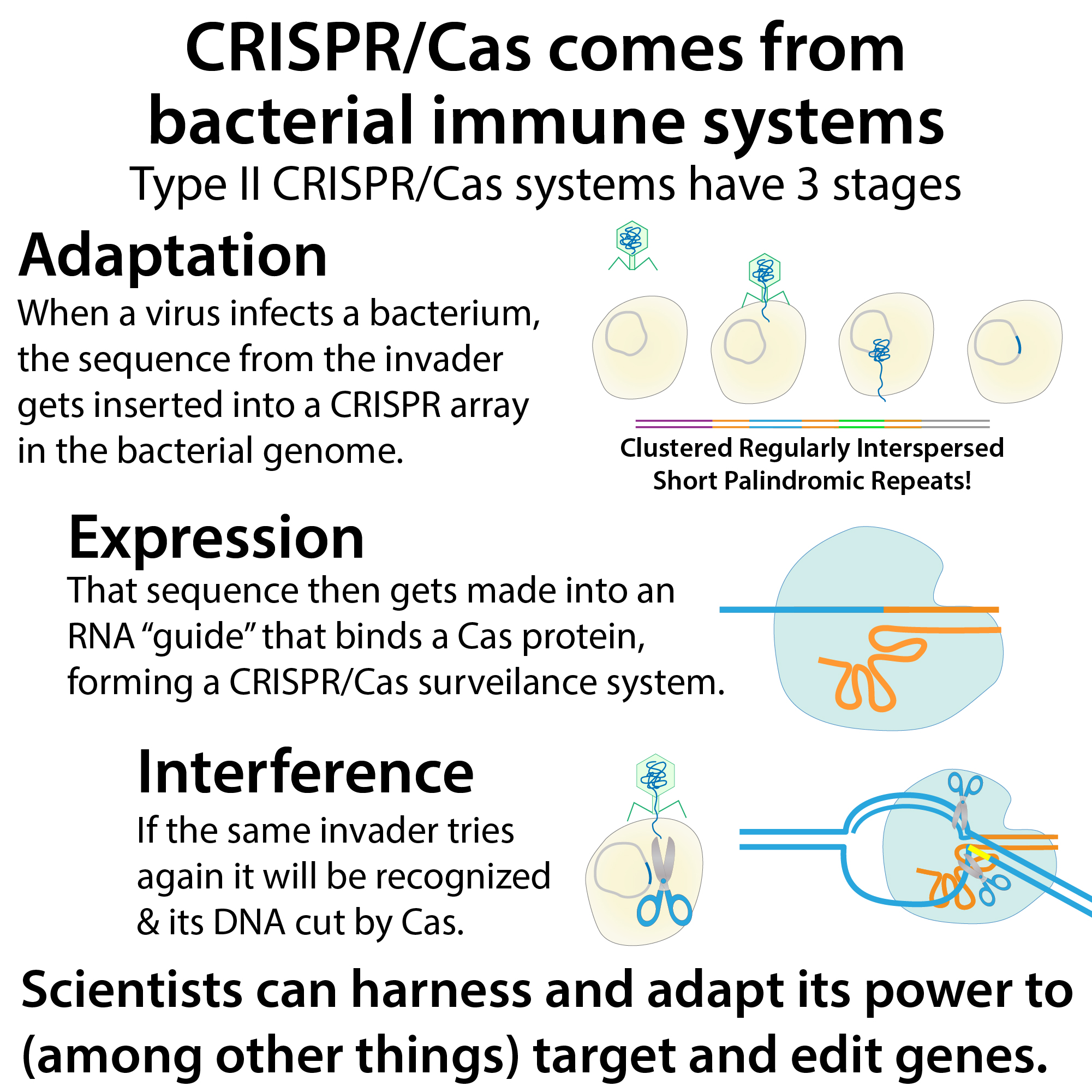
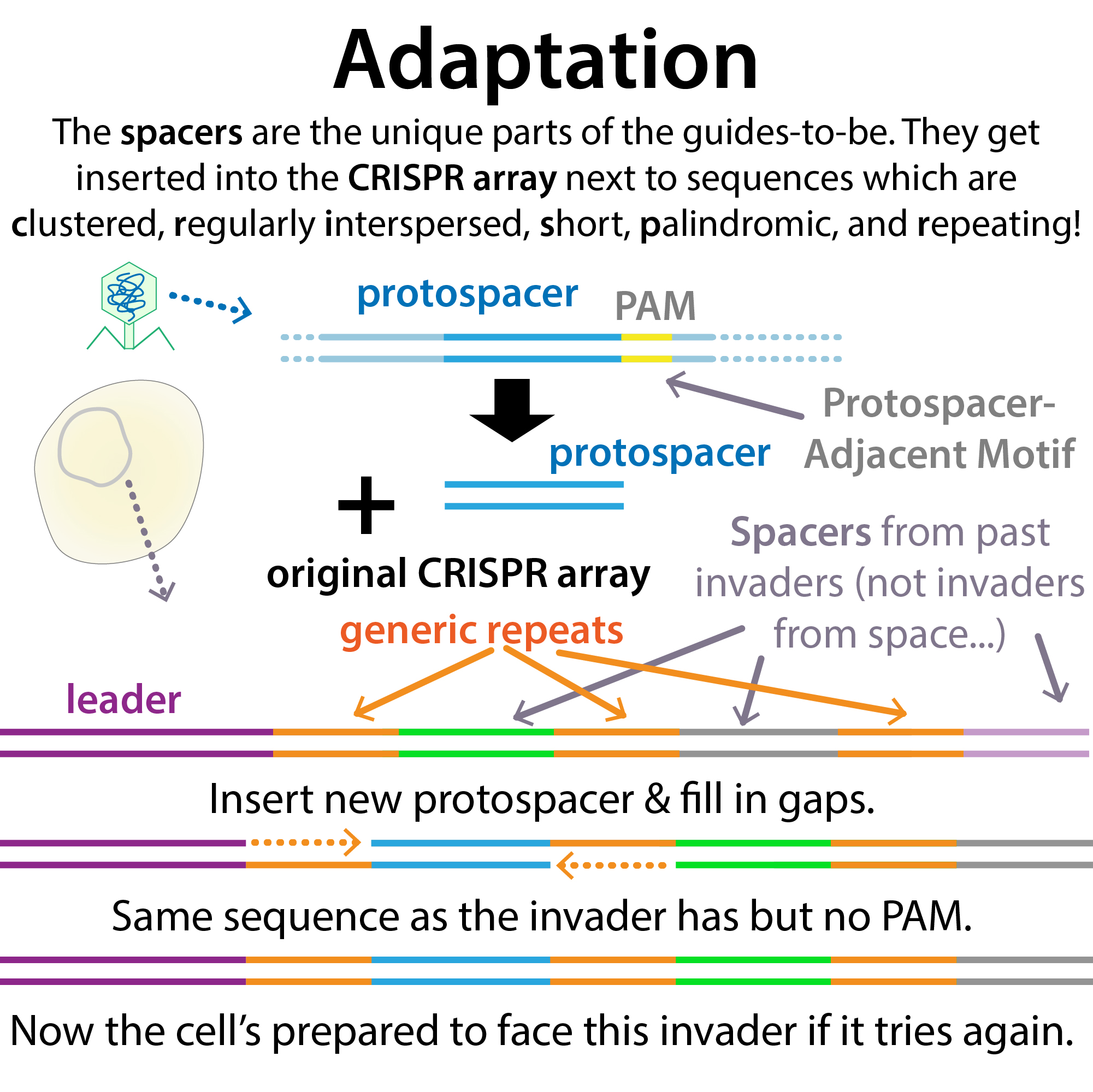
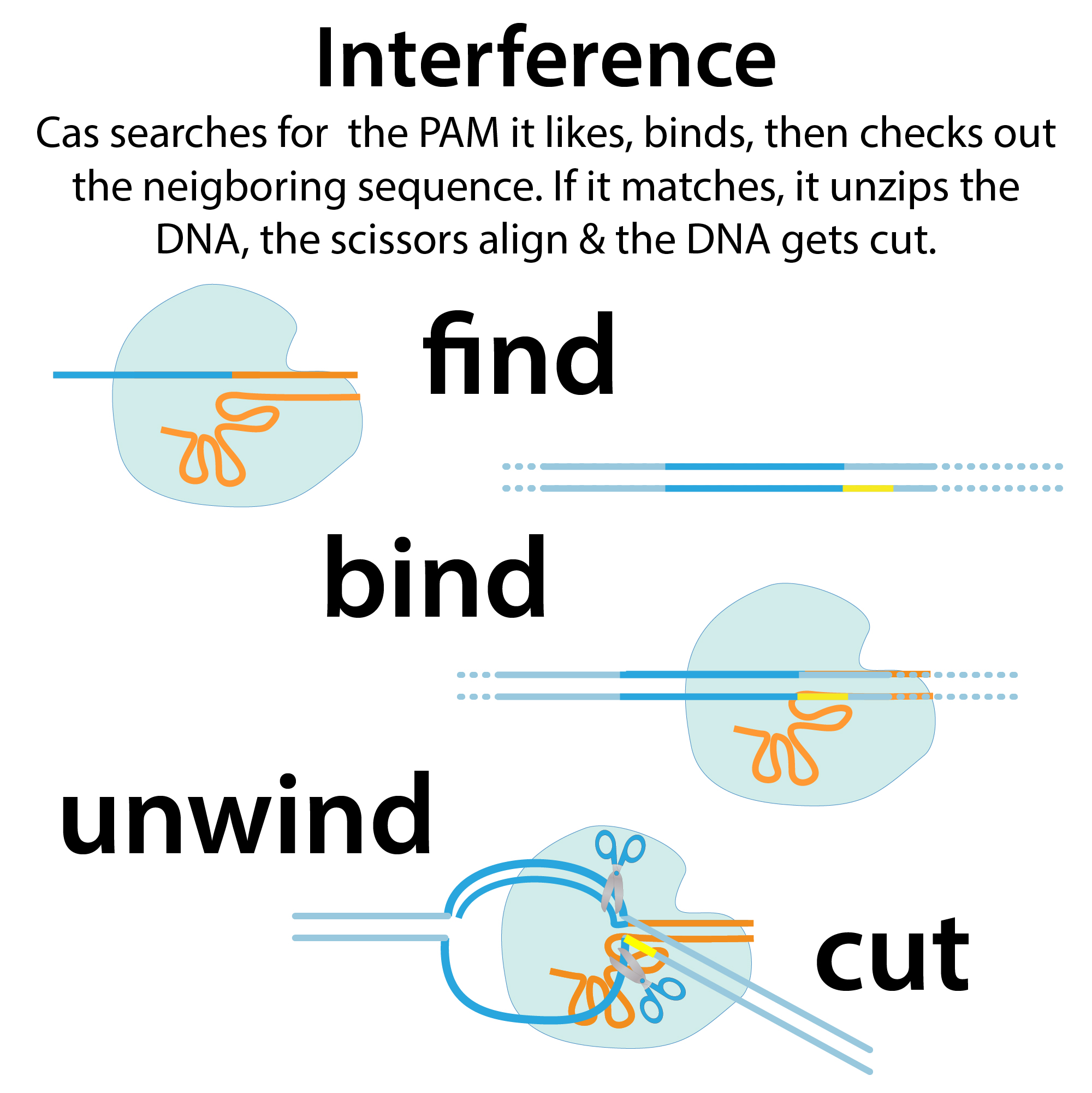
Remember the goal of this system is for the bacteria to be able to recognize and attack invaders (typically viruses) that try to invade them again. So say a DNA virus infects a bacteria and they inject their DNA genome into the cell. The bacteria is then going to take a piece of that genome and stick it into this thing called the CRISPR array, (Clustered Regularly Interspersed Short Palindromic Repeats – that’s what CRISPR stands for, in case you were wondering). It has generic repeats that are palindromic (you could “flip it over” and it’d read the same). And in between those repeats are unique sequences coming from viruses that have attacked them in the past. The sequences (spacers) then get used to make guide RNAs, and the guide RNA bind to the CAS protein, and the CAS protein uses this guide RNA to find the virus based on it having a matching “protospacer” sequence if it tries to infect it again. If it finds it, then it’s going to interfere with it and it’s going to cut the DNA.
This can all be broken up into 3 main stages to how it works:
- Adaptation (aka spacer acquisition, aka immunization): bacteria insert pieces of foreign DNA as “spacers” between repeated sequences in their own genome (collection of DNA) in a CRISPR array, which serves a “running tally” of past invaders 🎶 CRISPR’s got a long list of ex-invaders, they’ll tell you Cas9 cut their DNA. But CRISPR’s got a blank space, baby, & phage, it’ll write your name! 🎶
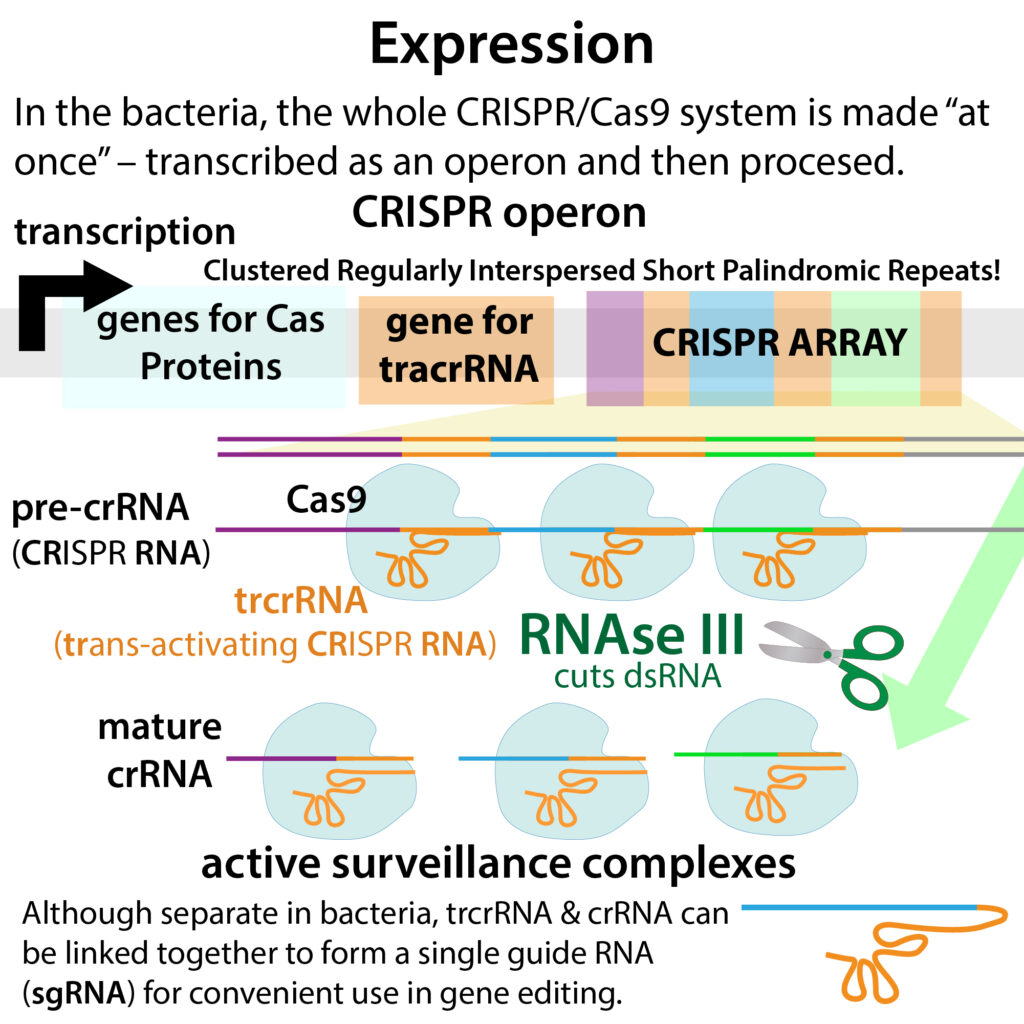
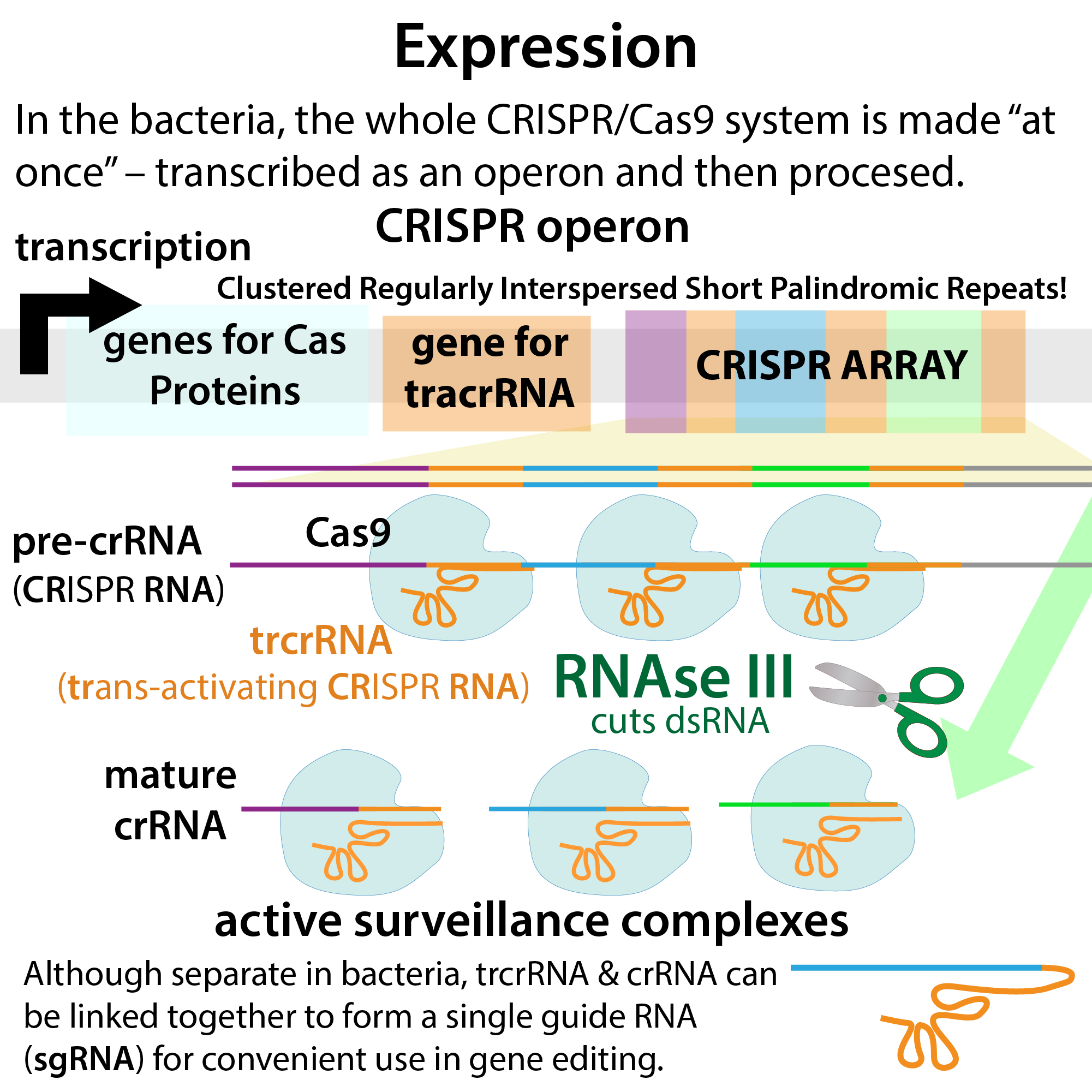
- Expression: All the components of the CRISPR/Cas system are expressed as an operon – this means that it’s all expressed together as a “package deal.” So, at the same time the guide RNAs are made, so are the necessary proteins (Cas proteins) & adapters (trans-activating CRISPR RNA (trcrRNA)).
- CRISPR arrays are transcribed (an RNA copy made) from a promoter with a leader sequence into one long pre-crRNA (pre-CRISPR RNA) and processed into individual mature crRNAs (CRISPR RNAs)
- Cas proteins are transcribed into messenger RNA (mRNA) that’s then translated into protein.
- RNA parts (tracrRNA & crRNA) + Cas effector nuclease (Cas9) = active surveillance complex with its eye out for the invader that has a matching sequence (protospacer)
- Interference: If the invader tries again, this surveillance complex will find it, bind it, unwind it, cut it & degrade it.
Some more details:
Adaptation Phase – Cas9 is the protein that cuts the target in the interference stage, but there are other Cas proteins needed to cut the target out of its original home (invader’s genome), cut the array open at a repeat, and stick it into the array for the adaptation stage. Cas1 & Cas2 help with this part.
A couple important notes here:
- The repeat is cut staggerdly & the overhangs get filled in so the new spacer gets inserted without having to erase any existing one.
- The part of the target that complements the spacer is called the “protospacer” and, in the target, it’s next to that short “code word” called a PAM (Protospacer Adjacent Motif) (in SpyCas9 (Streptococcus pyogenes’ version) this is just NGG where N can be any letter). The PAM is NOT inserted into the CRISPR array (is not part of the spacer) & this prevents the cell from attacking itself as we’ll see…
Expression Phase – crRNA maturation: pre-crRNA has to get processed into mature crRNAs – the individual guides get separated. This is part of the reason you need those generic repeats – they’re like the “dotted lines” that tell the cell where to cut them apart. They match part of the sequence of an “adapter” RNA called trcrRNA. This makes a section of double-stranded RNA (dsRNA) that another pair of scissors called RNase III recognizes & cuts.
The repeats also provide a way to connect them to the Cas9 protein, which will cut the foreign DNA – part of tracrRNA recognizes the Cas protein & part of it recognizes the generic repeat part of the guide RNA
Interference Phase – When it goes on the hunt, Cas roams around bouncing off of things until it lands on a piece of DNA with a PAM sequence. This is the first signal that something might be “foreign.” As discussed above, different bacteria have slightly different Cas-es which like different PAMs, and they keep that PAM away from the spacer copy that’s in their own genome, so they don’t confuse self (version in array) for foreign.
So if they recognize that sequence a red flag goes up. CRISPR/Cas’ version of a SPAM filter is a “PAM” filter! But the PAM sequence is really short & not very specific (unlike the part of the guide that has to match the target (the SPACER), which is like 20 letters long, the PAM is simple – just a few letters. For the “classic” Cas – SpyCas9 (“Spy” because it’s from S. pyogenes not cuz it’s spying on invaders…) the PAM is just “NGG,” where N is just shorthand for the “any letter”).
This short-but-sweetness of the PAM means it occurs by chance relatively frequently, so CRISPR can target genes all over the place – but it also means the cell needs to make sure it’s not a “false alarm”!
The DNA letters in the PAM interact with specific protein letters (amino acids) in Cas. So Cas kinda roams around the cell colliding into things and if it lands on DNA where there’s the right PAM it will get stuck momentarily. And this momentariness is enough for it to shape-shift a bit and disrupt the double-strandedness of the DNA, giving the guide the chance to start sneaking in…
Once Cas binds to the PAM it starts to unzip the DNA & look around. If the guide matches it’ll sneak its way in between the DNA strands, peeling away one strand so it can partner with the other. But this is in the middle of a big ole chain, so instead of the second strand falling off, it just bulges out in something we call an R-loop → RNA bound to DNA and the other DNA strand bulging out.
Now Cas really knows something is foreign. So it cuts the DNA (the binding and unwinding also positions the DNA in the path of Cas’ 2 pairs of scissors – the HNH motif and the RuvC motif). It does this cleavage 3bp upstream of PAM.
And bam – the virus is inactivated!
Now, let’s get to that key 2012 finding: In these bacteria, there’s both a tracer RNA (trcrRNA) and a crRNA. The trcrRNA is generic and the crRNA is part-generic (that repeat) and the other part has that unique spacer (that matches the protospacer in the target). Part of the trcrRNA recognizes the CAS protein to allow it to bind to the CAS protein. And part of it recognizes the generic repeat portion of the crRNA. It works well for the bacteria, but it’s in two pieces, which isn’t ideal for using it as a genome editing tool.
One of the big findings from Doudna and Charpentier in was that you can actually combine these two into a single guide RNA and use that to effectively target specific DNA targets.
Note: Some CAS proteins, like Cas12a, actually just like natural use a single piece guide RNA and recognize structural features and things in order to get it to bind to the CAS protein.
With any Cas, there’s still a lot of optimization and still a lot of screening that goes into finding a sequence that will be a good guide. It’s got to bind near a PAM and avoid off target activity (you want it to be really unique for the site that you want, not bind to other sites). It also needs to not fold up into structures that you don’t want.
Yup, there’s lots of complications. You need to make sure it actually makes changes that you want, and that it doesn’t make the changes that you don’t want. But it is this really powerful tool. And remember, it comes from that basic research into these bacterial immune systems. So I hope this helped you understand CRISPR/Cas, appreciate it more, think about where it comes from, think about where it is and think about where it’s going.
P.S. I got to meet you after Donna before she won the Nobel Prize, and so I was actually introduced to her by my PI. So my basically my boss and grad school, Leemor Joshua Tor, introduced me. And so it was really exciting. And I got a picture and I’m really glad I got the picture. Kind of wish I got an autograph, but a picture and the memory will suffice :).
More on Jennifer Doudna: https://thebumblingbiochemist.com/wisewednesday/jennifer-doudna/
Recommended reading:
- Doudna and Charpentier’s game-changer article:
- Jínek, M., Chylinski, K., Fonfara, I., Hauer, M., Doudna, J. A., & Charpentier, E. (2012). A programmable dual-rna–guided dna endonuclease in adaptive bacterial immunity. Science, 337(6096), 816-821. https://doi.org/10.1126/science.1225829
- And a 2014 article from them giving perspective on the findings leading up to it:
- Doudna, J. A.; Charpentier, E. The New Frontier of Genome Engineering with CRISPR-Cas9. Science 2014, 346 (6213), 1258096–1258096. https://doi.org/10.1126/science.1258096.
- This paper introduced base editing with a cytosine base editor
- Komor, A. C.; Kim, Y. B.; Packer, M. S.; Zuris, J. A.; Liu, D. R. Programmable Editing of a Target Base in Genomic DNA without Double-Stranded DNA Cleavage. Nature 2016, 533 (7603), 420–424. https://doi.org/10.1038/nature17946.
- This paper introduced adenine base editing
- Gaudelli, N. M.; Komor, A. C.; Rees, H. A.; Packer, M. S.; Badran, A. H.; Bryson, D. I.; Liu, D. R. Programmable Base Editing of A•T to G•C in Genomic DNA without DNA Cleavage. Nature 2017, 551 (7681), 464–471. https://doi.org/10.1038/nature24644.
- This article reported on the activity of Cas12a2:
- Dmytrenko, O.; Neumann, G. C.; Hallmark, T.; Keiser, D. J.; Crowley, V. M.; Vialetto, E.; Mougiakos, I.; Wandera, K. G.; Domgaard, H.; Weber, J.; Gaudin, T.; Metcalf, J.; Gray, B. N.; Begemann, M. B.; Jackson, R. N.; Beisel, C. L. Cas12a2 Elicits Abortive Infection through RNA-Triggered Destruction of dsDNA. Nature2023, 613 (7944), 588–594. https://doi.org/10.1038/s41586-022-05559-3.
- These articles used Cas12a2 to selectively target and kill specific cells (cancer cells, virus-infected cells, and unedited cells):
- Zeng, J.; Cheng, Z.; Chen, H.; Wang, Z.; Thompson, J.; Crosby, K. T.; Han, H.; Singhal, A.; Ngo, W.; Xia, C.; Rosas-Rivera, D.; Zhang, Z.; Kang, M. H.; Mao, Y.; Diolaiti, M. E.; Lee, G. C.; Diffley, J. F. X.; Song, Y.; Qiu, L.; Krah, N. M.; Murthy, N.; Jackson, R. N.; Liu, Y.; Ashworth, A.; Doudna, J. A. Targeting Cancer-Specific Mutations with RNA-Triggered Chromatin Shredding. Nature 2026, 1–3. https://doi.org/10.1038/s41586-026-10738-7.
- Scholz, P.; Thompson, J.; Crosby, K. T.; Fauth, T.; Krah, N. M.; Schlauderaff, G.; Back, R.; Berkheimer, Z. A.; Jolley, A.; Sombroek, D.; Medert, R.; Zurek, C.; Dmytrenko, O.; Wilson, E.; Schut, F. T.; Rutter, J.; Zhang, X.; Krohn, M.; Jackson, R. N.; Beisel, C. L.; Liu, Y. RNA-Triggered Cell Killing with CRISPR–Cas12a2. Nature 2026, 1–10. https://doi.org/10.1038/s41586-026-10466-y.
- As reviewed in:
Takallo, M.; Staals, R. H. J. DNA-Shredding CRISPR Enzyme Takes Aim at Cancer Cells. Nature 2026. https://doi.org/10.1038/d41586-026-02122-2.
- Some nice review articles, etc.:
- Pacesa, M.; Pelea, O.; Jinek, M. Past, Present, and Future of CRISPR Genome Editing Technologies. Cell 2024, 187 (5), 1076–1100. https://doi.org/10.1016/j.cell.2024.01.042.
- CRISPR 101: Cytosine and Adenine Base Editors. https://blog.addgene.org/single-base-editing-with-crispr (accessed 2025-05-17).
- Macarrón Palacios, A.; Korus, P.; Wilkens, B. G. C.; Heshmatpour, N.; Patnaik, S. R. Revolutionizing in Vivo Therapy with CRISPR/Cas Genome Editing: Breakthroughs, Opportunities and Challenges. Front. Genome Ed. 2024, 6. https://doi.org/10.3389/fgeed.2024.1342193.
- Chehelgerdi, M.; Chehelgerdi, M.; Khorramian-Ghahfarokhi, M.; Shafieizadeh, M.; Mahmoudi, E.; Eskandari, F.; Rashidi, M.; Arshi, A.; Mokhtari-Farsani, A. Comprehensive Review of CRISPR-Based Gene Editing: Mechanisms, Challenges, and Applications in Cancer Therapy. Molecular Cancer 2024, 23 (1), 9. https://doi.org/10.1186/s12943-023-01925-5.
- Anzalone, A. V.; Randolph, P. B.; Davis, J. R.; Sousa, A. A.; Koblan, L. W.; Levy, J. M.; Chen, P. J.; Wilson, C.; Newby, G. A.; Raguram, A.; Liu, D. R. Search-and-Replace Genome Editing without Double-Strand Breaks or Donor DNA. Nature 2019, 576 (7785), 149–157. https://doi.org/10.1038/s41586-019-1711-4.
- Zhao, Z.; Shang, P.; Mohanraju, P.; Geijsen, N. Prime Editing: Advances and Therapeutic Applications. Trends in Biotechnology 2023, 41 (8), 1000–1012. https://doi.org/10.1016/j.tibtech.2023.03.004.
- Murray, J. B.; Harrison, P. T.; Scholefield, J. Prime Editing: Therapeutic Advances and Mechanistic Insights. Gene Ther 2025, 32 (2), 83–92. https://doi.org/10.1038/s41434-024-00499-1.
- Mawson, S. J.; Dunne-Dombrink, K. A.; Pollak, B. R.; Komor, A. C. Precision Genome Editing with DNA Base Editors. Nat Rev Methods Primers 2026, 6 (1), 23. https://doi.org/10.1038/s43586-026-00478-3.