Much more on protein purification on the protein expression and purification page!
Meet the AKTA! A quick tour of the basics of an FPLC (Fast Protein Liquid Chromatography) system
AKTA flow paths and injection valve modes – controlling the plumbing on an FPLC!
Getting your sample on the AKTA: Sample Loops and Sample Pumps
Bottom line: Sample loops are good for small volumes, sample pumps for large volumes, but the pumps are expensive. Superloops are an option for larger volumes without a pump, but they’re kinda a pain
Priming pumps on an AKTA
Priming your pumps on an AKTA is important for removing air from them that can damage your system and mess up your chromatography run!
Running FPLC (e.g. an AKTA) in the cold
We keep our AKTA in a deli fridge to protect the precious proteins we’re purifying! At higher temperatures, proteins can denature (unfold) and degrade, and any proteases (enzymes that chew proteins) are more active. You therefore almost always want to keep the proteins you’re working with in the lab cold. Even when you’re purifying them! So, we keep our AKTA in a deli fridge, with wires going out to a computer. This set up is ideal and allows us to avoid the cold room!
But, it’s important to know that at temperatures that are low, you typically need to reduce your flow, so your runs will go slow! At lower temperatures, liquids are more viscous, so flow through the lines will create higher pressures. You want to make sure that you have pressure sensors set to avoid crushing your column. When setting up a method, you can set it to control the flow to avoid going over the pressure limit and, if you look at the system flow rate during a run, you might see it’s below what you set the flow rate to be. And this is probably why. Just be patient, your protein will thank you!
More on running in the cold from Cytiva (AKTA makers whom I am NOT paid by). https://www.cytivalifesciences.com/en/us/news-center/how-to-improve-cold-room-protein-purification-10001
Attaching HiTrap and other small columns to an AKTA column valve
Attaching HiTrap and other small columns to an AKTA column valve – These small columns screw right into the valve (the B port), as opposed to the bigger columns that have tubing connections on both ends. With any of these, it’s important to attach things without leaks.
Linking together pre-packed FPLC columns to increase column volume
When you’re using HiTrap chromatography columns, you can simply link them in series to increase your column volume, negating a drawback of pre-packed columns being limited in available concentrations as opposed to manually packed gravity flow columns, where you choose the precise volume based on how much protein you have. In the past, we were using gravity flow for His-tag purification in part because we wanted to use more resin than the 5 mL HisTrap column we had would allow. But using the AKTA is so much more convenient during the busy semester (as opposed to the summer). So we got a second 5 mL column, screwed it into the first and voila – 10 mL! Works great. A couple of notes though . . .
- Pre-check the connection for leaks manually by injecting in buffer and reinforce it with a wrapping of Parafilm if needed (more likely if the columns are older and the threads wearing down)
- Watch the pressure – pressure can build up more easily, so be sure to adjust your flow rate as needed
Good luck!
Injecting sample into a sample loop and starting SEC run on an AKTA
Running size exclusion chromatography (practical look at running gel filtration on an AKTA PURE)
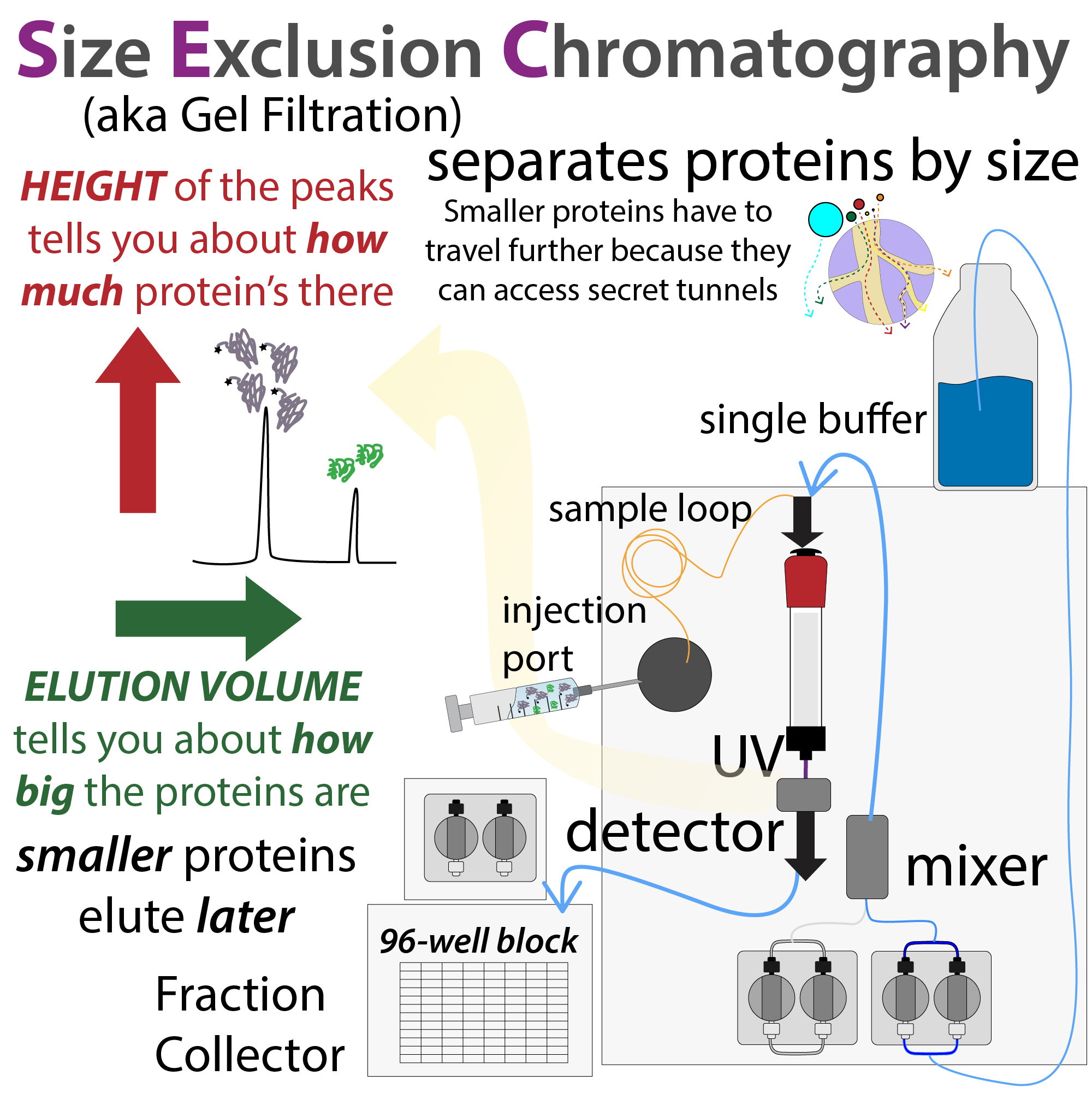
More on size exclusion chromatography: http://bit.ly/sizeexclusionchromatography
Wash the line to the fraction collector on your AKTA after your runs!
The outlet valve defaults to “waste”, which bypasses the fraction collector tubing. To wash that tubing (which is where your precious proteins actually go through to reach their destination) you’ll want to change the outlet valve to “Frac.” Then, making sure your column position is set to by-pass so you don’t crush any columns, set your flow rate of water to 5 mL/min and let it run for a few minutes. The water will run through the line to the fractionator, then drip into your waste.
Quick tips: FPLC (e.g. AKTA) needle maintenance (washes, cleaning wires, selection, etc.)
Quick tips: FPLC (e.g. AKTA) needle maintenance (washes, cleaning wires, selection, etc.)
Determining the void volume (Vo) of a Size Exclusion Chromatography (SEC)/Gel Filtration (GF) column with Blue Dextran
Determining the void volume (Vo) of a Size Exclusion Chromatography (SEC)/Gel Filtration (GF) column with Blue Dextran
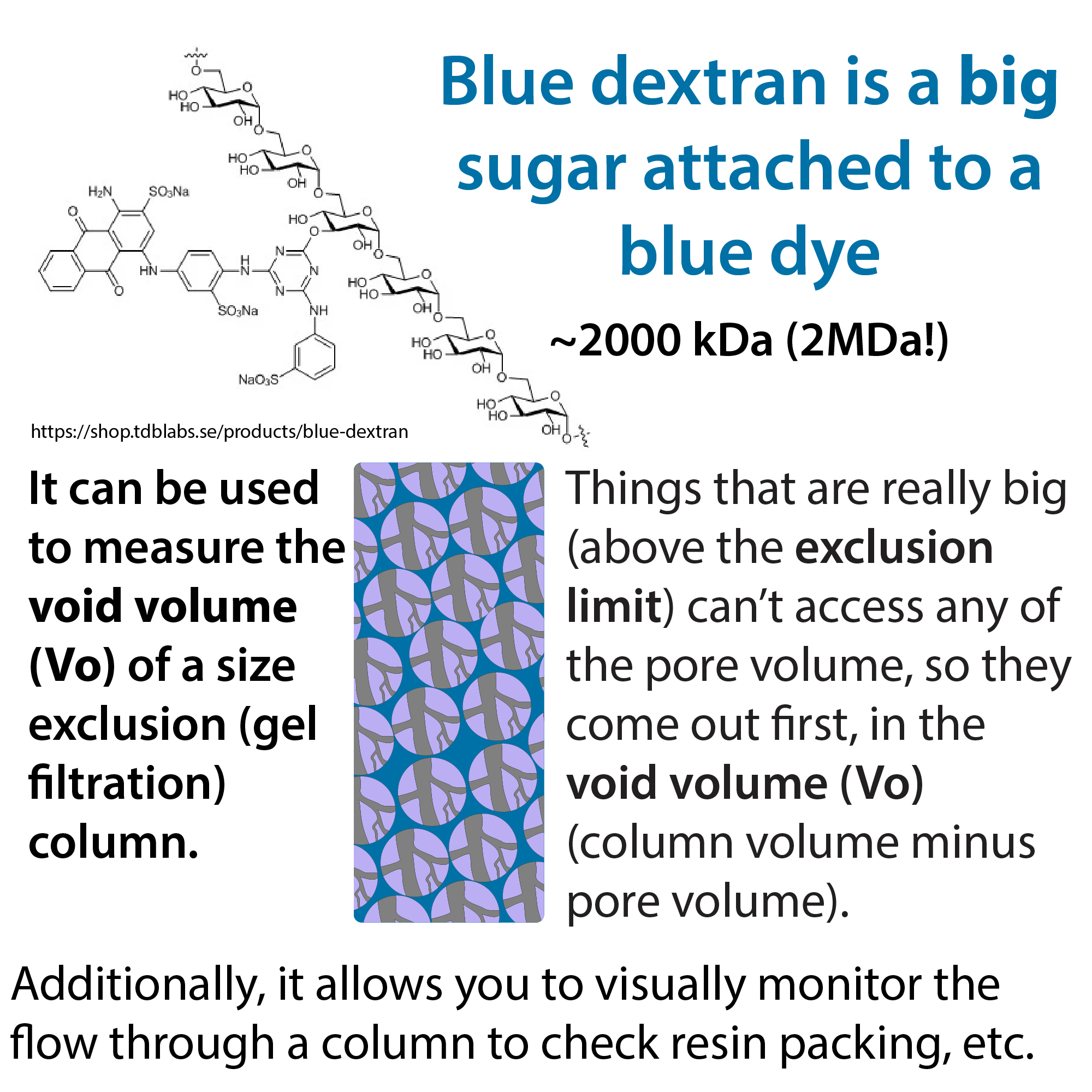

Not a paid endorsement, but here’s a link to the kit we’re using: https://www.sigmaaldrich.com/US/en/product/sigma/mwgf200?srsltid=AfmBOopXbeWHty_K8sOWGKRr6cWnNkWputXTp7wyaMx_ebcmFP6H2LWL
Tips for using Hamilton syringes & other needle/syringe options for injecting into an FPLC
Whatever you choose make sure it’s blunt-end 🙂
Not a paid endorsement, but here are the ones we’re using
- Hamilton® syringe, 700 series, special needle, 500 µL 26222-U
- Hamilton® syringe, 700 series, special needle, 250 µL 58384
Keep track of your runs
Protein purification and analysis is addicting 🙂 Before you know it, you’ve got tons and tons of runs! So it’s important to keep track of them. I like to keep a log with the following information for each:
- Date
- Protein
- Column
- Buffer
- Sample volume
- Purification date & concentration (if applicable)
- Notes – especially important if there are issues or unexpected results, strange curve shapes, alarms, etc.
Additionally, I take a screenshot (you can do this by clicking one of the icons in the upper left corner in Unicorn)
If there’s a problem with a run, I also rename the file name to start with “BAD”
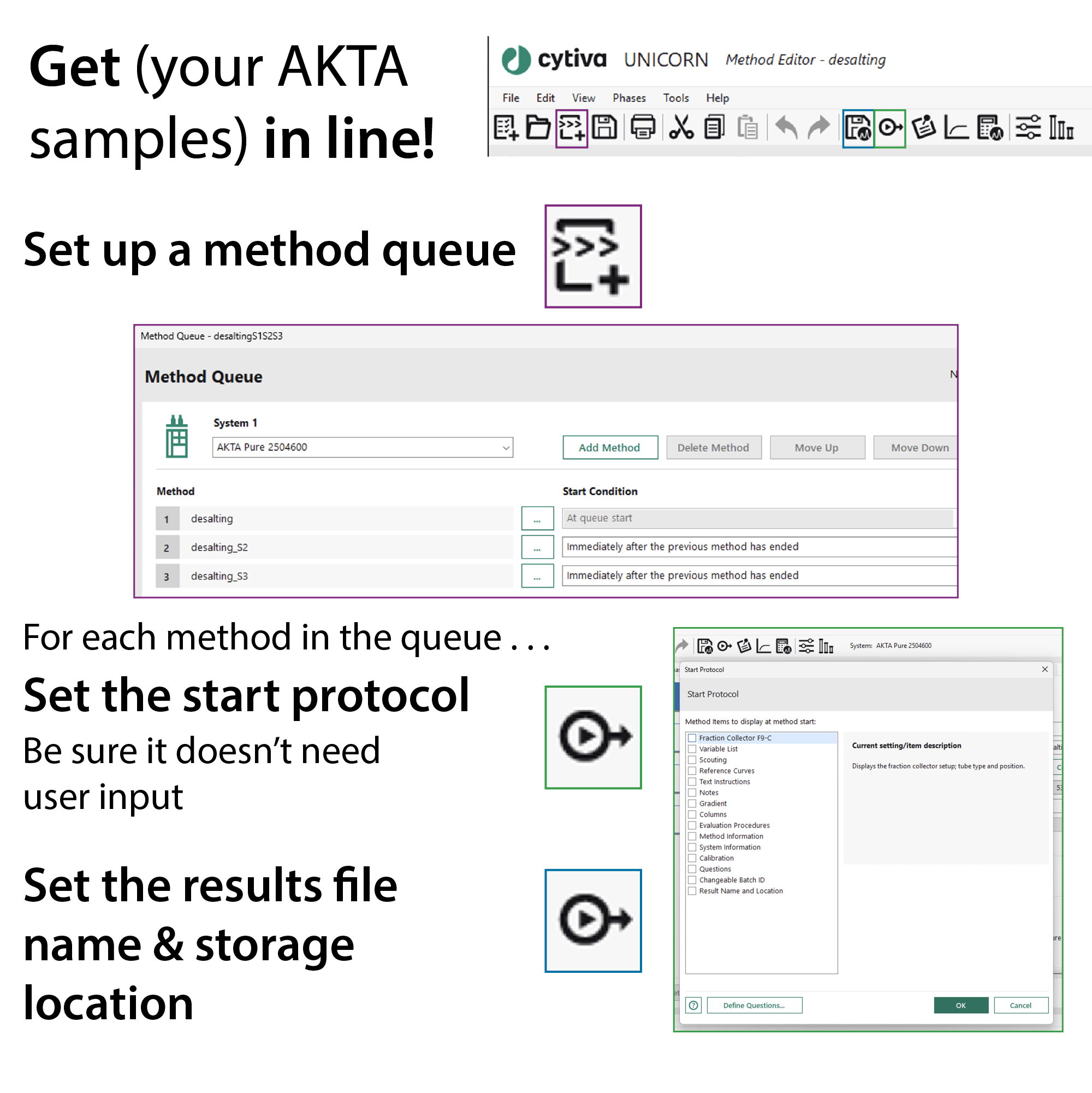
Get (your protein samples) in line! AKTA queues
Pre-run checks
Before you press start, here are some things to check on your AKTA (or other brand of FPLC).
First things first, ensure that the right buffer line is in the right buffer. But that’s not the only thing to look for buffer-wise. It’s critical that you don’t introduce any air into the system, so you want to ensure, right before the run:
- There are no air bubbles in your buffer lines
- You have plenty of buffer in your bottle for your run
- The buffer line is secured (either with the special bottle caps or tape)
- The bottom of the buffer line is right above the surface of the bottom of the bottle
- The buffer line isn’t curled up
Also, make sure you have enough empty tubes, etc. for collecting all of your fractions.
AKTA loop valve
We’re quite excited about getting a loop valve for our AKTA so we can have multiple sample loops hooked up at once, allowing us to 1) use different size sample loops without having to change them out (and risking leaking in the process) and 2) being able to queue samples to run. These are huge benefits for using the AKTA with undergrads on a busy schedule and with lots of protein constructs to test!
Huge thanks to An Lam from Cytiva for installing for us and giving us the run-down. And Alice and Ryan for explaining things for y’all. And LMU’s Seaver for funding.
Seriously not a paid endorsement. Just really authentically excited.