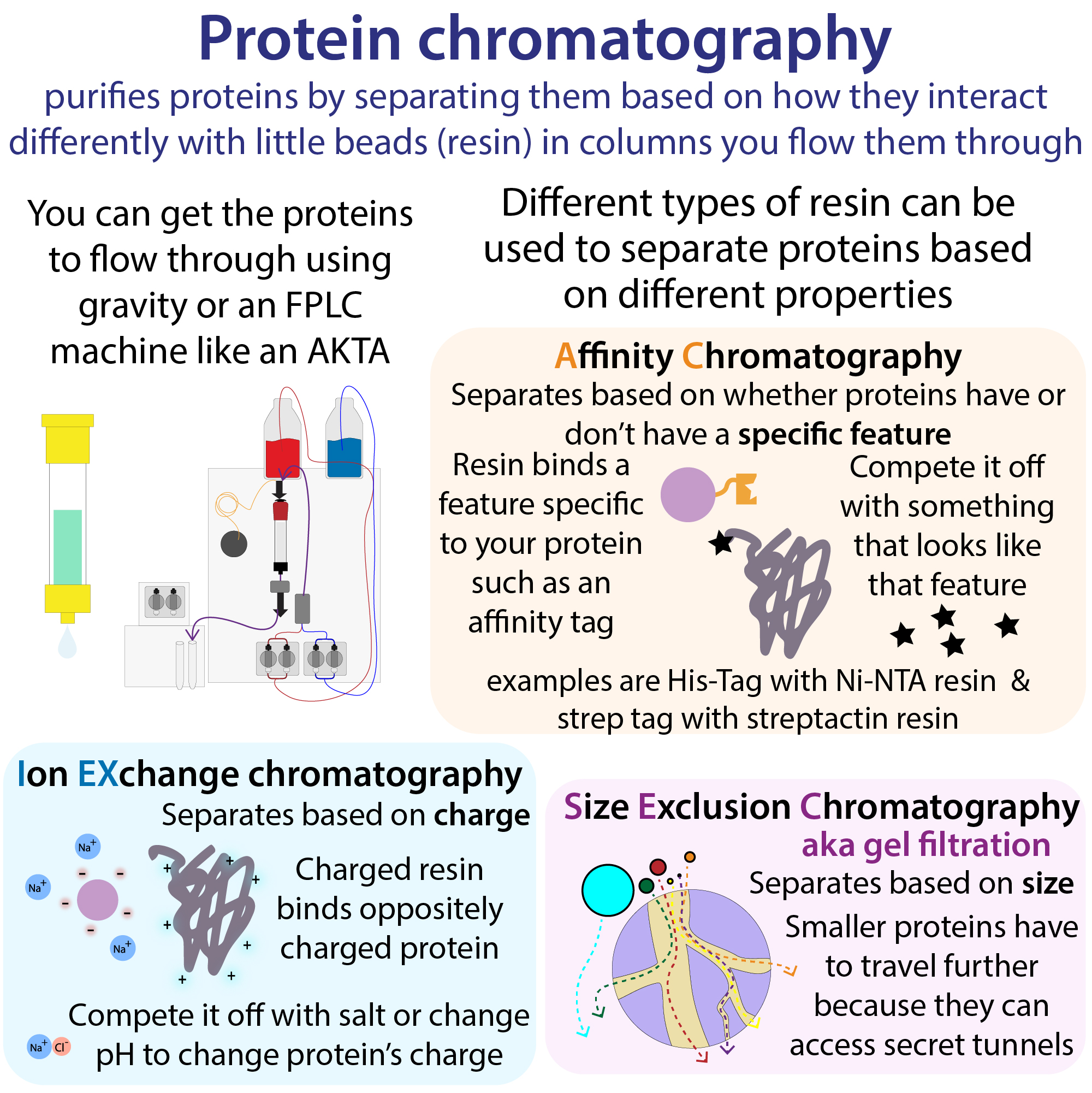
Chromatographic resolution (non-overlap of components being separated) comes from a combination of selectivity (further apart peak centers) and efficiency (crisp, symmetrical peaks).
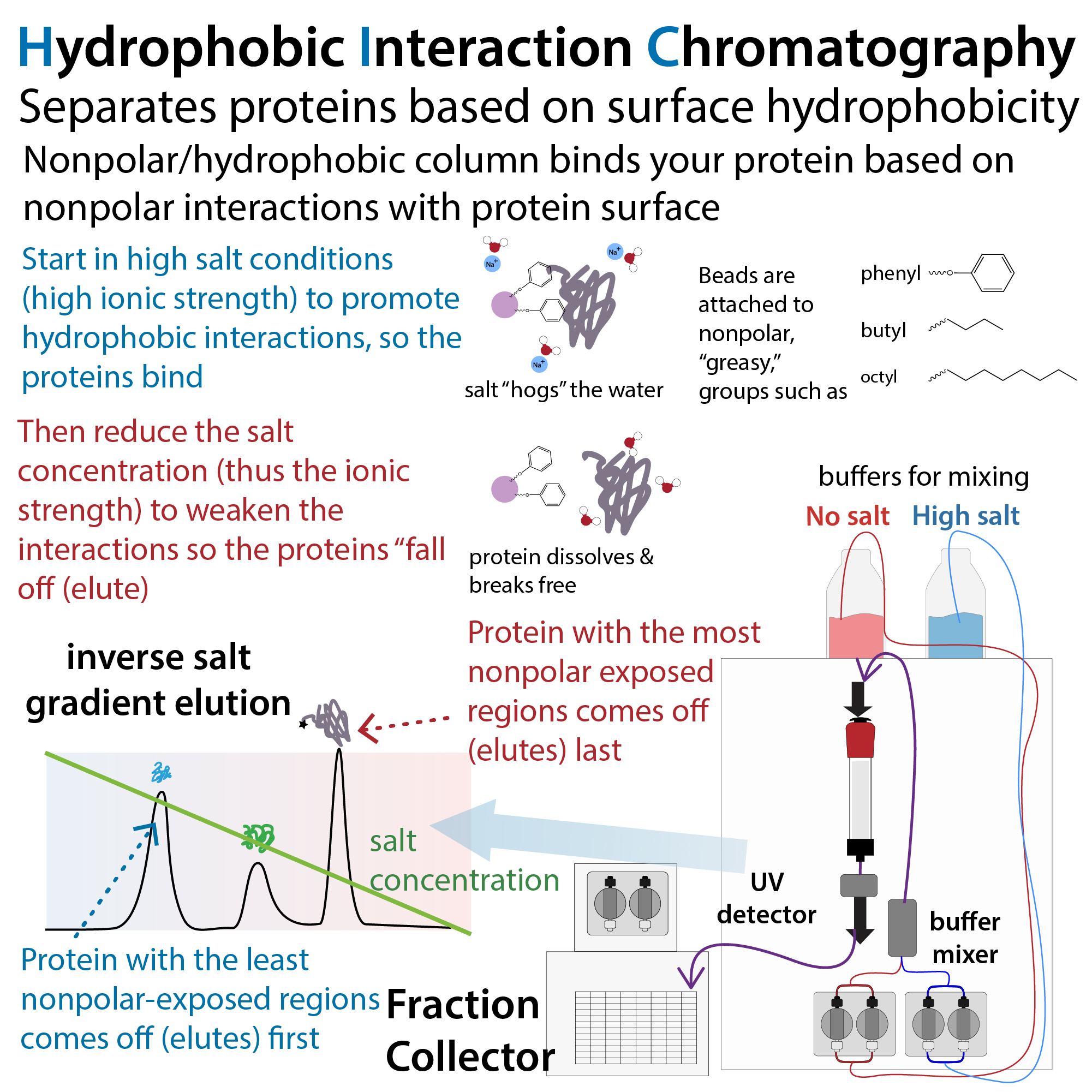
Selectivity comes mainly from properties of the chemical groups attached to the beads (ligands) & how they interact with the molecules being separated under the given buffer conditions.
Efficiency comes largely from bead size and how much diffusion (molecular wandering), and thus “zone broadening,” they permit.
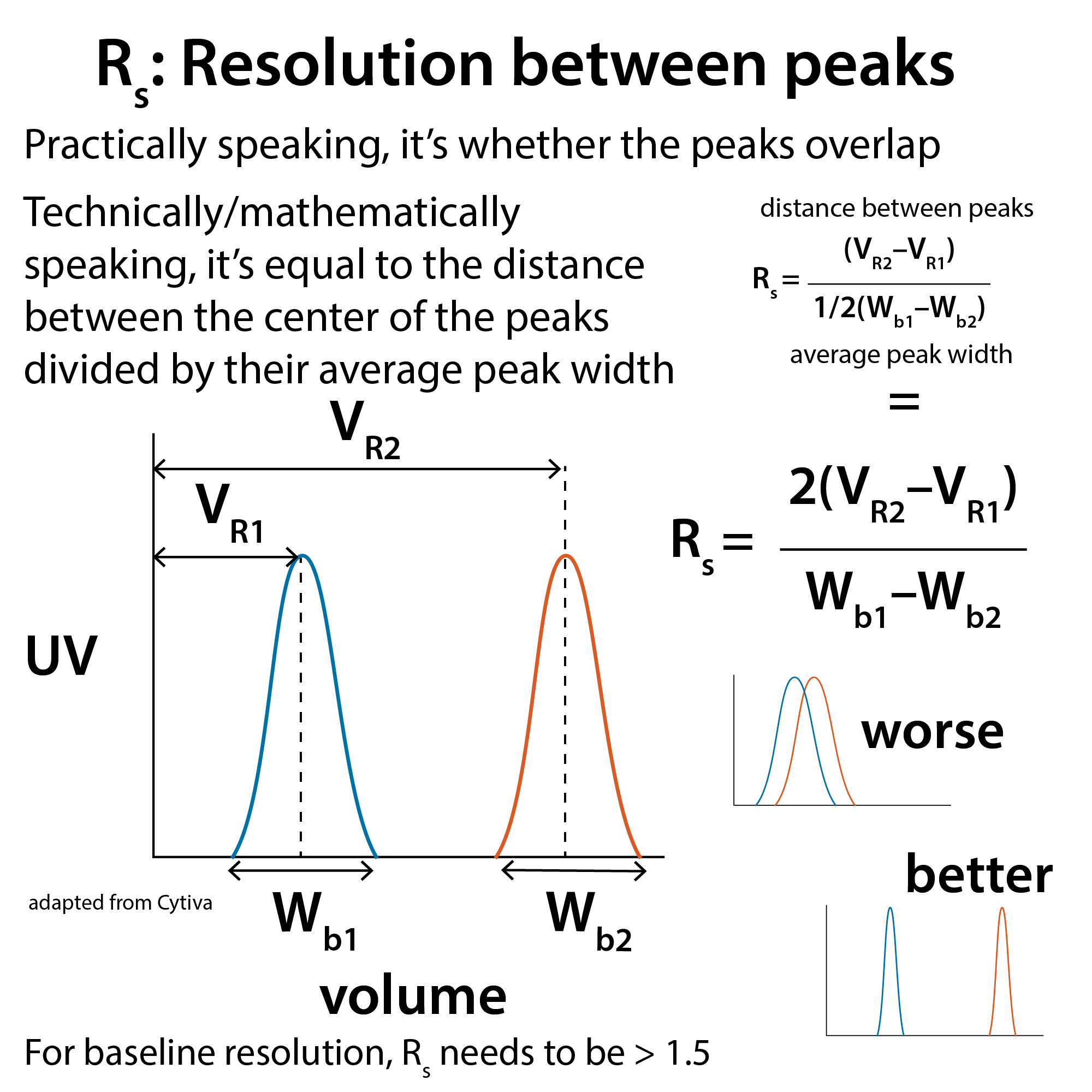
Rs: Resolution between peaks – Practically speaking, it’s whether the peaks overlap. Technically/mathematically speaking, it’s equal to the distance between the center of the peaks divided by their average peak width. For baseline resolution, R needs to be > 1.5.
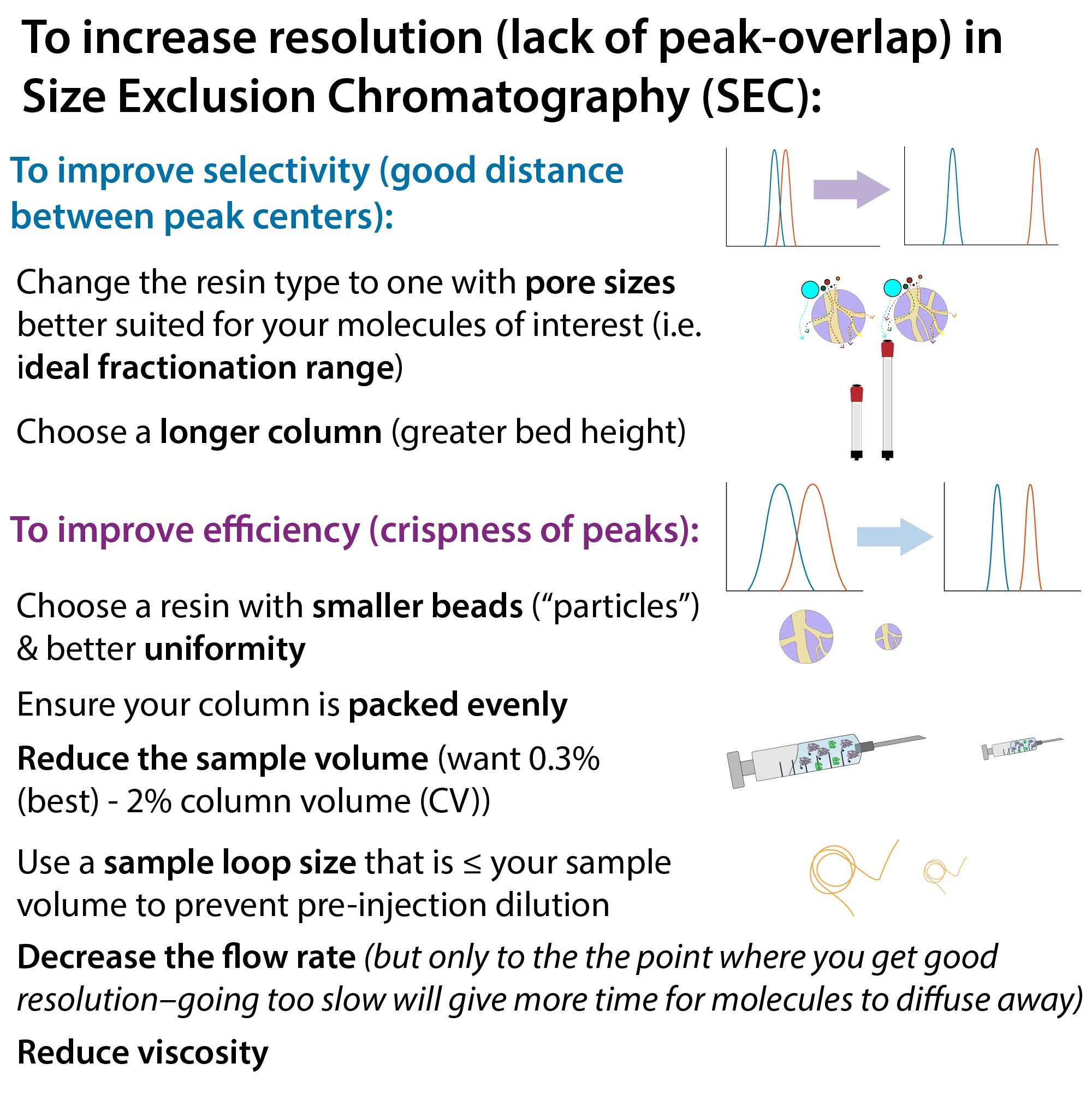
To increase resolution in Size Exclusion Chromatography (SEC):
- To improve selectivity (distances between peak centers):
- Change the resin type to one with pore sizes better suited for your molecules of interest (i.e. ideal fractionation range)
- Choose a longer column (greater bed height)
- To improve efficiency (crispness of peaks):
- Reduce the sample volume (want 0.3% (best) – 2% column volume (CV))
- Decrease the flow rate (but only to the the point where you get good resolution–going too slow will give more time for molecules to diffuse away and reduce efficiency)
- Ensure your column is packed evenly
- Use a sample loop size that is ≤ your sample volume to prevent pre-injection dilution
- Choose a resin with smaller beads (“particles”) & uniformity
- Reduce viscosity
If you want to know more, I recommend checking out Cytiva’s chromatography handbooks.
More on HIC and optimizing it: https://www.cytivalifesciences.com/en/us/insights/optimizing-hydrophobic-interaction-chromatography
More on chromatography: http://bit.ly/proteinpurificationtech
More about all sorts of techniques: https://thebumblingbiochemist.com/lets-talk-science/techniques/