Scientific writing–be it an abstract, a paper manuscript, a poster, or a thesis–is hard. No getting around it. Just through it. But here are some things you can do to help make the journey smoother. Starting with realizing that it is (and remains even when you’re an established scientist) typically an iterative, often collaborative, process that can occur over days, weeks, months, or even years. And lots of red marks are a normal part of the process and not evidence you’re “bad” or a “failure.” Go into the process with an open mind and clear expectations. And know that – you can do it!
Quick words of advice for scientific writing
The writing and reviewing process:
- Give yourself time – To write, then edit, then sleep on it and revisit with fresh eyes, then re-edit . . .
- I like to start by just getting my thoughts down, then work on organizing and polishing the parts
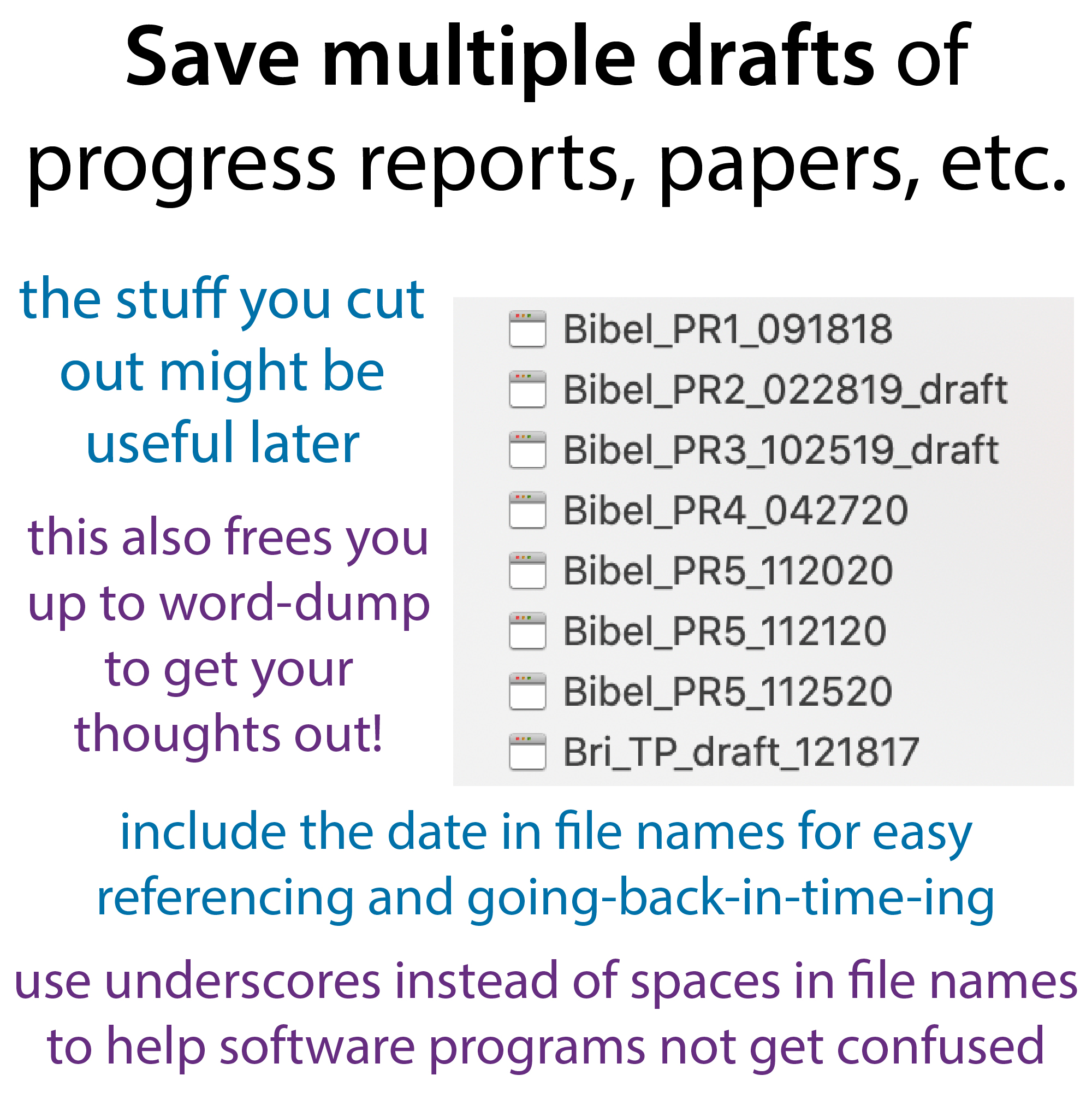
- Save dated versions of your work in case you change your mind, want to include something you cut out, etc. (or just want to see how far you’ve come)
- Read over whatever you write before you give it to someone else to read over (no matter how eager/excited you are to just “be done” with it)
- Read what you have written out loud to spot grammatical problems and/or tense inconsistencies
- Make use of available resources such as campus writing centers and friends willing to read it
- Give your reviewers/editors etc. time to review it
- Give your reviewers/editors etc. guidance as to what “level” feedback you want (do you want nitty-gritty copy editing (late drafts) or just “higher level” feedback on general direction, organization, flow, etc. of earlier drafts to see if you’re on the right track before you get to far astray)
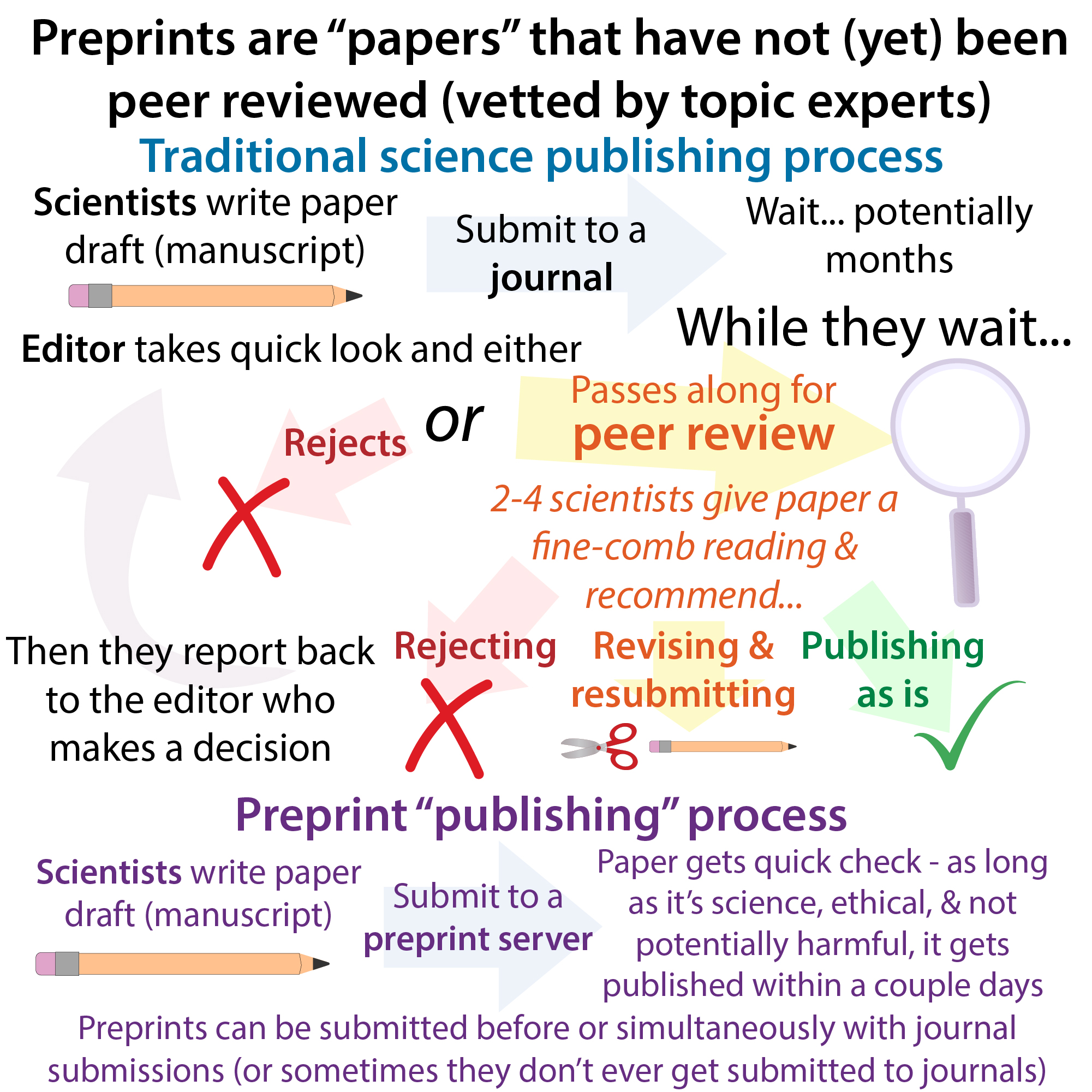
- Expect lots of markup. That is completely normal!!!!!! It might feel devastating and discouraging at the time, but it’s totally a normal part of the process. Even big wig scientists typically must do lots of revisions of their work! (peer review!)
- Try not to take feedback personally (no matter how difficult this is to do!)
- Everybody has different preferences and expectations – learn your reviewers’ and preempt future “corrections” (even if you don’t always agree with them)
- Resign yourself to the fact that, like science, nothing you write will ever be “finished” and can always be “improved” and/or extended. But at the “end of the day” (sometimes years later) something must be considered “done.”
The writing itself:
- Identify your audience and write with them in mind
- Ensure that your writing has a logical flow, uses transitions between paragraphs and concepts, keeps the larger picture in mind throughout, and ties things together at the end
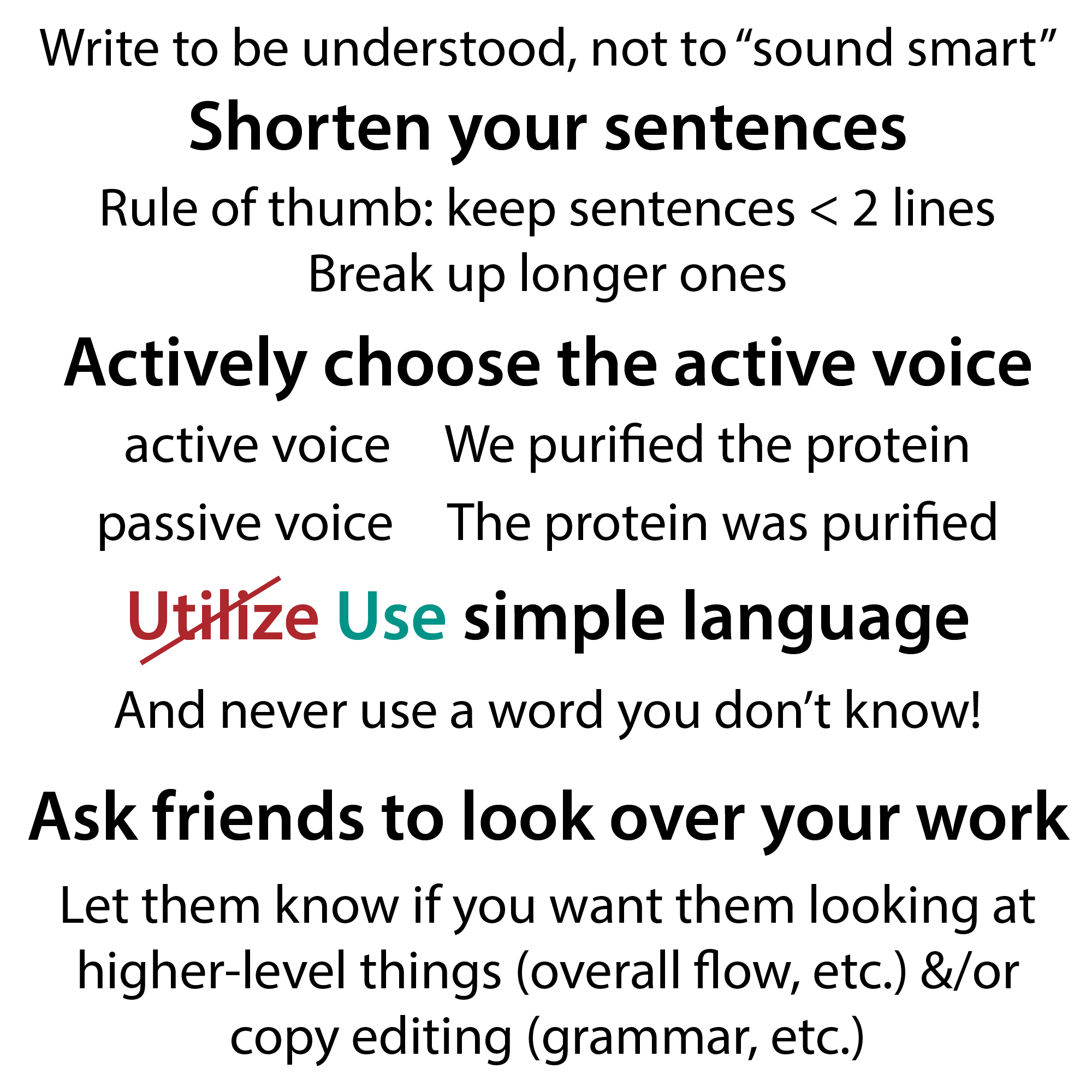
- Be concise: when possible, shorten your phrases and use “simpler” words when they do the trick (but use technical terms when their nuances are important to the work and/or field)
- Remove words and/or sentences that don’t serve a purpose (other than to make you sound “scientific” or “fancy”) – go through and remove one word or sentence at a time and see if you lose meaning
- Break up long sentences – try not to let any sentence run over more than 2 lines.
- Spend time early on learning scientific grammar conventions and practice using them correctly… English is complicated – even for native speakers!
- Be careful to differentiate between assumptions, things that are “known” and things that you theorize
- Avoid the word “proved” – in science, we only disprove the null hypothesis; but our evidence can “suggest” or “support” theories
- Even though a lot goes into your work, don’t try to fit in every single thing you did.
- Some things will have to be left out. But that does not mean that the work you did on them was a waste of time. You might not appreciate it (and really likely didn’t appreciate it at the time) but all the “failures” and mistakes and artifact-chasing made you a better, more independent scientist.
To make your life easier when it comes time to write:
- Spend time reading the literature. Like scientific writing, it’s an important, but hard and sometimes obscure, aspect of science that only gets easier if you practice.
- As you take notes on background, etc., make sure you make note on what source various facts, etc. came from so you don’t have to track them down when you want to use them
- Keep detailed notes on your research work:
- I keep both a physical lab book and a digital version so that I can search
- Date and number everything – makes cross-referencing much easier
- Make “paper-style” figure legends for figures that are just for your notes (and potentially lab meetings, etc.) – This has come in really handy when I need to put them into papers, etc.
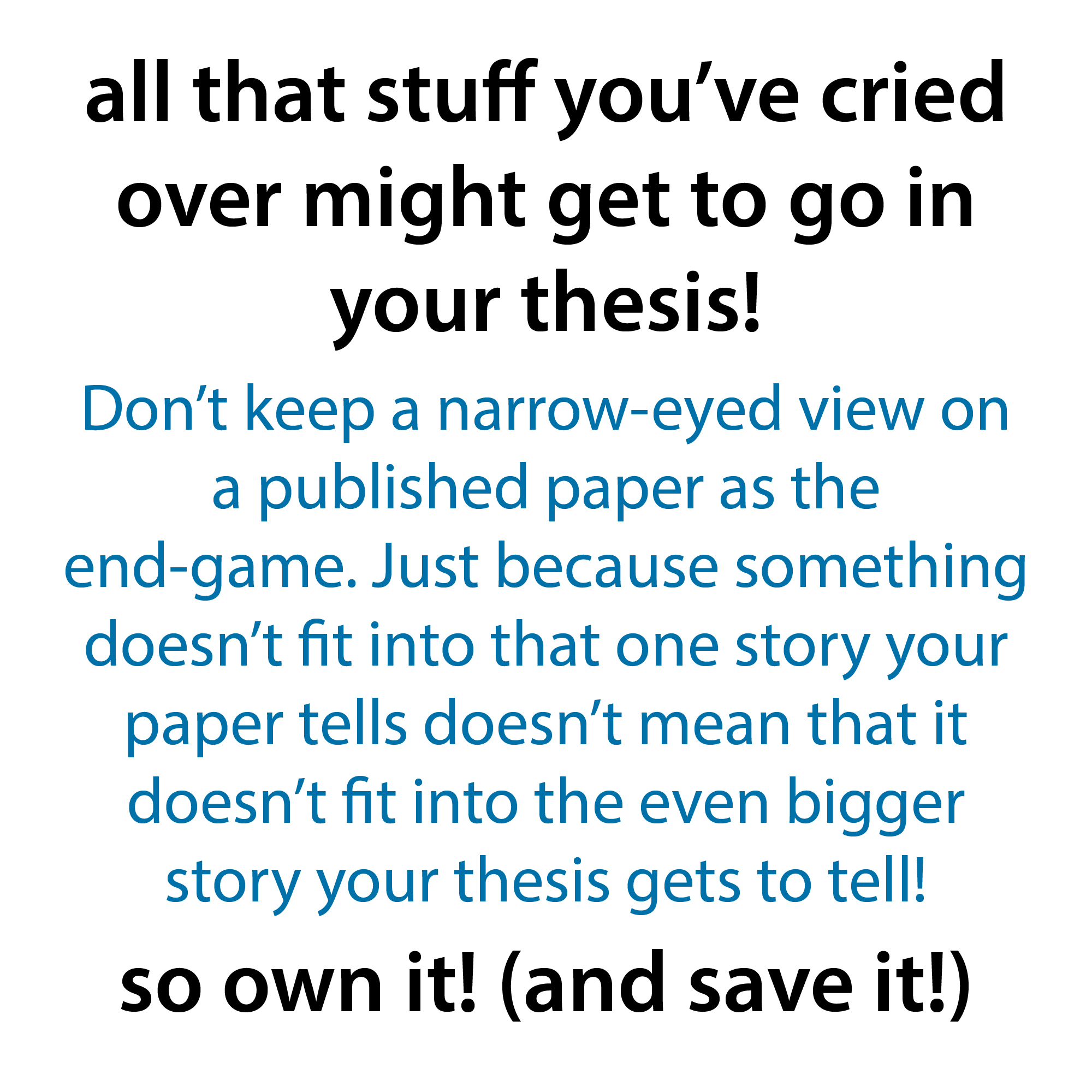
Extra note for grad school students: One of the key things to know is that a lot more gets to go into your thesis than gets to go into the paper(s) you end up publishing. You can’t put in everything you did in those 5-ish years (and don’t try to – instead try to be as concise as possible so your examiners don’t hate you), but you can put in a lot more than you can fit into a few-page journal article. Bottom line – all that stuff you had to cut out might find a home!!!!! So save everything along the way.
note: more on what the thesis is here: http://bit.ly/thesisfun but it’s basically a really long (couple hundred page) report, almost like a book that describes the research you did during grad school and how that research fits into the broader scientific picture.
Some other pieces of advice from past posts:
The main types of science writing you might encounter and have to write as a scientist include:
- Papers (journal articles)
- Abstracts (brief summaries of papers and/or posters)
- Grants/fellowship applications
- Thesis/dissertation
- Stuff for a “general audience”
Speaking of a “general audience” – one of the things I’ve found is that it’s much harder to explain things simply than it is to explain things in a complicated manner. In part because the more you simplify things, the more “careful” you have to be to not give the “wrong idea” because you can’t give all the context and nuance that your brain is itching to include. Another “in part because…” is that, once you’re so deep into the science, it can get really hard to know what “most people” know and what only those of us fortunate to have had an extensive specialized education and years in the field know. And when people say “general audience” they can really mean different things (such as a “scientific audience” – people with a strong science background just not in your field) making things confusing.
side note: please try not to say “as everyone knows…” because it can make people who don’t know feel bad. I know that some people say it because they don’t want people to think they’re talking down to the audience or anything – but always err on the side of providing too much of the simple stuff so everyone can follow along, and don’t feel like you have to justify that with saying that you know everyone knows. I think it’s a bad habit that it’s easy to fall into, especially when you’re starting out and insecure, but it can be really hard for trainees to hear when big wig scientists say it and you don’t know what they say everyone knows.
Speaking of hard – It can be hard for me to switch back and forth between my fun writing style and the formal scientific writing style. I’ve had a couple embarrassing occasions when I didn’t switch enough and got told my supposed-to-be-all-serious writing was too informal and/or conversational.
What gets even trickier is that we’re taught to simplify our language and use the active voice (e.g. we purified the protein instead of the protein was purified). Using active voice makes it easier for the audience to quickly understand who is doing what and what happens because of that (subject, action, & consequences). And it often uses fewer words with less clutter and more clarity.
But, growing up, we kinda got the impression that writing in dense passive voice made you sound more “scientific” and formal. I remember purposely writing like that throughout school to sound sciencey and smart. Also utilizing – er, I mean using – longer, more complicated words that mean the same thing as simple ones. And I’ve seen people do this in applications I’ve looked over as well, so I know I’m not alone. There definitely seems to be a disconnect between what’s officially taught and what’s practiced…
I still catch myself falling into the “write to sound smart” trap when I’m editing. And speaking of editing… I really hate editing my own stuff – in part because I usually am exhausted after finishing it and just really don’t want to look at it any more – and in part because my perfectionism kicks in and then I can never get it good enough. So it’s a lot more freeing not to try for perfection (so sorry for all my typos and stuff!)
That works okay for my informal bloggy stuff (and is soooo freeing!), but when it comes to “real” science writing, I do editing, and editing, and editing, and editing…
When I write and edit, I typically save drafts with the date and then the next day I resave with that date and the next day… this way if I make changes I end up not liking I can go back. And, importantly, I can add back in things that I had cut out. I have to do a lot of cutting out because I’ve always been one of those people who finds maximum page/word limits much harder than the minimums – when other people where increasing spacing and don’t sizes I was shrinking them to try to squeeze more in. My mom likes to tell the story of how we were assigned to write a report on an animal of our choice and I wrote a report on an animal for every letter of the alphabet…
I typically start out with a word dump just to get my ideas down without worrying about format or grammar or anything but then I have to cut a lot down and polish things up. I really really hate that part – I’m also one of those people who as a kid in school would do 99% of a project as soon as it was assigned and then, right before the due date, realize I’d never actually finished it…
On a related note; the reason I did that whole A to Z animals thing was because I finished the first one right away and needed more to do. I finished it so quickly because even then, I had this tendency to work in spurts of “inspiration” and productivity. I think I might be more flow-prone than other people – I seem to enter the flow state a lot – especially when I’m writing. The rest of the world fades away and the words and thoughts just flow. Then I snap out of it, often exhausted – and definitely not in the mood to edit… When editing is necessary, I find it really helpful to sleep on it and approach it with fresh eyes. Even then it’s really hard to edit my own stuff because I tend to read it how I intended it even if that’s not how I actually wrote it – it’s so hard to catch your own typos! It’s also hard to “give up” parts you like even though it’s for the better. I just get really attached to my work – especially when I’ve spent a ton of time on it. And I’ve had some really rough experiences being told my stuff is too long and I need to cut it down before anyone would even look at it. So then struggling to trim it down and worrying I cut out important stuff but no one would ever know…
I keep multiple copies of drafts when I work on papers and reports – I usually save them daily with the name underscore date. Eg. PR5_112020 for the draft of my 5th progress report which I edited on November 20, 2020. I usually end up writing way too much and cutting some out, but by saving multiple drafts I still have that final-draft-deleted content which might come in handy.
A lot of times, scientists seem to use long words and complex phrasing to try to sound smarter or more scientific (I know I’ve been guilty of this in my science writing, so tend to go probably too far opposite for my blogging!). But style guides actually encourage you to use simpler words and use the active voice (e.g. “we pipetted the liquid into tubes”) instead of the passive voice (e.g. liquid was pipetted into tubes”).
Another English thing I wish I’d been better about when first writing drafts of theses, etc. – citations go before punctuation!
I found the NCBI Style Guide really helpful. Especially Chapter 3: Grammar Reminders and a Little Technical Writing https://www.ncbi.nlm.nih.gov/books/NBK993/ and Chapter 5: Style Points and Conventions https://www.ncbi.nlm.nih.gov/books/NBK995/#A262
Recommended reading: Gastel, B., Day, R. A. (2022). How to Write and Publish a Scientific Paper.