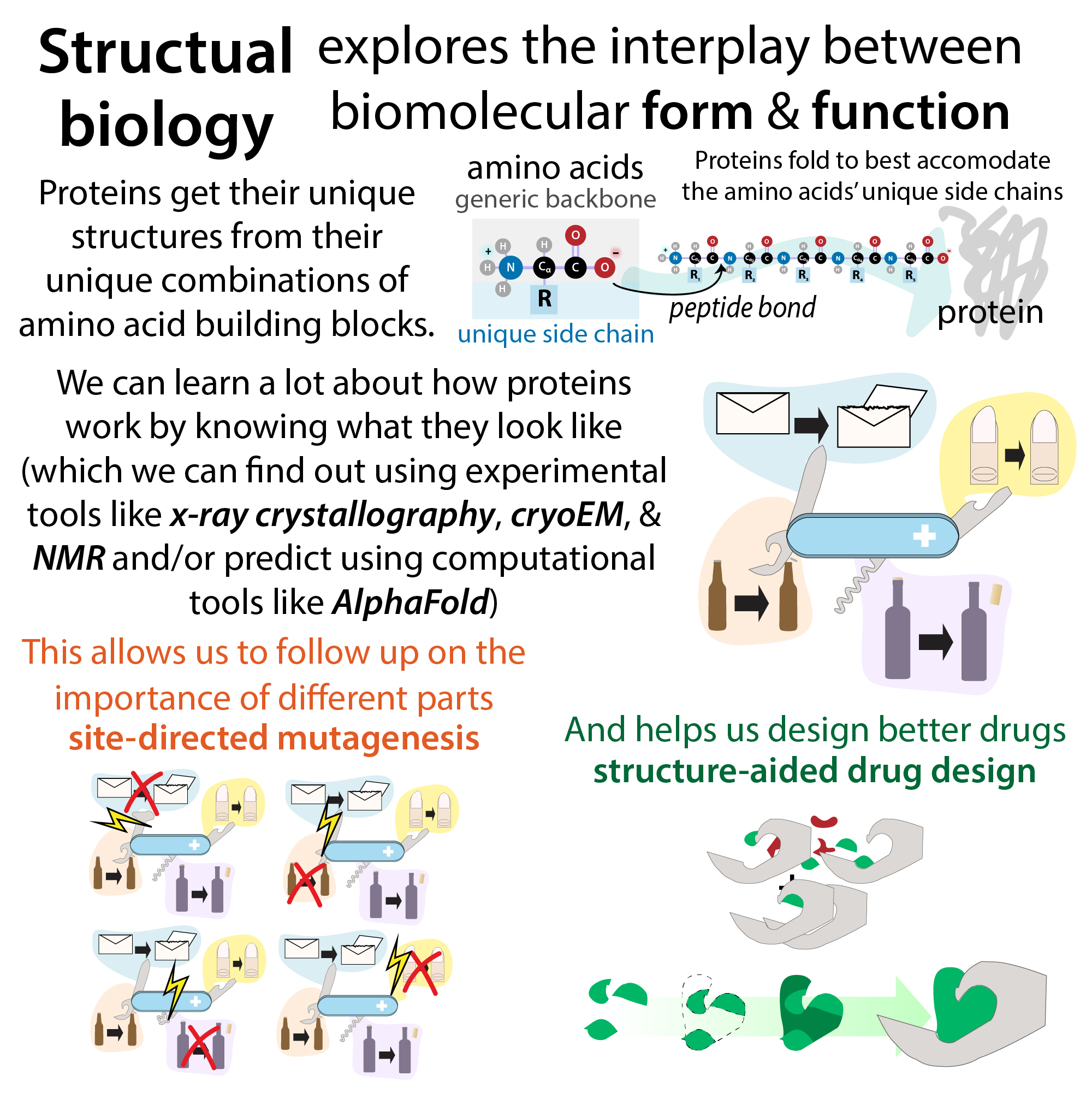
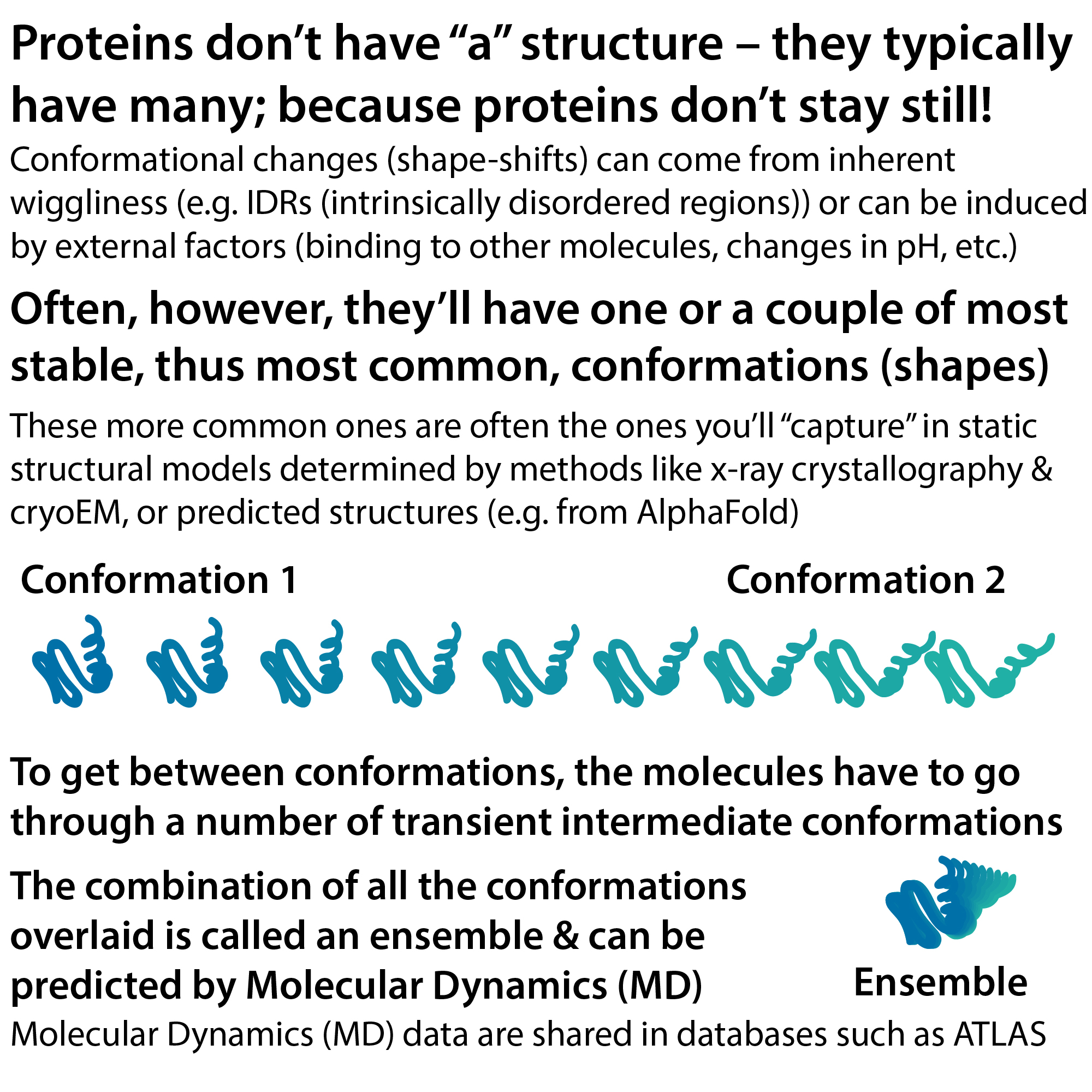
Proteins don’t have “a” structure – they typically have many; because proteins don’t stay still! Conformational changes (shape-shifts) can come from inherent wiggliness (e.g. IDRs (intrinsically disordered regions)) or can be induced by external factors (binding to other molecules, changes in pH, etc.).
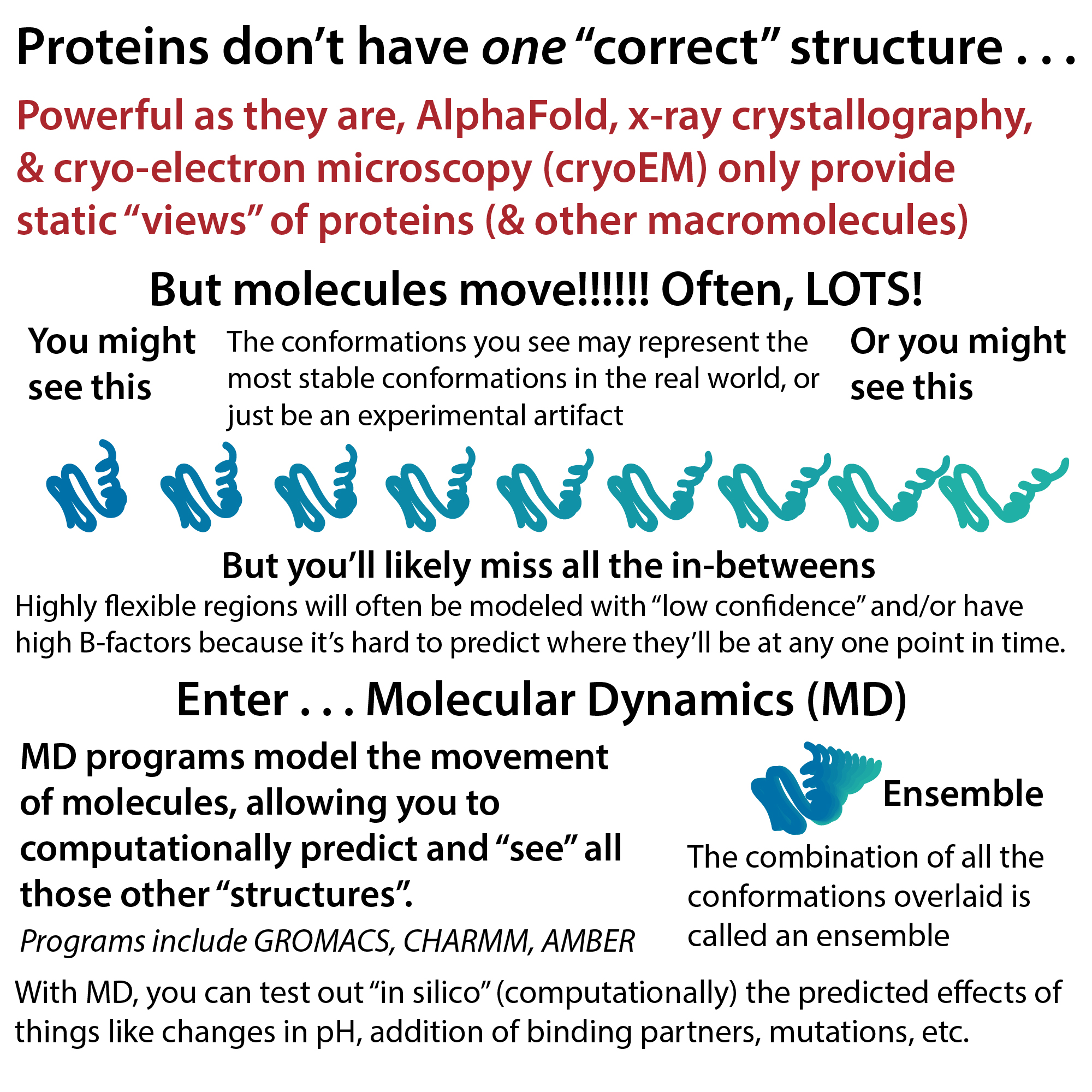
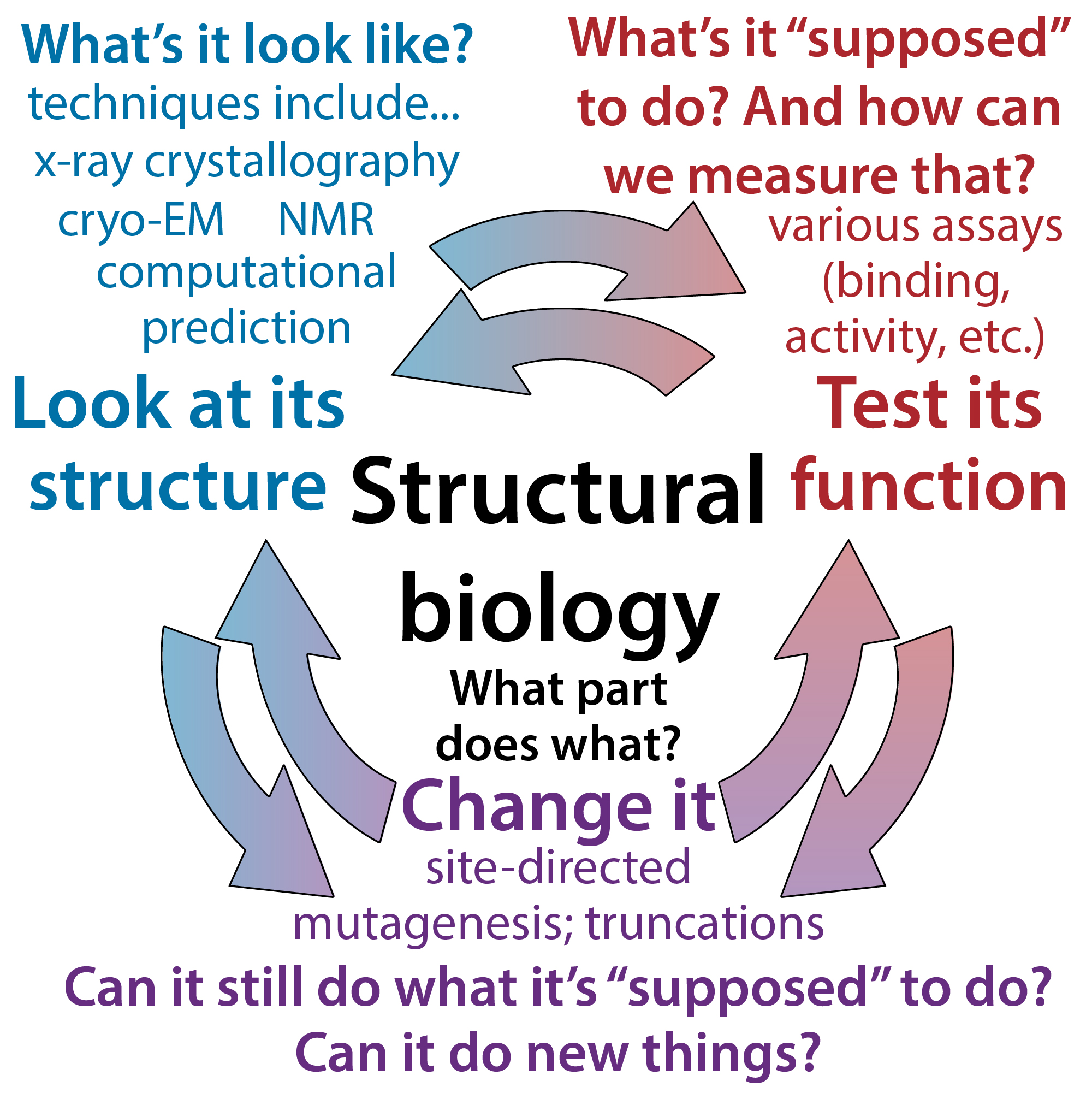
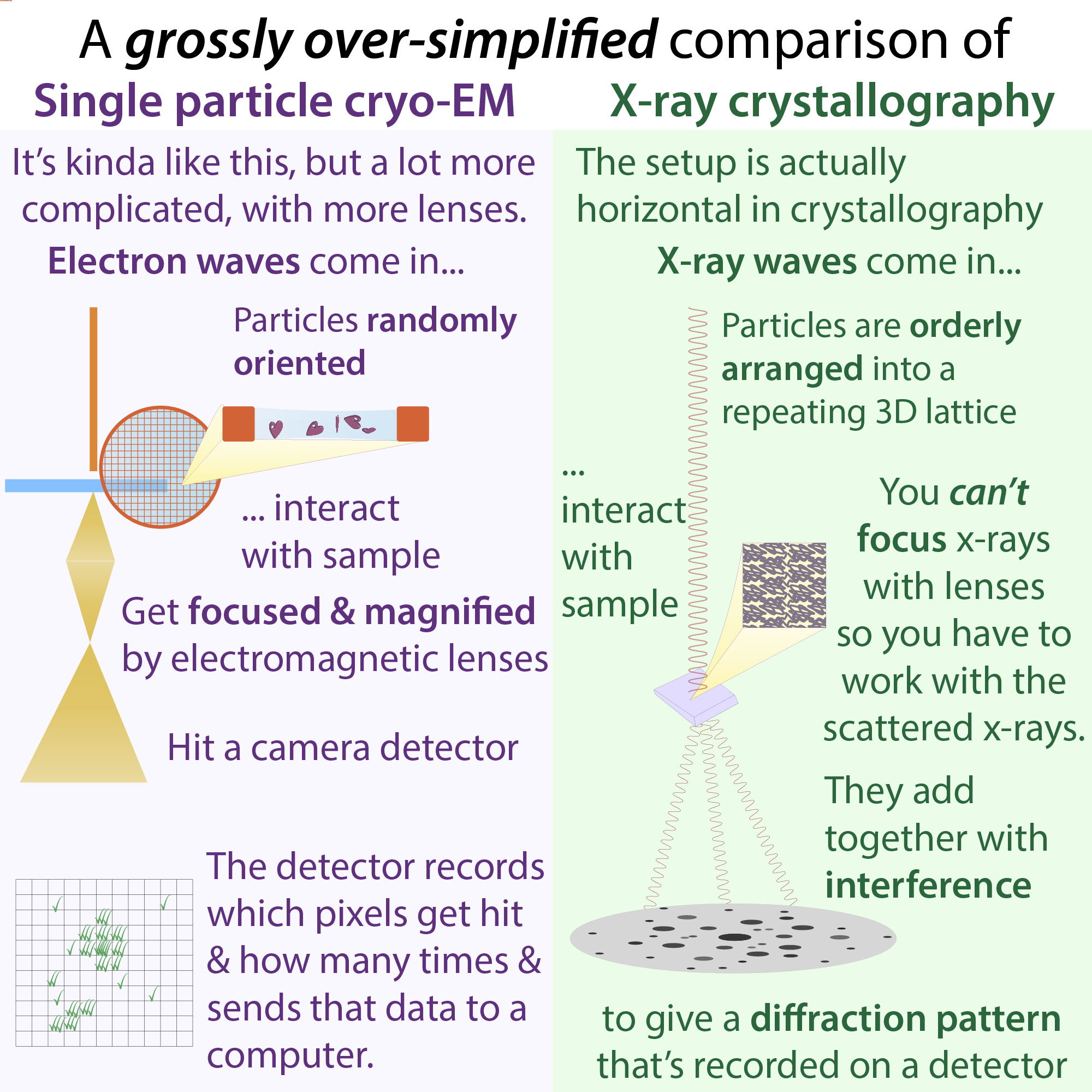
Powerful as they are, AlphaFold, x-ray crystallography, & cryo-electron microscopy (cryoEM) only provide static “views” of proteins (& other macromolecules). But molecules move!!!!! Often, LOTS!
Often, however, proteins have one or a couple of most stable, thus most common, conformations (shapes). These more common ones are often the ones you’ll “capture” in static structural models determined by methods like x-ray crystallography & cryoEM, or predicted structures (e.g. from AlphaFold). To get between conformations, the molecules have to go through a number of transient intermediate conformations, which you don’t see.
The combination of all the conformations overlaid is called an ensemble & can be predicted by Molecular Dynamics (MD). Molecular Dynamics (MD) data are shared in databases such as ATLAS
Powerful as they are, AlphaFold, x-ray crystallography, & cryo-electron microscopy (cryoEM) only provide static “views” of proteins (& other macromolecules). But molecules move!!!!! Often, LOTS!
The conformations you see may represent the most stable conformations in the real world, or just be an experimental artifact
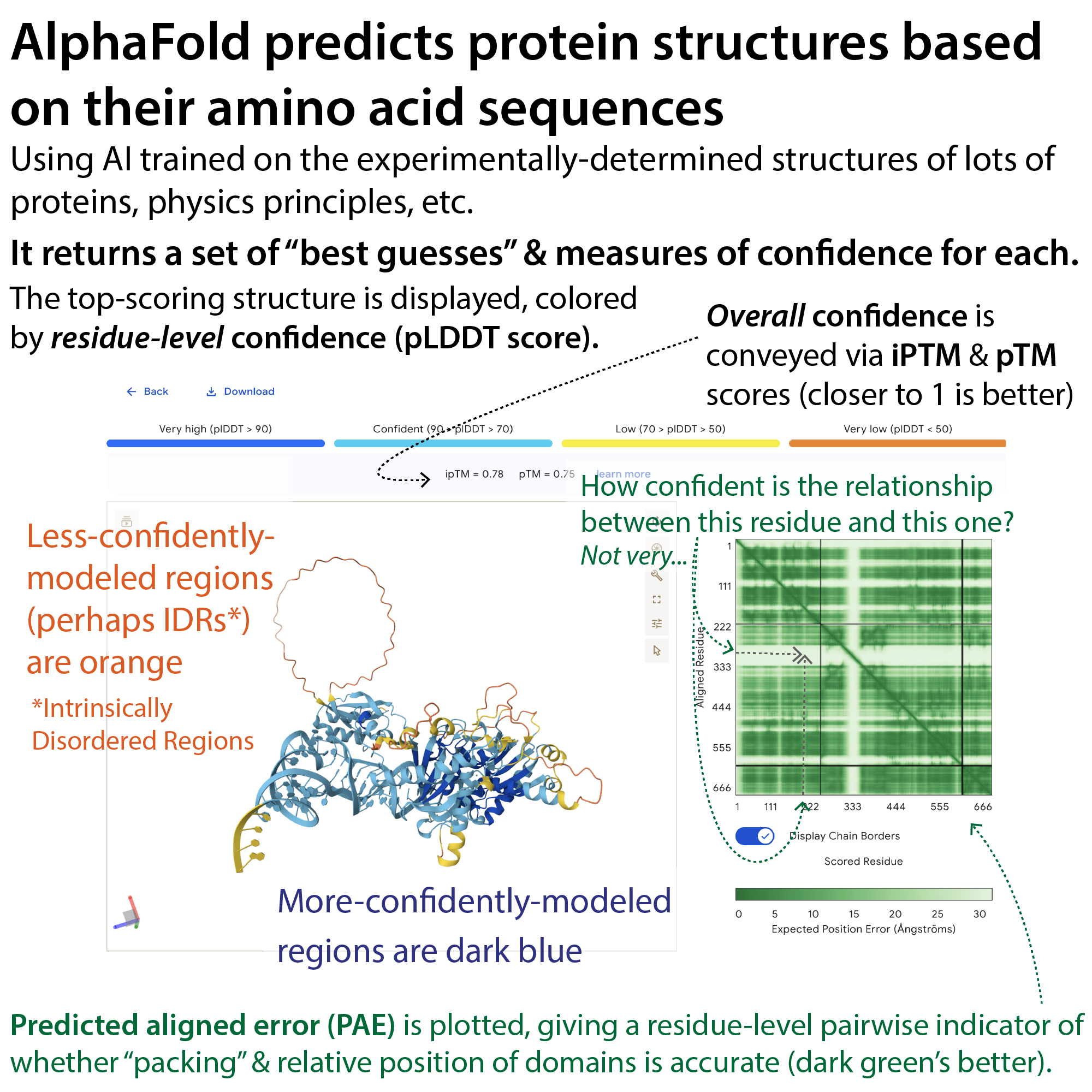
Highly flexible regions will often be modeled with “low confidence” and/or have high B-factors because it’s hard to predict where they’ll be at any one point in time.
Enter… Molecular Dynamics (MD). MD programs model the movement of molecules, allowing you to computationally predict and “see” those other “structures”. With MD, you can test out “in silico” (computationally) the predicted effects of things like changes in pH, addition of binding partners, mutations, etc. Programs include GROMACS, CHARMM, AMBER.
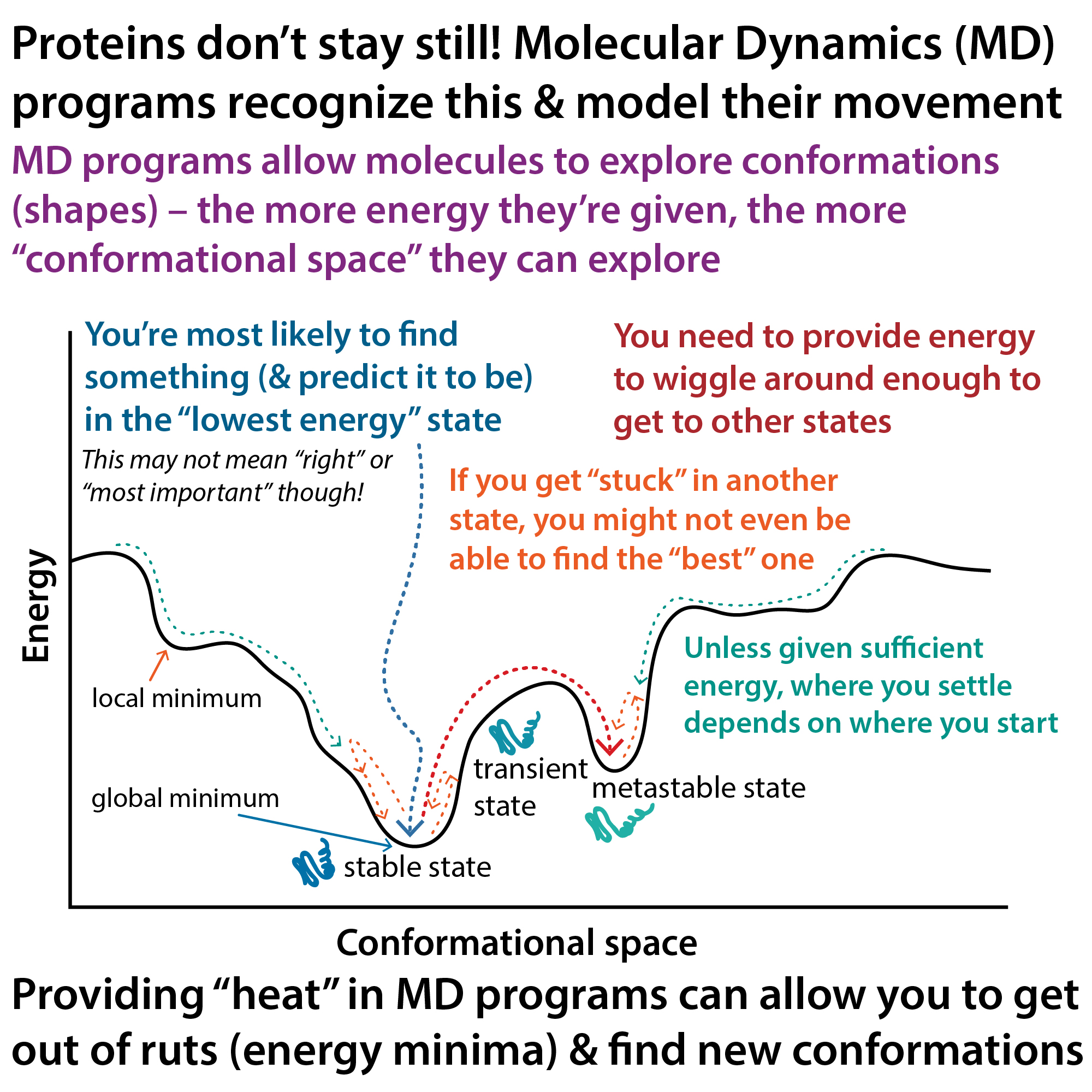
MD programs allow molecules to explore conformations (shapes) – the more energy they’re given, the more “conformational space” they can explore. You’re most likely to find something (& predict it to be) in the “lowest energy” state (This may not mean “right” or “most important” though!). You need to provide energy to wiggle around enough to get to other states. If you get “stuck” in another state, you might not even be able to find the “best” one and unless given sufficient energy, where you settle depends on where you start. Providing “heat” in MD programs can allow you to get out of ruts (energy minima) & find new conformations.
But remember, predictive tools are just that – predictive. Molecular modeling’s real strength is in allowing for hypothesis generation. Follow up at the bench!
I also want to note that NMR can be good for showing dynamics as well, experimentally though, but it only works on small proteins or peptides or protein parts and requires a lot of sample. But, its results can help parameterize MD programs.
For more on MD:
Hollingsworth, S. A.; Dror, R. O. Molecular Dynamics Simulation for All. Neuron 2018, 99 (6), 1129–1143. https://doi.org/10.1016/j.neuron.2018.08.011.
Read, R. J.; Baker, E. N.; Bond, C. S.; Garman, E. F.; van Raaij, M. J. AlphaFold and the Future of Structural Biology. IUCrJ 2023, 10 (4), 377–379. https://doi.org/10.1107/S2052252523004943.
Vander Meersche, Y.; Cretin, G.; Gheeraert, A.; Gelly, J.-C.; Galochkina, T. ATLAS: Protein Flexibility Description from Atomistic Molecular Dynamics Simulations. Nucleic Acids Res 2024, 52 (D1), D384–D392. https://doi.org/10.1093/nar/gkad1084.
Cui, X.; Ge, L.; Chen, X.; Lv, Z.; Wang, S.; Zhou, X.; Zhang, G. Beyond Static Structures: Protein Dynamic Conformations Modeling in the Post-AlphaFold Era. Brief Bioinform 2025, 26 (4), bbaf340. https://doi.org/10.1093/bib/bbaf340.
PRACE 2021 Autumn School: Fundamentals of Biomolecular Simulations and Virtual Drug Development, Presenter: Prof. Anela Ivanova, Sofia University, Hosted by NCSA (the Bulgarian National Center for Supercomputing Applications) and organised jointly with BioExcel, STFC, Sofia University, Astra Zeneca, and Nostrum Biodiscovery https://youtu.be/nIvsM8_GGlc?si=oBZshX_v1zM1MbaN
More on structural biology: https://bit.ly/structural_biology & https://youtube.com/playlist?list=PLUWsCDtjESrGhwVxsRbTJdL-BEsN60RCs
More about IDRs: https://bit.ly/IDRsandIUPred
More about AlphaFold: https://thebumblingbiochemist.com/365-days-of-science/interpreting-alphafold-predictions/