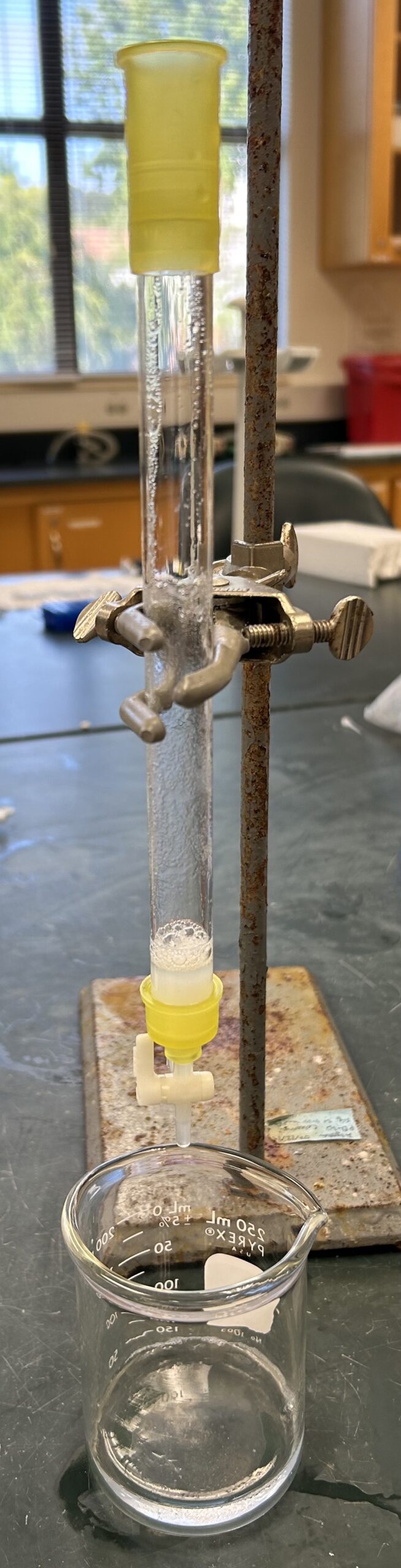
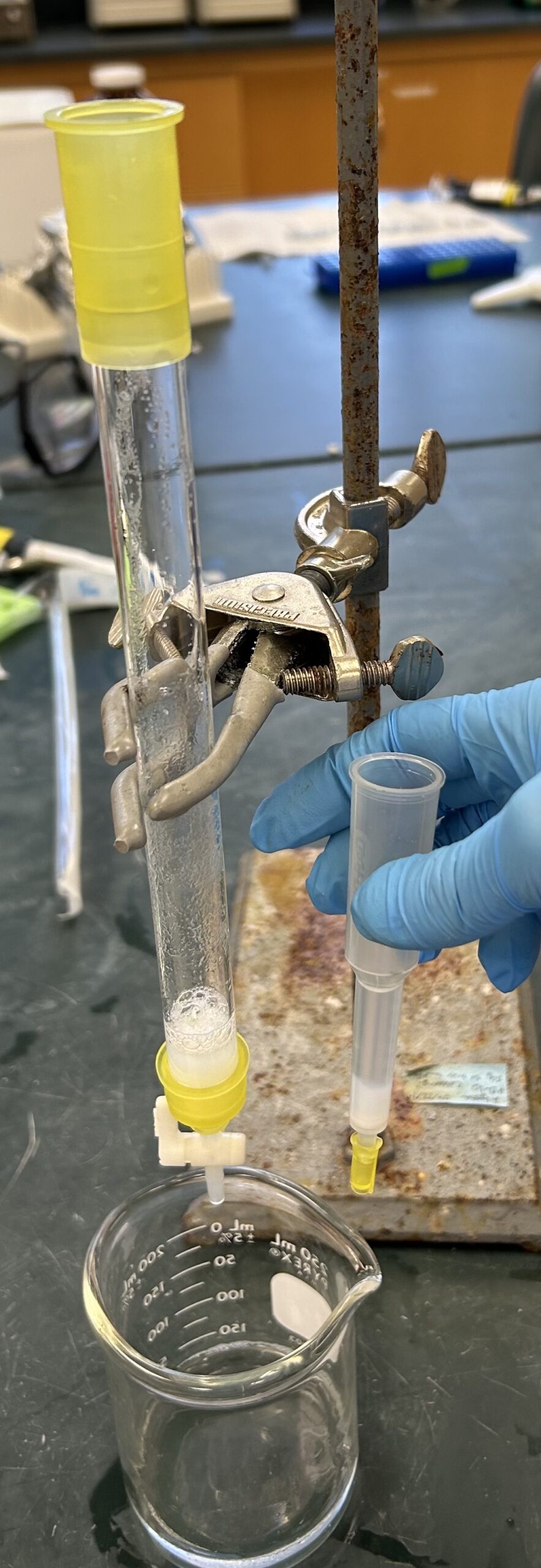
As a biochemist, you might have thousands of CVs! CV as in “column volume” that is! For affinity chromatography, this typically refers to the “packed bed volume” – how much resin is in the tube you’re flowing protein through. It’s important to note that, when you’re packing your own columns, this is *not* the volume of stuff you pipet out of the bottle – instead that’s typically a slurry of resin & storage solution (often at a 50% or 75% mixture). Let me step back and explain…
The most commonly-used method to purify proteins is column chromatography, where we flow a solution containing our protein of interest (and other proteins we want to separate our protein from) through a column (glass or plastic tube) filled with resin (itty bitty beads). You can get and use different types of resin with different properties that will make them interact differently with different proteins. The proteins will interact with the resin to different extents as they flow through (bind tightly, bind loosely, not bind), so they will travel through the column differently and come out the bottom (elute) at different times and/or under different conditions. You can collect the elution in small portions (fractions), thereby isolating separated proteins.
The amount of resin in the column will influence the amount of protein that can be bound, as well as how fast the liquid will flow (which also depends on the column diameter and solution viscosity (goopiness). This “amount of resin” is often referred to as the “packed bed volume” or the “column volume” (CV)****. It’s an important number to know because it will influence how much liquid you use for your washes, etc. For example, your protocol might have you wash your column with 10 CV of wash buffer. If your CV was 1 mL, this would be 10 mL. If your CV was 0.5 mL, this would be 5 mL.
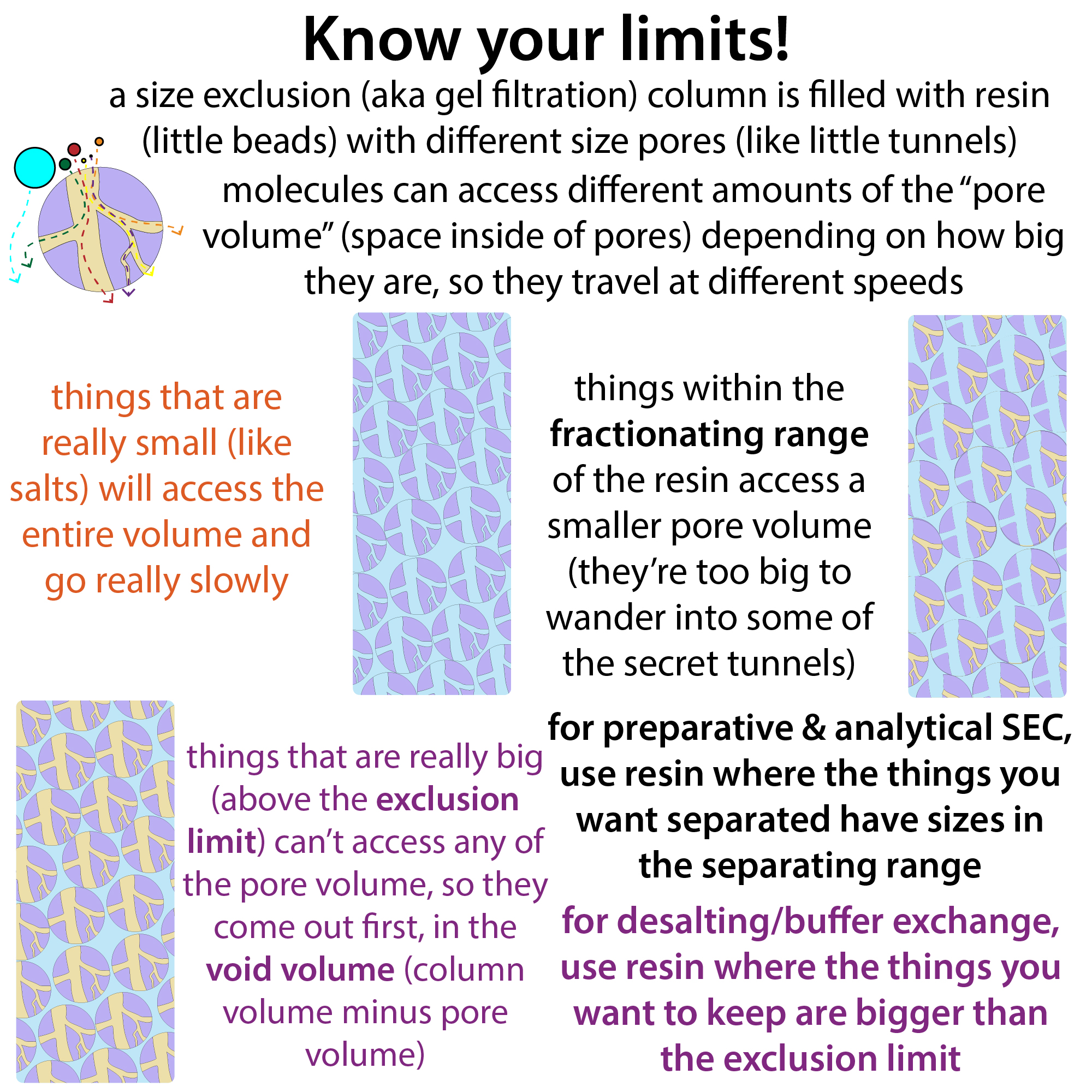
*****note: I’m going to be talking about CV as it’s used to discuss things like affinity chromatography & ion exchange chromatography, where your protein is sticking to the beads. CV is more complicated for things like size exclusion chromatography (SEC), where the liquid flows *through* the beads. There, the CV might refer to the volume of liquid in the column, not the volume of the beads
If you buy a pre-packed column (such as those for use with an AKTA), you don’t need to worry about figuring out the CV – the column (and/or its product info) should tell you. But, if you pack your own columns (such as for gravity flow methods), you will have to choose your CV at a more granular level (taking into account how much protein you expect to have, how much protein the resin can hold (binding capacity) and how much volume you have (which will influence how long it will take for all the molecules to bump into resin & bind).
Once you’ve determined the amount you want, you’ll need to equilibrate that much resin in the buffer you want to bind in. So you go get the bottle, and then what? You need to know how much of the resin to actually pipet into your column (or tube if you’re equilibrating in batch mode). To know this, you need to know how much of what’s in the bottle is resin and how much is storage solution. If it’s a new bottle, you can find out from some Googling or product info sheets.
Ni-NTA resin, for example, is often sold as a 50% slurry. This means that for every mL you pipet out, only 0.5 mL is actually resin. So you need to pipet out 2X more than the CV you want (e.g. 2 mL for a 1mL CV). The glutathione-sepharose resin I’m using is a 75% slurry, so I have to pipet 1/.75 = 1.3X more than the CV I want (e.g. 1.3 mL for a 1 mL CV).
In order for that to be true though, you need to mix the slurry well before you pipet out (the resin settles to the bottom of the tube)
If you don’t know the slurry percentage, you can measure/estimate it by mixing the slurry, transferring some to a graduated cylinder (or a falcon or eppendorf tube if you just need a rough estimate), letting the resin settle, and then reading out the packed & total volumes (% slurry = packed volume/total volume)
You can also pipet slurry into a column, let it pack as the liquid flows out, then calculate the volume based on the column diameter and bed hight. To make things easier for the next time, you can also mark lines on the column representing common column volumes (1 mL, 5 mL, etc.)
more on resin slurry calculations if you need to be really precise: https://www.cytivalifesciences.com/en/us/solutions/bioprocessing/knowledge-center/how-to-determine-resin-slurry-concentration
Typically, resin can be regenerated and reused (look to product manuals for recommended protocols), and when you do this, not the slurry concentration when you store your cleaned resin to make things easier for the next time. Also note what protein you used it for an ideally only use it again with that same protein to avoid cross-contamination.
lots more on protein purification: http://bit.ly/proteinpurificationtech & https://youtube.com/playlist?list=PLUWsCDtjESrEtqQkEXsQpTyRfMhywBVQ7
more about all sorts of things: #365DaysOfScience All (with topics listed) 👉 http://bit.ly/2OllAB0 or search blog: https://thebumblingbiochemist.com