
Here’s an overview of what I feel are the key biochemistry equations to know (including thermodynamics, Henderson-Hasselbalch, and Michaelis-Menten). I recommend trying to get to the point where you don’t need an equation sheet (or Google) for these, those should just be a failsafe in case you blank. I think it’s more important to know the concepts the equations encompass, be able to see where these concepts come from, be able to interpret the equations’ implications, and know how to use the equations as tools, than having memorized something you can easily Google. But of course, you will need to memorize them if your class requires it!
link to document form: https://bit.ly/keybiochemequationguide
Bioenergetics and thermodynamics
Generic formula for an equilibrium constant (Keq, or simply K) – this relates the concentrations of products & reactants at equilibrium
For the generic reaction
aA + bB ⇌ cC + dD

Where those are the concentrations at equilibrium
Why it’s important to know
- Forms of it will show up everywhere! (Ka, Kd, etc.)
- It will allow you to recognize that the equilibrium constant will be >1 if products are thermodynamically favored, <1 if reactants are favored
- You’ll need it for the Gibbs calculations
Generic formula for a mass-action ratio, aka reaction quotient (Q) – this relates the actual concentrations of products & reactants
For the generic reaction
aA + bB ⇌ cC + dD

Sometimes this is abbreviated as [products]/[reactants], but remember you need to take stoichiometry into account and multiply, not add, if you have multiple reactants and/or products
Why it’s important: You’ll need this for the Gibbs free energy calculations
Gibbs free energy change
- if ΔG is positive, the reaction is thermodynamically unfavorable
- if ΔG is negative, the reaction is thermodynamically favorable
- if ΔG is 0, the reaction is at equilibrium
| ΔG = ΔH-TΔS Why it’s important to know It will allow you to see how entropy, enthalpy, and temperature contribute to whether a reaction is thermodynamically favorable |   |
Standard free energy change
Technical note: In biochemistry, we often use the terms ΔG° & ΔG’° (also can be written as ΔG’°) interchangeably, but there is a formal distinction (so apologies in advance if I slip up).
- ΔG° = standard free-energy change (physical constant of a reaction) – under chemistry definitions of standard state
- the standard state in chemistry is defined as: all reactants and products at 1M concentrations (1 atm for gasses) & temperature = 298 K (25°C)
- ΔG’° = standard transformed free-energy change (physical constant of a reaction) – under biochemistry definitions of standard state
- the standard state in biochemistry is defined as: pH 7.0 ([H+] = 10-7 M); [H2O] is 55.5 M; [Mg2+] is 1 mM
- Why? Biochemical reactions don’t take place under chemistry-defined standard conditions, where pH = 0!!! Our reactions take place in pH-buffered aqueous solutions where pH is closer to 7 and water is everywhere! But even the biochemistry-defined “standard conditions” are much different from reality, hence, you will have to account for this in your calculations of ΔG as defined below
- For simplicity, I will simply be referring to this as standard free-energy change
- the standard state in biochemistry is defined as: pH 7.0 ([H+] = 10-7 M); [H2O] is 55.5 M; [Mg2+] is 1 mM
- ΔG = actual free energy change under the given conditions (a very important concept in biochemistry is that the concentrations of products and reactants (which can be controlled) greatly influences free energy change and thus favorability!)
ΔG’° = –RT ln K’eq
Why it’s important to know
- It will help you recognize that if products are favored at equilibrium, ΔG’° will be negative. And the more the products are favored (larger the K’eq), the more negative it will be
- You’ll need it below
Actual free energy change
ΔG = ΔG’° + RT lnQ
This is why I want you to know Q!
Sometimes this is written as
ΔG = ΔG’° + RT ln([products]/[reactants])
but remember the warning I gave when I introduced Q
If you know these, you can now rewrite this formula in various ways, including:
ΔG = -RT ln K’eq + RT lnQ
ΔG = -RT(ln K’eq – lnQ)
ΔG = -RTlnK’eqQ
Now, you can hopefully see that:
- If Q > K’eq, ΔG will be positive -> reaction will be driven towards reactants to reach equilibrium
- If Q < K’eq, ΔG will be negative -> reaction will be driven towards products to reach equilibrium
- If Q=K’eq, ΔG will be 0 -> reaction is at equilibrium -> no net change in concentrations of products or reactants
Acids, bases, etc.
pH = log 1[H+] = -log[H+]
Recognize that if [H+] is high, pH is low and vice versa
pKa = log 1[Ka] = -logKa
Why this is important to know
- It lets you recognize that if Ka is high (deprotonation is favored), pKa is low and vice versa -> the stronger the acid, the higher the Ka, and thus the lower the pKa
- You will need it for the Henderson-Hasselbalch equation, which will allow you to do things like figure out what proportion of an acid will be protonated or deprotonated at a given pH, which will be super handy
Note: Ka is just the equilibrium constant for an acid, sometimes called the acid dissociation constant
Henderson-Hasselbalch equation
pH = pKa + log [A-][HA] Why this is important to know It allows you to go between pH and pKa, doing things like:figuring out the pH of a solution given concentrations of acid and basefiguring out how much of an acid is deprotonated at a given pH (super important for when thinking about what protonation state amino acids have &, therefore, how they might react!) |  |
Enzyme kinetics
Michaelis-Menten equation
| v = Vmax[S]Km + [S] Why this is important to know It lets you see that…If [S] is very low compared to Km, the [S] in the denominator becomes insignificant, so this simplifies to v = Vmax[S]/KmIf [S] is very high compared to Km, Km becomes insignificant, so this simplifies to v = VmaxWhen v = ½ Vmax, Km = [S]Since Km is on the bottom, the higher Km is, the lower v is and vice versa It will allow you to do calculations to find rates of enzymatic reactions Note: the “v” we’re talking about here is technically “vo”, the initial velocity (before the enzyme runs out of substrate, etc.) |  |
Derivations at end
kcat = Vmax/[Et]
kcat is aka the turnover number and it is corresponds to how many substrate molecules a single copy of an enzyme can convert to product in some given unit of time if it is saturated with substrate; it’s the rate constant for the slowest step
So you can rewrite the MM equation as:
v = kcat[Et][S]Km + [S]
See that the faster the enzyme can work (higher the kcat), the faster the reaction will be at any given total enzyme concentration [Et] & [S]
See that a “better” enzyme would have a high kcat and a low Km – BUT this doesn’t tell you anything about specificity, ability to regulate it etc. which are often what makes a really great enzyme in vivo!
Derivations


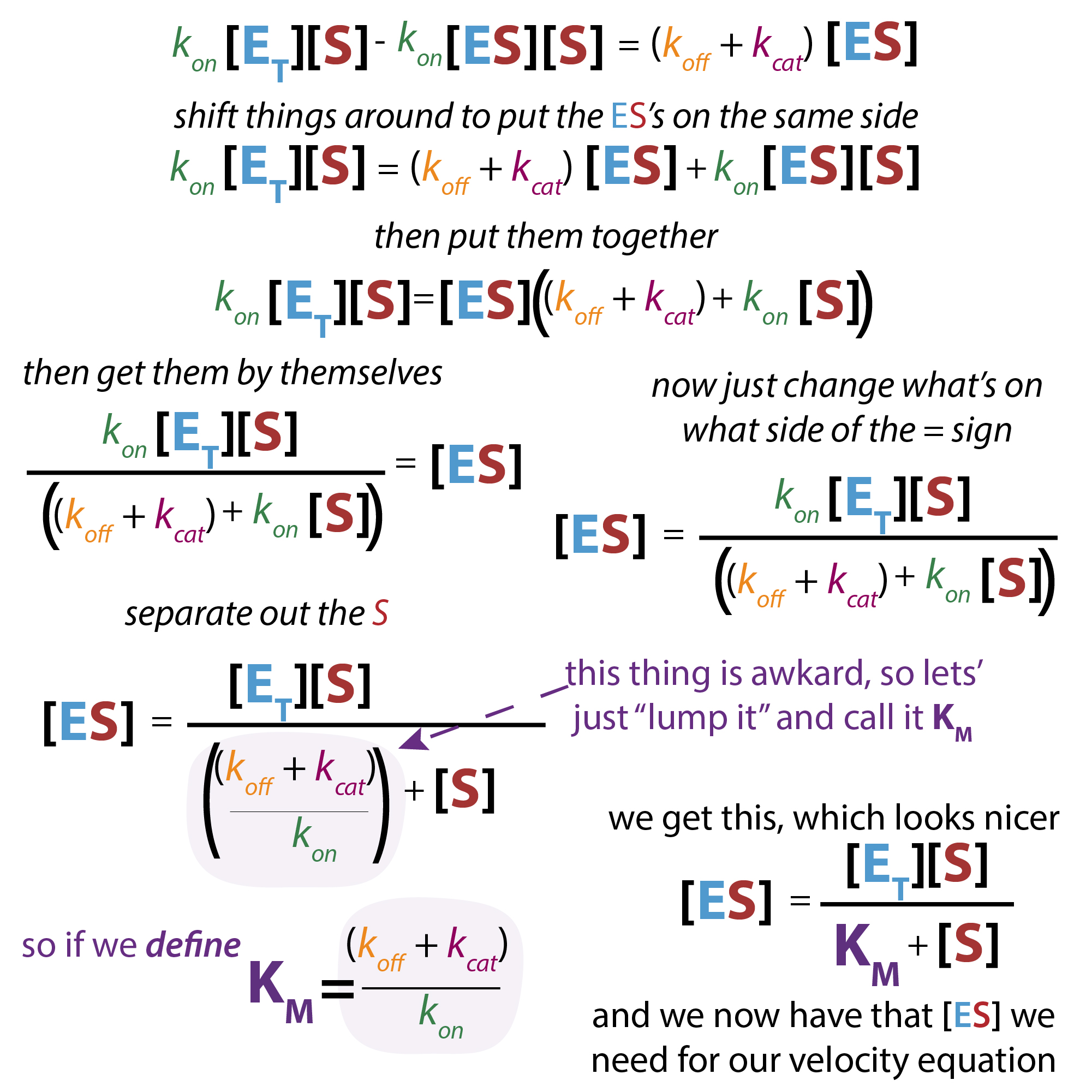


How do we measure it experimentally?

interesting article on Km: The meaning of the Michaelis-Menten constant: Km describes a steady-state. Enric I. Canela, Gemma Navarro, José Luis Beltrán, Rafael Franco. bioRxiv 608232; doi: https://doi.org/10.1101/608232
more on thermodynamics: https://bit.ly/thermodynamicstalk & http://bit.ly/partypopperscience & https://youtu.be/oX0KAJWnuog
more on pH, pKa, and the Henderson-Hasselbalch equation: http://bit.ly/phbuffers YouTube: https://youtu.be/VRJV2FTOUeM
more on Michaelis-Menten kinetics: https://bit.ly/maudmenten ; YouTube: https://youtu.be/BUIUKSlx2wY
