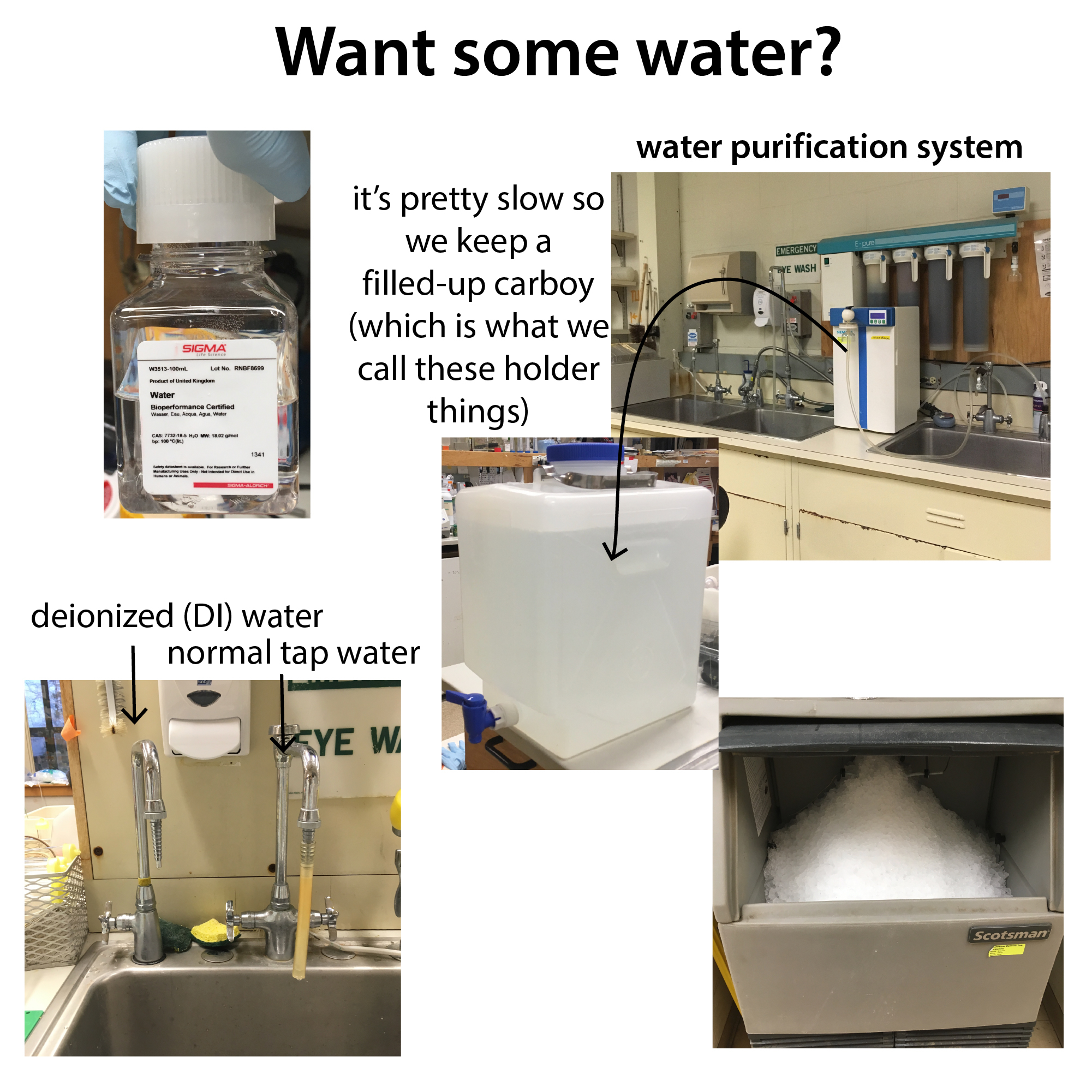
Which water’s which?????
- DI water or diH2O: deionized water – if a sink has 2 spigots, this is often the one on the left; they typically make it by passing the water through charged resin (little beads); it gets rid of ions (charged particles) but DOES NOT sterilize it or remove other impurities
- dH2O: distilled water – “intermediate-purity” water; made by heating water up so it boils, then collecting the boiled water (taking advantage of the fact that impurities will have different boiling points) – DOES sterilize (at least until you stick the water in a container!)
- ddH2O: doubly-distilled water – even purer water – has been through that above distillation process twice
- note: often used to refer to other super-purified water, such as MilliQ, even though milliQ uses filters not distillation
- RO: reverse osmosis – another form of water purification
- “MilliQ water” – water that’s been through a thorough “in house” filtration system (sometimes referred to as a polisher)- labs often have these filters installed but they’re slow so we often fill up carboys (like those tanks of Gatorade at sports games) with MiliQ water and get it from there instead
- if you need the water super duper pure, take it straight from the MilliQ instead of the carboy (which could be contaminated with RNases, etc. – also beware mold on the spigot!)
- similar to ddH2O, sterile initially but if you really need sterility, autoclave it
- NF-H2O, nfH2O – nuclease-free water: if its nucleases (e.g. RNases) you’re most concerned about, autoclaving as-is won’t do the trick,. If you just need a small volume, buy molecular grade/ultrapure water that’s guaranteed nuclease free. If you need a larger volume, you can treat with DEPC, then autoclave
- note: some of the by-products of DEPC autoclaving can inhibit various enzymes, so it’s typically safest to get the non-DEPC-treated nuclease-free water
- bottom line – you’re typically safe using MilliQ, and that’s what we use for most things, but we typically use that nfH2O for working with small volumes of nucleic acids (for resuspending PCR primers, etc.) & autoclave it when sterility is a key concern
Technical notes on types:
- sometimes you might see water talked about in terms of conductivity (how well the water conducts electricity) or resistivity (how well the water prevents the flow of electricity)
- electricity is the flow of ions, so the more ions there are in the water, the higher the conductivity (and lower the resistivity)
- the more thorough the deionization, the lower the conductivity/higher the resistivity
- ultra pure water has a resistivity > 18MΩ-cm and conductivity < 1 µS/cm
- electricity is the flow of ions, so the more ions there are in the water, the higher the conductivity (and lower the resistivity)
- you might also see water purity talked about in terms of total organic content (TOC)
- since microbes are organic, their presence will increase TOC
- if the TOC is really really low, there likely aren’t any microbes present
- there are actual official water quality types (1/2/3/4) with criteria for conductivity, resistivity, & TOC that must be met for each – based on American Society for Testing and Materials (ASTM) definitions https://www.astm.org/d1193-99e01.html
- Type 1 ultrapure: Milli-Q or similar polishing – use for molecular biology experiments (working w/nucleic acids, etc.), doing sensitive measurements, etc.
- Type 2 pure: deionized – can use for non-critical buffer making, etc.
- Type 3: second-lowest-grade, w/slightly better specs than type 4, purified only by reverse osmosis (RO) or similar, basically just use for dish washing, etc.
- Type 4: least-pure, purified only by reverse osmosis (RO) or similar, basically just use for dish washing, etc.
- more here: https://techsafety.com/blog/water-type-differences
more on RNases: https://bit.ly/rnaseadepc & https://youtu.be/yxZRE5L7Dms
more on autoclaves: https://bit.ly/autoclavessteam
more on osmosis: https://bit.ly/osmolarityandmore & https://youtu.be/RNu1vX8Mg18