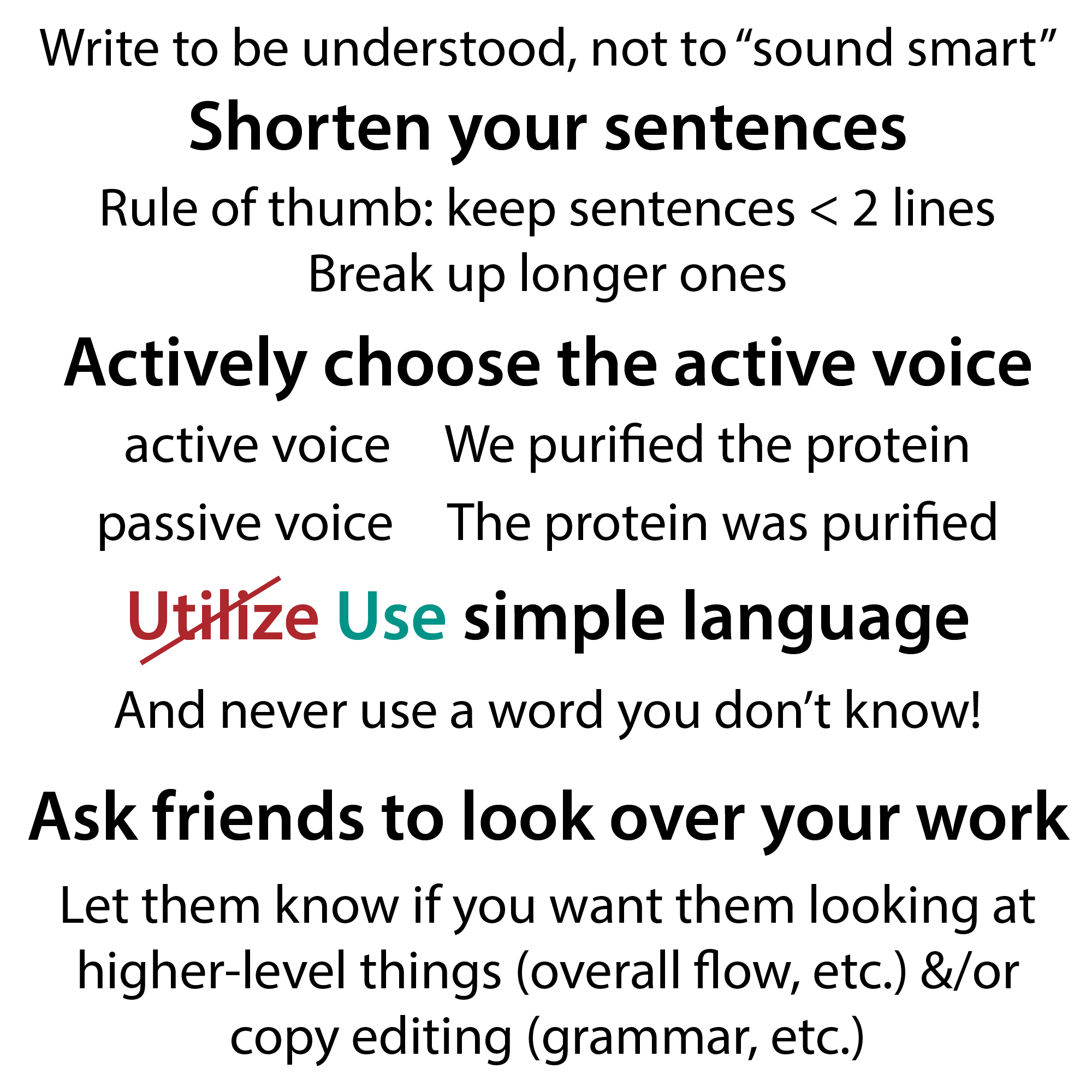
- Shorten your sentences – try to keep sentences shorter than 2 lines
- Go through your writing and if you see ones that are longer, try to break them up
- PS. Huge thanks to Dr. Leemor Joshua-Tor for giving me this advice in grad school!
- Simplify your word choices – don’t use complicated and/or awkward words just because they “sound smarter”
- Never use a word you don’t know
- Lay things out logically
- Include transitions
- Simplify your word choices
- for example… use “use” instead of “utilize”
- Short and sweet can still be scientific
- Don’t use a large number of unnecessary words, when a single one will do the trick 🙂
- for example… use “conflicted” instead of “were in conflict”
- Cut out any “fluff” words
- for example… use “conflicted” instead of “were in conflict”
- Don’t use a large number of unnecessary words, when a single one will do the trick 🙂
- see:
- NCBI Style Guide, Chapter 3: Grammar Reminders and a Little Technical Writing https://www.ncbi.nlm.nih.gov/books/NBK993/
- Gastel, B., Day, R. A. (2022). How to Write and Publish a Scientific Paper. Appendix II
- Use active voice, rather than passive voice, when possible
- e.g. “We found that…” rather than “It was found that…”
- Makes things less wordy
- Makes things easier to follow
- Makes things more “exciting”
note: be sure to check with your instructor if applicable because some might not like this
- Use past tense to discuss conducting experiments
- e.g. We ran an SDS-PAGE gel
- Describe your results & what’s where in present tense
- e.g. Figure 1 shows the gel results
- e.g. The gel scan shows a single band
- Use present tense to discuss generally-accepted knowledge
- e.g. DNA is double-stranded
- Use past tense to discuss experimental findings not yet at that “dogma” point
- e.g. People et al. found that DNA was purple
- Read lots
- see how it’s done (both well and poorly…)
- Ask friends to look over your work
- Let them know if you want them looking at higher-level things (overall flow, etc.) &/or copy editing (grammar, etc.)
- Consult style guides
- NCBI Style Guide
- Chapter 3: Grammar Reminders and a Little Technical Writing https://www.ncbi.nlm.nih.gov/books/NBK993/
- Chapter 5: Style Points and Conventions https://www.ncbi.nlm.nih.gov/books/NBK995/#A262
- Nature Scitable: English Communication for Scientists, Unit 2: Writing Scientific Papers https://www.nature.com/scitable/ebooks/english-communication-for-scientists-14053993/126083980/
- Gastel, B., Day, R. A. (2022). How to Write and Publish a Scientific Paper.
- NCBI Style Guide
- Keep an open mind and don’t become emotionally invested in your work
- but use version control (save versions as you go in case you decide you want to go back to something you got rid of)