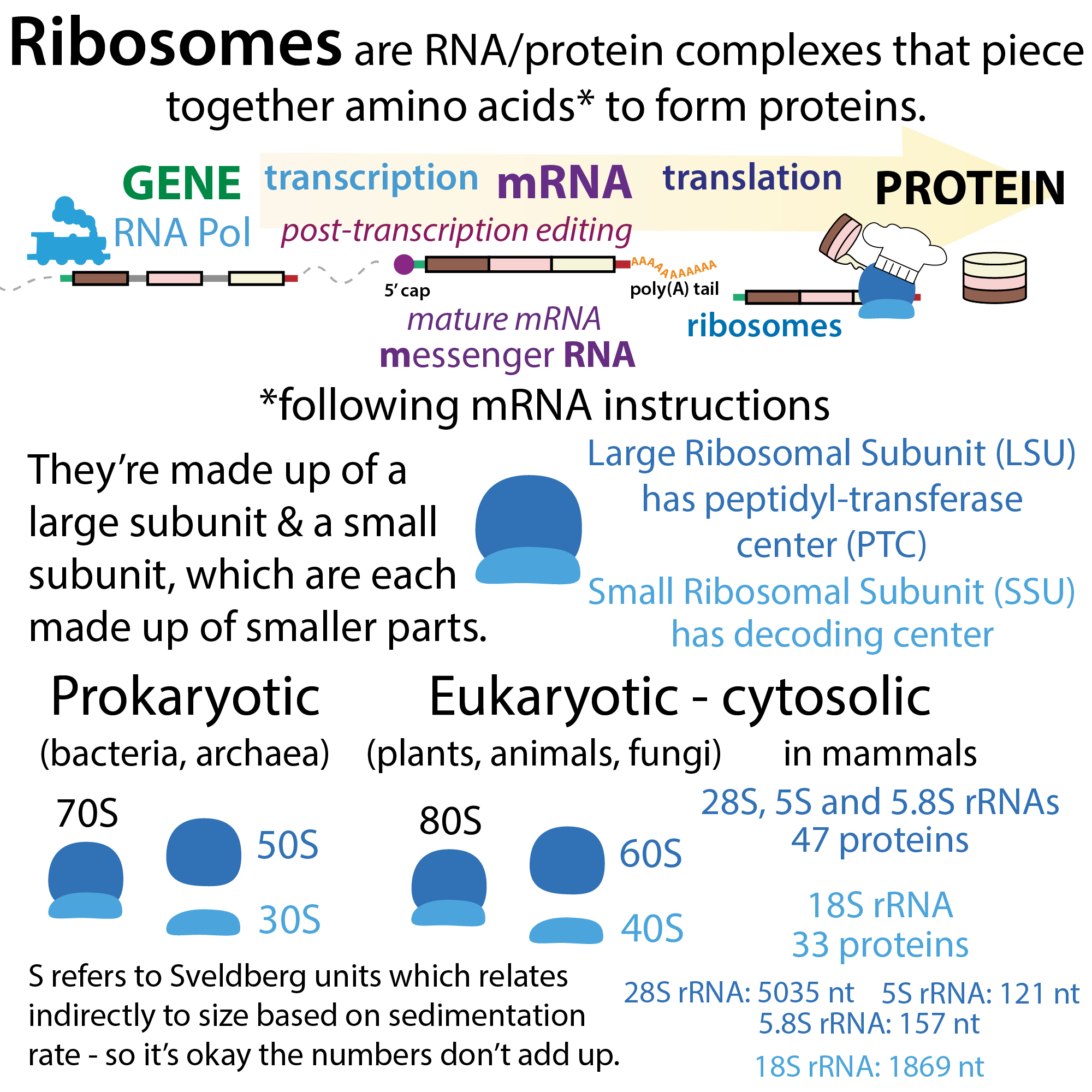
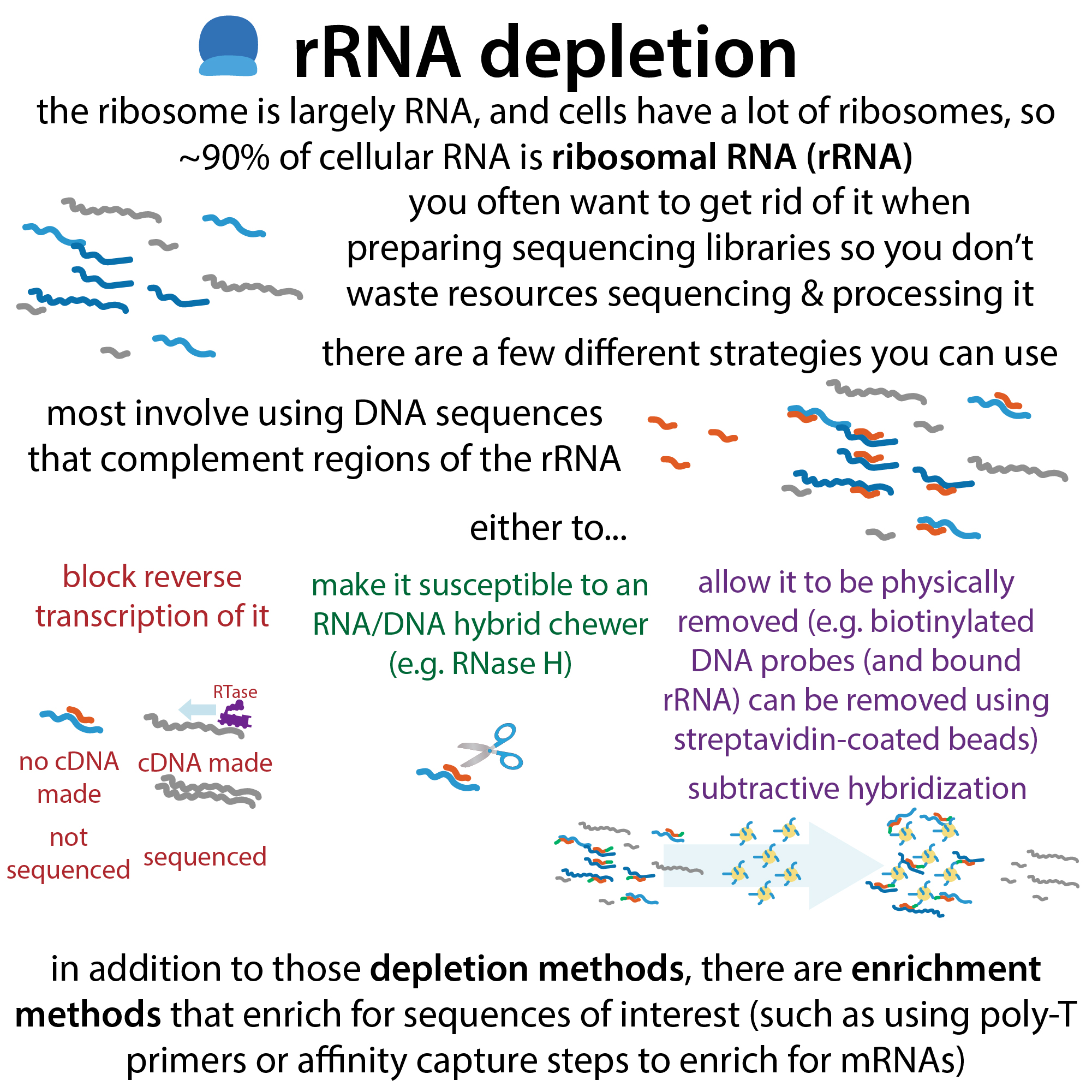
Ribosomal RNA (rRNA) can get in the way, so here are some methods to take it away! Ribosomes (the protein-making machinery in cells) are made up of proteins and rRNA. Cells have a lot of ribosomes (because they need to make a lot of proteins). So cells have a lot of rRNA. Like, a lot a lot (~90% of cellular RNA). And, when it comes to creating sequencing libraries, want that rRNA you do not!
updated 5/23/23; new video: https://youtu.be/VgagVO5S-pI
There are a couple of main methods to remove it that rely on using DNA probes complementary to rRNA sequences. These probes bind to the rRNA and allow you to selectively degrade it (e.g. with RNaseH that cuts RNA/DNA duplexes) or physically remove it (e.g. with biotinylated probes you can get to stick to magnetic beads) – this is sometimes referred to as a form of subtractive hybridization.
Kits using kits using RNaseH include NEBNext rRNA depletion, Kapa RiboErase, and Takara/Clontech’s RiboGone. And kits using biotinylated probes & magnetic beads include Illumina’s RiboZero, Qiagen GeneRead rRNA depletion, and Lexogen RiboCop.
I’ve used that second strategy, the subtractive hybridization, when doing ribosome profiling experiments, where I want to see what sequences ribosomes are bound to – not what sequences make up the ribosomes! More on ribosome profiling (aka ribosome footprinting aka RiboSeq) here: https://bit.ly/ribosomefootprinting
Zinshteyn B, Wangen JR, Hua B, Green R. Nuclease-mediated depletion biases in ribosome footprint profiling libraries. RNA. 2020 Oct;26(10):1481-1488. doi: 10.1261/rna.075523.120. Epub 2020 Jun 5. PMID: 32503920; PMCID: PMC7491325. https://doi.org/10.1261/rna.075523.120
So it’s recommended you use the subtractive hybridization method instead. I’m using depletion probes based on this paper:
Ingolia, N., Brar, G., Rouskin, S. et al. The ribosome profiling strategy for monitoring translation in vivo by deep sequencing of ribosome-protected mRNA fragments. Nat Protoc 7, 1534–1550 (2012). https://doi.org/10.1038/nprot.2012.086
And this paper talks about a software program you can use to design optimal custom probes for your experiment to maximize the rRNA minimizing!
Ferhat Alkan, Joana Silva, Eric Pintó Barberà, William J. Faller, Ribo-ODDR: oligo design pipeline for experiment-specific rRNA depletion in Ribo-seq, Bioinformatics, Volume 37, Issue 17, 1 September 2021, Pages 2659–2667, https://doi.org/10.1093/bioinformatics/btab171
Here’s a nice website with info on different methods as well – https://www.lexogen.com/rna-lexicon-rna-pretreatment-enrichment-or-depletion/
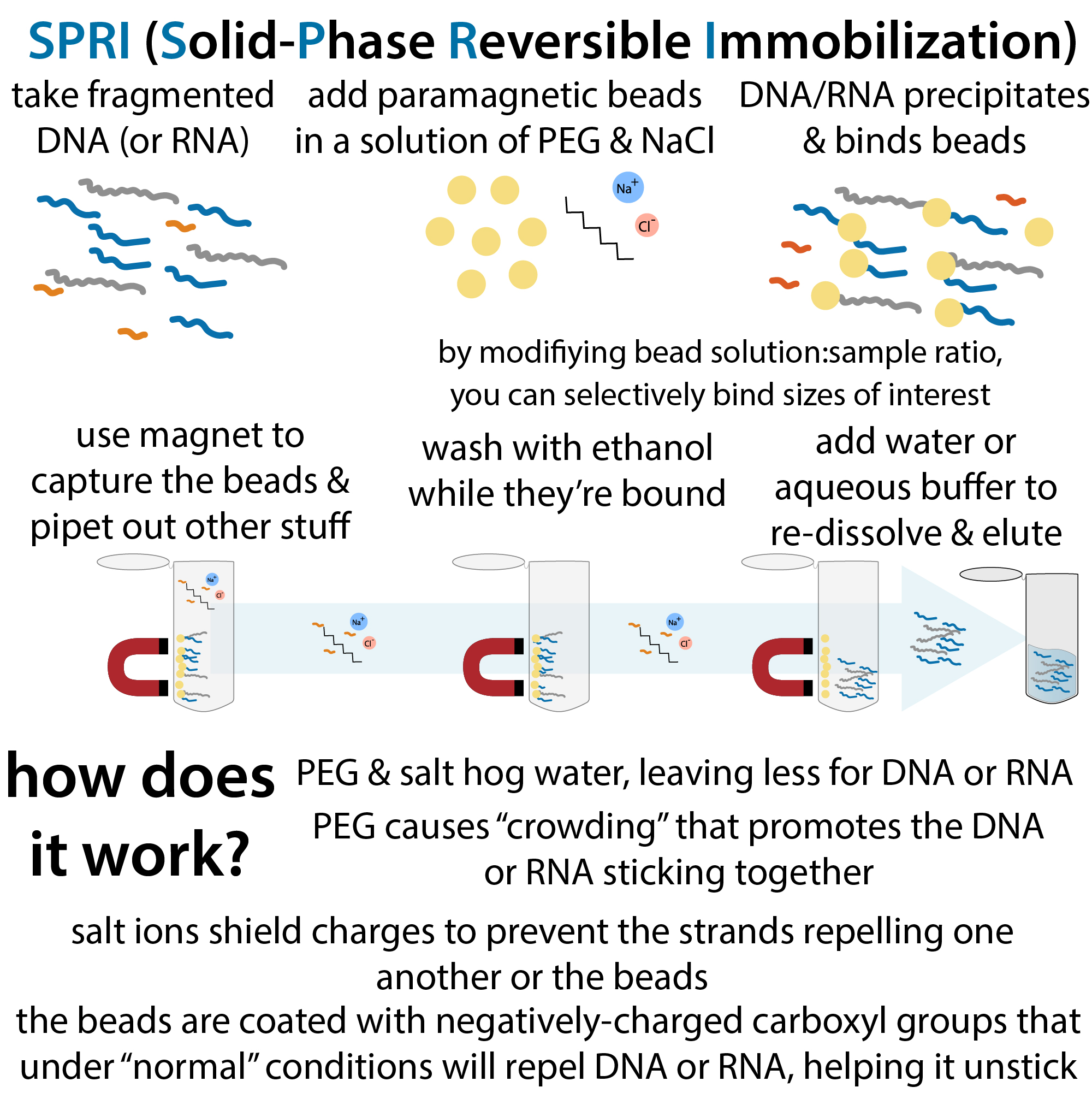
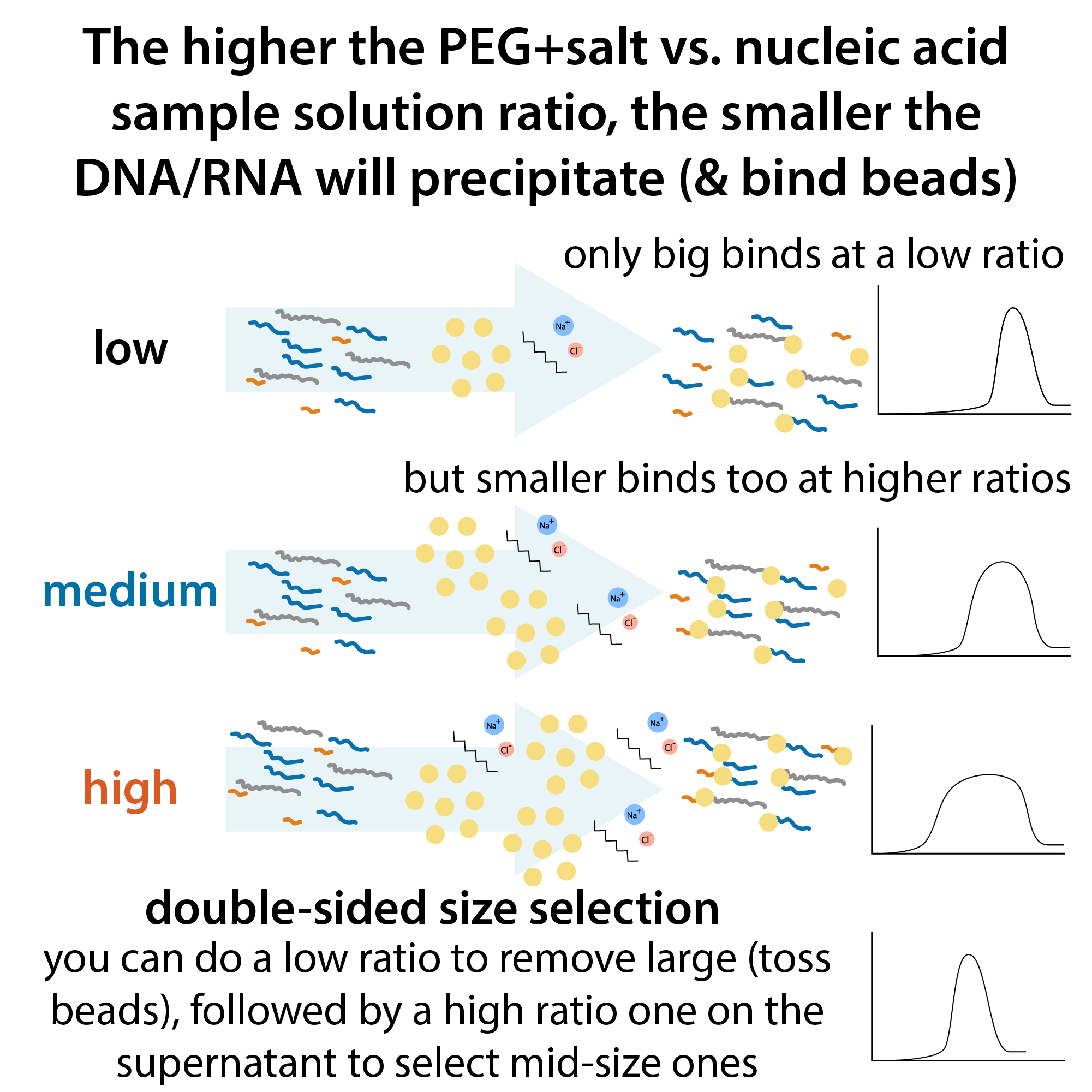
I’ve also done the RNaseH way when preparing total RNAseq libraries. For that, I used the NEBNext rRNA depletion kit. It also uses magnetic (technically paramagnetic) beads, but a different kind and for a different purpose. It uses a type of beads called SPRI beads (Solid-Phase Reversible Immobilization) beads, which are just used for purification rather than the actual depletion. Basically, you use conditions of high PEG & NaCl concentrations, which gets nucleic acids to precipitate & bind the beads. Then you wash other stuff off and then change the conditions so that the nucleic acids elute (come off). Much more on them here: blog: https://bit.ly/SPRIbeads ; YouTube: https://youtu.be/79cYJo_Cvqo
Here’s a nice website with info on different methods as well – https://www.lexogen.com/rna-lexicon-rna-pretreatment-enrichment-or-depletion/
There’s also, for example, a strategy that uses probes to block Reverse Transcriptase & prevent it from making cDNA copies of rRNA.
Other strategies enrich for the thing of interest (such as mRNA) instead of depleting things of non-interest. For example, NEBNext® Poly(A) mRNA Magnetic Isolation Module uses oligoDT-labeled beads to capture mRNAs by their polyA tails. Of course, that strategy only works if all you care about is mRNA. And, even then, you will miss parts of mRNAs that aren’t intact.
With any method, there’s likely still going to be some rRNA contamination. But that’s okay because we can filter them out of the sequencing data. We just don’t want to waste a ton of reads reading stuff we filter out! Instead, we’d rather get more reads of the stuff we care about.
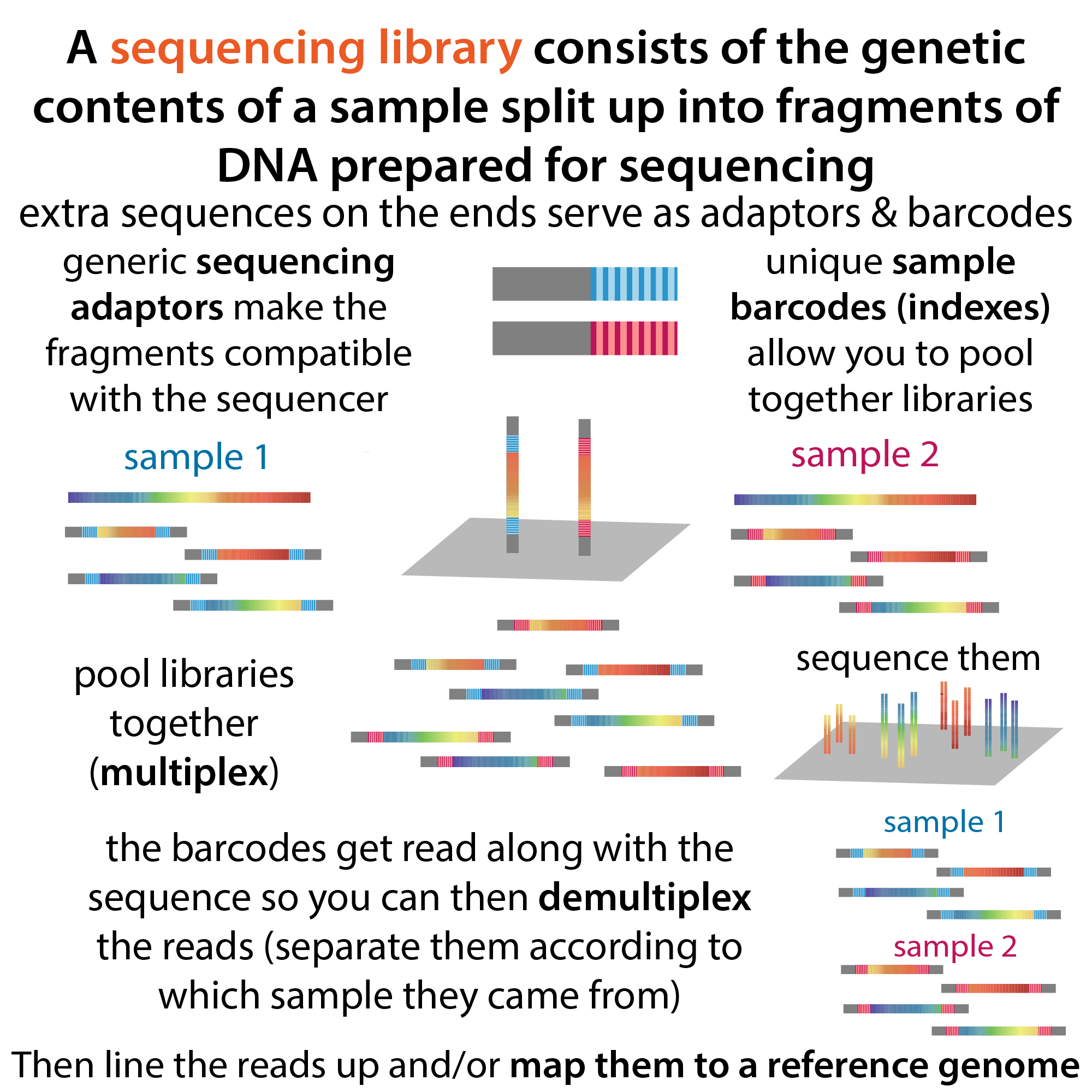
More about sequencing libraries here: https://bit.ly/molecularlibraries ; YouTube: https://youtu.be/lkjCiLwzBv0 & blog: https://bit.ly/multiplexingandbarcodes ; YouTube: https://youtu.be/_olpuoicdII
And IDT has some nice info about biotinylation – https://www.idtdna.com/pages/education/decoded/article/which-biotin-modification-to-use- & https://www.idtdna.com/pages/education/decoded/article/how-biotin-became-a-tool-of-molecular-biologists
That’s all for now. Sorry the text is brief, but all these papers I’m reading aren’t! So it’s back to work for me. But hope this helps someone other than just me :).
more about all sorts of things: #365DaysOfScience All (with topics listed) 👉 http://bit.ly/2OllAB0 or search blog: https://thebumblingbiochemist.com