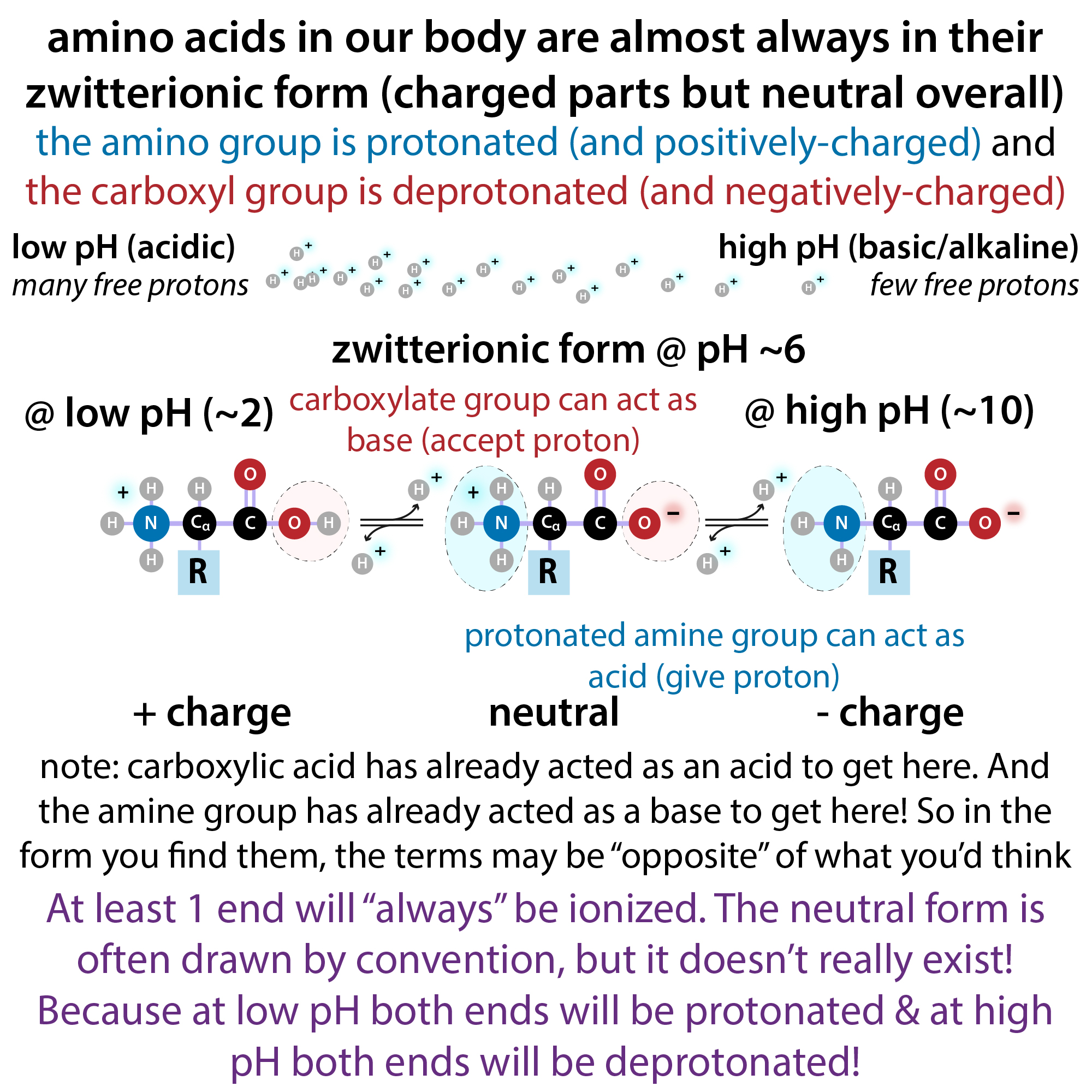
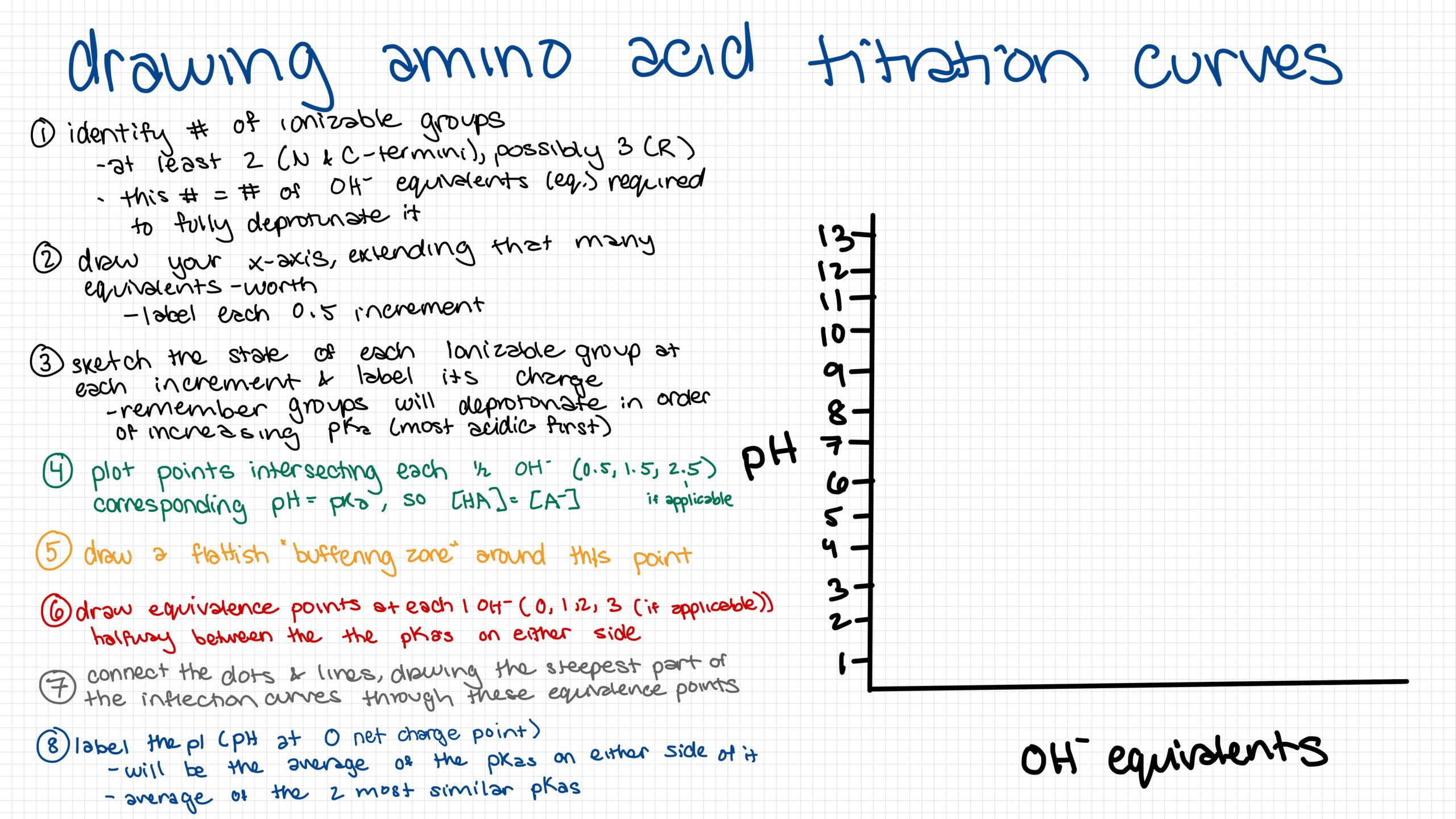
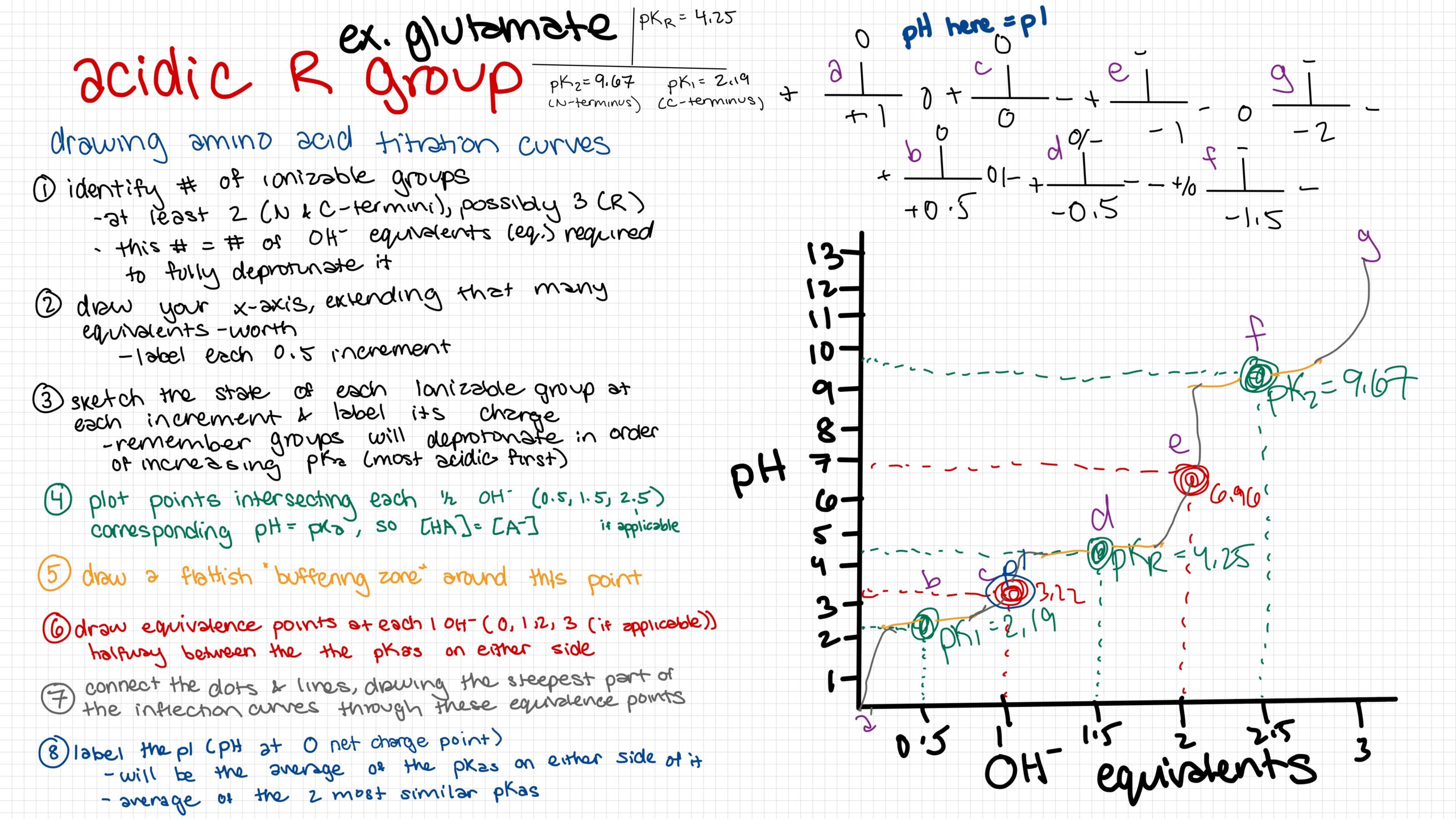
Strategy for drawing amino acid titration curves:
- Identify # of ionizable groups
- at least 2 (N- & C-termini), possibly 3 (R group, aka sidechain)
- this #= # of OH⁻ equivalents (eq.) required to fully deprotonate it
- Draw your x-axis, extending that many equivalents-worth
- label each 0.5 increment
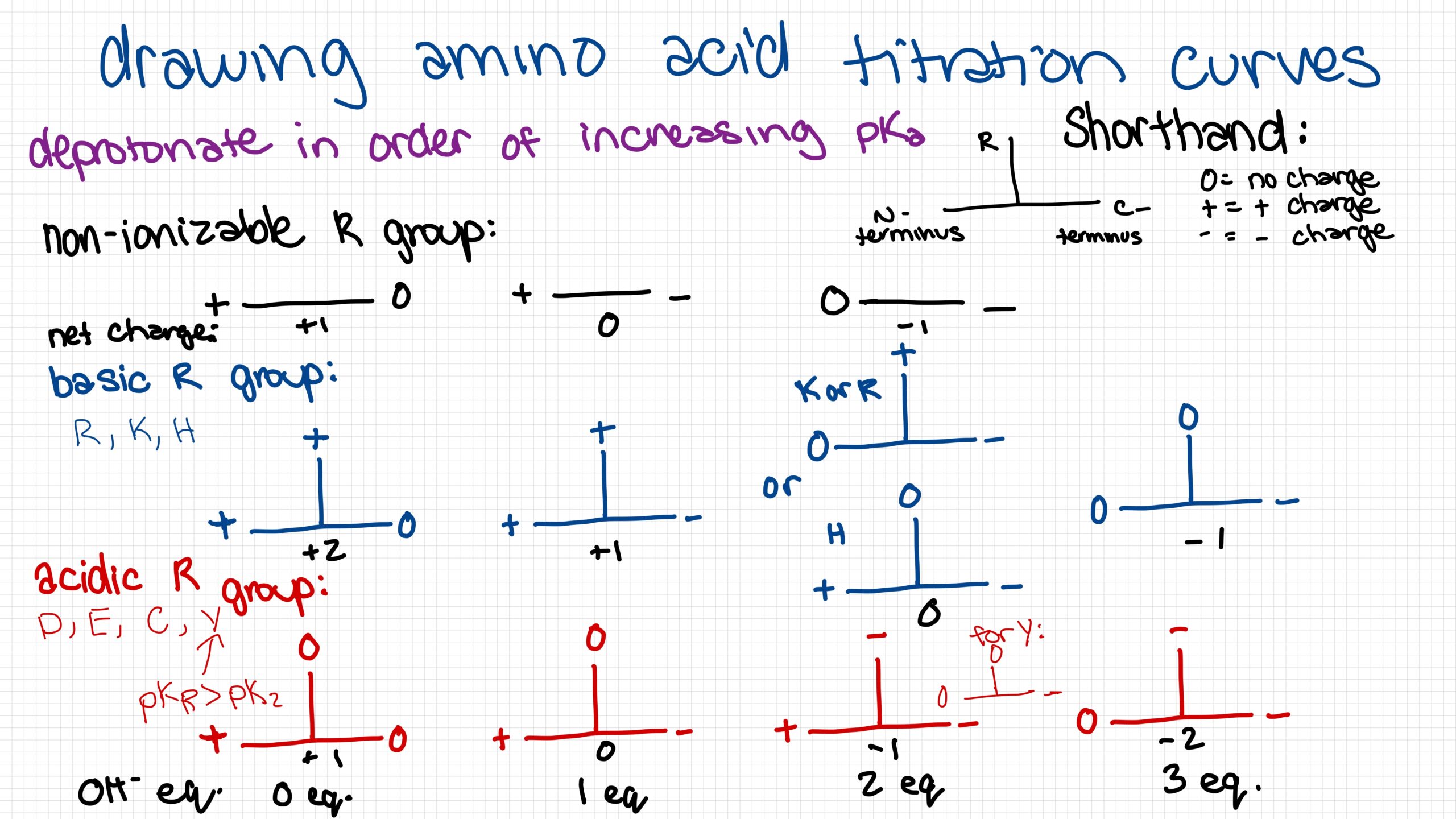
- Sketch the state of each ionizable group at each increment & label its charge
- remember groups will deprotonate in order of increasing pKa (most acidic first)
- Plot points intersecting each at each 1/2 OH⁻ (0.5, 1.5, 2.5 – if applicable)
- the corresponding pH = pKa, so [HA] = [A⁻]
- Draw a flattish “buffering zone” around this point
- Draw points at each 1 OH⁻ (0, 1, 2, 3 (if applicable)) halfway between the the pKas on either side
- the steepest part of the inflection will be here
- note: one of these pH’s will be the pI!
- Connect the dots and lines, drawing the steepest part of the inflection curves through these equivalence points
- Label the pI (pH at 0 net charge point)
- will be the average of the pKa’s on either side of it
- average of the 2 most similar pI’s
In the video, I start with an overview, then…
At 19:40, I show an example of how to draw an amino acid titration curve for an amino acid with a non-ionizable R group (in this case glycine). https://youtu.be/APX4cjovul4?t=1180

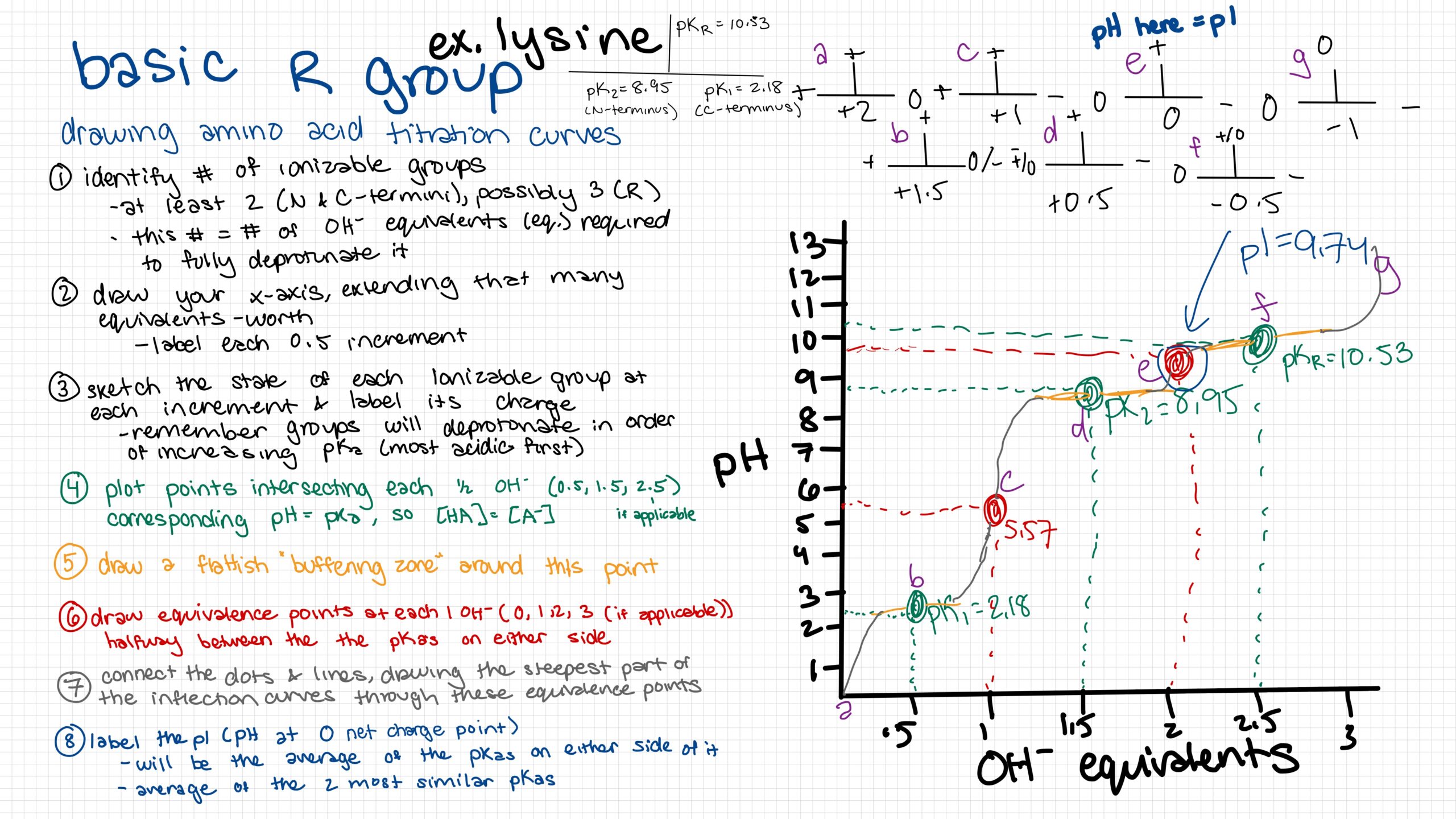
At 30:14, I show an example of how to draw an amino acid titration curve for an amino acid with a basic R group (in this case lysine) https://youtu.be/APX4cjovul4?t=1814
At 40:22, I show an example of how to draw an amino acid titration curve for an amino acid with an acidic R group (in this case glutamate) https://youtu.be/APX4cjovul4
Titration curves are nice for some things, especially helping you get a sense as to what’s going on at different pH’s, but if you want to actually calculate what the pH would be or what proportion would be protonated at a given pH, for an in-between equivalents point, the Henderson-Hasselbach equation is the place to go! http://bit.ly/phbuffers YouTube: https://youtu.be/VRJV2FTOUeM
P.S. Huge thanks to Dr. Jeff Sigman for helping teach me his method!
Much more on amino acids: http://bit.ly/allaminoacids ; YouTube: https://youtu.be/Os6VVovCR8U
More on acids, bases, & pKa calculations: http://bit.ly/phbuffers YouTube: https://youtu.be/VRJV2FTOUeM & https://youtu.be/I-n9YUFLjZ4
more about all sorts of things: #365DaysOfScience All (with topics listed) 👉 http://bit.ly/2OllAB0 or search blog: https://thebumblingbiochemist.com