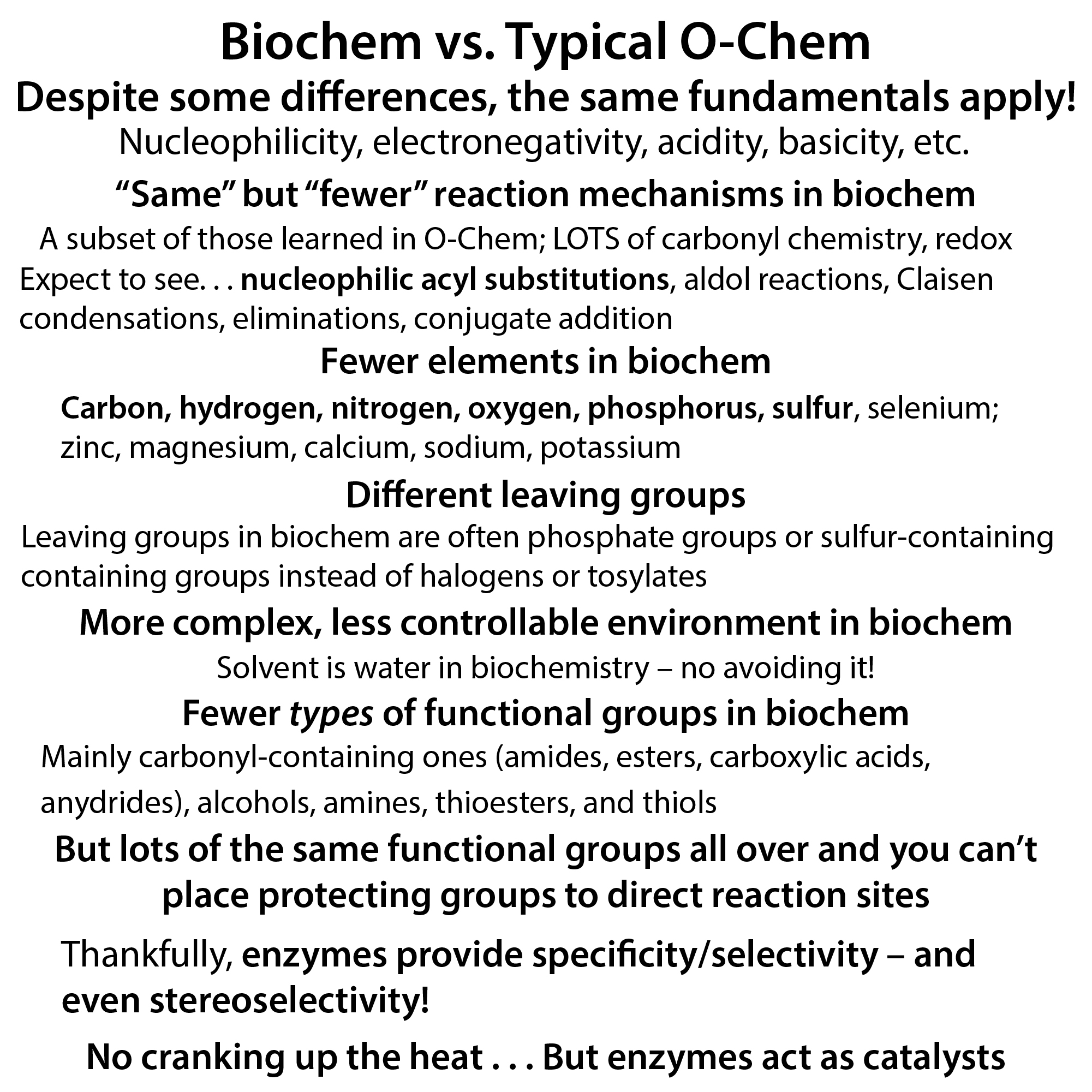
Whether you loved o-chem (which I hope you did) or hated it, you still might love biochemistry! O-chem is at the heart of biochemistry, but you’ll find the classes are very different. Also very different are the conditions under which the organic reactions (yep, those same ones from o-chem – or at least some of them) are occurring!
To prepare for biochemistry, you’ll want to review your o-chem, but you won’t need to review *all* of it – instead, focus on the fundamentals that apply in any situation a molecule finds itself in. We’re talking things like nucleophilicity, electrophilicity, electronegativity, resonance. Those things won’t change. And will be fundamental to understanding the reactions you see in biochem.
But you’ll see a lot fewer reactions in biochem – at least in terms of the core mechanisms that are occurring. There won’t be tons and tons of reaction mechanisms to learn – you’ll mostly just be seeing variations of nucleophilic substitutions & occasional elimination reactions. And they’ll be happening on a very limited subset of the functional groups you learned about in o-chem (you’ll mainly just see things like hydroxyls (alcohols), thiols, amines, amides, and carbonyls in various places (carboxylic acids, amides, esters, etc.).
But a big difference between biochem & o-chem is that you’ll see those same functional groups all over the place – including lots of places in the same molecule! And we don’t have protecting groups like BOC to hide the places we don’t want to react. Instead, our cells keep things less reactive in general, and then – when they want to make a change to a molecule – they use tricks to make the specific functional group site more active, such as by phosphorylating them. But in order to make the right site more active, cells have to have other tricks, such as using enzymes that recognize (and can differentiate between) the shapes of molecules and can position that desired functional group right where it’s needed.
And our cells can even control when & where we want different enzymes to be present.
They can also, to some extent, control the concentrations of reactants – but there are still tons and tons of various molecules floating around in there! It’s nothing like your carefully-controlled test tubes! Especially in terms of solvents!
Although you might occasionally see things like DMSO used in the lab to help make drugs soluble, etc. almost all of biochemistry is happening in an aqueous environment. All that stuff from o-chem about protic solvents messing stuff up? That applies all the time here! All those steps you took to dry out reactions? Well, that wouldn’t end too well if you tried it on a cell…
So, we’ll see how cells deal with it. And we’ll always need to keep the ~55M of water molecules in mind when thinking about reactions!
But don’t worry about keeping in mind (or at least don’t worry about remembering for biochem) all those exotic metals and “strange” elements. In biochem, it’s mainly just CHNOPS (Carbon, Hydrogen, Nitrogen, Oxygen, Phosphorus, & Sulfur).
Finally, there’s no heating up reactions to speed them up. And we can’t just dump in a bunch of catalytic metals, acids, or bases. But we’ll see how enzymes come to the rescue here as well, serving as biological catalysts – with that added specificity! – and offering those same catalytic tools in a controlled, site-specific, manner.
I hope you’re excited!!!!!!! If I can get my students to love biochem 1/10 of how much I do, I will be super happy!
P.S. In terms of what you should actually review from o-chem, I’ve put together a guide (and am working on breaking it up into shorter videos by topic so you can skip to whatever you need to review)
https://youtu.be/X9_ppqPmfWE & & slides: https://drive.google.com/file/d/1iPlD66uJ25rkpTdkwCDJjwUIsJSD8jvu/view?usp=sharing
more chemistry-related videos: https://youtube.com/playlist?list=PLUWsCDtjESrHKx_XQImnZaJTUSwY1umg6