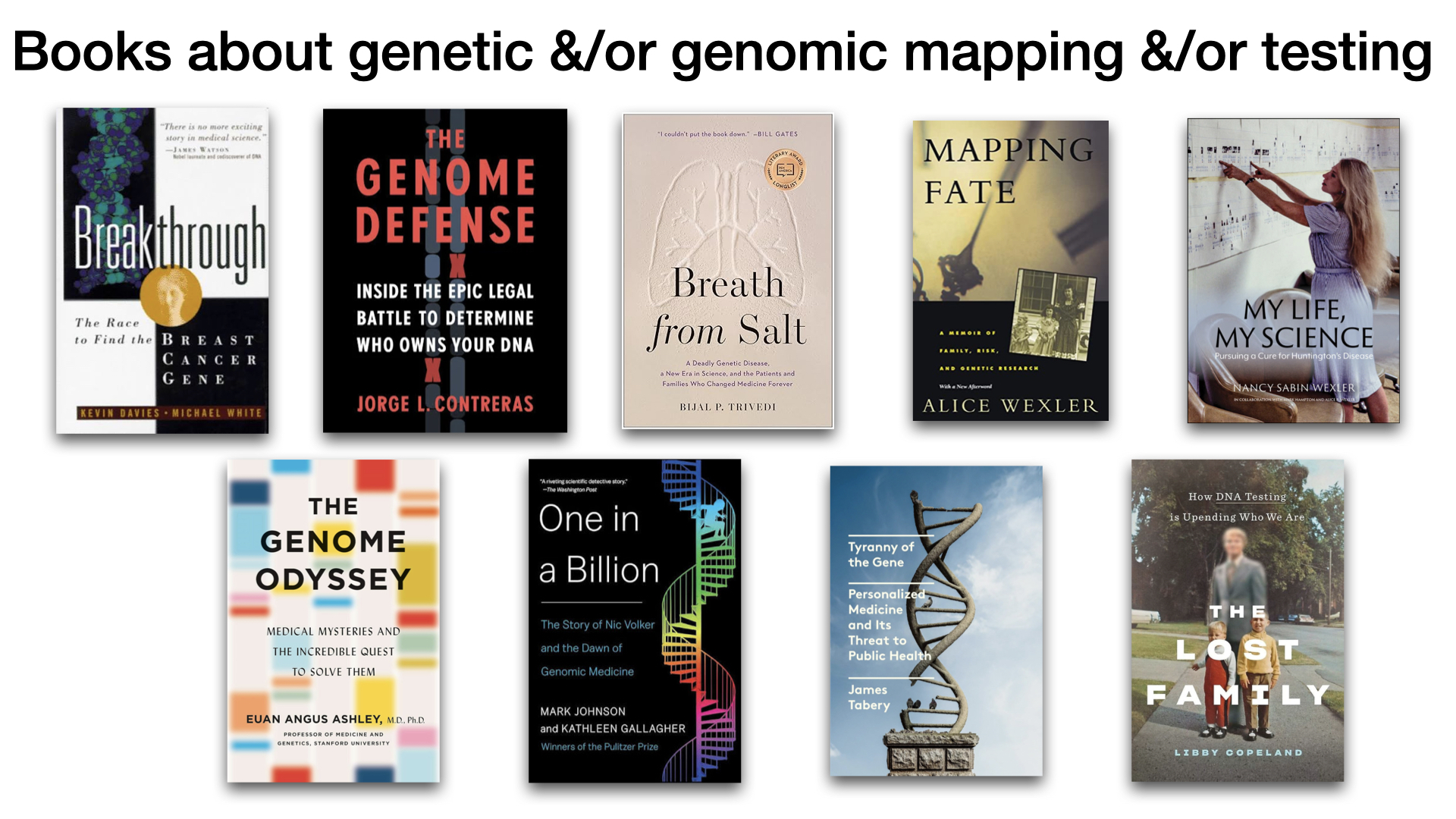
Books about genetic and/or genomic mapping and/or testing: Mapping Fate, My Life My Science, Breakthrough: The Race to Find the Breast Cancer Gene, The Genome Defense, Breath from Salt, The Genome Odyssey, One in a Billion, Tyranny of the Gene, The Lost Family
- Breakthrough: The Race to Find the Breast Cancer Gene by Kevin Davies and Michael White, 1996
- At its heart, this book is about the search for the cause(s) of breast cancer – encompassing both scientific and societal aspects of the quest.
- It centers around the discovery and genetic identification/isolation of the BRCA1 gene, which, when mutated, predisposes people to breast and ovarian cancers.
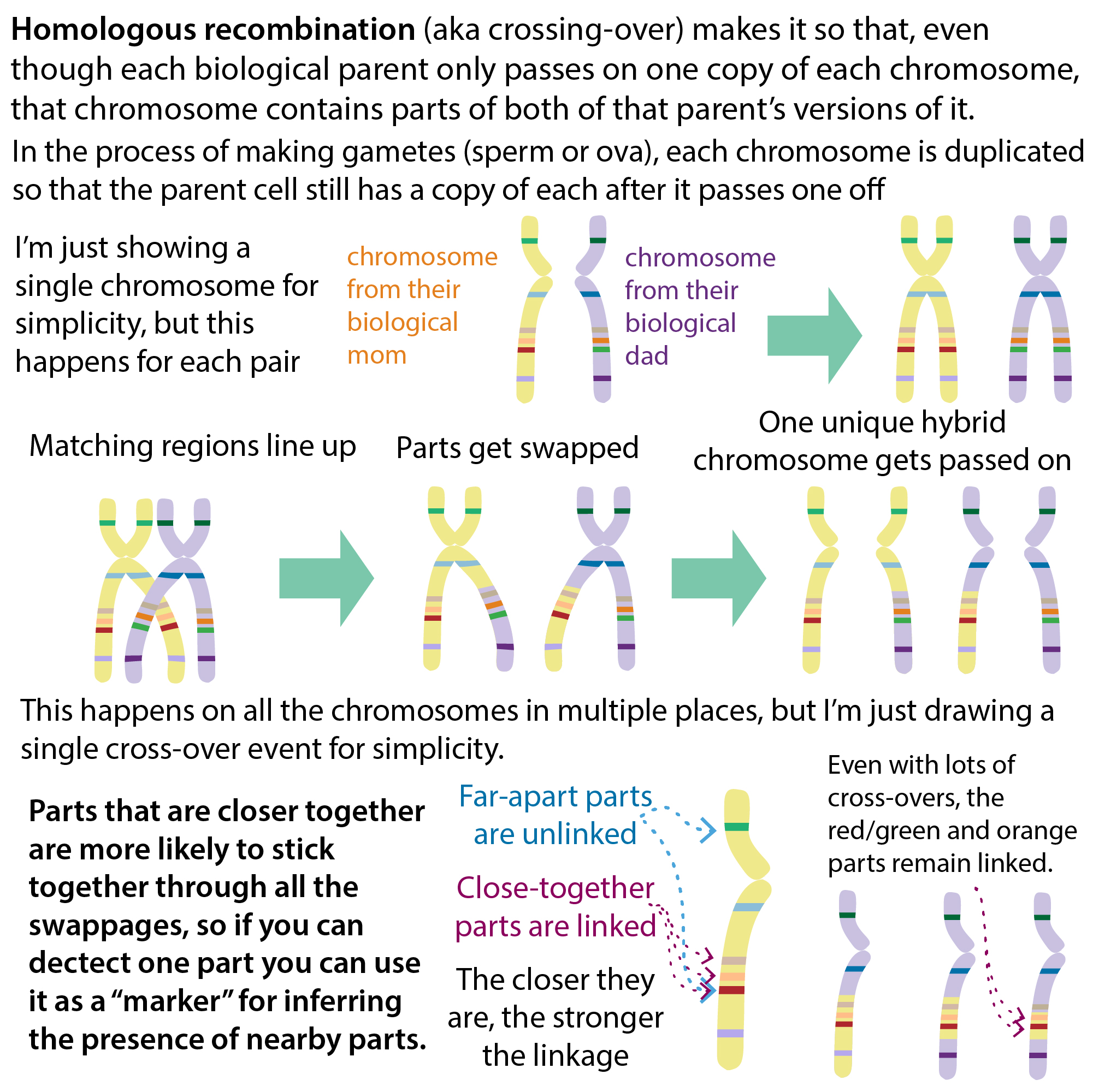
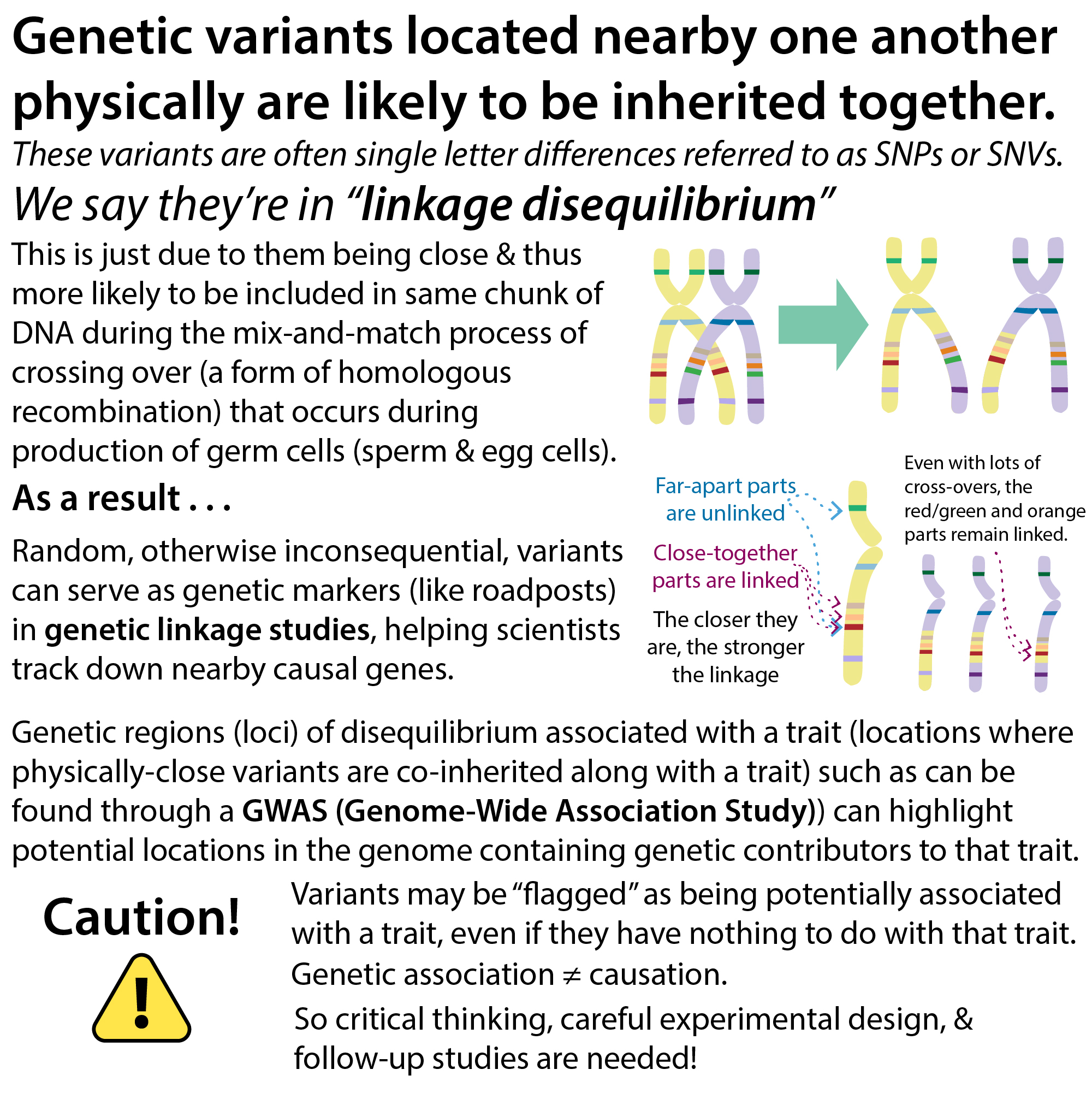
- In order to help readers understand the context of this multi-year, multi-lab, multi-continent quest, Davies describes work by scientists around that time to genetically map other genetic diseases including Cystic Fibrosis (CF), Huntington’s Disease (HD), and Neurofibromatosis (NF). These descriptions get into some serious science, detailing logistics of techniques ranging from genealogy tracing to classical genetic “mapping” techniques including “positional cloning” in which scientists used genetic markers (such as restriction fragment length polymorphisms (RFLPs) and microsatellites, for those curious) to see what features of DNA nearby the elusive gene tended to be inherited along with the mysterious mutant, thus homing in on the target.
- Although science-heavy (to my great pleasure) the book is written in a compelling, edge-of-your-seat manner, and provides back stories and descriptions that make the real-life characters come alive.
- It took me a while to get around to reading this book because it doesn’t have a digital version (at least not yet), I had to request it from my library, and I’ve been super busy, but I’m really glad I finally took time to read it.
If you want to learn more about the aftermath of the BRCA1 discovery . . .
- The Genome Defense: Inside the Epic Legal Battle to Determine Who Owns Your DNA by Jorge L. Contreras, 2021
- Describes work by the ACLU to challenge Myriad Genetic’s “ownership” of the BRCA1 gene – and, more broadly, the ability of any company or person to “own” a gene.
- Myriad Genetics had built upon the work of several groups of scientists, including Marie-Claire King, to isolate the BRCA1 gene, which, when mutated, predisposes people to breast and ovarian cancers. Since Myriad crossed the finish line first (after entering the race at the last lap…) they claimed “ownership” and the corresponding exclusive right to sell tests for its detection.
- This book chronicles the ACLU’s (spoiler alert – ultimately successful) fight to invalidate Myriad Genetic’s patent claims and set precedent that genes cannot be patented. This had the larger effect of increasing access of genetic testing for BRCA1 – and other genes – to more patients at lower cost.
- Although highly interesting and informative, it gets a bit dry at times and into some legal weeds, whereas I’m happier in the scientific weediness…
Although it focuses on genes associated with predisposition for breast cancer, Breakthrough also details some of the efforts to locate the genes associated with other genetic diseases including Cystic Fibrosis (CF) and Huntington’s Disease (HD). If you want more detailed accounts of those other searches, I recommend:
- Breath from Salt: A Deadly Genetic Disease, a New Era in Science, and the Patients and Families Who Changed Medicine Forever by Bijal P. Trivedi, 2020
- Chronicles research on Cystic Fibrosis, centering the tale on parents whose son died of the disease. Does a great job going into the history of research on the disease including the discovery of its genetic cause; the role of patient advocacy groups; and the development of truly life-saving pharmaceuticals.
- More on genetic mapping techniques and their use to find the cause of cystic fibrosis: Cystic fibrosis science: history, present, & future
- Mapping Fate: a memoir of family, risk, and genetic research, by Alice Wexler, 1995
- Tells the story of a family deeply and personally affected by Huntington’s disease. Written by a historian whose mother died from HD and whose sister, Nancy, and father, Milton, helped fuel the research into finding the genetic cause of the disease and pursuing treatments. It is a fascinating look at how scientists mapped genes but also a deeply affecting story of grappling with the implications of having a 50/50 risk of developing a fatal disease.
- My life, my science: Pursuing a Cure for Huntington’s Disease by Nancy Sabin Wexler (in collaboration with Mark Hampton and Alice R. Wexler), 2026
- Autobiography of Nancy Wexler – a geneticist, psychologist, advocate, and member of a family affected by the neurodegenerative disease Huntington’s Disease (HD).
- The book details her work with the Hereditary Disease Foundation (HDF, now called the Huntington’s Disease Foundation), which was started by her dad, Milton, upon her mother’s diagnosis, to fund research on HD. Nancy later took over the HDF’s helm and, in her work with the HDF, she led a project to determine the genetic cause of HD.
- Her work helped jump-start the Human Genome Project, in which Nancy herself played a key role, serving on the ELSI (Ethical, Legal, and Social Issues Working Group).
- A strong patient advocate, Nancy writes about how her genetic research led to lot of complex ethical questions and personal soul-searching about genetic testing.
- Nancy herself avoided getting tested for HD until 2019, when, showing symptoms of HD, she learned that she indeed had inherited it.
Those books largely talk about traditional genetic mapping techniques, but technology has greatly advanced since the identification of genes for CF, HD, BRCA1, and other early-identified genes. This is good because:
1) Those techniques were massively resource and labor-intensive
2) Those techniques were really only able to find genes associated with “simple” genetic conditions in which a single gene is involved, rather than diseases and disorders encompassing multiple genes and/or incomplete penetrance (i.e., having a mutation doesn’t necessarily cause any symptoms) and
3) Techniques dependent on family linkage can’t sleuth out genetic mutations that arise de novo in a patient (i.e., they’re not inherited but rather happen due to random mutation in the patient such as during early development).
If you want to learn more about more newer medical genetic sleuthing methods that developed as technology evolved . . .
- The Genome Odyssey: Medical Mysteries and the Incredible Quest to Solve Them by Euan Angus Ashley, 2021
- Really interesting and well-written book. A physician-scientist who works with patients with rare diseases uses real stories of patients he’s encountered over his years as a physician to show how DNA sequencing technology has advanced and altered diagnosis and treatment of diseases.
- One in a Billion: The Story of Nic Volker and the Dawn of Genomic Medicine by Mark Johnson and Kathleen Gallagher, 2016
- Tells the story of a boy named Nik Volker who suffered from a life-threatening mystery disease that, although seemingly genetic, eluded diagnosis using conventional methods. Doctors decided to sequence his genome and, by doing so, they discovered a mutation in a gene. This enabled them to devise a treatment strategy that saved the boy’s life.
- This case is regarded as the first (or second) time genome sequencing of a patient led to identification of a disease-causing mutation, coming on the tails of the human genome sequencing project. It served as not only a desperate life-saving endeavor, but also a test case: Now that scientists had a reference genome, could it actually live up to its promises?
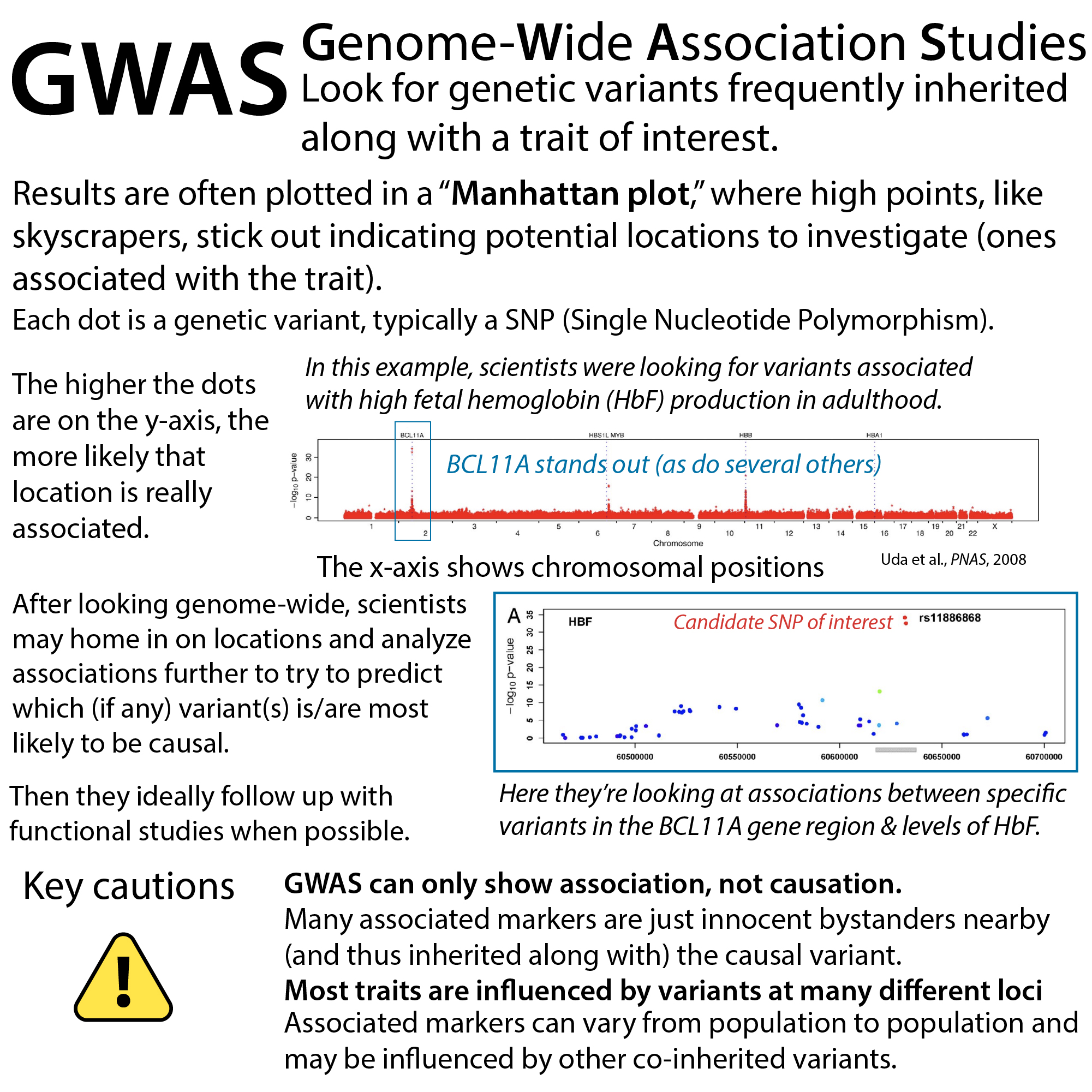
- The book provides an inside look at some of the difficulties entailed in sifting through massive amounts of genetic data and trying to figure out not only what genetic differences (polymorphisms) exist between sets of genetic data, but also which are actually meaningful and/or relevant.
For a more critical look at some of the costs (financial and societal, etc.) of genetic sequencing, however:
- Tyranny of the Gene: Personalized Medicine and Its Threat to Public Health by James Tabery, 2023
- Discusses the tension between personalized and precision medicine (which purport to deliver the right treatment to the right patient at the right time, often by taking advantage of genetic information and pricy, fancy, treatments), and public health.
- Takes you behind the scene of governmental decisions to prioritize precision medicine over public health initiatives, largely fueled by the Human Genome Project and its offshoots – Basically, we’ve got all this data, so now what?…
- Emphasizes the continuing importance of public health and environmental and societal factors in an age focused on technological fixes to, often complex and multifaceted, medical conditions
Those above books focus mainly on medical genetics and genomics. If you want a broader discussion of DNA sequencing:
- The Lost Family: How DNA Testing Is Upending Who We Are by Libby Copeland, 2020
- Tells about the history of at-home DNA testing and what it can – and cannot – tell people. Sometimes, people over-interpret it, while at other times they underestimate how much information it can reveal. And whom that information might go to and whom it might affect.
- Discusses the complex ethical questions that can arise, as well as surprising secrets and mysteries that can be revealed through it – written around an investigation carried out by a woman trying to figure out why she got DNA results that conflicted with what she’d expected
- Also goes into the idea of identity, and what our genetics, and what our ancestry, contributes to it but is far from the only thing.
For a longer list of book recommendations, see: Nonfiction science book recommendations