
Pay attention to Retention (Time)! In GC-MS (gas chromatography-mass spectrometry) or LC-MS (liquid chromatography-mass spectrometry), chromatography has two main benefits with regards to identifying constituents of a sample:
- It spreads out compounds to make sure they all get a chance to be ionized and subsequently have their (and/or their fragments’) mass/charge ratio (m/z) determined by the mass spec part (and don’t overlap in their signals) and
- It directly provides information in the form of the Retention Time (RT) is the time it takes a compound to elute (go through the chromatography column) and thus have its ions show up at the detector.
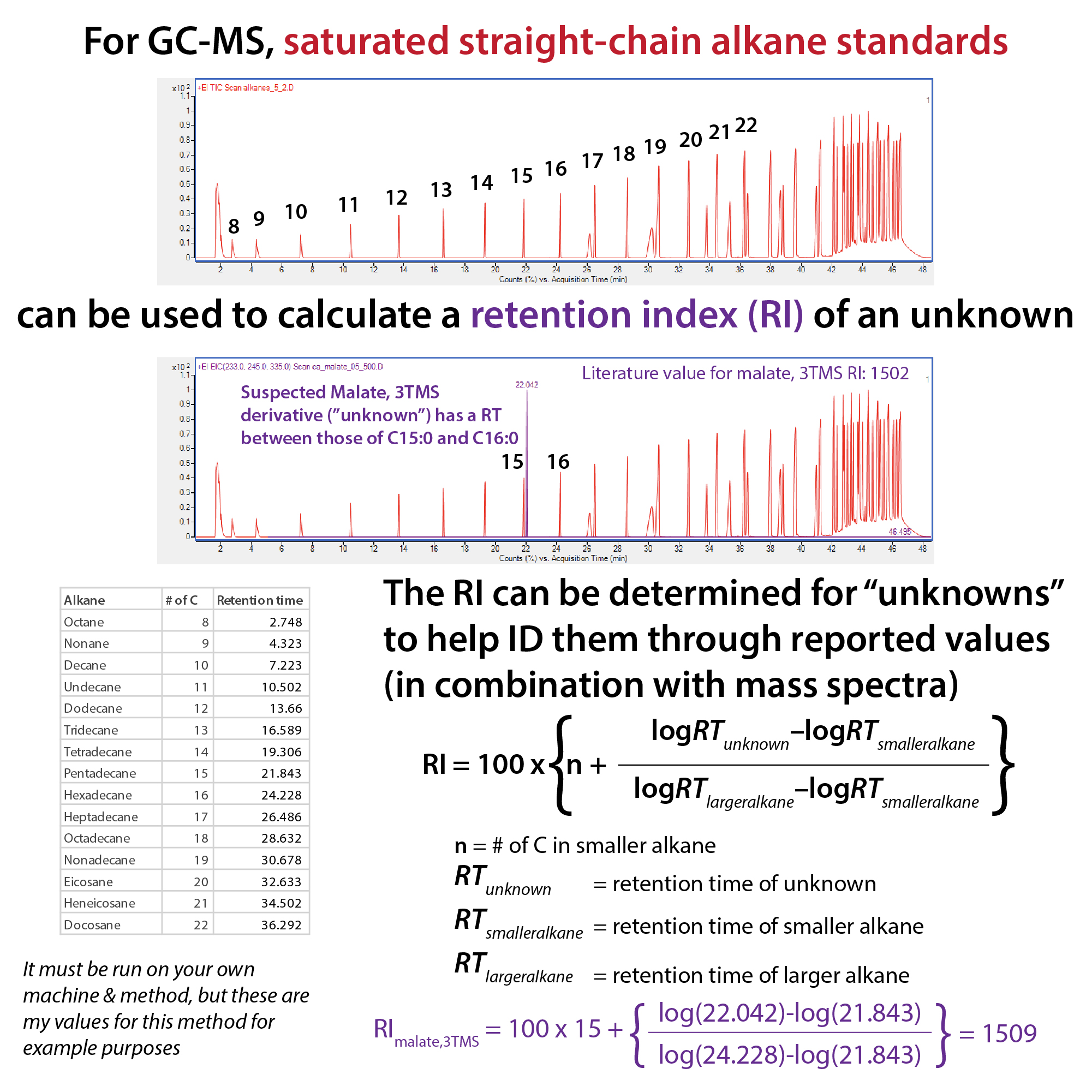
One of the benefits of GC is the high reproducibility in RT. So much so that you can even calculate something called a retention index (RI), which compares the RT of your test compounds to those of saturated straight-chain alkanes (linear hydrocarbons with no double bonds or anything). Although the actual RT may vary between methods and systems, the RI should be constant since the elution order should stay consistent*, and the RI is a relative value based on that elution order. The RI therefore adds a valuable piece of information to which to compare for ID purposes and is typically included in databases.
*This is not the case for LC, where different columns and buffers can affect elution order. In GC, the columns used tend to be very similar nonpolar columns (some variation of DB5 ( diphenyl dimethylpolysiloxane polymer with 5% of silica atoms conjugated to 2 phenyl groups, 95% to 2 methyl groups). Therefore, you “only” see RI used in the context of GC.
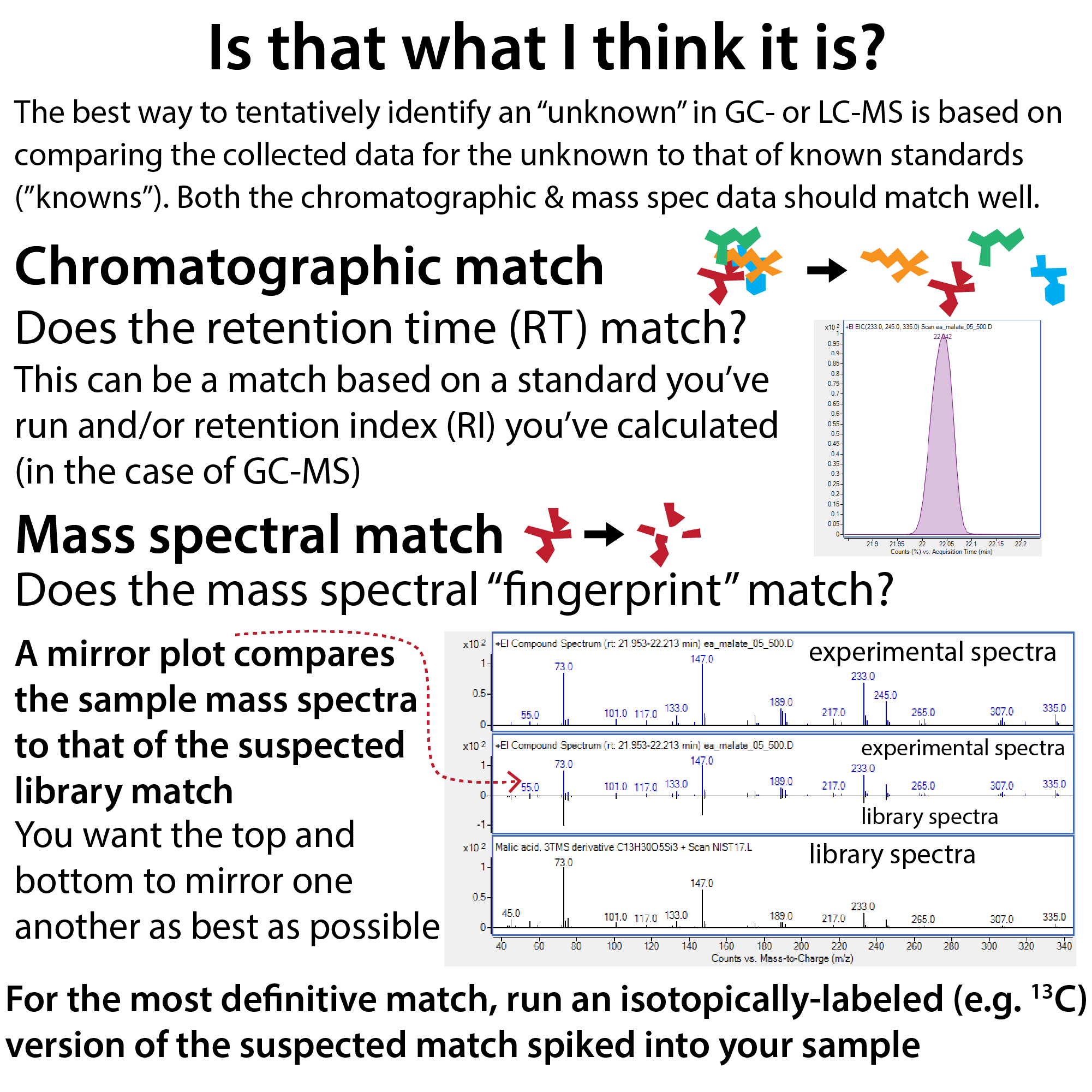
If you run a sample of saturated straight-chain alkane standards (e.g. C7-C30), using the same method you use for your standards, and the same machine, you can calculate the RI for “unknowns” to help ID them through reported values (in combination with mass spectra).
The formula for calculating RI is:
retention index (RI) = 100*(n+ ((logRTcompound-logRTsmalleralkane)/(logRTlargeralkane-logRTsmalleralkane)))
where:
n = # of C in smaller alkane (that which elutes right before your compound)
RTunknown = retention time of unknown
RTsmalleralkane = retention time of the smaller alkane
RTlargeralkane = retention time of larger alkane (that which elutes right after your compound)
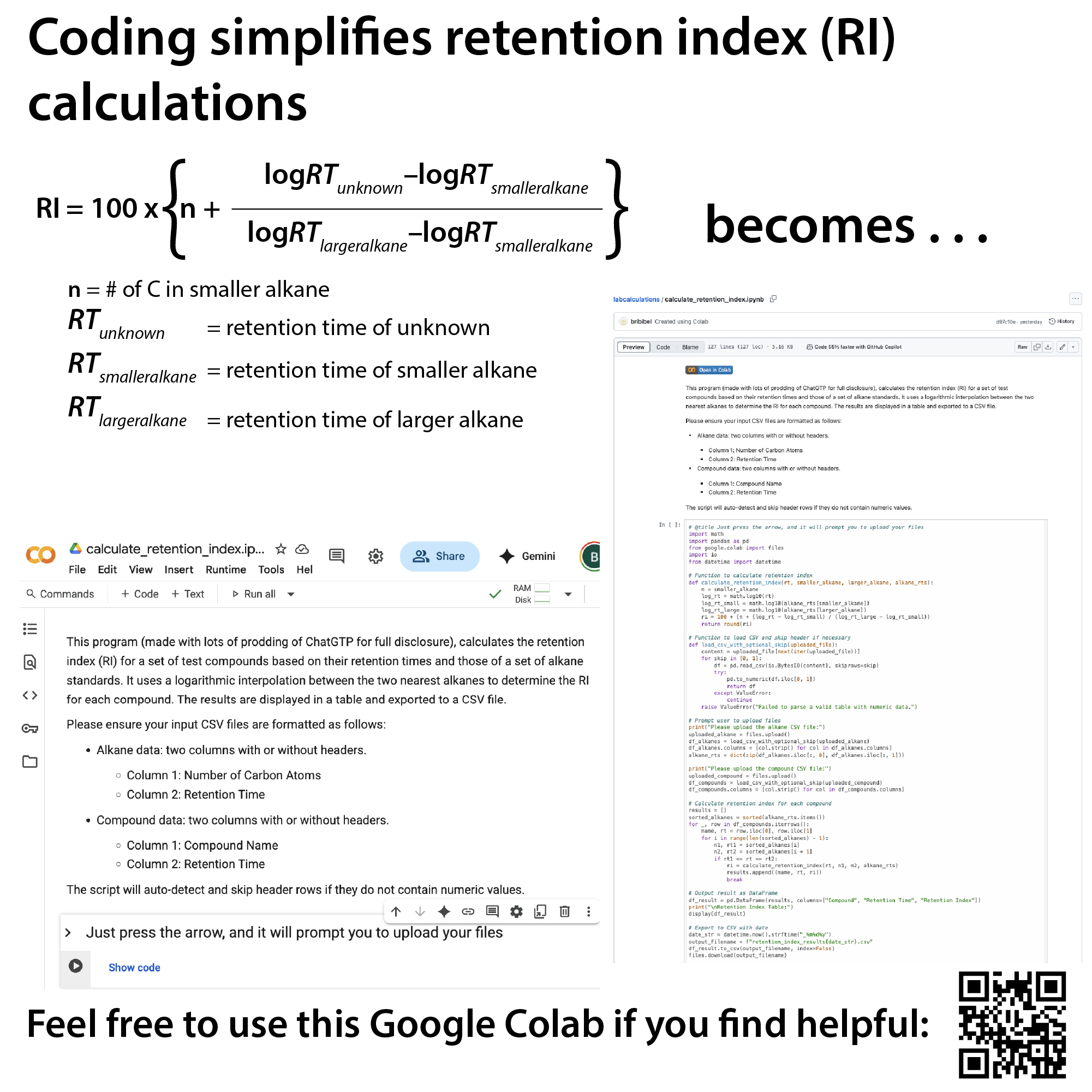
You could do this manually, but coding makes it way easier. With lots of prodding of ChatGTP, I put together a simple python-based Google Colab to calculate RI and put it on GitHub. Feel free to use it and/or build off of it if you find helpful: https://github.com/bribibel/labcalculations/blob/d97c10efa6513aa40c4748604eaa7894cf050414/calculate_retention_index.ipynb
For more about chromatography-paired mass spectrometry, see: https://bit.ly/massspecgraphs and https://bit.ly/gcmstest.
A few references:
Choi, H.; Moon, J.-K.; Seo, J.-S.; Kim, J.-H. Establishment of Retention Index Library on Gas Chromatography-Mass Spectrometry for Nontargeted Metabolite Profiling Approach. J Korean Soc Appl Biol Chem 2013, 56 (1), 87–90. https://doi.org/10.1007/s13765-012-2376-y.
Bizzo, H. R.; Brilhante, N. S.; Nolvachai, Y.; Marriott, P. J. Use and Abuse of Retention Indices in Gas Chromatography. Journal of Chromatography A 2023, 1708, 464376. https://doi.org/10.1016/j.chroma.2023.464376.
Lucero, M.; Estell, R.; Tellez, M.; Fredrickson, E. A Retention Index Calculator Simplifies Identification of Plant Volatile Organic Compounds. Phytochemical Analysis 2009, 20 (5), 378–384. https://doi.org/10.1002/pca.1137.


More about mass spec-related topics…
Tandem mass spectrometry (MS-MS), mass analyzers, etc.
MS/MS (Tandem MS) comes in many different flavors (e.g. the “triple quadrupole (QqQ), Q-orbitrap (e.g. Q-Exactive), Q-Time of Flight (Q-TOF)), […]
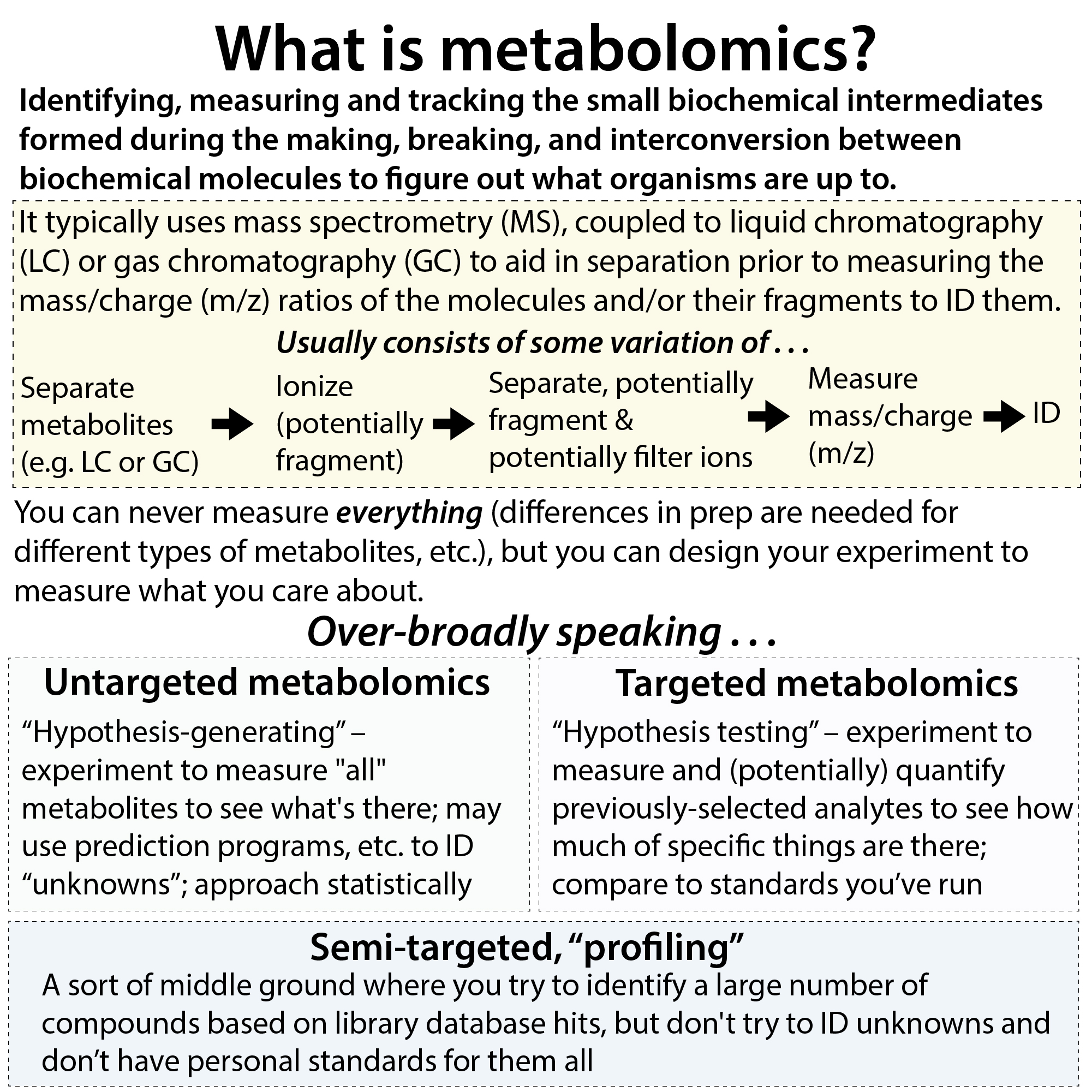
What is metabolomics?
What is metabolomics? My definition: Identifying, measuring and tracking the small biochemical intermediates formed during the making, breaking, and interconversion between biochemical molecules to figure out what organisms are up to.
Mass resolution and mass accuracy in mass spectrometry
When it comes to mass spectrometry, don’t confuse high resolution and accurate mass! High resolution is basically having sharp spectral […]
Retention Indexes
Pay attention to Retention (Time)! In GC-MS (gas chromatography-mass spectrometry) or LC-MS (liquid chromatography-mass spectrometry), chromatography has two main benefits […]
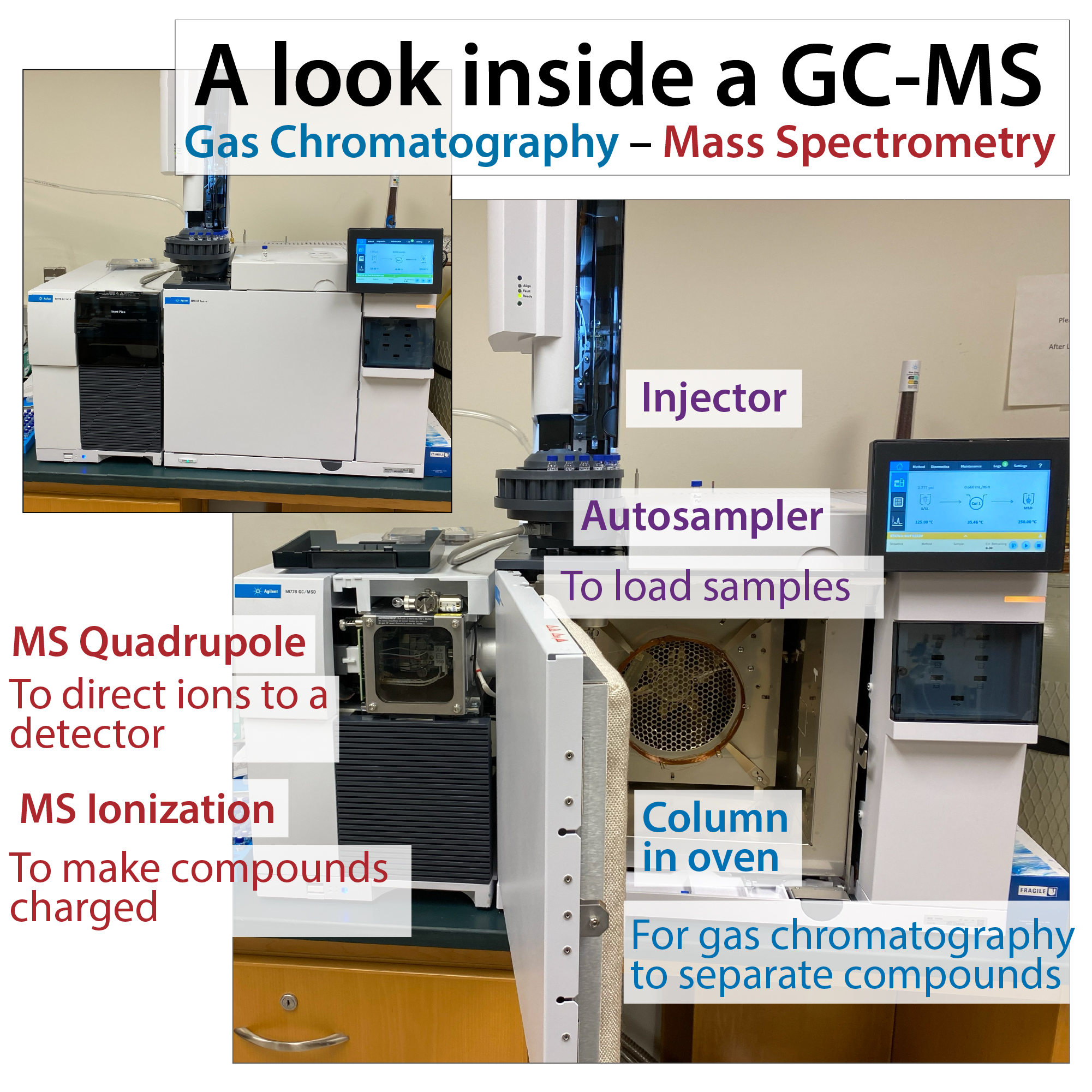
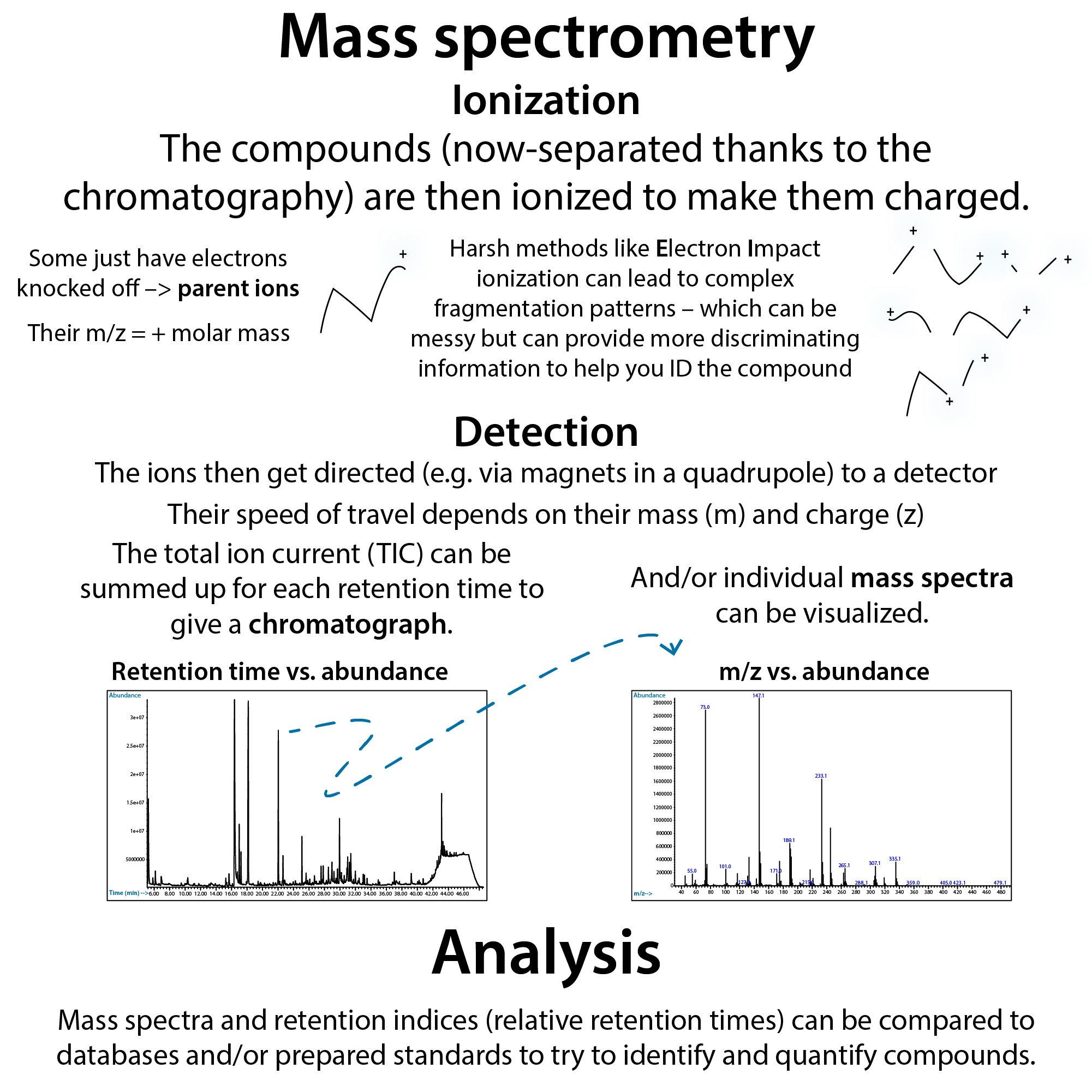
Chromatography-coupled mass spectrometry graph types, etc.
Chromatography-paired mass spectrometry typically uses mass spectrometry (MS), coupled to liquid chromatography (LC) or gas chromatography (GC) to aid in […]
Derivatization of metabolites for GC-MS via methoximation+silylation
Silylation may sound silly to say, but if you want to make organic acids volatile for GC-MS, it gives you […]
