Quick protein purification tip: when doing gravity flow chromatography, monitor protein elution by dye by checking fractions with Bradford dye!
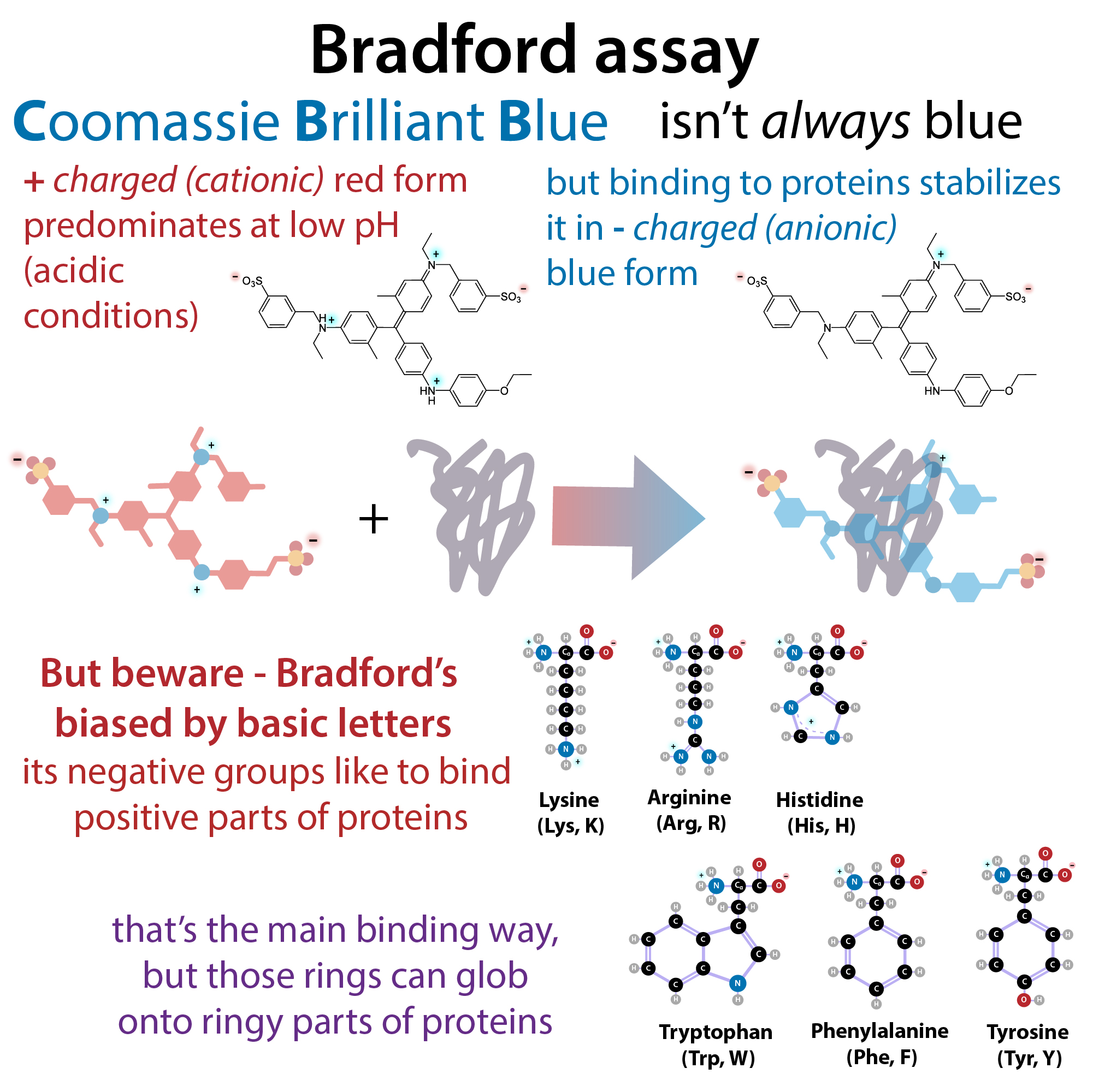
The Bradford assay is a protein-quantification experiment we can do to measure protein concentration. It’s based on a dye called Coomassie Brilliant Blue. That dye, in an acidic environment, is mainly in a + charged (cationic) form, which appears reddish-brown (absorbing light maximally 465 nM). But binding to protein stabilizes it in its – charged (anionic) form, which looks blue because it absorbs light maximally at 595. The more protein there is to bind, the more copies of the dye molecule will go blue. And you can see this when they do, by visualizing a darker hue!
If you mix a protein-containing sample with Bradford reagent, you can measure absorption at 595 nm with a spectrophotometer, and compare it to a standard curve measured with a dilution series of a protein (most commonly BSA) of known concentrations. That will give you a numerical value (i.e. it’s quantitative). But if you just want to get a “sense” of where protein is, where there’s more, where there’s less, etc. you don’t need to measure. You can use the Bradford assay qualitatively – just look!
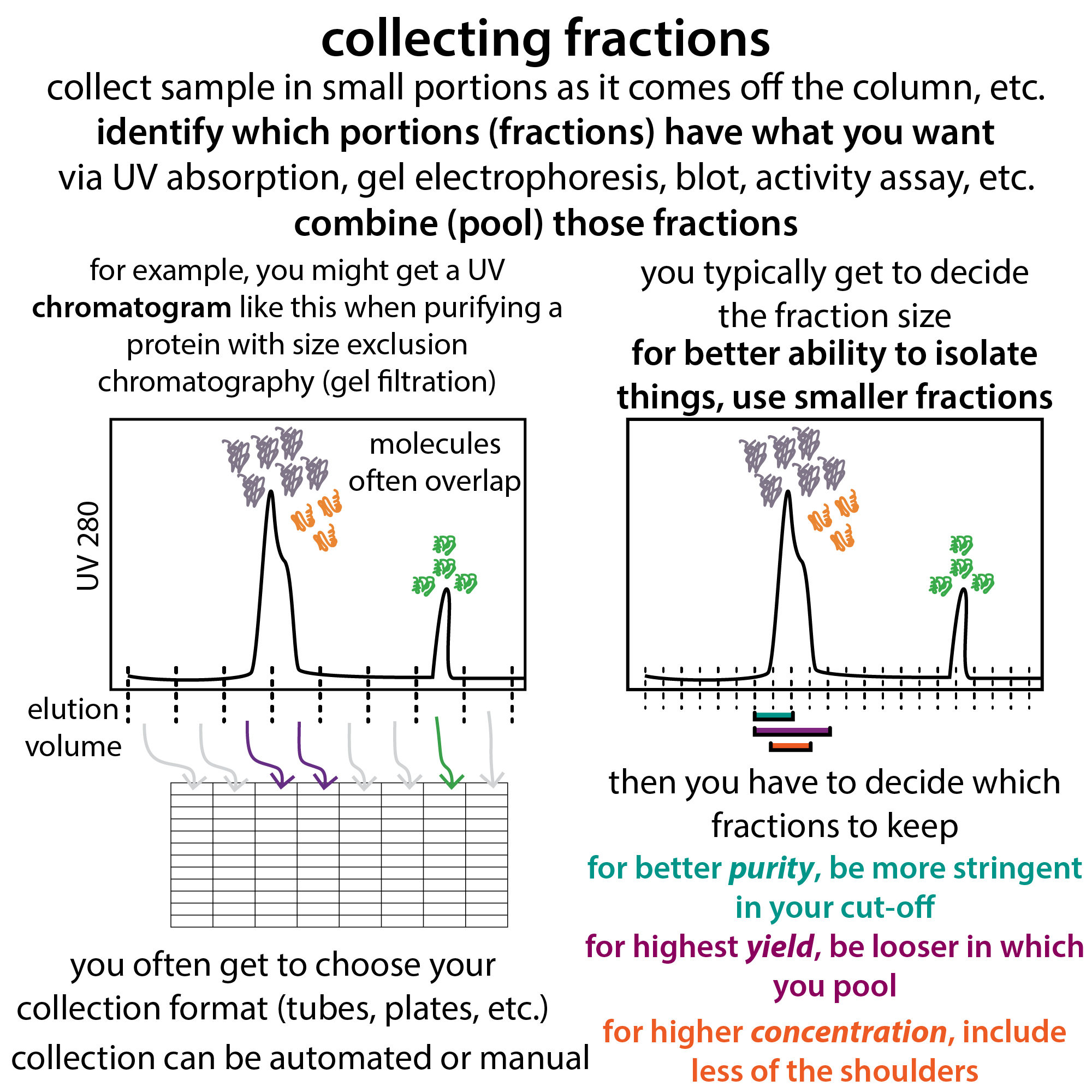
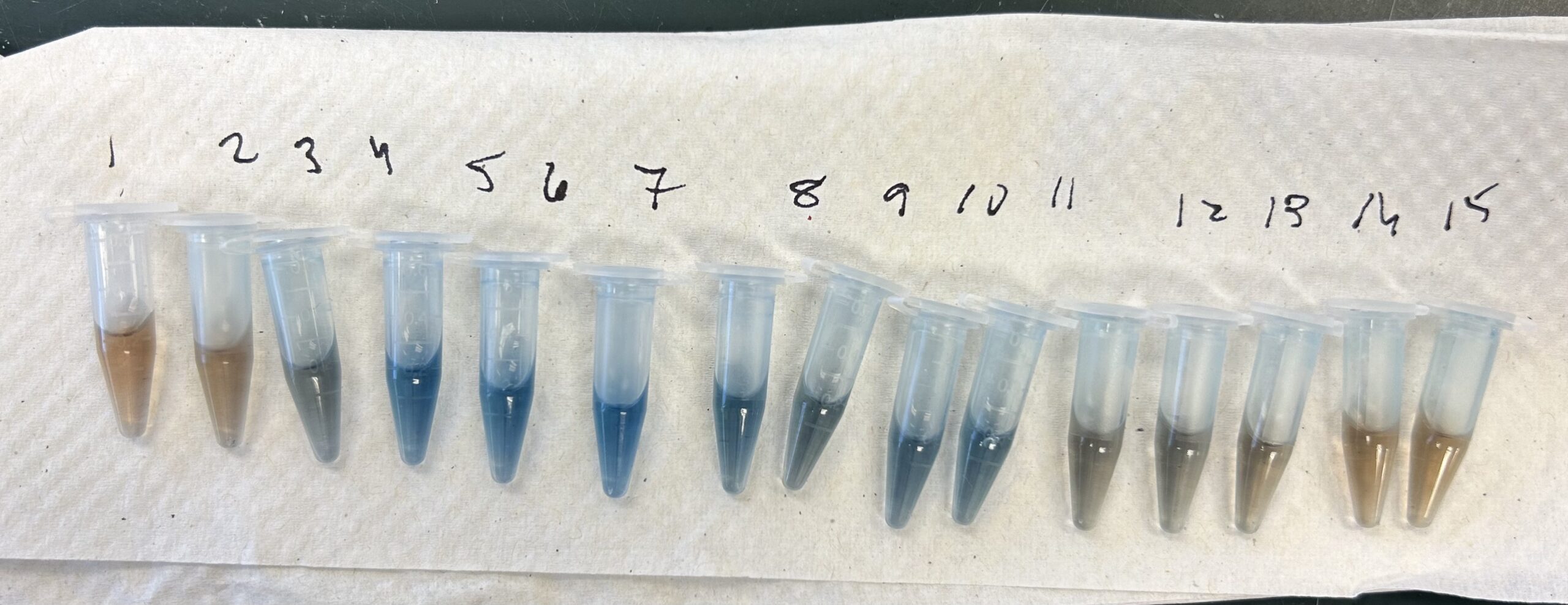
This can be really helpful when doing protein chromatography via gravity flow or batch method – no machines with fancy UV detectors telling you when your protein is coming off the column (eluting). What I typically do is set up a series of tubes containing Bradford reagent in front of my fraction collection tubes in an Eppendorf rack for easy checking and cross-correlation.
I put 250 μL Bradford reagent (make sure it’s 1X – if you start from concentrate, you’ll need to dilute it (e.g. 1:5 for the Biorad one) in each tube. Then, as I collect fractions, I add 5 μL of the elution to the Bradford reagent, cap, mix by inverting several times, then look (holding it next to a blank if it’s faint and I can’t tell if I see blue or not). This helps me know when protein stops coming off during the wash steps (telling me I can stop washing & move on to pushing off my protein such as by adding competitor) and then it lets me know when my protein stops coming off (and thus I can stop collecting fractions and/or I could increase the competitor concentration to see if any more is stuck on there that needs a bigger push).
The Bradford assay doesn’t tell us anything about purity, but if you expect your fractions to be fairly consistent with one another (such as if you’re doing a step elution), you can then pool together the blue ones that were collected under the same conditions (you’ll have to decide where to draw the cut-off. What I like to do is take the ones on the border and check them quickly with UV280 on the Nanodrop to see how high they are. Depending on whether I care more about concentration (if, for example, I’m trying to avoid having to concentrate) or if I care more about making sure I get everything, I will choose fractions accordingly.
Much more on the Bradford assay here: http://bit.ly/bradforduv
lots more on protein purification: http://bit.ly/proteinpurificationtech & https://youtube.com/playlist?list=PLUWsCDtjESrEtqQkEXsQpTyRfMhywBVQ7
Much more on protein chromatography here: http://bit.ly/proteincleaning
Much more on fraction collection here: https://bit.ly/fraction_collecting & https://youtu.be/zRN9wYNY9Uk
Much more on elution here: blog: https://bit.ly/elution ; YouTube: https://youtu.be/14A7uoDD_Ng
other practical lab tips & tricks: https://bit.ly/lab_tricks_page