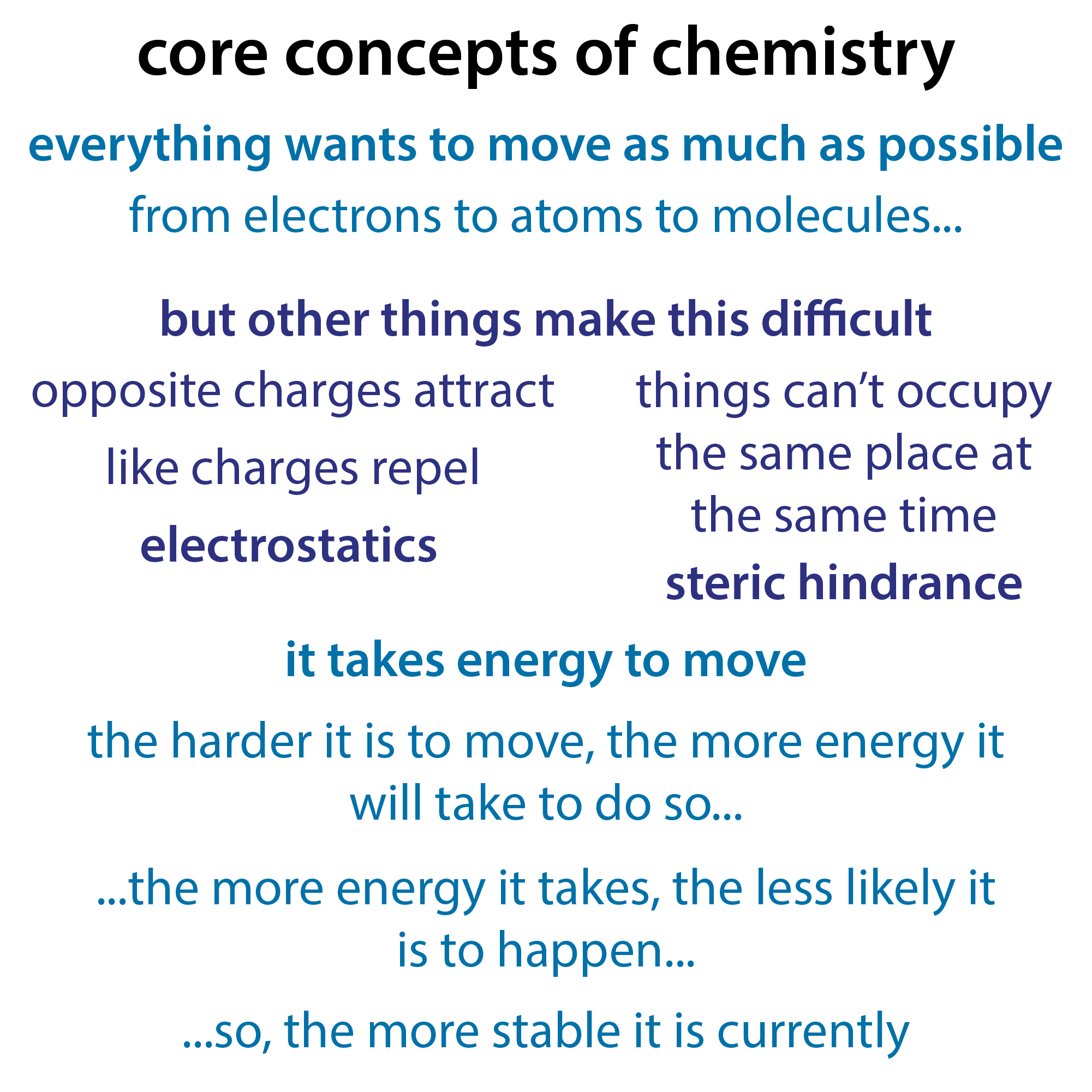
The concept of “high energy” comes up a lot in biochemistry. And the details can get confusing. But the fundamental things to keep in mind are…
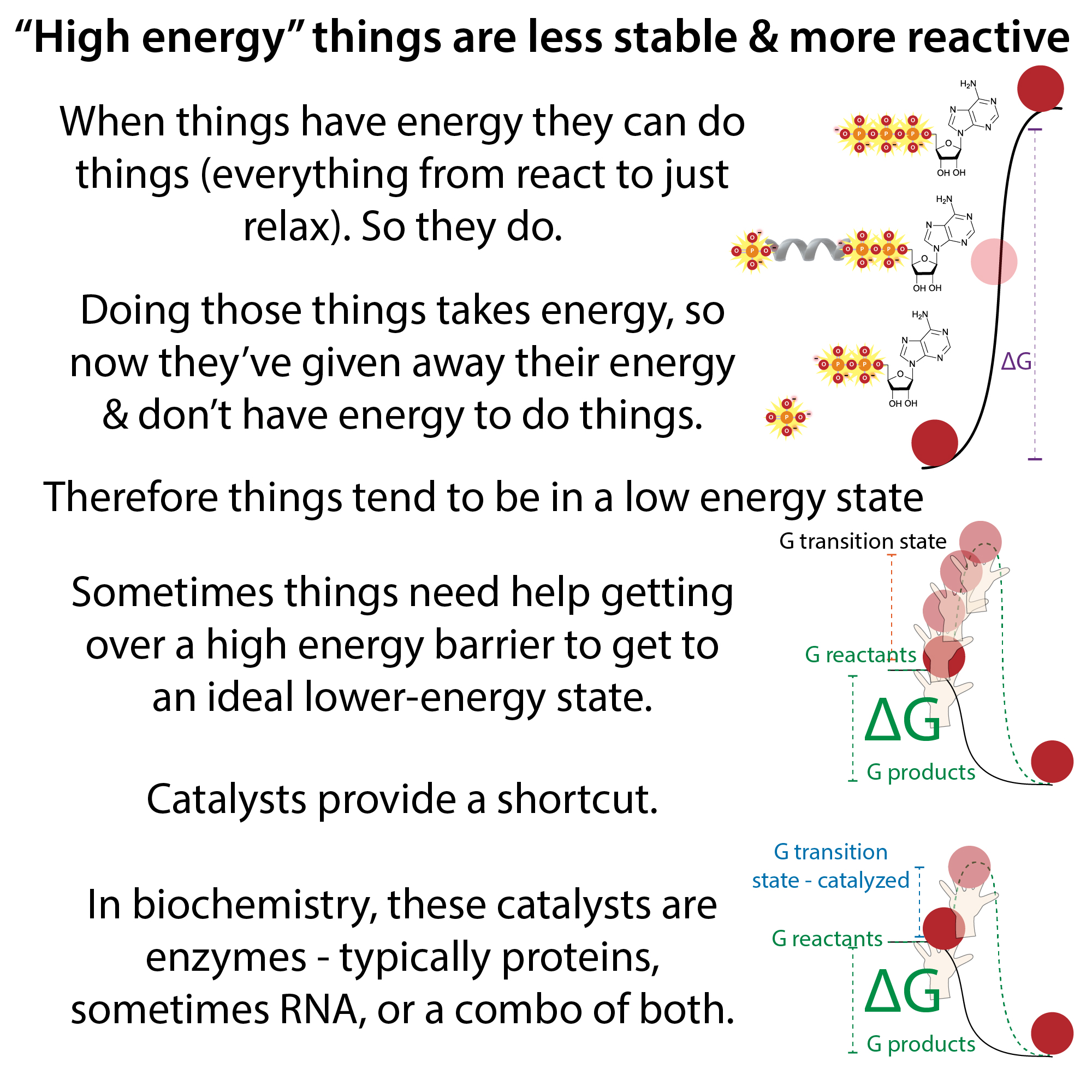
- “High energy” molecules, bonds, states, etc. are “unstable” or “reactive.” (I like to think of them as “uncomfy”). Conversely, “low energy” stuff is more stable, less reactive.
- High energy stuff will do things (like react or just squirm around) in order to get more comfy.
- Doing those things requires energy, so they end up in a low energy state where they don’t have energy to do more things.
- Since without energy they can’t do things, they’re more stable in low-energy states. And you’re therefore most likely to find molecules in low-energy states (at least eventually).
- In order to get low-energy things to do stuff you’ll have to give them energy, such as by coupling a reaction to the breaking of ATP.
link to video in case embed isn’t working: https://youtu.be/k54DZSopNkg
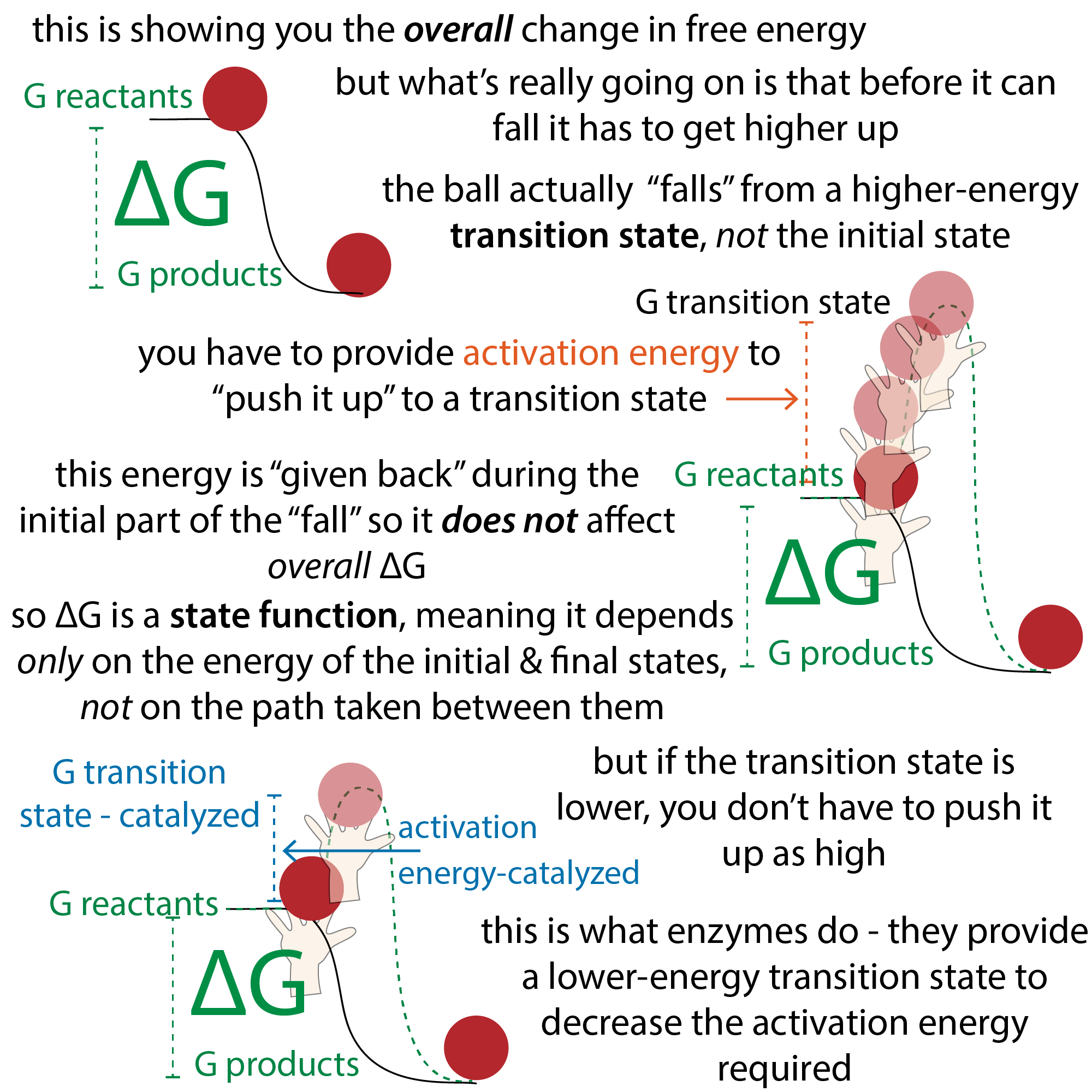
Sometimes molecules need help getting to a lower energy state because there’s a higher-energy/requiring “activation barrier” in between them (think of the arch of a rainbow keeping you from the pot of gold at the other side). In biochemistry, enzymes help make reactions happen by lowering the activation barrier so that less activation energy is required (analogous to decreasing the steepness of the rainbow’s arch). In the lab we can also sometimes just add energy directly in the form of heat. You see this come into play in things like PCR, where we raise the temperature in order to get DNA strands to unzip.
Sometimes there are multiple low-energy states. For example, an unfolded protein typically has high energy. So it’s going to fold in a way that minimizes that energy. This is one reason tools like AlphaFold can predict how proteins will fold (though it’s also a lot more complicated! It involves evolutionary homology (relationship to known structures), etc.). One of the reasons AlphaFold can’t just try to minimize free energy is that there are too many possibilities and multiple “good solutions” (low energy states). Which fold a protein ends up in can depend on what’s around it in the cell, help from chaperones, etc. But if a protein ends up in one fold (either in reality or on a computer) it’s hard to change shape to a different fold – even if that fold has lower energy – because it gets stuck in a free energy* minima (stuck in a valley between mountains) and doesn’t even know there may be better stuff out there.
If a protein doesn’t fold nicely, another way it can reach a low energy state is by aggregating (clumping up with other protein copies). Much more on this in my post on “crashing out” (a slang term we use for when molecules precipitate like this), but if a protein aggregates we have to lower the barrier to reaching a folded state, such as by adding denaturants like detergents and urea to allow the molecule to go back through the unfolded state.
more on this crashing out stuff: blog: https://bit.ly/crashingout; YouTube: https://youtu.be/RDo5P5Wsces
*time to revisit this terminology I’ve been skirting around. What do we mean by “energy”?
When we talk about energy in biochemistry, we’re typically referring to “Gibbs free energy”, abbreviated “G”. I talk about it a LOT more in my posts on thermodynamics. But the gist of G is that it’s a measure of ability to “do work” – basically do stuff. The higher the G, the more you can do. Kinda like the higher up a ball is on a mountain the more damage it can do when it rolls down. But instead of dealing with just kinetic potential energy like in the ball case, we’re dealing with chemical potential energy, taking into account things like enthalpy (heat, bond strength)(abbreviated H) and entropy (randomness, disorder)(abbreviated S).
But do you have enough energy? A single G on its own isn’t that useful when it comes to predicting what molecules might do. Instead we need to have alternative Gs to compare to. What we typically deal with is thus actually ΔG (difference in G) between two states (e.g. reactants and products). Delta (Δ) comes from subtracting the energy of the initial state from the energy of the final state. So if the final state has a lower G than the initial G, ΔG will be negative. As we talked about above, lower energy is more stable – molecules are happier and more comfy. So a negative ΔG means a reaction is “thermodynamically favorable” aka “spontaneous.” And it will give off energy if it happens (e.g. it is exergonic, as opposed to endergonic reactions which take energy)
Warning: Spontaneous doesn’t mean the reaction *will* happen – or even that it’s likely to happen – thanks to that whole activation barrier thing. But the bigger (negatively) the ΔG, the more energy is released and the less likely the reaction is to “undo” itself (go in the reverse direction) if it does happen.
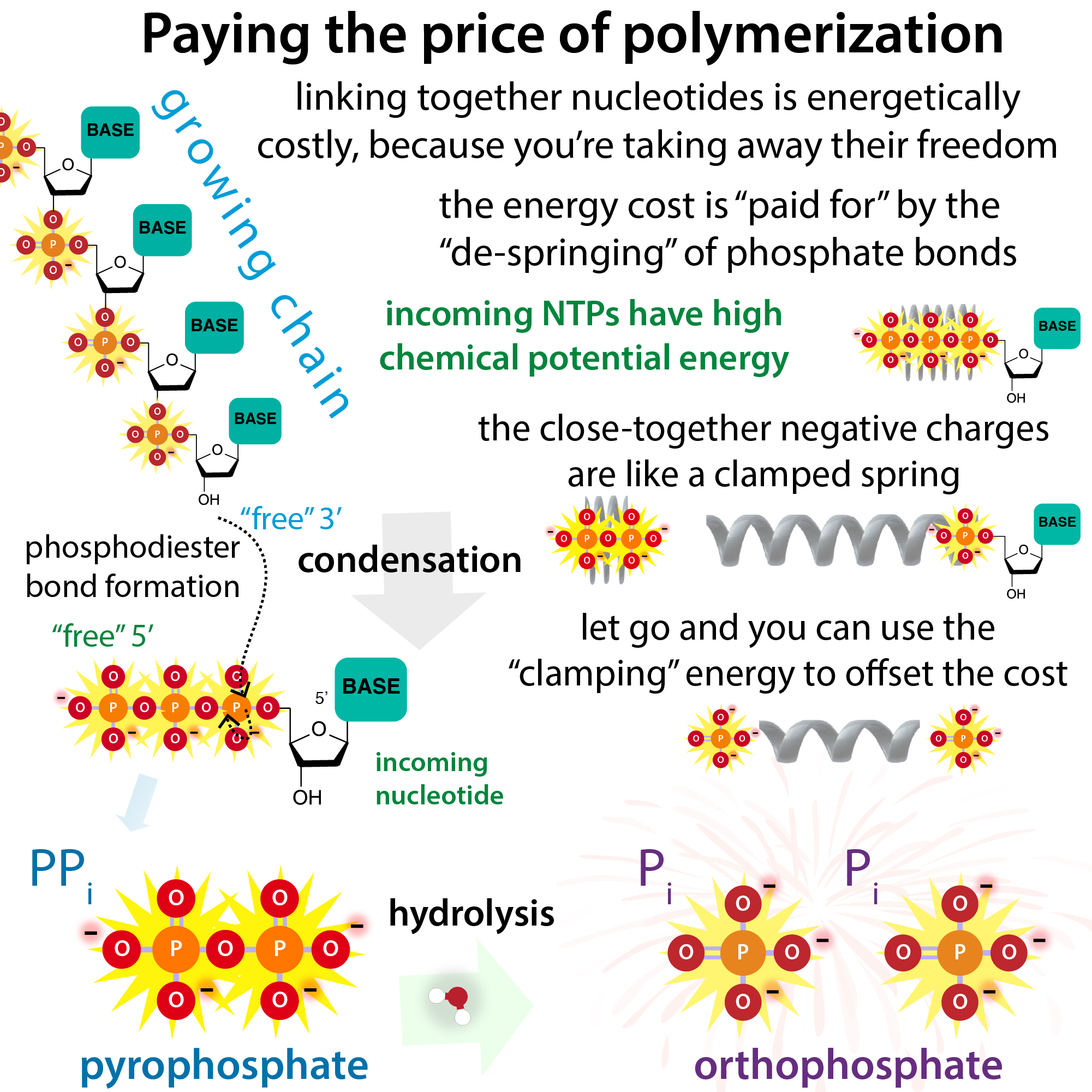
A key example of this is ATP, which is used in our bodies as energy storage. In order to serve as storage it can’t be *too* unstable or it would be useless. But it is “high energy” – it has high energy bonds but they usually need a little help breaking (such as through enzymatic help) to release that energy. The “high energy” bonds in ATP are phosphoanhydride bonds. Scary looking term referring to phosphate groups hooked up together with a net loss of water. Phosphate groups are negatively-charged and like charges repel one another so those phosphate groups hate being stuck together and it takes energy to hold them together. This energy is “hidden” in the chemical bonds linking them but you can visualize it kinda like a clamp clamping down on a stiff spring. If you release the clamp the spring will stretch out (and send anything you had on the end flying across the room). Similarly, if you break one of those phosphate-phosphate bonds, you release energy that can be used to power reactions.
Technical note:
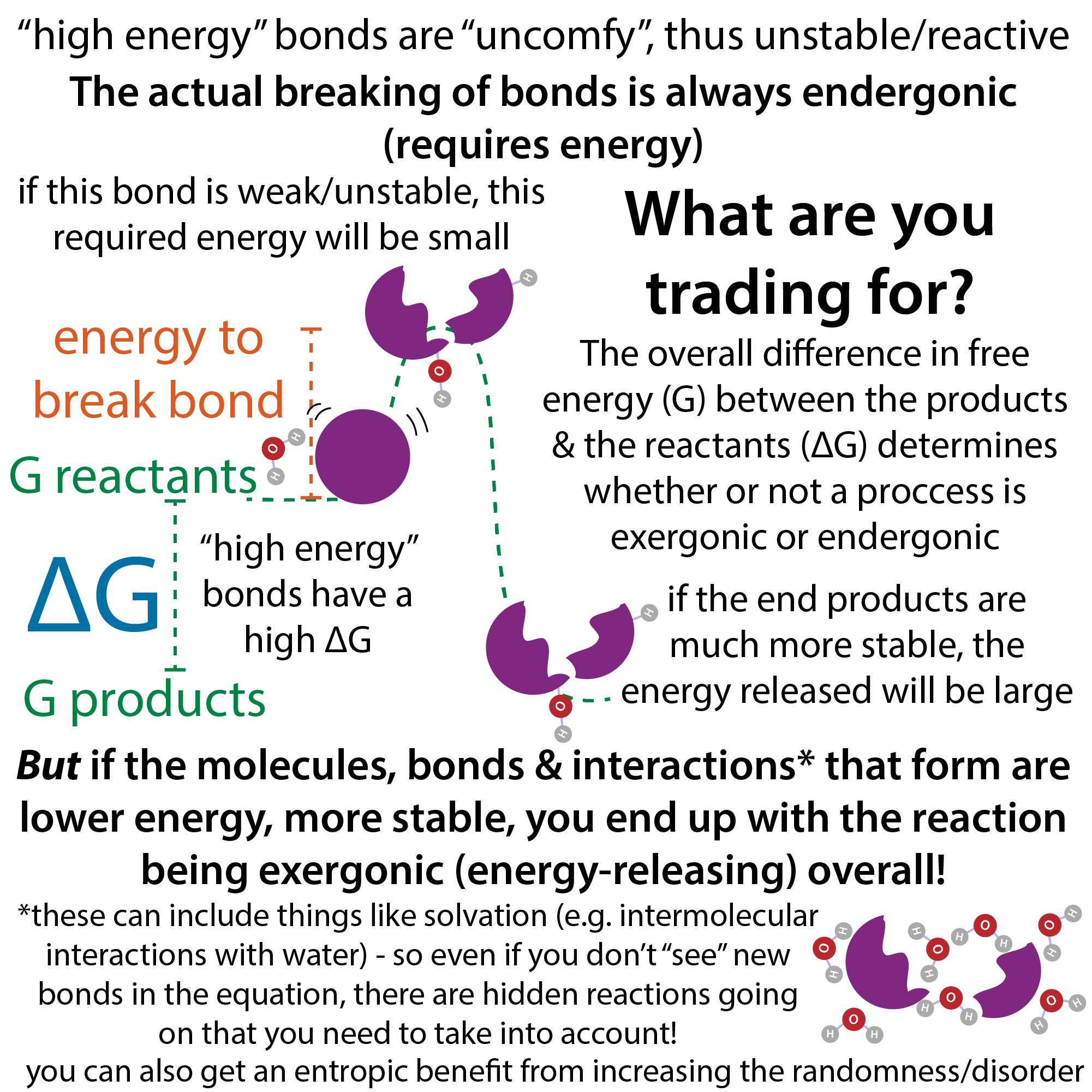
The overall difference in free energy (G) between the products & the reactants (AG) determines whether or not a process is exergonic or endergonic. That is, delta G is a “state function” – taking only into account the initial and final states, not any intermediates in between. And there may be many.
The actual breaking of bonds is always endergonic (requires energy). (Though if this bond is weak/unstable, this required energy will be smaller).
But if the molecules, bonds & interactions* that form are lower energy, more stable, you end up with the reaction being exergonic (energy-releasing) overall!
*these can include things like solvation (e.g. intermolecular interactions with water) – so even if you don’t “see” new bonds in the equation, there are hidden reactions going on that you need to take into account! You can also get an entropic benefit from increasing the randomness/disorder – for example when you break ATP you get more molecules and thus more different orientations in which molecules can be found (more entropy).
Much more on ATP here: blog form: https://bit.ly/atpenergymoney ; YouTube: https://youtu.be/1AOuyEDezzI
And free energy here: https://bit.ly/thermodynamicstalk & http://bit.ly/partypopperscience & https://youtu.be/oX0KAJWnuog
But I hope today helped you intuit things a bit without getting lost in the thermodynamic alphabet!
Don’t get me wrong – details and formulas and all that good stuff are really important. But it’s also important to have a sense of why they work, what they’re doing, and why they matter. I strongly feel that a key component of being a good biochemist is developing an intuitive understanding of molecular goings-on and I hope this helps you develop one!