Biochemistry can seem really overwhelming at first glance. But if you break things down to basic concepts, you can take charge of the situation and see that it’s really not that bad. In fact, it’s brilliantly beautiful!
link to video in case embed isn’t working: https://youtu.be/e6idbVepR14
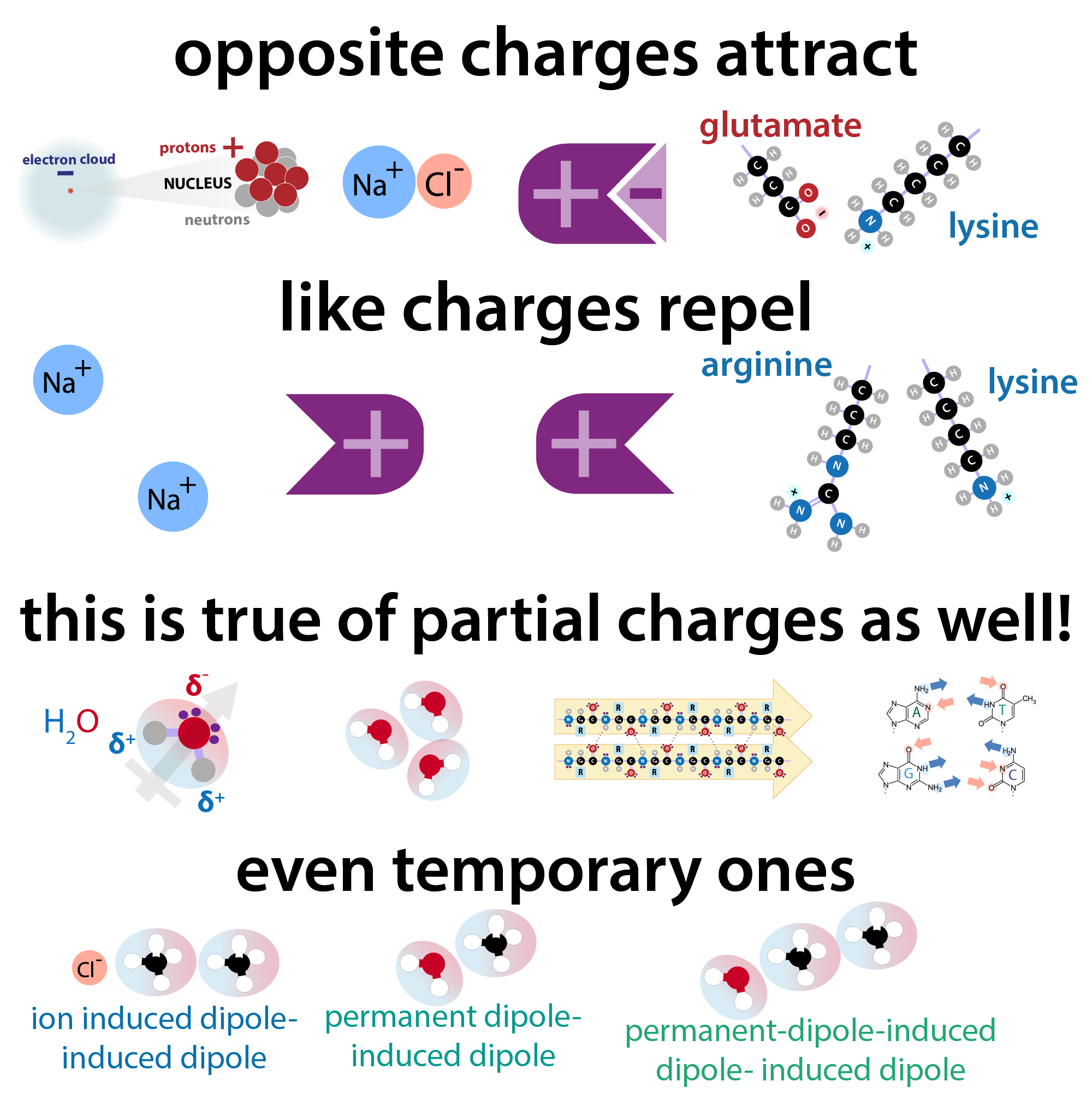
One of the key things that helped me understand all the various interactions and goings-on in biochemistry was to realize that you can pretty much view everything through the lens of charge. Keep in mind that:
- Opposite charges attract
- Like charges repel
- This is true of partial charges as well
- Even temporary ones!
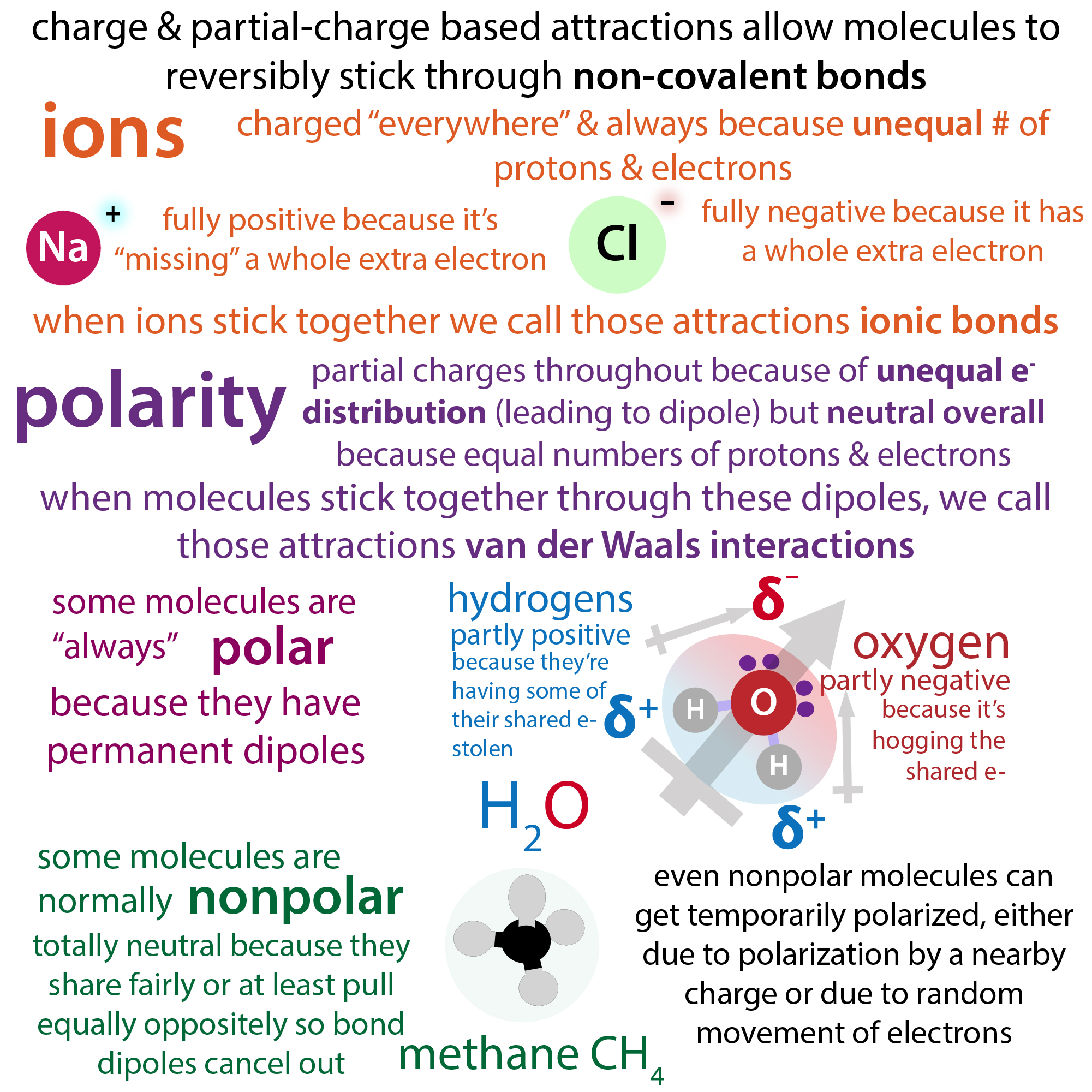
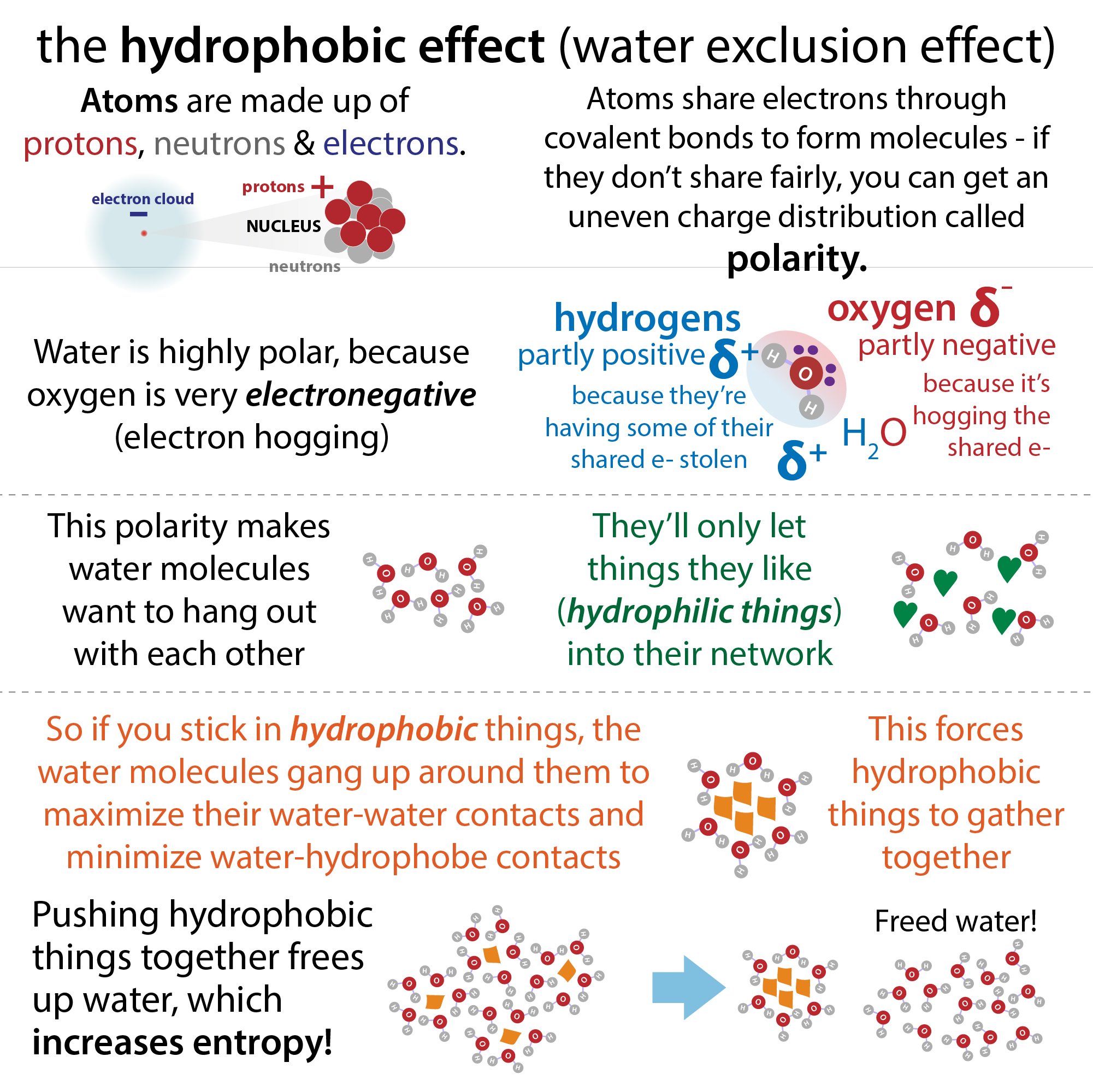
You might be able to remember the whole opposites attract thing thanks to dating cliches, but it can be harder to see how this applies in a lot of cases because charges in biochemistry are often hidden in regions of molecules that are neutral (charge-less) overall. Take water for example – good ole H2O. It’s neutral overall, but the hydrogens are partly positive and the oxygen is partly negative. So oxygens of one water molecule stick to hydrogens of another, and this allows water to form networks.
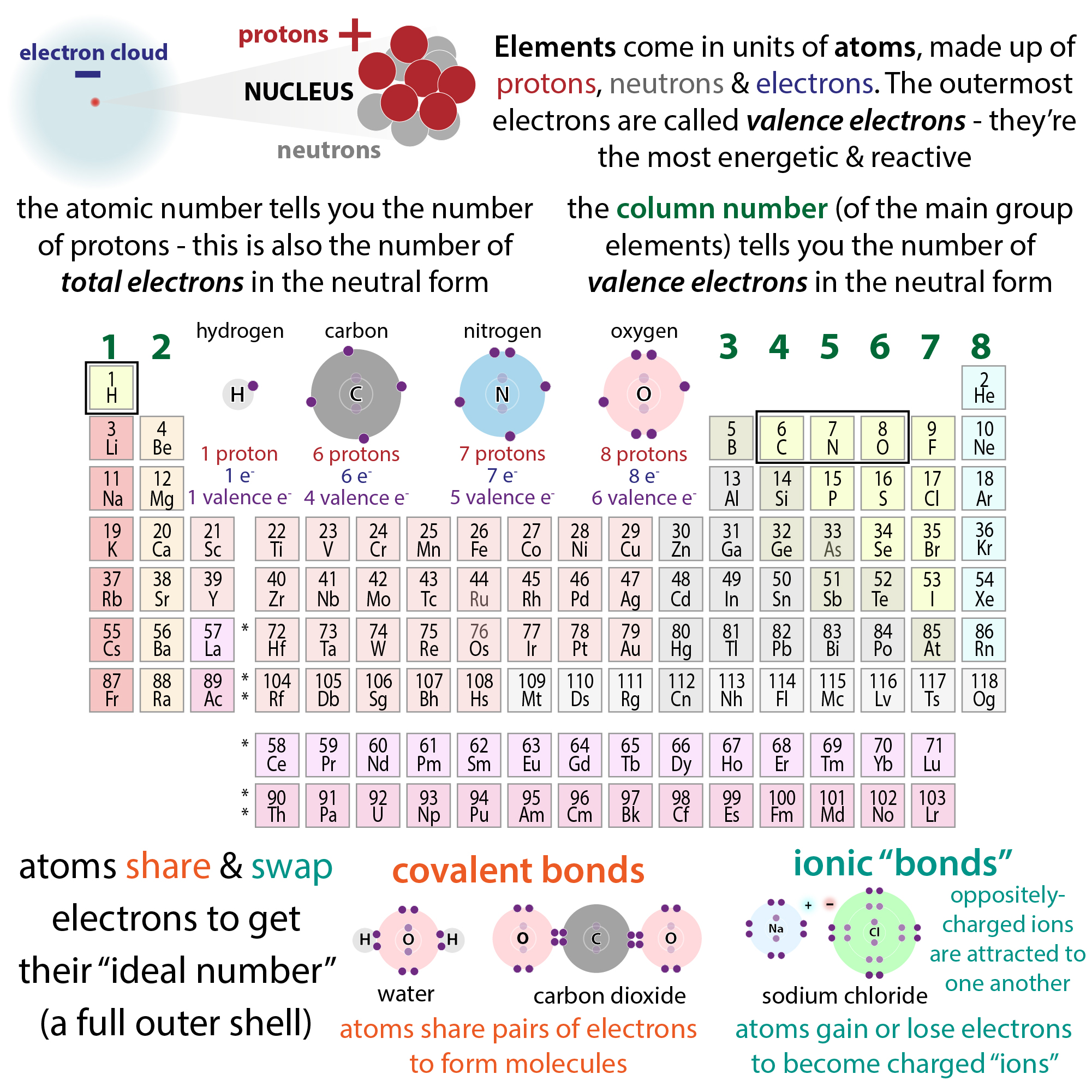
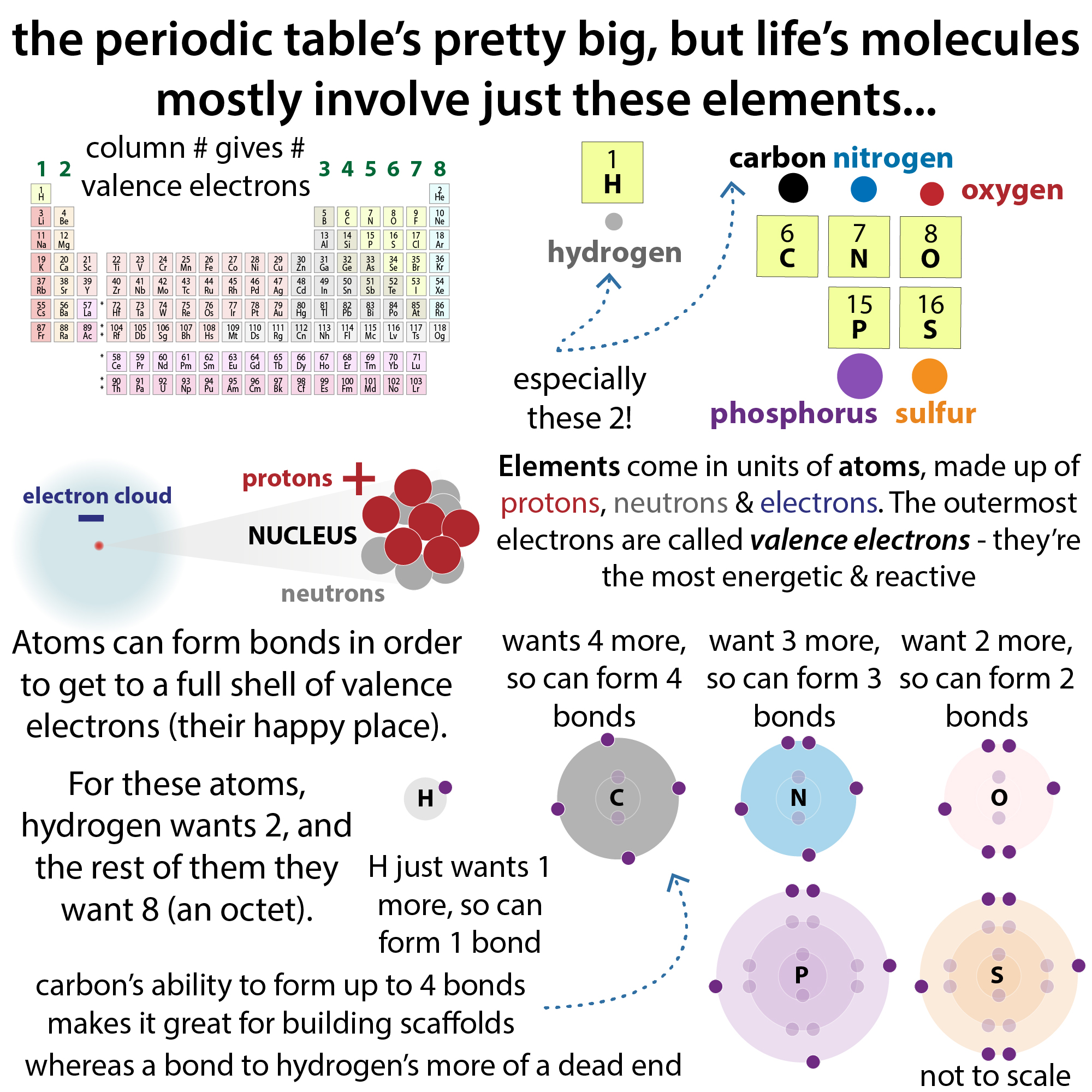
Where do these charges come from? Subatomic particles. Each of those atoms – the hydrogens and the oxygens – is made up of smaller parts: protons, neutrons, and electrons. The protons are positively-charged, neutrons are neutral, and electrons are negatively-charged. Each element has a fixed number of protons, and the protons in each atom are “glued” in place by neutrons in the central core of the atom called the nucleus. The electrons whizz randomly around there in an “electron cloud” and the electrons of different atoms can interact.
Although the electrons move randomly and we can’t predict exactly where they will be at any one point in time, there are places where they’re more likely to hang out (atomic orbitals). Atoms have ideal numbers of electrons (especially outermost “valence” electrons which are the most loosely-held and reactive) and can share pairs of electrons to get to those ideal numbers. Atoms share electrons by overlapping regions of their electron clouds, merging orbitals to form molecular orbitals. The geometry of these is dictated in large part by optimization of charge-based attractions and repulsions outside the scope of this post. This electron-sharing is called a covalent bond. And it’s how atoms within a molecule are held together (it’s holding Mickey Mouse’s ears onto his face in a water molecule).
A molecule is a group of atoms held together through strong covalent bonds that involve electron-sharing.
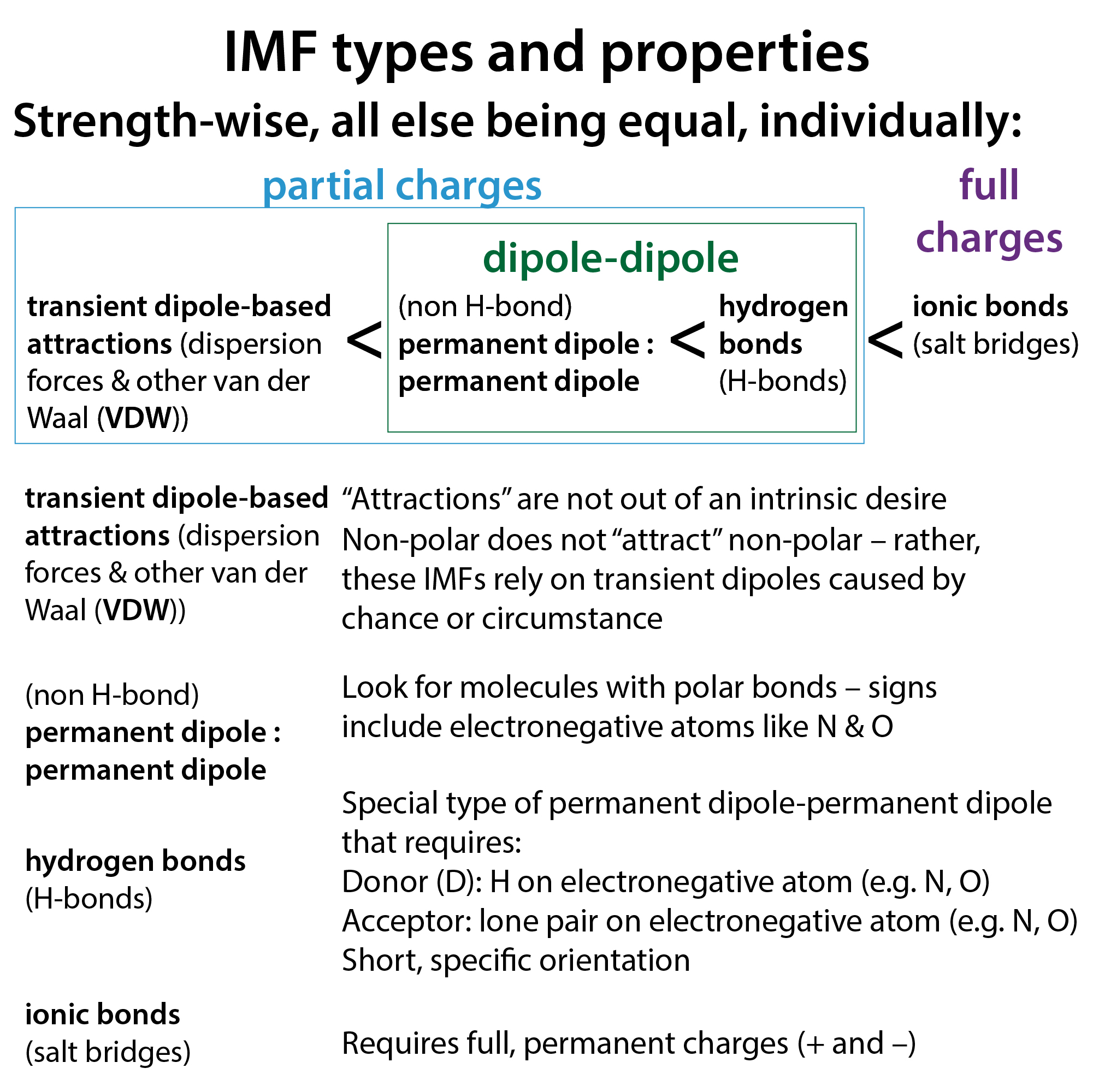
Such bonds are a key focus in chemistry and in some aspects of biochemistry, especially metabolism (the making and breaking of molecules). But much of the time in biochemistry we’re instead focused on intermolecular interactions or forces (so-called IMFs). The things keeping multiple Mickey Mice hanging out together. (Though we’re usually dealing with proteins, nucleic acids, etc instead of disembodied cartoon heads!). Instead of merging clouds and sharing electrons, these “non-covalent” interactions involve (individually) weaker attractions based on charge. Sometimes this charge is “obvious” – like when you’re dealing with “ionic bonds” – attractions between fully-charged molecules (ions). But much of the time the charge is hidden…
In a neutral molecule, the # of protons = # of electrons. But since the electrons are whizzing all around – and they can spend more time hanging out in certain areas – the charge isn’t always evenly balanced everywhere in the molecule, and you often have a situation where electrons (with their negative charge) like to hang out more in one part of the molecule, making that part partly negative (δ-), leaving the other part of the molecule they fled from partly positive (δ+). We call this gradient of imbalance a dipole. δ is pronounced delta and it means partly. (Don’t confuse it for uppercase delta, Δ which means change in and we often use to avoid calculus…)
There are different ways to end up w/such partially-charged regions…
Going back to the covalent bonds making up a molecule, shared electrons aren’t always shared fairly. Instead, electrons are more likely to hang out around atoms that want them more (are more electronegative). Examples of electronegative atoms are oxygen and nitrogen. When they’re bonded to something less electronegative (such as carbon or hydrogen), this can set up a permanent dipole (separation of charge). This is how we get Mickey’s ears being partly positive. In addition to hanging out with other polar molecules, polar molecules can hang out with ions.
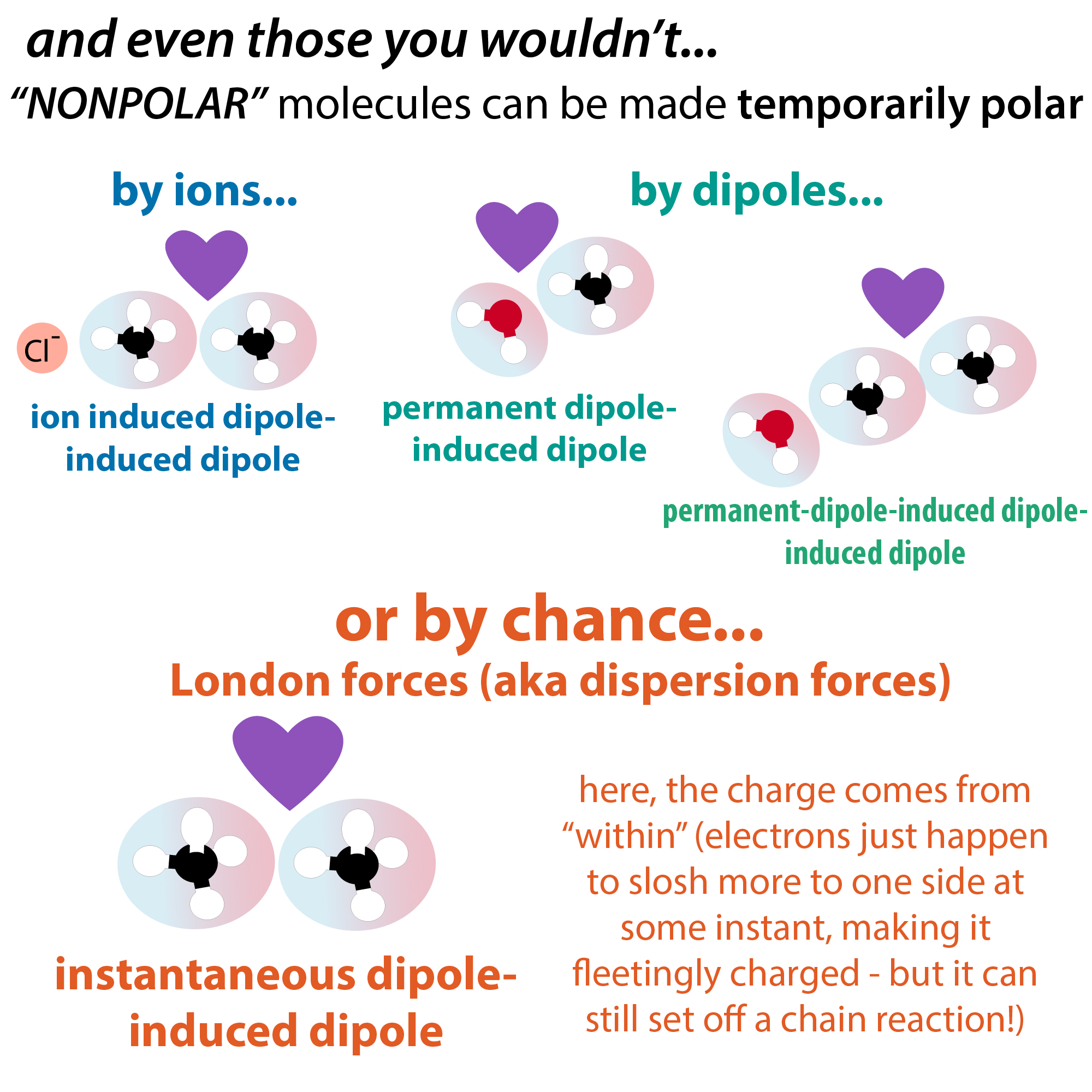
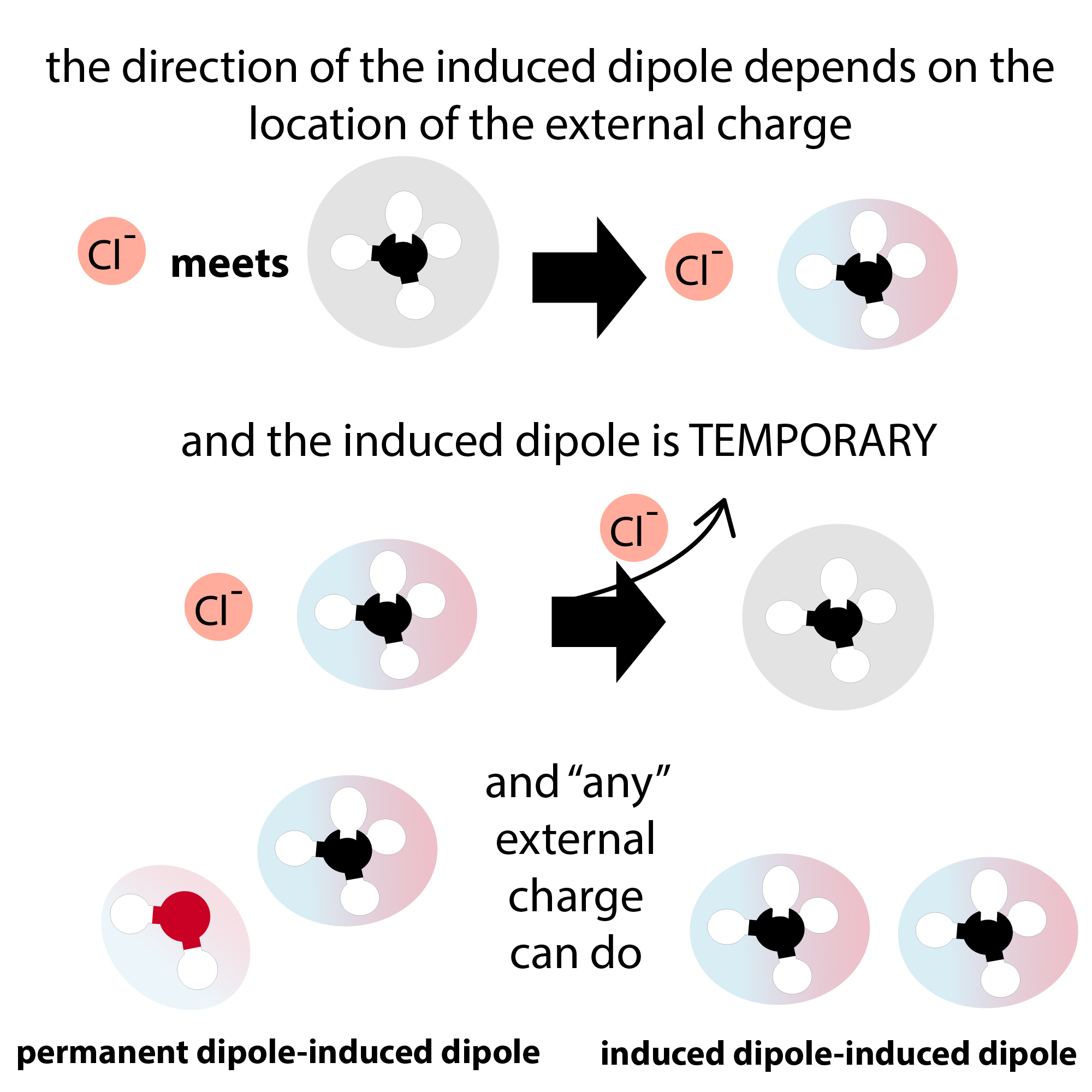
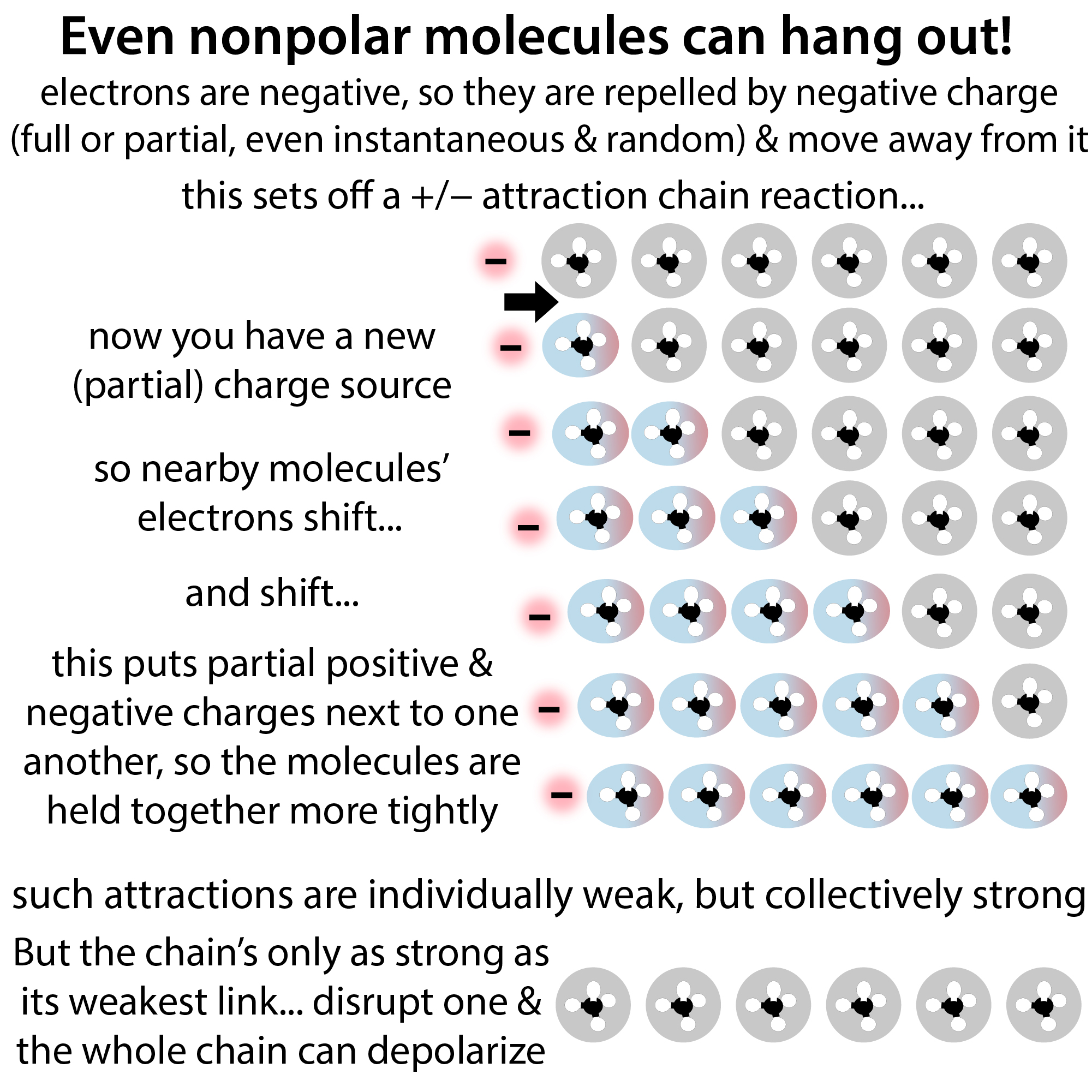
What about molecules made up of atoms that share their electrons more fairly (such as hydrogen and carbon)? How do they hang out with anything if they’re so “blah”? Well, although they’re normally “boring” charge-wise, they can be induced to be temporarily-charged if a charge comes near them and causes a temporary dipole. Basically, the electrons will shift away from negative things and towards positive things. And this can lead to chain reactions where atoms and molecules can kinda sync up their electron clouds. Leading to collectively strong sticking (think geckos walking up walls or DNA base stacking).
That original trend-setting charge can come from a permanently-charged or permanently-partially-charge molecule. But it can also just arise from the random roamings of electrons. Remember how I said electrons whizz around randomly in their clouds? People have a tendency to think if something’s random it should be like even all the time (heads, tails, heads, tails, etc.). But really, randomness leads to things that might seem suspicious (heads, heads, heads, heads…) and even lead us to accuse people of cheating. In the subatomic case, electrons might just randomly happen to be hanging out in one region at some point of time (an instantaneous dipole) and this can be enough to kick that chain reaction into action.
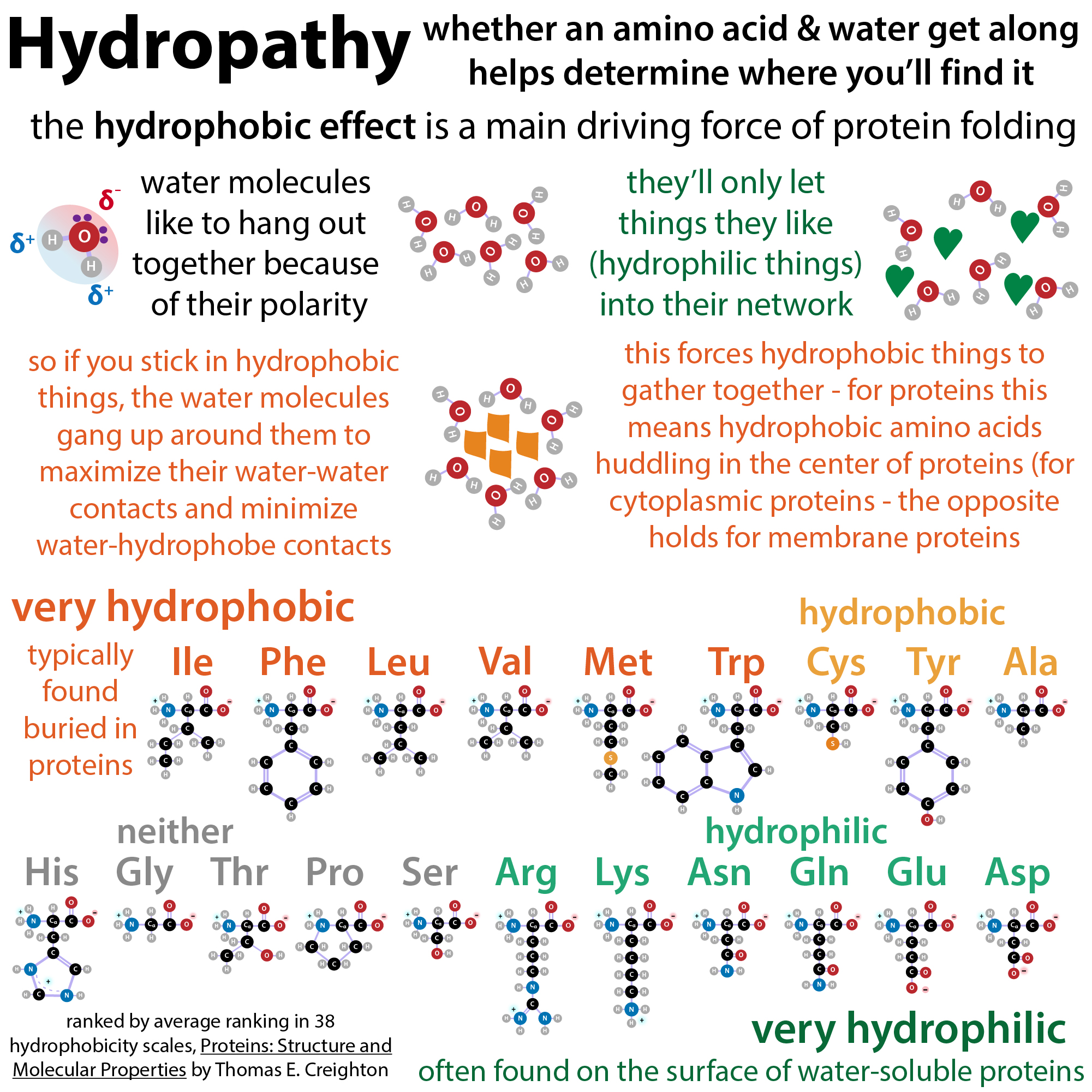
And that chain reaction can be more likely if the non-polar molecules are clustered together, such as in the center of a protein after being excluded from water’s network. This is the basis for “hydrophobic interactions.”
See – charge is involved even in these interactions that seem like they’d be the opposite of charge-based interactions!
Instantaneous dipole-induced dipole interactions are sometimes called dispersion forces or London forces & they’re the weakest type of IMFs but together they add up! And, speaking of adding up, the combination of all these IMFs can be called van der Waals forces – and they literally let geckos walk up walls!
To summarize IMFs: The fundamental core of IMFs is that opposite charges attract, like charges repel. Then you just have terminology to distinguish between sources of charge unevenness. The source of the external charge can be…
- a fully charged particle (ion): ion-induced dipole
- a partially charged part of a polar molecule: dipole-induced dipole
- a partially charged part of a temporarily polar molecule: induced dipole-induced dipole
- a partially charged part of a randomly temporarily polar molecule: instantaneous dipole-induced dipole (aka dispersion forces or London forces)
IF you want even more IMFs…: http://bit.ly/polarityIMF
Some core things to keep in mind regardless of what you’re dealing with:
- opposite charges attract, like charges repel
- it “doesn’t matter” where the charge comes from
- these charges don’t have to be “full charges”
- these charges don’t have to be “permanent”
- this applies both at the “large scale” (whole molecules interacting with one another through intermolecular forces (IMFs)) and the “small scale” (electrons within atoms within molecules)
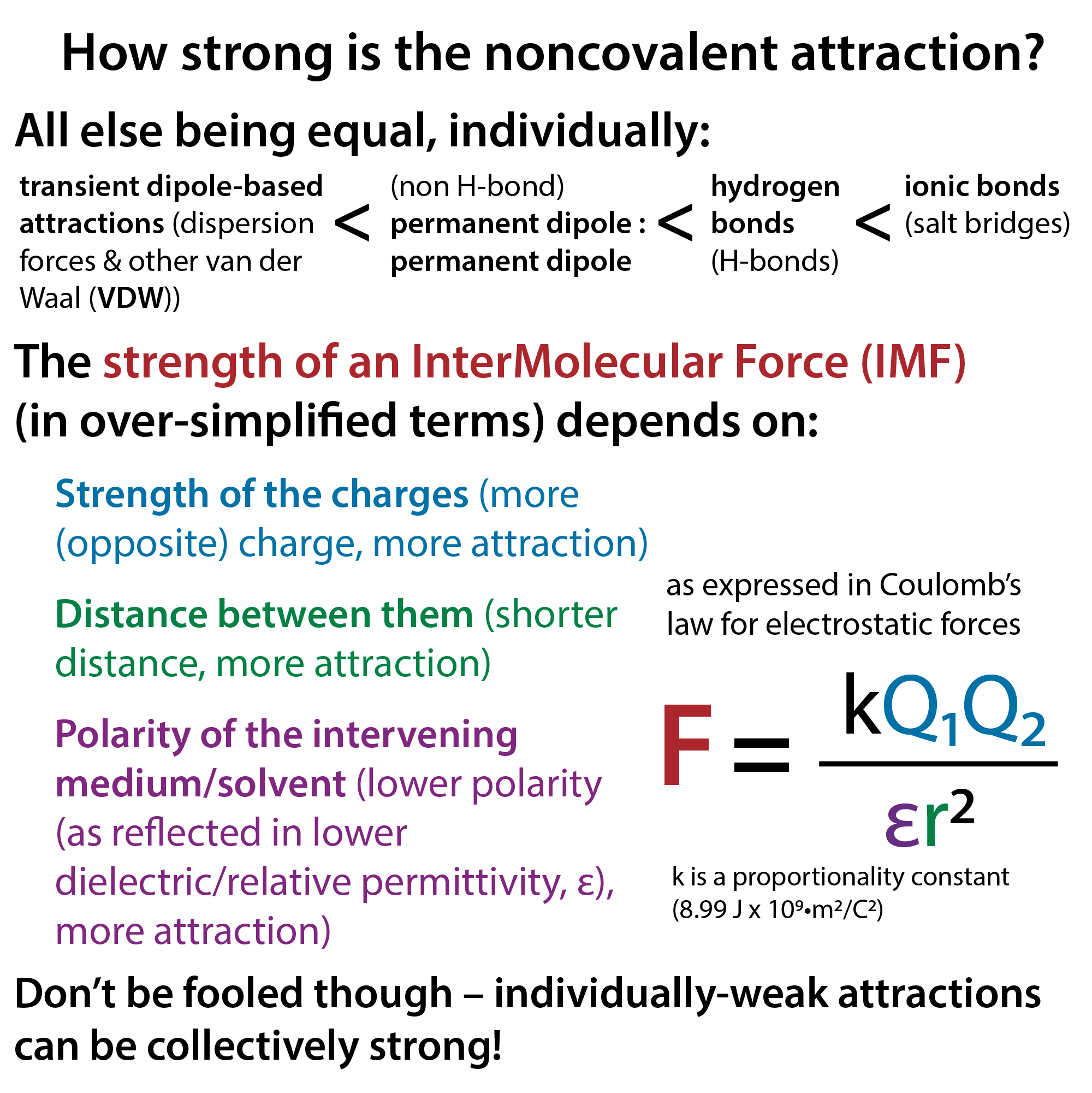
- the bigger the opposite-chargeness, the stronger the attraction
- the further apart the opposite charges, the weaker the attraction
- charge-based attractions are fickle friends – they’re “weak” and “easily” reversible
- every bit counts – lots of small attractions can add up to pretty powerful stickiness (just ask the Geiko gecko’s feet!)
more about all sorts of things: #365DaysOfScience All (with topics listed) 👉 http://bit.ly/2OllAB0 or search blog: https://thebumblingbiochemist.com