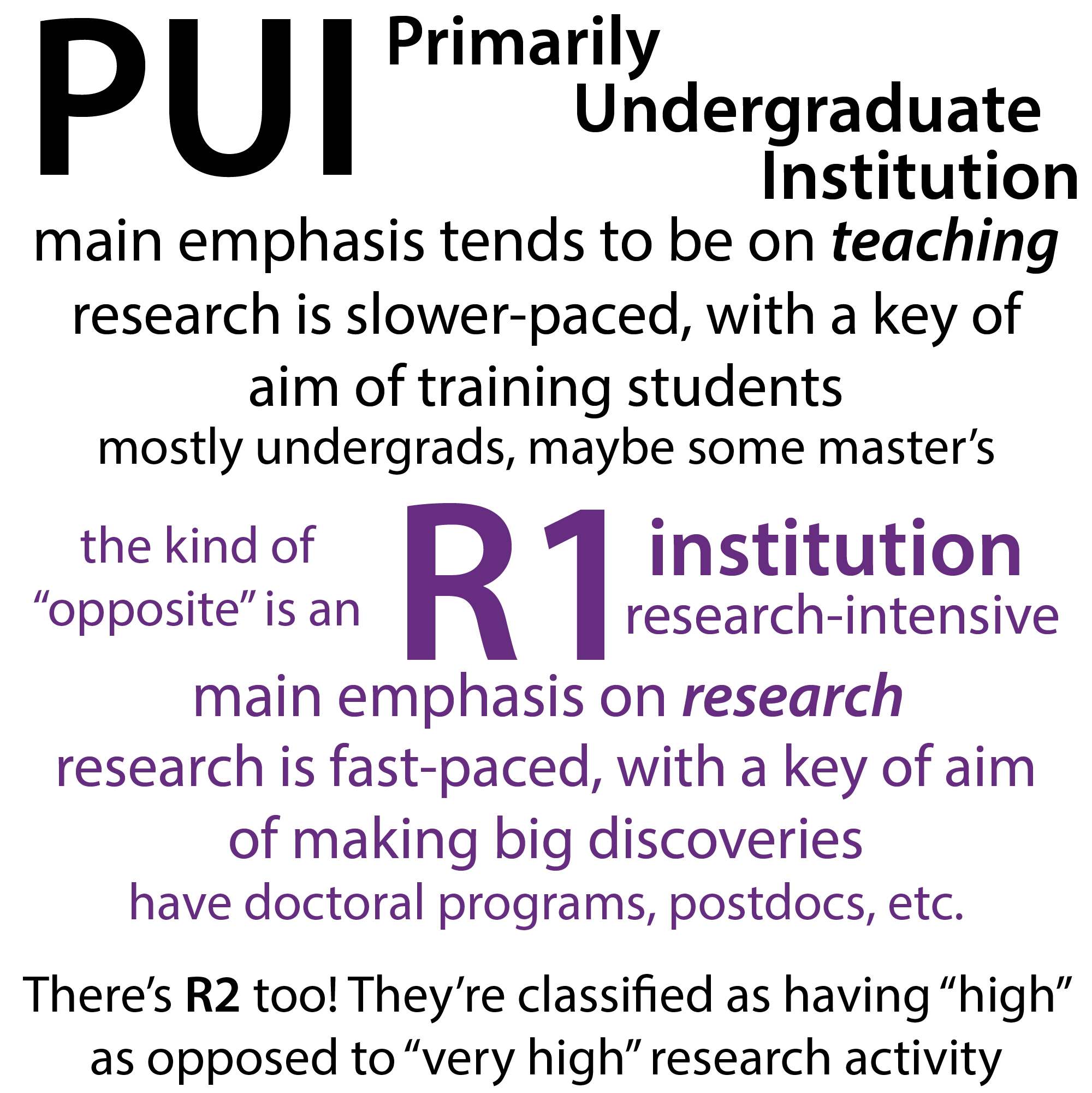
PUI stands for Primarily Undergraduate Institution. It’s a term used to refer to a college or university that’s mostly undergrads (maybe some master’s too). The main emphasis tends to be on teaching research is slower-paced, with a key of aim of training students. It’s the kind of place I went for undergrad (I went to a small liberal arts school called St. Mary’s College of California) – and it’s the kind of place I want to end up being a professor at.
link to video in case embed isn’t working: https://youtu.be/cUEtMOV2xjc
The kind of “opposite” of a PUI is an R1, which is a research-intensive doctoral-degree-granting institution. Here, the main emphasis on research. This research is fast-paced, with a key of aim of making big discoveries. They tend to have a lot of high-end equipment, “cutting-edge” stuff.
There’s R2 too! They’re classified as having “high” as opposed to “very high” research activity.
Which brings me to the point that although we use the term “R1” pretty loosely to refer to research-intensive institutions, it’s actually a technical classification (from the Carnegie Classification scheme) with a specific definition.
“To achieve the “R1” classification, a university must meet the following requirements: award at least 20 research/scholarship doctoral degrees in the update year; spend at least $5 million in total research (as reported through the National Science Foundation (NSF) Higher Education Research & Development Survey (HERD)); and, score high in a Research Activity Index calculation.”
“2021 Carnegie Classifications of Higher Education Institutions released,” Emily Chesser, 01/06/22 https://ssti.org/blog/2021-carnegie-classifications-higher-education-institutions-released
So, basically, the “R1” designation is based on # of degrees given & $$$ spent on research. A lot of that $ is spent on fancy equipment so if you train there you might get to use some of it. At an R1 institution there will be more different types of experiments you can do (but you can still do awesome lower-tech research at a PUI and then later, in grad school or postdoc, go to an R1 & use the fancier stuff if you want).
Places often want to reach R1 status because it’s the most “prestigious” but PUIs can be amazing places for research as undergrads.
I had a life-changing experience at a PUI and it’s basically motivated most of what I do. But a PUI may or may not be the right choice for *you*. So here’s a little more about how PUIs & more research-intensive places vary when it comes to a student perspective.
The details will vary from place to place, but at a PUI, the professors tend to be more actively involved in the lab work (at the bench with students). At an R1 institution, usually the professors steer the ship in the big picture, but tend to be less hands-on – they have a lot of other obligations taking their time like getting grants to do all the research!
Sometimes, even at an R1 institution, the professors are more hands-on. This is especially common for newer professors who are just starting up their labs and don’t have as many hands on deck to help (nor as many obligations yet, other than to get preliminary results to get grants & publish findings).
When you’re choosing a lab, whether at a PUI, an R1, an R2, or some other place, it’s important to choose a lab where the professor’s mentorship style fits what you want. This is something you can find out during grad school lab rotations (where you test out a few labs before choosing) or by talking to current students or by directly asking the professor about expectations. Know what you’re getting into. And know that there’s not one “right” style – it just depends on what you want and how you best learn.
If you do go to a PUI, since the course offerings, etc. will be more limited, try to seek out opportunities outside of your college to get a broader perspective of the vast world of science (such as by attending conferences). It’s also important to learn more about the sort of hierarchy and schema of “academia” (grad students, postdocs, etc.). For this latter perspective, a great thing is to do a summer research experience (e.g. an REU (research experience for undergraduates) at an R1 (or similar) institution. I am really grateful that my research mentor at SMC, Dr. Jeff Sigman, pushed me to do one because it helped me realize I wanted to go to grad school, not med school!
So, bottom line, there are pros & cons to all types of places, and it’s largely a personal choice as to what you want most. I worried that coming from a small liberal arts school might negatively impact my grad school chances but I was pleasantly surprised to find it didn’t. In fact, going there really helped me – in so many ways – including by providing an extensive research experience that I was able to articulate in my essays.
Hope this helped people thinking about these things.
more about the classifications:
Carnegie Classification of Institutions of Higher Education, Basic Classification: https://carnegieclassifications.acenet.edu/carnegie-classification/classification-methodology/basic-classification/
Wikipedia “list of research universities in the United States”: https://en.wikipedia.org/wiki/List_of_research_universities_in_the_United_States
more school-related posts: https://bit.ly/gradpostdocetc