I was super excited when I saw that Carolyn Bertozzi was awarded the Nobel Prize in Chemistry for her pioneering work on “bioorthogonal chemistry”. To help you get excited too, I thought I’d give a bioorthogonal chemistry overview!
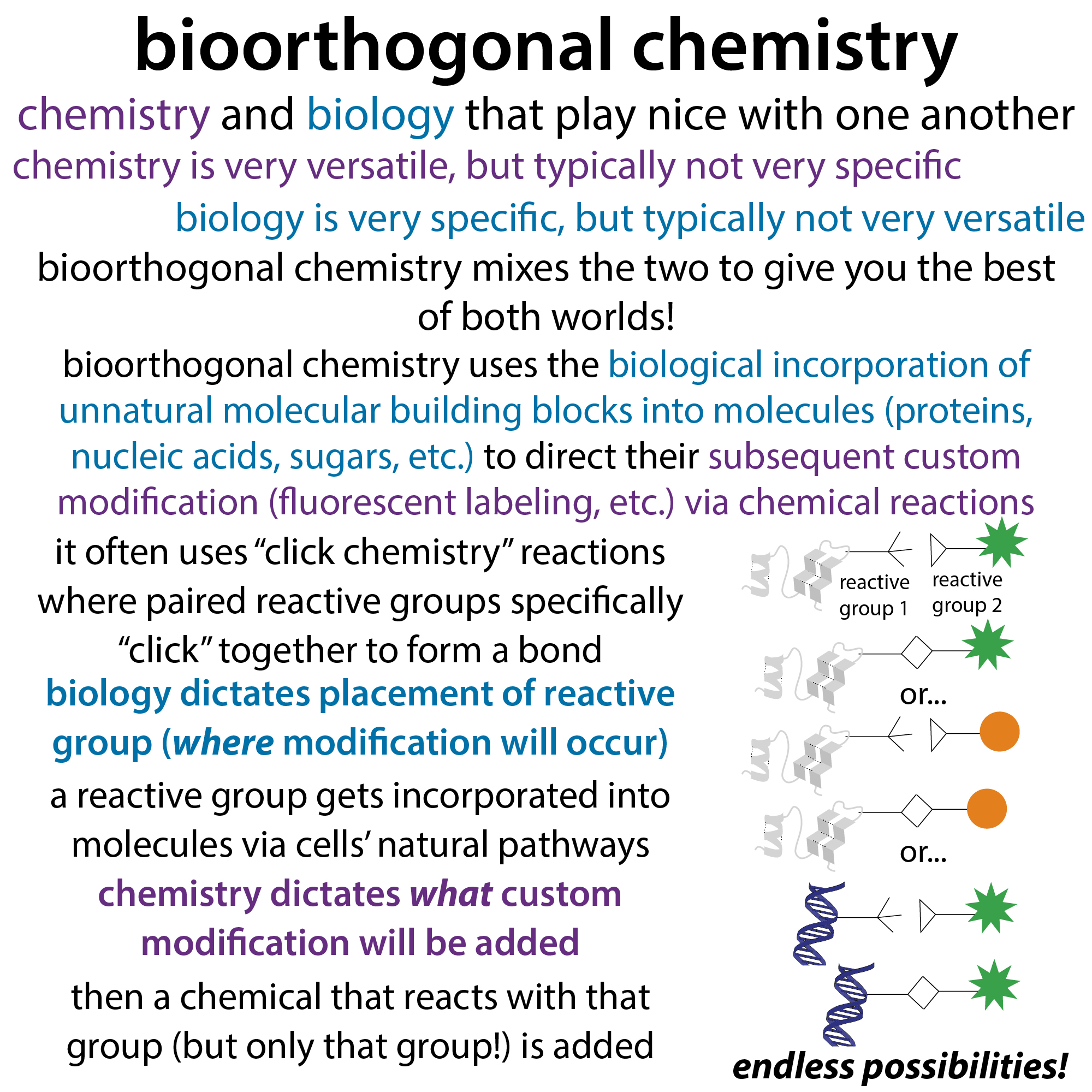
The name sounds intimidating, but bioorthogonal chemistry is just chemistry and biology that play nice with one another. You see, chemistry is very versatile, but typically not very specific. Biology, on the other hand, is very specific (thanks enzymes!), but typically not very versatile. Bioorthogonal chemistry mixes the two to give you the best of both worlds!
Bioorthogonal chemistry uses the biological incorporation of unnatural molecular building blocks into molecules (proteins, nucleic acids, sugars, etc.) to direct their subsequent custom modification (fluorescent labeling, etc.) via chemical reactions.
It often uses “click chemistry” reactions where paired reactive groups specifically “click” together to form a bond.
Biology dictates placement of reactive group (where modification will occur) – a reactive group gets incorporated into molecules via cells’ natural pathways
Chemistry dictates what custom modification will be added – a chemical that reacts with that original reactive group (but only that group!) is added.
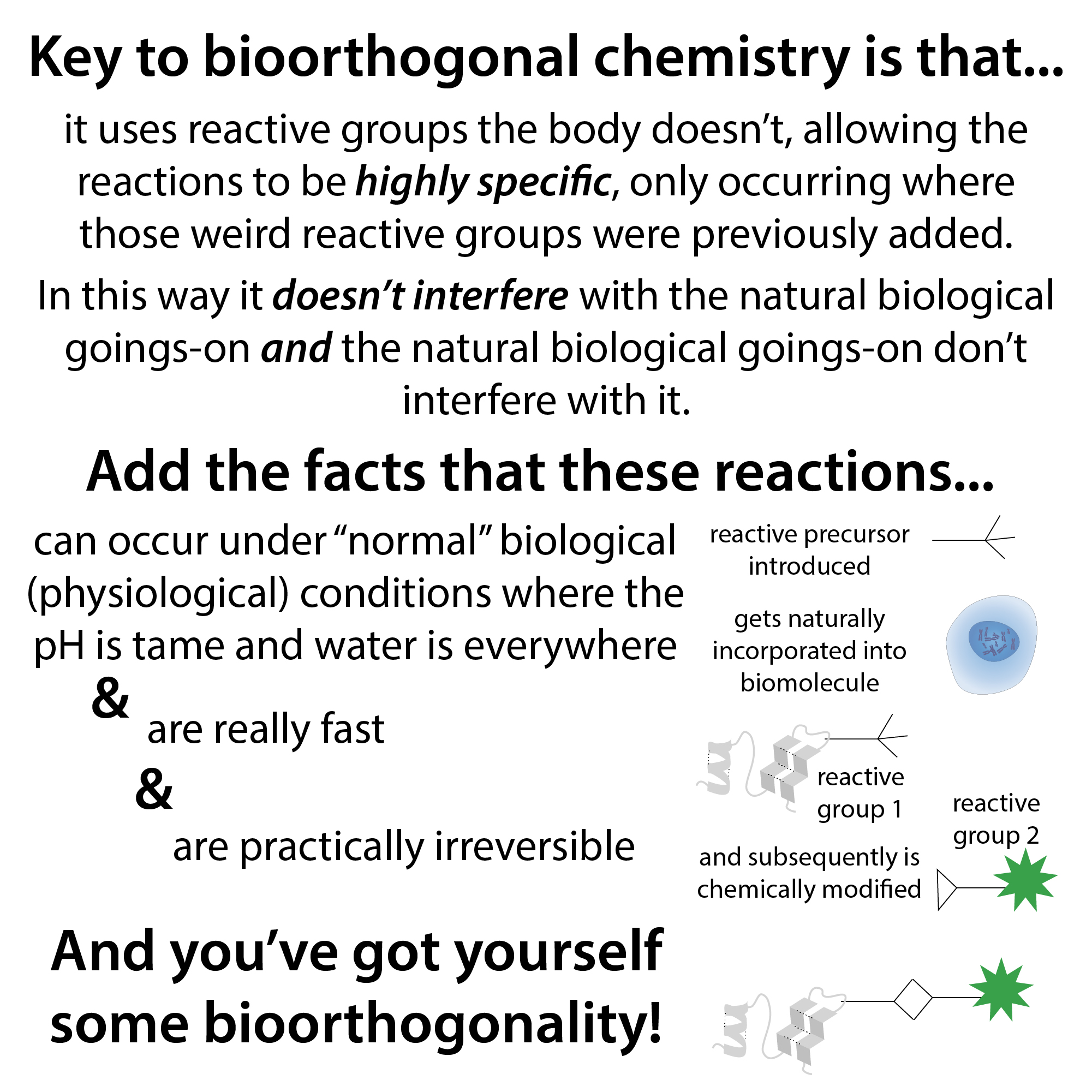
Key to bioorthogonal chemistry is that…
- It uses reactive groups the body doesn’t, allowing the reactions to be highly specific, only occurring where those weird reactive groups were previously added.
- In this way it doesn’t interfere with the natural biological goings-on AND the natural biological goings-on don’t interfere with it.
Add the facts that these reactions…
- can occur under “normal” biological (physiological) conditions where pH is tame and water is everywhere
- Are really fast
- Are practically irreversible
And you’ve got yourself some bioorthogonal chemistry!
Bertozzi specializes in using such chemistry to study glycans (sugar chains) – specifically the glycans coating the surface of cells. This coat can change under some disease conditions, and Bertozzi developed bioorthogonal chemistry techniques to track where glycans are and how/why their composition changes. To do this, she designed reactive group-modified monosaccharides (individual sugars) that cells could incorporate into their natural glycans. Then she could add a labeled chemical with the complementary reactive group, leading the glycans to get labeled.
Initially (late 1990s) she used ketone-based reactions. But this wasn’t truly bioorthogonal because cells have and use ketones as reactive groups too, just not on the surface of cells.
Mahal, L. K., Yarema, K. J., & Bertozzi, C. R. (1997). Engineering chemical reactivity on cell surfaces through oligosaccharide biosynthesis. Science (New York, N.Y.), 276(5315), 1125–1128. https://doi.org/10.1126/science.276.5315.1125
The reaction also wasn’t ideal speed, yield etc.-wise so she turned to alternatives, developing a version based on something called a “Staudinger reaction.” The details are beyond the scope of this post, but the traditional reaction involves a reactive group called a phosphine which has some stability and specificity issues. And the type of bond it generates between the two things you want to link is unstable in water. Which is a big problem if you’re trying to carry out these reactions in biological solutions, where water is everywhere! Bertozzi found a way to stabilize the unstable bond, getting a more stable bond – an amide bond to be specific – to form.
Saxon, E., & Bertozzi, C. R. (2000). Cell surface engineering by a modified Staudinger reaction. Science (New York, N.Y.), 287(5460), 2007–2010. https://doi.org/10.1126/science.287.5460.2007
That was a big step forward, but it still wasn’t good enough for Bertozzi (or for complex applications). They still had the problem of the phosphine. So they looked for alternatives.
Around this time (early 2000s) this year’s other 2 chemistry Nobel laureates (Morten Mendal and Barry Sharpless) announced a breakthrough in “click chemistry” – the canonical click chemistry reaction of a copper-catalyzed cycloaddition between an azide (N3) and an alkyne (C triple-bonded to another C). The two’s independent finding that copper could dramatically accelerate and improve the reaction has gone on to transform various fields, allowing people to “easily” link together diverse things just by incorporating an azide on one thing and an alkyne on the other. These groups are really small so they don’t interfere with the molecules much. But the copper does! Copper is toxic to cells and organisms if not tightly controlled. So Bertozzi knew that if she wanted to use a similar reaction in cells, she would need to find a way to do it without the copper.
And she did! By searching the literature for inspiration, she got the idea to use a strained cyclic alkyne. She’d stick the alkyne in an awkward ring which would make it more eager to react in a way that would relieve the strain. This came to be know as strain-promoted azide–alkyne cycloaddition (SPAAC).
Agard, N. J., Prescher, J. A., & Bertozzi, C. R. (2004). A strain-promoted [3 + 2] azide-alkyne cycloaddition for covalent modification of biomolecules in living systems. Journal of the American Chemical Society, 126(46), 15046–15047. https://doi.org/10.1021/ja044996f
SPAAC has been widely used and adapted in various applications.
Here is a great open-access (free-to-read) review article (very comprehensive, so some of it is highly technical but there are also more accessible overviews and figures).
Bird, R. E., Lemmel, S. A., Yu, X., & Zhou, Q. A. (2021). Bioorthogonal Chemistry and Its Applications. Bioconjugate chemistry, 32(12), 2457–2479. https://doi.org/10.1021/acs.bioconjchem.1c00461
The Nobel Prize website has some great explanatory resources.
https://www.nobelprize.org/prizes/chemistry/2022/summary/
Popular science background: https://www.nobelprize.org/uploads/2022/10/popular-chemistryprize2022.pdf
Scientific background: https://www.nobelprize.org/uploads/2022/10/advanced-chemistryprize2022.pdf
Here’s a write-up from ChemistryWorld: Explainer: why have bioorthogonal and click chemistry won the 2022 Nobel prize? by Jamie Durrani: https://www.chemistryworld.com/news/explainer-why-have-bioorthogonal-and-click-chemistry-won-the-2022-nobel-prize/4016337.article
And here are some more reviews and papers from Bertozzi, who is currently a Professor at Stanford.
Dube, D. H., & Bertozzi, C. R. (2003). Metabolic oligosaccharide engineering as a tool for glycobiology. Current opinion in chemical biology, 7(5), 616–625. https://doi.org/10.1016/j.cbpa.2003.08.006
Hang, H. C., Yu, C., Kato, D. L., & Bertozzi, C. R. (2003). A metabolic labeling approach toward proteomic analysis of mucin-type O-linked glycosylation. Proceedings of the National Academy of Sciences of the United States of America, 100(25), 14846–14851. https://doi.org/10.1073/pnas.2335201100
Here’s a cool talk Bertozzi recently gave about therapeutic targeting of glycans.
MRC Laboratory of Molecular Biology Max Perutz Lecture 2022: Therapeutic Opportunities in Glycoscience – Carolyn Bertozzi https://youtu.be/jVm3Ec53aeg
more about noncanonical amino acid incorporation: http://bit.ly/pyrrolysine & https://youtu.be/CisKOn2h6bE
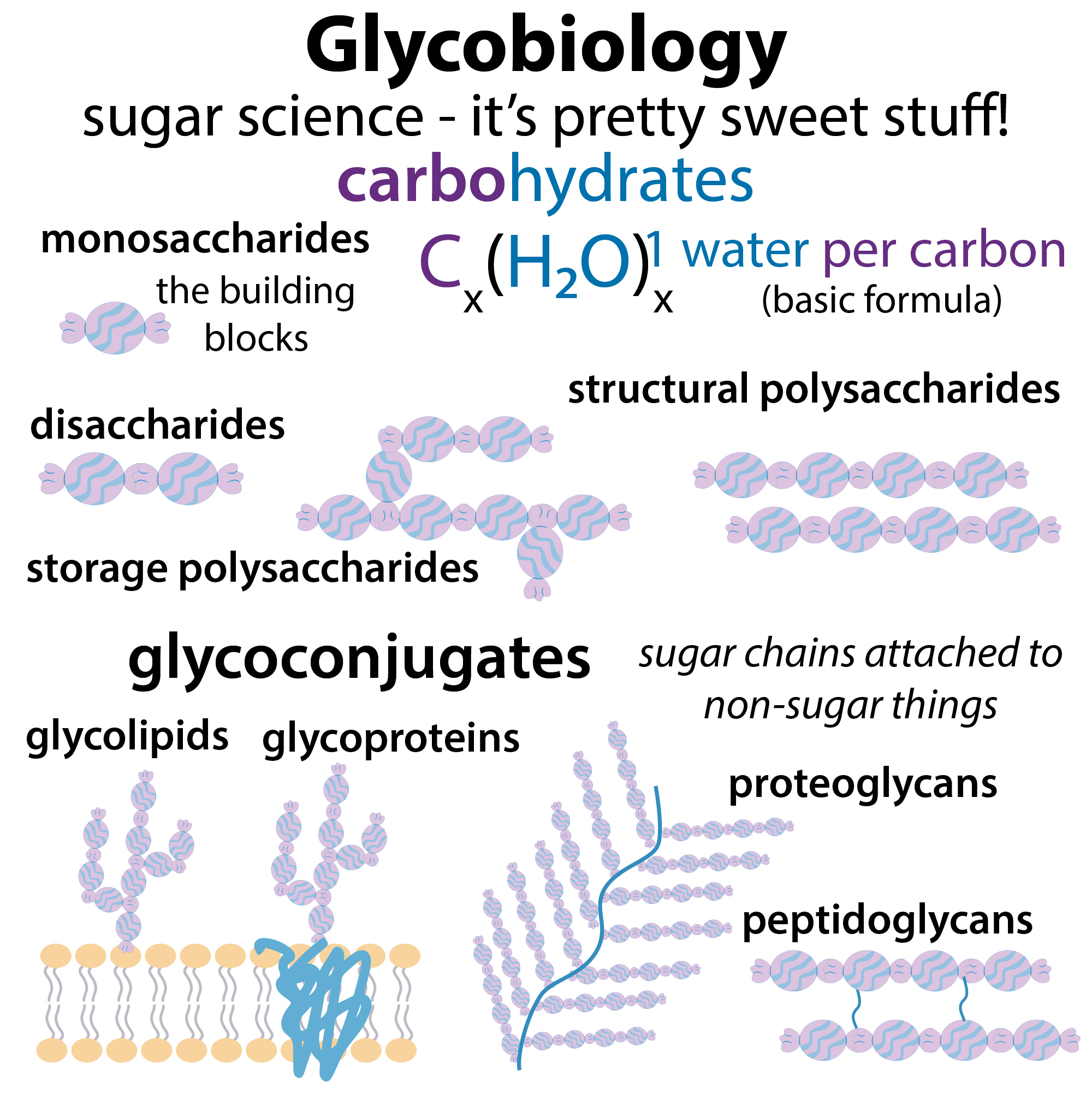
more about glycobiology: https://bit.ly/sugarssci
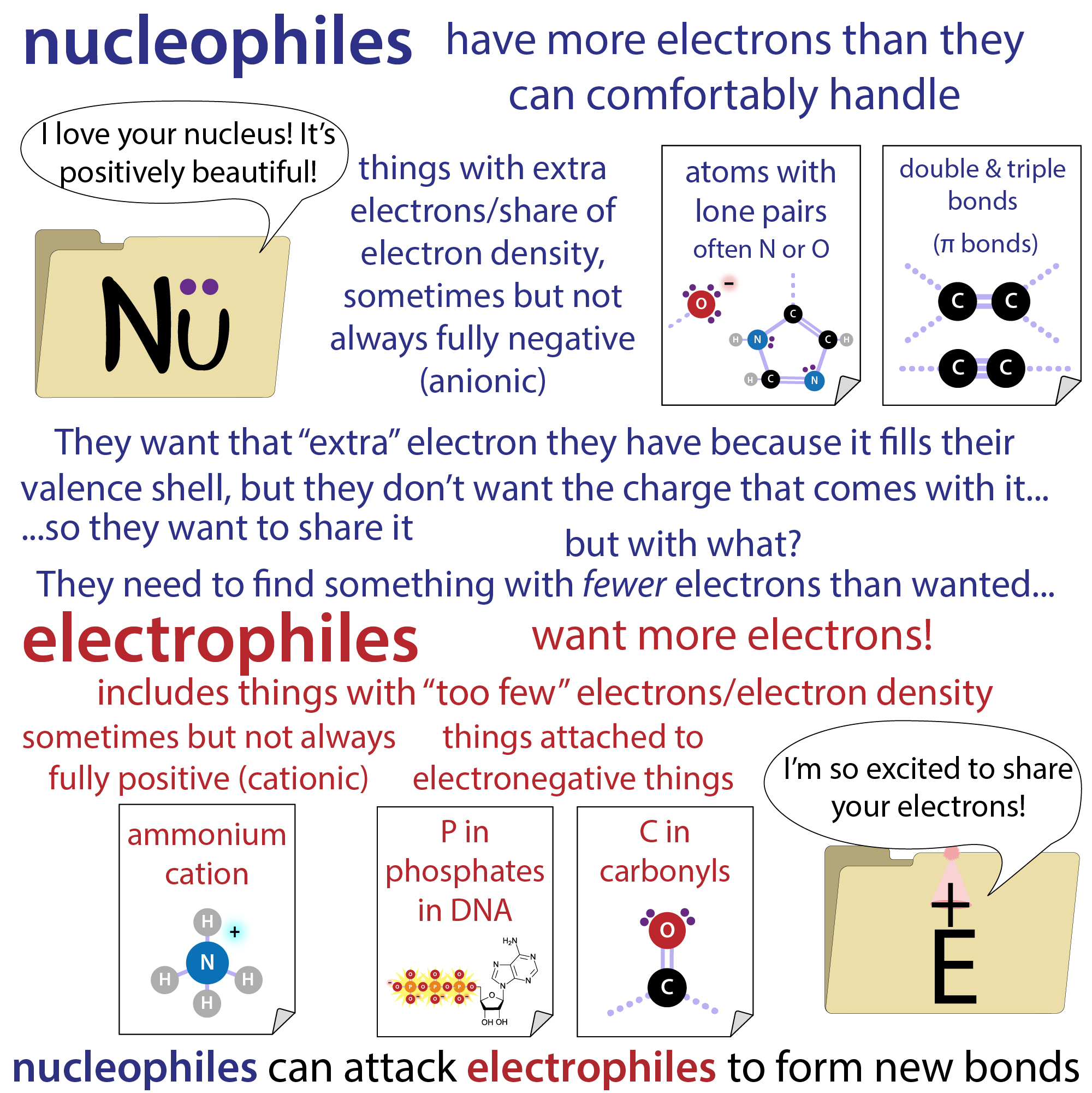
more about nucleophiles & electrophiles: http://bit.ly/nucleophilefiles & https://youtu.be/xfCgDBdEn_I
more about solid state nucleic acid synthesis: http://bit.ly/solidstateoligo