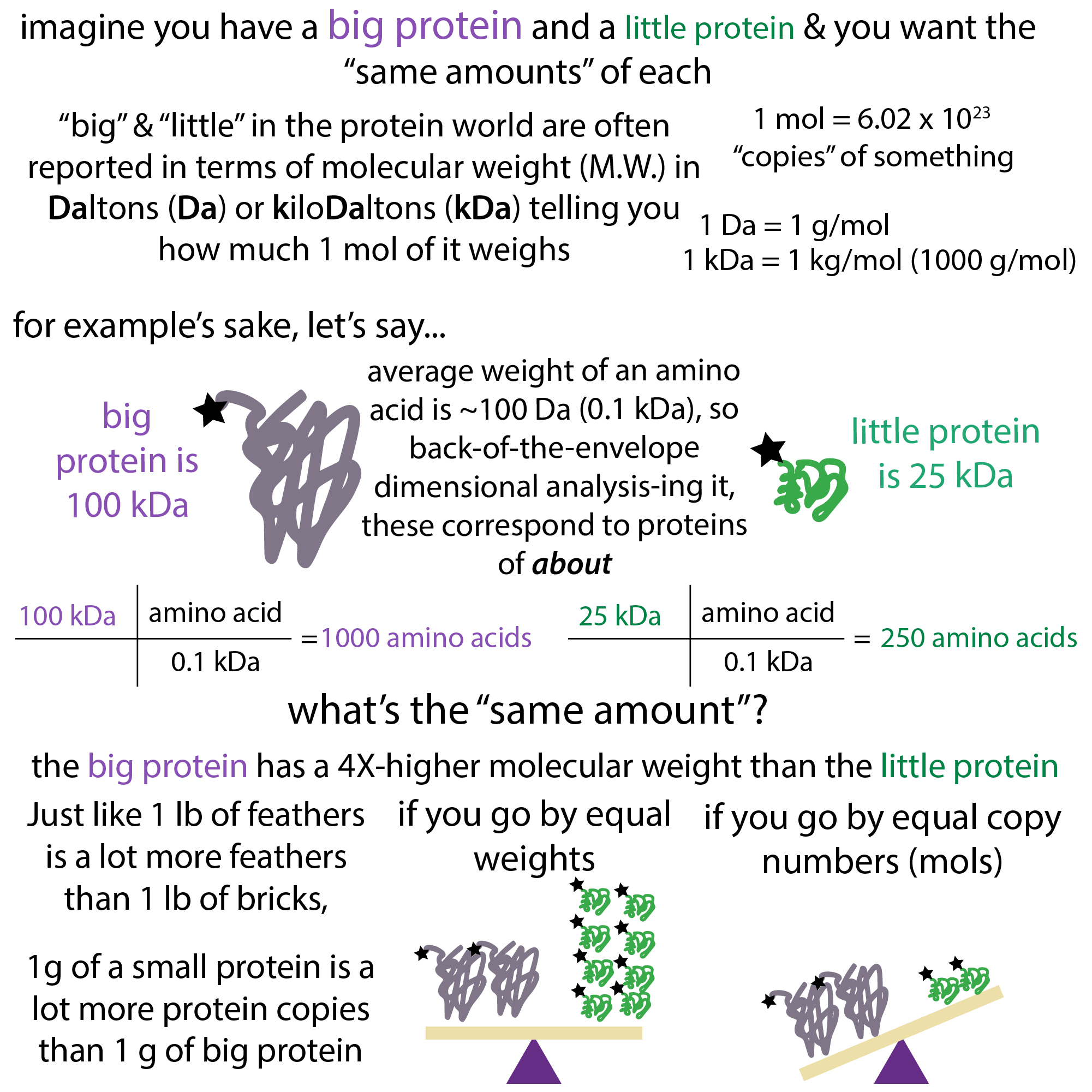
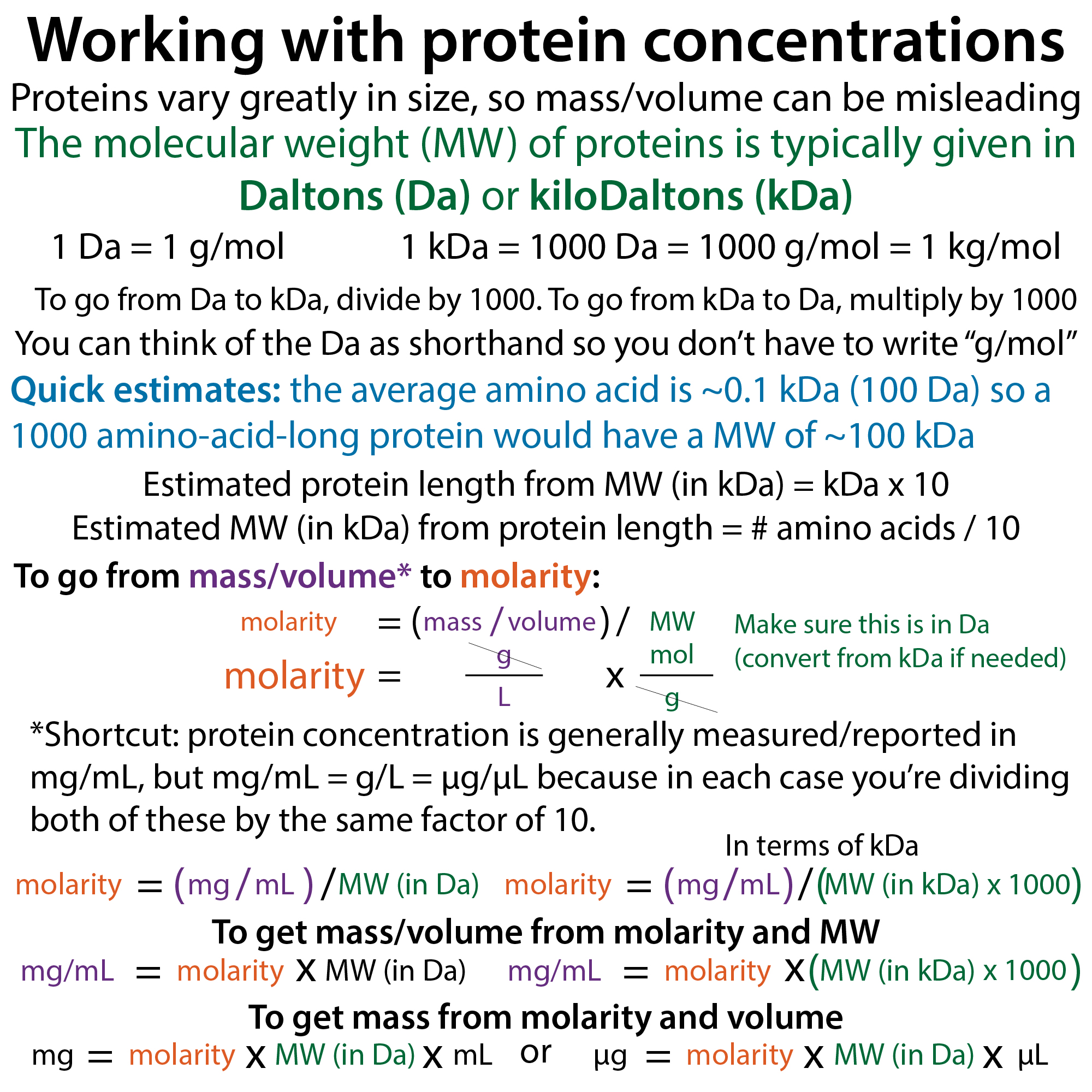
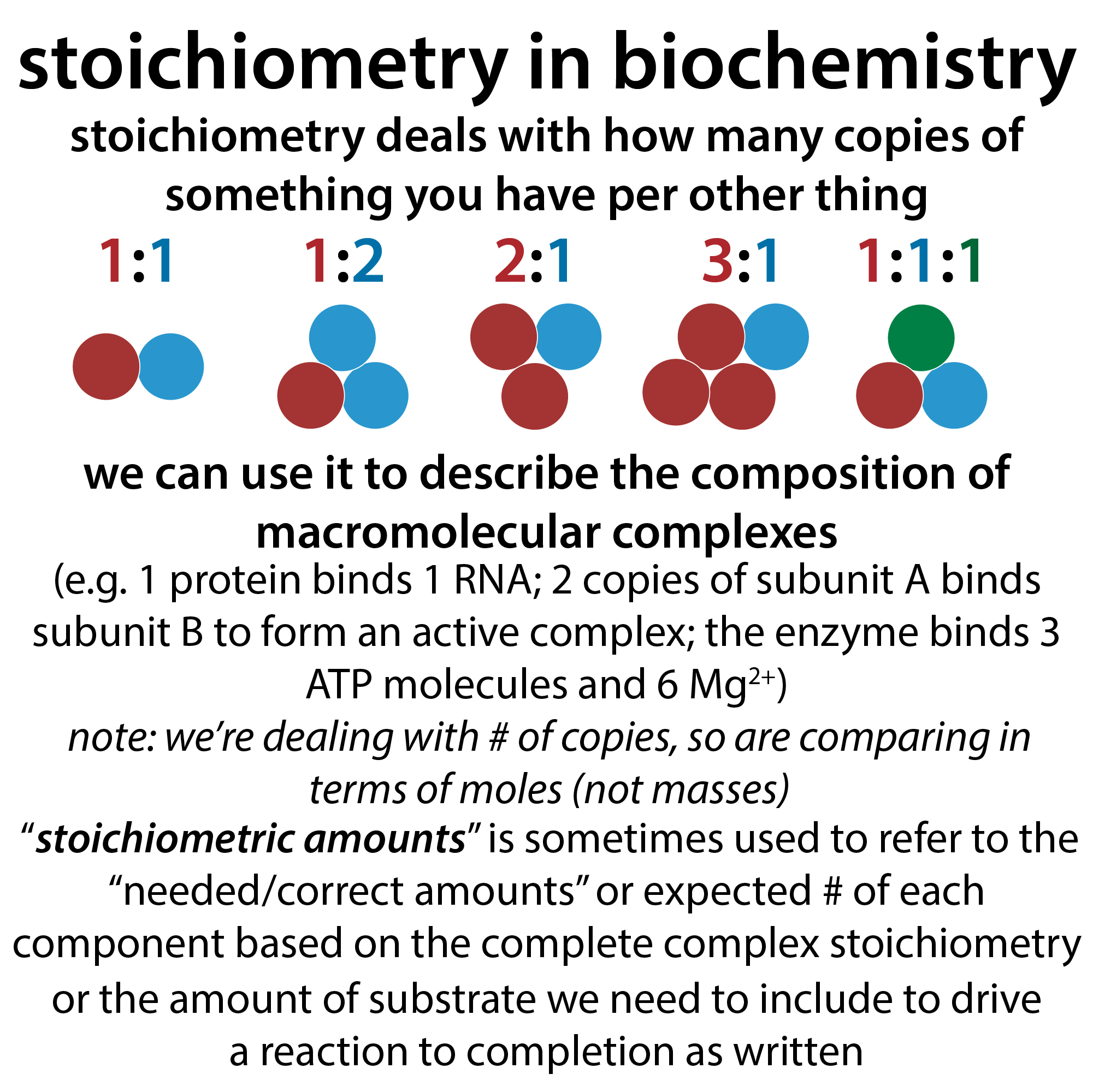
When it comes to protein concentrations, mg/mL is only part of the story! It’s the part we can most easily measure, but it doesn’t tell us how many copies of the protein there are! There could be a lot of copies of a little protein or a few copies of a big protein. But if you have a pure protein and you know its molecular weight (MW, aka molar mass), you can convert between weight and copy number. Between mg/mL and molar!
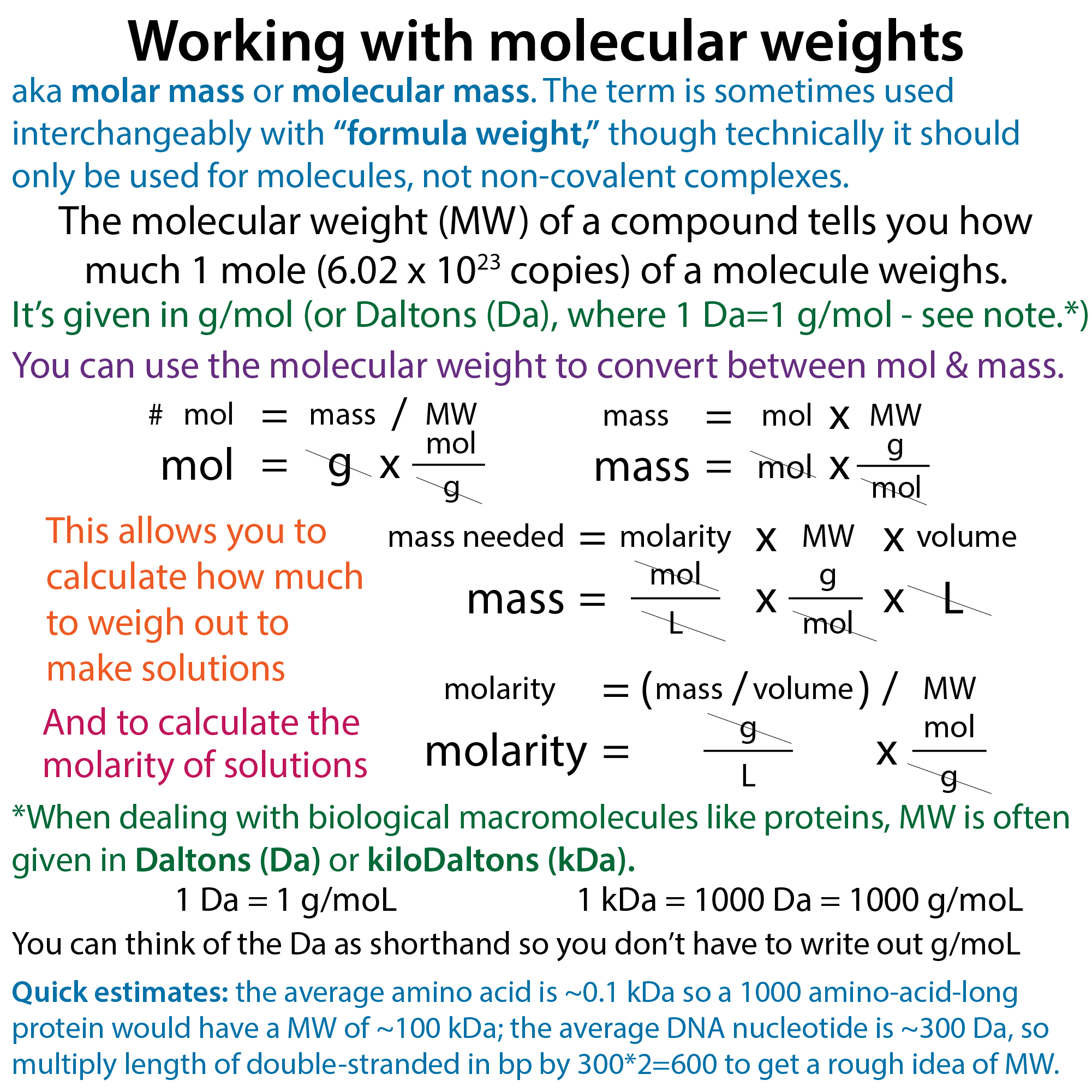
When dealing with proteins and other biological macromolecules, MW is often given in Daltons (Da) or kiloDaltons (kDa)
1 Da = 1 g/moL
1 kDa = 1000 Da = 1000 g/moL
you can think of the Da as shorthand so you don’t have to write out g/moL
and what’s a mol you might ask?
A mol is like the biochemist’s “dozen” – it just means Avogadro’s number (6.02×10²³) of something. And the molar mass is how much 1 mol of something weighs. Usually for proteins it’s reported in Daltons (Da) or kiloDaltons (kDa). 1 Da = 1g/mol. So if a protein has a molar mass of 40,000 Da, 1 mol of the protein weights 40,000g (which is the same as 40kg). Alternatively we can write its molar mass as 40 kDa.
That’s a pretty average size for a protein – the average protein is around 300-400 amino acids long (according to bionumbers.org) and the average weight of an amino acid is ~100 Da). So if you had a 400-amino-acid-long protein, it would have a molecular weight of ~ 400 aa *100 Da/aa = 40,000 Da, or 40 kDa.
quick back-of-the-envelope estimates: the average amino acid is ~0.1 kDa so a 1000 amino-acid-long protein would have a MW of ~100 kDa
If you know how long a protein is, you can do one of these back-of-the-envelope estimates, but since each amino acid has a different weight and a protein might have gabobbles of glycines (tiny) or a ton of tryptophan (big), the exact molar mass will depend on their exact sequence and you can use free websites like ExPasy ProtParam to help you get a more accurate number.
You can then use that molecular weight in your conversions.
for some example calculations:
Sometimes we don’t just care about copy number. Instead, we care about function (I mean, if some of the proteins are duds, why count them, right?) When we can measure function, we can then calculate something called a specific activity, which is a sort of measure of activity concentration that’s used a lot when talking about enzymes and how much of an enzyme to use to carry out some reaction. Much more on it here: http://bit.ly/enzymeactivity ; YouTube: https://youtu.be/FFBXGBm5Sv4
if you want some more practice with unit conversion, I have some examples here: https://bit.ly/bumbling_uploads with walkthroughs here: https://youtu.be/0fQuXs8qtz0 and https://youtu.be/p6s7N5N-tpY
more about metric conversions: https://bit.ly/metric_calcs ; YouTube: https://youtu.be/A-J7kdLNb8c
more on dimensional analysis: http://bit.ly/dimensionalanalysising & https://youtu.be/KQMA0aAGfP4
more about concentrations: http://bit.ly/sciencestocksolutions ; YouTube: https://youtu.be/RjXYvOiLh2w & https://youtu.be/wC623-AGBOs