When you’re really excited about your research project (or when you’re feeling like you don’t have much to show for your work) it can be super tempting to try to go, go, go – cramming in as many experiments as possible. But it can be much better in the long run to slow down a bit, taking time to analyze your results, use them to plan out your next experiments more effectively. Working slower and more thoughtfully also helps you avoid mistakes, and not exhaust yourself (burnout anyone??) This is a lesson I learned the hard way in grad school, and it was a key talking point that came up during our IUBMB Trainee Initiative workshop at the DiscoverBMB conference as part of our discussion on what we wish we knew when we started grad school.
link to video in case embed isn’t working: https://youtu.be/f3JeYbNV_Bs
One of the most important lessons that my main mentor during grad school, a scientist named Elad Elkayam, taught me was that it’s okay – in fact, it’s good – to take things slower. When I started in the lab I was so eager to get results (especially after spending weeks writing about the experiments I wanted to do) that I was working crazy hard with long hours. Elad saw that I was getting exhausted, on the path to burnout (when you get kinda apathetic about it all) and helped me see that I should slow down.
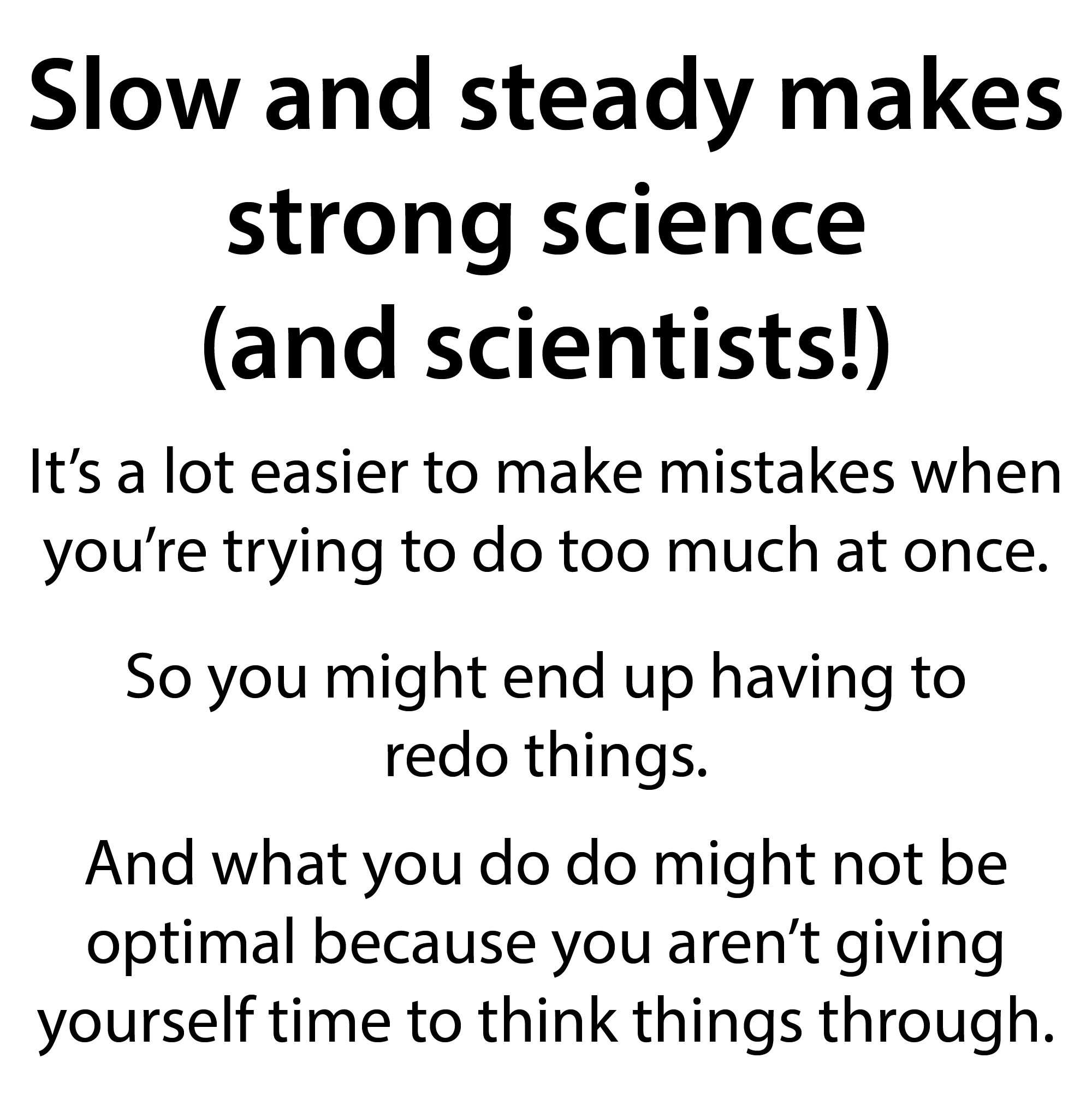
If I didn’t, he convinced me, I would jeopardize my physical and mental health and therefore be unable (and/or unmotivated) to do any more experiments! Plus, the experiments I was doing would suffer from my rushing if I didn’t slow down. It’s a lot easier to make mistakes when you’re trying to do too much at once. So you might end up having to redo things. And what you do do might not be optimal.
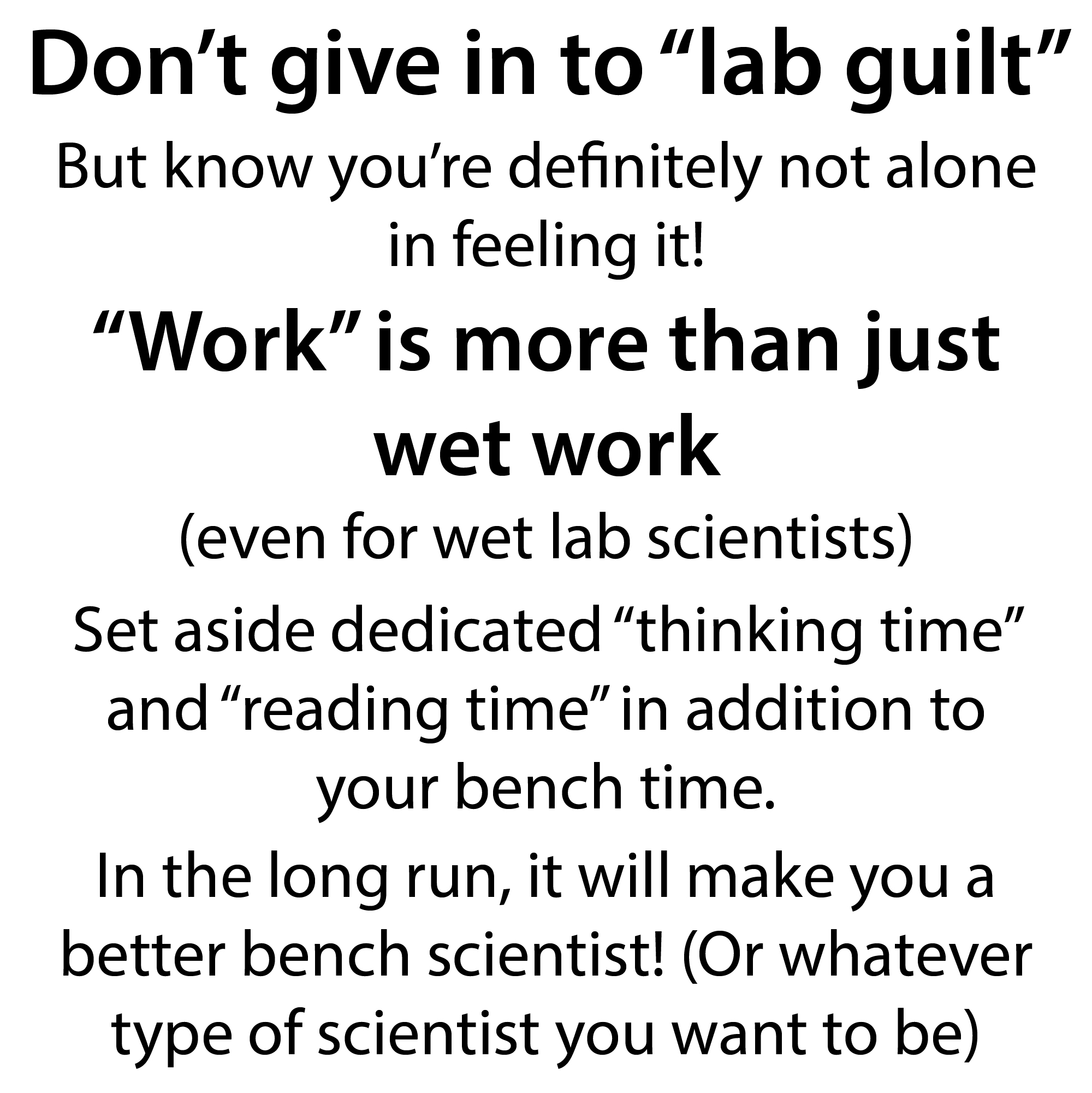
When I say slow down, I don’t mean be lazy – instead I mean realize that “work” isn’t just “wet work”. Planning experiments, analyzing results, even reading papers – all are important forms of work that “count” too. So try not to succumb to “lab guilt” which is super common in grad school (and beyond – in fact, I’m finding it’s even harder as a Postdoc since more is expected of you!)
Though it’s hard for me to think of any (or at least most) of it as “work” because I love it so much and still can’t believe I get paid to do it!
Bottom lines:
- you don’t have to be physically pipetting, etc. to be being productive
- Sometimes you’re more productive when you’re not racing from one experiment to the next
On the other hand, you don’t want to spend too much time overthinking things before trying to get some preliminary results. Sometimes the easiest way to figure out if something might work is to try it out! But when you do try it, start with something simple, a couple controls, to see if it works before diving in with tons of samples only to find out it doesn’t work or it kinda works but you need to optimize.
In order to optimize you need to really think over your initial results before changing things up. Which means you need to take a step back from the bench before diving back in.
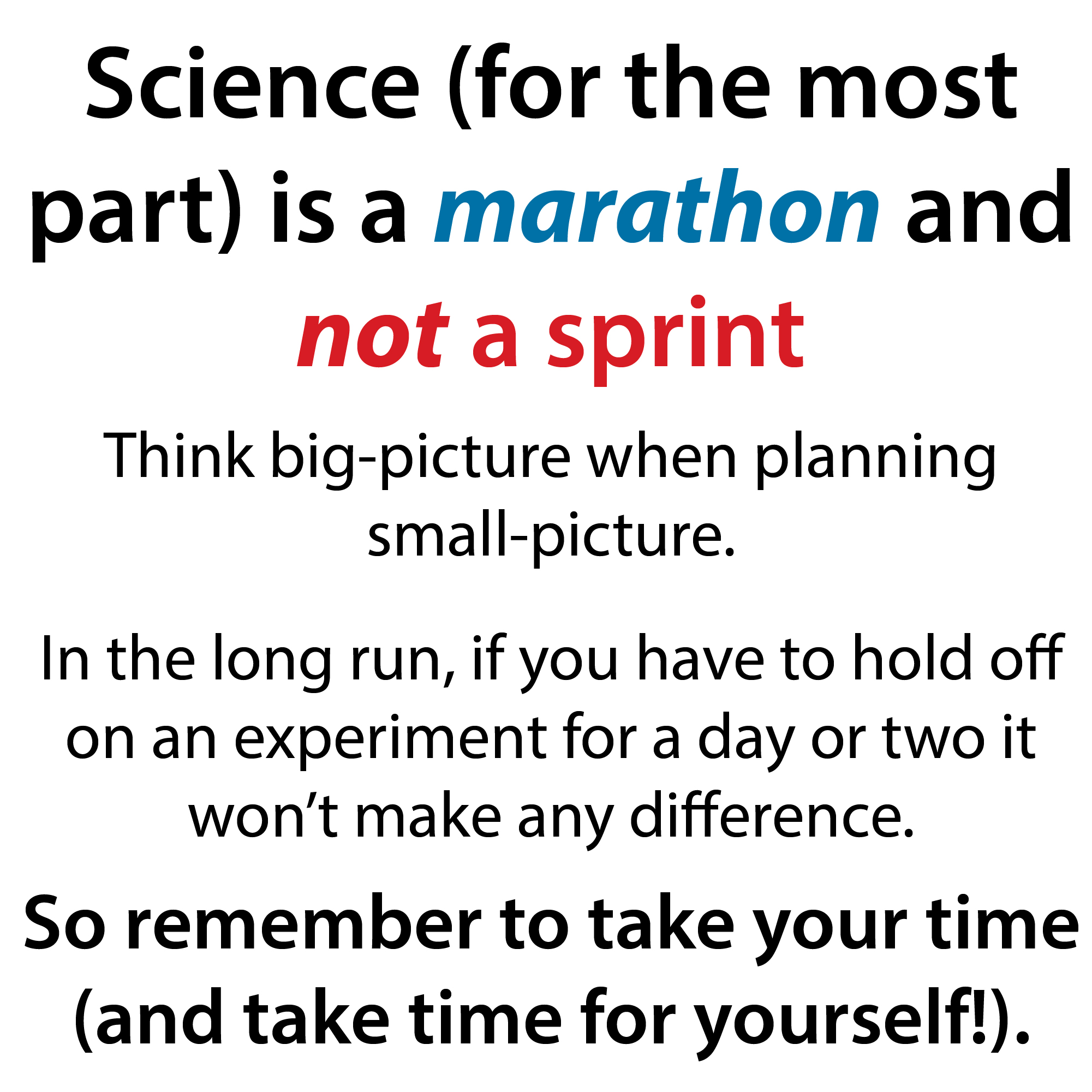
It’s cliche to say, but really is true – science (for the most part) is a marathon and not a sprint. In the long run, if you have to hold off on an experiment for a day or two it won’t make any difference. So remember to take your time (and take time for yourself!).
There will be times (such as when you’re up against report deadlines or paper review stuff) when things will be more sprint-y. And these times might not be so fun. For example, I’ve been running PCR and gels pretty nonstop this week, and in grad school I was purifying 3 proteins at a time each day one week…. But these times should be the exception to the rule!
Don’t feel “guilty” for setting aside dedicated “thinking time” and “reading time” in addition to your bench time. In the long run, it will make you a better bench scientist! (Or whatever type of scientist you want to be)
You can tell yourself this all you want, but sometimes it really only feels “legitimate” to hear it from someone else. For example, I still think of Elad’s words when I feel guilty. So, if you need to hear it, here it is – not that I have any sort of authority or power to do so, but I hereby I give you “permission” to take things slower. Be a careful, thoughtful, happy and healthy scientist rather than focusing solely on what on the surface seems to be the quickest path to results.
Also, remember the things that your mentors do that make a difference and pass them on to those you mentor. Pay it forward!
Some final thoughts…
Set reasonable expectations for yourself. I know that for me personally I probably expect more of myself than anyone expects of me. Which is a recipe for stress… You aren’t (or at least you shouldn’t be) expected to just crank out beautiful results. Science involves a lot of trial, error, “failure,” and optimization. And everyone around you in the lab knows that.
I know it’s hard, but try not to compare yourself to colleagues – either in terms of hours worked or “results”. And when picking a lab, try to find one where people aren’t there nonstop. Take your weekends off – at least from the physical lab, and preferably totally off.
And take mini breaks when things feel overwhelming. Step back, breathe, clear your head with a walk or something and things might just magically seem more manageable.
PS… when planning, know that things almost always take longer than you think they will! So yet another reason to try not to overschedule your day (an incubation step does not mean you have to start another experiment in parallel)
more on experimenting thoughtfully: https://bit.ly/experimenting_thoughtfully & https://youtu.be/R4tihl0BZcc
more posts on topics pertaining to scientists-in-training: https://bit.ly/gradpostdocetc
I’m incredibly grateful they’re giving me the opportunity to attend DiscoverBMB and co-host an interest group for trainees with my IUBMB Trainee Initiative colleagues!