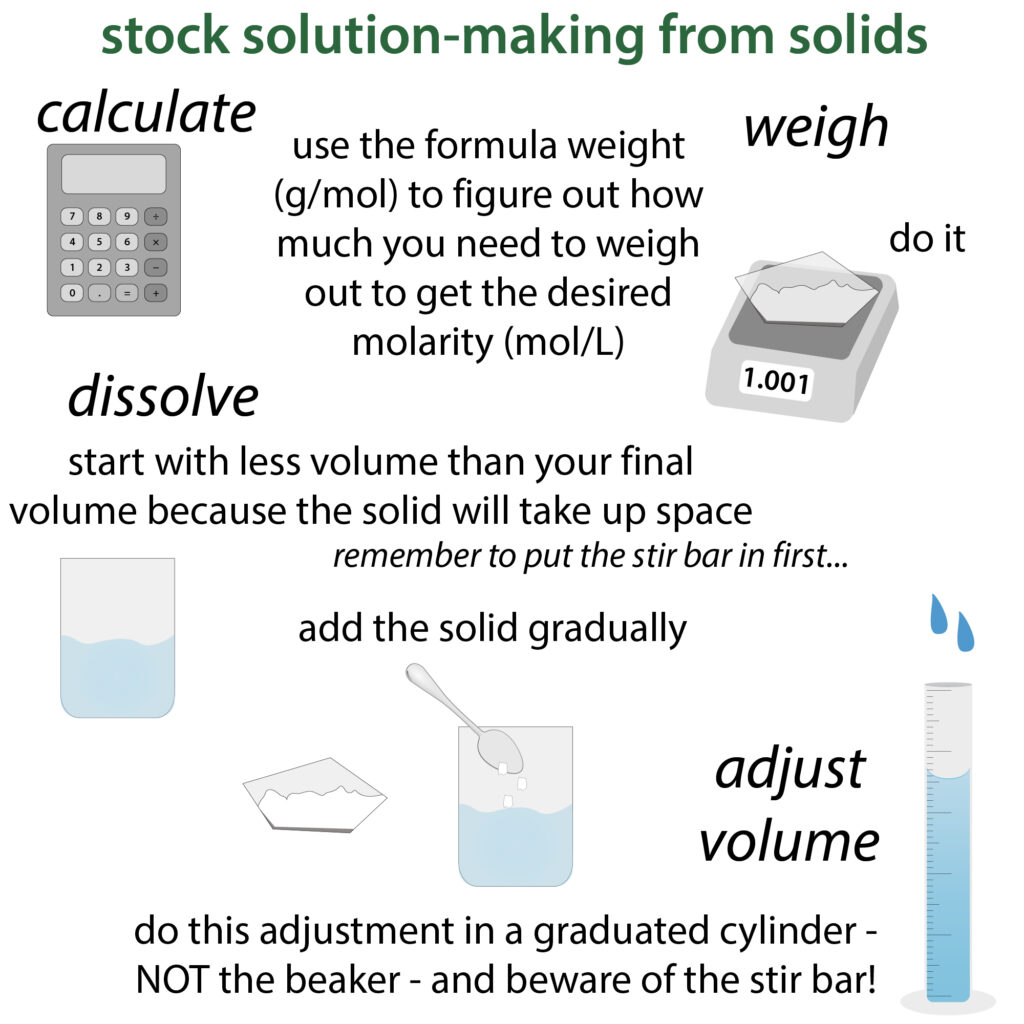
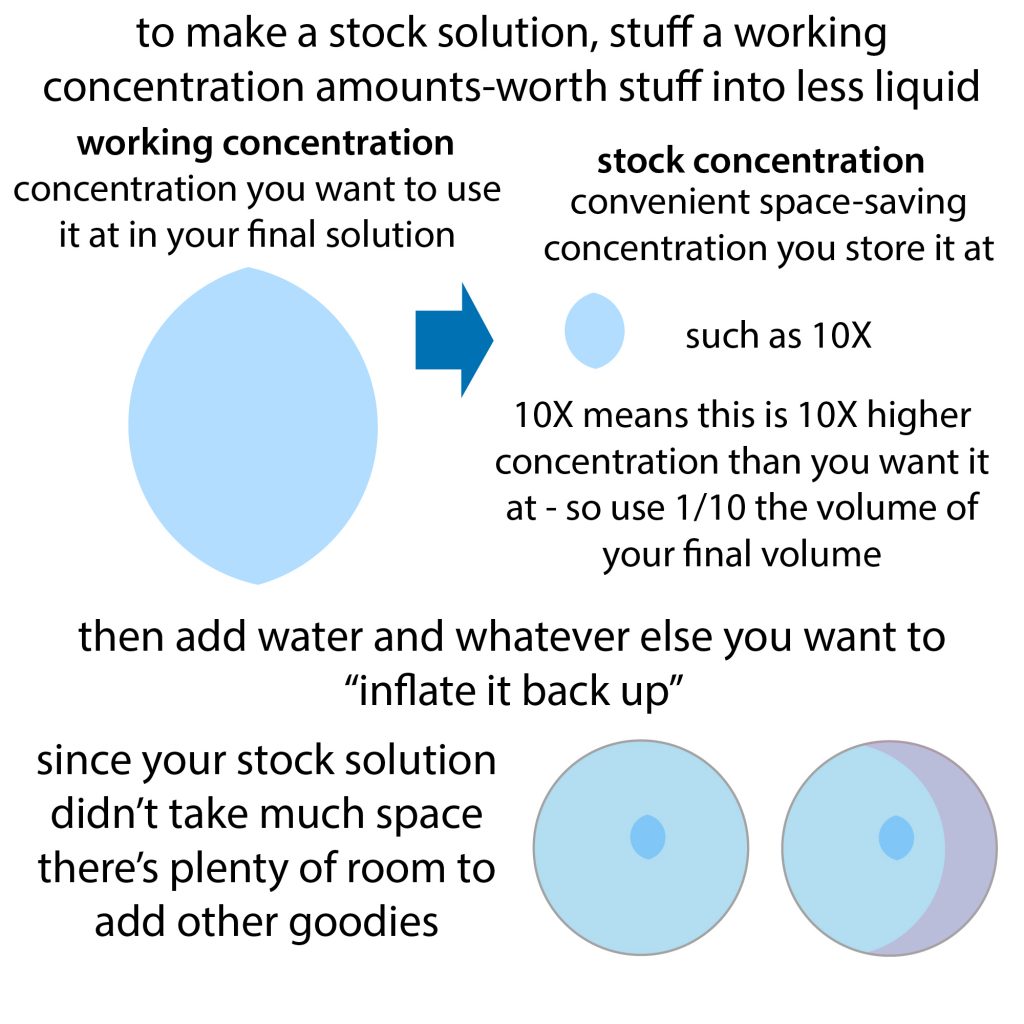
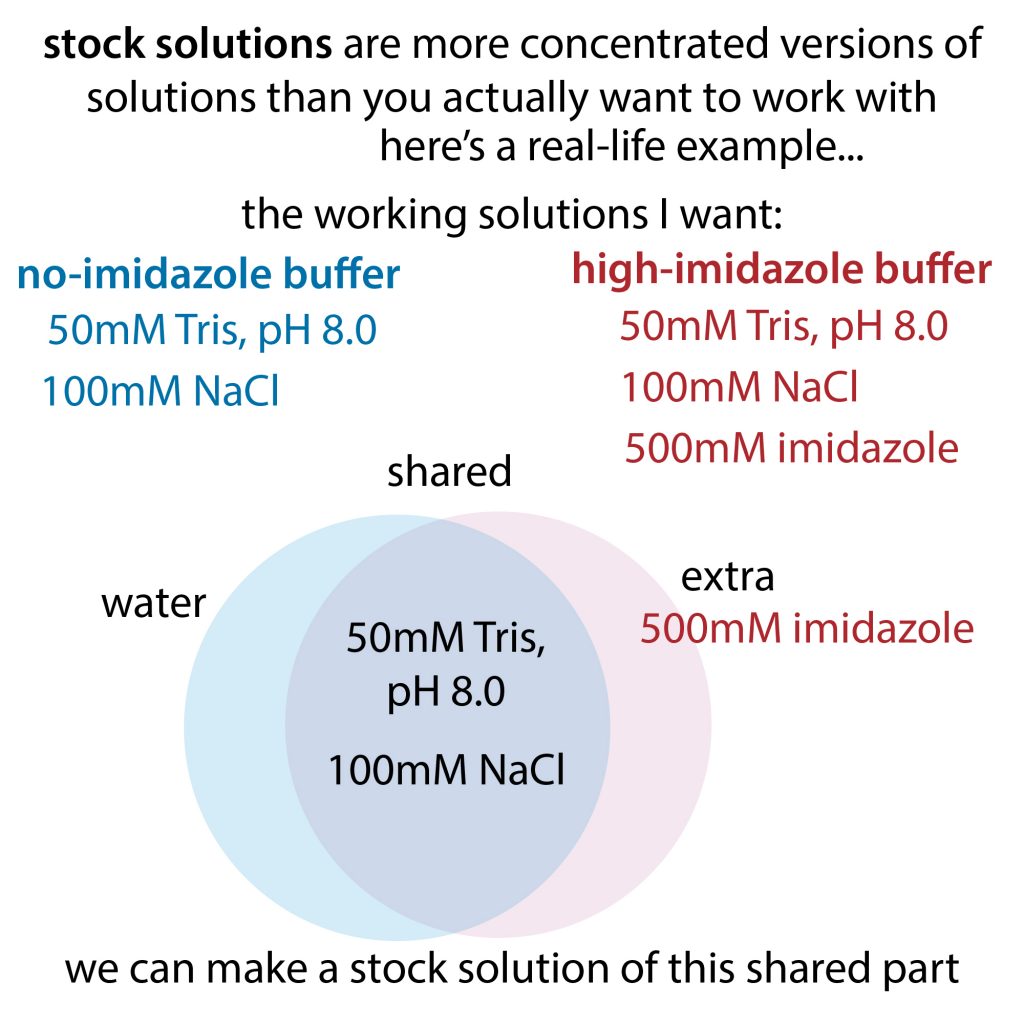
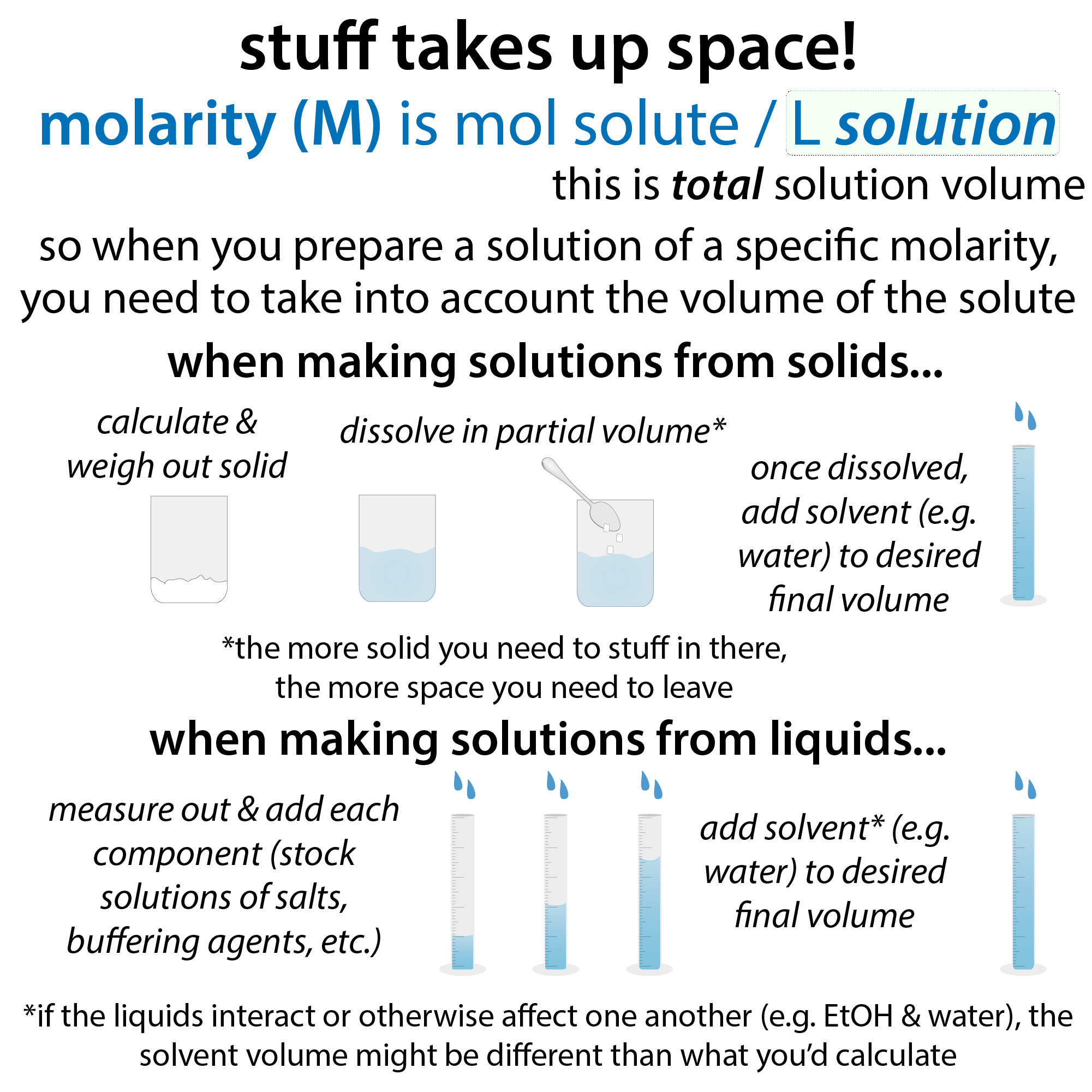
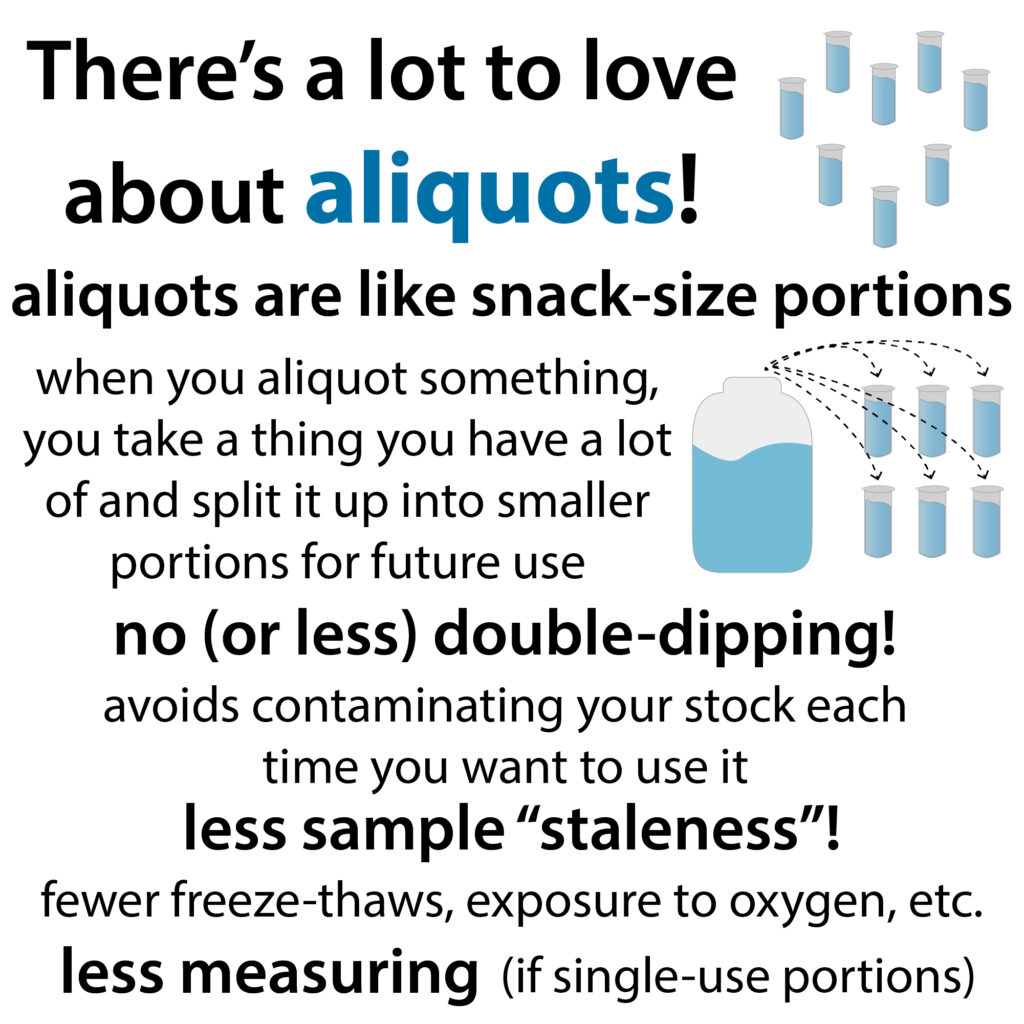
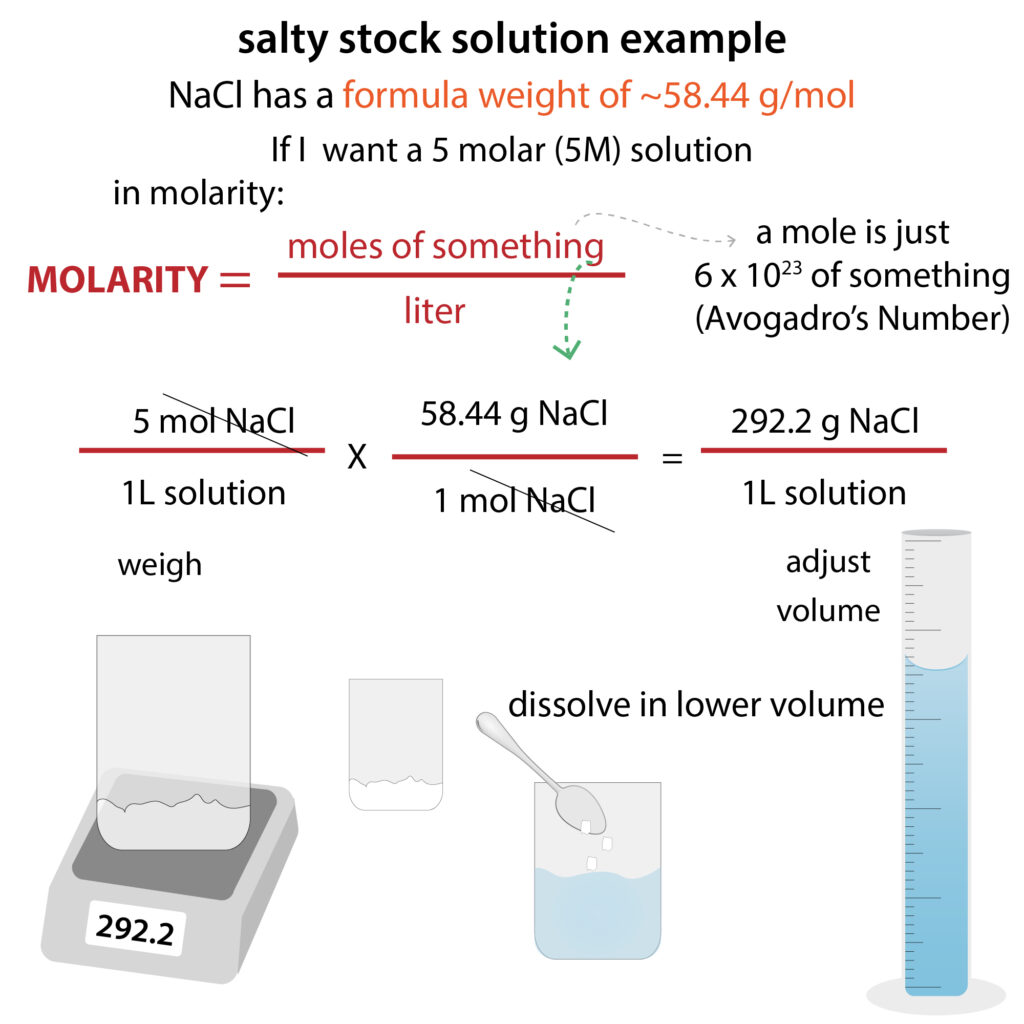
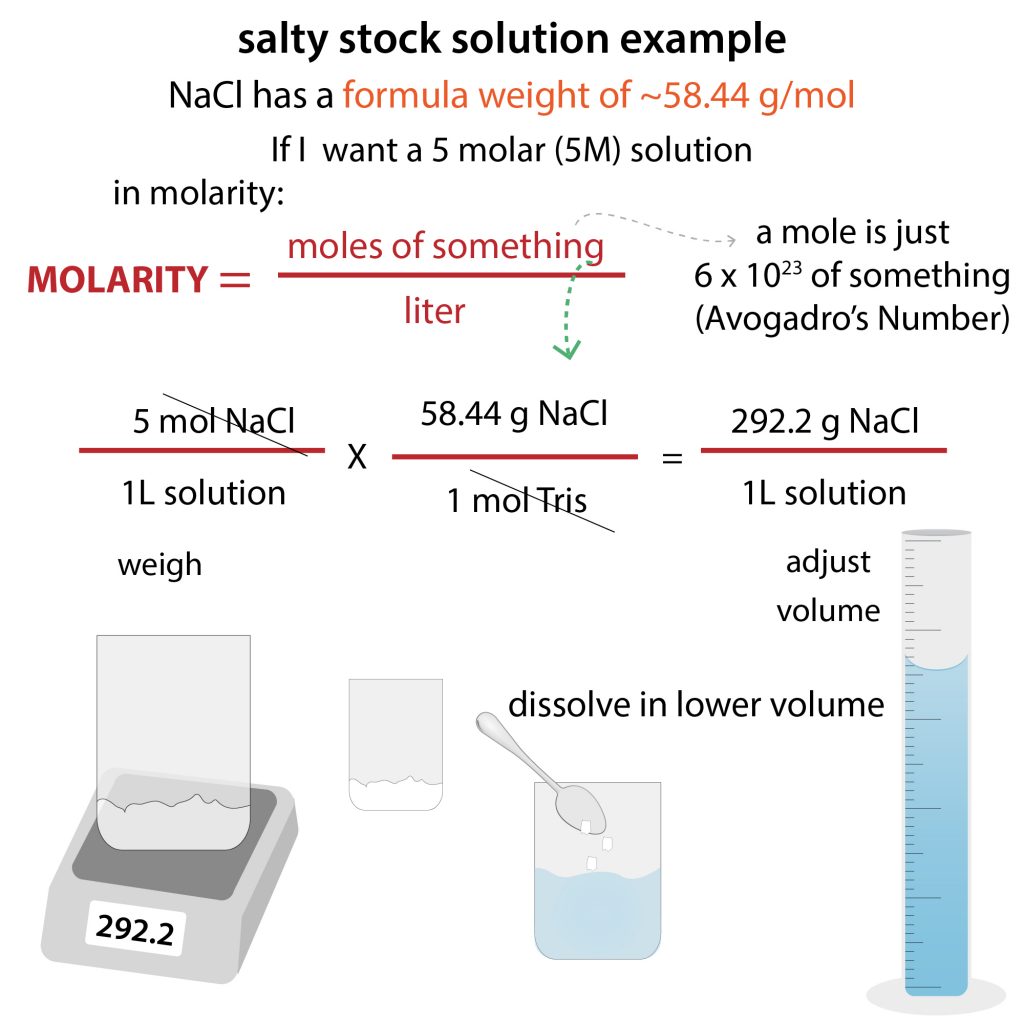
I prepare a lot of solutions but you won’t see me weighing out lots of solids – instead, I try to avoid that sort of thing as much as possible by starting with stock solutions. Stock solutions are just solutions of chemicals (typically ones like salts and pH buffers we use a lot) that are at a high (and often convenient for calculations) concentration. When we want a solution containing that chemical, we just take a portion of that stock solution and dilute it to our desired “working concentration.”
YouTube: https://youtu.be/m8Af9tI6U7o
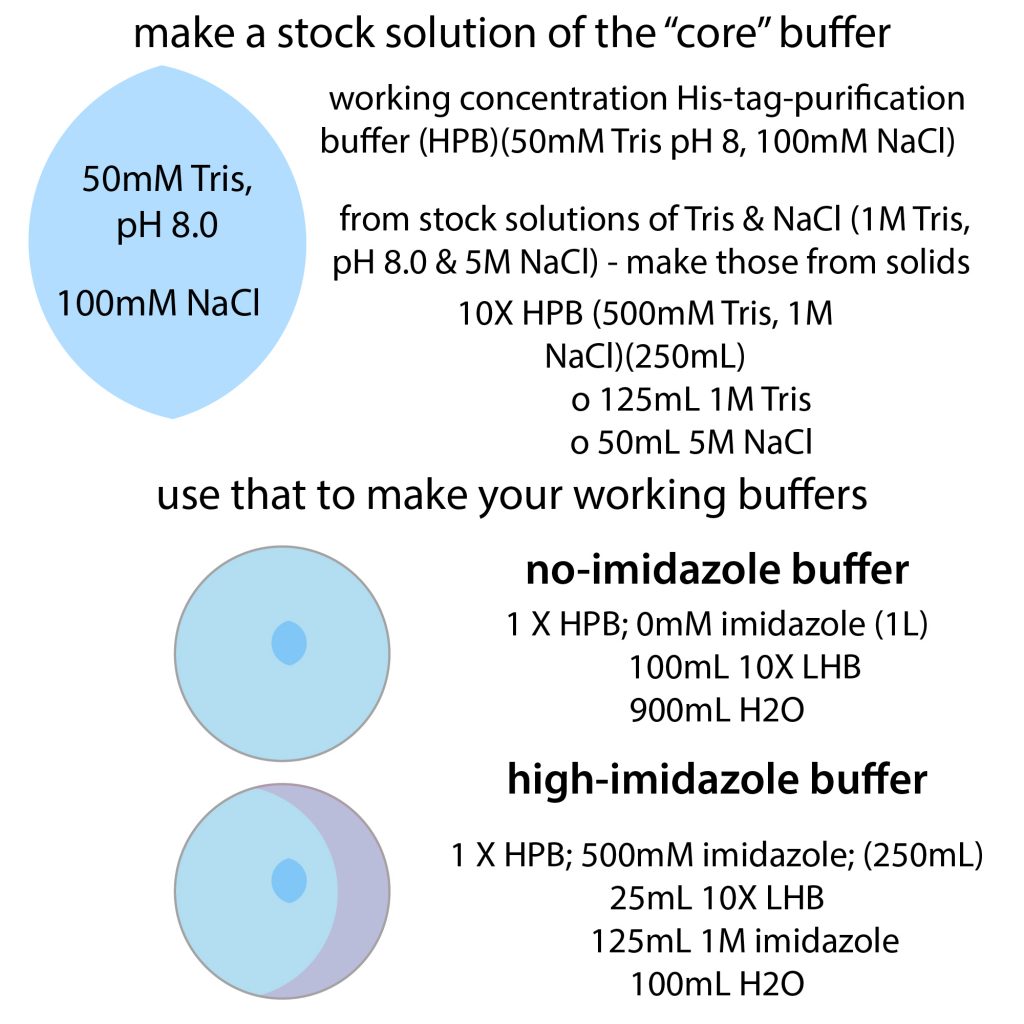
I highly recommend that one of the first things to do when you join a new lab is to make yourself a core set of stock solutions (suggestions below). Also look to see what working solutions you will need for all your experiments and prepare the appropriate stock solutions to be able to make those working solutions (over and over again without having to weigh anything out each time!). If you aren’t sure what’s “appropriate” (and even if you think you know), Google it! Look to see what concentrations of that chemical people normally make stock solutions at, whether there are special preparation or storage notes, etc.
Here’s a bullet-pointed summary of the basics to hopefully convince you that stock solutions are the way to go! And then some links to posts with much more information about actually preparing them. As well as uploaded examples and practice problems.
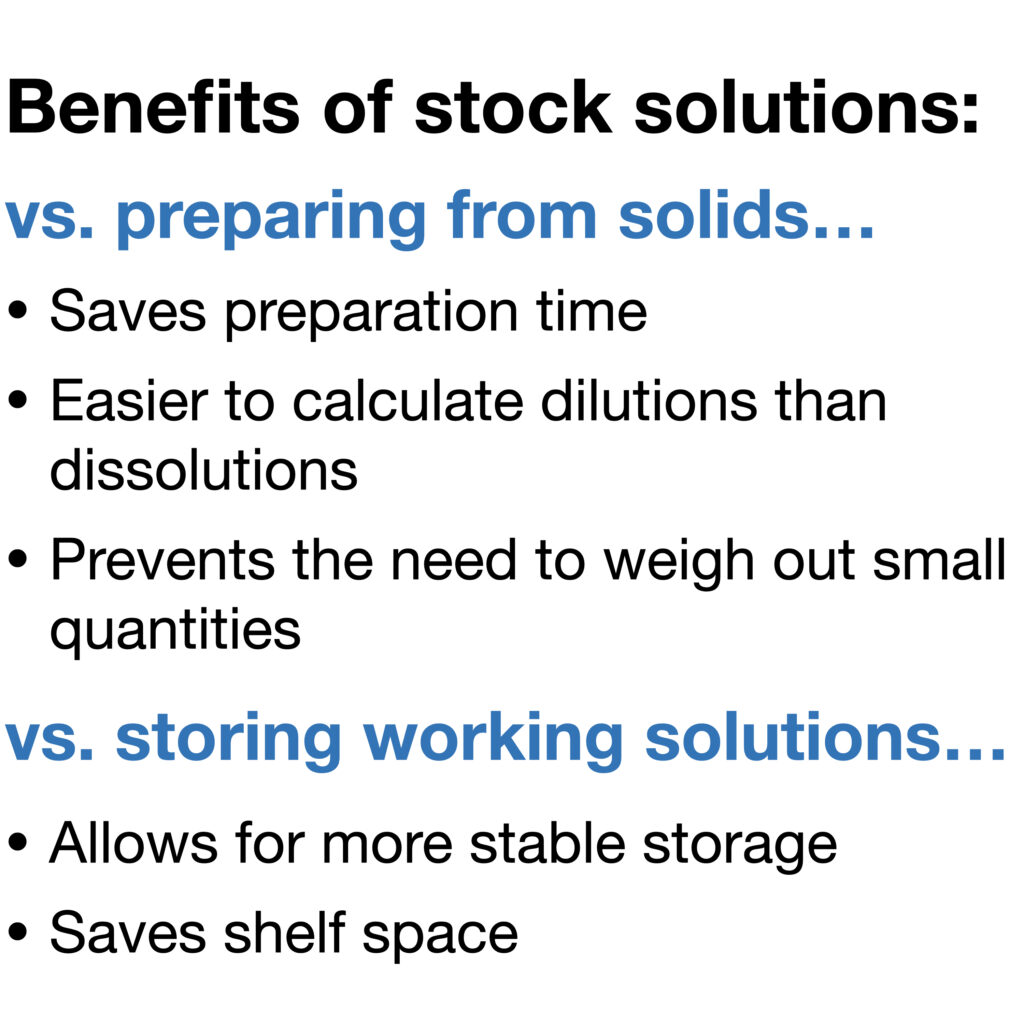
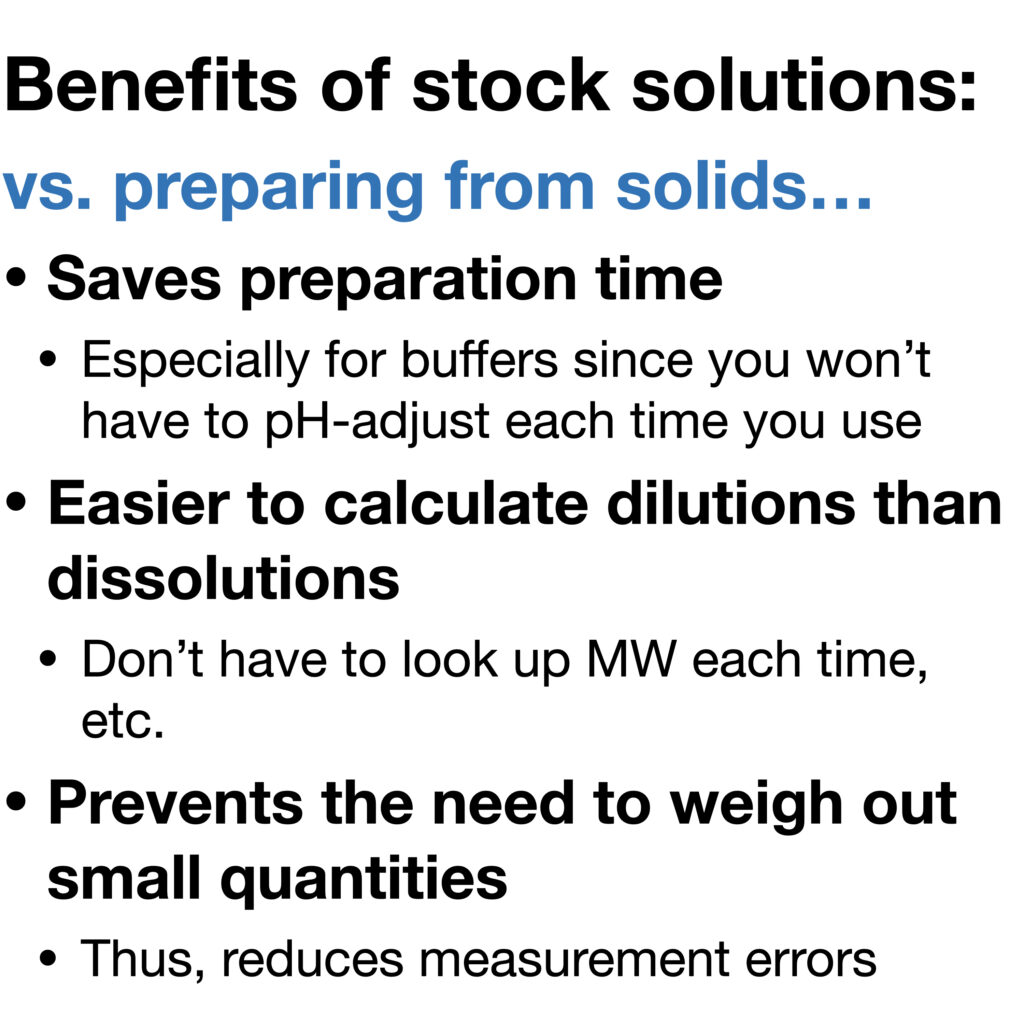
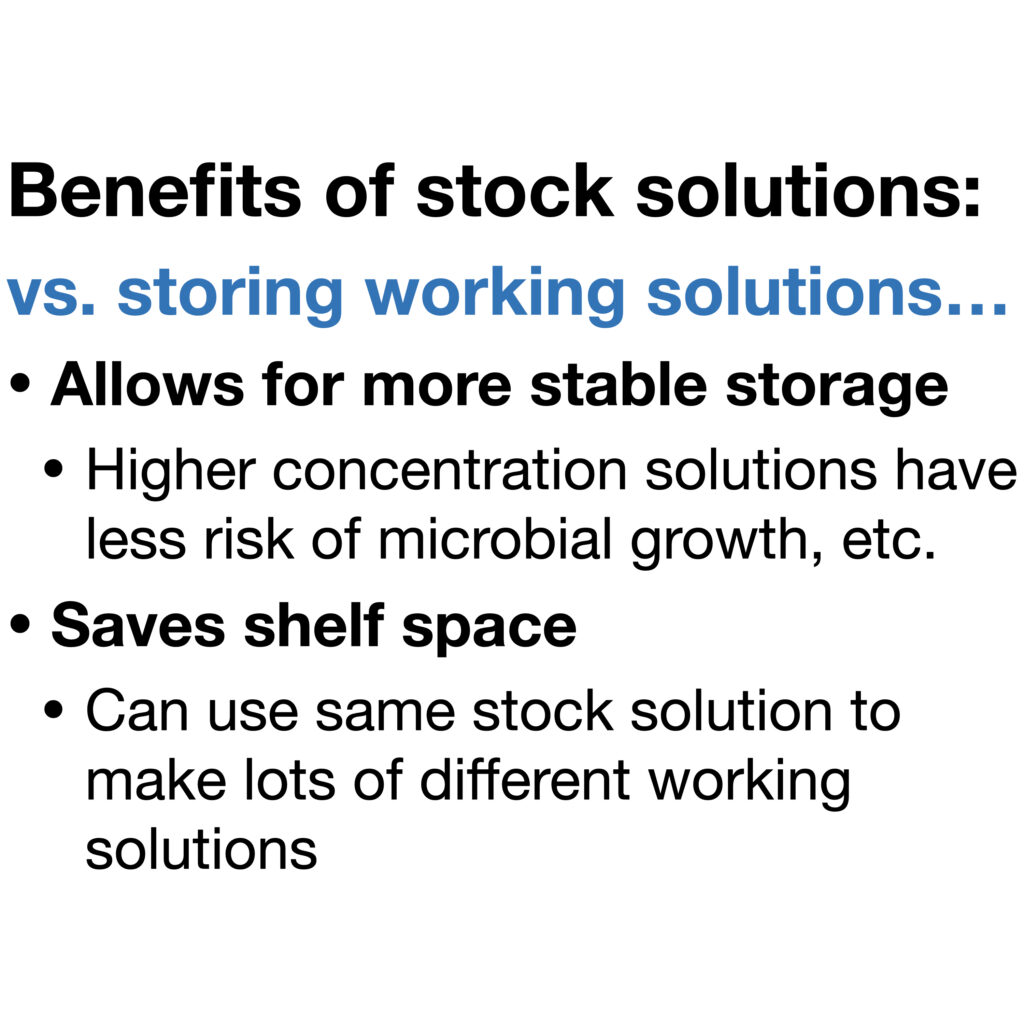
Benefits of stock solutions:
vs. preparing from solids…
- Saves preparation time
- Especially for buffers since you won’t have to pH-adjust each time you use
- Easier to calculate dilutions than dissolutions
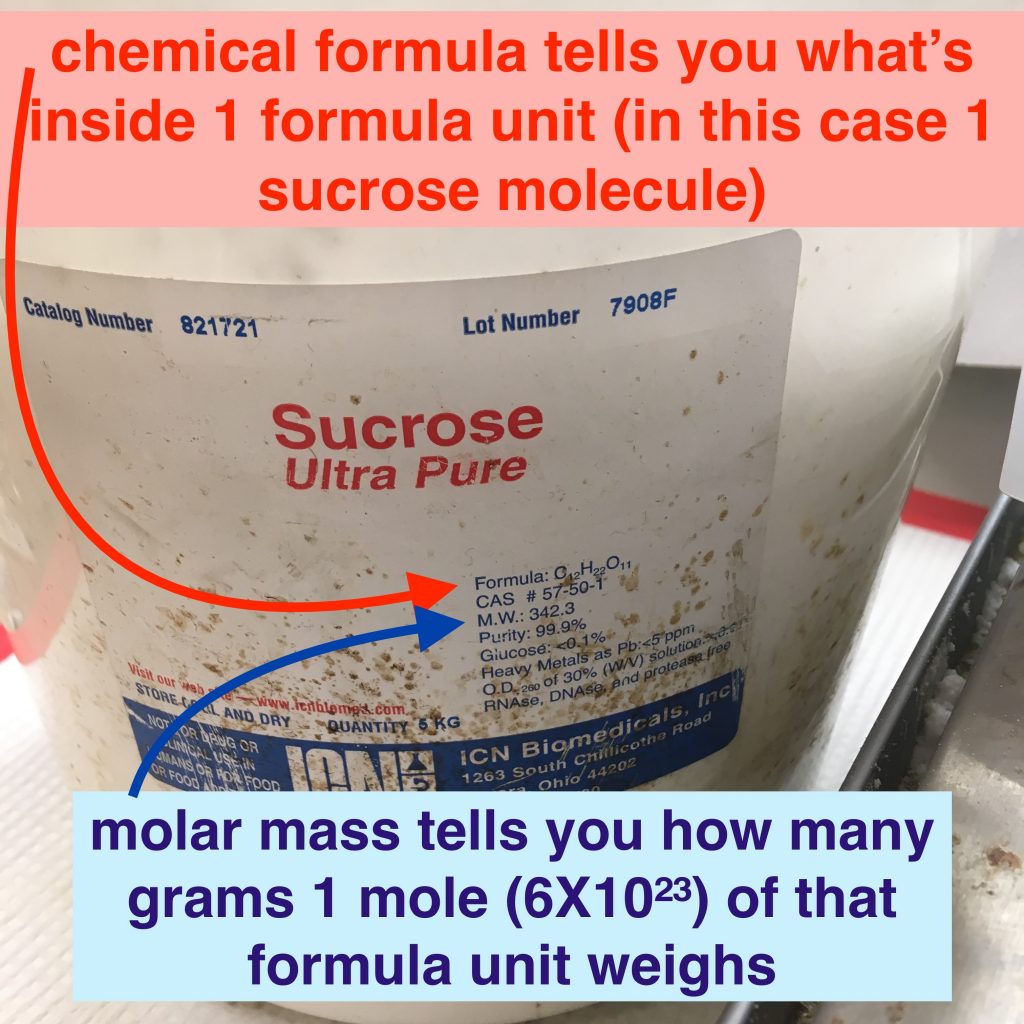
- Don’t have to look up MW each time, etc.
- Prevents the need to weigh out small quantities
- Thus, reduces measurement errors
vs. storing working solutions…
- Allows for more stable storage
- Higher concentration solutions have less risk of microbial growth, etc.
- Saves shelf space
- Can use same stock solution to make lots of different working solutions
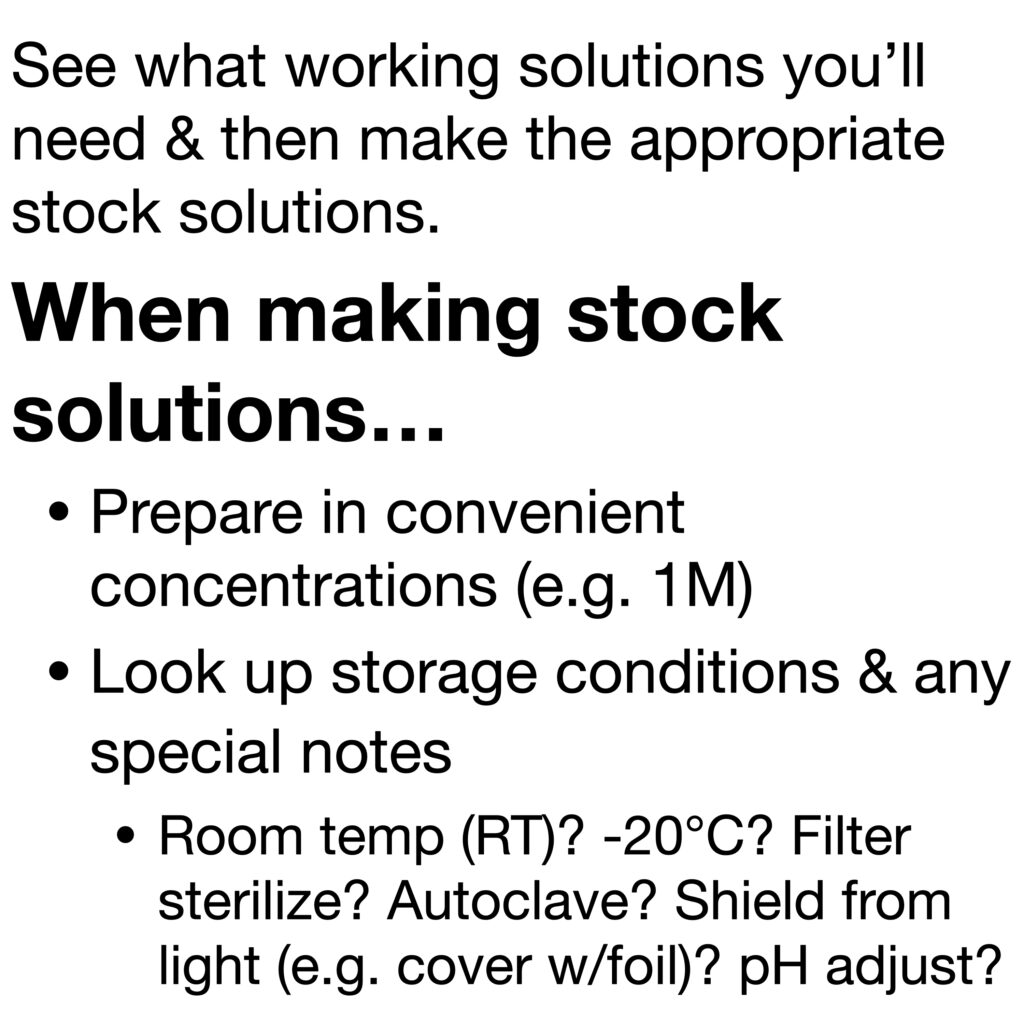
Once you know what working solutions you will need you can make the appropriate stock solutions.
When making stock solutions…
- prepare in convenient concentrations (e.g. 1M)
- Look up what people commonly use
- Make sure you don’t try to exceed solubility limits
- look up storage conditions & any special notes
- room temp (RT)? -20°C? filter sterilize? autoclave? shield from light (e.g. cover w/foil)? pH adjust?
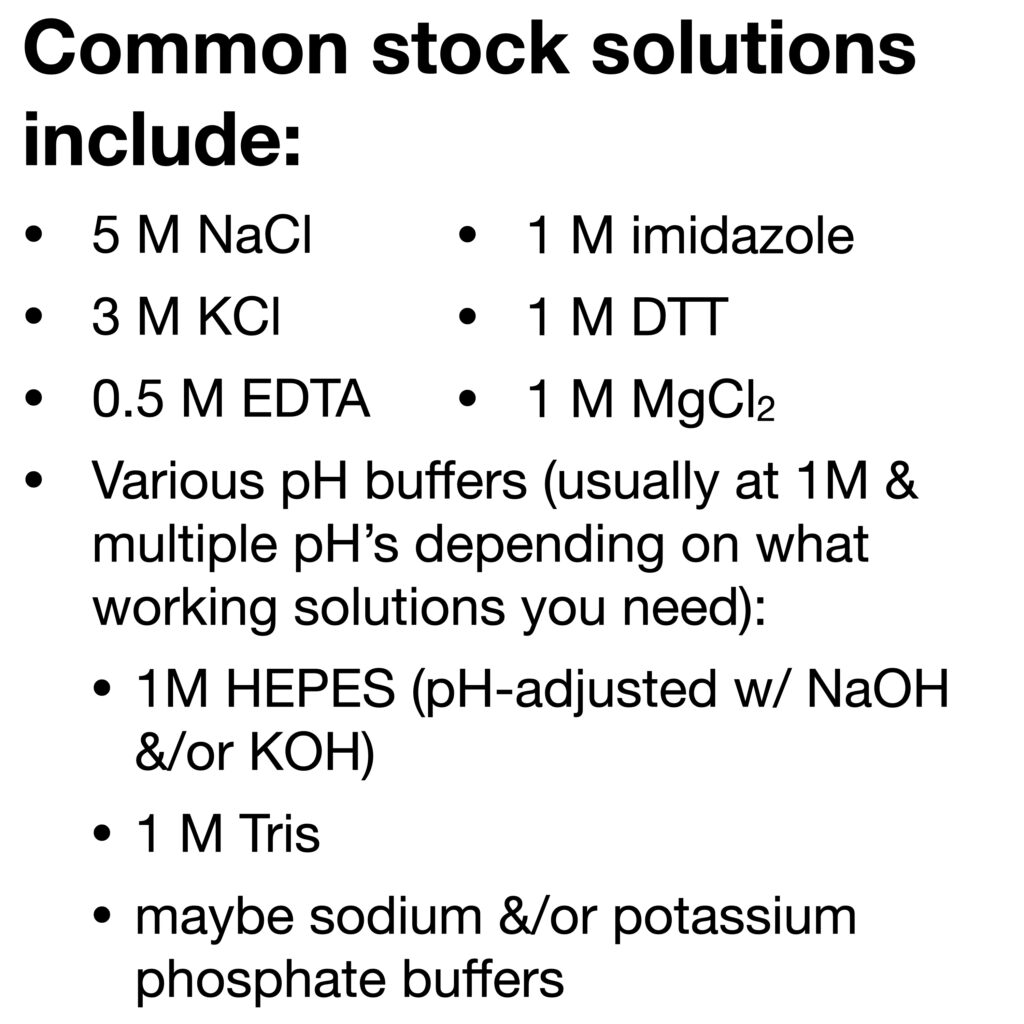
Common stock solutions include:
- 5 M NaCl
- 3 M KCl
- 1 M imidazole
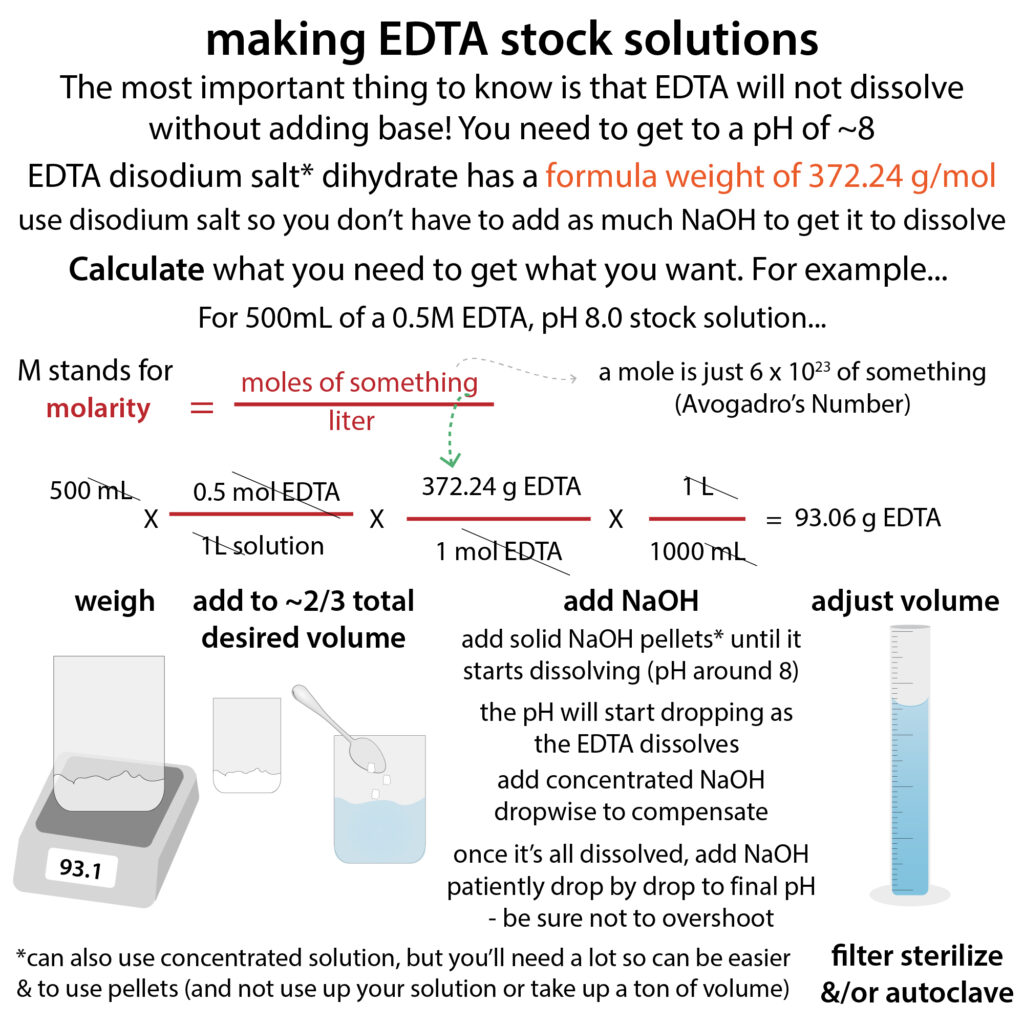
- 0.5 M EDTA
- 1 M DTT
- 1 M MgCl2
- Various pH buffers (usually at 1M):
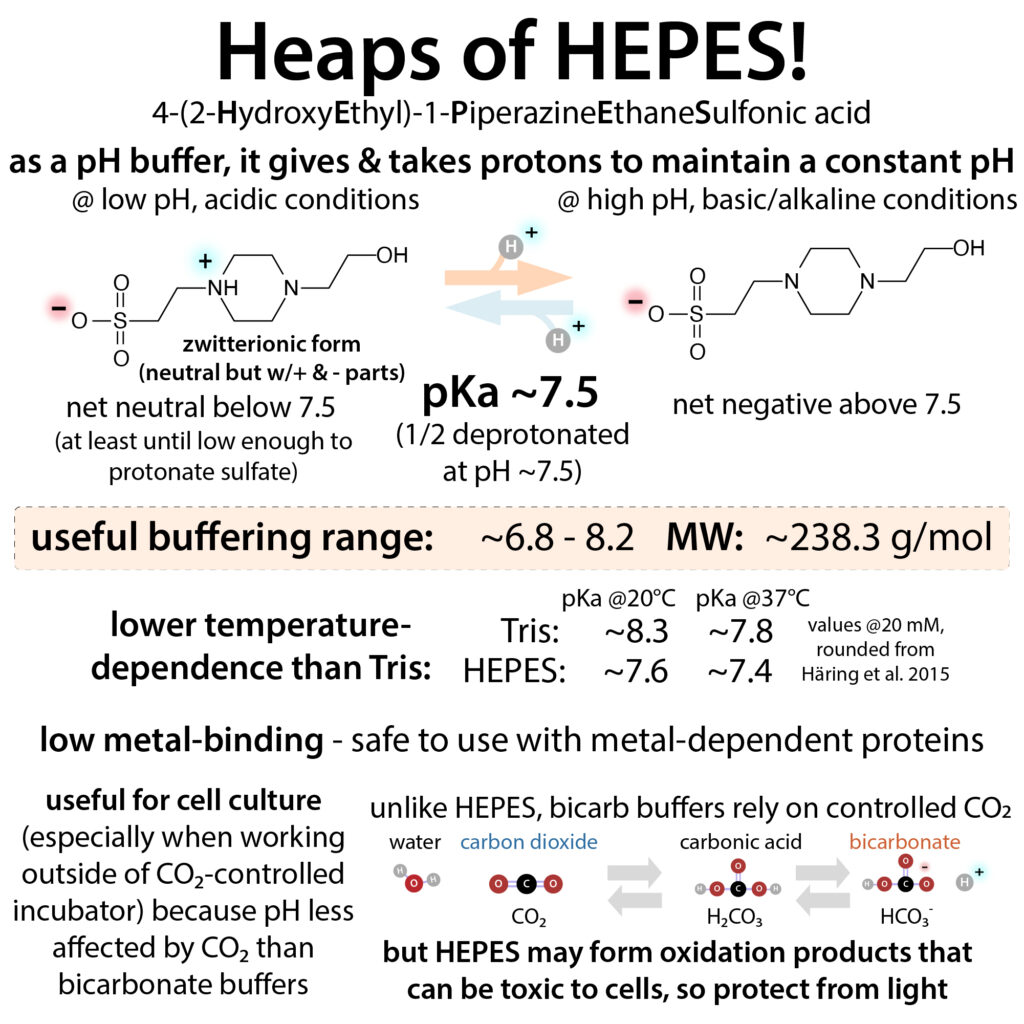
- 1M HEPES (pH-adjusted w/ NaOH &/or KOH, various pH’s depending on what working solutions you need)
- 1 M Tris (various pH’s depending on working solutions you need)
- Others might include sodium phosphate, potassium phosphate, etc.
much more on stock solutions & making them: http://bit.ly/sciencestocksolutions ; YouTube: https://youtu.be/9OtxOHLYaOQ
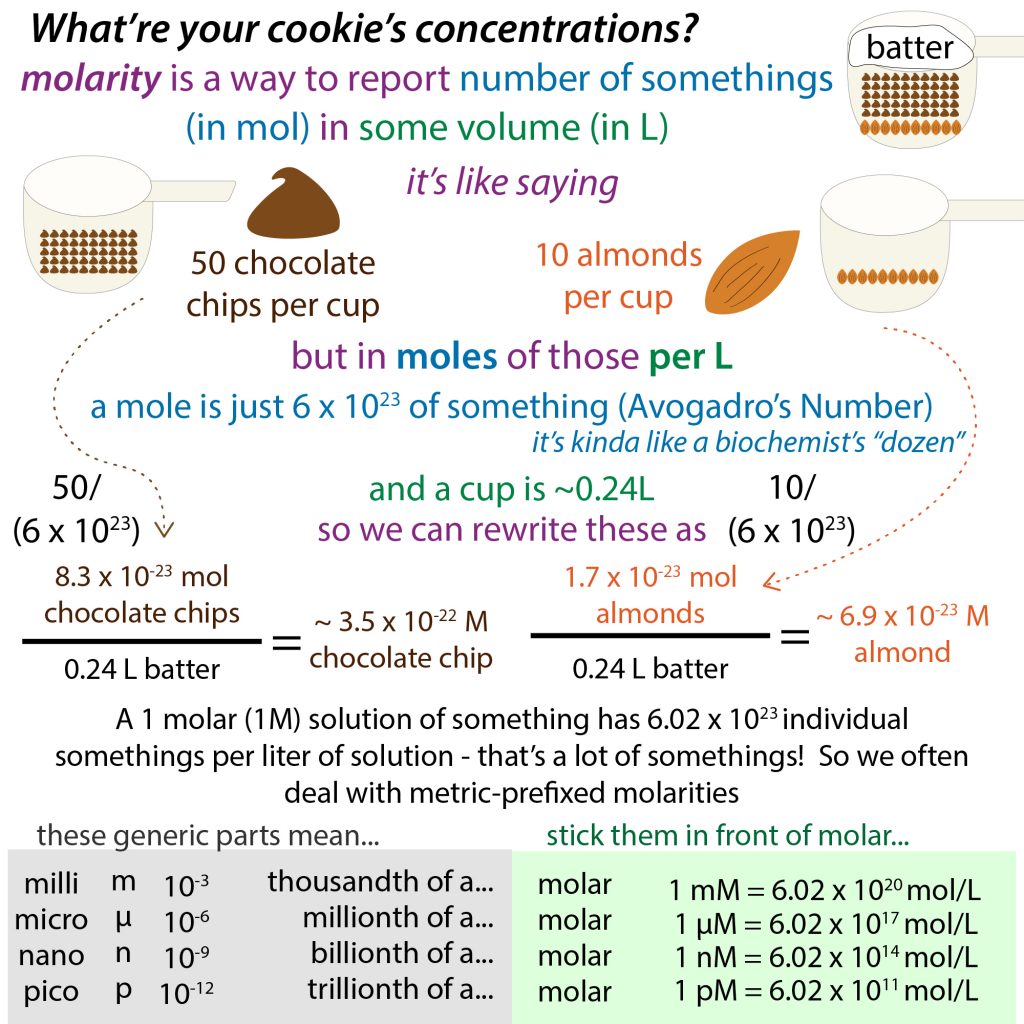
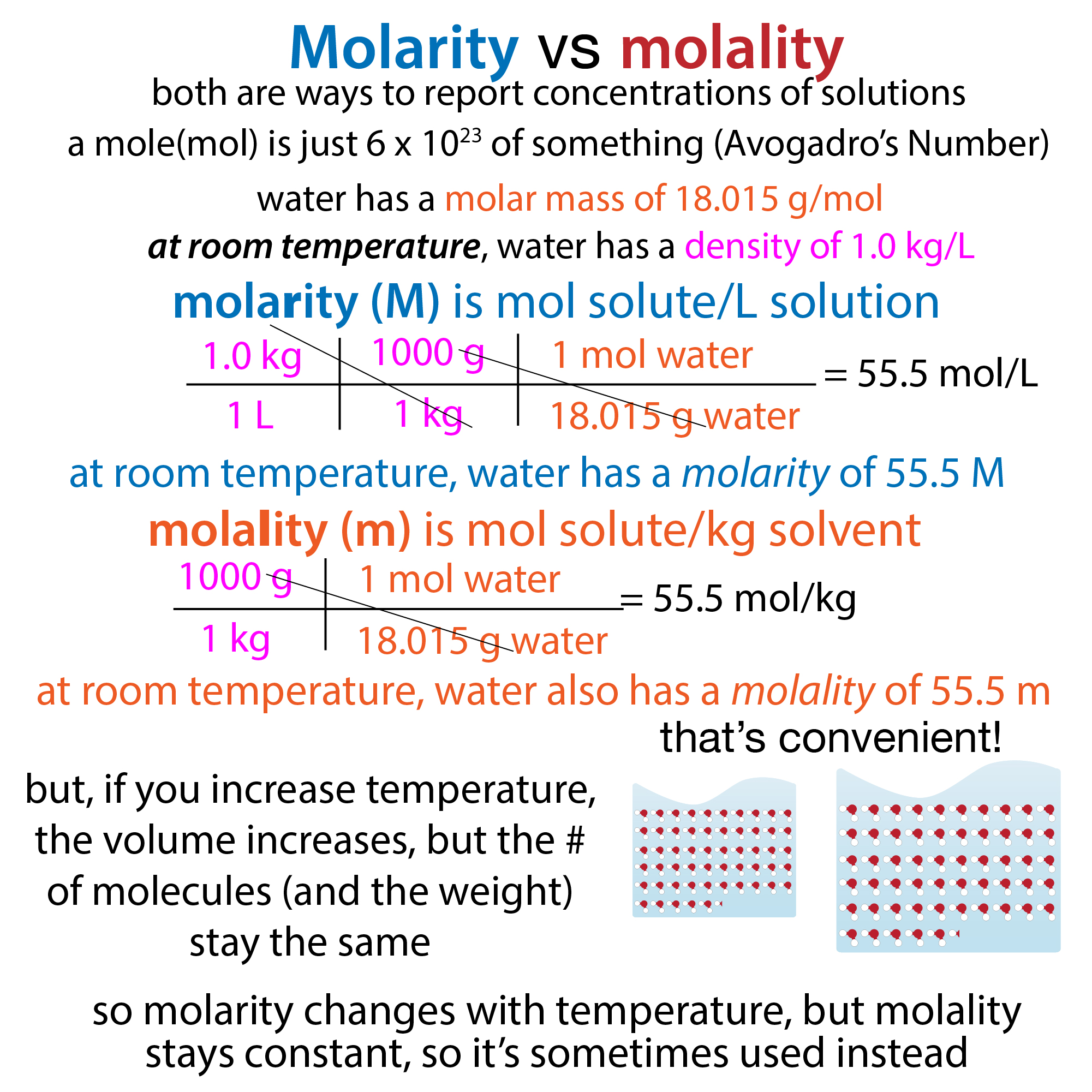
more about concentrations: https://youtu.be/RjXYvOiLh2w & https://youtu.be/wC623-AGBOs
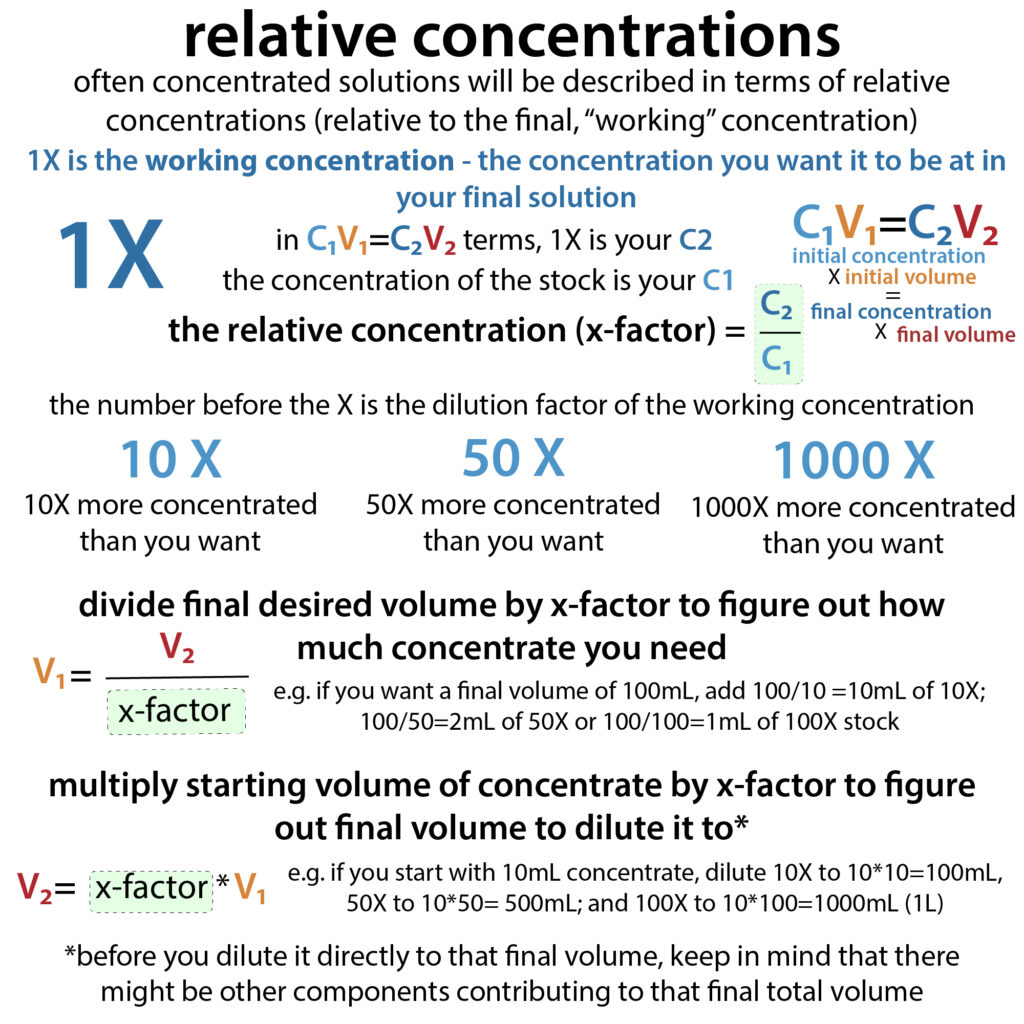
more about C1V1 = C2V2: http://bit.ly/c1v1equalsc2v2 & https://youtu.be/JbtTwDOVyOo
more about metric conversions: https://bit.ly/metric_calcs ; https://youtu.be/A-J7kdLNb8c
calculations demo: https://youtu.be/0fQuXs8qtz0 & https://youtu.be/zvfWQawYciM
example problems: https://bit.ly/bumbling_uploads
more about EDTA stock solution-making: https://bit.ly/edta_stock & https://youtu.be/BMoaTwDVn4c
more practical lab tips: https://bit.ly/lab_tricks_page & https://www.youtube.com/playlist?list=PLUWsCDtjESrFEAWZCRKJL7sMc6a_KgfLU
more about all sorts of things: #365DaysOfScience All (with topics listed) 👉 http://bit.ly/2OllAB0 or search blog: https://thebumblingbiochemist.com