Research poster guidance
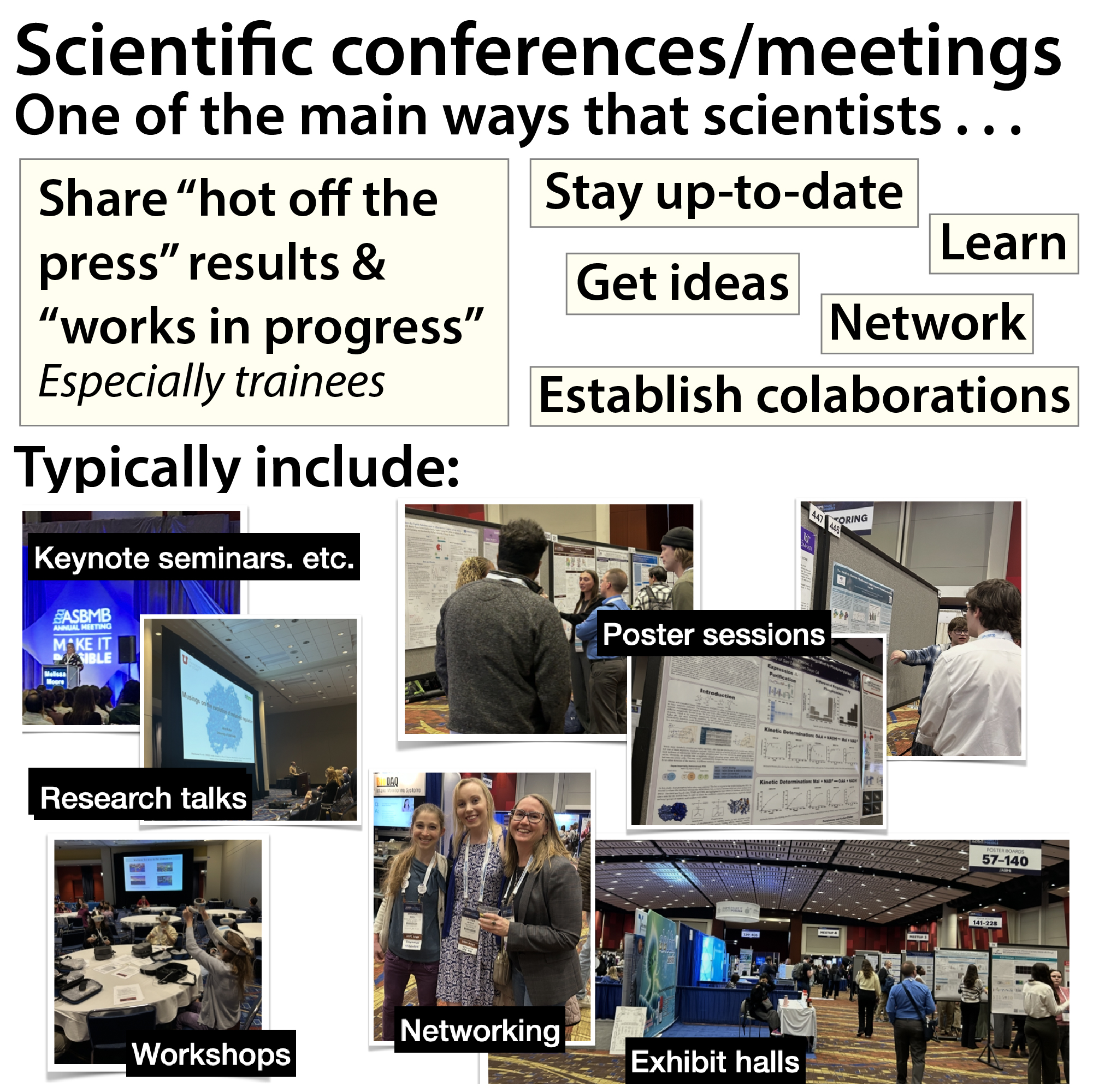
Posters are one of the main ways in which scientists (often scientists in training) present “hot of the press” results and “works in progress.” The format of research posters varies widely, but the following general format is what is typical.
General format & guidelines
Title: Use sentence case. Do Not Use Title Case.
Authors: The people who did the main work (e.g., the students) first, the primary/primary/principal investigator (PI) (lab head and/or professor) last
Introduction: The introduction section provides more information on the system you are working with and/or the methods used in the study. For example, providing structures of the molecules, explaining how an instrument works, describing a reaction in more detail, etc. It should provide enough information for an outsider to understand but only include relevant background (you will need to make strategic choices).
It is typically in paragraph form (but not too long!) broken up with/accompanied by visuals.
Note: Citations are provided at the bottom right of the poster if included (but only include key citations)
Materials & Methods: The materials and methods section should give your audience a general idea of the methods you used to do your research. Less detailed than a paper M&M, it should include enough detail to understand the experiment, but not too much (include things like final concentrations of a buffer, but not volumes pipetted to make the buffer and/or catalog numbers). You should only include M&M for experiments whose results you include. It is most accessible in a visual form, such as in drawings, flowcharts, brief lists, tables, and schemes.
Results (might be combined with Discussion): The results section of your poster should present the results you’ve obtained. Typically, scientists have way more results they could present than they do present – there’s just not enough space and, more importantly, simply listing results is not the purpose of the poster. Rather, the poster should serve as a visual aid to assist you in telling a (informative and accurate, yet compelling) story of your research.
Too much information can actually detract from the main story. Therefore, you should decide on what to include here to tell the story of your research to someone who is not familiar with the topic (what would you need on your poster to tell this story at a conference or symposium to people not in your field?). Ideally, results should be included from different approaches (helps provide robustness to findings).
It should include, when appropriate, a mixture of figures, tables, graphs, schemes, etc. Use figure legends to help explain your visuals. Bullets can help break up blocks of text.
Conclusions (might be combined with Discussion and/or Future Work): Here, you will summarize conclusions made from your results, place your results in the context of the field of research, and describe the impact – why someone should care about your results. I recommend using bullet points.
Future Work: Here, you provide a statement about unanswered questions and ongoing and/or future work that is needed on the project. I recommend using bullet points.
Acknowledgements: Credit individuals who have assisted you in accomplishing your work (research advisor, lab mates, department, college, university, funding sources, etc.)
Overall appearance: Uncluttered, use of white space, easy to follow, easy to read, not too much text, consistent and neatly formatted content
General Poster Guidelines
- Use large text (text should be at least 18-24 pt, headings 30-60 pt, title at least 72 pt)
- Do not use more than 2-3 font styles
- Make sure your font style is easy to read (such as Times New Roman, Helvetica, Arial, and Calibri)
- Align your edges, center your figures, etc.
- Be careful not to squish your figures when resizing – resize from the corners to preserve aspect ratios.
- Do not justify the blocks of text to have a consistent text width – rather, simply align left margins
- Avoid too much text
- Avoid using too much technical language (based on your audience)
- Choose colors carefully.
- Dark letters on light backgrounds tend to look the best.
- Remember some colorblind people cannot distinguish between red and green
- White space is important because it makes the poster more readable. This is the “empty” space between blocks of text and graphics.
- Keep an eye on the resolution of your images. Avoid fuzzy images. Use images with at least 300 ppi.
- Use the institutional and/or school logo.
- Check for grammar and spelling.
More granularly . . .
- Introduction:
- Accurately describe findings from past experimental results
- Give sufficient background information to allow the reader to 1) understand the impetus for the present work and 2) follow along
- Provide “big-picture” justification for why the work was performed
- Results:
- Include (annotated) figures for key experiments
- Annotate figures to indicate what’s what (rather than just relying on the legend)
- Label each of the experimental figures with the type of experiment and a summary sentence of the key findings from that experiment
- Present data accurately
- Include (annotated) figures for key experiments
- Conclusion:
- Compare and integrate results from different experiments
- Provide an overall conclusion that incorporates the integrated findings to evaluate whether they’re consistent with the initial hypothesis
- Ensure all conclusions are supported by the evidence – don’t make unsubstantiated claims
- Ensure content is accurate
- Draw back to the “why” – state (but don’t overstate) the significance of the reported findings
- Outstanding questions and Future work:
- Introduce remaining questions
- Mention ongoing experiments extending/following up on/confirming reported results
- Propose potential future experiments
- Written content:
- Write concisely
- Get straight to the point: e.g., instead of “When conducting this experiment, it was determined that A correlated with B”, simply state: “A correlated with B”
- Avoid “fluff” and “filler” words
- Only provide enough information for your audience to follow along – don’t give exhaustive methods, etc.
- Ensure writing is clear and easy to follow
- Structure the content to flow logically
- Check carefully for errors in grammar, spelling, and/or formatting
- Write concisely
- Visuals:
- Use large, left-justified text
- Ensure figures are high-resolution and have proper aspect ratios (aren’t fuzzy and/or squished)
- Minimize amount of text (while still conveying needed information) and maximize use of figures
- Make good use of white space
- Label figures thoroughly and consistently (including all axes, gel lanes, ladder band MWs, etc.)
- Ensure all text, figures, etc. are aligned, centered, etc. to help the poster appear polished
- Be strategic & consistent in choice and formatting of text and figures
- Follow all provided guidelines
- Walk-through
- Start by introducing yourself – What’s your name? Where are you doing research? Are you an undergrad, PhD student, postdoc, etc.? If applicable, whose lab are you in?
- Ask your audience how familiar they are with the topic and/or whether they want a quick version or a whole walkthrough.
- Invite your audience to ask questions throughout
- Put away your phone & appear enthusiastic & accessible.
- Don’t read off poster or notecards during your presentations (except for minor details like values that can be read off the poster, but not a notecard)
- Talk clearly and loudly (poster sessions are typically really loud so it’s hard to hear!)
- Avoid the use of filler words (ums, etc.)
- Use a strong, compelling, introduction/hook to draw the audience in
- Give a “why” for the research project
- For a “full” walkthrough, interpret and discuss all figures
- Use the poster as a visual aid throughout the presentation (point to things while you’re talking about them, etc.)
- Try to make your presentation flow logically and smoothly
- Describe your work accurately
- Place your work is placed in the context of prior research
- Draw back to the “why” in the conclusions – state (but don’t overstate) the significance of your findings
- End your presentation with a discussion of potential future directions
- Q & A
- Be open to questions throughout your talk as well as at the end
- Before diving in, invite your audience to ask questions throughout (and try not to get thrown off by them)
- Ask if audience has any questions at the end
- Be able to further (and accurately) justify any claims you make during the presentation (e.g., if asked how you know your protein was pure, be able to explain what data shows it is.)
- Be able to further (and accurately) describe any of the experimental findings you present on a poster and/or in their walk-through (e.g., if asked what a peak on a chromatogram represents, be able to provide a potential explanation.)
- Be upfront about the extent of your knowledge – it’s okay to say you don’t know and/or that you’ll have to look into something! What’s not okay is pretending you know and making something up.
- Be open to questions throughout your talk as well as at the end
The easiest way to prepare posters (if you don’t have/know how to use Adobe Illustrator, InkScape, or similar) is to prepare them as a slide in Powerpoint, Google Slides, Keynote, Canva, etc.
PosterNerd has free templates: https://www.posternerd.com/sciposters-templates
- Be sure to download the correct size
These sites provide some scientific graphics that are great for method outlines, etc.
- SciDraw: https://scidraw.io/
- bioicons: https://bioicons.com/
- Biorendr: https://www.biorender.com/
Downloadable version: https://docs.google.com/document/d/1pKeXZVujgXWtgbyJmaI7GGo9Dt2jur3B/edit?usp=sharing&ouid=110501489579733284162&rtpof=true&sd=true