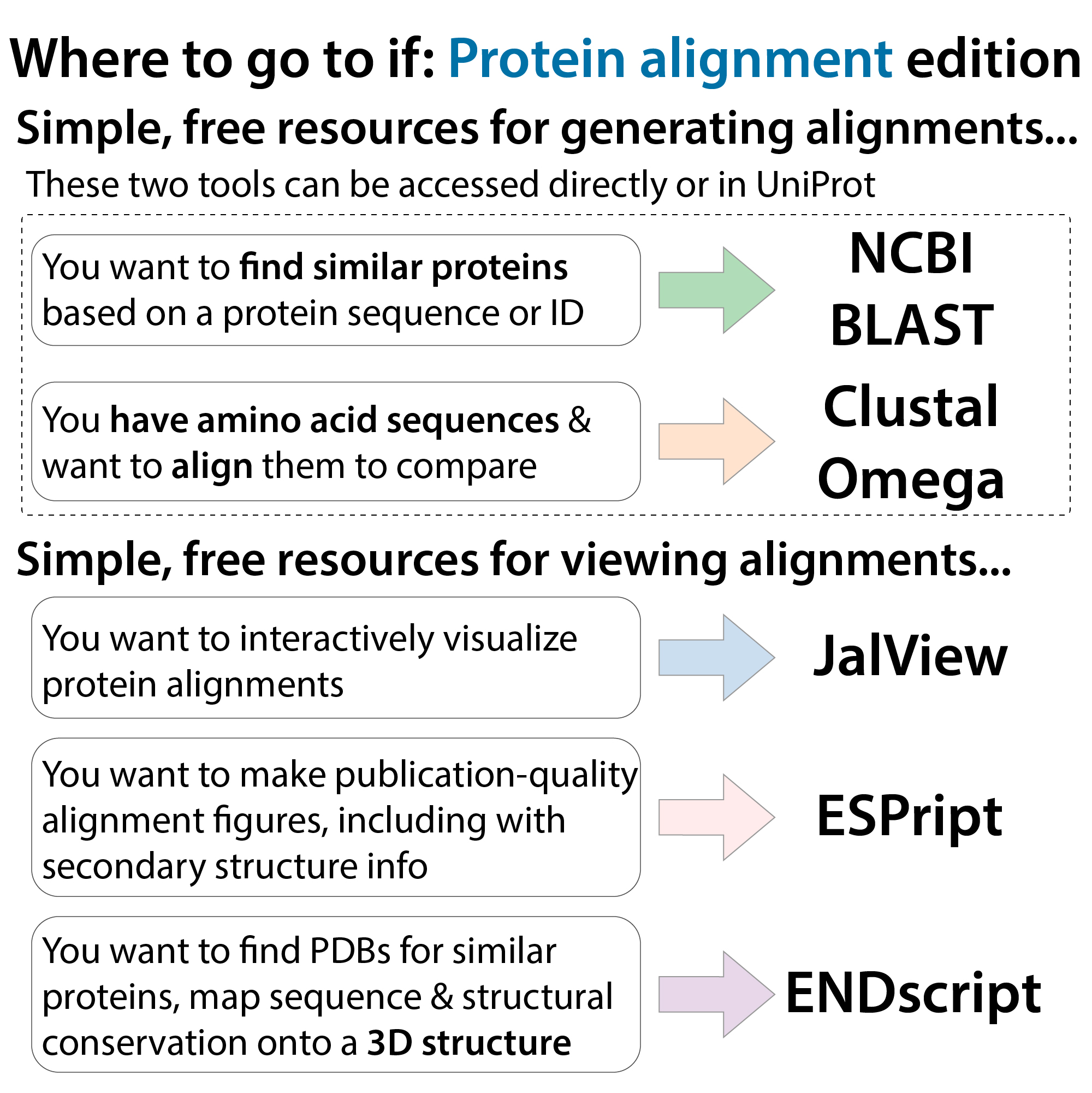
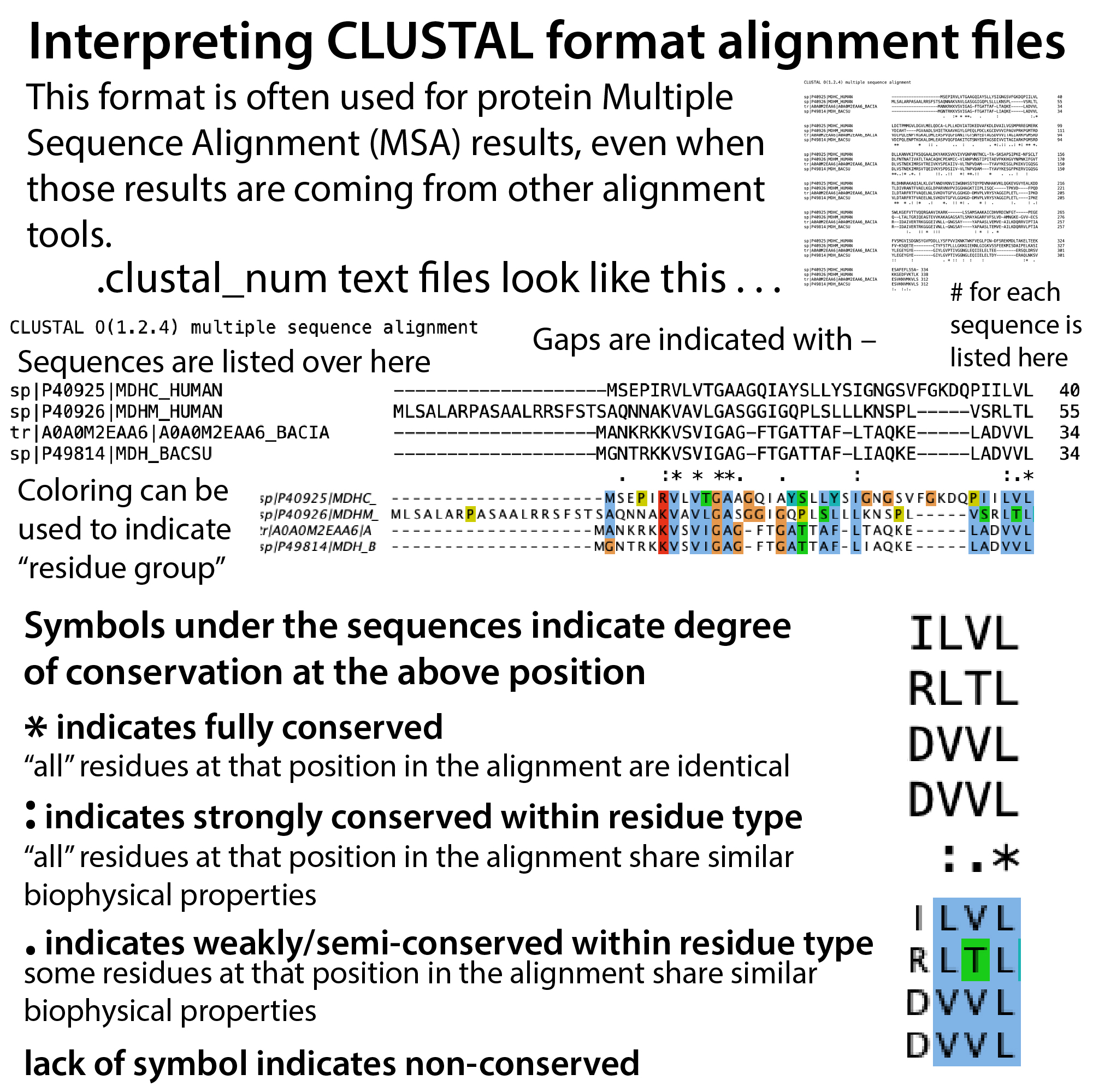
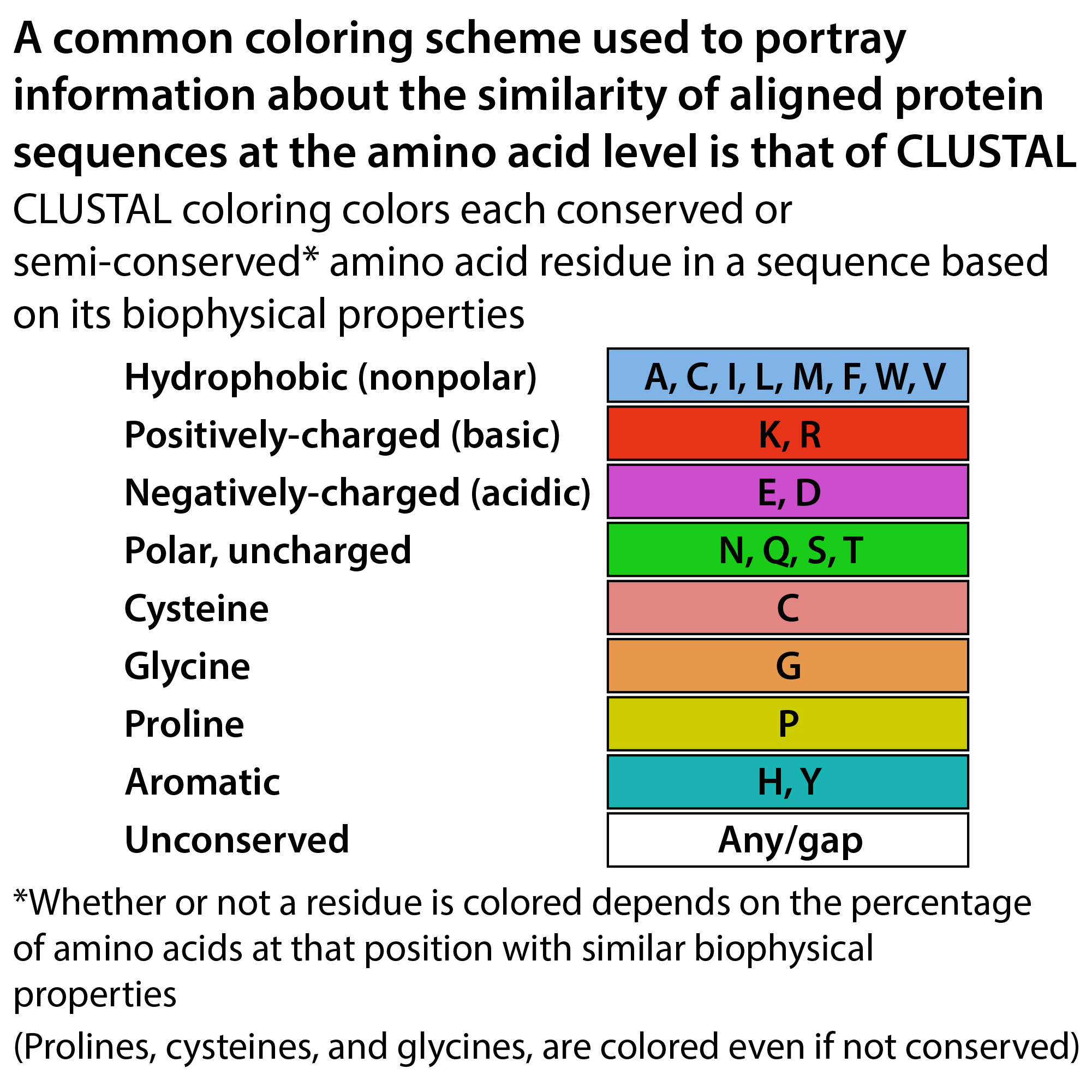
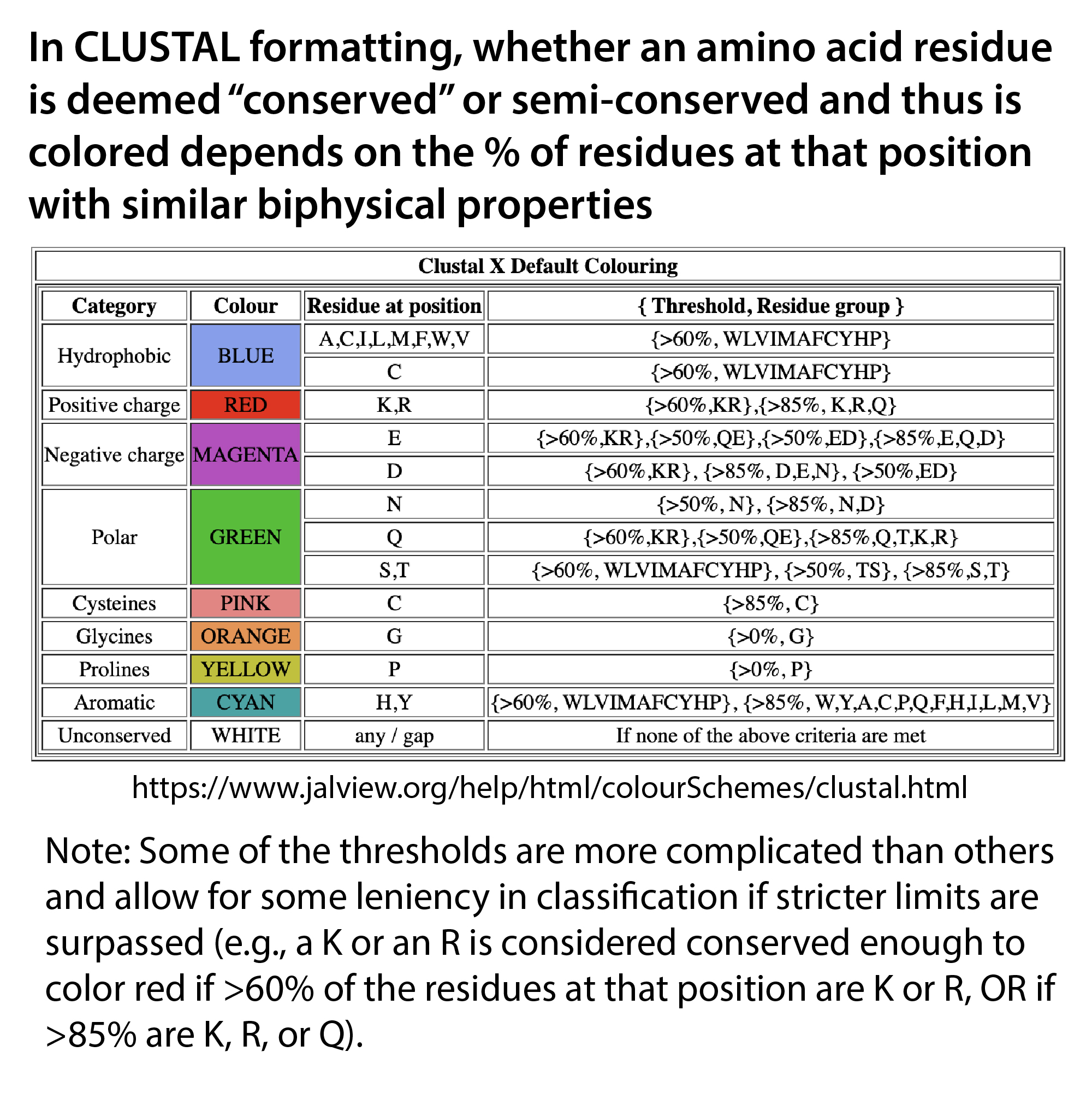
If you’re looking to create and/or visualize (interactively or for figures) protein alignments, here are a few free resources I recommend.
- For creating alignments
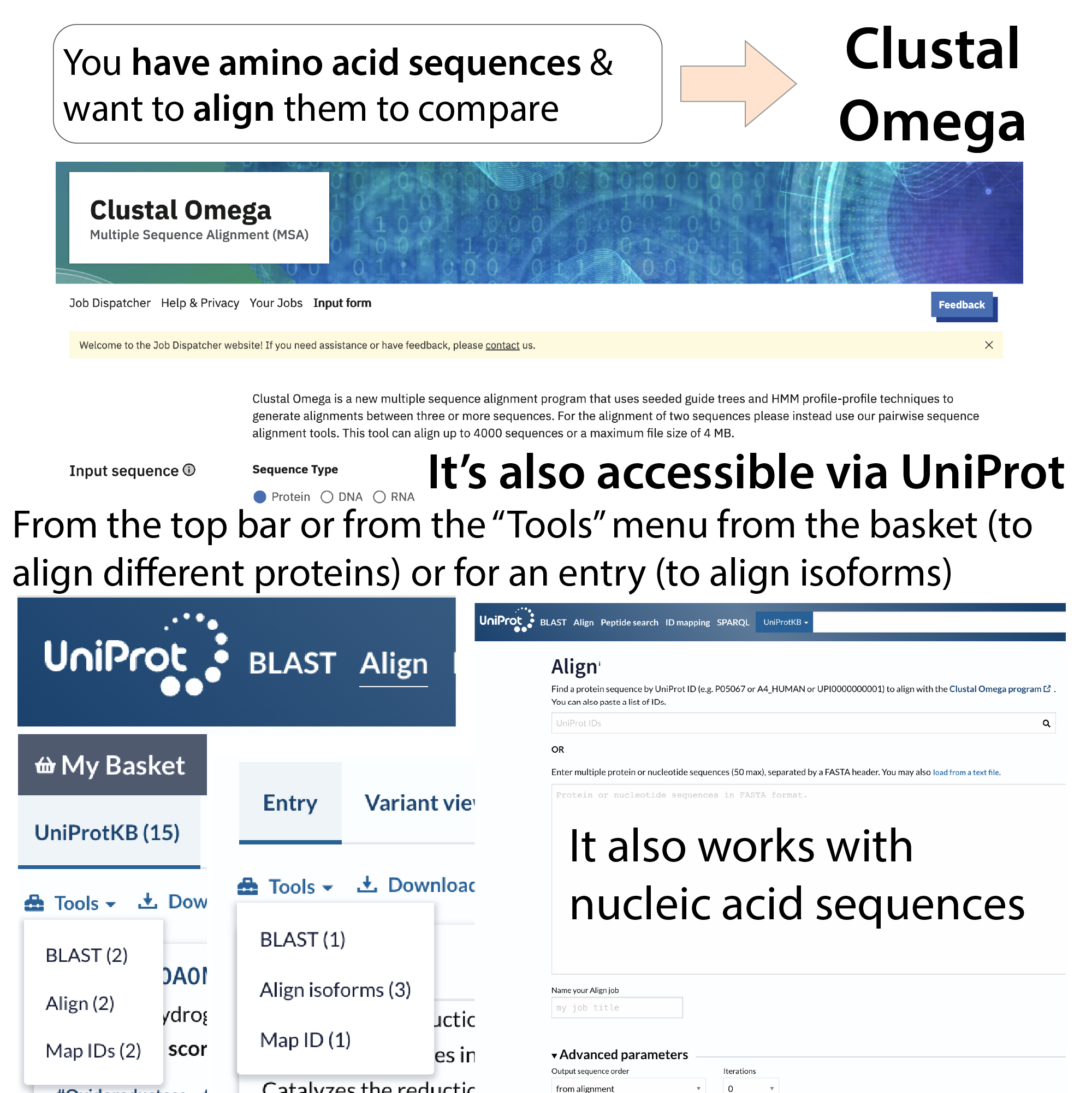
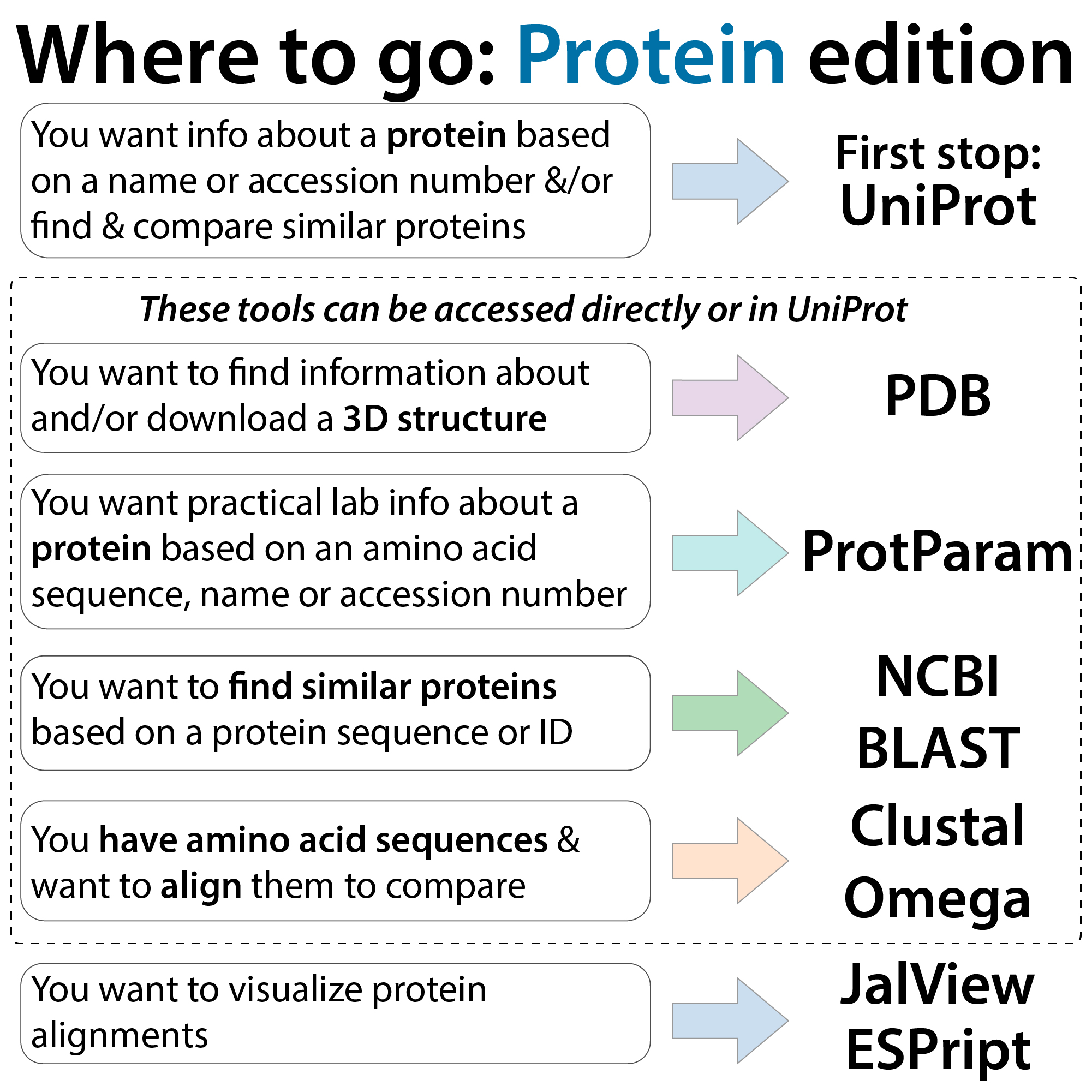
- Clustal omega: https://www.ebi.ac.uk/jdispatcher/msa/clustalo
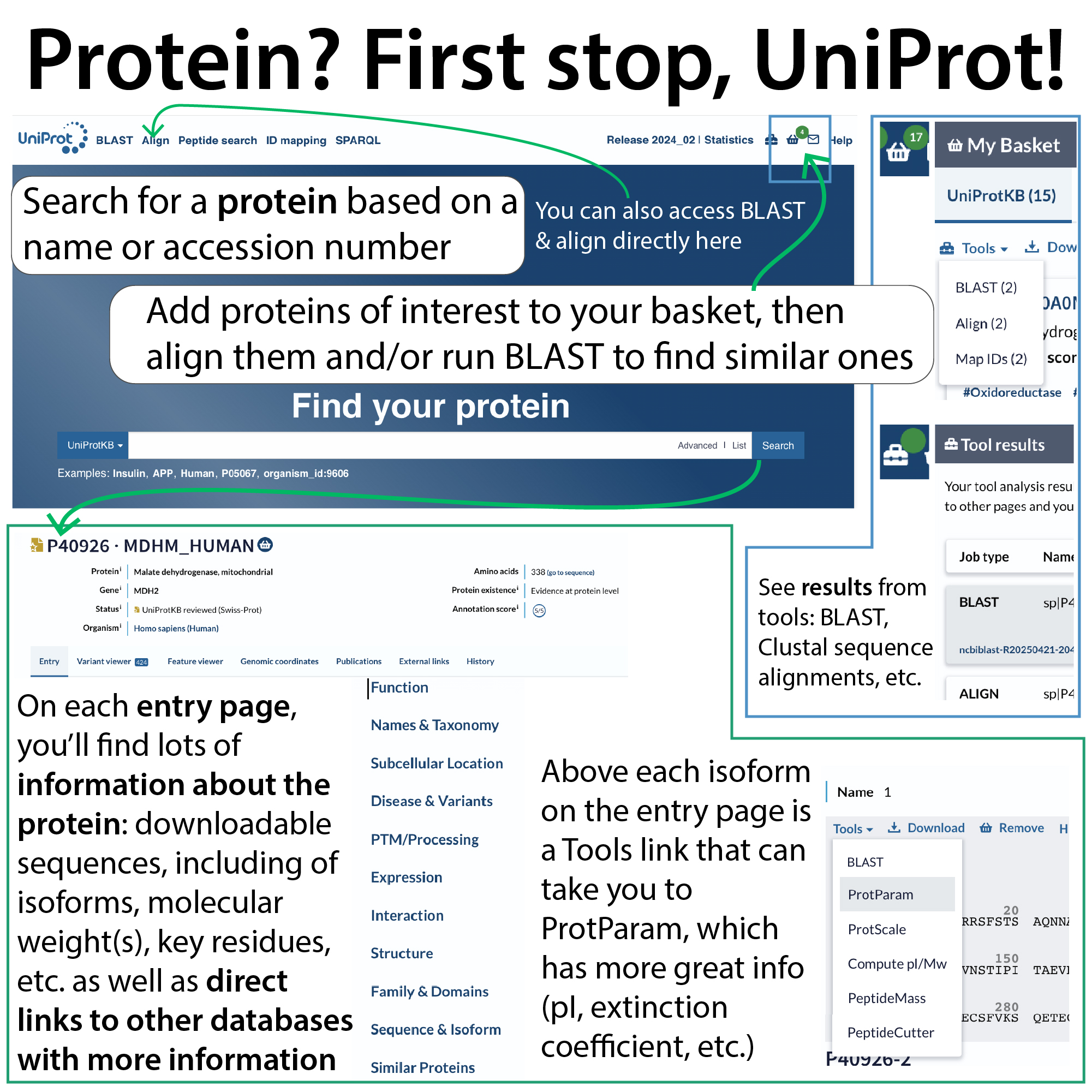
- Which you can access through the “Tools -> Align” button in UniProt: https://www.uniprot.org/
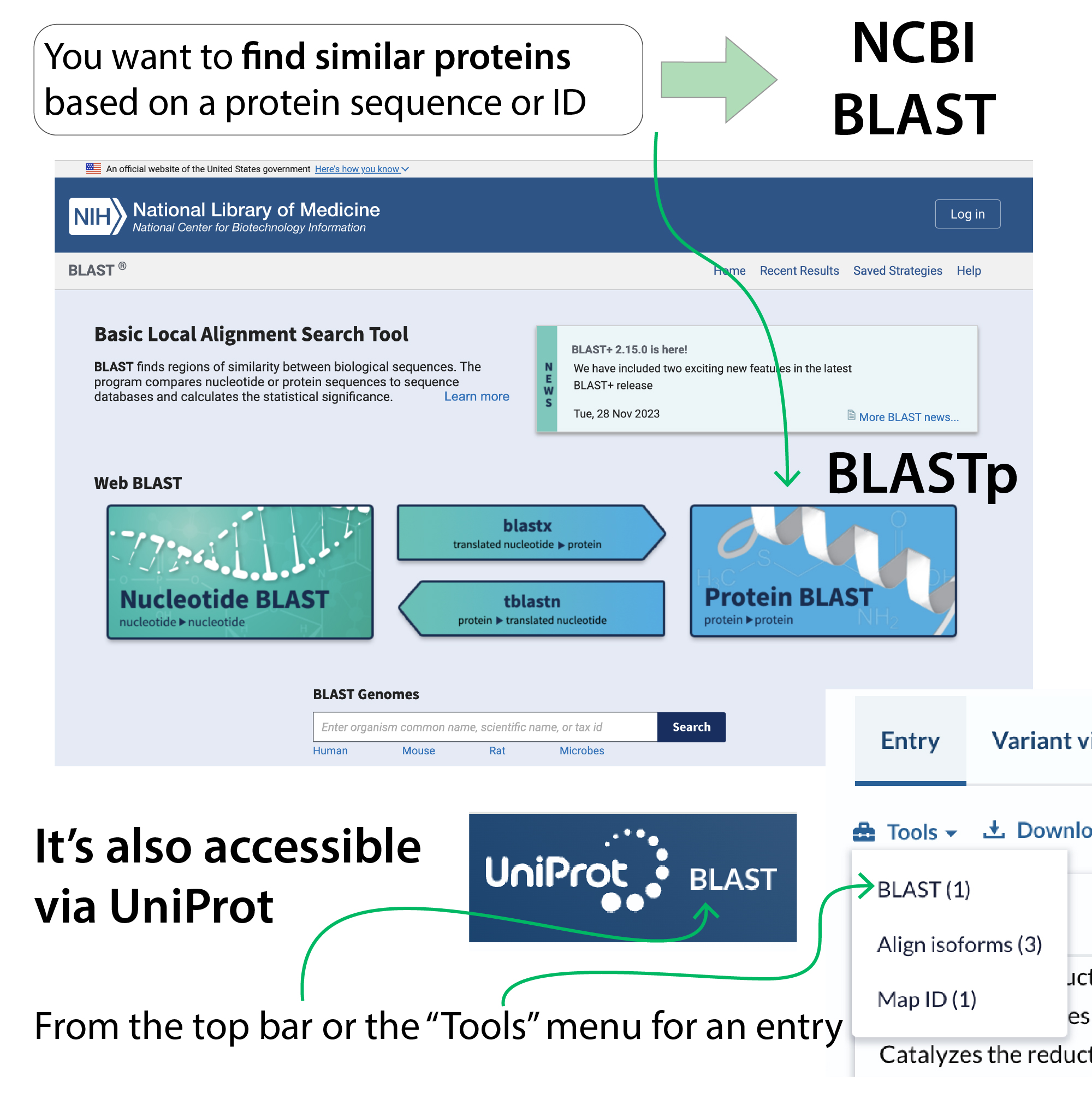
- For finding sequences to align:
- BLASTp (Which you can access through the “Tools -> BLAST” button in UniProt or from BLAST directly): https://blast.ncbi.nlm.nih.gov/Blast.cgi
- For visualizing sequences interactively:
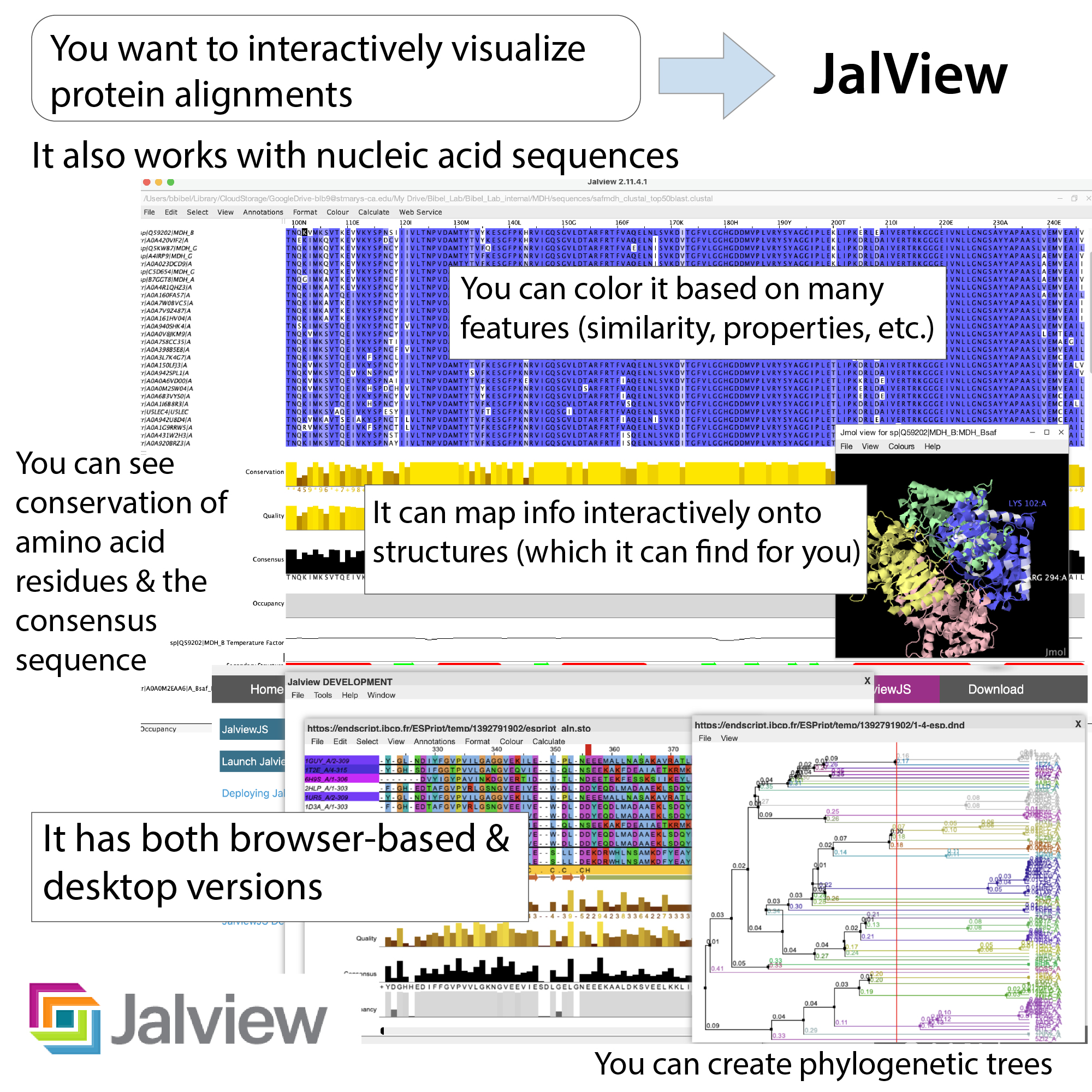
- JalViewJS (web version) or JalView desktop version: https://www.jalview.org/jalview-js/JalviewJS/
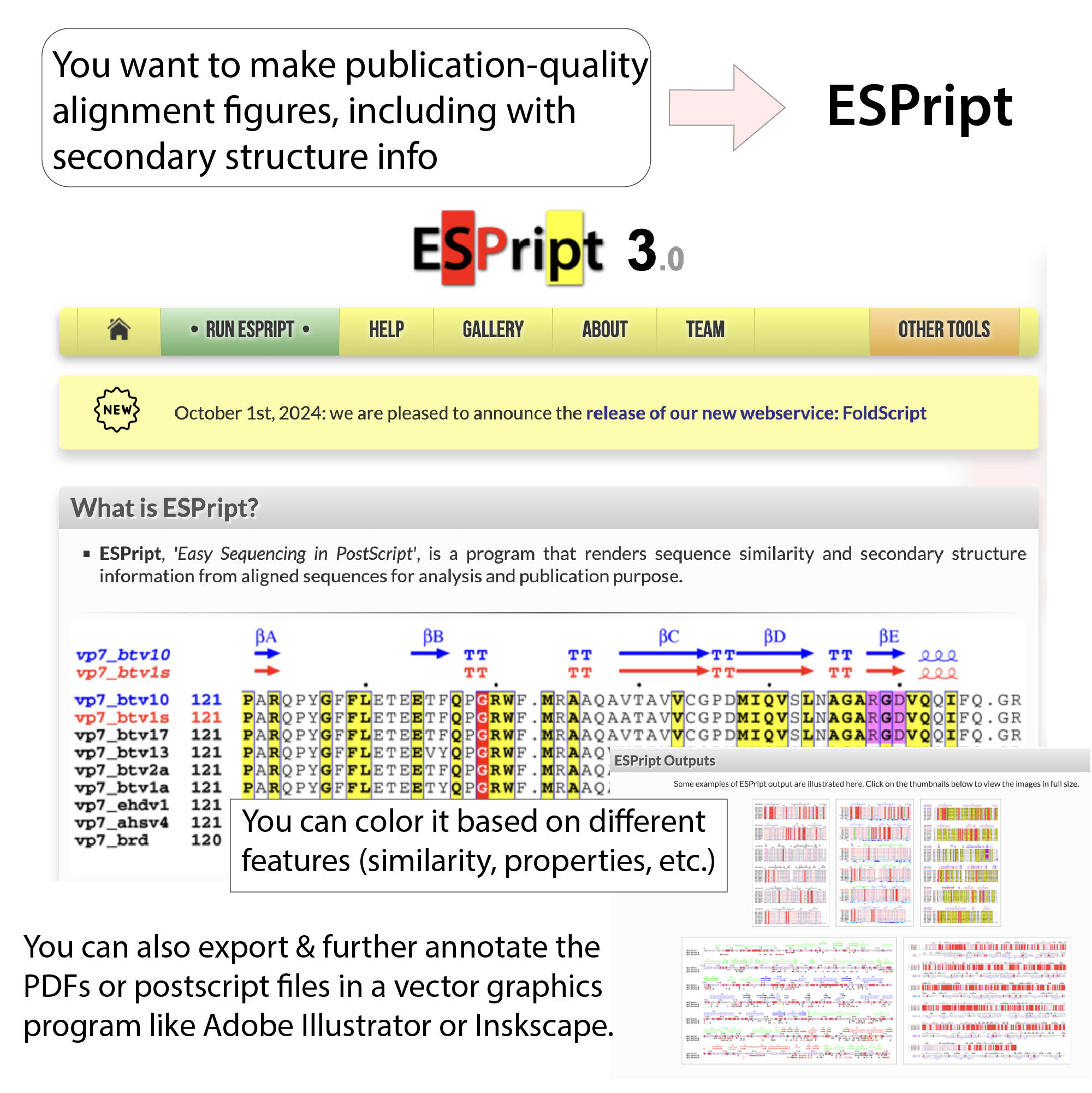
- For making nice pretty sequence alignment figures, including with overlying secondary structural information, etc.:
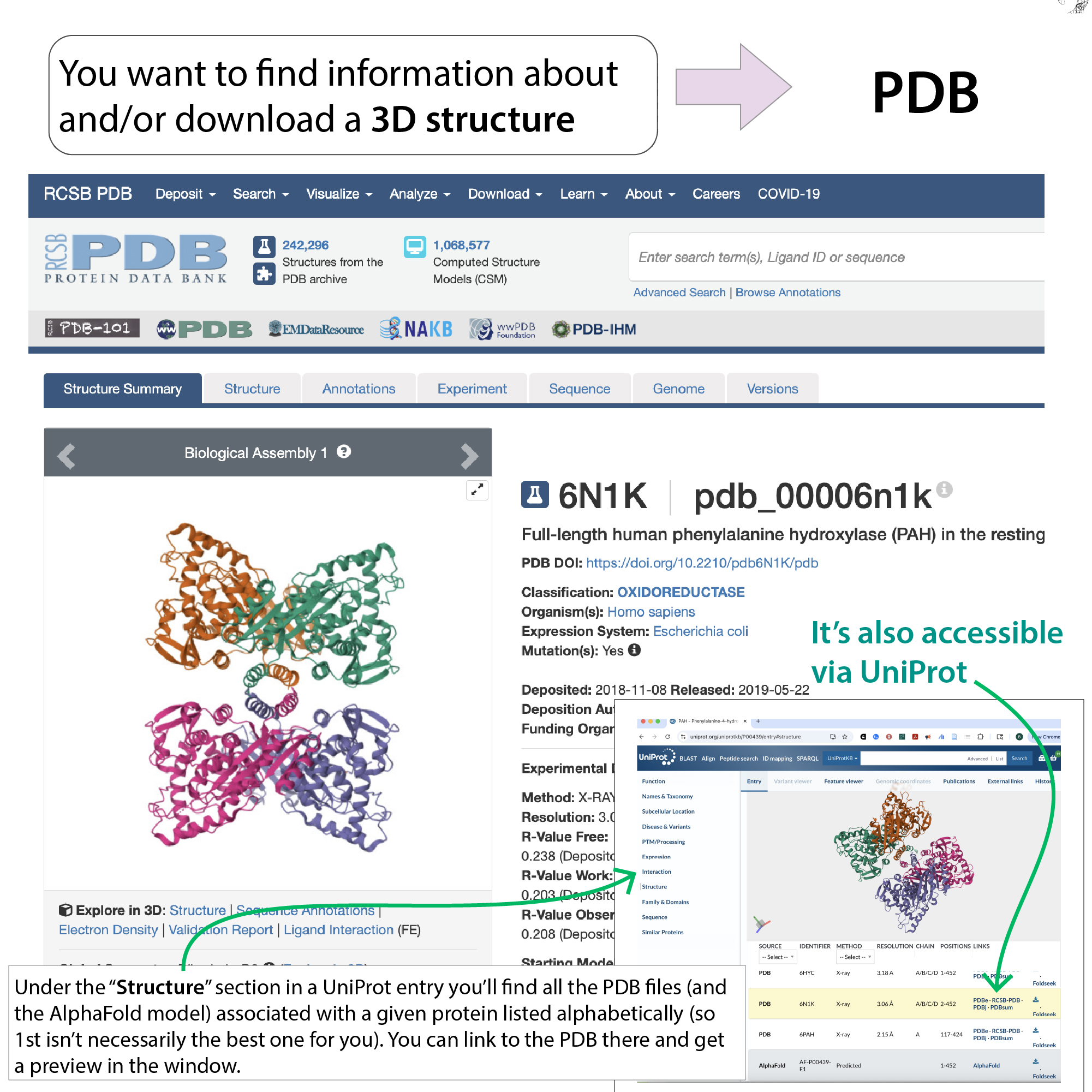
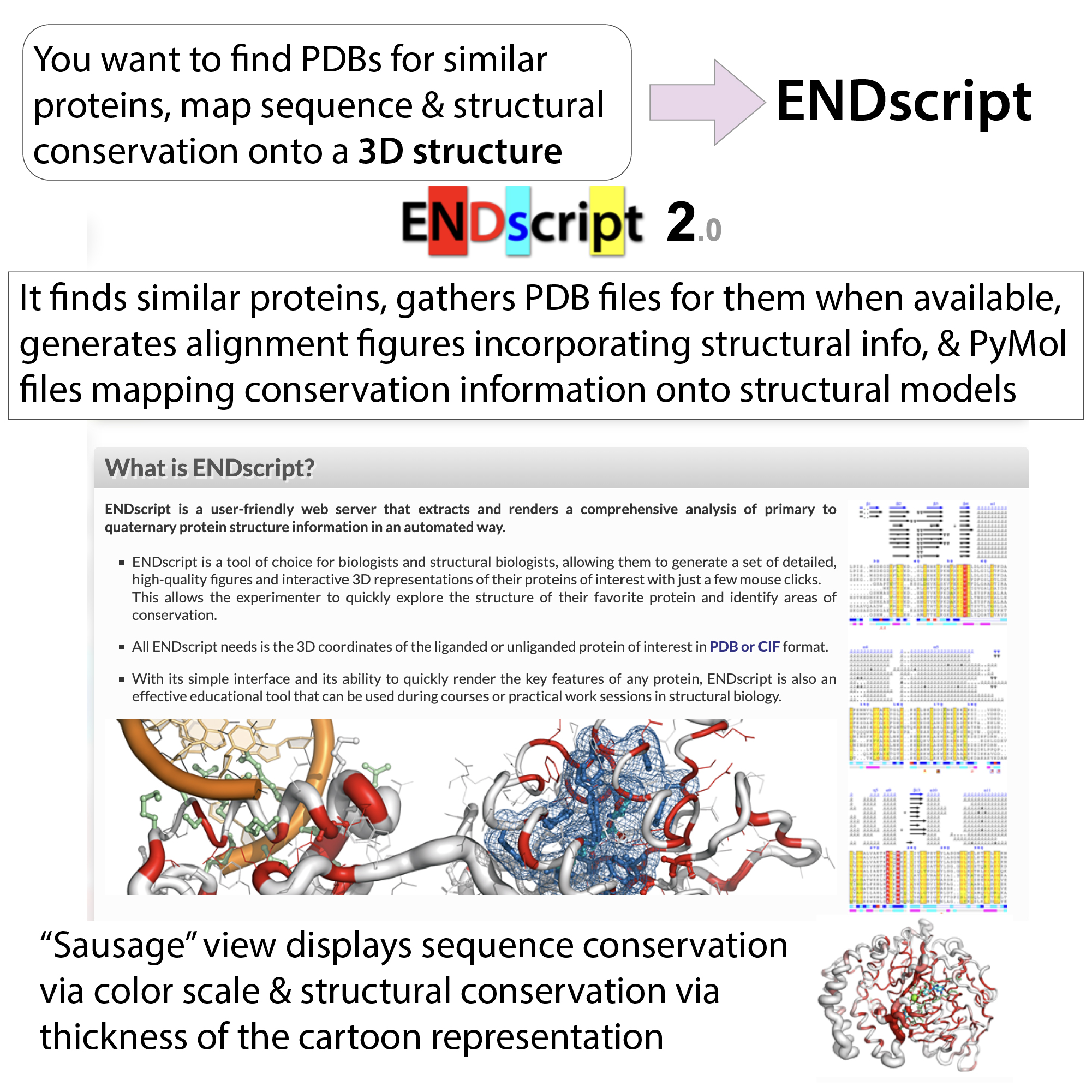
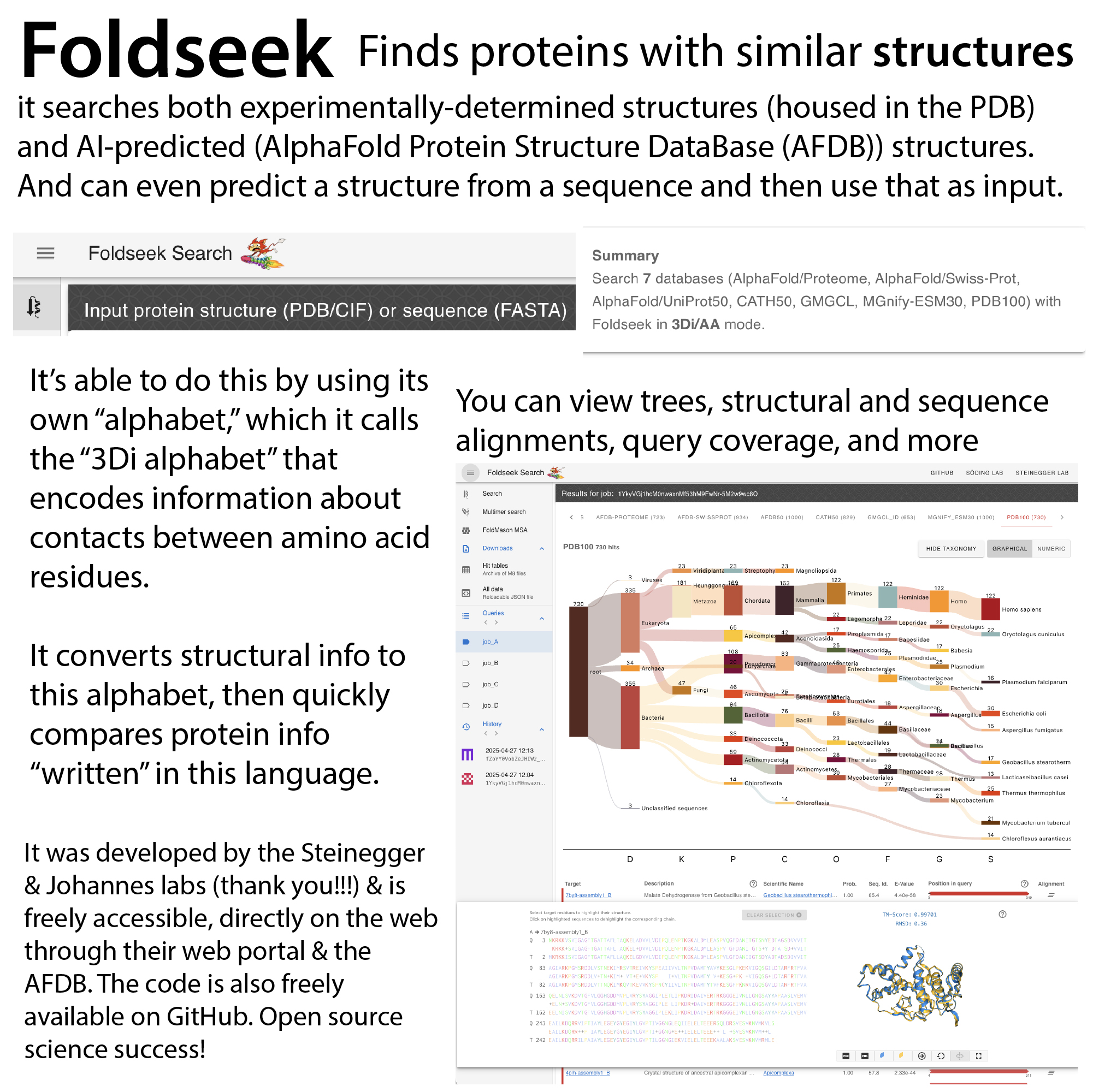
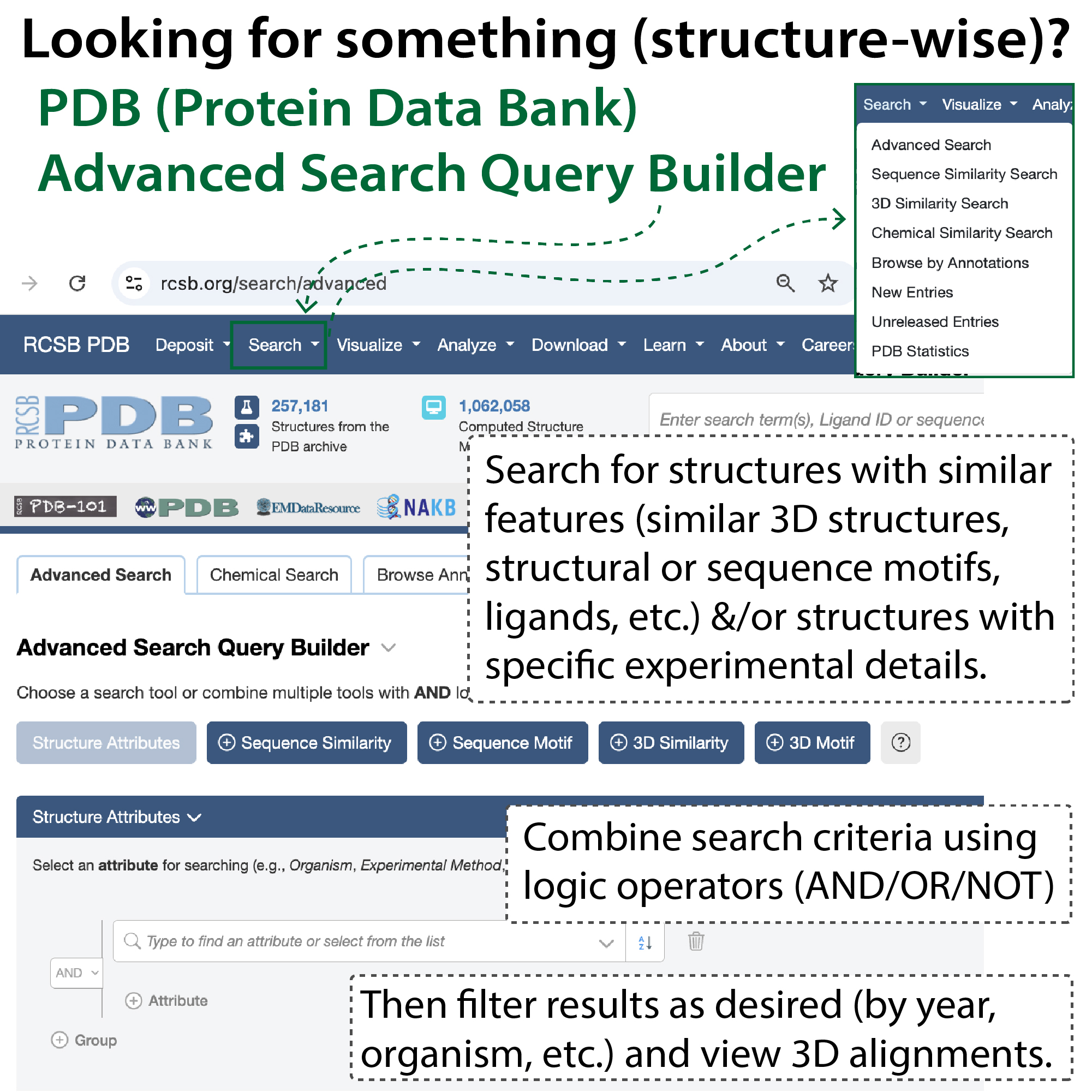
- For finding sequences to align and getting their PDB codes and structural information:
Thanks to all who provide these resources!!!!!
More on databases and when & how to use them here: https://bit.ly/databases_guide ; YouTube: https://youtu.be/ZyLOWqZazgc
downloadable guide: https://bit.ly/biochemdatabases
Robert, X. and Gouet, P. (2014). Deciphering key features in protein structures with the new endscript server. Nucleic Acids Research, 42(W1), W320-W324. https://doi.org/10.1093/nar/gku316
PS – they’re great – they answered my emailed question ASAP espript@ibcp.fr
note from endscript website:
“ENDscript 2 is developed and maintained by Patrice GOUET and Xavier ROBERT in the “Retroviruses and Structural Biochemistry” research team of the “Molecular Microbiology and Structural Biochemistry” laboratory (UMR5086 CNRS / University Lyon 1). ENDscript 2 is a major upgrade of ENDscript 1.x, which was created by Patrice GOUET and Emmanuel COURCELLE. ENDscript is provided as a service to the scientific community and can be used free of charge for research and educational purposes without restriction. When publishing data resulting from the use of ENDscript, please use the following citation:
Robert, X. and Gouet, P. (2014) “Deciphering key features in protein structures with the new ENDscript server”. Nucl. Acids Res. 42(W1), W320-W324 – doi: 10.1093/nar/gku316 (freely accessible online).”
“ESPript 3.x is developed and maintained by Patrice GOUET and Xavier ROBERT in the “Retroviruses and Structural Biochemistry” research team of the “Molecular Microbiology and Structural Biochemistry” laboratory (UMR5086 CNRS / University Lyon 1). ESPript 3 is a major upgrade of ESPript 2.x, which was created by Patrice GOUET and Emmanuel COURCELLE. ESPript is provided as a service to the scientific community and can be used free of charge for research and educational purposes without restriction. When publishing data resulting from the use of ESPript, please use the following citation:
Robert, X. and Gouet, P. (2014) “Deciphering key features in protein structures with the new ENDscript server”. Nucl. Acids Res. 42(W1), W320-W324 – doi: 10.1093/nar/gku316 (freely accessible online).
Do not hesitate to contact us (espript@ibcp.fr) if you need any further information or if you need some help with ENDscript.”
looks like you can use Chimera or JMol with Jalview. I haven’t watched yet, but there’s a tutorial video and exercises: https://youtu.be/yRBLIukwdH4?si=Cchzq2w1vdIllgea https://www.jalview.org/tutorial/exercises/ex-14-Jmol/ https://www.jalview.org/tutorial/exercises/ex-15-Chimera/
In case this is helpful to anyone – I had Claude & Gemini help me write a Google colab to compare amino acid sequences provided in clustal format.
https://drive.google.com/file/d/1U4RwZZp0nlQ7YD-QQrz6j7NJaCzkoYaT/view?usp=sharing
It will take an amino acid alignment in clustal format and allow you to
1) Scroll through the alignment, colored by property – hover over a location to show identity & number
2) Enter a specific amino acid position in a selected sequence and display the corresponding amino acid and position number in the other sequences
3) Find positions of difference between selected sequences
4) Find positions of difference between groups of sequences (places where the amino acid is the same at that position within sets but different between sets)
I also tried uploading it to GitHub but it’s showing invalid but I think it should still work if you open it in Google Colab or Jupyter: https://github.com/bribibel/clustal_comparer/blob/ab4cd7391b9add2857e20798d2da60c2f5caacfd/clustal_alignment_comparer.ipynb