The terminology’s fuzzy and there’s overlap – but the terms “domain” and “motif” are both just ways we can refer to specific parts of a protein that are somehow “interesting” – functionally, structurally, evolutionarily, etc.
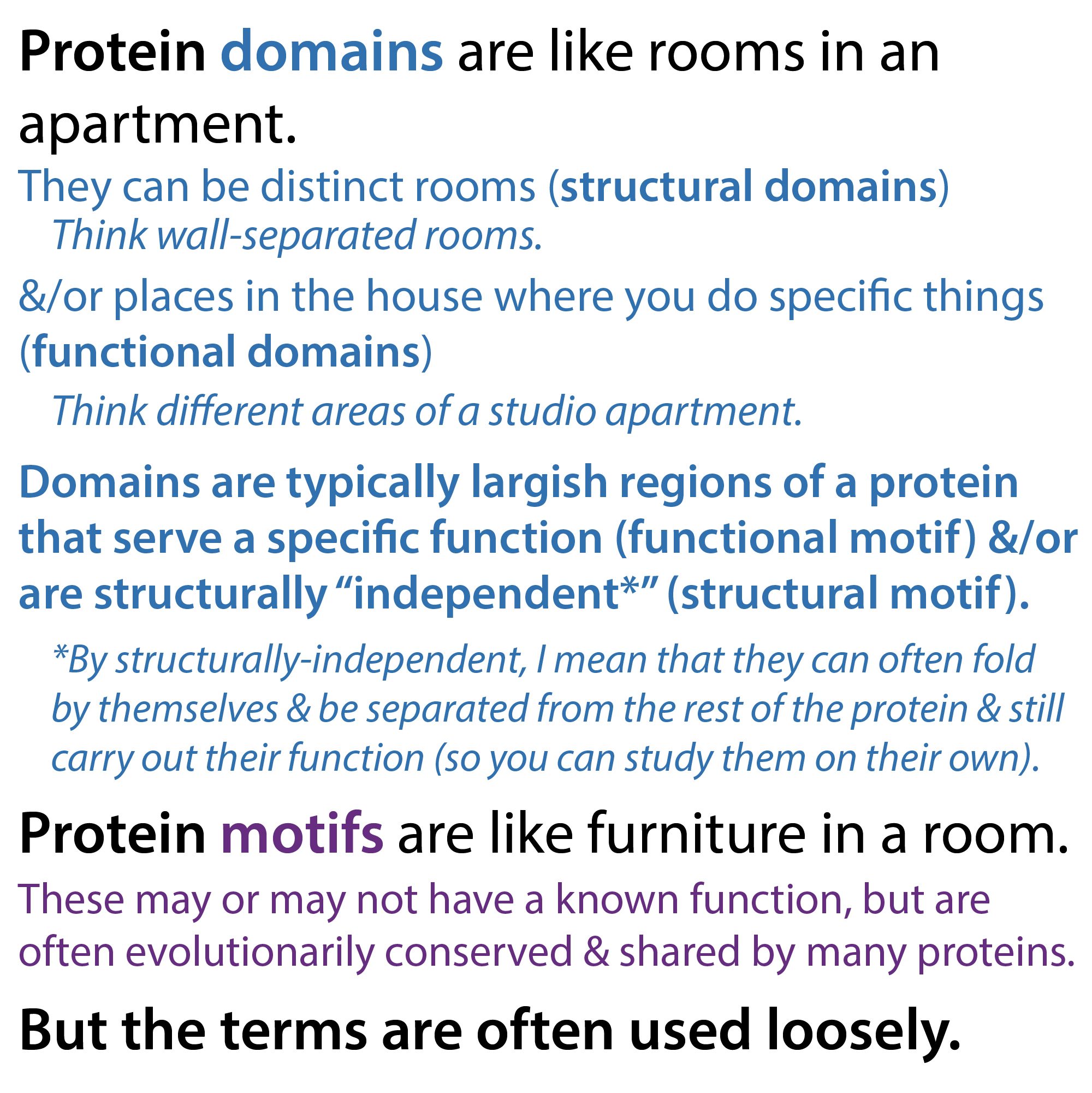
Protein domains are a bit like rooms in an apartment – they can be distinct rooms (structural domains) (think wall-separated rooms) and/or places in the house where you do specific things (functional domains) (think different areas of a studio apartment).
Domains are typically largish regions of a protein that serve a specific function (functional motif) &/or are structurally “independent*” (structural motif)
*by structurally-independent, I mean that they can often fold by themselves and be separated from the rest of the protein and still carry out their function (so you can study them on their own)
Protein motifs are a bit like furniture in a room – these may or may not have a known function ( e.g. zinc fingers typically bind DNA), but are often evolutionarily conserved & shared by many proteins.
examples: zinc finger, β turn, helix-turn-helix , β hairpin
Motifs may be located in a larger “domain” (e.g. a zinc finger motif in a protein’s DNA-binding domain)
more about protein structure: https://bit.ly/proteinstructure & https://youtu.be/-9F7B_A7Lqk
videos: https://youtu.be/7ejb6P6Fo-8 & https://youtu.be/oPv7EDF_UMU
resources:
UniProt: https://www.uniprot.org/
Pfam: http://pfam.xfam.org/
InterPro: https://www.ebi.ac.uk/interpro/
Bernstein, N. K., Williams, R. S., Rakovszky, M. L., Cui, D., Green, R., Karimi-Busheri, F., Mani, R. S., Galicia, S., Koch, C. A., Cass, C. E., Durocher, D., Weinfeld, M., & Glover, J. N. (2005). The molecular architecture of the mammalian DNA repair enzyme, polynucleotide kinase. Molecular cell, 17(5), 657–670. https://doi.org/10.1016/j.molcel.2005.02.012