If you’re like me before a year ago, if you thought of Parkinson’s disease (PD), you thought of the uncontrollable jerky movements of Michael J. Fox. But those movements (more officially referred to as “dyskinesia,” meaning literally “bad movements”) are actually side effects of the medication levodopa (a precursor to making the neurotransmitter (brain signaling molecule) dopamine, which PD patients don’t make enough of), not symptoms of the underlying disease. If he weren’t taking the levodopa (or, during his “off” periods between doses when the medication’s been depleted), you’d see the underlying “parkinsonian” symptoms – rigidity, tremors, and “bradykinesia” (slow movements). For Fox and many PD sufferers like him (including my dad), PD involves a constant battle of trying to find a balance between these two extremes. This balance is made incredibly complex because of levodopa’s biochemistry and pharmacology. So today, as I look into all of this in the continuous hope of better understanding my dad’s condition, I want to talk about PD medications. I will focus on the mainstay levodopa-carbidopa combo, but also discuss some variations, add-ons, and delivery mechanisms.
It will, by necessity, get fairly technical and jargon-y, but I will try to explain things as best I can in normal-people words (with the jargon alongside so you can recognize the official words when you see them). Also, disclaimer that I am not a medical doctor, and I am not a neuroscientist, just a biochemist trying my best, so apologies if I make any errors (please let me know!) and please talk to a medical doctor about medications. This definitely should not be taken as medical advice!
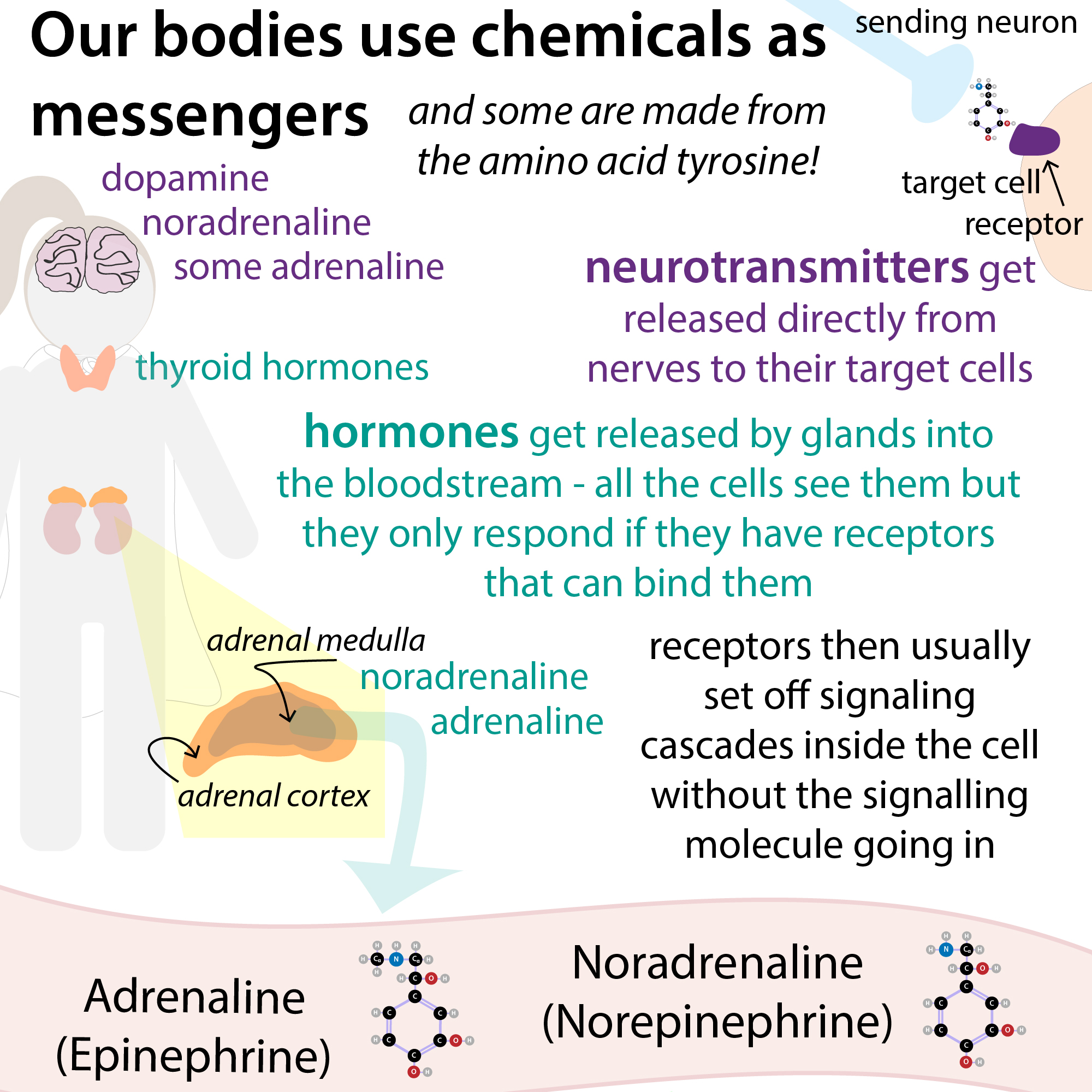
At first hearing, it might seem surprising that levodopa is still the main treatment, given that it was established years ago and is known to have such side effects. Yet, if you think about what it is, and what PD is, it makes sense. Just like patients with Type 1 Diabetes (T1D) can’t make insulin, so you give them insulin, PD patients don’t make enough dopamine (due to degeneration of dopamine-producing brain-cells (dopaminergic neurons) in a part of the brain called the substantia nigra), so you give them a dopamine precursor, levodopa (aka L-DOPA). (P.S. We will return to the T1D analogy later when discussing infusion pumps.)
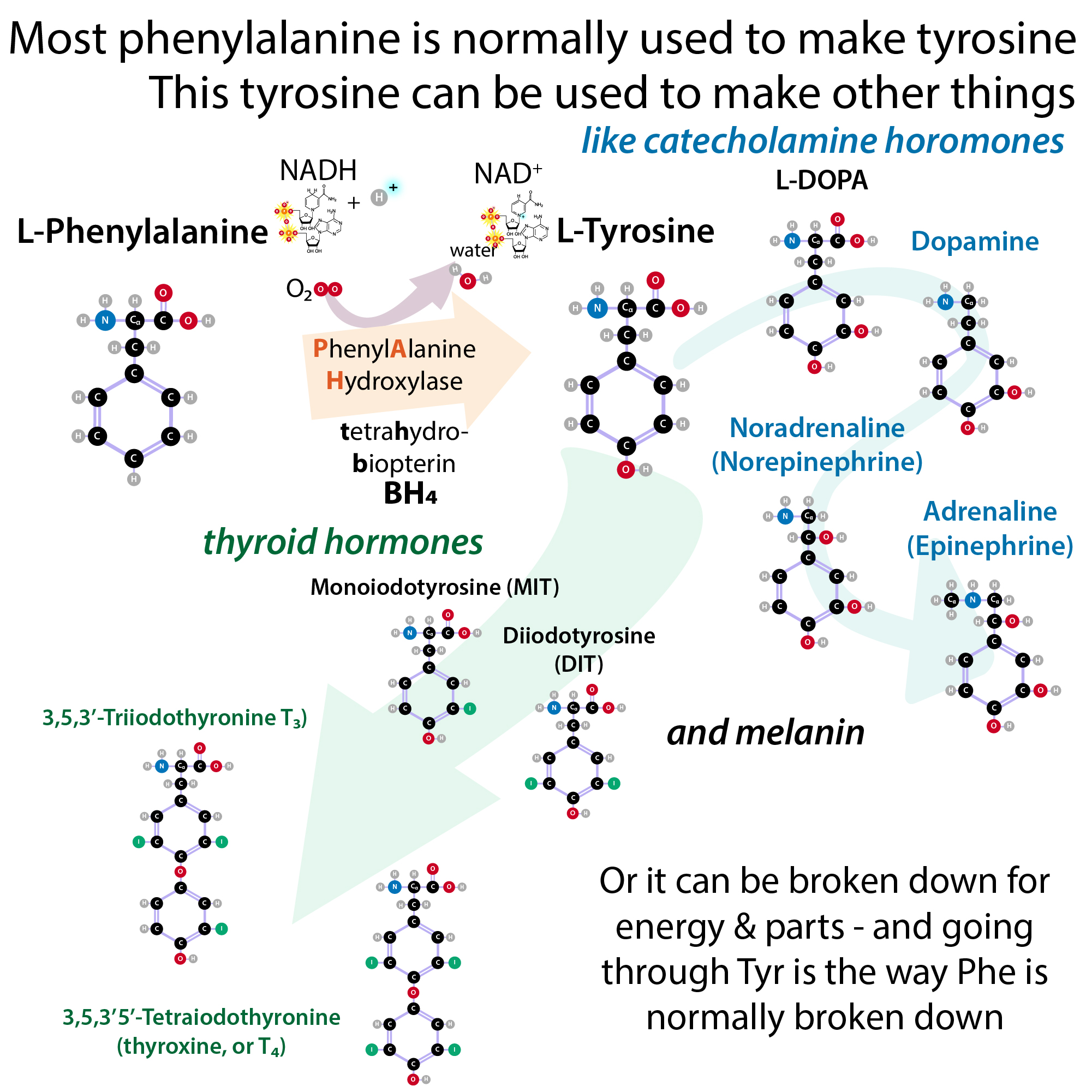
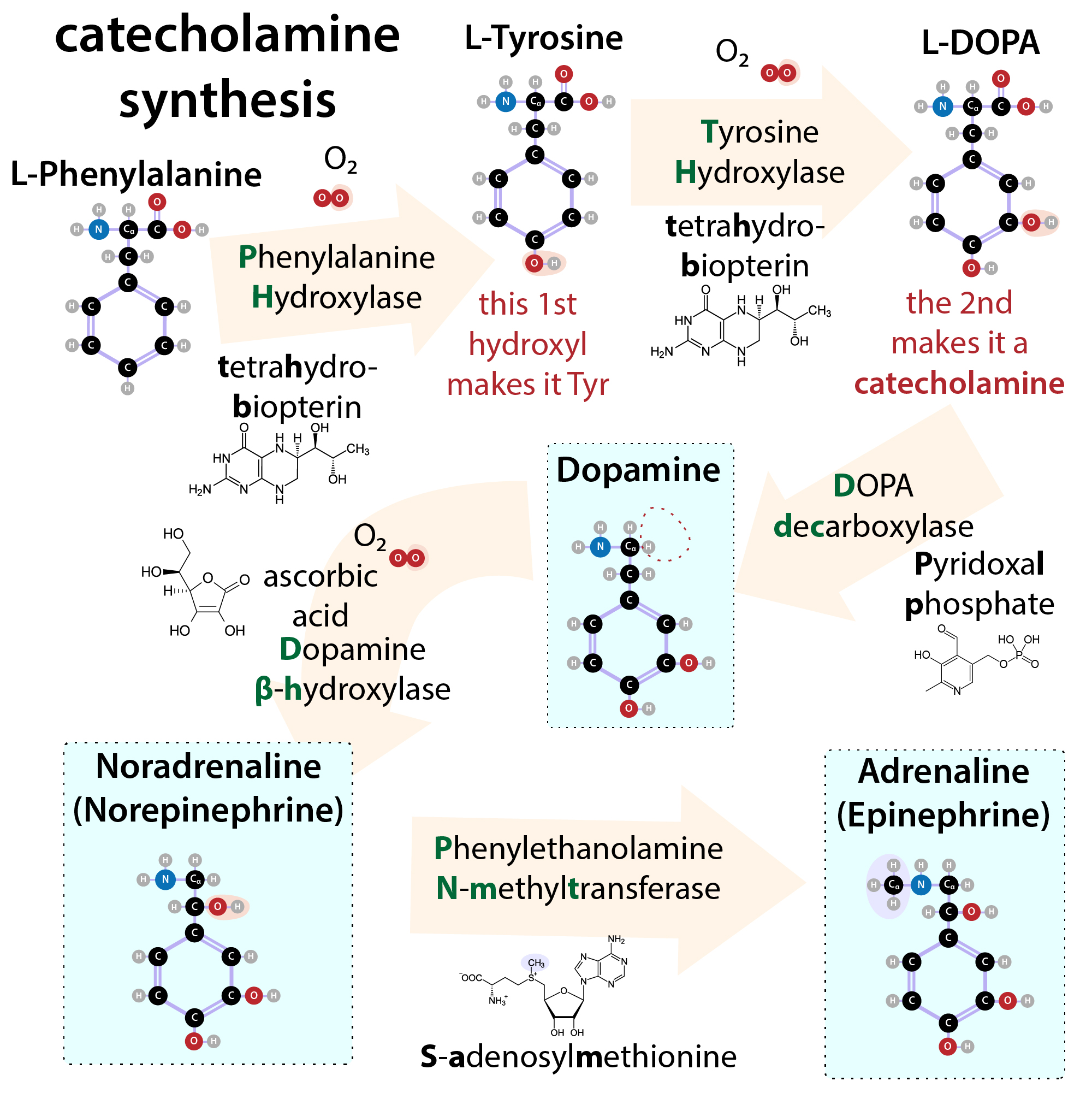
Side note: levodopa itself typically comes from the amino acid tyrosine via conversion by tyrosine hydroxylase–if you see things refer to “TH-positive cells” that’s what they’re referring to–the dopaminergic neurons that can be recognized by the presence of tyrosine hydroxylase. Also, in case you’re wondering, the “L” refers to the way in which the atoms are oriented in space (stereochemistry)).
You can’t give straight dopamine to patients because it can’t cross the blood-brain barrier (and it causes nausea). Thankfully, levodopa (aka L-DOPA) can cross the blood-brain barrier (via the L-type amino acid transporter 1, LAT1), where it can be converted into dopamine. If, that is, if the levodopa can 1) get absorbed into the bloodstream and 2) make it to the brain without getting “chemically sidetracked” by enzymes that convert it to dopamine or other molecules, or break it down along the way. These are big ifs. The first complicates the delivery mechanism and steady dosing and the second is the reason levodopa is pretty much never given alone (i.e. as a monotherapy) – instead, it is almost always given in a combination with another drug called carbidopa (one trade name for the levodopa-carbidopa combo is Sinemet). And sometimes additional enzyme inhibitors such as ones to block catechol-O-methyl-transferase (COMT) or monoamine oxidase-B (MAO-B) are added on (or MAO-B inhibitors are given alone).
Let’s start with carbidopa. Turns out, it’s not just your brain that has an enzyme that can convert levodopa to dopamine. This enzyme, aromatic amino-acid decarboxylase (AADC), is present in other parts of the body as well (intestines, circulation, liver, kidneys . . .), where it can remove a carbon dioxide from levodopa to make dopamine. (It also plays other functions and modifies other molecules, as the name suggests). And dopamine, remember 1) can’t cross the blood-brain barrier and 2) causes nausea. So AADC action is definitely something we want to avoid. Call in the decoy!
Carbidopa looks a lot like levodopa. It just has a couple extra small chemical groups: a methyl group (a carbon and three hydrogens) and an amino group (NH3). Not enough to confuse the AADC. Instead, the AADC, tricked by our carbidopa decoy, goes after the carbidopa instead of the levodopa, buying the levodopa time to reach the blood-brain barrier and get into the brain! Thankfully, although levodopa can get into the brain, carbidopa cannot, so you don’t inhibit conversion to dopamine in the brain, where patients need it made! (Without carbidopa, or another such “peripheral decarboxylase inhibitor (PDI)” such as benserazide, only 1-3% of the levodopa could actually survive the journey!!!!)
Once inside the brain, levodopa can get taken up by the terminals of still-functioning dopaminergic neurons, where it can get stored in vesicles. Then, when the neurons get stimulated, they convert it to dopamine and release it. The dopamine then travels across synapses (nerve cell junctions), binds to a receptor on the abutting, “post-synaptic” neuron, and sets off intracellular events in that neuron, leading to a response. Tada!
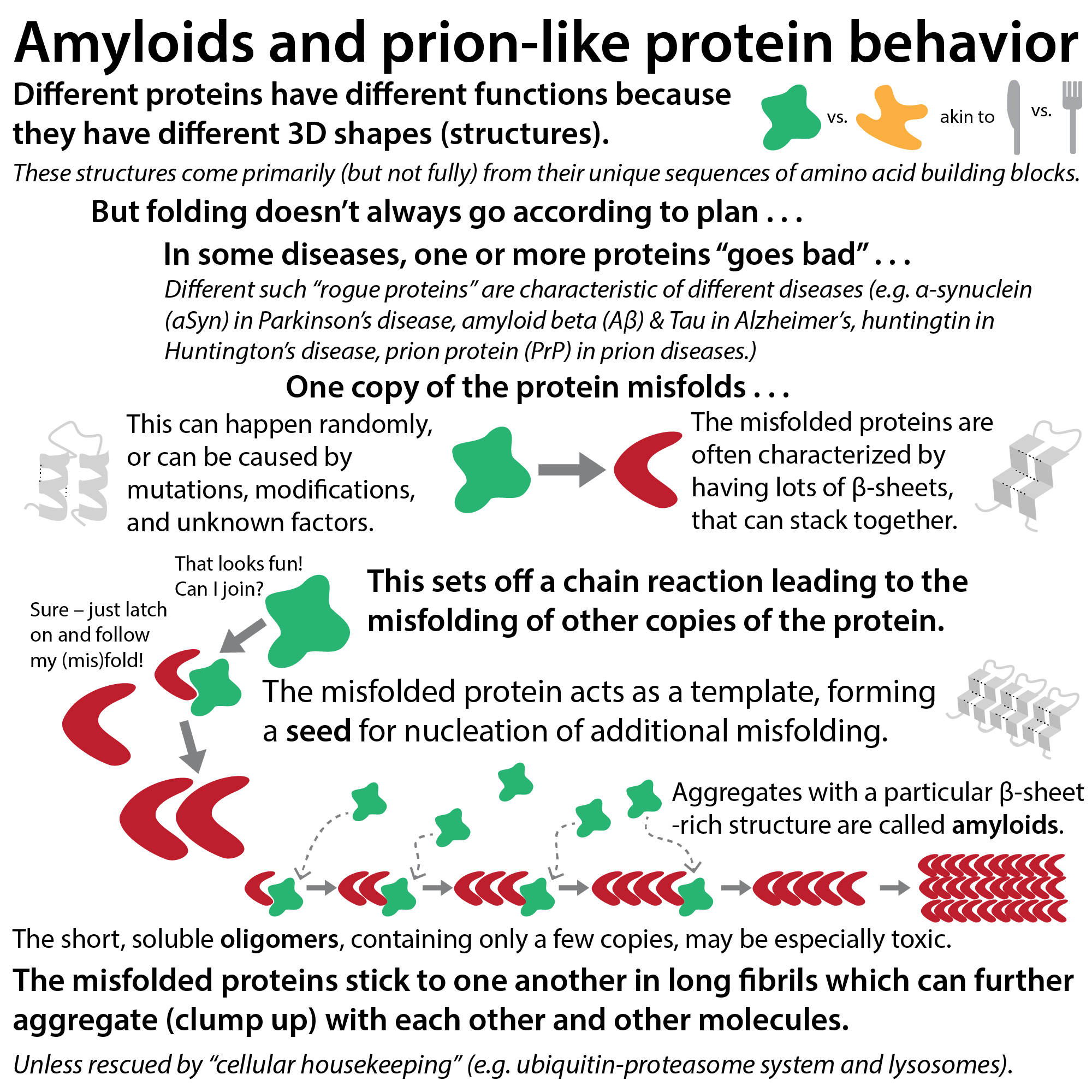
The dopamine can then be “recycled” by being taken back up by that first, “pre-synaptic” neuron and stored for further use. This storage option provides buffering capacity that allows patients to help regulate dopamine release even though they can’t control its production. Problem is, because PD is degenerative, the dopaminergic neurons progressively stop functioning (as they get taken over by the toxic build-up of misfolded α-synuclein protein), taking away this buffer capacity. This makes patients at later stages of PD more at the whims of the blood concentrations of levodopa.
In any case, even if you protected the levodopa with carbidopa, allowing the levodopa to get to the brain and get converted to dopamine, the dopamine itself is also vulnerable to chemical conversion and breakdown. Not only can dopamine get converted to noradrenaline (aka norepinephrine) and then adrenaline (aka epinephrine), but it can also get converted and broken down to other things that are less useful. Two of the main sidetracking enzymes as I like to think of them are MAO-B (monoamine oxidase B) and catechol-O-methyl-transferase (COMT), which add oxygen and methyl groups, respectively. To prevent the breakdown of dopamine in the brain, therefore, MAO inhibitors (e.g. selegiline, rasagiline, safinamide or zonisamide) and/or COMT inhibitors (e.g. entacapone or opicapone) might be co-administered with levodopa-carbidopa. Note: COMT can also act outside of the brain, working directly on levodopa.
Another strategy is to use a more stable molecule that isn’t dopamine but looks like dopamine and therefore stimulates dopamine receptors. We call such molecules “dopamine agonists” and they include ropinirole, pramipexole and rotigotine. There was originally a lot of excitement about them, but they ended up having a lot of additional side effects of their own, so largely fell out of favor.
Now that we’ve addressed how to protect the levodopa in the blood so it could make it into the brain (e.g. with carbidopa ± a COMT inhibitor) and how to protect dopamine in the brain (e.g. with MAO and/or COMT inhibitors), let’s go back to thinking about how to get the levodopa into the blood in the first place. . .
Typically, levodopa-carbidopa is given orally (i.e. the patient swallows pills, typically 3 times a day or so due to the drugs’ short (90 min) half-life (time it can remain in the body without getting converted or broken down)). Recall that levodopa comes from the amino acid tyrosine. Tyrosine is one of the so-called “large neutral amino acids” (LNAAs) and the intestines contain cross-membrane transport proteins called LNAA transporters that will happily let the levodopa in. But, gastrointestinal track-wise, those transporters are only present in a couple small sections of the intestine (mainly the duodenum and proximal jejunum). So how much gets absorbed can be quite variable, depending on things like gastric emptying rates (how quickly things go through the stomach) and timing of meals.
Combined with the short half-life, these factors make it so that levels of levodopa are in frequent flux, leading to “off” and “on” periods for the patient with corresponding cyclic periods of dyskinesia, bradykinesia, etc. Especially for patients in later stages, where the ability to store dopamine to buffer (level out) these fluxes has diminished severely, this is a major problem. A problem that has proven to be surprisingly hard to address… One strategy is extended release versions of the drug, with the active combo stored in slowly degraded capsules before release. Some drug versions (e.g. Rytary) even have pills contain little storage beads composed of different types of coatings that degrade at different rates, with hopes of spreading release out over time.
These still don’t however address the whims of gastric emptying rates, which themselves can be thrown askew in PD patients. One, drastic, strategy is to bypass the stomach all together, surgically implanting a direct line for infusion straight into the region of the intestines with the needed transporters. This is the strategy taken by the Duodopa pump.
And, as long as you’re pumping things in, you can more precisely control the timing and dosages. But, it requires an invasive procedure and comes with its own risks.
The pump thing though – that has definite promise! In fact, knowing a lot about Type 1 Diabetes, it was one of the first things I thought of when I heard about the inconsistent levodopa levels problem. (I told you I’d get back to the T1D analogy!) These days, patients with T1D often have a continuous insulin infusion pump which they can use to administer insulin when their blood sugar gets high (or to prevent it from getting high when they eat). This avoids them having to inject themselves with insulin via shots. Currently, most patients with T1D, even those with an infusion pump, still have to monitor their blood sugar through fingerstick blood tests with glucose monitors to know when and how much to inject. But the hope is to combine a pump with continuous glucose monitoring in a so-called “artificial pancreas.”
Ideally, you could have a sort of pump that both measures levodopa levels continuously and then administers levodopa correspondingly. Indeed, such “closed loop systems” have been proposed (see Teymourian et al.).
But insulin is much simpler to administer, so levodopa again has been faced with delivery problems. What’s really exciting is that in 2024 the FDA approved a subcutaneous (under-the-skin) levodopa-carbidopa* pump, Vyalev/Produodopa, which doesn’t require surgical intervention!
*rather than levodopa-carbidopa, it’s technically a modified version called foscarbidopa/foslevodopa, in which a couple of hydroxyl (-OH) groups have been replaced by another type of chemical group called a phosphate group.
It comes with additional risks and side effects compared to the simple levodopa-carbidopa though, and is crazy expensive at this point.
I do, however have strong hopes that a closed-loop system might be in the future. But, even then, it’d likely be expensive and out of reach for many. And the population of people with PD is growing rapidly as society ages (at least in the US). And it still requires continuous care. And is only addressing the symptoms, not stopping the cause (or even slowing down the disease progression). So, ultimately, I truly hope that disease prevention and disease-modifying treatments can prevent patients (or potential patients-to-be) from needing dopamine-replacement treatments in the first place. PD scientists, we’re counting on you. Thank you for all you do!
In the meantime, one of the most effective treatments (and even preventative strategies): EXERCISE! One symptom PD patients may struggle with (especially in “off” periods) is apathy. It can be hard for them to feel motivated to get exercise, so it’s great if friends, family, etc. can get into healthy habits together (a book I read recommended tandem bikes and walks together).
Having done all this research, I feel like I have a much better grasp on things than I did before, but I also feel there is so much more to learn. I hope that I at least now know enough to help my family and that by sharing what I’ve learned I’ve been able to help others as well.
Related posts:
- When protein folding goes rogue: amyloids and prion-like protein misfolding at the heart of some diseases such as Parkinson’s and Alzheimer’s
- PCR for Problematic Proteins? Seed Amplification Assays (SAAs)(e.g. PMCA & RT-QuIC) for measuring amyloid precursors and formation
- Tyrosine, hormones, neurotransmitters, catecholamines – and what the heck that means
Bibliography
- Abbott, A. Levodopa: The Story so Far. Nature2010, 466 (7310), S6–S7. https://doi.org/10.1038/466S6a.
- This is written to be more accessible and has a great history of the use of levodopa. I highly recommend
- The Parkinson’s Foundation has a great medication guide that goes into some of the differences between different formulations, etc. https://www.parkinson.org/living-with-parkinsons/treatment/prescription-medications
- UCHealth, T. N., for. Vyalev pump eases “off” periods for advanced Parkinson’s patients. UCHealth Today. https://www.uchealth.org/today/vyalev-pump-eases-off-periods-for-advanced-parkinsons-patients/ (accessed 2025-07-16).
- This is a nice article that talks about the Vyalev pump
- Stocchi, F.; Bravi, D.; Emmi, A.; Antonini, A. Parkinson Disease Therapy: Current Strategies and Future Research Priorities. Nat Rev Neurol2024, 20 (12), 695–707. https://doi.org/10.1038/s41582-024-01034-x.
- Goes over medication and a lot more.
- Lee, H.; Elkamhawy, A.; Rakhalskaya, P.; Lu, Q.; Nada, H.; Quan, G.; Lee, K. Small Molecules in Parkinson’s Disease Therapy: From Dopamine Pathways to New Emerging Targets. Pharmaceuticals2024, 17 (12), 1688. https://doi.org/10.3390/ph17121688.
- This is more technical, but it goes over dopamine metabolism and different targets and inhibitors
- Nishijima, H.; Tomiyama, M. What Mechanisms Are Responsible for the Reuptake of Levodopa-Derived Dopamine in Parkinsonian Striatum? Front Neurosci2016, 10, 575. https://doi.org/10.3389/fnins.2016.00575.
- Another more technical one, it goes over levodopa and dopamine uptake
- Beckers, M.; Bloem, B. R.; Verbeek, M. M. Mechanisms of Peripheral Levodopa Resistance in Parkinson’s Disease. npj Parkinsons Dis.2022, 8 (1), 56. https://doi.org/10.1038/s41531-022-00321-y.
- This one goes into some of the challenges of levodopa treatment and why some people don’t respond well.
- Teymourian, H.; Tehrani, F.; Longardner, K.; Mahato, K.; Podhajny, T.; Moon, J.-M.; Kotagiri, Y. G.; Sempionatto, J. R.; Litvan, I.; Wang, J. Closing the Loop for Patients with Parkinson Disease: Where Are We? Nat Rev Neurol2022, 18 (8), 497–507. https://doi.org/10.1038/s41582-022-00674-1.
- Here they talk about the potential for closed-loop pump systems to continuously monitor levodopa levels and deliver it as needed.