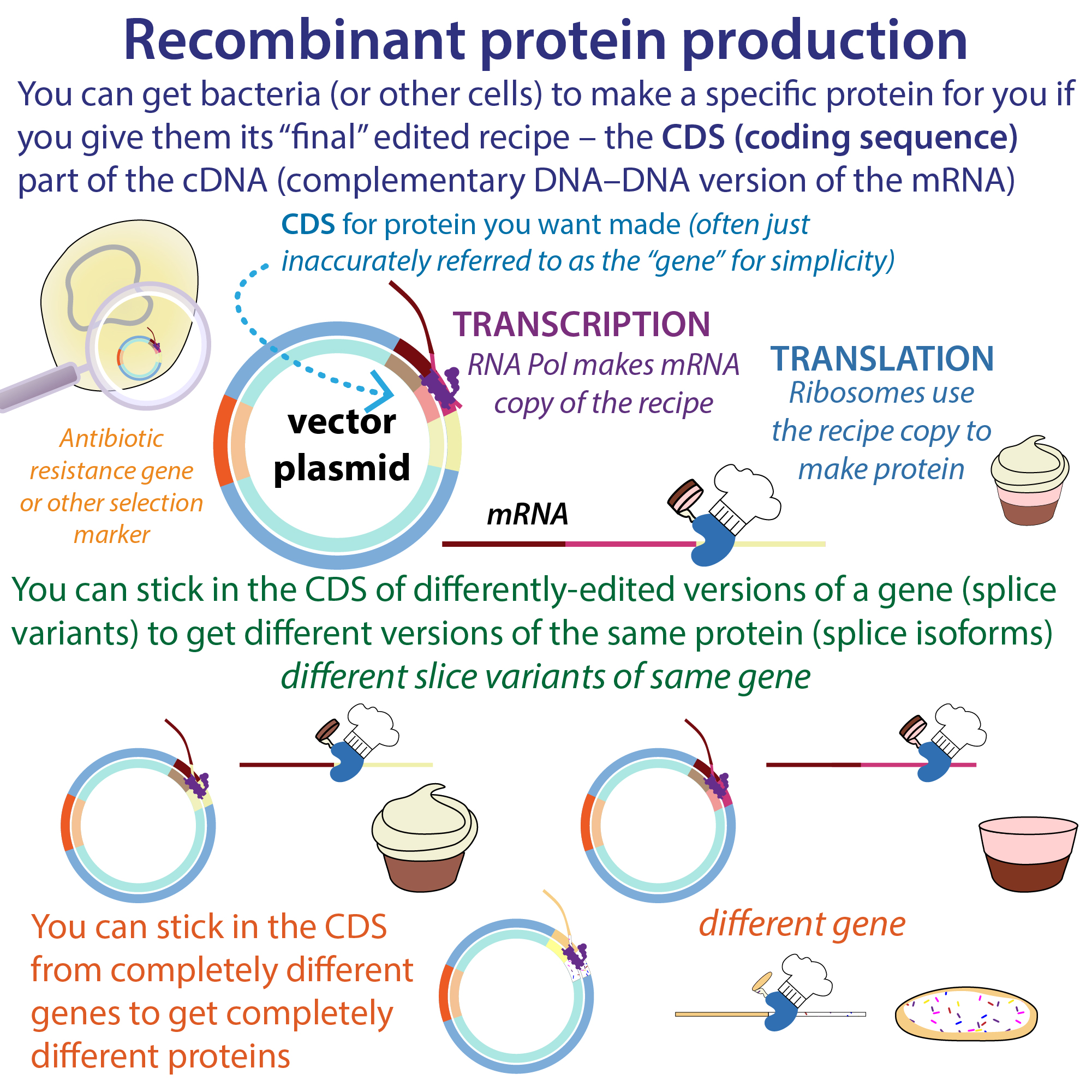
We often say we stick the “gene” for making a protein into cells to get them to make the protein for us, but what we actually stick in is just the CDS (protein coding sequence). And explaining what that is takes us on a journey through jargon! So we’re often lazy and say gene, but that’s not really what we mean . . .
Protein-coding genes are regions of DNA with the instructions for making a protein-both regulatory information & coding instructions (parts that say place this amino acids in these order). Introns are intragenic (within gene) regions separating exons (regions that get expressed in the sense that they make it into the mature messenger RNA (mRNA)). Genes are transcribed letter-for-letter into pre-mRNA. Introns get removed from pre-mRNA in a process called splicing. pre-mRNA can be spliced in different ways (a process called alternative splicing) to make different isoforms (versions). Splicing keeps the 2 untranslated regions (UTRs) at the ends that allow for use & regulation. Thus, mature mRNA only has exons – but this includes the UTRs!
We can make DNA copies of mRNAs by reverse transcribing the mRNA. We call these complimentary DNAs (cDNAs), and they have UTRs. If we remove those UTRs, we get what we refer to as the CDS (coding sequence). The CDS is what you use for recombinant protein expression.
You don’t want to use the gene because the cells might not be able to splice out the introns (for example, bacterial cells don’t have splicing machinery) and even if they are able to splice, they won’t know what splice isoform to make for you. And you don’t want to use the cDNA, because the UTRs typically aren’t meaningful in their new home. Instead, when you stick the CDS into a plasmid, the plasmid provides regulatory info that’s more appropriate for the cell type you stick it in and the features you want for timing and strength of expression.
You can find the CDS for human and mouse protein isoforms of interest for at the CCDS, Consensus CDS server. https://www.ncbi.nlm.nih.gov/projects/CCDS/CcdsBrowse.cgi
And you can get there from UniProt, where you can find lots of informations about basically any protein, including the amino acid sequences for its various isoforms – and links out to nucleic acid databases to get the CDSs.
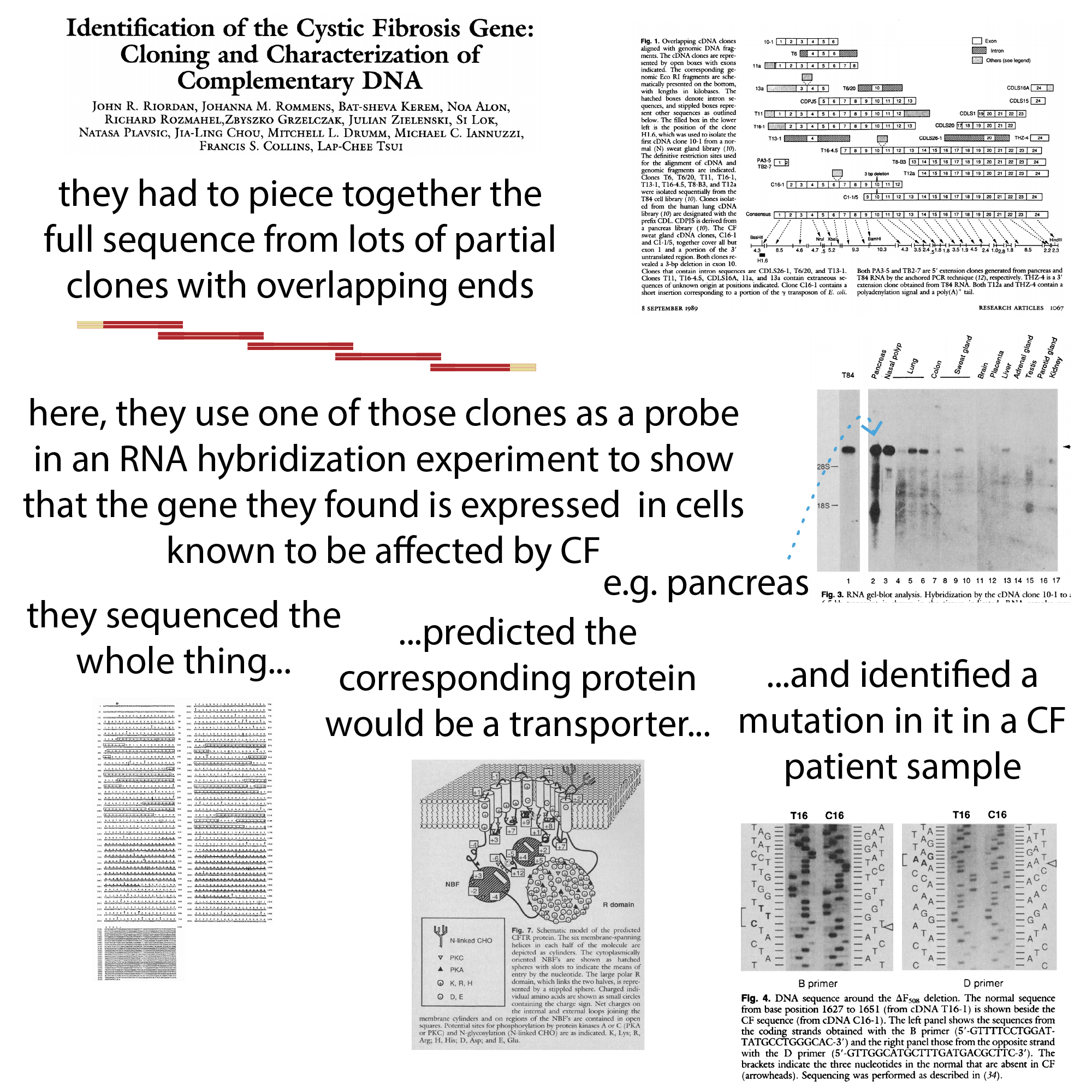
Once you find a CDS of interest, if you want to try to get cells to make it for you, you need to physically get it. Options include checking plasmid repositories like addgene and DNASU, sending the sequence to a company to get it synthesized (made from scratch), or making a probe from part of the CDS to use to go fishing in a cDNA library, which contains all the cDNA made by a cell. Once you get your hands on it, you can clone it into a plasmid and/or subclone it into a plasmid that has features for expression. Stick that into expression cells and hope it works!
Although it sounds like it would be some commercial entity just out there to make a profit, it actually serves as a nonprofit plasmid repository – labs can send a sample of their plasmids to and Addgene will propagate them (make more copies) and distribute them to the public for a minimal fee ($89/plasmid when I just ordered some).
Addgene is a great place to start because, if authors have deposited the plasmids they used for protein expression, and that expression was in the system you want (e.g bacterial expression not a mammalian expression vector) then you won’t even have to subcclone! and the plasmid might be optimized for good expression – or at least you know it *should* work). If you can only find the gene cloned into a vector for a different expression system, don’t worry – you can just subcclone it into one you want – more work, but shouldn’t be an issue – and definitely not worth paying commercial companies an arm and a leg to get a version in the plasmid you want.
note: Addgene also has a really great educational blog – I suggest checking out their Plasmids 101 guide https://www.addgene.org/educational-resources/ebooks/
If Addgene turns up short, DNASU is a depository that has plasmids containing cDNAs for “all” human genes, even those that people haven’t worked with already. These are generally in generic cloning vectors but you can easily subcclone them out. Note: you might see different splice versions or alternative transcripts for the same gene, so you might need to do a little looking in UniProt, etc. to make sure you get the version you want. Note 2: some plasmids are marked “fusion” and others “closed” – “fusion” ones don’t have stop codons – these must be supplied by the vector you’re cloning into, “closed” ones do have stop codons
Addgene: https://www.addgene.org/
DNASU: https://dnasu.org/DNASU/Home.do
Much more about molecular cloning: http://bit.ly/molecularcloningguide
More about plasmids: https://bit.ly/vector_plasmids
More about cDNA and cDNA libraries: https://bit.ly/cDNA_uses ; YouTube: https://youtu.be/x13Wx9E3H6I