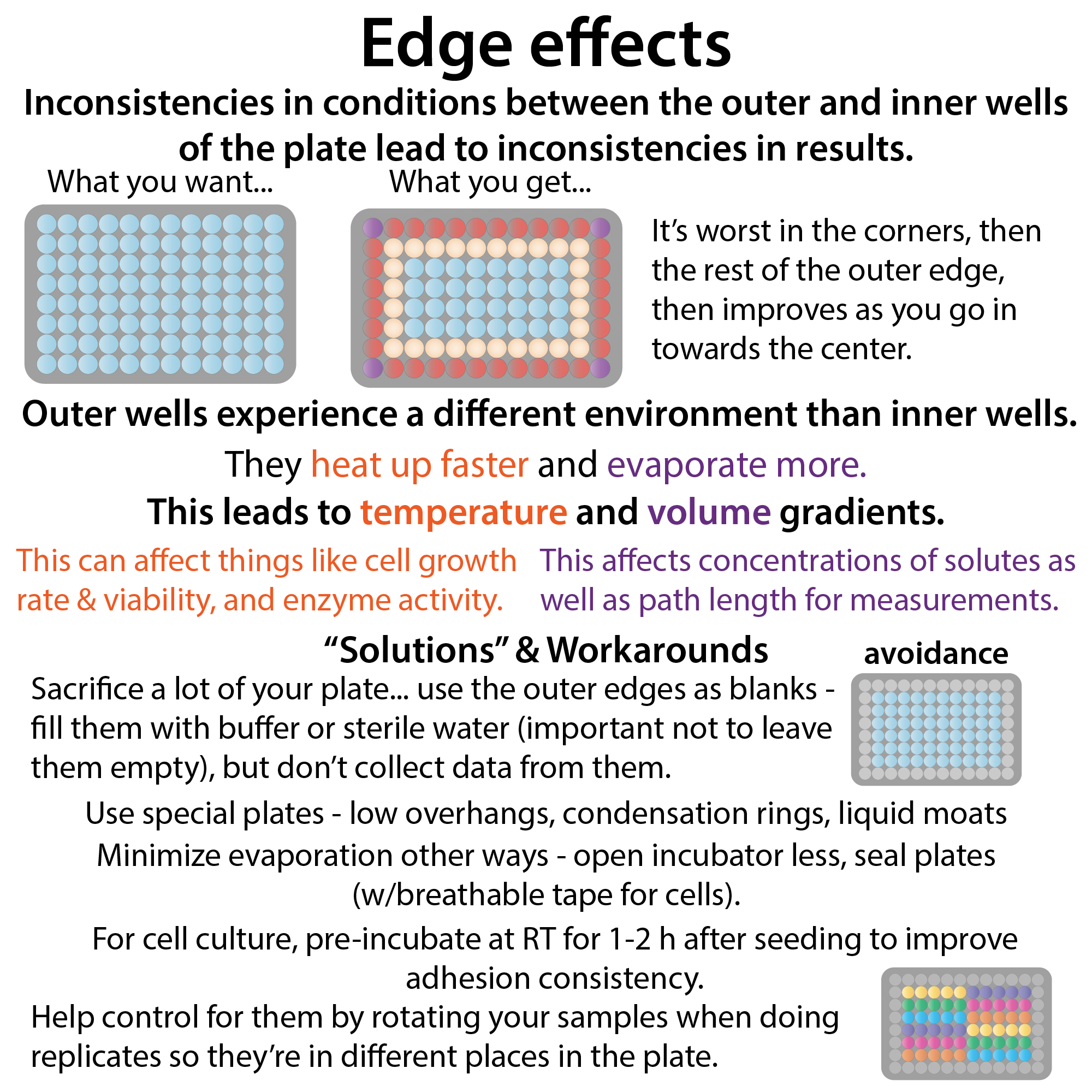
You’d think a 96-well plate would mean you could test 96 things right? Unfortunately, “edge effects” can cut down your usable wells (and/or confound your results) – plus you have to include all your controls! Edge effects are where stuff going on in the outer wells of a plate acts differently than the stuff going on in the inner wells. Making calculations and comparisons between inner and outer wells inaccurate. It happens because the outer wells (worst in corners) experience different conditions than the inner wells. They evaporate more and heat/cool more quickly since they’re not as insulated as the inner wells. This causes an evaporation and temperature gradient going from the outside in.
This can be a big problem
- evaporation increases the concentration of solutes (dissolved things), altering the conditions of the reaction, growth environment for cells, etc.
- Evaporation also reduces the volume, shortening the path length which can mess up light-based measurements which rely on the path length through the liquid in each well being the same.
- Temperature differences can affect enzyme activity, cell growth, cell viability, and cell adhesion (cells sticking to the plates when you seed them)
- This can lead to crescent shaped cell concentrations, where the cells preferentially settle down towards the outer edges of the outer wells because they warm up fastest when you stick the plate in the incubator
If you don’t need all the wells for your assay, you can just avoid “using” the edge wells – but do fill them! Fill them with buffer or sterile water to maintain a consistent humidity environment throughout the plate. This avoids the problem, but significantly cuts down on your plate real estate (you lose about a third of a 96-well!)
Alternatively, there are some other things you can try to reduce edge effects.
One is to use specially-designed, low evaporation plates. These include features like
- larger overhangs
- condensation rings above the individual wells to prevent condensation from one well dripping down into another well
- liquid moats around outer or all wells – helps insulate things more consistently and maintain even humidity
Different types and brands of plates, “normal” or advertised to be low-evaporation, can vary drastically in their susceptibility to edge effects, as this paper shows:
Mansoury, M., Hamed, M., Karmustaji, R., Al Hannan, F., & Safrany, S. T. (2021). The edge effect: A global problem. The trouble with culturing cells in 96-well plates. Biochemistry and biophysics reports, 26, 100987. https://doi.org/10.1016/j.bbrep.2021.100987
If you don’t want to buy fancy plates you can try plate tape – be sure to use breathable tape for cell culture!
In terms of inconsistent cell adhesion… it occurs largely because the outer wells equilibrate to 37°C faster than the others – also note that there are stacking effects such that when you stack plates, the top and bottom plates equilibrate to 37°C faster than the others.
One way to get better adhesion consistency is to pre-incubate the plate for 1-2 h @RT (room temperature) after seeding before the sticking plate in incubator
Lundholt, B. K., Scudder, K. M., & Pagliaro, L. (2003). A simple technique for reducing edge effect in cell-based assays. Journal of biomolecular screening, 8(5), 566–570. https://doi.org/10.1177/1087057103256465
Allison Tanner, Corning, Helpful hits to manage edge effect of cultured cells for high throughput screening https://iccb.med.harvard.edu/files/iccb/files/an_hintsedgeeffecthts.pdf?m=1465310603
Also, beware of batch effects and other artifacts: https://thebumblingbiochemist.com/365-days-of-science/artifacts/
more posts on cell culture: https://bit.ly/cell_culture
more random practical lab tips and tricks: https://bit.ly/lab_tricks_page