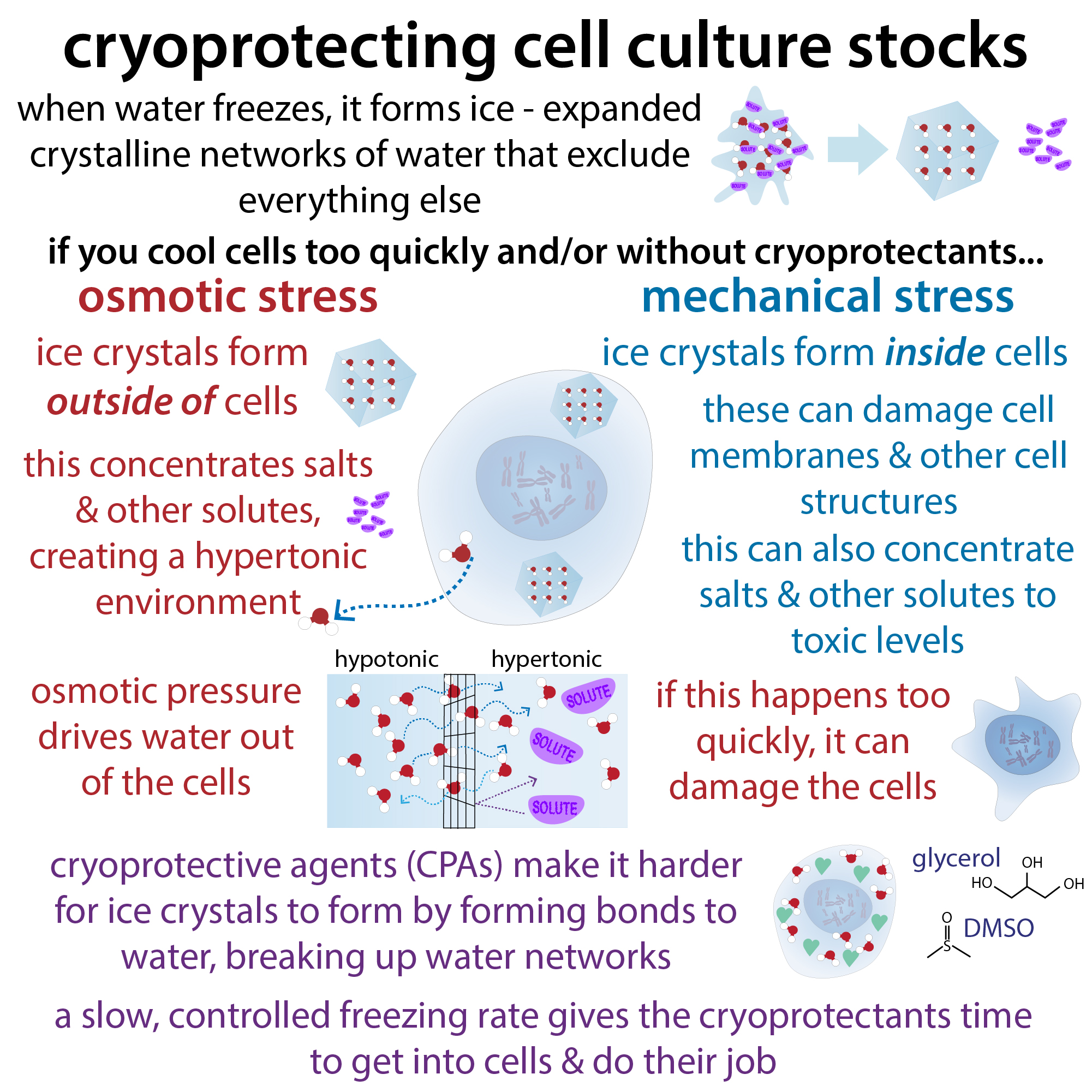
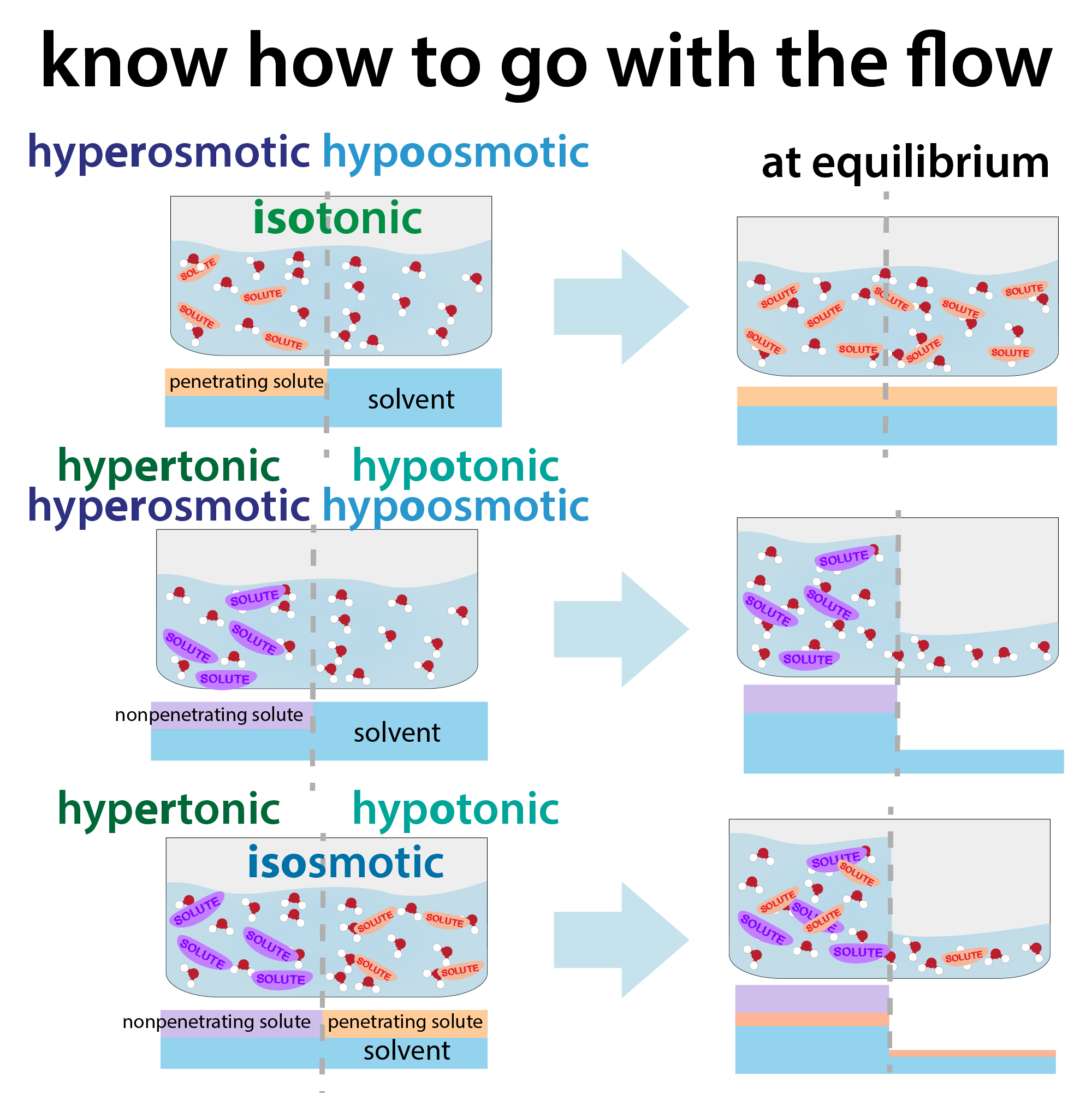
When it comes to “freezing” cell stocks, the key is actually to avoid freezing! You don’t want ice to form inside or outside of the cells, as it cause direct damage (from ice forming inside of cells and damaging structures) or indirect damage (from the concentration of salts and other solutes and resultant osmotic pressure driving water out of cells). Thankfully, we can use cryoprotectant agents (CPAs) like DMSO to allow us to get the water and other molecules in and around the cells really cold – cold enough that the molecules can’t keep doing what they were doing (metabolizing stuff (making & breaking compounds), etc.) – but without ice crystals forming. Here’s how these CPAs let us basically put cells into hibernation until we’re ready to wake them up.
I didn’t have time to write out a whole long post today, but I have much much more detail on cryoprotection in general, see this post: https://bit.ly/cryoprotectantsandvitrification & https://youtu.be/JsvjoJmfRDo
And here are some notes that are more specific for freezing cell culture solutions – for example, those HEK293 cells we talked about the other day: https://bit.ly/hekcells & https://youtu.be/tLtKMvZ2z5U
I also have links to some helpful articles I found at the end.
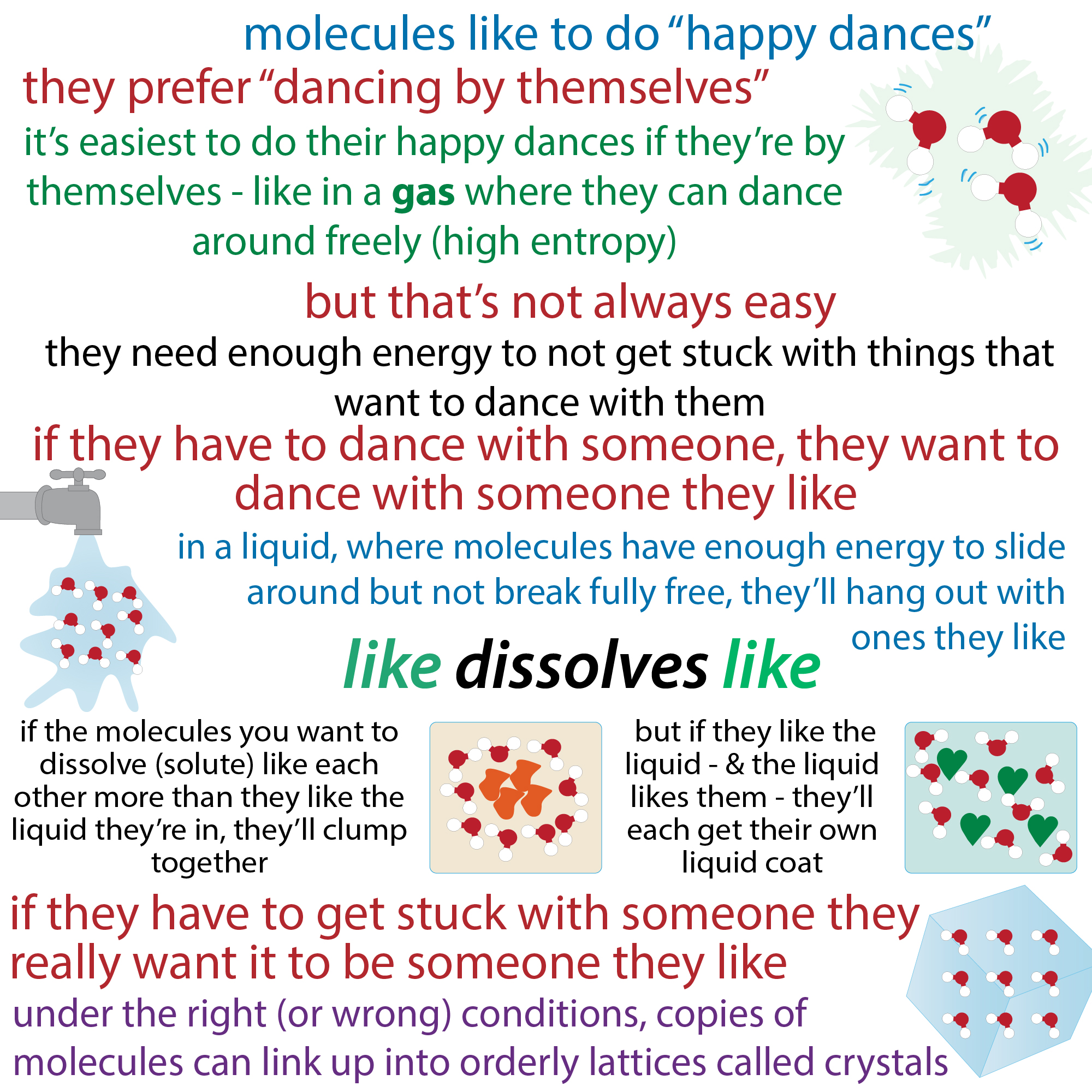
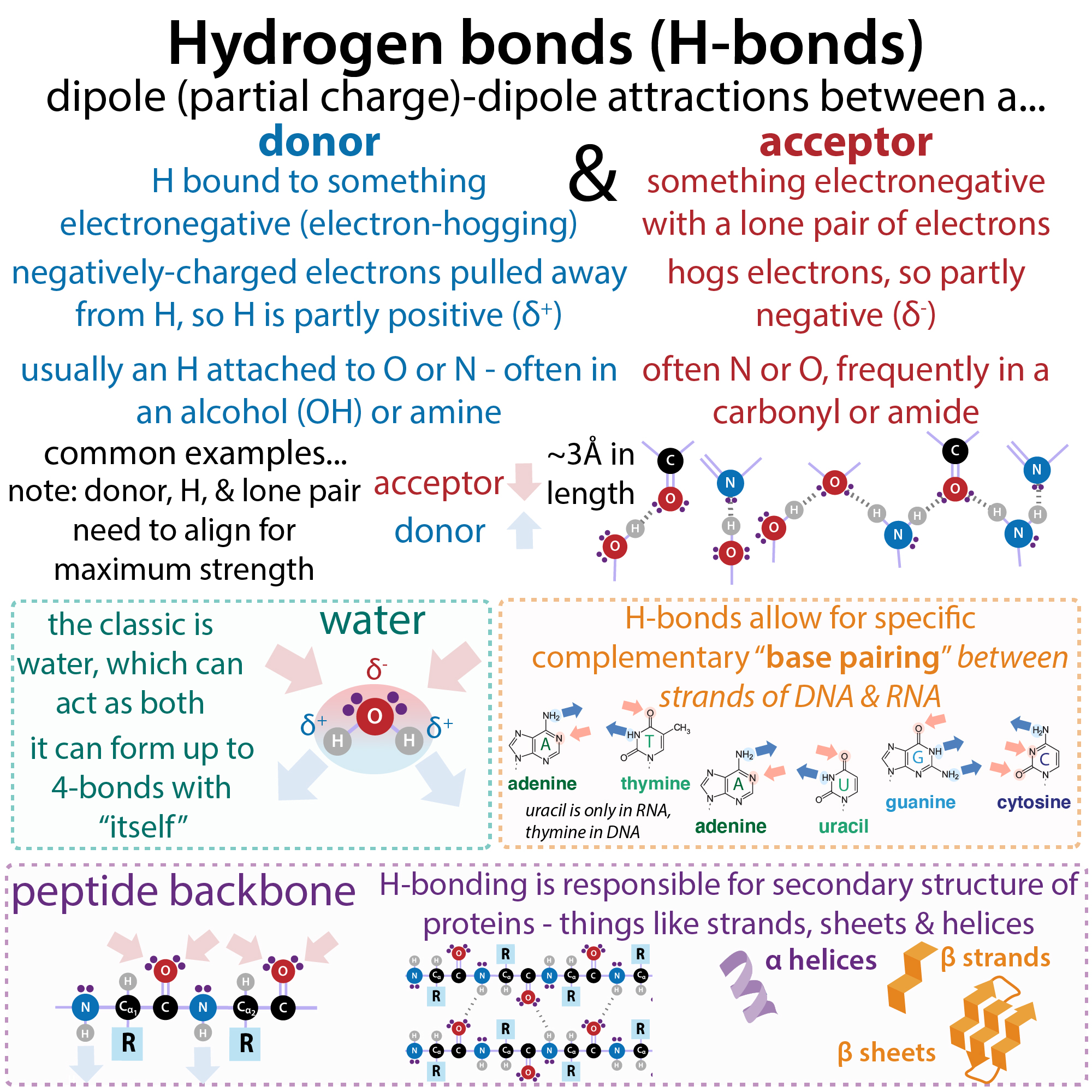
Basically, water is really sticky. It forms extensive water-water networks. In its liquid and gas forms, water will let some things hang out with it in its network (we call such things hydrophilic). When water coats each copy of a thing (e.g. each sugar molecule or salt ion (charged particle)), we say those things are dissolved. We call that water the solvent and the dissolved things the solutes. When water freezes, it excludes those solutes it once considered friends – it’s water only in that ice! So those solutes become more concentrated, leading to something called osmotic pressure. Much more about it here: https://bit.ly/osmolarityandmore & https://youtu.be/RNu1vX8Mg18 but the end result is water is going to move to the area with higher solute concentration (lower effective water concentration). In the case of ice forming outside of cells, this is going to cause water to leave the cells, dehydrating them. Do this too fast and it can cause problems.
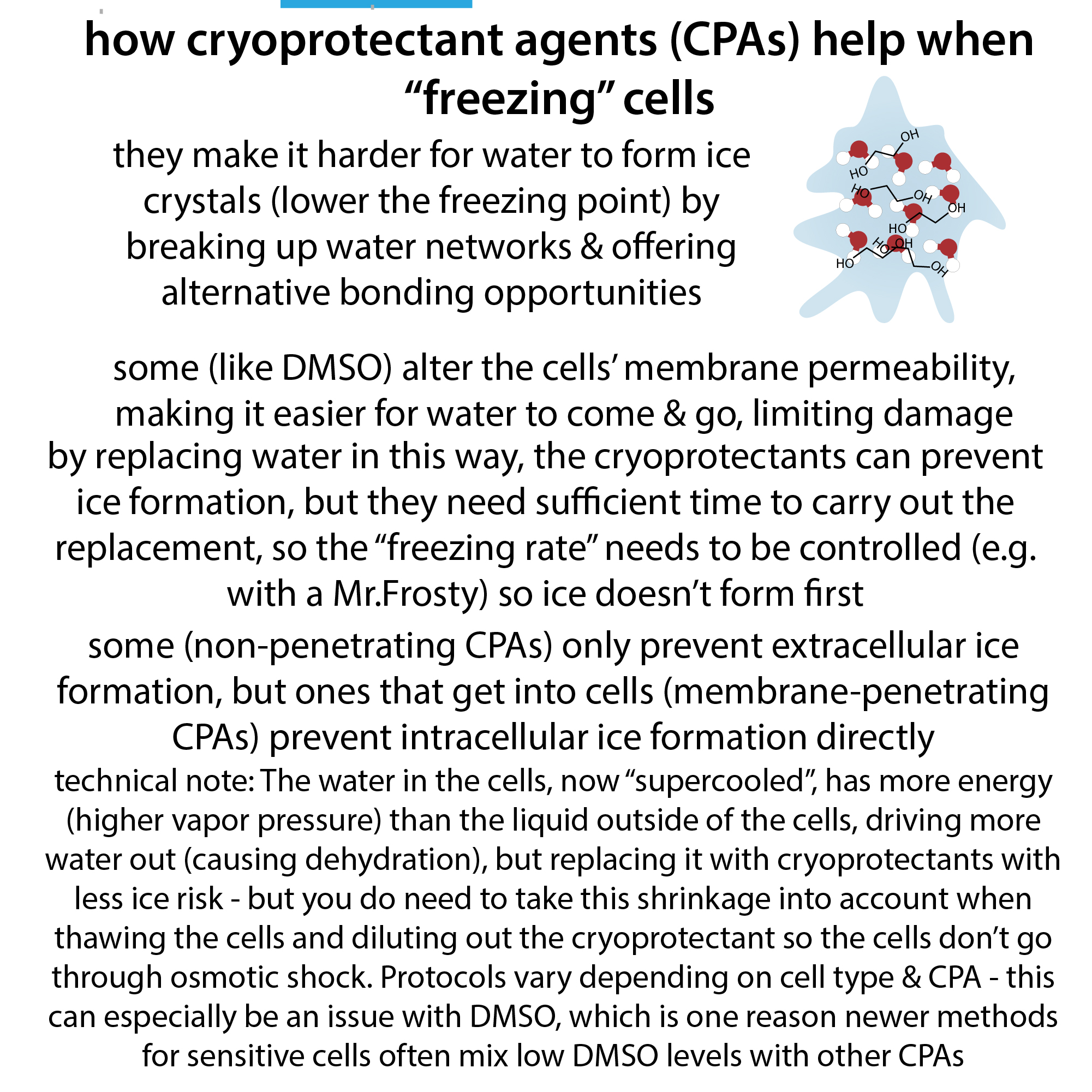
Ice forming inside of cells can also directly cause damage to the membranes, proteins, and other cell structures. So you want to prevent ice forming both inside and outside of the cells, and cryoprotectants (those “CPAs” like DMSO and glycerol) can help. They make it harder for water to form ice crystals (lower the freezing point) by breaking up water networks & offering alternative bonding opportunities.
Some (like DMSO) alter the cells’ membrane permeability, making it easier for water to come & go, limiting damage. By replacing water in this way, the cryoprotectants can prevent ice formation, but they need sufficient time to carry out the replacement, so the “freezing rate” needs to be controlled (e.g. with a Mr.Frosty which is filled with isopropanol, which has a lower freezing point than water and thus cools your samples gradually) so ice doesn’t form first. Some (non-penetrating CPAs) only prevent extracellular ice formation, but ones that get into cells (membrane-penetrating CPAs) prevent intracellular ice formation directly. Sometimes people use a mix of penetrating & non-penetrating CPAs, since penetrating ones are often cytotoxic (damaging to the cells).
technical note: The water in the cells, now “supercooled”, has more energy (higher vapor pressure) than the liquid outside of the cells, driving more water out (causing dehydration), but replacing it with cryoprotectants with less ice risk – but you do need to take this shrinkage into account when thawing the cells and diluting out the cryoprotectant so the cells don’t go through osmotic shock. Protocols vary depending on cell type & CPA – this can especially be an issue with DMSO, which is one reason newer methods for sensitive cells often mix low DMSO levels with other CPAs.
This is at least my understanding of things but I’m still learning it all too! So, if you have corrections or further insight, please do let me know! Also, sorry I said “permeable” when I meant “penetrating” a couple times.
Some articles I found helpful:
Awan, M., Buriak, I., Fleck, R., Fuller, B., Goltsev, A., Kerby, J., Lowdell, M., Mericka, P., Petrenko, A., Petrenko, Y., Rogulska, O., Stolzing, A., & Stacey, G. N. (2020). Dimethyl sulfoxide: a central player since the dawn of cryobiology, is efficacy balanced by toxicity?. Regenerative medicine, 15(3), 1463–1491. https://doi.org/10.2217/rme-2019-0145
Hunt C. J. (2019). Technical Considerations in the Freezing, Low-Temperature Storage and Thawing of Stem Cells for Cellular Therapies. Transfusion medicine and hemotherapy : offizielles Organ der Deutschen Gesellschaft fur Transfusionsmedizin und Immunhamatologie, 46(3), 134–150. https://doi.org/10.1159/000497289
Kilbride, P., Meneghel, J. (2021). Freezing Technology: Control of Freezing, Thawing, and Ice Nucleation. In: Wolkers, W.F., Oldenhof, H. (eds) Cryopreservation and Freeze-Drying Protocols. Methods in Molecular Biology, vol 2180. Humana, New York, NY. https://doi.org/10.1007/978-1-0716-0783-1_6
Whaley, D., Damyar, K., Witek, R. P., Mendoza, A., Alexander, M., & Lakey, J. R. (2021). Cryopreservation: An Overview of Principles and Cell-Specific Considerations. Cell transplantation, 30, 963689721999617. https://doi.org/10.1177/0963689721999617
Yang, J., Cai, N., Zhai, H. et al. Natural zwitterionic betaine enables cells to survive ultrarapid cryopreservation. Sci Rep 6, 37458 (2016). https://doi.org/10.1038/srep37458 r