Don’t be fooled by biochemically-plausible-sounding claims!
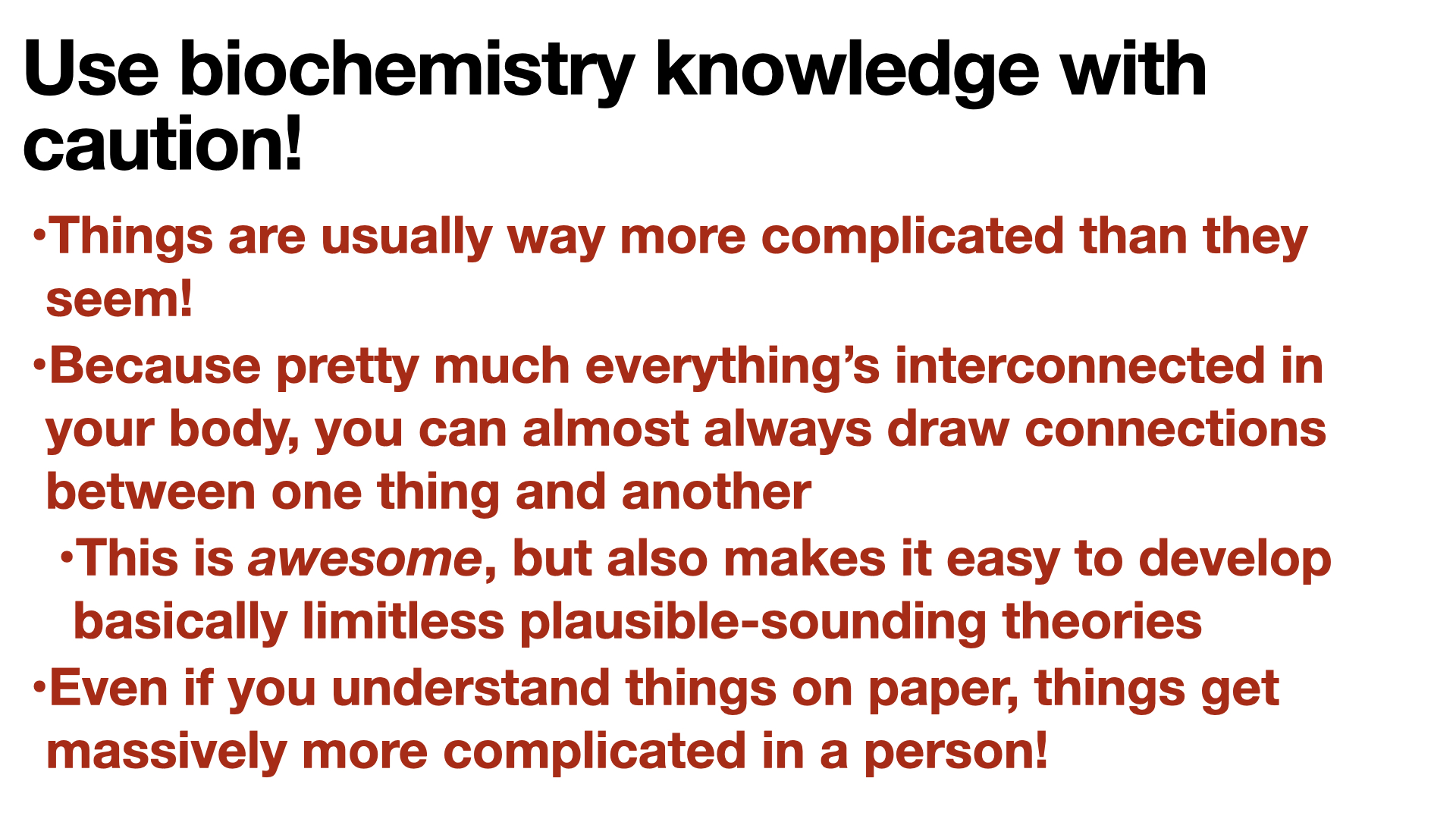
Use biochemistry knowledge with caution!
- Things are usually way more complicated than they seem!
- Because pretty much everything’s interconnected in your body, you can almost always draw connections between one thing and another
- This is awesome, but also makes it easy to develop basically limitless plausible-sounding theories
- Even if you understand things on paper, things get massively more complicated in a person!
- Because pretty much everything’s interconnected in your body, you can almost always draw connections between one thing and another
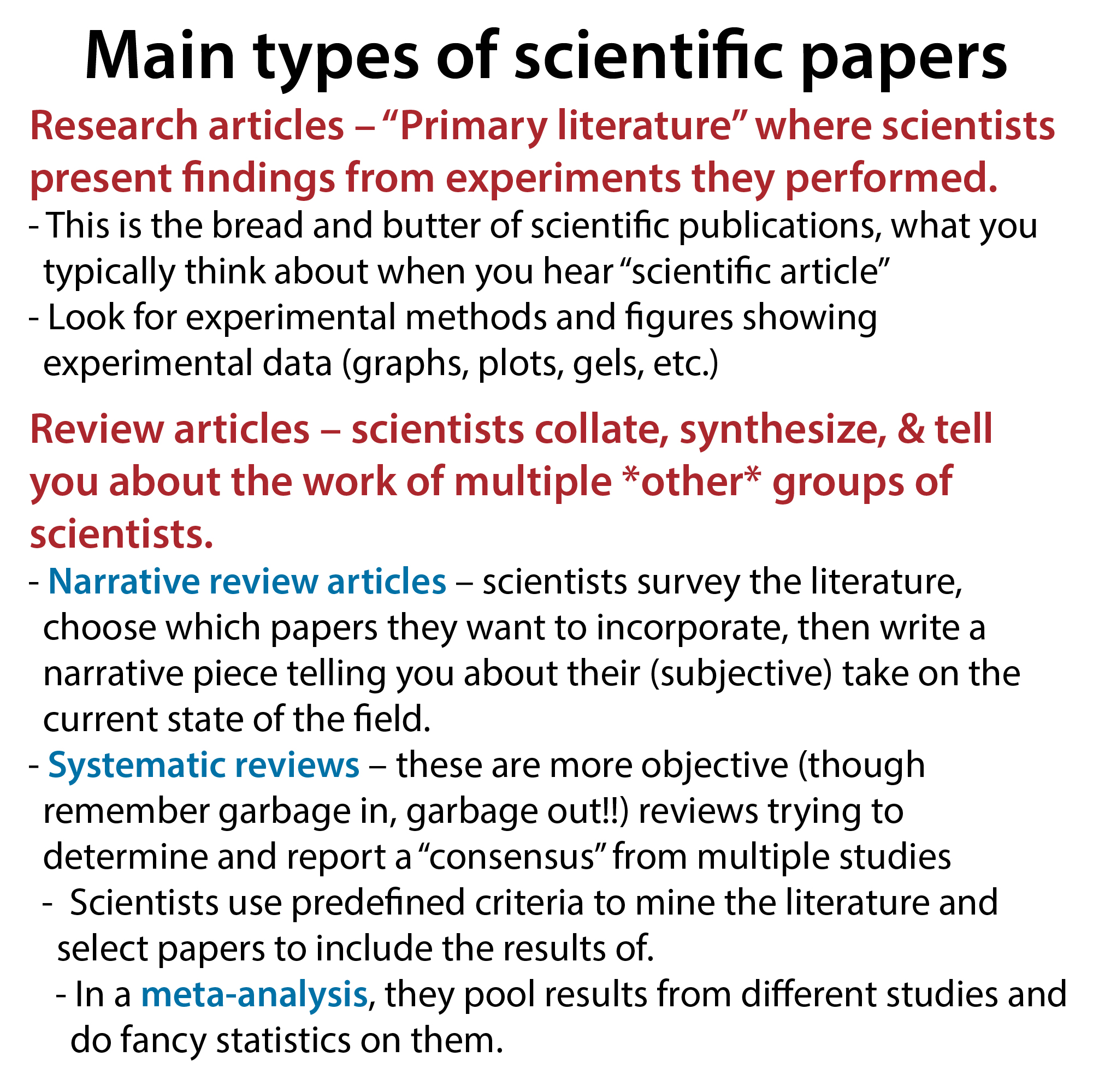
Seek out systematic reviews & meta-analyses
- These filter, collate, and try to determine “consensuses” from numerous studies surrounding a topic
But remember: garbage in, garbage out!
- The conclusions are only as strong as the studies that go into them
- The results can be biased based on which studies are and are not included, and how rigorous those studies were
Seek out trusted sources – and multiple sources
- One of my favorite podcasts is Skeptic’s Guide to the Universe. One of the co-hosts, Steve Novella, co-runs a website called Science-based medicine which is a great place to turn if you want to quickly evaluate the evidence (or lack thereof) behind a new (or old) fad, etc. https://sciencebasedmedicine.org
Comparing different studies is inherently difficult
- Populations differ
- Methods differ
- Etc.
Correlation does not equal causation
- Just because #s for both ice cream sales and pool drownings rise and fall together doesn’t mean that ice cream causes drowning!
Look for the hidden variables
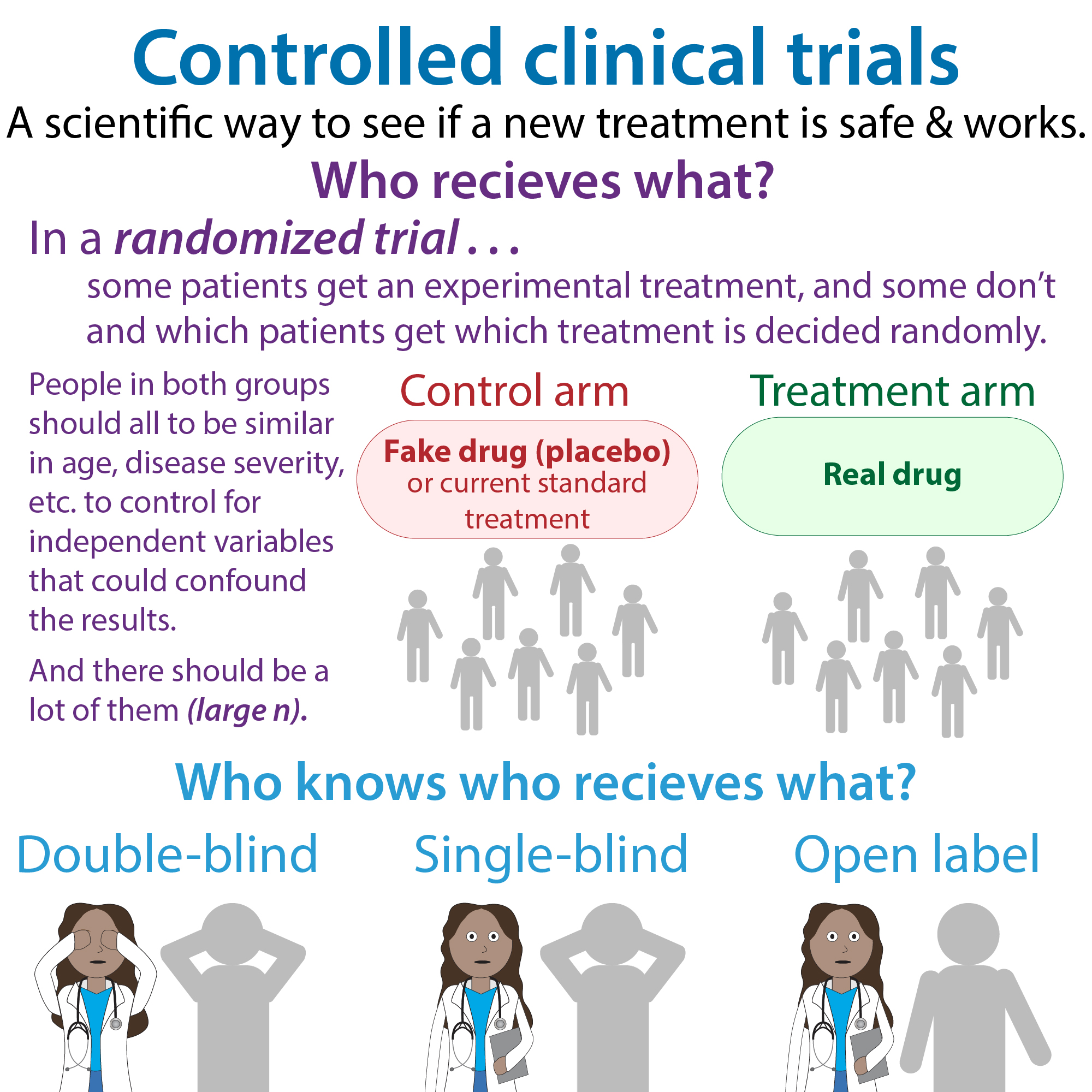
- Good studies should control for things like diet, exercise, socioeconomic status, underlying or co-existing health conditions, etc.
Judge the quality of the evidence
- Sample size: bigger’s better
- Blinding – gold standard is randomized, double-blinded, placebo-controlled
Be aware of p-fishing/p-hacking/data dredging
- The more correlations you look for, the more likely you are to find one just by chance
Don’t confuse statistical significance with clinical/meaningful significance
- Is it really worth taking a supplement if it is shown to statistically-significantly increase your sleep 0.5 s/night?
Remember risk (and cost) vs. benefit
- Side effects?
- Adverse events?
- Wasted money?
Don’t undervalue the power of biases (conscious and unconscious)
- Who’s likely to volunteer?
- Who’s likely to self-report?
- Who’s funding things?
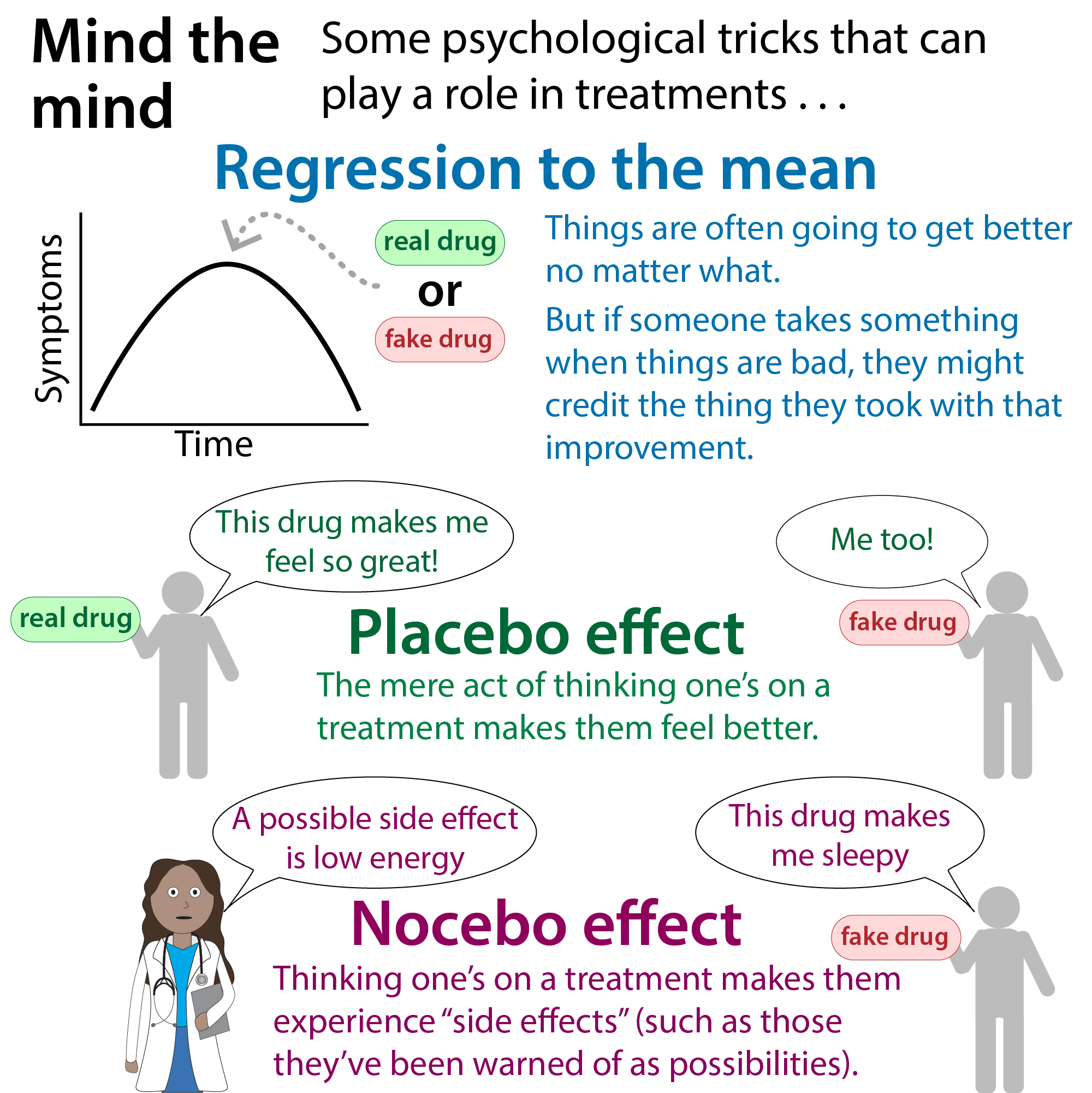
Always keep in mind regression to the mean
- Things often get better – with or without intervention
- People often seek out intervention when things are bad
- When things get better they credit the intervention, even though they would have gotten better anyway
Know the placebo effect is powerful!
- This isn’t saying “it’s all in your head” – just that your head affects your body
Some search terms that might help you find things
- “Topic” + __________:
- “systematic review”
- “meta-analysis”
- “evidence-based”
- “controversial”
- “consensus”
- “conflicting”
- differing”
- “evidence”
- Can also search within article for these terms to see whom they’re citing and go look there
Remember that everything has chemicals!
- And naming them scientifically doesn’t make them any different
Remember that natural doesn’t = healthy &/or better
- Natural arsenic and synthesized arsenic are chemically the same and chemically just as deadly!
Remember that. . .
- The dose makes the poison
- Animals aren’t people
- Each person’s different
- No person is perfect
- No study is perfect
In general. . .
- Eat a well-balanced diet and you shouldn’t need supplements
- Exercise
- “Everything” in moderation is probably fine
Some nice resources:
- National University library guide to Systematic Reviews & Meta-Analyses: https://resources.nu.edu/researchprocess/systematicreviews
- Barnard ND, Willett WC, Ding EL. The Misuse of Meta-analysis in Nutrition Research. JAMA. 2017;318(15):1435–1436. doi:10.1001/jama.2017.12083 https://jamanetwork.com/journals/jama/fullarticle/2654401
- Himmelfarm Health Sciences Library, Study Design 101: https://guides.himmelfarb.gwu.edu/studydesign101/?fbclid=IwAR11tACR8mhECeFUGgKg3YTftI0ieq1nl_HTp4tW6Ukg4HcUoFpJfzh48X8_aem_Ae2DV2wPPs5jCI5zHXsz9HdJ7ozyxcIP0gWnskqUaD1fisBBuCUH9SWtRe5VkyiqRLkbqQxP-wxrsVJTOo4tbf5z
- Cochrane reviews guide: https://www.cochranelibrary.com/help/how-to-use
- Trip database: https://www.tripdatabase.com/