Difficulty deciding on detergents? Let me try to help… Detergents are “artificial soaps” and they’re a type of surfactant (SURFace ACTing agENT). They get that name because they accumulate at water’s SURFace and ACT to to change the surface’s properties, such as lowering the water’s surface tension (how sticky the water is to other water molecules). By interfering with these water-water bonds, they give other molecules a chance to hang out with water (which can increase solubility of aggregates). But they don’t just interfere with water-water interactions – instead they disrupt a ton of different biochemical attractions! They can do this because, in a single molecule, they offer up things that are attractive to multiple types of molecules – hydrophilic head groups that are attractive to water and other partly or fully-charged molecules; and hydrophobic “tails” that are attractive to the hydrophobic parts of lipids. We call such molecules amphiphilic or amphipathic.
YouTube: https://youtu.be/pJTKMzhJSEQ
For more about the why if the matter, you have to take a deep look inside of matter – go all subatomic and stuff. I do that in this past post: https://bit.ly/amphilphiles ; YouTube: https://youtu.be/kV3tPr7ZT4o
For the sake of focusing on the applications, I’m going to let you check that out if you want to know more, and focus on the consequences of that amphiphilicity.
Thanks to it, detergents can (depending on their “strength”/“harshness”) disrupt a wide range of interactions – both between (inter-) and within (intra-) molecules. They give molecules the option to hang out with them (the detergent molecules) instead of whatever else they were hanging out with (such as phospholipid molecules in a cellular membrane or other proteins they were weakly, “nonspecifically” bound to). This makes them super useful in the lab.
We can use detergents to…
But, as you might suspect by a list including methods that unfold proteins and methods that try to maintain protein-protein interactions, we use different detergents for different things. So here is a bit about how to choose which detergent you should use (and note that there are tons of detergents out there so there’s not one right answer, but there are some general things to keep in mind)
Before you get too scared off by the enormous number of them, know a couple of key things:
- The main thing you need to focus on is whether or not they have full net charges on their heads. These “ionic” detergents tend to be the most disruptive.
- Ionic detergents (e.g. SDS) tend to be harsh & denaturing (disrupt intra- & interprotein interactions, whereas nonionic ones (e.g. Tween, Triton) are milder & nondenaturing (disrupt mainly lipid-lipid & lipid-protein interactions & weak, “nonspecific” protein-protein ones).
- Zwitterionic detergents have heads that contain full positive and full negative charges that cancel each other out, so there’s no net charge. They are somewhere in the middle of the harshness scale
- unless you’re working with membrane proteins or weird organelle stuff you’re probably only going to see a few used, key among them being:
- SDS (ionic)
- Tween (nonionic) – there are a couple varieties of it with different tail lengths but we most commonly use Tween-20 (this is the second T in TBST)
- Triton (nonionic) – we most commonly use TritonX – 100; a downside of it is that it absorbs UV light in the same range as proteins do so can interfere with UV-based protein detection methods
- Brij
- There are usually protocols available for different experiments that tell you what works best
All that being said, it’s good to know how these things work! And if you do run into detergent difficulties, it’s good to know what you might want to try. So here goes…
First a quick review of phospholipid and detergent structure and what will happen if you stick them in water and/or together.
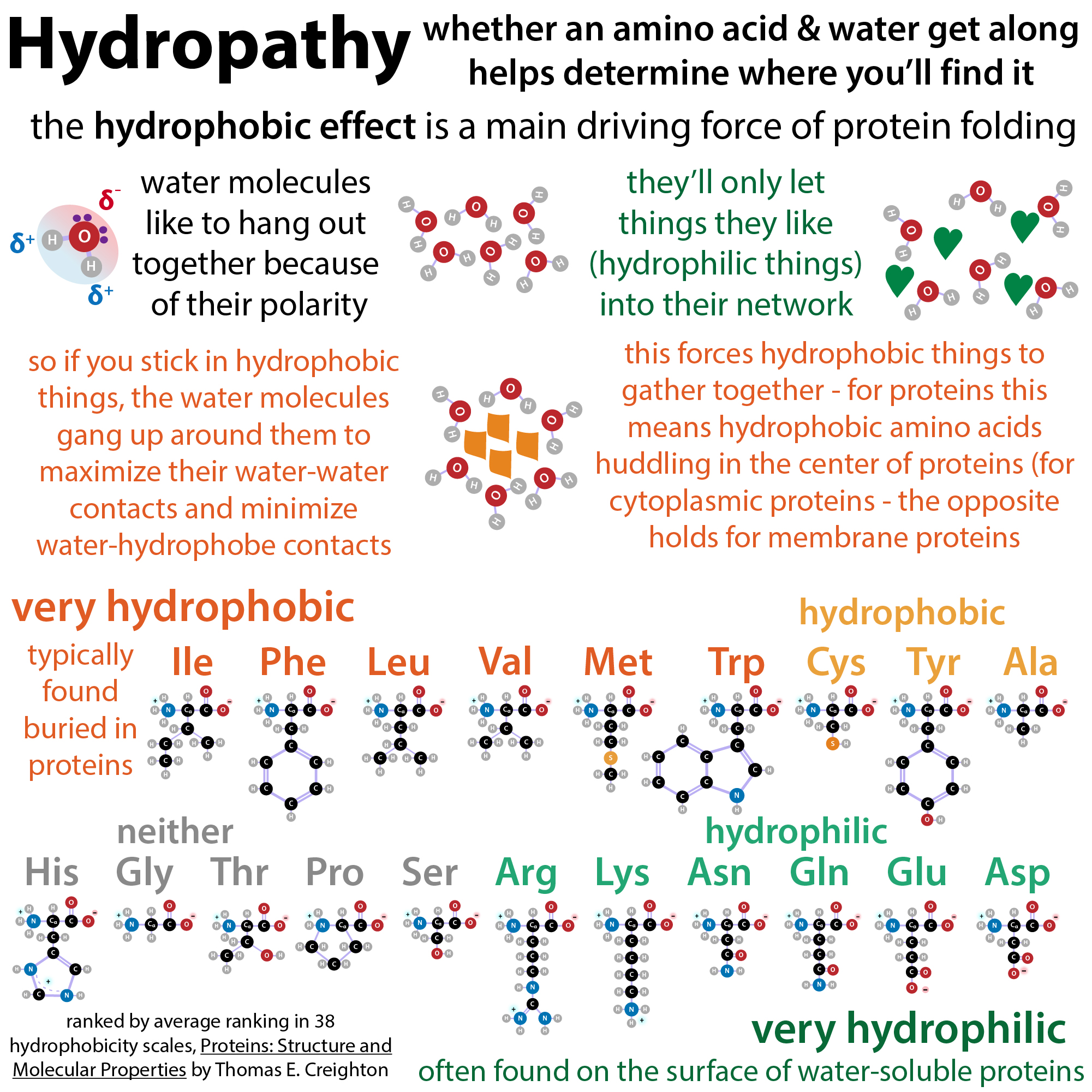
Both have a hydrophilic head that water’s cool with and a hydrophobic tail that water rejects. So these molecules orient themselves so that those hydrophobic tails huddle together with the heads sticking out to interact with the water. The heads of detergents are bulkier than their tails (at least “width”-wise) so they have a cone-like shape and when their tails huddle up, they forms spheres called micelles. Phospholipids, on the other hand, have 2 tails. They’re bulkier, more rectangular, compared to the conical detergents. So it’s harder for them to coordinate w/one another to form little spheres – instead they arrange themselves into bilayer “sandwiches” with the tails in the middle.
In order to form those micelles, there needs to be enough of the detergent molecules to make a sphere and they have to be able to find one another. So the concentration of surfactant helps determine when micelles will form. The “tipping point” concentration is called the Critical Micelle Concentration (CMC) and different surfactants have different ones. The CMC depends on the molecular makeup of the detergent (e.g. less lipophilic detergents are more less desperate to avoid water by hanging out together and minimizing their exposure so you have to get more of them together to “convince them” to → higher CMC.) The CMC also varies based on things like temperature, pH, and salt concentrations.
Key things to keep in mind:
- if you want to extract membrane proteins, you want to be above the CMC
- most of the time in the lab, however, if you’re just using detergent to lyse cells, prevent nonspecific binding, keep things soluble, etc. you want to be below the CMC. You don’t cordon off molecules within your solution!
When detergent meets phospholipid, the lipid-y situation depends on the detergent concentration
- starts by detergents getting into & disrupting membranes, resulting in cell lysis (breaking open)
- at 0.1:1 – 1:1 detergent : membrane lipid, the lipid bilayer stays intact but some membrane proteins you may extract
- as you raise the detergent concentration…
- at 2:1, the membrane is solubilized, and you have “mixed micelles” containing various proportions of detergent, membrane lipids, & membrane proteins
- at 10:1 you pretty much have replaced all the membrane lipids with detergent molecules in your micelles
In addition to different CMCs, different detergents have different “aggregation numbers” – this is the number of individual detergent molecules (monomers) per micelle. The larger this number and the heavier the monomer, the bigger and heavier the micelle (higher the micelle molecular weight, MW).
That size can come into play when thinking about if/how you want to remove excess detergent. The bigger those micelles are, the harder it will be to remove them via size-based methods like dialysis or size exclusion chromatography (gel filtration). And the lower the CMC, the harder it will be to break up micelles into monomers that are easier to get rid of. There are non-size-based methods though, such as affinity or ion exchange chromatography which will separate molecules by other properties. Just note that if you’re using an ionic detergent, ion exchange chromatography is *not* the way to go!
The final other main value you’ll find in detergent property tables is something called the “cloud point” or Critical Micelle Temperature (CMT). This the temperature at & above which detergent micelles aggregate, separating a solution into 2 phases. Below the CMT, the micelles will be miscible with the liquid, basically spread out throughout the watery stuff. And the solution will thus be clear. But above the CMT, things cloud up as the micelles clump up and separate from the watery stuff as a separate phase (so you get like 2 layers). This can be used to bulk separate detergent micelles from the rest of the stuff. If you are going to use this strategy, be sure to choose a detergent with an appropriate CMT. For example, if doing it with proteins you’d want to choose something like
which has a low CMT so that you don’t have to get your protein hot (which would likely denature it).
Here’s a bit more info about some of the main detergents we use in the lab…
The most “famous” detergent of them all is probably Sodium DodecylSulfate – the SDS behind SDS-PAGE! Similarly to how soaps and detergents can sneak into cell membranes, some can slither into proteins & denature (unfold them) and others can break up protein-protein interactions but leave the proteins folded. SDS is a really harsh detergent – and that harshness is great for SDS-PAGE because it unfolds proteins so that you can separate proteins based only on their “length” instead of their shape. By “harsh” I mean that SDS actually denatures (unfolds) proteins, whereas milder detergents like Tween-20 leave them be, just disrupt proteins’ interactions with one another. Mild detergents like Tween-20 are often used at low concentrations designed to break up weak, non-specific interactions, but not denature (unfold) proteins and not “outcompete” specific interactions, whereas we use harsh detergents like SDS when we want to denature them.
SDS is negatively charged (anionic) – which is one of the primary reasons we use it for SDS-PAGE, a technique to separate proteins by size by sending them traveling through a PolyAcrylamide Gel mesh using Electrophoresis (bigger proteins get tangled up more so travel slower). The SDS is crucial to this technique for a couple of reasons: when SDS unfolds & coats proteins, it coats them with negative charge. And that negative charge gives us a way to direct them by putting a positive charge to “bribe them” to go where we want them to go (towards the bottom of the gel in SDS-PAGE. The negative charge also makes the proteins stay unfolded because negative charges repel each other. Once the protein’s unfolded the hydrophobic parts of the SDS can glob onto the hydrophobic parts of the protein (which were probably hidden in the center of the protein). And then the negative heads of the SDS repel each other so the protein doesn’t try to refold. http://bit.ly/sdspageruler
Tween-20 is a non-ionic (uncharged) detergent. And it’s considered “mild” because they don’t unfold proteins. Basically, proteins get their shape largely through interactions between the amino acids’ (protein letters)’ unique parts (side chains) and/or generic parts (backbone). Unlike the strong, covalent peptide bonds linking the letters together to form the polypeptide chain that folds up, these other interactions are non-covalent and reversible. Individually, they’re weak, but collectively they’re strong. If you think of these interactions as a sort of glue, you typically have more glue holding a protein’s shape together (intrAmolecular interactions) than you do holding proteins to other proteins or molecules (intERmolecular interactions). So those intermolecular interactions are easier to break up and milder detergents like Tween can break them up.
Detergents like Tween-20 are great for things like preventing non-specific binding during Western blots, etc. http://bit.ly/westernblotworkflow
In case you’re curious, the “20” in Tween-20 indicates that it has 20 ethylene oxide subunits and they’re attached to a sorbitol (a type of sugar) backbone ring. The hydrophobic part is a lauric acid (a type of fatty acid). Its relative, Tween 80 has an oleic acid tail instead.
In addition to ionic detergents like SDS (and deoxycholate, chelate, sarkosyl, etc.) and non-ionic detergents like Tween-20 (and Triton X-100, DDM, digitoxin, Tween-80, etc.) there are zwitterionic detergents – these have positive and negative parts that balance each other out so there’s no net charge. An example of this is CHAPS.
for more information…
- more good info on lab detergents: https://www.labome.com/method/Detergents-Triton-X-100-Tween-20-and-More.html
- ThermoFisher page with tables I show in the video: Detergents for Cell Lysis and Protein Extraction https://www.thermofisher.com/us/en/home/life-science/protein-biology/protein-biology-learning-center/protein-biology-resource-library/pierce-protein-methods/detergents-cell-lysis-protein-extraction.html
- Stetsenko A, Guskov A. An Overview of the Top Ten Detergents Used for Membrane Protein Crystallization. Crystals. 2017; 7(7):197. https://doi.org/10.3390/cryst7070197
- good info about CMT: Linke D. (2009). Detergents: an overview. Methods in enzymology, 463, 603–617. https://doi.org/10.1016/S0076-6879(09)63034-2
- more on removing detergents: Thermo Fisher Tech Tip #19: Remove detergent from protein samples https://assets.thermofisher.com/TFS-Assets/LSG/Application-Notes/TR0019-Remove-detergent.pdf
A few nice practical pages from Milliipore Sigma:
- Detergent Properties and Applications: https://www.sigmaaldrich.com/US/en/technical-documents/technical-article/protein-biology/protein-lysis-and-extraction/detergent-properties
- Solubilization of Membrane Proteins: https://www.sigmaaldrich.com/US/en/technical-documents/protocol/protein-biology/protein-purification/solubilization
- Purification of Membrane Proteins: https://www.sigmaaldrich.com/US/en/technical-documents/technical-article/protein-biology/protein-purification/purification-his-tagged-proteins
more about membrane proteins: Blog: https://bit.ly/membraneproteinbiochemistry ; YouTube: https://youtu.be/uoXu1EF6atc
more about all sorts of things: #365DaysOfScience All (with topics listed) 👉 http://bit.ly/2OllAB0 or search blog: https://thebumblingbiochemist.com