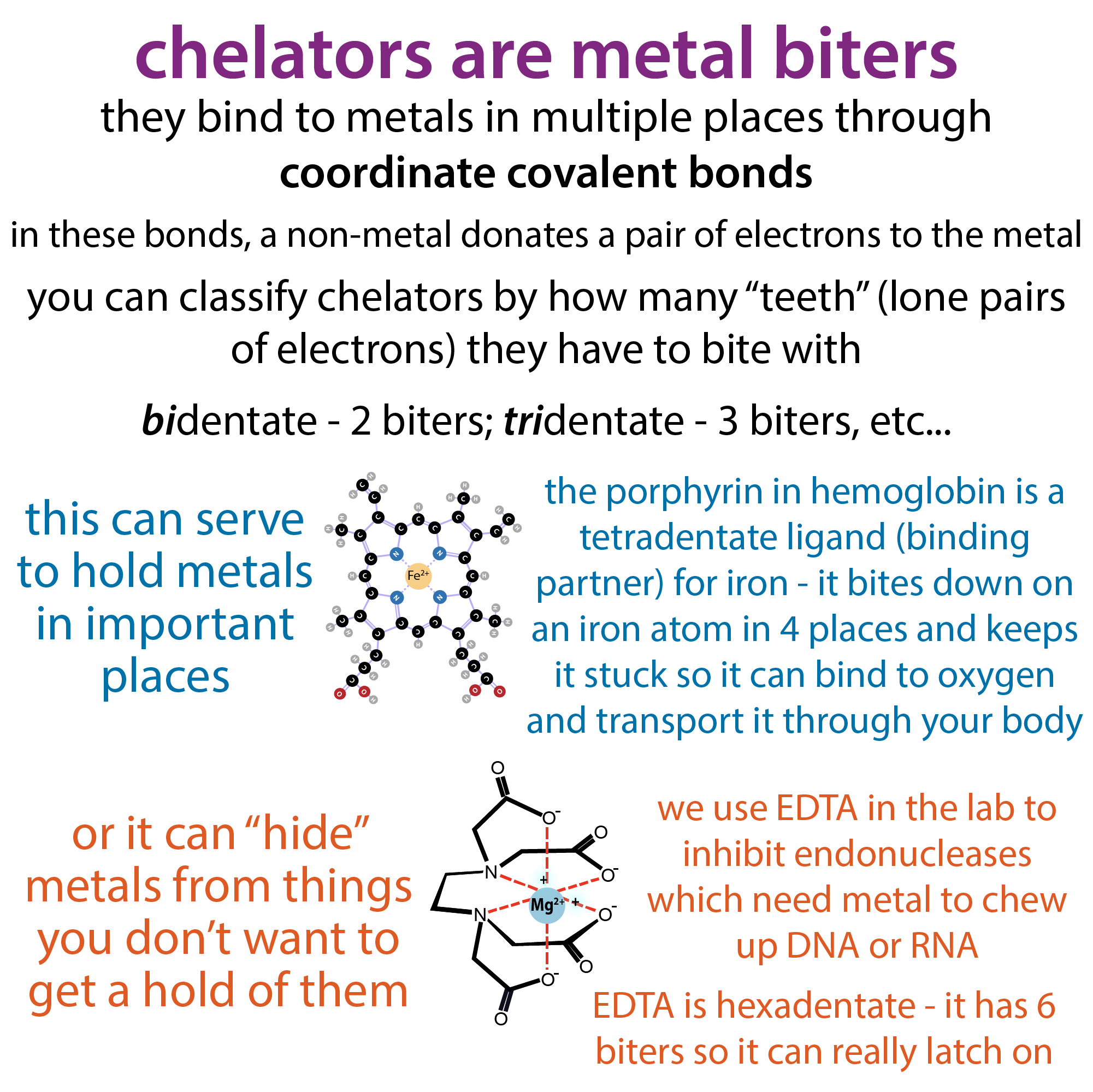
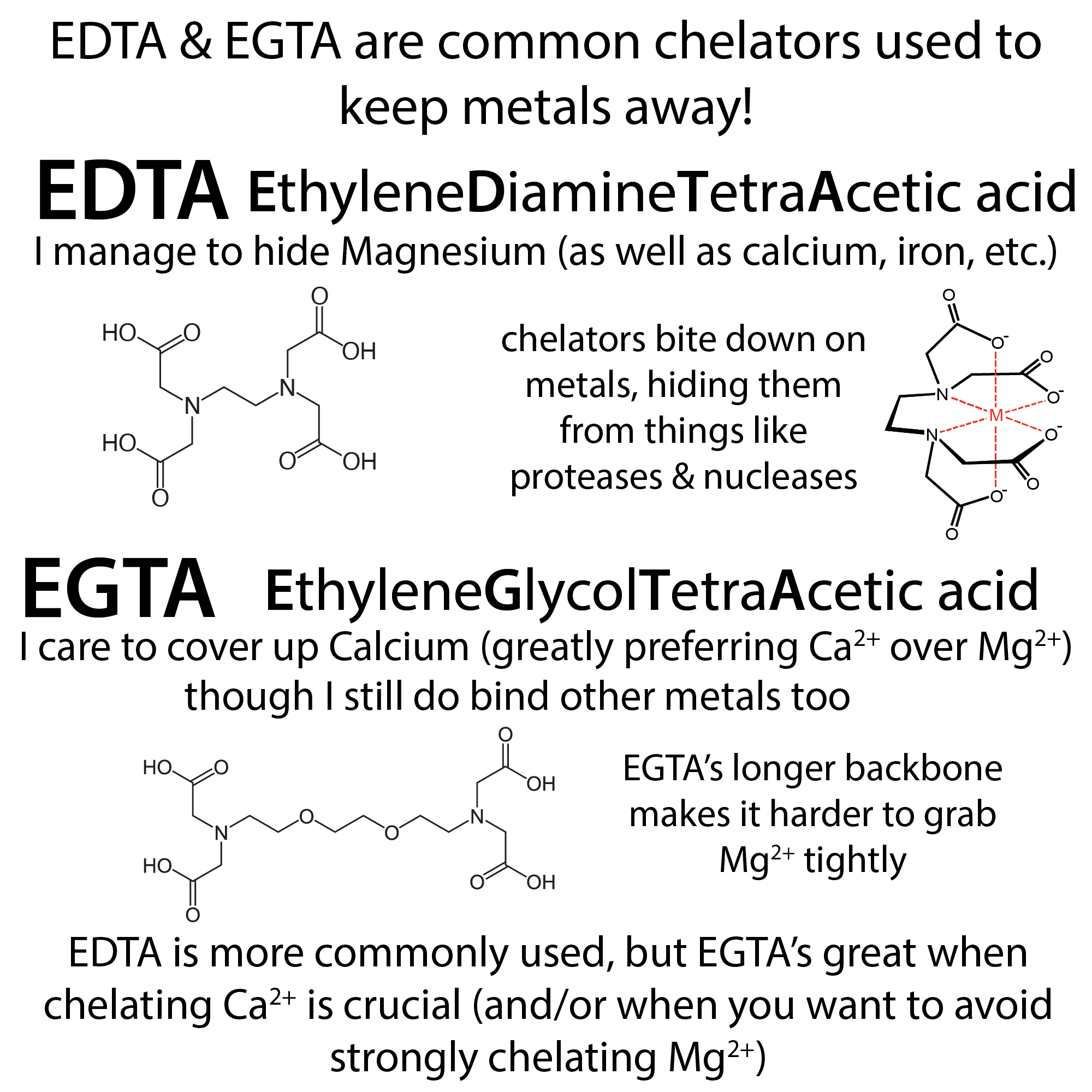
Chelators are “metal-biters” – they act like arcade claws that grab onto metal ions (charged particles) in multiple places, thereby hiding the metals from other molecules that might want to bind them or react with them. A couple common ones we use in the lab are EDTA (ethylene diamine tetraacetic acid) and EGTA (ethylene glycol tetraacetic acid), and we’re often using them to keep metals away from metal-dependent proteases (protein-chewers) and nucleases (DNA & RNA chewers) so they don’t wreck havoc on our precious reaction mixtures. We most commonly use EDTA but we also use EGTA sometimes. As we’ll get into, EGTA has a bigger claw so it has a hard time gripping Mg²⁺ ions, and therefore has a high selectivity for Ca²⁺, making it useful for when you need to get rid of calcium from an environment with an excess of Mg²⁺ and/or when you need to get rid of calcium while preserving some magnesium. Because they’re so useful, it’s common to make stock solutions of them (highly-concentrated solutions such as 0.5M) which we can then dilute into various reaction mixtures and buffers when we want to use them (often at a final, “working concentration” of 1-5mM). Unfortunately, making the stock solutions can be a bit of a pain due to solubility issues – they don’t dissolve unless you add base (typically NaOH). Let’s discuss why this is and how to make stock solutions in practice.
First off, how are these compounds even binding metals?
Metals have huge electron clouds – the places where electrons whizz around their atomic nuclei containing the positive protons reigning them in. When metals bond to other metals in metallic bonds, they kinda just merge some of their clouds into a vast, communal electron sea. And when electrons move throughout the sea you have electric current, which is why metals are good electrical conductors.
But when metals bond to nonmetals, they often do so as coordinate covalent bonds – these bonds form when one atom shares 2 electrons with a metal ion in the middle (in normal covalent bonds each atom shares one) – we call the result a complex and you can learn more about them here: https://bit.ly/2BDBml0
In order to complex with a metal, an atom has to have a lone pair of electrons they can share – like nitrogen or oxygen. If a molecule has more than one atom with a pair to spare, they can “bite down” on the metal in multiple places, hence polydentate. We call such multiple-toothed-biters chelators.
As I mentioned at the top, the two most common chelators we use in the lab are EDTA and EGTA. We use EDTA more commonly but EGTA comes in handy when you really need to chelate calcium (and/or don’t want to strongly chelate magnesium). EGTA has a longer backbone that makes it hard to tightly grip magnesium so it has a much higher preference for Ca²⁺ compared to Mg²⁺.
It’s not that EDTA doesn’t like calcium. It actually slightly prefers it over magnesium as well. The big difference is that EGTA *really really* prefers calcium. So even if there’s a lot of magnesium around (such as in our bodies) it can still capture the small amounts of calcium floating around. If you want actual affinity numbers, check out this table: Metal Chelates Table of Stability Constants: https://www.dojindo.eu.com/images/Product%20Photo/Chelate_Table_of_Stability_Constants.pdf
But it’s important to keep in mind that the affinity is highly pH-dependent. As is the solubility.
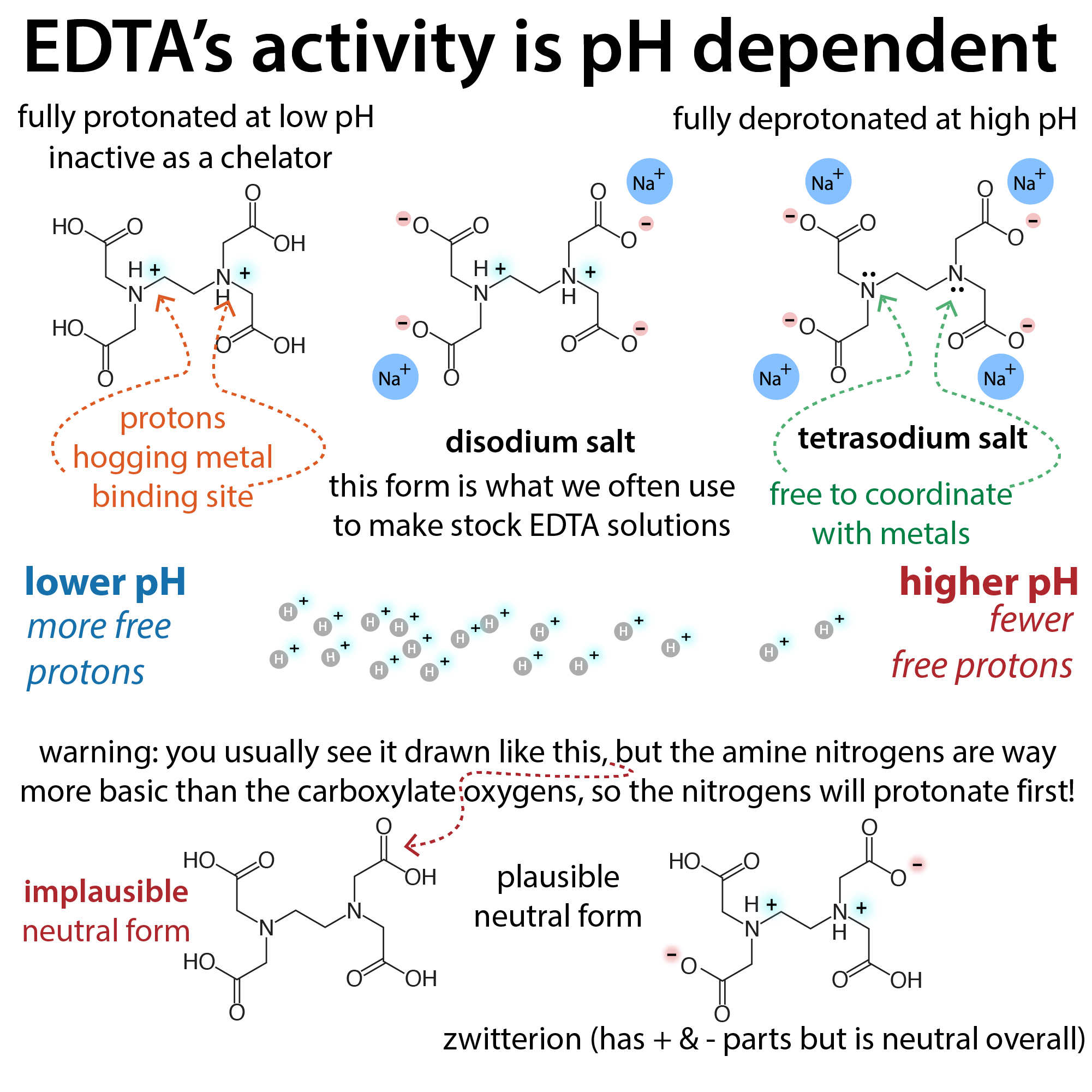
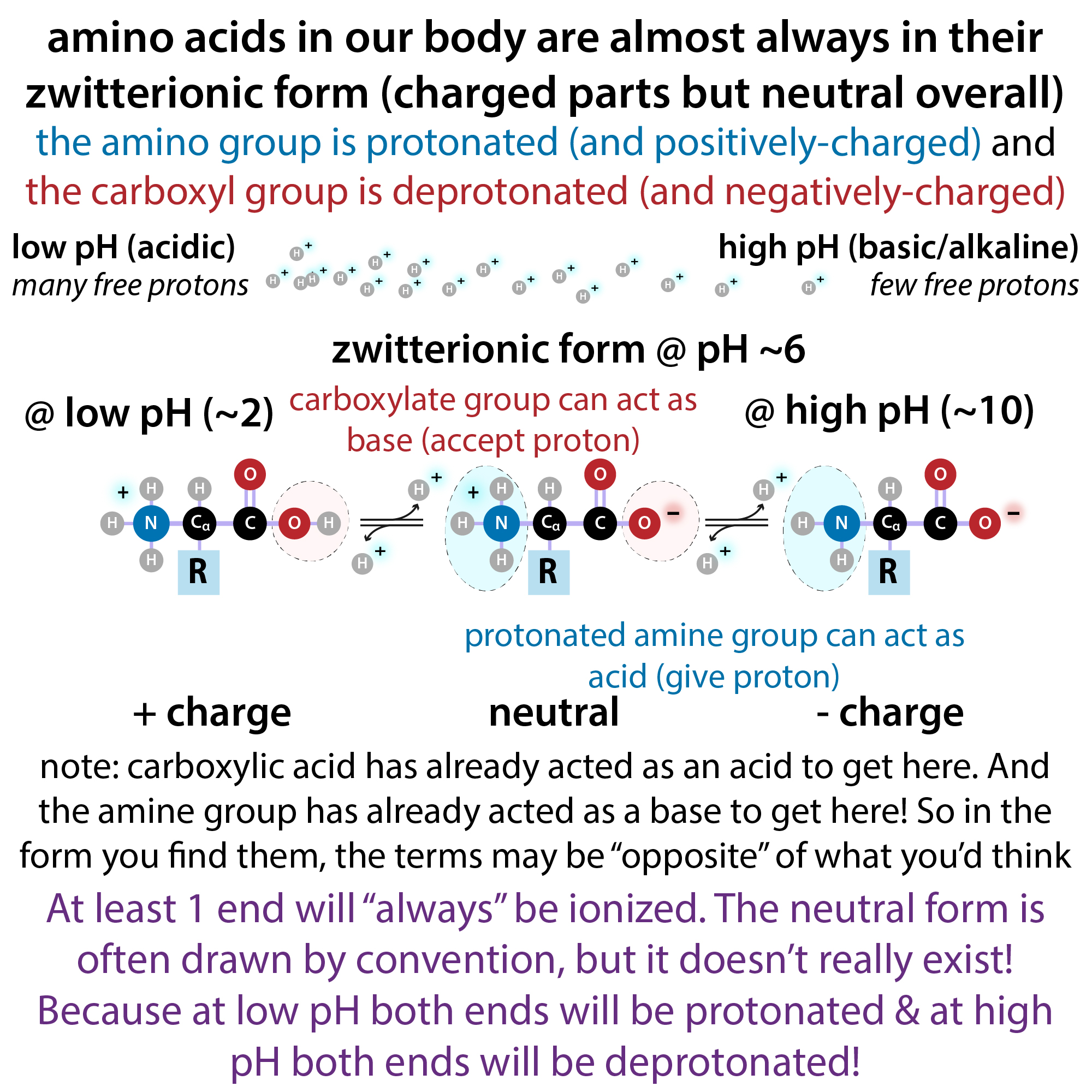
If you think about the name … “tetraacetic acid you might think the big thing we’ll be focused on are the carboxylic acid groups. But these “acid groups” are so acidic (prone to deprotonation) that unless the pH is super low, they’ll be in their deprotonated, negatively-charged “carboxylate” state.
Therefore, when it comes to pH, what will play a bigger role are the nitrogens. These nitrogens are way more basic (prone to proton-grabbing) than carboxylate groups. As a result, as you decrease the pH, raising the concentration of free proteins, the nitrogens will protonate first. And you end up with a situation where all 4 carboxylic acid groups are deprotonated (and thus negatively-charged but the nitrogen groups are protonated (and thus positively-charged) giving you an overall charge of -2, which can be balanced out by two sodium cations (Na⁺) to give an EDTA disodium salt. This salt often complexes with water, resulting in EDTA disodium salt dihydrate. And this is generally the version that’s easiest to work with in the lab. But it’s still a challenge to get it to dissolve…
Those protons on the nitrogens are doing a couple things we don’t want when it comes to both metal binding, and solubility.
- they decrease the magnitude of the negative charge. Less negative charge makes them less attractive to the negatively-charged metals. Less charge also makes them less attractive to water, making it harder to dissolve.
- They hog the sites where the metal would bond – the lone pair of electrons is being used up to bond to the proton, preventing them from being used to bond to the metal – the metal and the proton are in direct competition, with relative concentrations playing a large role in who wins. At lower pH, the protons win, but at higher pH, the metals win (or, if metals aren’t around, the deprotonated version still wins, maybe hanging out with a sodium cation, which is technically still a metal, but here it’s not forming one of those special bonds, just a charge-charge attraction (ionic bond))
So, the compound will be a better chelator if we raise the pH, and it will be more soluble if we raise the pH. And both of these are because raising the pH helps pull the protons off. (Raising pH means lowering free proton availability and raising free hydroxide ion (OH⁻) availability which protons can latch onto as an alternative to the compound)
If you want some specs on just how much pH affects chelation, check out the chart in this guide:
Chelation chemistry: General concepts of the chemistry of chelation, Dow Inc: https://www.dow.com/content/dam/dcc/documents/en-us/app-tech-guide/113/113-01388-01-chelation-chemistry-general-concepts-o
The carboxylic acid groups are pretty darn acidic, but If you go to a really low pH they will protonate. And this makes them super reluctant to dissolve. So if you start with the carboxylic acid form of EDTA you will have to add a TON of NaOH because you have more protons you need to pull off.
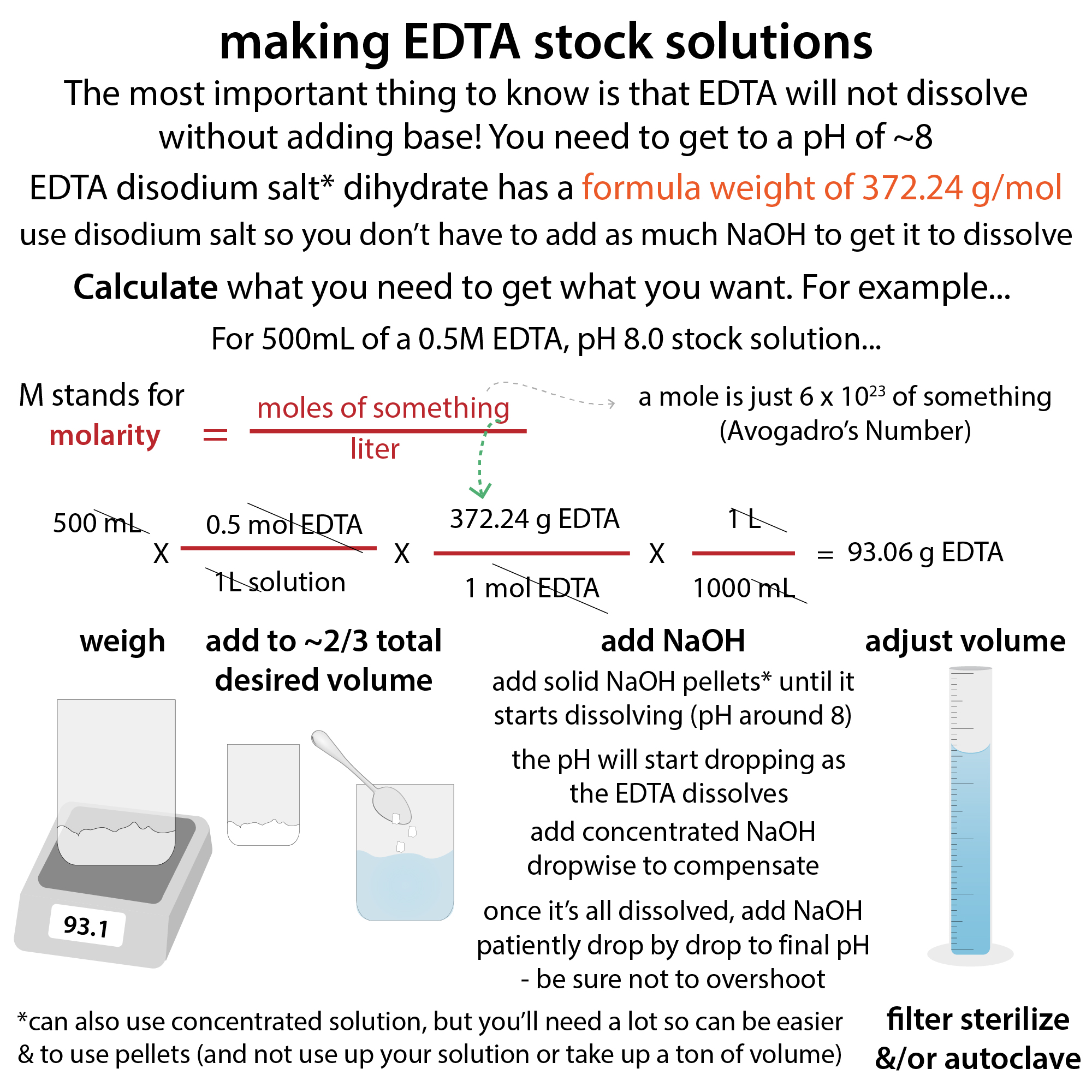
Instead, it’s easier to start with the job partly done – if you start with the disodium salt, some of those protons were already pulled off for you, so you don’t need to add as much NaOH – but you’ll still have to add quite a lot – more than you might expect if you’re used to adding NaOH dropwise to fine tune the pH of buffers. Therefore, we commonly start by adding solid NaOH pellets. You could add a concentrated NaOH solution but you will have to make a lot and “waste” a bunch of your prepared NaOH solution. That will also add a lot to your volume, potentially making you go over.
That solution will come in handy though because it will give you finer control as you near your target pH and try to avoid overshooting and adding too much. So, start off with pellets, add them until you start to see the EDTA dissolve, then back off, see how much of the EDTA dissolves and what the pH does, and then add concentrated NaOH solution dropwise, monitoring the pH.
Because you’re adding all that NaOH you need to be extra careful to leave plenty of room when you first add the EDTA to water (do not add to the final volume of water – instead add to ~2/3-3/4 of the final volume).
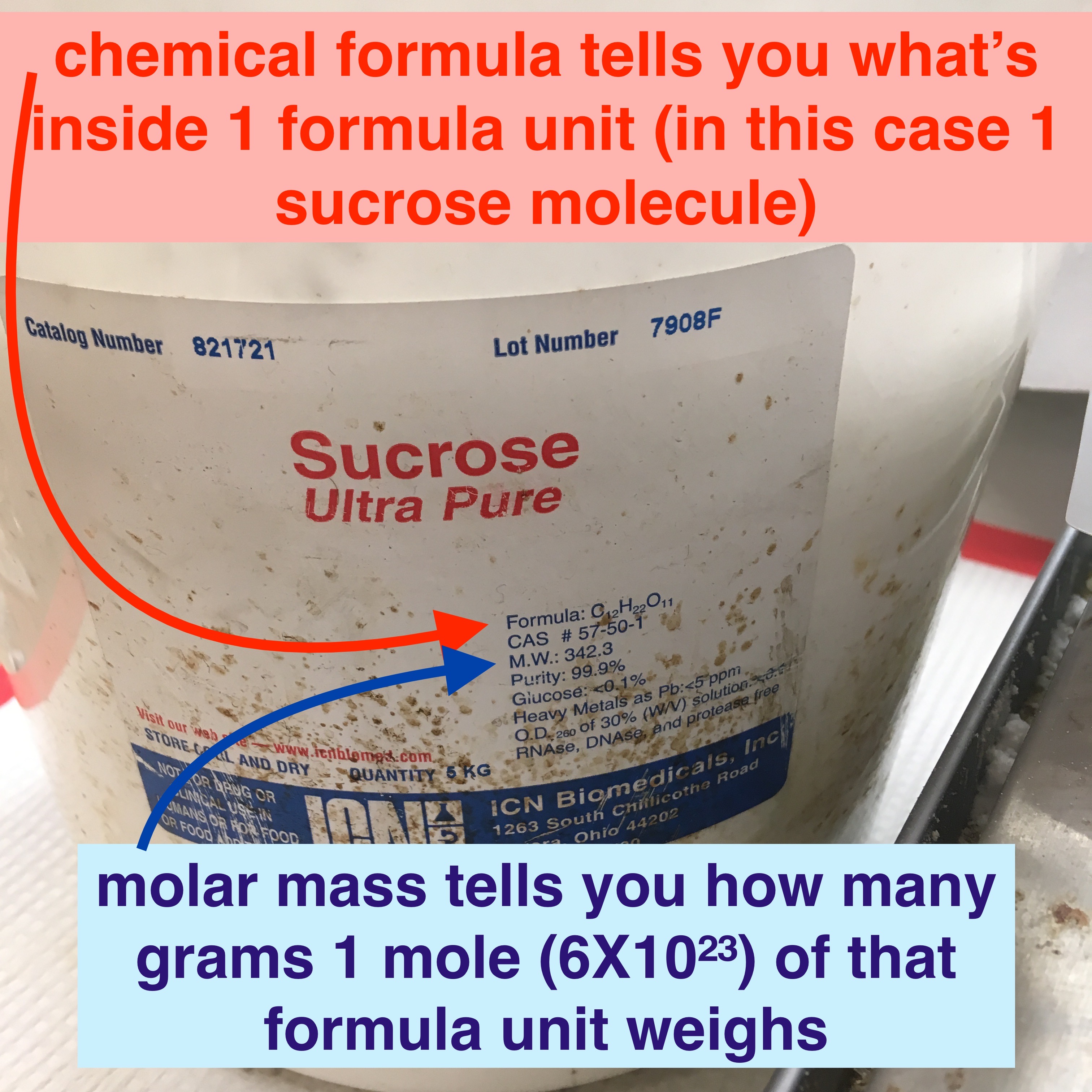
How much EDTA to add? To figure that out, you need to know the formula/molecular weight (how much one copy weighs), the desired molarity (a measure of copies/L), and the desired volume. Then you can use dimensional analysis to find how much you need. It’s really important to keep in mind that the formula weight will depend on the formula – is it EDTA alone or EDTA with sodium and water? Sodium and water add weight to each “formula unit” and because the formula weight tells you how much one moles-worth of copies of the formula unit weigh, the formula weight will therefore be higher. As a result, you will have to weigh out more to get the same number of EDTA copies because you have to take into account that some of the weight is coming from the Na+ and water.
- Anhydrous EDTA (CAS Number 60-00-4, Molecular Weight 292.24)
- Disodium EDTA dihydrate (EDTA.Na2.2H2O, CAS Number 6381-92-6, Molecular Weight 372.24) and
- Tetrasodium EDTA tetrahydrate (EDTA.Na4.4H2O, CAS Number 13235-36-4, Molecular Weight 452.23).
You might be wondering why not start with that tetrasodium salt? Well, if you dissolved that, the pH would be way too high (>10) for adding to our reactions. Preparation of 0.5 M EDTA Stock Solution from Anhydrous EDTA Free Acid, Laboratory Notes: https://www.laboratorynotes.com/preparation-of-0-5-m-edta-stock-solution-from-anhydrous-edta-free-acid/
From that number, we can see that we don’t actually want to deprotonate all the sites on all the copies of EDTA. So we get it in the disodium salt form and go a bit further by adding NaOH. We don’t want to go too far which is why we need to be careful and go dropwise near the end.
If you don’t need the pH to be exact, you can get it to somewhere around the 7.5-8 range and call it quits (make sure you mark the pH on the bottle though). But if you do need it exact you need to be careful because if you overshoot you have to start over if you want your solution to be pure. Sometimes, when we are adjusting the pH of a solution, if we overshoot we can lower the pH by adding acid. Often HCl. But there’s no chlorine in our solution, so if we add HCl we are introducing something we don’t want (and which can alter the ionic strength of the solution). So if you want to do things the right way, you need to just start over. In practice though, if you need to add a couple drops it’s not usually an issue.
When your EDTA is dissolved and your pH stably where you want it, pour your solution into a graduates cylinder and add water to the desired volume. Then use a vacuum filter with a 0.2um filter to sterilize it and/or autoclave it.
Here are a couple example stock solutions:
- 0.5M EDTA, pH 8.0 – make 500 mL
- start from EDTA disodium salt dihydrate
- mw: 372.24 g/mol
- for 500mL:
- 93.06 g EDTA disodium salt dihydrate
- add to ~400 mL ddh2O
- **** won’t dissolve w/o NaOH
- add solid NaOH pellets to raise pH to ~8
- ~9g
- switch to concentrated liquid NaOH towards the end for finer control (add dropwise)
- add solid NaOH pellets to raise pH to ~8
- adjust volume
- vacuum filter
- start from EDTA disodium salt dihydrate
- 0.5M EGTA, pH 8.0 – make 100 mL
- mw: 380.35 g/mol
- for 100mL:
- 19 g EGTA
- add to ~80 mL ddh2O
- **** won’t dissolve w/o NaOH
- add solid NaOH pellets to raise pH to ~8
- ~4g NaOH
- switch to concentrated liquid NaOH towards the end for finer control (add dropwise)
- add solid NaOH pellets to raise pH to ~8
- adjust volume
- vacuum filter
Here are some resources if you want to learn more:
Chelation chemistry: General concepts of the chemistry of chelation, Dow Inc: https://www.dow.com/content/dam/dcc/documents/en-us/app-tech-guide/113/113-01388-01-chelation-chemistry-general-concepts-of-the-chemistry-of-chelation.pdf
Tsien R. Y. (1980). New calcium indicators and buffers with high selectivity against magnesium and protons: design, synthesis, and properties of prototype structures. Biochemistry, 19(11), 2396–2404. https://doi.org/10.1021/bi00552a018 free version: http://www.tsienlab.ucsd.edu/Publications/Tsien%201980%20Biochemistry%20-%20New%20Calcium%20Indicators.pdf
Metal Chelates Table of Stability Constants: https://www.dojindo.eu.com/images/Product%20Photo/Chelate_Table_of_Stability_Constants.pdf
Preparation of 0.5 M EDTA Stock Solution from Anhydrous EDTA Free Acid, Laboratory Notes: https://www.laboratorynotes.com/preparation-of-0-5-m-edta-stock-solution-from-anhydrous-edta-free-acid/
more on dimensional analysis: http://bit.ly/dimensionalanalysising & https://youtu.be/KQMA0aAGfP4
more about all sorts of things: #365DaysOfScience All (with topics listed) 👉 http://bit.ly/2OllAB0