Receptors are like watch towers for cells. They’re how cells are able to sense what’s going on outside of cells and relay the message to the inside of the cells so the cells can respond. Different cells have different combinations of various types of receptors and the different receptor types keep watch for different signals (which instead of ships are binding partners called ligands – hormones, drugs, etc). This allows some cells to respond to a signal while others ignore it. But how do the cells respond if they do? That depends on the type of signal.
Traditionally, it’s been thought that there are two main types of receptor ligands: agonists, which activate the receptor and antagonists which prevent it from being activated. In the traditional thinking, the receptor would always be inactive in the absence of an agonist – that is, it would have no “constitutive” activity. So the receptor would be quiet if there was no agonist and, if there were agonist present, if you added enough antagonist, it would compete out all the agonist, silencing the receptor.
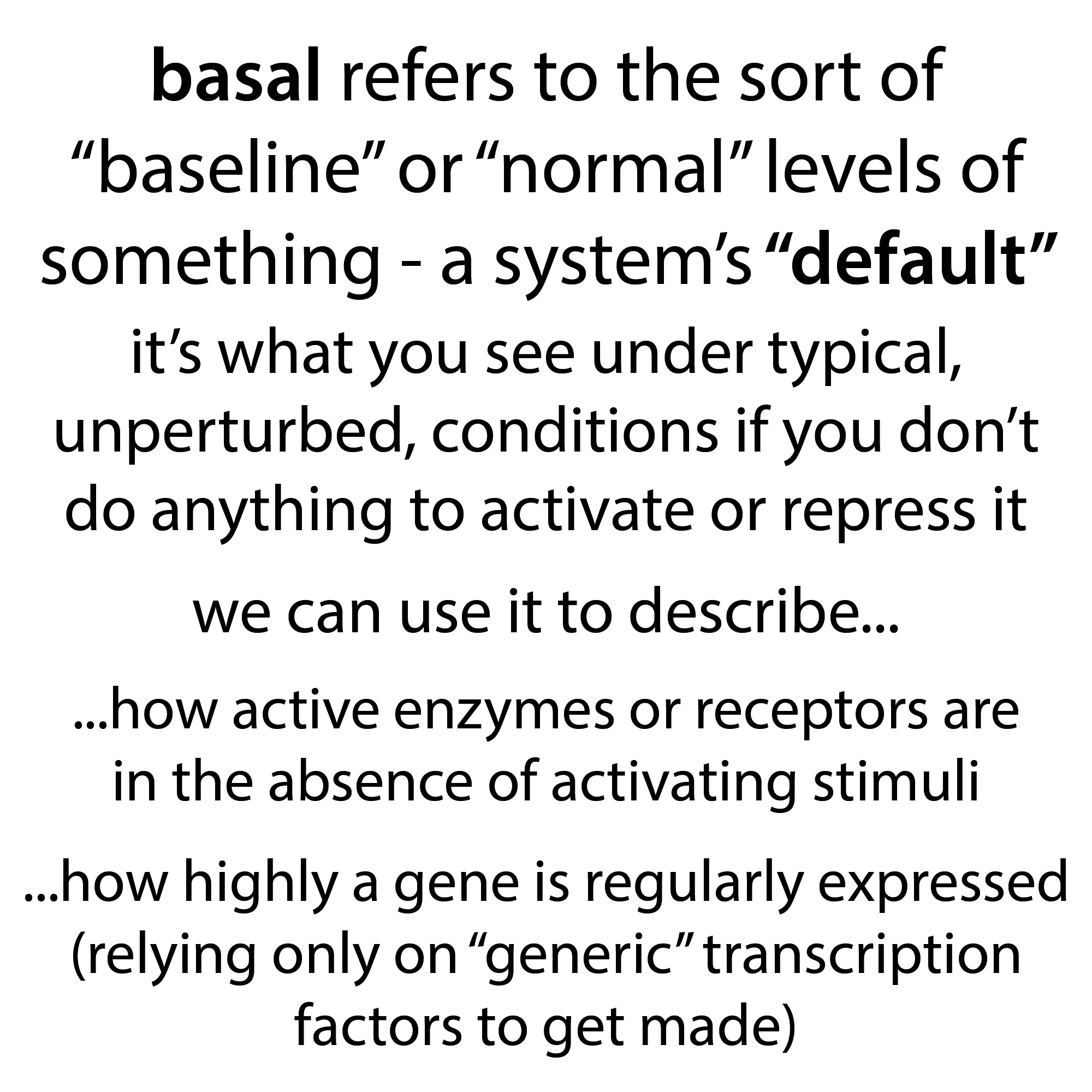
But, it turns out that there are some receptors where, no matter how much antagonist you add, you’ll still see some activity. Maybe not much, but not nothing. What’s going on? The receptor has constitutive activity! It signals some in the absence of agonist. Leading to above-zero “basal” activity, where basal refers to the sort of “default” level.
Antagonists can’t reduce activity below the basal level. But another type of ligand, inverse agonists, can. Why is this? Let’s look at what’s going on at the molecular level.
Often this signal is conveyed through a conformational change (shape-shift). Receptors typically go all the way through (transverse) the membrane, leaving them with one part outside the cell (the extracellular domain) and one part inside the cell (the intracellular domain). Binding of a ligand to the extracellular domain often causes a conformational change that ripples through to the inside of cells and triggers a signaling cascade, with the message often relayed by kinases, which add negatively-charged phosphate groups onto molecules, altering their activity.
So you can think of the receptor having 2 main conformations (shapes) – one active, where the inside-the-cell signaling stuff is triggered; and one inactive, where no message is sent. And, although agonist binding stabilizes the active state, the agonist isn’t actually required for that state to exist.
Depending on the inherent makeup of the receptor (how flexible it is and stuff) as well as things like the pH, in the absence of any ligand, receptors will have some proportion of receptors in the active state and some in the inactive state. If there are lots in the active state, you’ll get high constitutive activity and if there aren’t many in the active state, it will have low constitutive activity. Since different receptors have different makeups, they’ll have different constitutive activity levels (different defaults). Some will be loudish and others silent.
Mutations in receptors can alter the active/inactive proportions. For example, in some cancers, receptor mutations lead to receptors being “always on high” leading to dysregulated messaging, excessive cell growth, etc.
Even without mutations, the receptor proportions can change – this time, in response to ligands. Different types of ligands change the proportions in different directions, leading to differences in activity.
Agonists stabilize the active conformation, increasing the proportion of receptors in the active state and thereby increasing the activity above basal levels.
Inverse agonists stabilize the inactive conformation, decreasing the proportion of receptors in the active state and thereby decreasing the activity below basal levels.
What about antagonists? They don’t change the proportions. So they can’t reduce activity below basal levels. But they hog the agonist’s spot on the receptor (or otherwise prevent the agonist from binding) and therefore they prevent activation and are able to reduce activity when an agonist is present.
So, unless we’re talking about allosteric molecules (which bind elsewhere on the receptor, maybe causing the binding site to change shape), antagonists, inverse agonists, and agonists are all competing for the same spot on the receptor. Which one wins will depend on a combination of which binds more tightly (has a higher affinity) and has more copies (has a higher concentration). Most of the time these are all binding reversibly, so you should be able to overcome the effects of one of you add enough of another. This can lead to some complicated pharmacological graphs and models and stuff.
But at its core it’s just the same biochemical concepts we see over and over and over in biochemistry. We just give things fancy names like inverse agonist.
So, to review those fancy names:
- an agonist is a ligand (binding partner) that binds to a receptor and activates it
- an antagonist is a ligand that binds to a receptor and prevents it from being activated (typically by physically blocking the agonist’s binding spot), but doesn’t reduce constitutive activity (instead, it flattens things out at basal levels, so you see the same amount of activity you’d see in the absence of any ligand)
- an inverse agonist binds to a receptor and reduces its baseline activity (as well as typically blocking the agonist from binding). So you get less activity than you get normally in the absence of agonist (below basal levels)
Things can quickly get much more complicated because some agonists and antagonists are only “partial agonists” or “partial antagonists” – they don’t fully activate or prevent activation. In these cases their overall effects will depend on what the activity was like to start with. If you had a lot of agonist, adding a partial agonist will dampen the activity. But if you didn’t have much agonist, a partial one would increase the activity!
I’ve focused so far on the ligand binding, which starts the whole thing going. But then what? Say an agonist binds. What happens next? Depending on the receptor and the ligand and the cellular context, this can lead to various outcomes. Context matters – a LOT. The same ligand/receptor combo can have different effects depending on what type of cells the receptor is on and how the signal gets relayed. If you want to learn more about this, look up “biased agonism.” I’ll even do you a solid and provide a great reference that describes this all!
Berg, K. A., & Clarke, W. P. (2018). Making Sense of Pharmacology: Inverse Agonism and Functional Selectivity. The international journal of neuropsychopharmacology, 21(10), 962–977. https://doi.org/10.1093/ijnp/pyy071
That was a lot of complicated stuff, so now for a fun example. My favorite antagonist is caffeine. Long story short: Caffeine is a purine that acts as an adenosine receptor antagonist. Basically, it pretends to be adenosine and binds to adenosine receptors but doesn’t activate them. And blocks adenosine from binding. When adenosine binds, you get sleepy so…
note: this is major oversimplification. Much more in this past post: blog: https://bit.ly/caffeinebiochemistry ; YouTube: https://youtu.be/5Y5jLMzmbHk
That example also brings up another point – ligands can be natural or artificial and can be made by a person’s own body (in which case we call it endogenous) or be introduced from outside the body (in which case we call it exogenous). The same ligand can be both endogenous and exogenous – it just depends on the source. For example, adenosine is naturally made in our bodies all the time – when this adenosine binds to receptors, it’s endogenous. But “extra” adenosine can can be given as a drug to patients whose heart rate is too high. In this case, the adenosine is exogenous. Since our bodies can’t produce caffeine, all the caffeine binding to our receptors is exogenous though! much more about endogenous vs exogenous here: https://youtu.be/0fE0rtBaNW0
For more binding partner naming stuff see this post from which today’s was adapted from as an extension: blog form: https://bit.ly/bindingpartners YouTube: https://youtu.be/sVcfAGH65y4
And I also have added these to my glossary: https://thebumblingbiochemist.com/glossary/