A lot of the experiments we do require us to “incubate” things – keep things at constant, specific, temperatures (sometimes with shaking or with controlled CO₂ and/or humidity, etc.). So we have a bunch of types of incubators and other equipment we can use to keep things hot or cold. Here’s a basic guide to some of this equipment you might find in a lab.
Note: the most common “temperature” we incubate things at doesn’t require any fancy equipment – room temperature! Sometimes abbreviated “RT” this is typically around 20°C but can vary greatly which can also cause experimental results to vary greatly if they’re temperature sensitive. So if your reactions are temperature sensitive, control the temp even if it’s close to room temp.
Hot or cold:
- thermal cyclers – we often refer to these as PCR machines because we use them a lot for PCR (a method where we make lots of copies of a specific DNA sequence based off of a DNA template). They’re useful for that because they can get hot and cold really quickly, allowing for the cycling temperatures PCR requires. This also makes them useful for simple incubations at a large range of temperatures – as long as your samples are in those tiny PCR tubes! So it’s only useful if you have samples with volumes less than about 200μL
- Thermal shakers (mostly used for heating, but some have cooling features that can go down to about 0°C) – these are basically temperature-controlled blocks with different size holes for various tube or plate sizes. The blocks are on an orbital shaker so you can shake things at various speeds (or you can turn off the shaking). The standard eppendorf tube holder size is great for the recovery/outgrowth step after a bacterial transformation (after sticking a plasmid into bacterial cells you want to let them recover in the absence of antibiotics before playing them).
Heating (in addition to thermal cyclers and thermal shakers):
- heat blocks – similar to thermal shakers but lower tech – they don’t shake. Often these are simply metal blocks in sand with a heated base. The temperature on the older ones at least can be hard to precisely control, involving lots of knob turning and thermometer reading. But a cheaper easy option for when exact temps aren’t as big of a deal, such as when you just need to boil gel samples, etc. There are also newer digital ones that probably have better temp control but cost more (but probably still less than the ones that also shake)
- Water baths – these are basically just temperature-controlled water buckets and they’re good if your samples are in irregularly shaped containers, like media bottles or stuff. Another nice thing about them is you can quickly take multiple samples in and out if you put the samples in styrofoam floaters or other racks. We use these a lot for heat shock steps during bacterial transformations as well as thawing or heating up various things.
- Bead baths – these are similar to water baths but use metal beads instead of water. These are often used in place of water baths in cell culture rooms because they can be kept sterile more easily.
- Plate incubators – these are basically heated chambers with shelves for holding Petri dishes of bacteria, plates of adherent cells, etc. They range in size but are often about the size of a mini fridge. But they’re warm (often 37°C) and some are CO₂- and humidity-controlled (mammalian cell culture typically needs this).
- Shaker incubators – similar to the plate incubators in concept but have an orbital shaker platform instead of shelves. Good for growing suspension cultures (cells suspended in liquid food (media)) because the shaking allows for aeration so oxygen gets to even the cells that were at the bottom of the flask.
- Heated magnetic stir plates: stir plates have spinning magnets – so when you place a magnetic stir bar in your sample and place it on the plate (and turn it on) the stir bar will spin and make the liquid in your sample mix. Some of these have heating elements too – but not all do so check before you plan to use one! Also be careful not to accidentally bump the heat knob and turn it on or up when you don’t mean to. And also never store items on a hot plate (even one that’s not currently on) – it can start fires. Those warnings aside, they can be really useful for helping you dissolve things that don’t want to dissolve and for controlling chemical reactions.
These next few aren’t for incubating, but they do get things hot!
- Bunsen burners – those classical flames you start with flint strikers and which my dad seems to think I use all the time because that’s what’s always shown in stock scientist photos. In reality I don’t use them that much – primarily when I want to maintain a sterile environment at my bench such as when pouring agar plates to grow bacteria on. In some fields you use them more though.
- Microwaves: we often use these for heating up solidified LB-agar to pour those plates I mentioned. Also useful for some gel destaining protocols
- Autoclaves – these are high-temp high-pressure oven-like contraptions that steam sterilize things
Cooling
- Ice – both wet (normal ice) and dry (dry ice, which is solid CO₂ and is much much colder)
- I really like the rectangular ice buckets if you get a say! Autoclave trays can also work nicely for large things like cell culture flasks
- When working with ice I like to use metal cooler blocks. I didn’t know about them until I got to this lab but now I’m obsessed with them! They get cold super quickly and stay cold even if you take them off the ice – good for transporting samples or replacing the ice easily. Because they have holes for the tubes they prevent the tubes from getting lost in the ice, make it easier to stay organized, etc.
- they also have color-changing plastic ones that change color when they warm up but don’t cool as quickly
- even if you don’t have those (which are unfortunately quite expensive) there are cheap plastic racks you can use to at least keep the tubes organized and upright.
- when working with dry ice we often use styrofoam shipping containers – and we can ship samples on dry ice to keep them about -80°C
- liquid nitrogen (LN2) is great for flash/snap freezing samples to prevent ice crystals from forming and damaging the samples, messing up concentrations, etc. much more on it here:
- LN2 is also good for keeping samples really cold long-term. We often keep boxes of tubes (such as cell stocks) in racks in LN2 dewars (basically giant thermoses). We keep crystals in these too and can ship them in small ones.
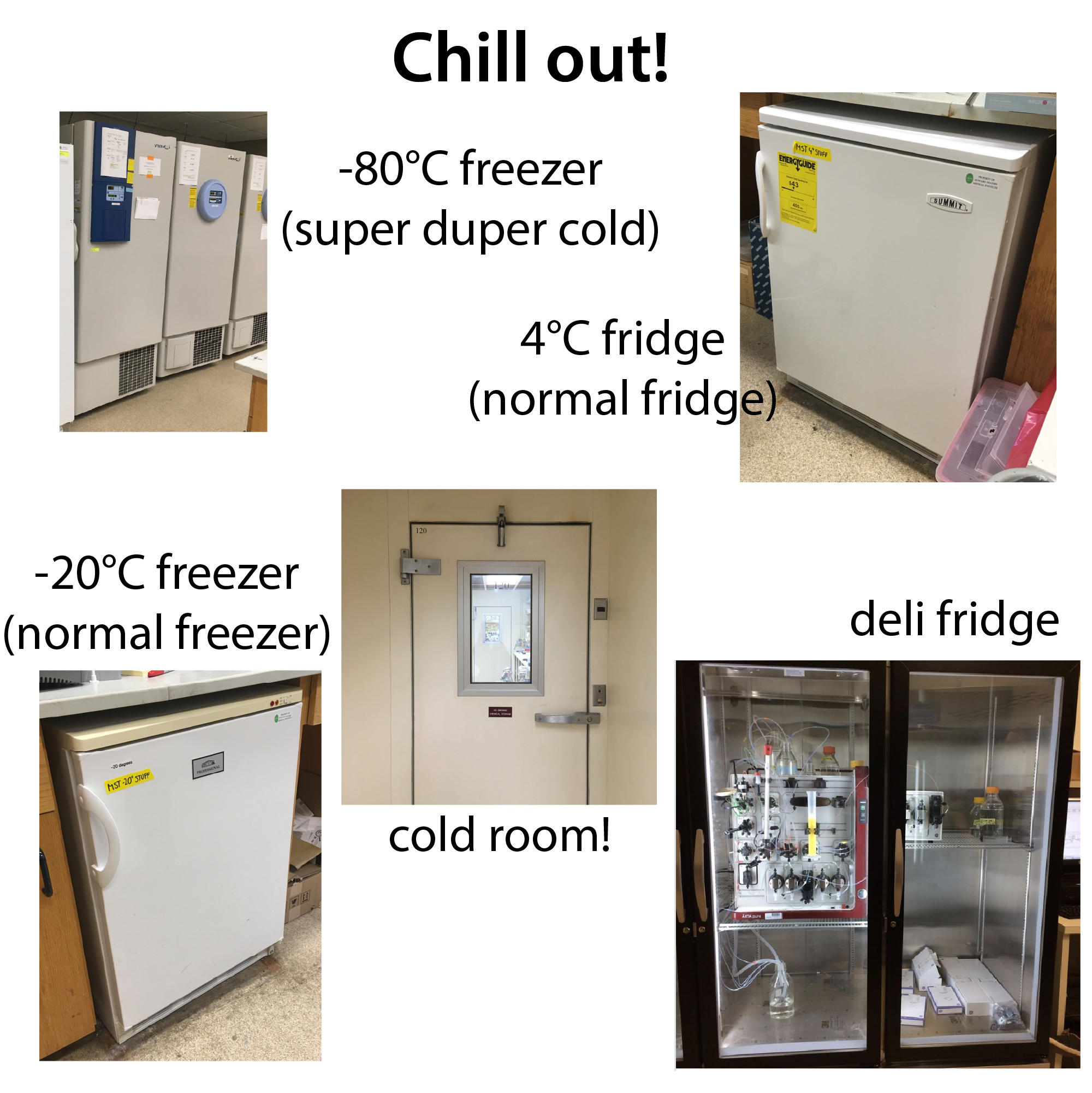
- fridges (typically ~4C) and freezers (normal ones are ~-20°C, really cold ones are ~ -80°C)
- we have a variety of sizes and styles. In addition to normal fridges we often have deli fridges with sliding glass doors. These are useful for storing big equipment such as AKTAs that needs to be kept cold.
- For actually working in the cold (doing gravity flow purification etc) or for experiments that need shaker platforms or stuff (such as overnight antibody probing of western blots) we have cold rooms. Which are basically walk-in fridges with lab benches and shelves. And which I hate working in.
Again, not really “incubating” but if you need your samples to stay cold when you’re centrifuging them (spinning them really fast) there are refrigerated centrifuges (often their names have an R at the end). They take a while to cool off (especially the big ones) so if you need them cold, turn them on ahead of time and use the “fast temp” button to cool them off.
more on liquid nitrogen and flash freezing: https://bit.ly/cryoprotectantsandvitrification
more on dry ice: https://bit.ly/cryoprotectantsandvitrification
more on lab equipment: http://bit.ly/equippedtoexperiment