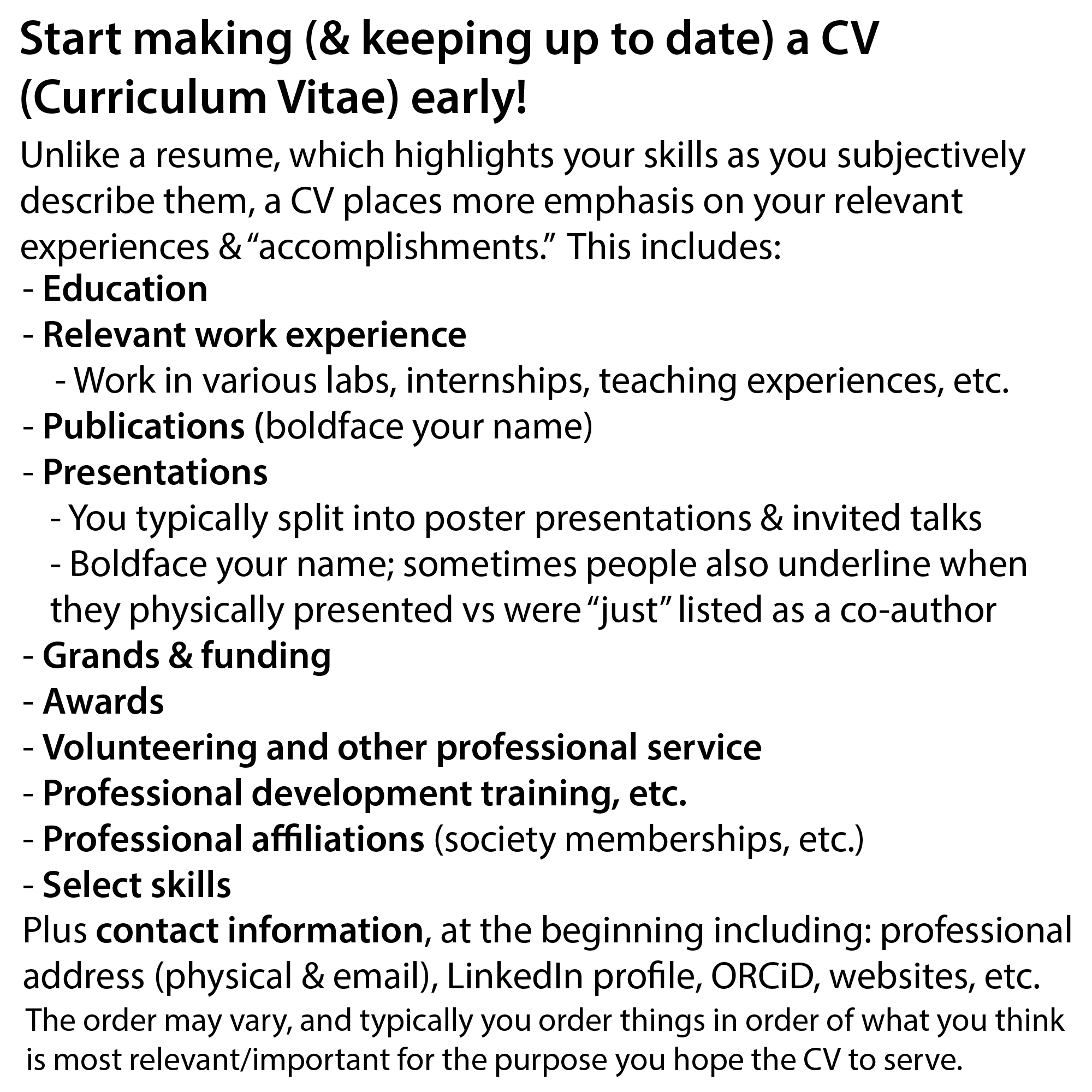
Unlike a resume, which highlights your skills as you subjectively describe them, a CV places more emphasis on your experiences and “accomplishments” (for better or for worse). This includes:
- Education
- Relevant work experience
- Work in various labs, internships, teaching experiences, etc.
- Publications
- Boldface your name
- Presentations
- You typically split into poster presentations and invited talks
- Boldface your name; sometimes people also underline when they physically presented vs were “just” listed as a co-author
- Grands & funding
- Awards
- Volunteering and other professional service
- Professional development training, etc.
- Professional affiliations
- Select skills
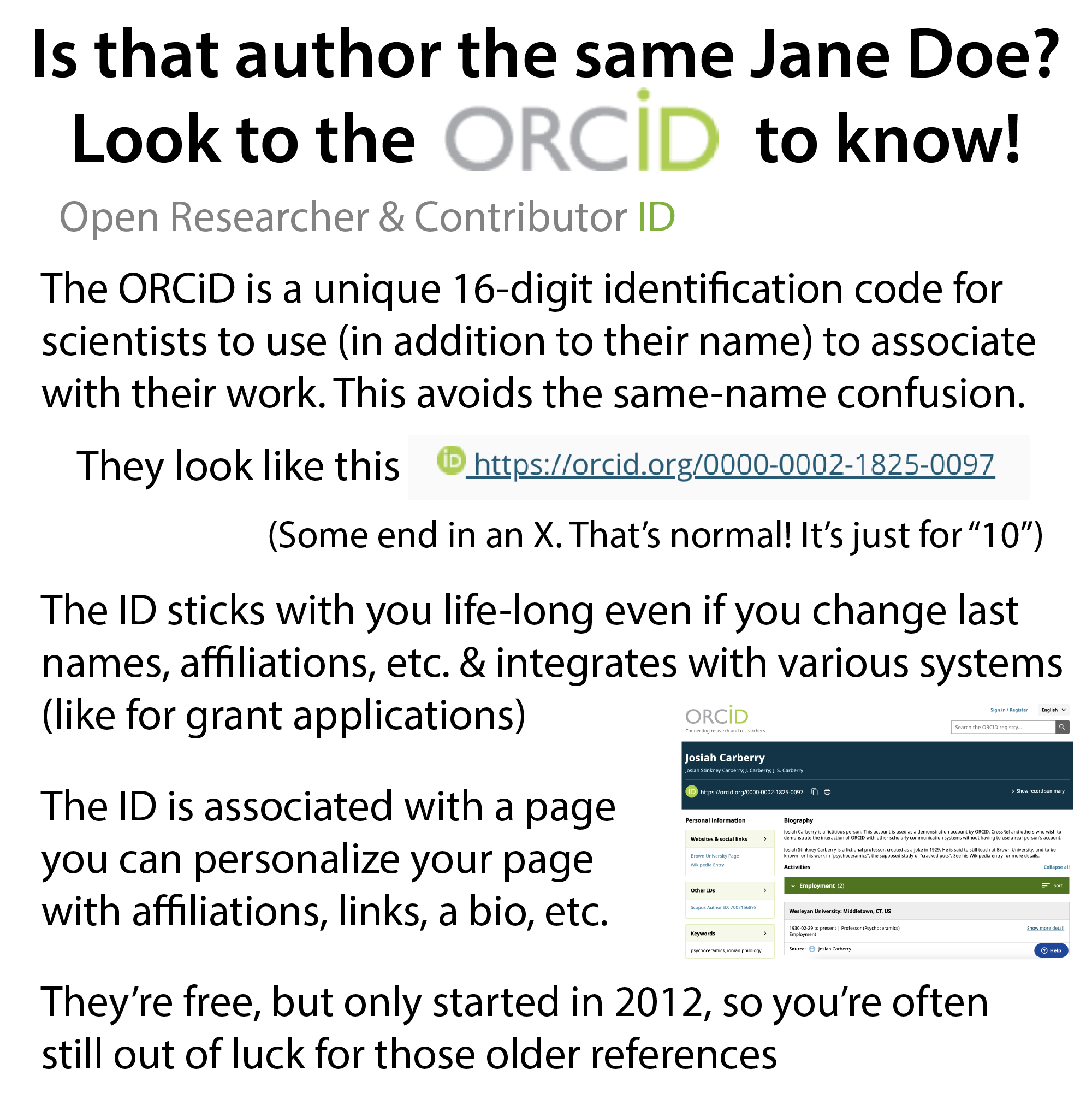
And, of course, contact information, at the beginning including: professional address (physical & email), LinkedIn profile, ORCiD (a unique identifier number for scientists you can register for for free), websites, etc.
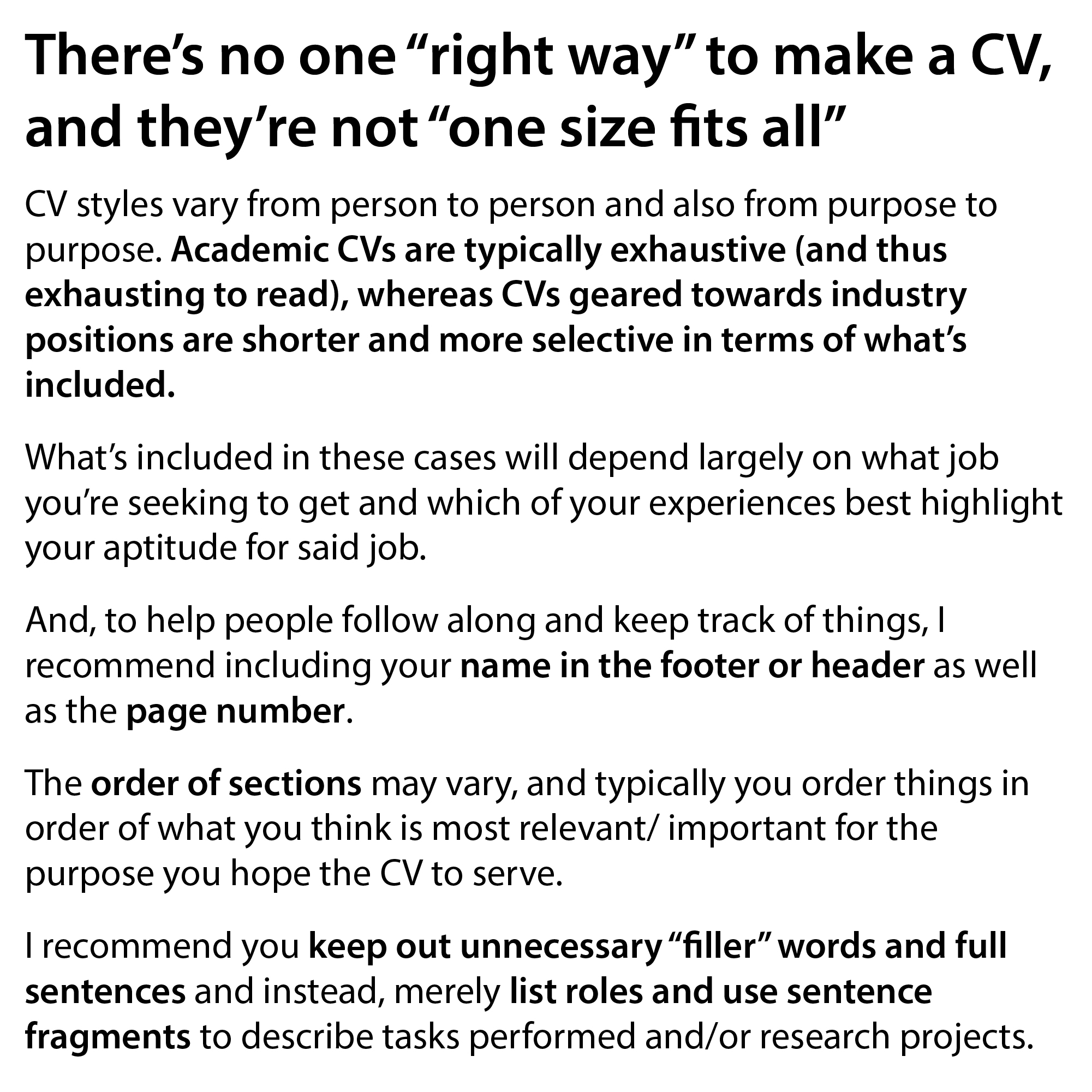
The order may vary, and typically you order things in order of what you think is most relevant/important for the purpose you hope the CV to serve.
That’s a lot to cram in, so you want to keep out unnecessary “filler” words and full sentences (e.g., “I was a Postdoctoral Researcher in Dr. Danica Fujimori’s lab, where I had a number of tasks including . . .”) and instead, merely list roles “Postdoctoral Researcher” and use sentence fragments to describe tasks performed and/or research projects (e.g., Performed mitochondrial ribosome profiling and purification for cryo-electron microscopy to investigate context-dependent effects of phenicol and oxazolidinone antibiotics on human mitochondrial ribosomes.” Then list the advisor/PI: “Danica Fujimori, PhD”
CV styles vary from person to person and also from purpose to purpose. Academic CVs are typically exhaustive (and thus exhausting to read), whereas CVs geared towards industry positions are shorter and more selective in terms of what’s included. What’s included in these cases will depend largely on what job you’re seeking to get and which of your experiences best highlight your aptitude for said job. And, to help people follow along and keep track of things, I recommend including your name in the footer or header as well as the page number.
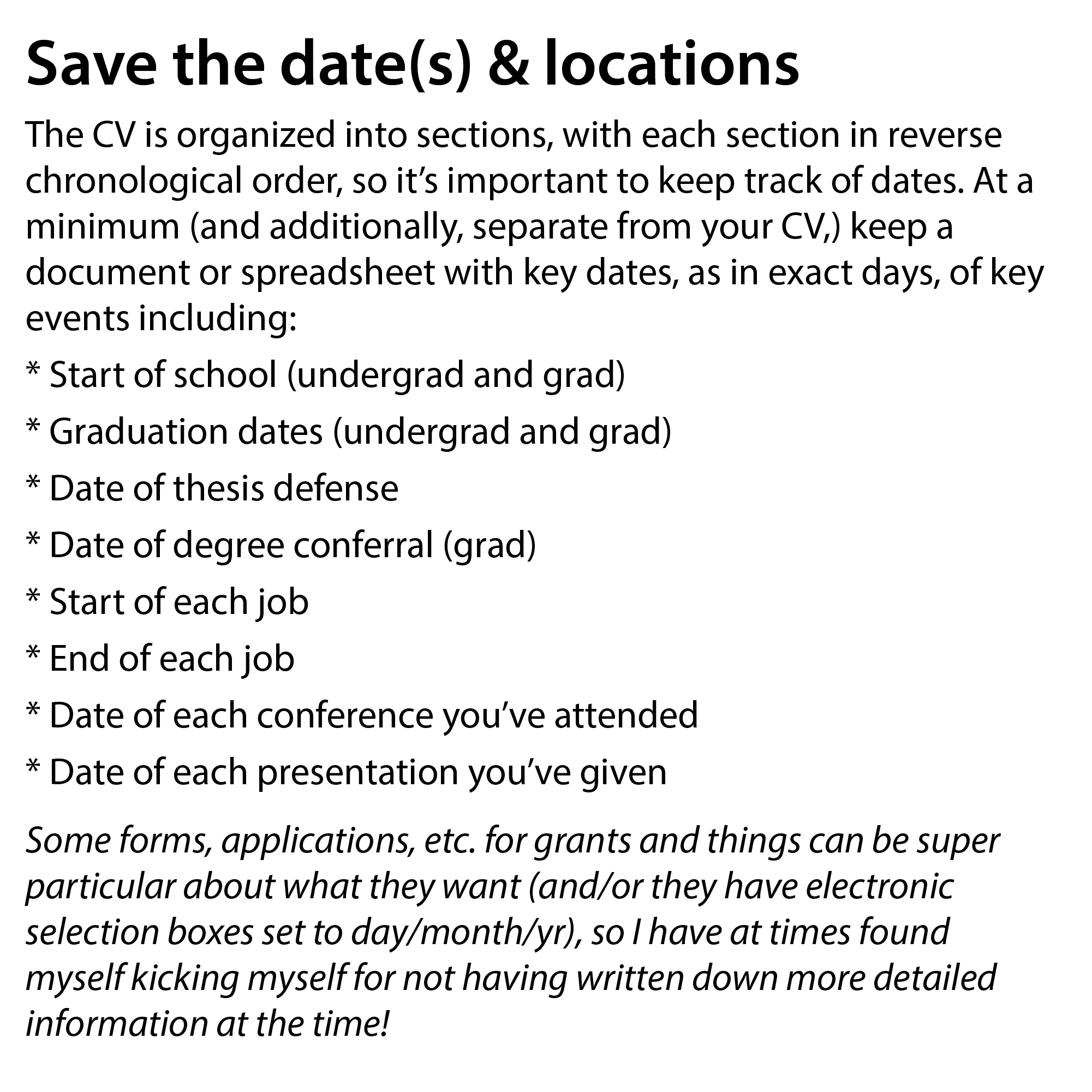
The CV is organized into sections, with each section in reverse chronological order, so it’s important to keep track of dates. At a minimum (and additionally, separate from your CV,) keep a document or spreadsheet with key dates, as in exact days, of key events including:
- Start of school (undergrad and grad)
- Graduation dates (undergrad and grad)
- Date of thesis defense
- Date of degree conferral (grad)
- Start of each job
- End of each job
- Date of each conference you’ve attended
- Date of each presentation you’ve given
Some forms, applications, etc. for grants and things can be super particular about what they want (and/or they have electronic selection boxes set to day/month/yr), so I have at times found myself kicking myself for not having written down more detailed information at the time! (also include locations)
Versions:
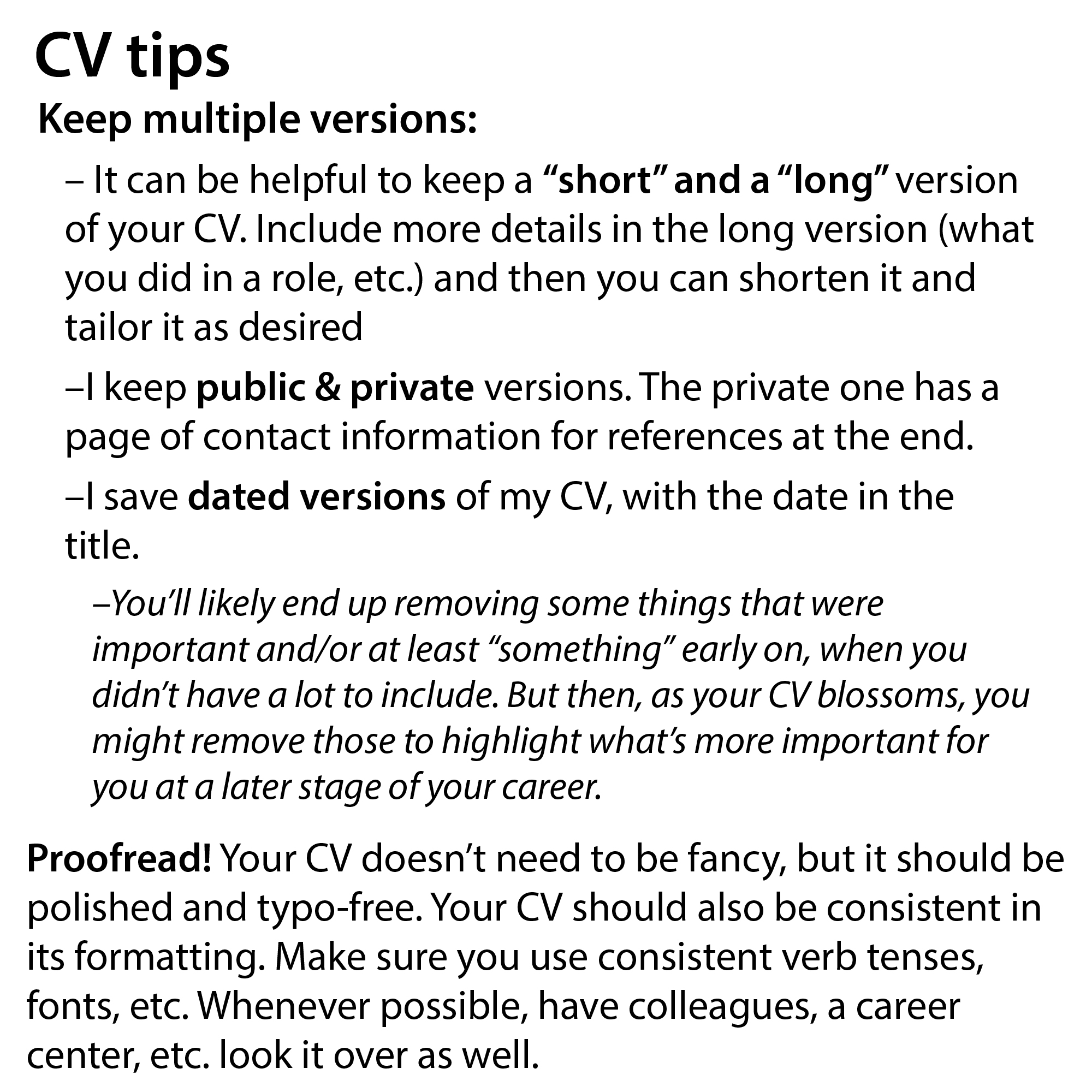
- It can be helpful to keep a “short” and a “long” version of your CV. Include more details in the long version (what you did in a role, etc.) and then you can shorten it and tailor it as desired
- I keep public & private versions. The private one has a page of contact information for references at the end.
- I save versions of my CV, with the date in the title.
- You’ll likely end up removing some things that were important and/or at least “something” early on, when you didn’t have a lot to include. But then, as your CV blossoms, you might remove those to highlight what’s more important for you at a later stage of your career.
Although it might seem silly to start early in undergrad (or even high school?) you don’t want to get caught in the situation when someone asks you for your CV and you have to go scrambling!
You also want to make sure you have plenty of time to PROOFREAD!!!!!!!!! Your CV doesn’t need to be fancy, but it should be polished (which word processors make exceedingly difficult for some reason . . .) and typo-free. Whenever possible, have colleagues, a career center, etc. look it over as well.
In addition to typo-free, your CV should be consistent in its formatting. Make sure you use consistent verb tenses, fonts, etc.
Speaking of looking things over, one of the best ways to approach writing a CV is to start by looking at examples. This has some great ones:
The Scientist’s Conundrum: CV, Resume or Something In-Between? Laura Stark FAS Office of Career Services Harvard University gsas-just-for-scientists-cvs-resumes.pdf
Keep in mind that everyone starts out with a skeletal CV, but over time it builds up! So don’t feel intimidated or inferior!
Here are some helpful resources for making scientific CVs:
Purdue Online Writing Lab (OWL): https://owl.purdue.edu/owl/index.html
More specifically, “Writing the Curriculum Vitae”: https://owl.purdue.edu/owl/job_search_writing/resumes_and_vitas/writing_the_cv.html
They also have more information about CV’s and how they’re similar to but distinct from résumés: https://owl.purdue.edu/owl/job_search_writing/resumes_and_vitas/index.html
Hope this helps!
More on ORCiDs: https://bit.ly/quickstartscience
for lots more grad school- and postdoc-related content, I have a whole blog page full of posts on it: https://bit.ly/gradpostdocetc & YouTube playlists: https://youtube.com/playlist?list=PLUWsCDtjESrE5by6kK_GsGNPQtmdaVynz
More on the hidden curriculum of academic science: https://www.youtube.com/playlist?list=PLUWsCDtjESrH10HorjPfP_AreNCf6S4rL