SPRI (Solid-Phase Reversible Immobilization) beads are used frequently in the preparation of DNA or RNA sequencing libraries. The protocols for library prep involve adding adapters, doing reverse transcription and/or PCR, etc. – steps that leave you with enzymes, primers, adapters, and other things you want to remove. So you need to do a number of purifications along the way to a library that’s ready to sequence. Thankfully, SPRI beads (SPRIselect, AMPure, RNAClean XP, etc.) make this easy(ish).
YouTube: https://youtu.be/79cYJo_Cvqo
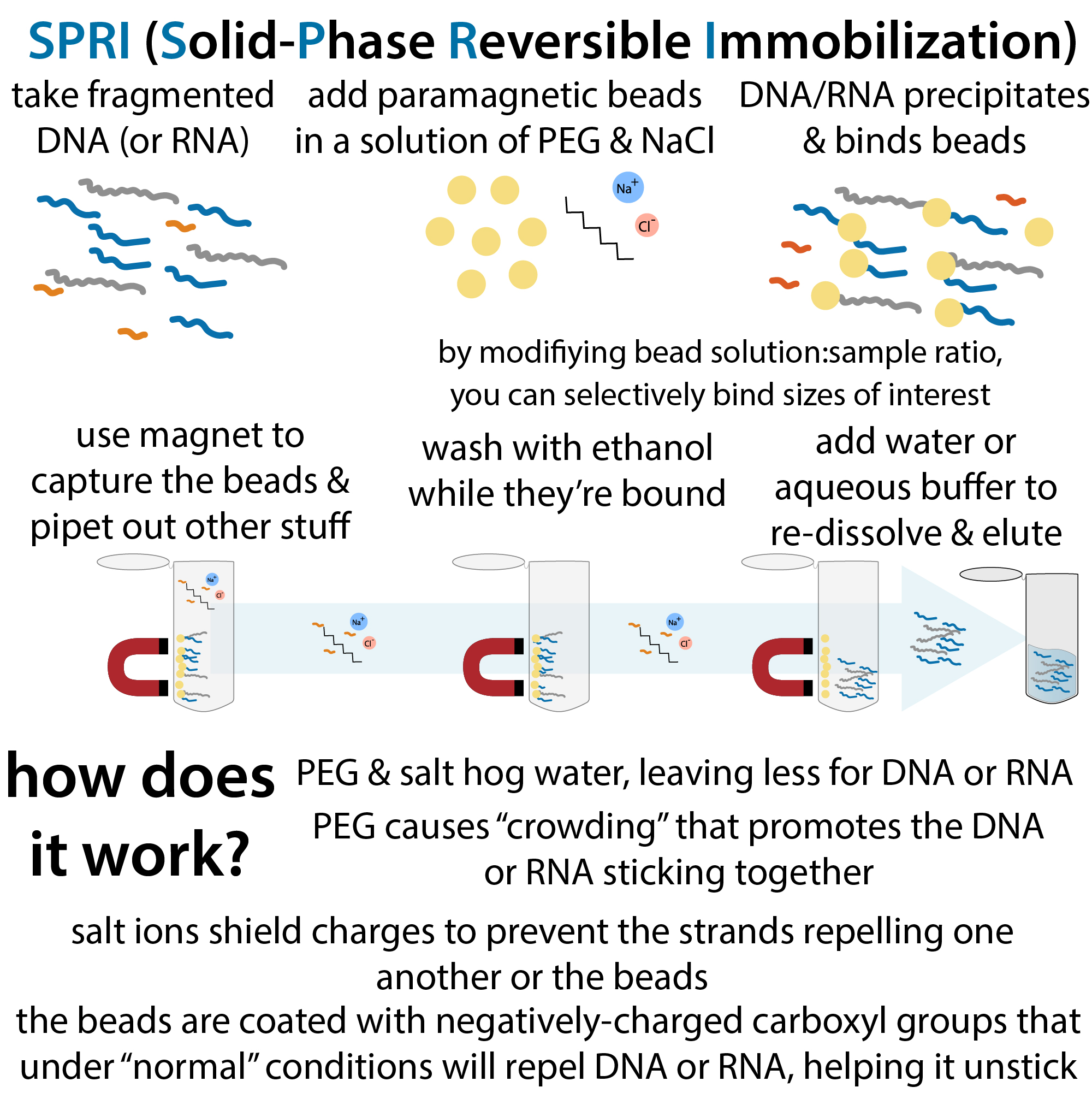
The basic idea is:
- take fragmented DNA (or RNA)
- add paramagnetic beads (they’ll only act like magnets if you place them on a magnet) in a solution of PEG & NaCI
- under those conditions, the DNA/RNA precipitates & binds beads
- by modifying bead solution:sample ratio you can selectively bind sizes of interest
- use magnet to capture the beads & pipet out other stuff
- wash with ethanol while they’re bound
- add water or aqueous buffer to re-dissolve & elute
How’s it work?
- PEG & salt hog water, leaving less for DNA or RNA
- PEG causes “crowding” that promotes the DNA or RNA sticking together
- salt ions shield charges to prevent the strands repelling one another or the beads
- the beads are coated with negatively-charged carboxyl groups that under “normal” conditions will repel DNA or RNA, helping it unstick
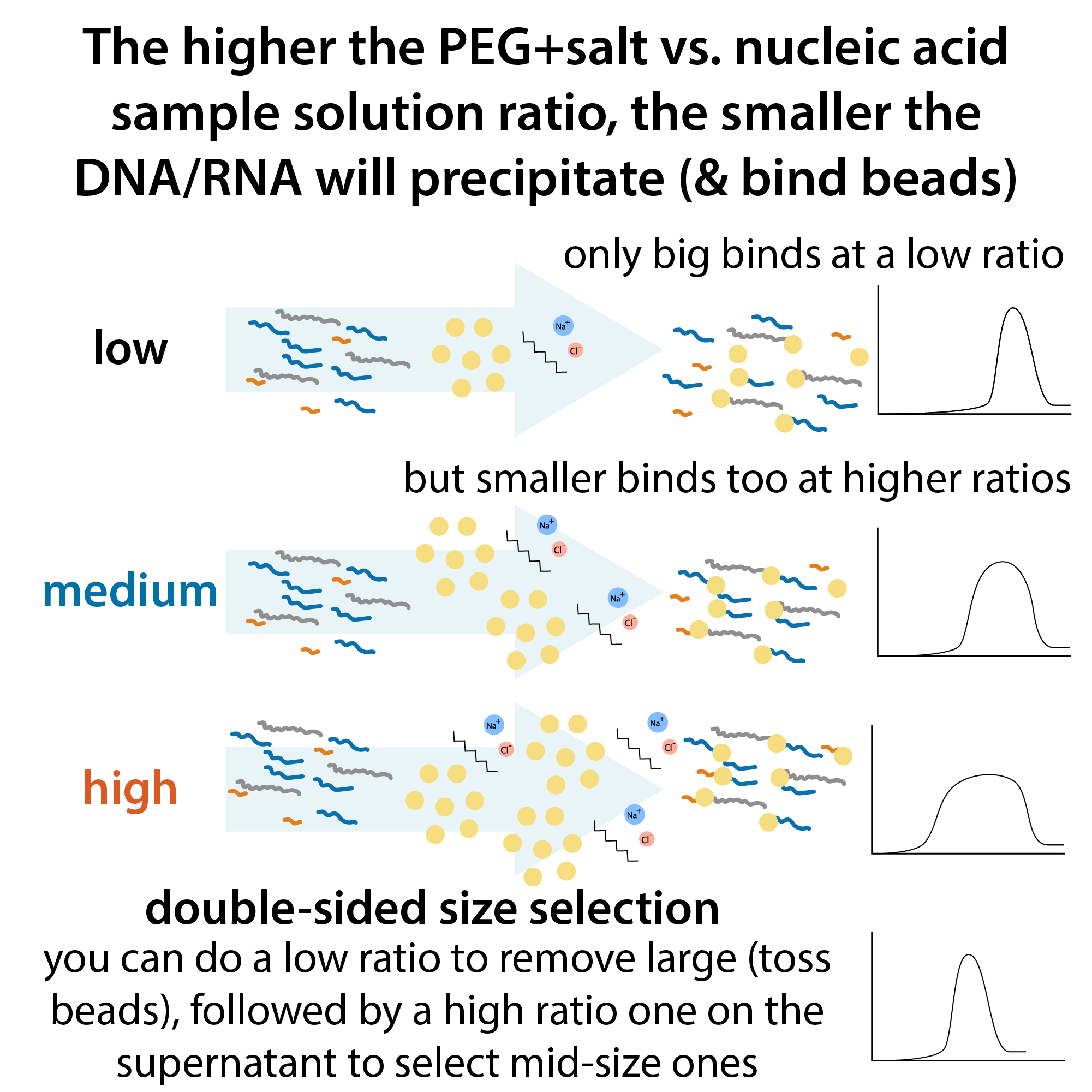
The higher the PEG+salt vs. nucleic acid sample solution ratio, the smaller the DNA/RNA will precipitate (& bind beads). Only big stuff binds at a low ratio, but smaller binds too at higher ratios.
You can do a low ratio to remove large (toss beads), followed by a high ratio one on the supernatant to select mid-size ones. This is referred to as a double-sided size selection.
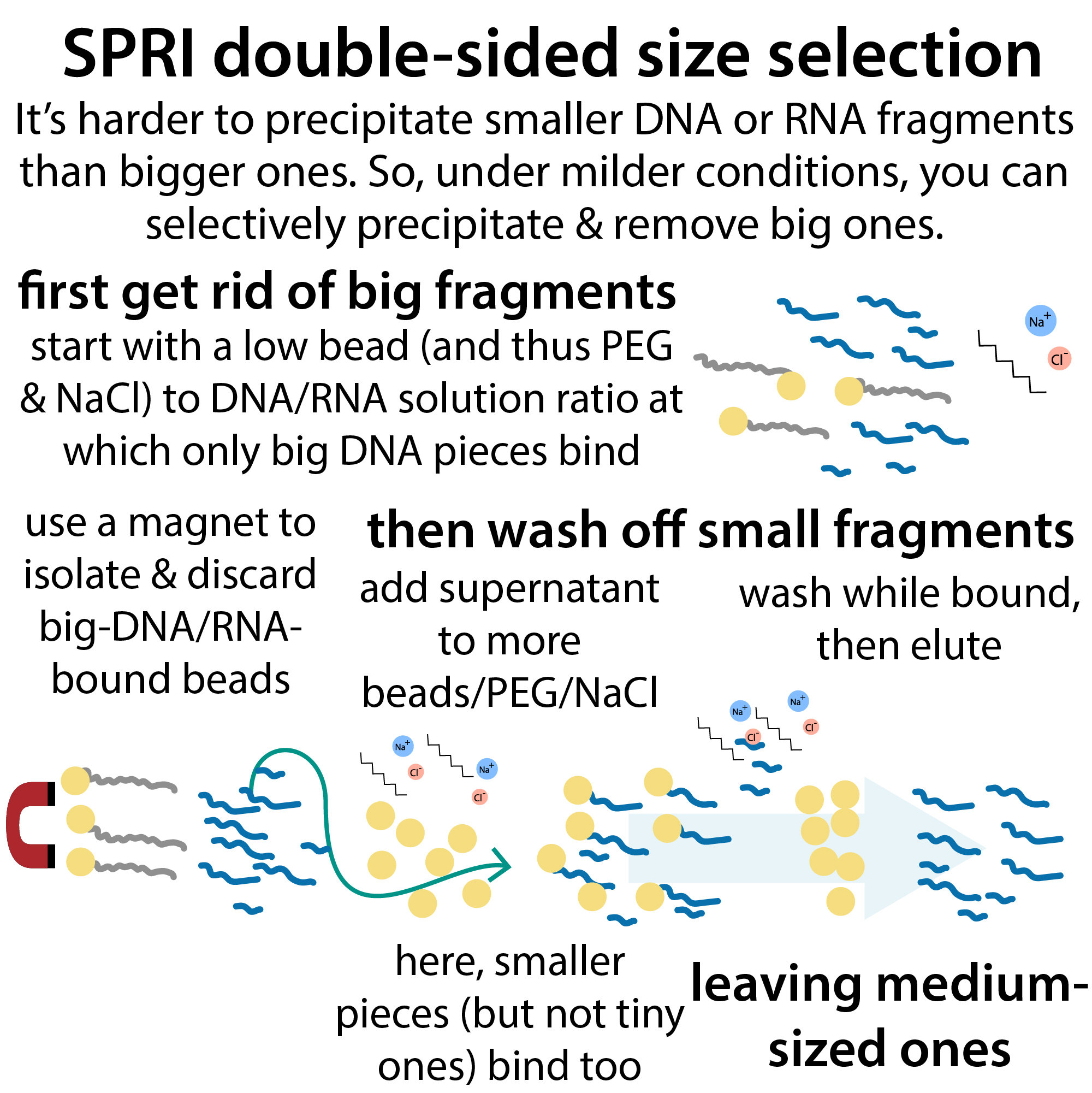
It works because it’s harder to precipitate smaller DNA or RNA fragments than bigger ones. So, under milder conditions, you can selectively precipitate & remove big ones.
- First get rid of big fragments
- start with a low bead (and thus PEG & NaCI) to DNA/RNA solution ratio at which only big DNA pieces bind.
- use a magnet to isolate & discard big-DNA/RNA-bound beads
- Then wash off small fragments
- add supernatant to more beads/PEG/NaCI
- here, smaller pieces (but not tiny ones) bind too
- wash while bound
- add supernatant to more beads/PEG/NaCI
- Leaving medium-sized ones
- add buffer to elute
Sorry I don’t have much text (at least for now)! But I do have resources!
Setting the stage…. You can size-selectively precipitate DNA with PEG/NaCl!
Lis, J. T., & Schleif, R. (1975). Size fractionation of double-stranded DNA by precipitation with polyethylene glycol. Nucleic acids research, 2(3), 383–389. https://doi.org/10.1093/nar/2.3.383
You can use beads!
DeAngelis, M. M., Wang, D. G., & Hawkins, T. L. (1995). Solid-phase reversible immobilization for the isolation of PCR products. Nucleic acids research, 23(22), 4742–4743. https://doi.org/10.1093/nar/23.22.4742
You can go bigger!
Stortchevoi, A., Kamelamela, N., & Levine, S. S. (2020). SPRI Beads-based Size Selection in the Range of 2-10kb. Journal of biomolecular techniques : JBT, 31(1), 7–10. https://doi.org/10.7171/jbt.20-3101-002
The SPRIselect User Guide from Beckman Coulter has good figures, etc. https://research.fredhutch.org/content/dam/stripe/hahn/methods/mol_biol/SPRIselect%20User%20Guide.pdf
Here’s a guide to making your own bead mixtures to save money –
Solutions for purifying nucleic acids by solid-phase reversible immobilization (SPRI); Philippe Jolivet and Joseph W. Foley; Ludmer Centre for Neuroinformatics and Mental Health, October 21, 2015 – Based on DeAngelis MM, Wang DG, Hawkins TL, “Solid-phase reversible immobilization for the isolation of PCR products.” Nucleic Acids Res 1995, 23:4742–4743. https://s3-us-west-2.amazonaws.com/oww-files-public/f/f8/SPRI_buffers_v2_2.pdf
and even if you go the pre-made route, this guide is still helpful at showing you what’s in it! Their recipes for DNA and RNA are:
- DNA mix: 10 mM Tris base, 1 mM EDTA, 2.5 M NaCl, 20% PEG 8000, 0.05% Tween 20, pH 8.0 @ 25 °C
- RNA mix: 1 mM trisodium citrate, 2.5 M NaCl, 20% PEG 8000, 0.05% Tween 20, pH 6.4 @ 25 °C
And they use it with Sera-Mag™ Magnetic SpeedBeads™, carboxylated, 1 μm, 3 EDAC/PA5 (GE Healthcare Life Sciences #65152105050250)
This review talks about a number of considerations and aspects of sequencing library preparation: Quail, M. A., Swerdlow, H., & Turner, D. J. (2009). Improved protocols for the illumina genome analyzer sequencing system. Current protocols in human genetics, Chapter 18, 10.1002/0471142905.hg1802s62. https://doi.org/10.1002/0471142905.hg1802s62
These iBiology videos by Eric Chow explain the chemistry behind the sequencing procedure and show you what it looks like in practice
- Next Generation Sequencing 1: Overview https://youtu.be/mI0Fo9kaWqo
- Next Generation Sequencing 2: Illumina NGS Sample Preparation https://youtu.be/PFwSe09dJX0
- Next Generation Sequencing 3: Purifying DNA Samples with Magnetic Beads https://youtu.be/hrKM7d6_8hQ
- Next Generation Sequencing 4: Checking Nucleic Acids with an Agilent BioAnalyzer https://youtu.be/V4tvmhdBSFs
Here’s a video from NEB on using their SPRI beads; “Size Selection and Cleanup with NEBNEXT® Ultra II and SPRI beads) https://www.neb.com/tools-and-resources/video-library/size-selection-and-cleanup-with-nebnext-ultra-ii-and-spri-beads
Illumina guide for determining volumes for double sided size selection and bead clean up:
This has more about the beads and some interesting discussion in the comments section: “How do SPRI beads work?”, Enseqlopedia.com, http://enseqlopedia.com/2012/04/how-do-spri-beads-work/
more about DNA sequencing methods: blog form: http://bit.ly/DNAsequencingmethods ; YouTube: https://youtu.be/QSaRUt-cUDw