In molecular cloning, we can take genetic recipe for making a protein and stick that recipe into a circular piece of DNA called a plasmid. That plasmid serves as a vector or “vehicle” for getting (and keeping) the protein instructions in bacterial cells. But before we try to get cells to make the protein, we want to make sure that the recipe got into the plasmid okay and there aren’t any typos. A technique called analytical digest (aka diagnostic digest) can quickly tell us if our recipe *likely* got in there before we waste time and resources purifying the plasmid and sending it for sequencing if it’s bad. Here’s a bit about how it works… note – text adapted from a mix of past posts I will link to, with more details on various aspects
In molecular cloning, we can take genetic recipe for making a protein and stick that recipe into a circular piece of DNA called a plasmid. That plasmid serves as a vector or “vehicle” for getting (and keeping) the protein instructions in bacterial cells. But before we try to get cells to make the protein, we want to make sure that the recipe got into the plasmid okay and there aren’t any typos. A technique called analytical digest (aka diagnostic digest) can quickly tell us if our recipe *likely* got in there before we waste time and resources purifying the plasmid and sending it for sequencing if it’s bad. Here’s a bit about how it works… note – text adapted from a mix of past posts I will link to, with more details on various aspects
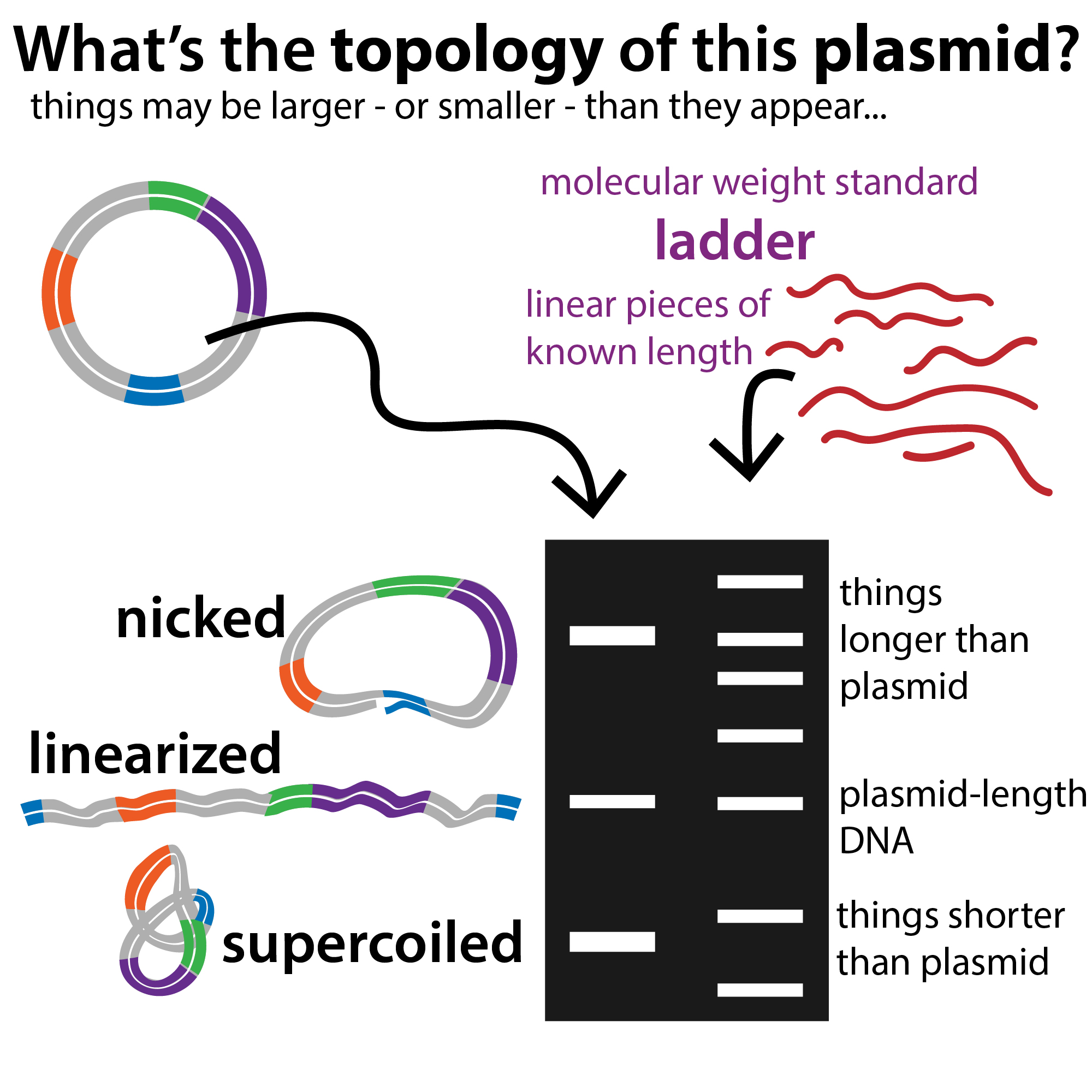
In analytic restriction digest (aka diagnostic digest) we use sequence-specific DNA “scissors” – restriction enzymes, restriction endonuclease (REases), – to cut our plasmid. Different scissors recognize different “code words” (restriction sites) – so you can take plasmid DNA you want to see if has insert → add restriction enzyme(s) (and a buffer containing salts, pH stabilizers, Mg²⁺, etc. to keep the enzyme happy) → heat it up to give the enzymes energy to work & give it time to cut → then you run an agarose gel → check how many fragments you see & how big they are
- number of pieces you get depends on how many restriction sites there are for the enzyme(s) you use
- size of pieces depends on how much stuff’s in between the sites
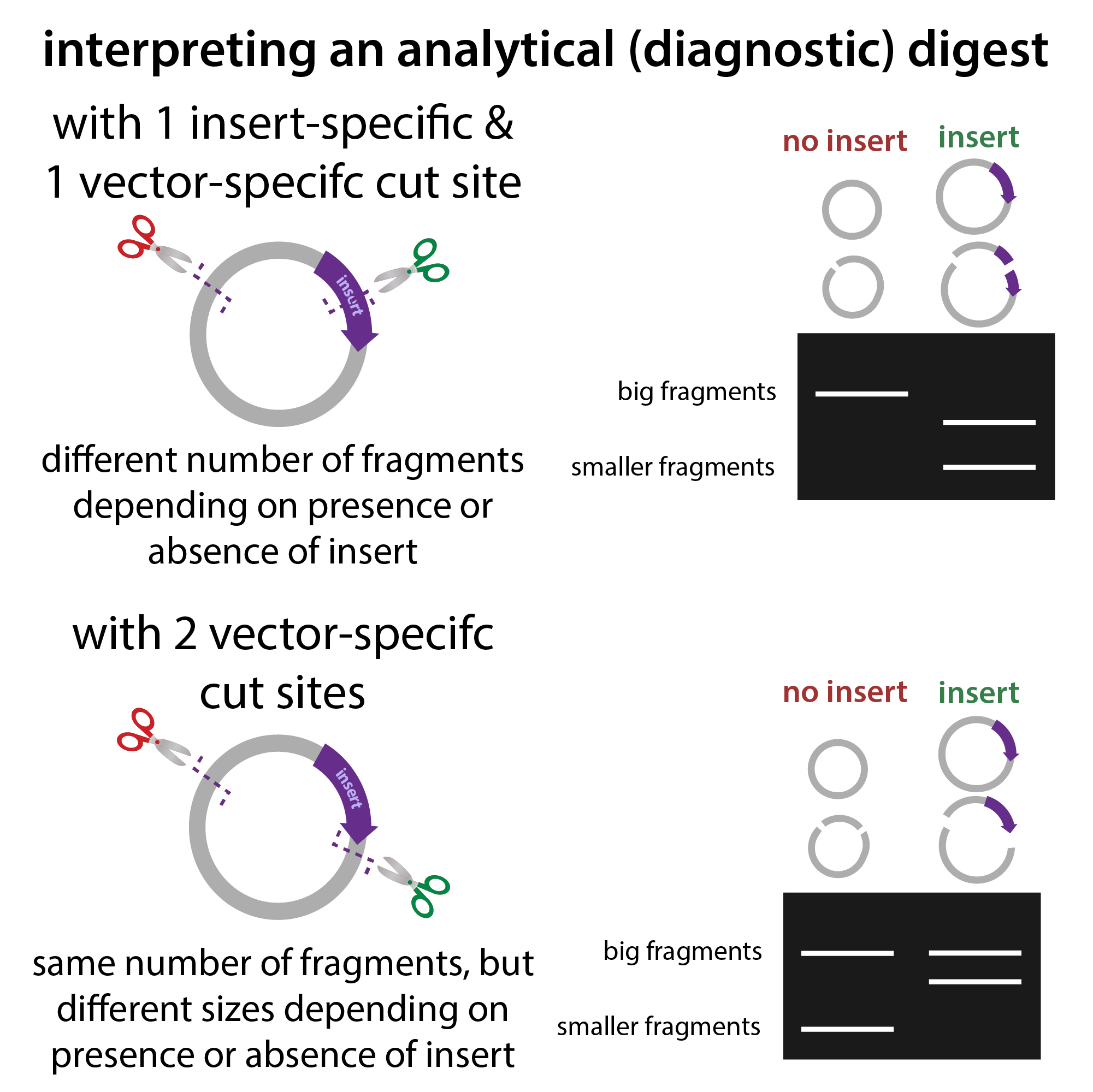
If your gene contains a restriction site that the vector backbone doesn’t, presence of the gene will lead to 1 more cut, so you get an extra product (or, if this is the only site present, you’ll get 1 linear product instead of the circular plasmid). Circular DNA runs kinda unpredictably so it’s nicest if you have 1 site in backbone & 1 site in insert – you can use multiple restriction enzymes to make this happen
In addition to wanting to make sure you have an enzyme that will cut, you want to make sure it’s not going to cut where you don’t want – you want to check that there aren’t a lot of sites for that enzyme on your plasmid or else you’ll get lots of little pieces that are hard to analyze.
You can use tools like NEBcutter to find good ones: https://nc3.neb.com/NEBcutter/
Sometimes your gene doesn’t have any unique restriction sites (or at least none you have matching enzyme for) BUT all hope’s not lost! You have a few options
- buy another restriction enzyme & likely end up w/racks & racks of various ones you’ll probably never need again…
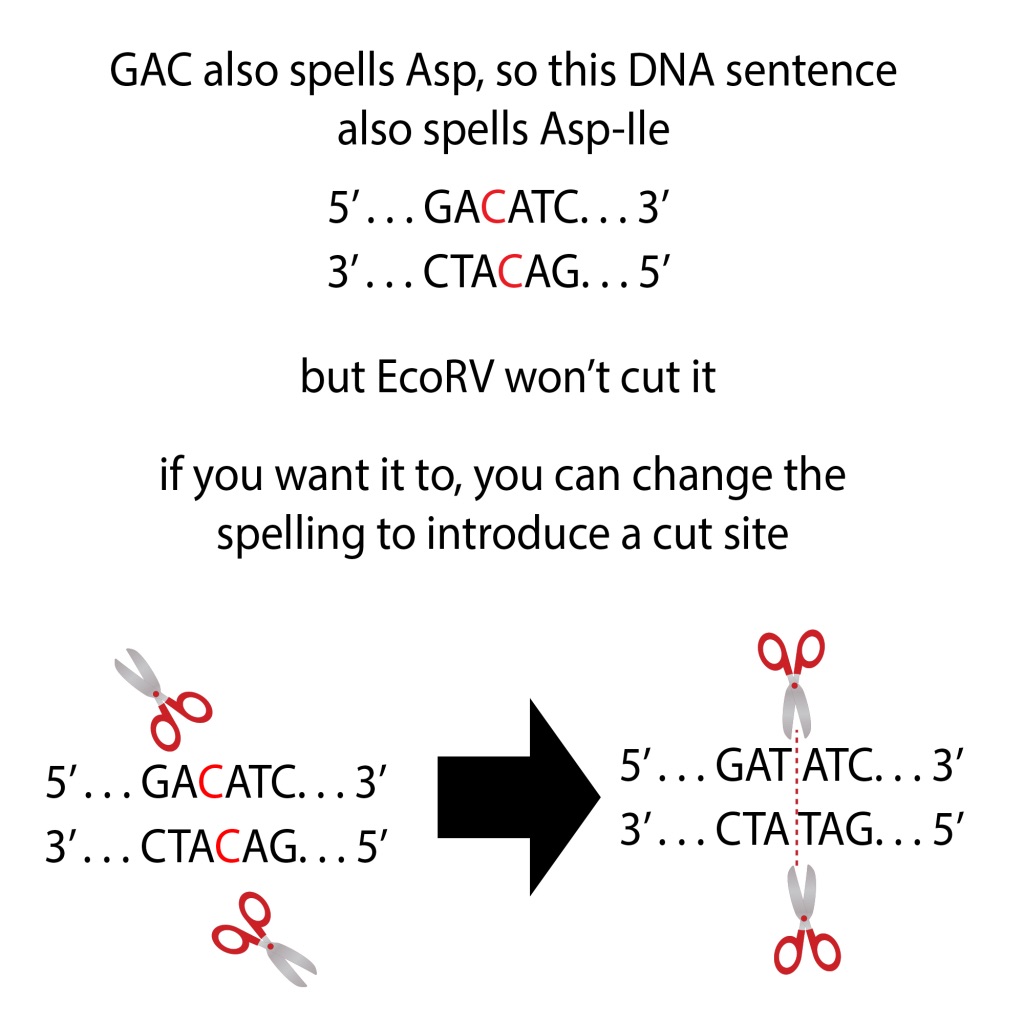
- check if you can introduce a “silent mutation” that changes the DNA sequence (to something that will get cut) but does NOT change the protein sequence it codes for (like “grAy” vs “grEy” – different spellings, same meaning BUT different restriction enzymes will only recognize 1 & not other) If your restriction enzyme is pickier than your protein-makers, you can take advantage of these differences
- To make a protein from DNA, DNA first gets copied (transcribed) into mRNA which then gets turned into protein (translated). It takes 3 DNA (or RNA) letters (the same bases except the T’s become U’s) (more here: http://bit.ly/2yCisGq ) to spell a single protein letter (amino acid). We call these 3 nucleotide “code words” CODONS.
- There are 4 different nucleotides & 20 (common) amino acids – do the math (4 bases & 3 spaces so 4^3 = 64) & you have more codons than amino acids. How to reconcile this? Multiple codons spell the same word (degeneracy) – the protein translation machinery (ribosomes) knows “gray” & “grey” mean same thing BUT a restriction enzyme might be more of a “purist” & refuse to get near anything that doesn’t spell it the way it considers “proper.” So you can mutate the DNA’s sequence before you stick it in, changing spelling so it’ll get cut by restriction enzyme BUT the protein product won’t be affected
- A helpful tool for checking for opportunities to do this is molbiotools’ Silent Mutator: https://molbiotools.com/silentmutator.php
- use restriction enzymes that only recognize the vector – you’ll get the same number of products regardless of whether your insert is in there, BUT the size of the products will be different – 1 will be a lot bigger if your gene’s inside (similar to the logic behind colony PCR w/ vector-specific primers)
Beware that some restriction sites might be present in the sequence but “masked” by methylation in the bacteria. Much more on it here: http://bit.ly/reasesvsmtases but basically bacteria have restriction enzymes as part of a 2-part defense mechanism, the Restriction-Modification system. They restrict viruses from replicating inside them by cutting the viral DNA with restriction enzymes. And to keep from cutting their own DNA, they modify vulnerable would-be cut sites in their own DNA with methylation.
Different bacteria have different methyltransferases, which, when we stick a plasmid in bacteria, will methylate the plasmid too. Therefore, you want to make sure the bacteria you use don’t modify the sites you want to use. Thankfully, Most of the REases we use in the lab don’t overlap with a common methyltransferase, Dam, sites, but ClaI, MboI, and XboI might. Another one is Dcm, which can interfere with cutting by ApaI, BsaI, and McsI. And EcoKI can hide cut sites for DraI, HpaI, and PmeI
A couple practical notes
- The enzymes are “numbered” not “lettered” (e.g. EcoRV isn’t an all-electric RV model, it’s EcoR FIVE (learned this the embarrassing way). It tells you it was the 5th restriction enzyme found in the “RY13” strain of E. coli)
- To help you compare, run some controls: negative control: don’t add enzyme – shows you what uncut looks like. also run plasmid-only (you know it doesn’t have insert) and insert-only (you know it doesn’t have plasmid)
- You have to purify the DNA first – & you don’t want to waste all your DNA (if you do decide to “hire it” you’ll need the rest – so you typically just test a tiny bit in ~20μL total (1 μL (microliter) is 1 millionth of a liter)
We can also we can also use a similar PCR-based method called colony PCR, where we use short pieces of DNA called primers to bookend regions of the plasmid we want copied and then make copies and see how big the copied bits are. Depending on how you design the primers you’ll only get a product (copied bit) if the insert was in there (if you use an insert-specific primer as one of the bookends) or you’ll get different sized products if the insert is or isn’t in there (if you use only vector-specific primers). http://bit.ly/colonypcretc; http://bit.ly/colonyPCRchat ; video: https://youtu.be/Ve4I9ELBleA
A nice thing about colony is you don’t have to do the mini prep first – you can work straight from the colony. Which especially helpful if you are trying to screen a number of them. Here’s more on how it works:
Speaking of screening – methods like blue-white screening can help you triage which clones to check. Basically, you do your cloning so that your insert is inserted into a gene the bacteria need in order to make a blue product. If your insert (or at least something) gets in there, it disrupts that gene, so the cells can’t make the blue product and those colonies look like normal colonies, not blue. This doesn’t tell you about the size of the thing that got in, so it tells you less than the PCR and restriction cloning, but it can be used to choose which colonies to test.
more on blue-white screening: blog: https://bit.ly/bluewhitescreening ; video: https://youtu.be/9UlP25YVVLE
But all of these techniques are just helping you choose which are probably okay and then you have to take the probably okay ones and send them for sequencing to be sure all’s spelled okay. These days, sequencing has gotten really cheap and fast so you might just go directly to that for routine cloning.
more on clone-checking: http://bit.ly/colonychecking
more on DNA sequencing: http://bit.ly/DNAsequencingmethods & http://bit.ly/sequenceclones & http://bit.ly/sequencetermstools