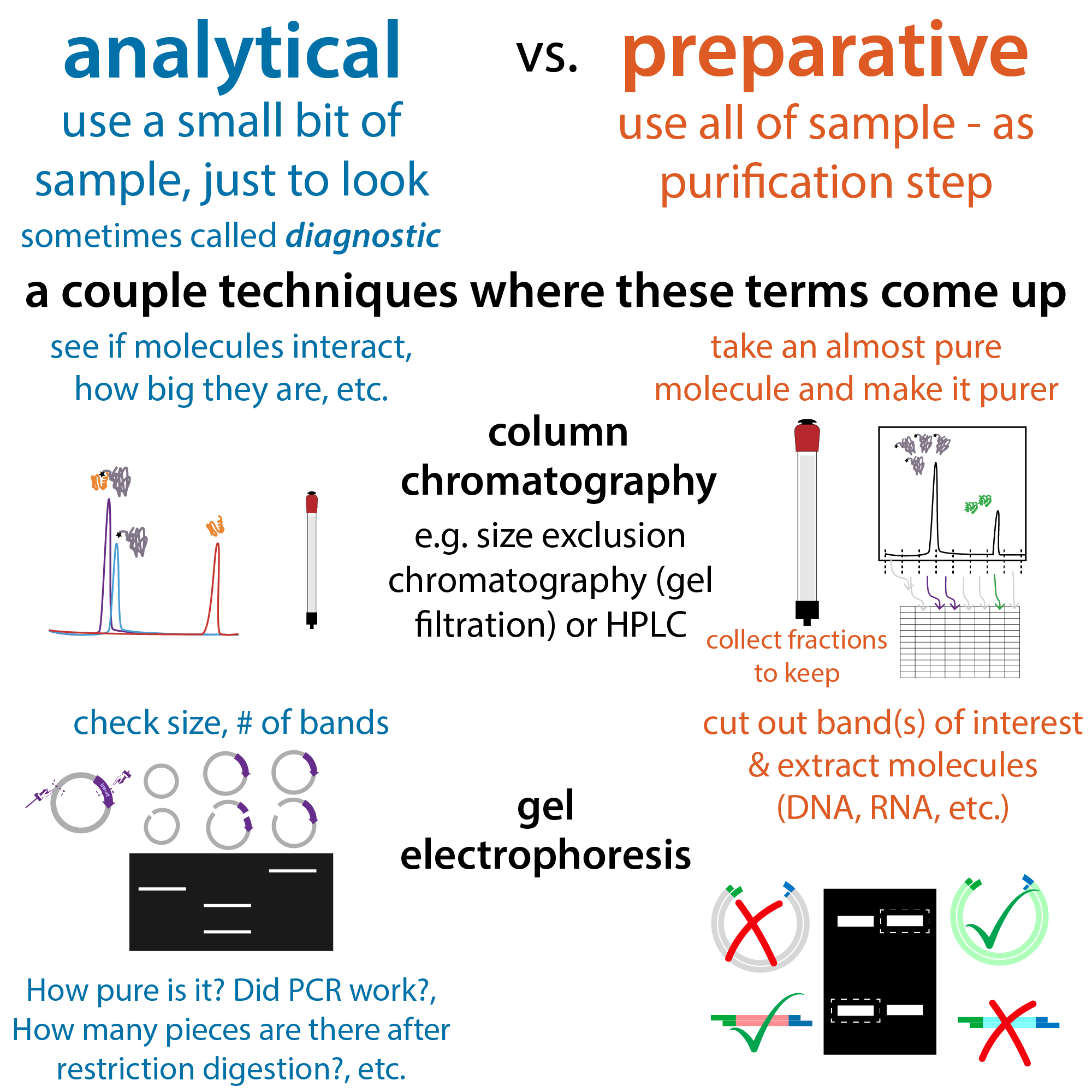
Techniques that separate molecules can often be done at either “analytical” or “preparative” scales. When you do something at the analytical scale you’re typically just using a small portion of your sample and your goal is just to “take a look” – NOT to actually recover the molecules in the sample. But, when you do something at the preparative scale, you’re typically running “all” your sample with the hopes of recovering it in a more pure form – so prepare to collect it!
A couple of the main places you see these terms used are with gel electrophoresis (where you use electricity to send molecules traveling through a gel mesh that separates them by size) and some forms of column chromatography (where you use pumps or gravity to flow molecules through columns filled with little beads called resin which can separate them based on different properties). In terms of column chromatography, the analytical vs preparative thing comes up most frequently with size exclusion chromatography, aka SEC, which is often used for proteins as well as other molecules; and HPLC which is harsher than the FPLC machines typically used with proteins and is often used for smaller things like chemical compounds.
What all these techniques have in common is that they’re separating components in a sample. And they offer you some sort of look at and characterization of what it is that’s been separated (how many components (how pure), how big, how polar (for some HPLC columns), etc.).
If you just want that info, you don’t need to waste your whole sample to get it (nor going through the effort and yield-loss of salvaging your sample afterwards). Instead you want to use as little of your precious sample as possible while still having a strong enough signal to detect. This is the idea with analytical scale. And it’s what we typically are doing when we run gel electrophoresis. It allows us to do things like see if our PCR reaction worked or see how pure our protein preparation is.
Sometimes it’s referred to as a “diagnostic” gel. Fittingly, another common place you will see this is with diagnostic digests (aka analytical digests) where you use restriction enzymes (sequence-specific DNA cutters) to see if specific sequences are present in a sample (as indicated by number and size of bands).
more on these diagnostic digests: http://bit.ly/RFLPanalysis
We can also use analytical scale chromatography. In terms of protein SEC, we can use this to see if proteins interact and stuff. Much more on it here: http://bit.ly/sizeexclusionchromatography ; YouTube: https://youtu.be/7Cy8srQB_D4
They typically use small, narrow but long, columns so you get good separation (resolution) with small amounts of sample.
Other times, however, you want to separate things in order to isolate a thing you want from things you don’t want. That is, you want to do things at a preparative scale. In this case you want to use all your sample (or maybe you’re saving some for another purpose but you hopefully get what I’m getting at).
These methods may use “bigger” equipment, such as larger SEC columns or bigger gel wells to accommodate larger volumes and quantities. Still, in order to run all your sample you might need to concentrate it first. Depending on the sample type this might mean using a centrifugal ultrafiltration device (spin concentrator) or precipitating the sample and resuspending the pellet in a lower volume or using some sort of concentrating column (e.g a clean and concentrator kit for RNA or DNA).
more on spin concentrators: https://bit.ly/spinconcentrators ; video: https://youtu.be/Q_Ua7tIjzWQ
more on nucleic acid precipitation: https://bit.ly/na_precipitation; YouTube: https://youtu.be/RE6Sd-xHoks
Not gonna lie, this can be kinda scary as you condense days worth of work into a few uL… and then you load it and hope the run goes okay…
Once your products are separated, you have to collect the ones you want. For the column based methods you typically know which ones you want because the samples pass through a UV detector on their way out (or you collect samples and test) and they go into fractions. You can then compare the UV trace, or your measurements to the corresponding fractions and pool the fractions of interest.
more here: https://bit.ly/chromatograms ; YouTube: https://youtu.be/rwpgoL86t_Q
For gels, you use some sort of stain to visualize the bands, then cut them out (e.g. with a razor blade) and extract the molecules out of the gel piece.
This allows you to purify DNA and RNA. A common time you might need to do it is if you are doing restriction cloning and need to purify the cut plasmid pieces so you can choose which to stitch together. Much more on that here: blog: https://bit.ly/gel_extraction_crush ; YouTube: https://youtu.be/baNpdx6txOo
So, bottom line:
- analytical – get a look at the makeup of a sample, but don’t try to recover anything (other than information of course)
- often, but not always, done on a smaller scale
- just need to run enough to detect
- preparative – separate components of a sample in order to isolate and recover just the components you want
- often, but not always, done one a larger scale
- run everything (so may need to concentrate it first)