g that’s a strong centrifugal field!
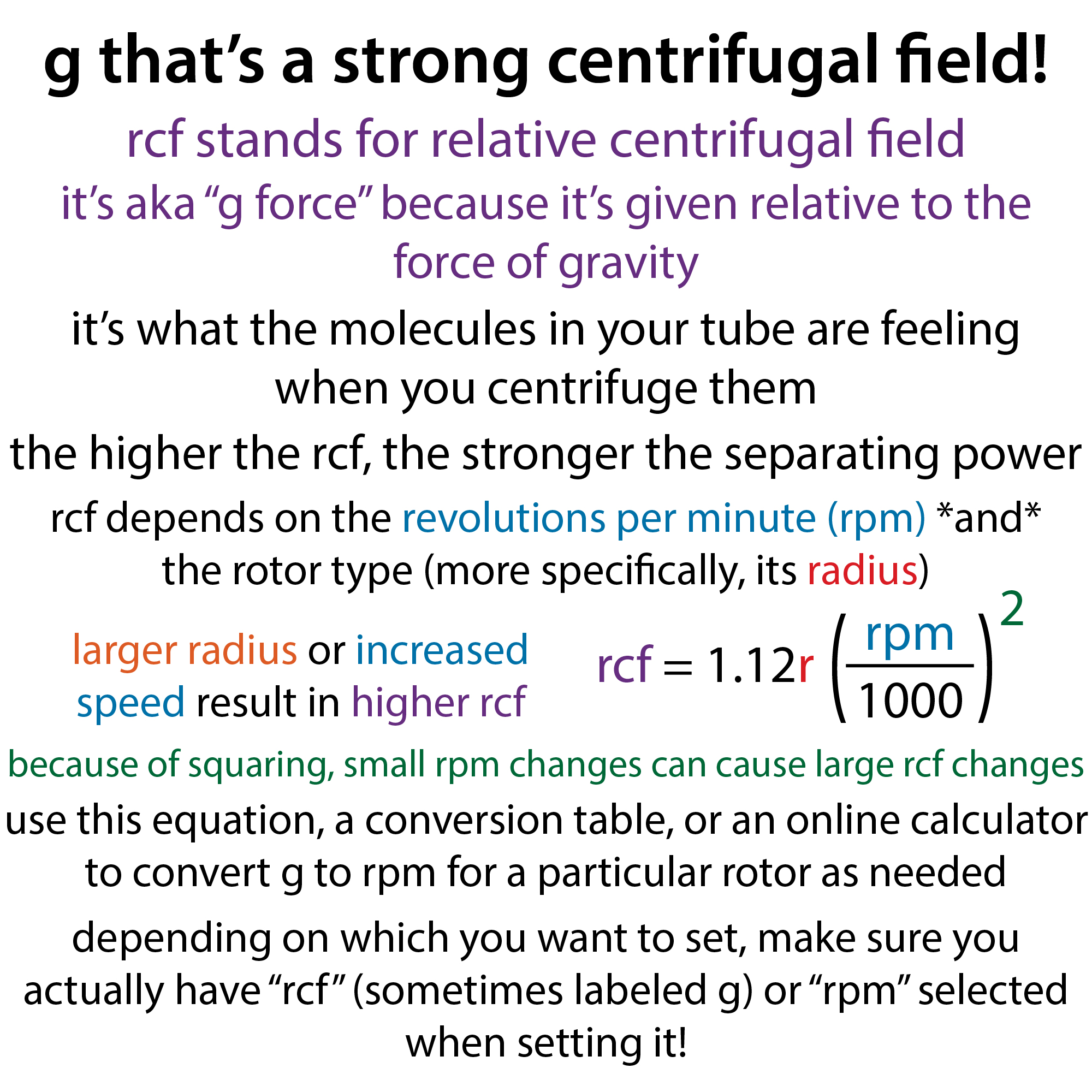
rcf stands for relative centrifugal field. It’s aka “g force” because it’s given relative to the force of gravity. It’s what the molecules in your tube are feeling when you centrifuge them. The higher the rcf, the stronger the separating power. rcf depends on the revolutions per minute (rpm) *and* the rotor type (more specifically, its radius). A larger radius or increased rpm results in a higher rcf.
The equation to convert between them is:
RCF = 1.12r (1000 )(rpm/1000)^2
Where r is distance (in mm) from center of rotation
Because of that squaring, small rpm changes can cause large rcf changes. You can I se this equation, a conversion table, or an online calculator to convert g to rpm for a particular rotor as needed.
Depending on which you want to set, make sure you actually have “rcf” (sometimes labeled g) or “rpm” selected when setting it!
If you’re trying to adapt a protocol to use a different speed (maybe your rotor can’t go that fast) or a different time (maybe you have a meeting so need to lengthen the run but don’t want to overdo it and pellet out stuff you want), you can estimate parameters using this equation:
(Rcf1)(t1)=(rcf2)(t2)
This is just a quick estimate. The precise relationship isn’t a ratio with rcf directly – instead it’s with something called the k factor of the rotor
(K1)(t1)=(k2)(t2)
The k factor takes into account the path length the molecules have to travel through (sedimentation distance, r max-r min)) in addition to the speed. (Normal rcf just tells you about the maximum, whereas the kfactor also takes into account the minimum) in order to tell you about how good it is at pelleting things out (getting a molecule all the way through the tube). The lower the k factor, the better the pelleting. How long it actually takes to pellet a specific molecule depends on that molecule’s specific size & mass, which is reflected in its sedimentation coefficient. That coefficient (typically given in Sveldberg units, abbreviated S) can be multiplied by k.
That’s the technical stuff, but in general you can just divide the refs for a quick estimate of starting conditions to try when adapting protocols
More here: https://handling-solutions.eppendorf.com/sample-handling/centrifugation/this-and-that/detailview/news/adapting-centrifugation-time/ & https://www.beckman.com/resources/reading-material/application-notes/using-k-factor-to-compare-rotor-efficiency
What type of centrifuging shouldya be using?
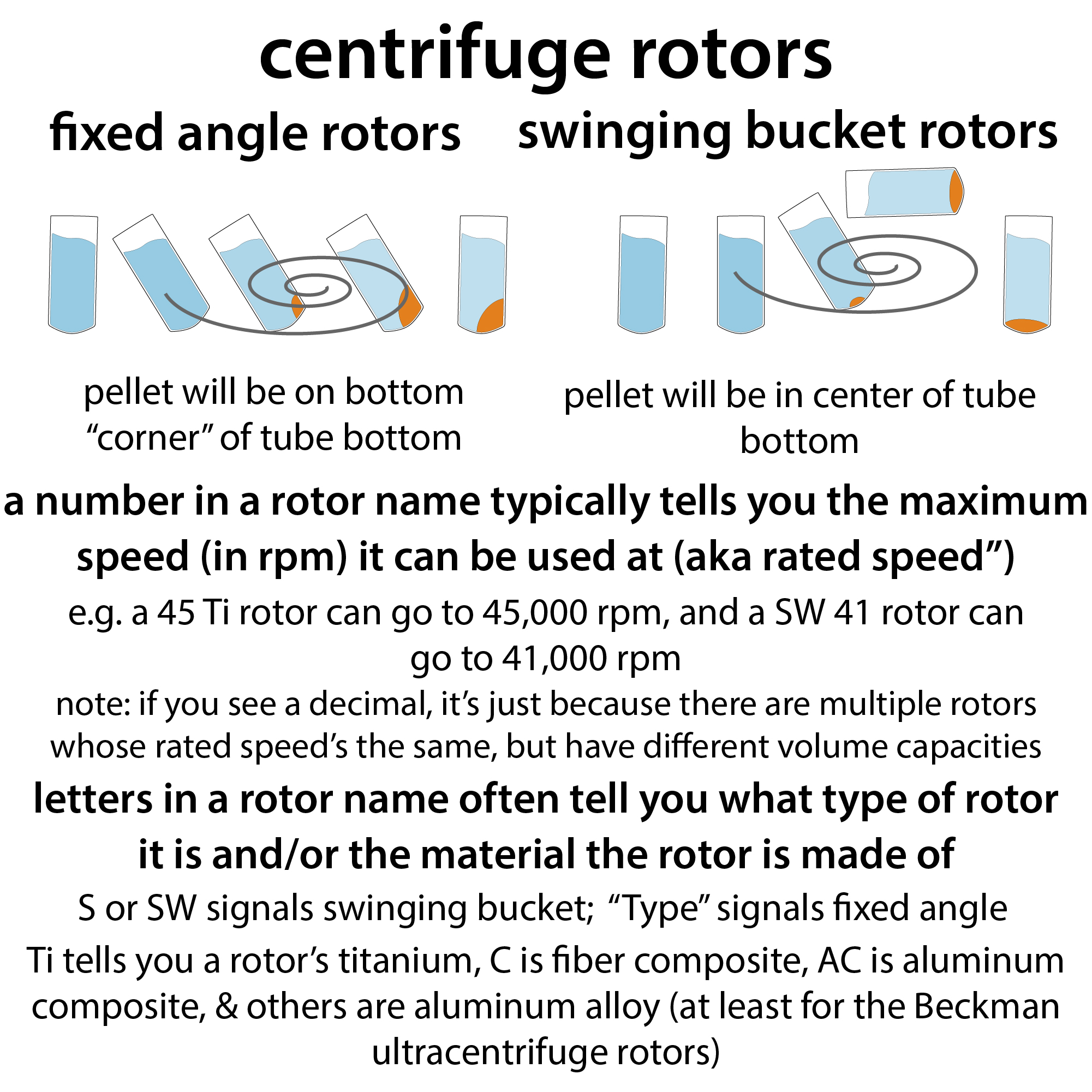
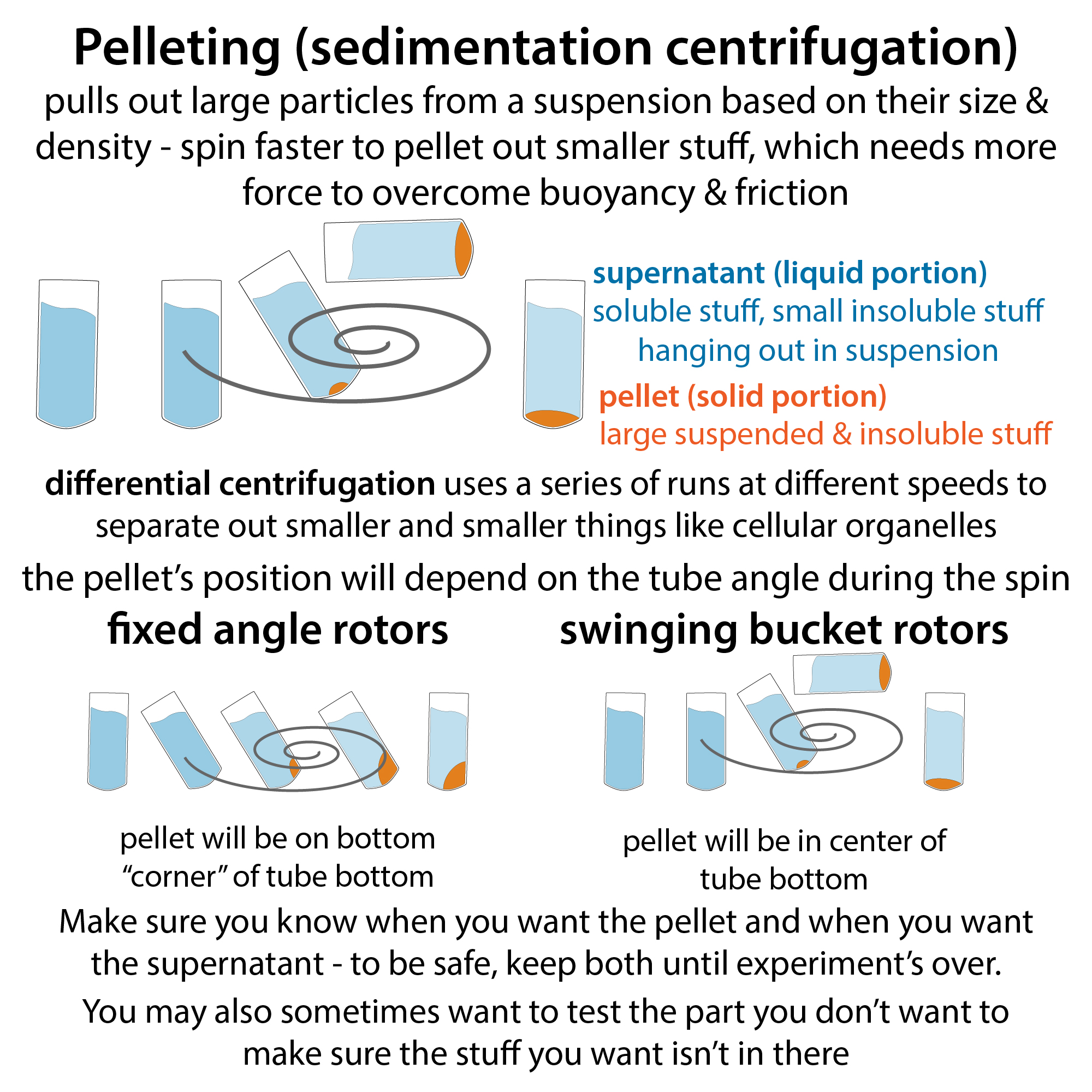
Fixed angle rotors hold tubes at a specific set angle (often somewhere around 20-40 degrees). They have shorter path lengths so shorter run times but less separating power in gradient centrifugations.
Swinging bucket rotors are like those jellyfish rides at theme parks. The tubes rise up to horizontal during the run. This makes it so that the path the molecules can travel through is the entire tube length. As a result, they have longer run times to sediment (pellet out) things but offer better gradient separation.
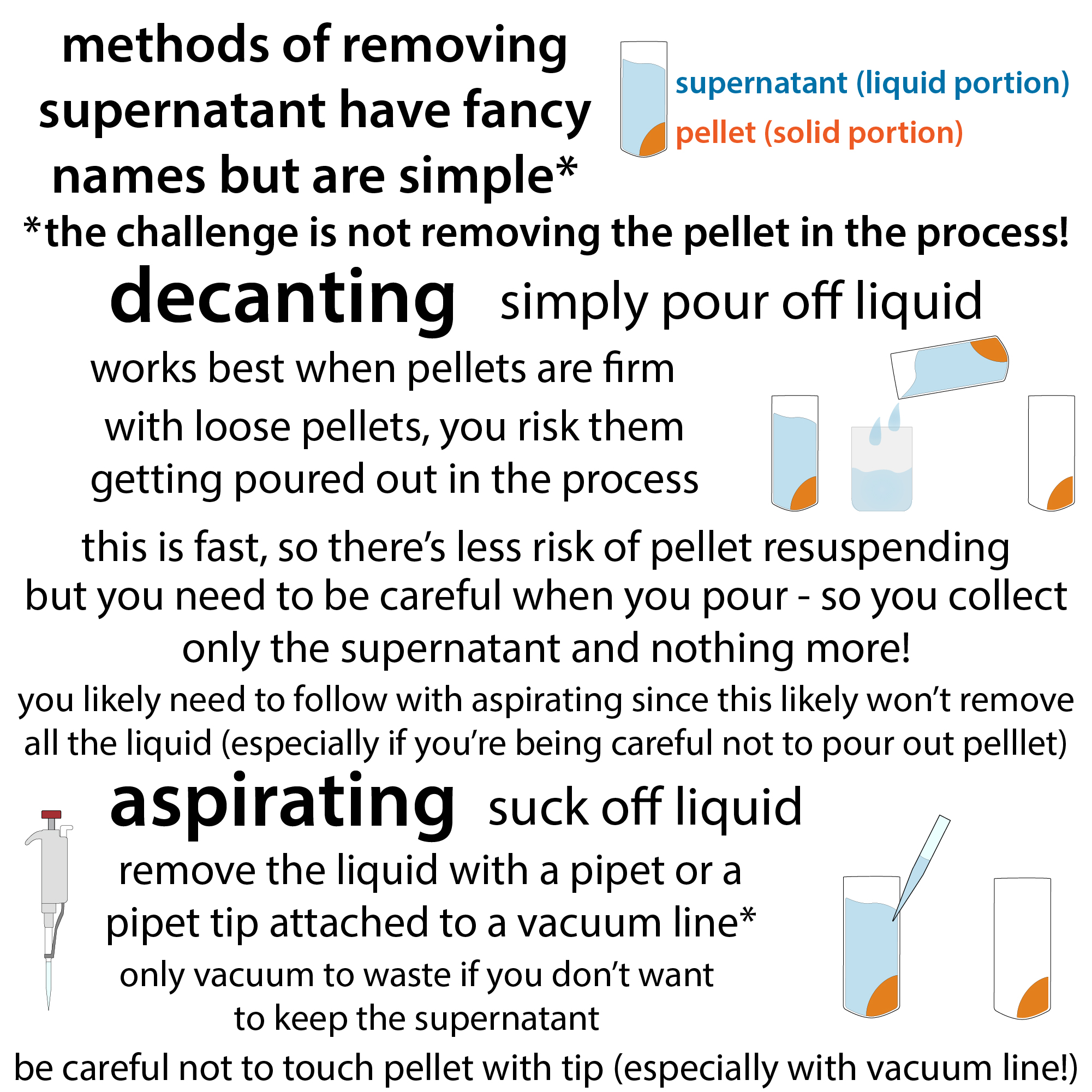
The simplest type of centrifugation is sedimentation (pelleting). It separates things with large differences in mass & also pulls out nonsoluble things into a solid pellet. Smaller soluble stuff remains in the liquid part, referred to as the supernatant. The higher the rcf, the less massive the stuff that will pellet out. So we can use low speed spins to pellet out massive stuff and high speed spins to pellet out smaller things. Sometimes people do a series of runs at different speeds to separate out smaller and smaller things like cellular organelles. This is called differential centrifugation.
The pellet’s position on the tube wall will depend on the tube angle in a fixed angle rotor and will be at the bottom of the tube in a swinging bucket rotor.
Gradient centrifugation is able to separate things with more similar differences in mass &/or density. They contain a gradient of some solute (dissolved thing) like sucrose or cesium chloride (CsCl) and, as you go down the tube, there’s more and more solute making it harder to travel through (especially if you’re small & or light). These gradients can be continuous (e.g. 15-30% sucrose) or discontinuous (step)(e.g. a section of 15% on top of a section of 30%). In gradient centrifugation, different things resolve as separate bands along the gradient rather than pellet vs. supernatant.
Working with centrifuges
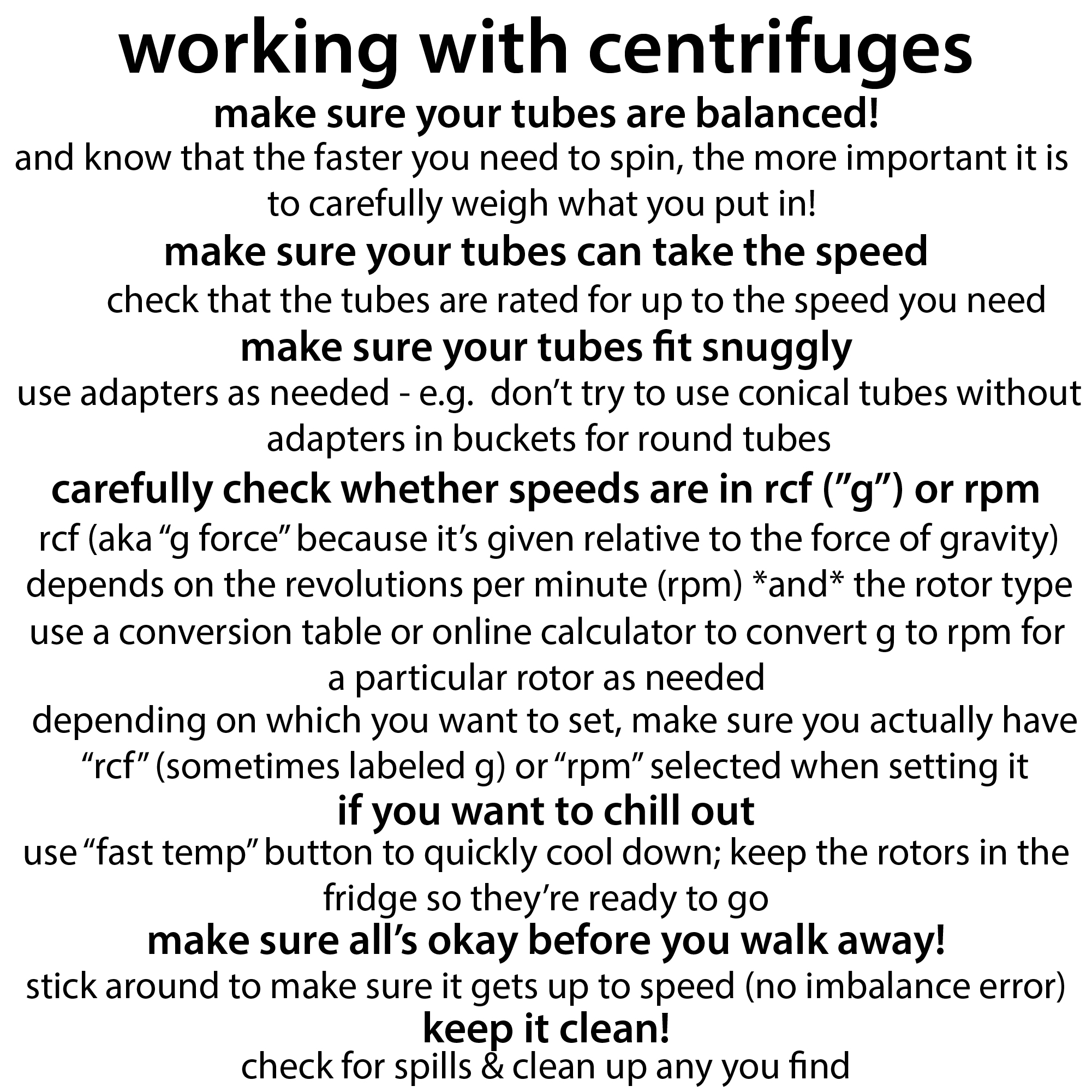
- Make sure your tubes are balanced!
- And know that the faster you need to spin, the more important it is to carefully weigh what you put in!
- For a swinging bucket centrifuge, you need to have all buckets in but don’t need to have tubes in all of them – but what’s in there does need to balance!
- Make sure your tubes can take the speed
- check that the tubes are rated for up to the speed you need
- make sure your tubes fit snuggly
- use adapters as needed – e.g. don’t try to use conical tubes without adapters in buckets for round tubes
- carefully check whether speeds are in ref (“g”) or rpm
- use a conversion table or online calculator to convert g to rpm for a particular rotor as needed
- here’s a helpful one from Beckman: https://www.beckman.com/centrifuges/rotors/calculator
- depending on which you want to set, make sure you actually have “rcf”‘ (sometimes labeled g) or “rpm” selected when setting it
- use a conversion table or online calculator to convert g to rpm for a particular rotor as needed
- if you want to chill out…
- use “‘fast temp” button to quickly cool down
- keep the rotors in the fridge so they’re ready to go
- make sure all’s okay before you walk away!
- stick around to make sure it gets up to speed (no imbalance error)
- check for spills and clean up any you find
Be ultra careful with ultracentrifuges
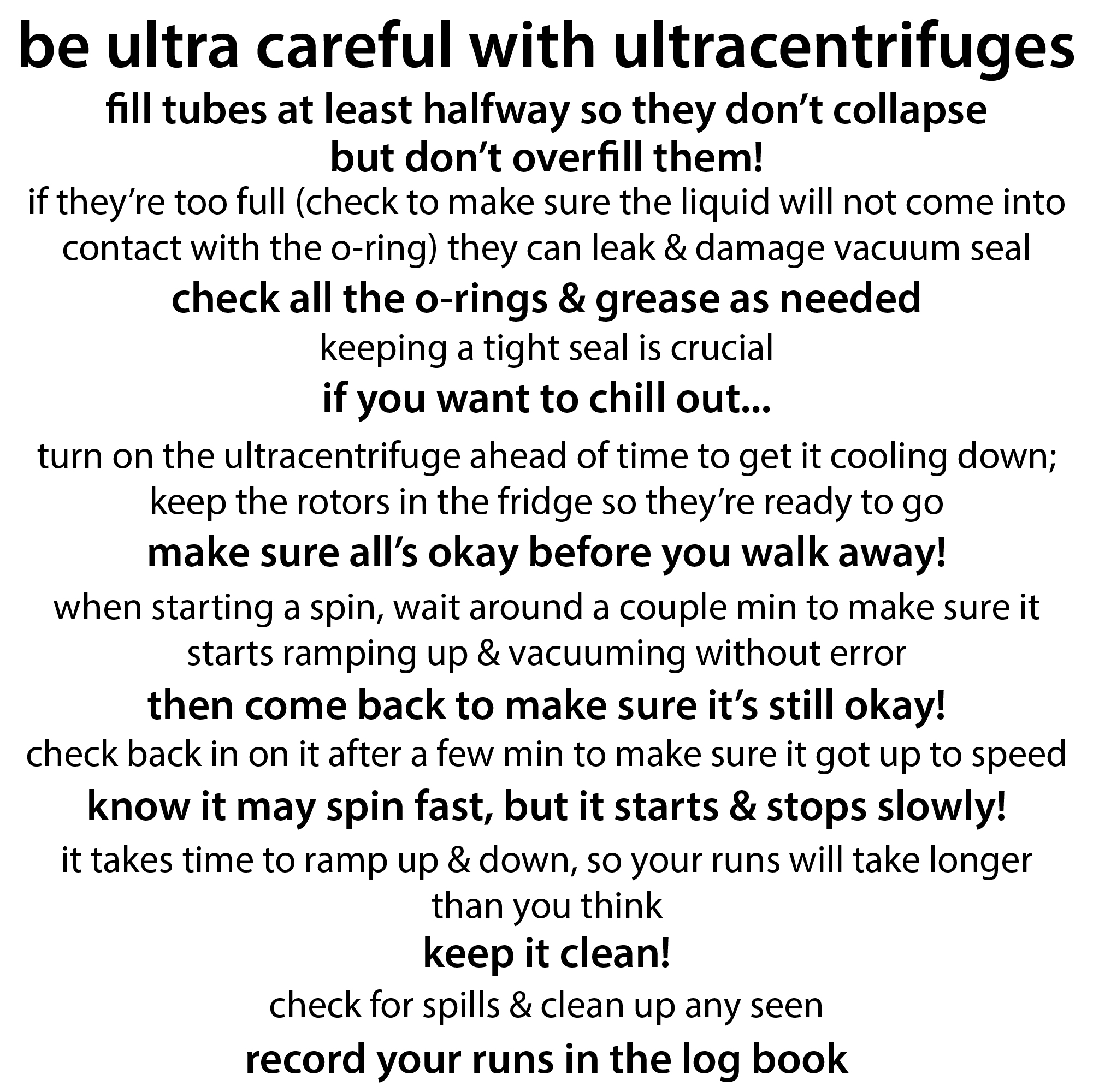
- fill tubes at least halfway so they don’t collapse
- but don’t overfill them!
- if they’re too full (check to make sure the liquid will not come into contact with the o-ring) they can leak & damage vacuum seal
- but don’t overfill them!
- check all the o-rings & grease as needed – keeping a tight seal is crucial
- if you want to chill out…
- turn on the ultracentrifuge ahead of time to get it cooling down
- keep the rotors in the fridge so they’re ready to go
- make sure all’s okay before you walk away!
- when starting a spin, wait around a couple min to make sure it starts ramping up & vacuuming without error
- then come back to make sure it’s still okay!
- check back in on it after a few min to make sure it got up to speed
- know it may spin fast, but it starts & stops slowly!
- it takes time to ramp up & down, so your runs will take longer than you think
- keep it clean!
- check for spills & clean up any seen
- record your runs in the log book
Centrifuge rotor info
- a number in a rotor name typically tells you the maximum speed (in rpm) it can be used at (aka rated speed”)
- e.g. a 45 Ti rotor can go to 45,000 rpm, and a SW 41 rotor can go to 41,000 rpm
- note: if you see a decimal, it’s just because there are multiple rotors whose rated speed’s the same, but have different volume capacities
- letters in a rotor name often tell you what type of rotor it is and/or the material the rotor is made of
- S or SW signals swinging bucket;
- “Type” signals fixed angle
- Ti tells you a rotor’s titanium, C is fiber composite, AC is aluminum composite, & others are aluminum alloy (at least for the Beckman ultracentrifuge rotors)
here are some nice resources :
A primer from Beckman: A CENTRIFUGE PRIMER – Beckman Coulter
For calculations and conversions: https://www.beckman.com/centrifuges/rotors/calculator
Here’s more on the Meselson & Stahl experiments (gradient centrifugation at work!): blog form: http://bit.ly/meselsonstahl ; YouTube: https://youtu.be/YBpDbXdkjrY