Molecular weight is aka molar mass or molecular mass. The term is sometimes used interchangeably with “formula weight,” though technically it should only be used for molecules, not non-covalent complexes. No matter what you call it, it’s super duper useful in the lab because it lets us easily and directly convert between what we care about (quantity of molecules in terms of how many copies of them there are) and what we can measure (how much they weigh). We can then extend this to figuring out concentrations in terms of copy numbers per volume (i.e., molarity). How?
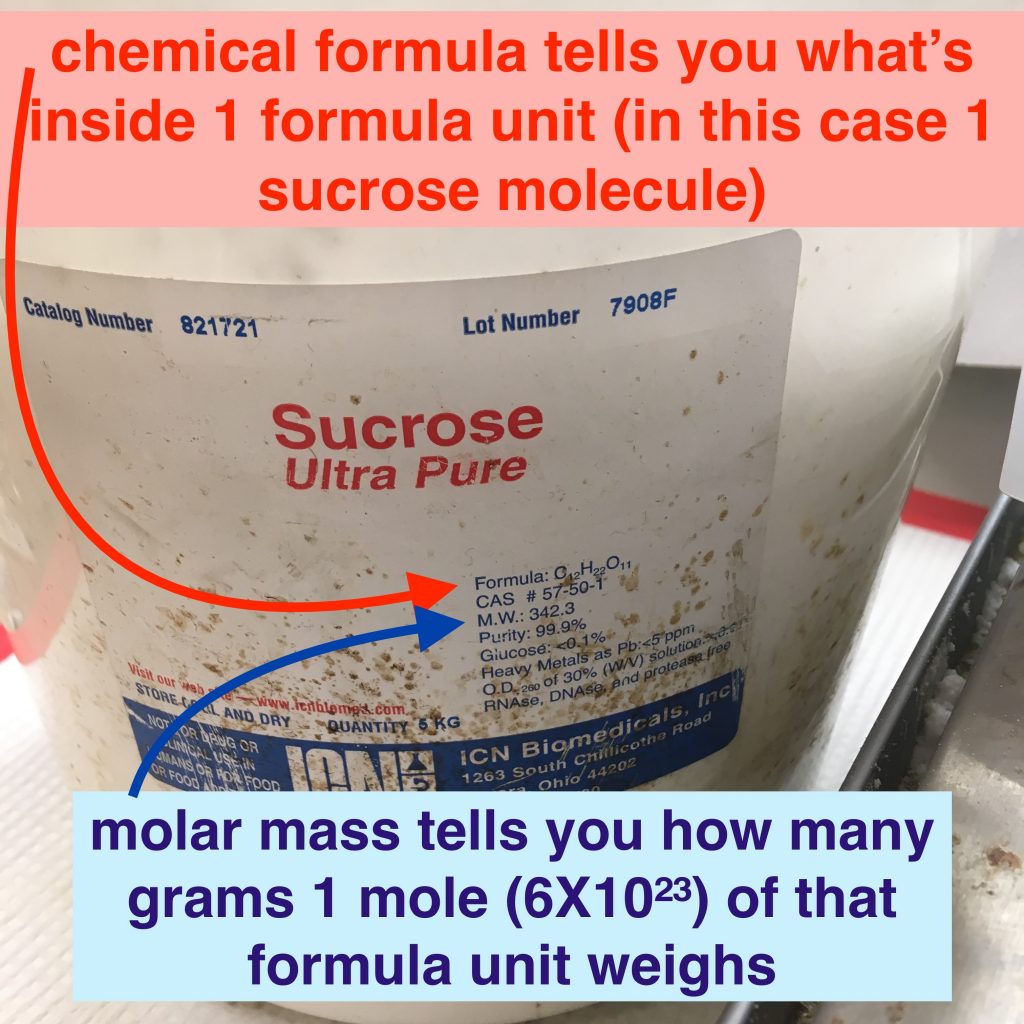
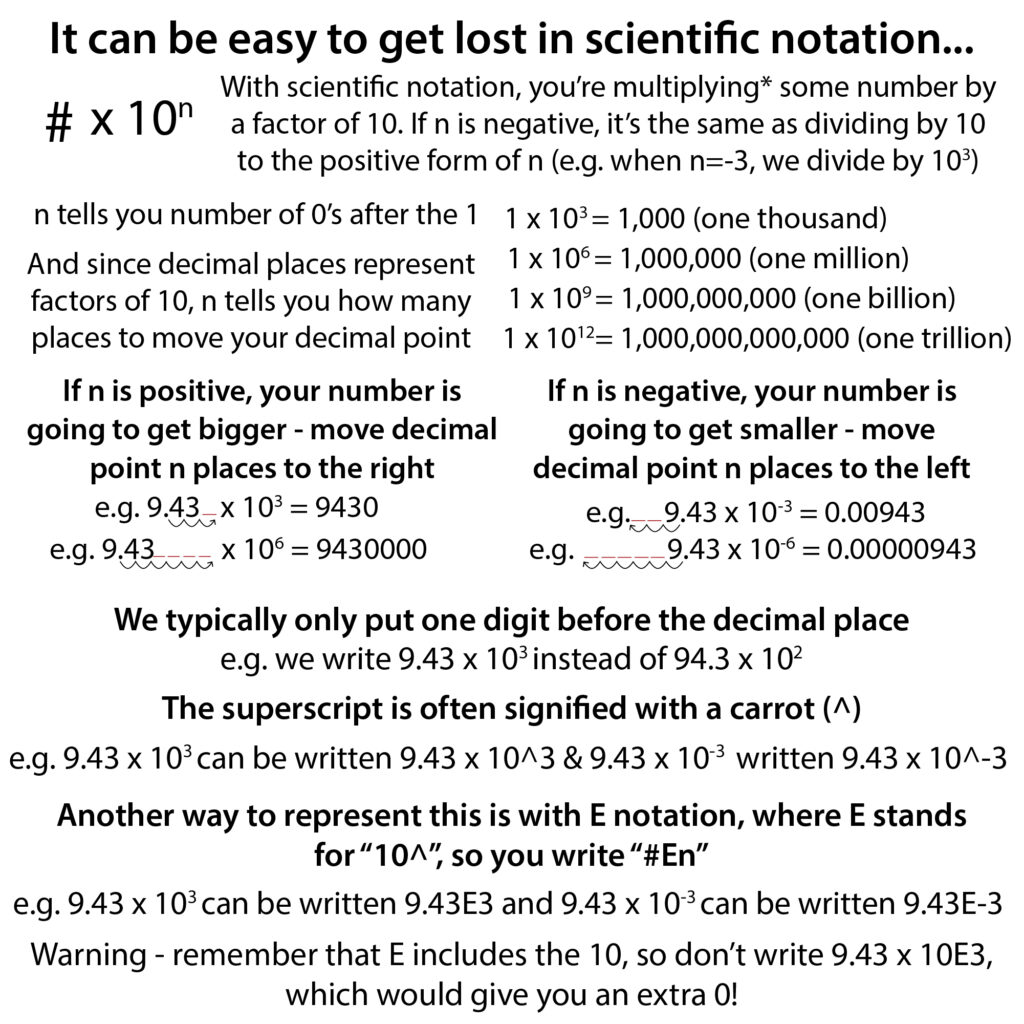
The molecular weight (MW) of a compound tells you how much 1 mole (6.02 x 10²³ copies) of a molecule weighs. It’s given in g/mol (or Daltons (Da), where 1 Da=1 g/mol – see note*)
YouTube: https://youtu.be/t2gbga7JGmI ; cheat sheet: https://drive.google.com/file/d/1TqCRh23TO8s5T23DjBcJeCUWl23ps9sI/view?usp=sharing
You can use the molecular weight to convert between mol & mass
mw = g/mol
we can rearrange this to
g = mol x MW
or
mol = g/mw
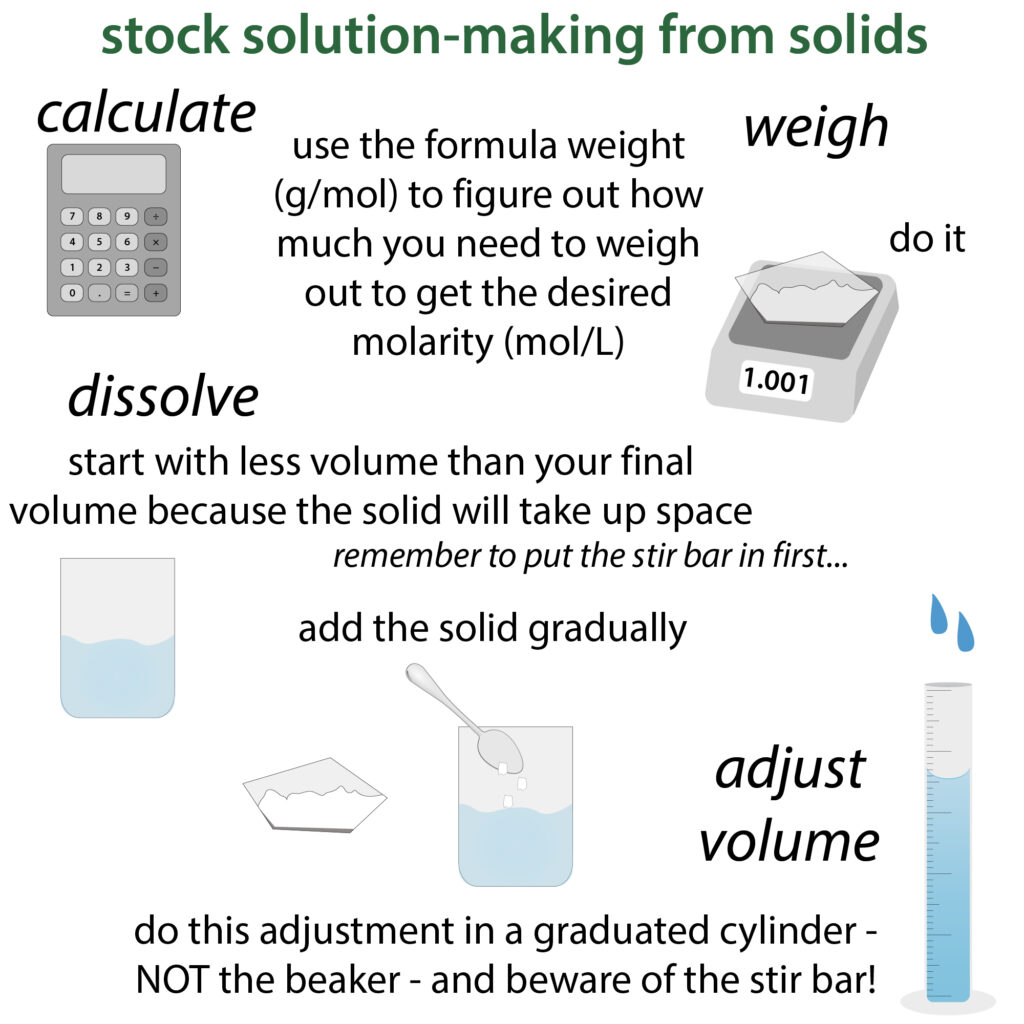
This allows you to calculate how much to weigh out to make solutions…
molarity (M) = mol/L
so mol = (M x L)
and g = mol x MW
so g = (M x L) x MW
in words, the mass needed to make a volumes-worth of a certain molarity solution is…
mass = desired concentration (in terms of molarity) x molecular weight (in g/mol) x desired volume (in L)
…and to calculate the molarity of solutions when you know the mass and volume
we said above that mol = g/MW
and M = mol/L
so M = (g/MW)/L
or M = (g/L) x 1/MW
so, to calculate the solute molarity of a solution when you know the solute mass and the total volume,
molarity (M) = (mass (in g)/ volume (in L))/ molecular weight (in g/mol)
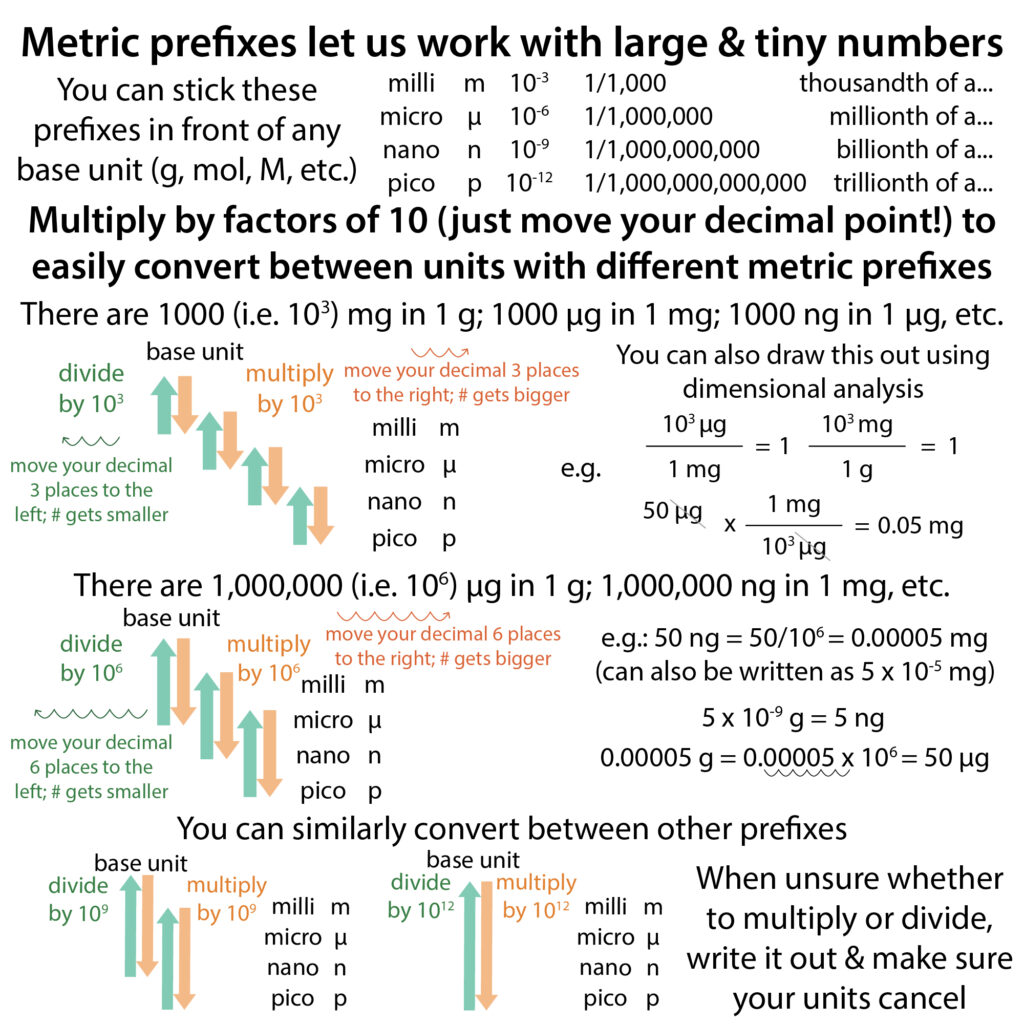
You can do all sorts of calculations! Just rearrange the molecular weight and/or molarity equation to isolate what you want to find. Then plug in what you know. When there are values you don’t know, use dimensional analysis (aka unit conversion or factor-label method) to fill in info you don’t know in terms you do know. If you get stuck, follow the units! Multiply or divide so that the units cancel out. You may need to do some metric conversions, such as dividing your mass in mg by 1000 to get the g you need. more on this stuff here: http://bit.ly/dimensionalanalysising & https://youtu.be/KQMA0aAGfP4
Be sure to check the label to make sure that the molecular weight of what’s in the bottle is what you think it is! Be on the lookout for salts and hydrates, where you have to take the counterion and/or water molecules into account. Video on this (from 7/11/23): https://youtu.be/xVnDlPX6BqA
Here’s that note on Daltons I promised…
*when dealing with biological macromolecules like proteins, MW is often given in Daltons (Da) or kiloDaltons (kDa)
1 Da = 1 g/moL
https://youtu.be/QnuVS3_x6TA
1 kDa = 1000 Da = 1000 g/moL
you can think of the Da as shorthand so you don’t have to write out g/moL
quick back-of-the-envelope estimates:
the average amino acid is ~0.1 kDa so a 1000 amino-acid-long protein would have a MW of ~100 kDa
the average DNA nucleotide is ~300 Da, so multiply length of double-stranded in bp by 300*2=600 to get a rough idea of MW
now for concentrations…
There are a number of different ways we can represent concentrations. Here’s an overview of what’s what and when to use which.
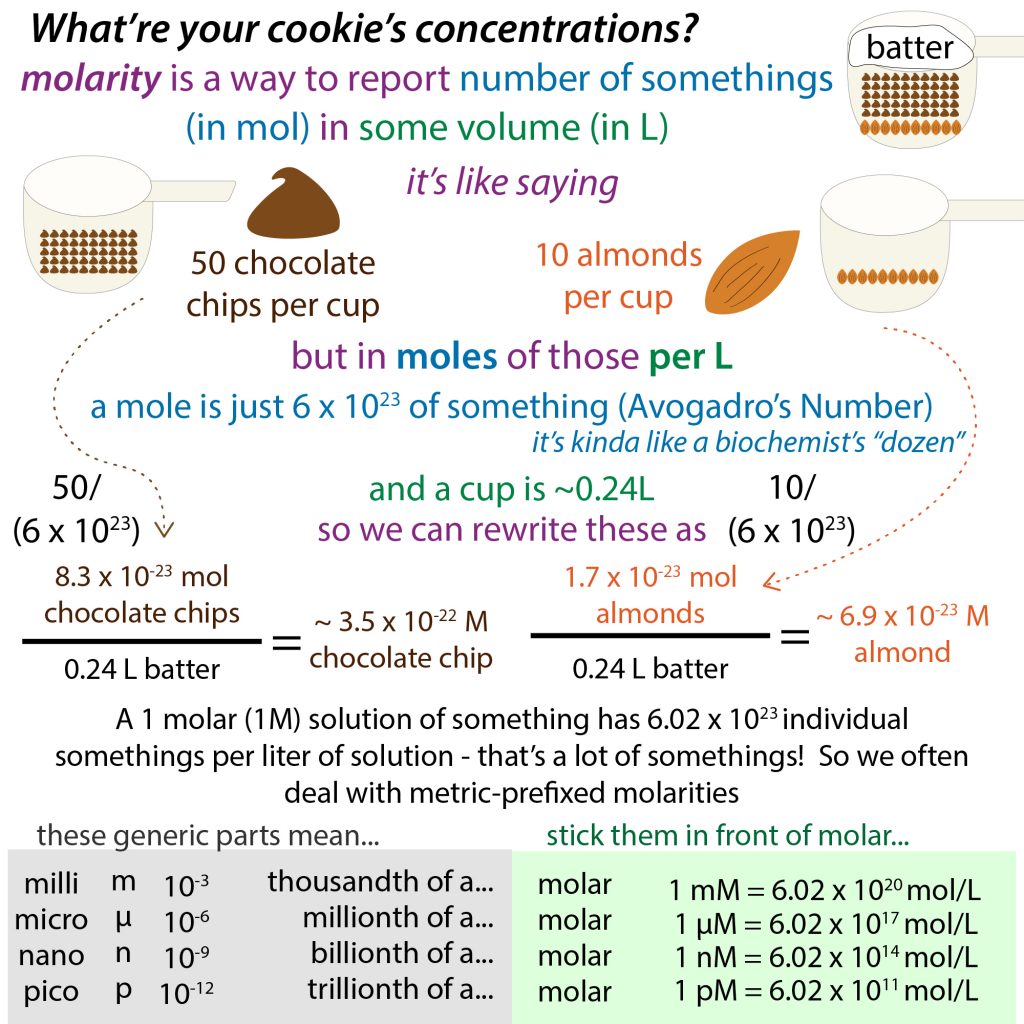
The molar mass we just discussed tells us how many grams are in 1 mole (mol) of a chemical. A mole is 6×10²³ (Avogadro’s number) and it’s like the biochemist’s “dozen” – it is just a set number of things – anything – but if you ordered a mole of bagels you’d get 6.02 x 10²³ of them… (that’s 602 and and then 21 0’s…) We can use that to figure out the molaRity (mol/L).
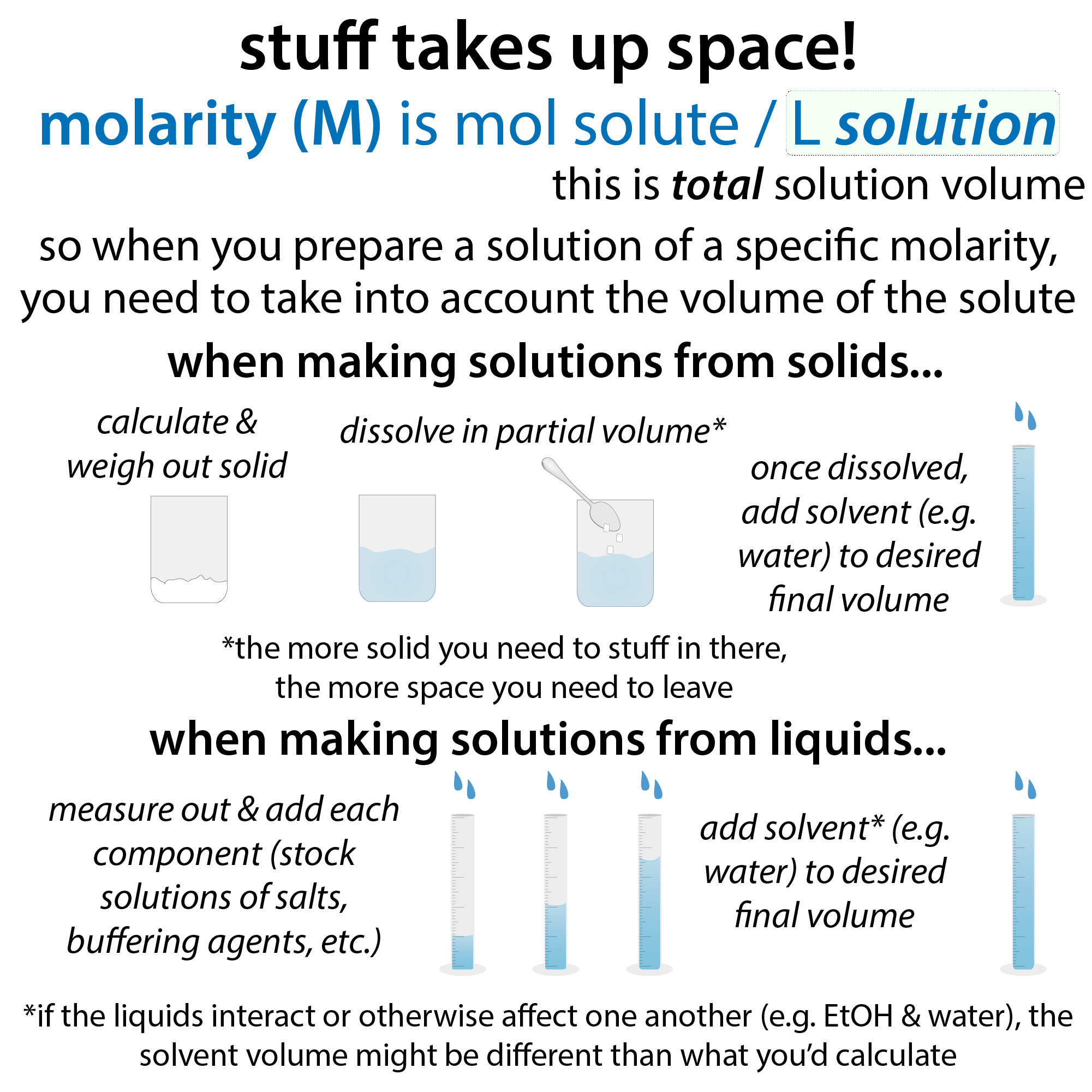
This is the main concentration type you see in biochemistry is molarity, which is moles solute per volume of solution – this is the total volume, so you need to take the solute volume into account (remember stuff takes up space so leave room when dissolving solids and, fill to the desired volume rather than calculating how much solvent you think you need.
more on how this comes into play when making 70% ethanol solutions: blog: https://bit.ly/ethanol_solution ; YouTube: https://youtu.be/9N4z857IuTc
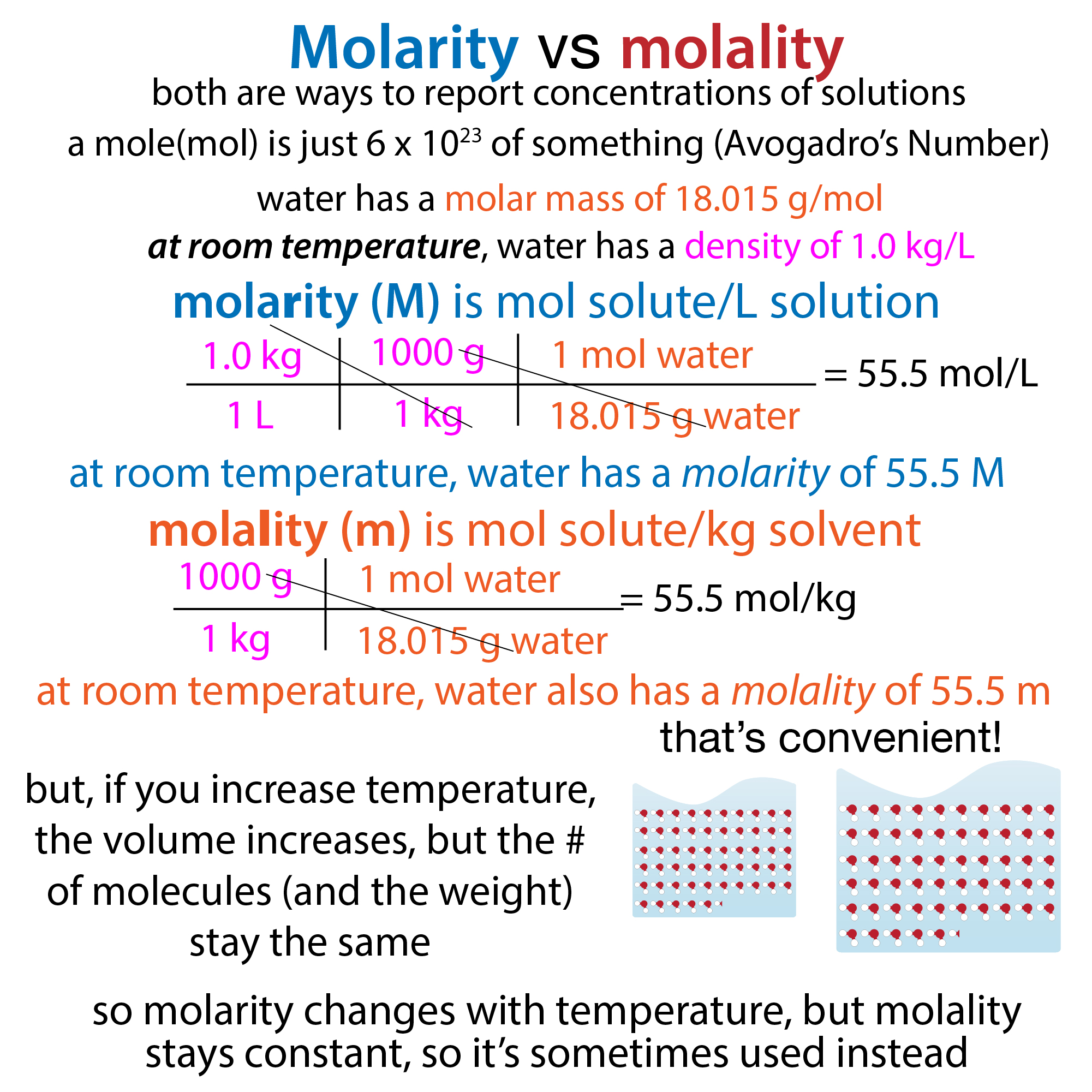
You might also see molality. The difference here is that you’re calculating based on solvent weight rather than solution volume.
But, the volume of a liquid can change with changing temperature… at a higher temp, molecules can move around more, so they take up more space. To account for this, we can use molaLity instead of molaRity. molaLity is moles per kg solvent & we represent it with a lowercase m. Helpfully, at room temperature, the density of water is 1.00 kg/L so the molarity & molality for water-based (aqueous) solutions at room temp are basically the same. more here: http://bit.ly/solutionconcentrations
The mole fraction (aka molar fraction) is the relative amount of 1 component of a mixture compared to the whole mixture.
This might sound really similar to molarity, BUT there’s a key difference Molarity is the moles of something compared to the volume of the solution. Whereas, mole fraction is the moles of something compared to the total moles of everything! more here: http://bit.ly/2DRc1mO
The molarity of one chemical won’t change if I add another chemical, but the mole fraction will!
There’s another reporting method we can use when we’re dealing with gases: partial pressure. We can do cool shortcuts with gases because gas molecules are so far apart that they don’t interact with one another and they don’t take up much space or anything, so different gases act basically the same. The ideal gas law says that, when it comes to pressure, it’s the # of particles, not their identity, that matters. Dalton tells us we that if we have a mixture of gases, can add together the pressure that would be generated by each gas separately and that would tell us the total pressure. And we can go the other way too – if we know what proportion of a mixture is a certain gas we can calculate what the pressure would be if we removed all of the other gases in there – and we call that the partial pressure.
Law of Partial Pressures: Ptotal = P1 + P2 + P3 …..
Each of those P’s is the partial pressure coming from one of the components and each can be calculated with P = (nRT)/V. And the only thing different between them will be the n (# of molecules of gas). So there’s a “shortcut” if we know what proportion of the gas mixture is that gas, and we call that value the “mole fraction” We can multiply the mole fraction of the component we’re interested in by the total pressure to get the partial pressure. http://bit.ly/2krA9p0
For example, if we had a gas mixture that was 1/2 A & 1/2 B, 1/2 of the gas molecules would be A and half would be B (each would have a mole fraction of 1/2) – so if we had 1 mol total we’d have 0.5 of each, if we had 2 mol total, we’d have 1 mol each, etc.
And 1/2 of the total pressure would come from A & half from B – each would have a partial pressure of 1/2 the total pressure (e.g. if the total pressure was 1 atm, the partial pressure of each would be 0.5 atm)
You’ll commonly see partial pressures used to describe things like the composition of the air we breathe in and out:
Earth’s atmosphere by volume (and mole fraction in parentheses because of that direct relationship we’ve been talking about): ~78% (0.78) N2; ~21% (0.21) O2; ~0.9% (0.009) Ar. There are also trace amounts of CO2, H2O, etc. If you’re at 1 atm partial pressures are -> 0.78 atm, 0.21 atm, 0.009 atm, respectively
What if we look at exhaled air? Mole fractions in exhaled air: N2: 0.741; O2: 0.151; H2O: 0.037; CO2: 0.063; Ar: 0.010
Frequently you’ll see some sort of “% one thing/all things,” especially when you’re dealing with mixing liquids.
% weight/weight (% w/w)
Weight solute/ weight solution x 100%
% volume/volume (% v/v)
Volume solute/volume solution x 100%
You might also see parts per million (ppm) or parts per billion (ppb). These basically take those fractions from above and, instead of multiplying by 100%, they multiply by a million (10^6) or a billion (10^9). This works out to one ppm meaning 1 mg/L or 1 mg/kg. That’s a really tiny amount so this type of concentration notation is mainly used to describe low levels of contaminants and stuff
% weight/volume (% w/v) (aka mass-volume percentage): g/mL x 100 % (so 1% = 1g/100mL)
More about the principle behind “percentage” weight-volume (aka mass-volume) here: but it has to do with biological solutions being mostly water. So the density of most biological solutions is close to the density of pure water, and the density of pure water is ~1g/mL (if you had 1ml of pure water it’d weigh 1g). So the density of most biological solutions is ~1g/mL.
So if you say that there’s 1g of something else in there, and the solution still had a density of 1g/mL it’d have to mean that the solution was 100% your thing. So 1g/mL is 100% w/v. It’s like if you calculated % w/v for water in water. But start adding in solute and in order to still be ~1g/mL the thing you’re adding has to be similar to the density of water and/or there’s just so little of it compared to water that it doesn’t make too much of a dent. If you add a lot of a more dense something, you end up with solutions that are >100% solute?!
So it only works for dilute aqueous solutions – more here: http://bit.ly/weightvolume ; YouTube: https://youtu.be/uo0Lx_OmKBA
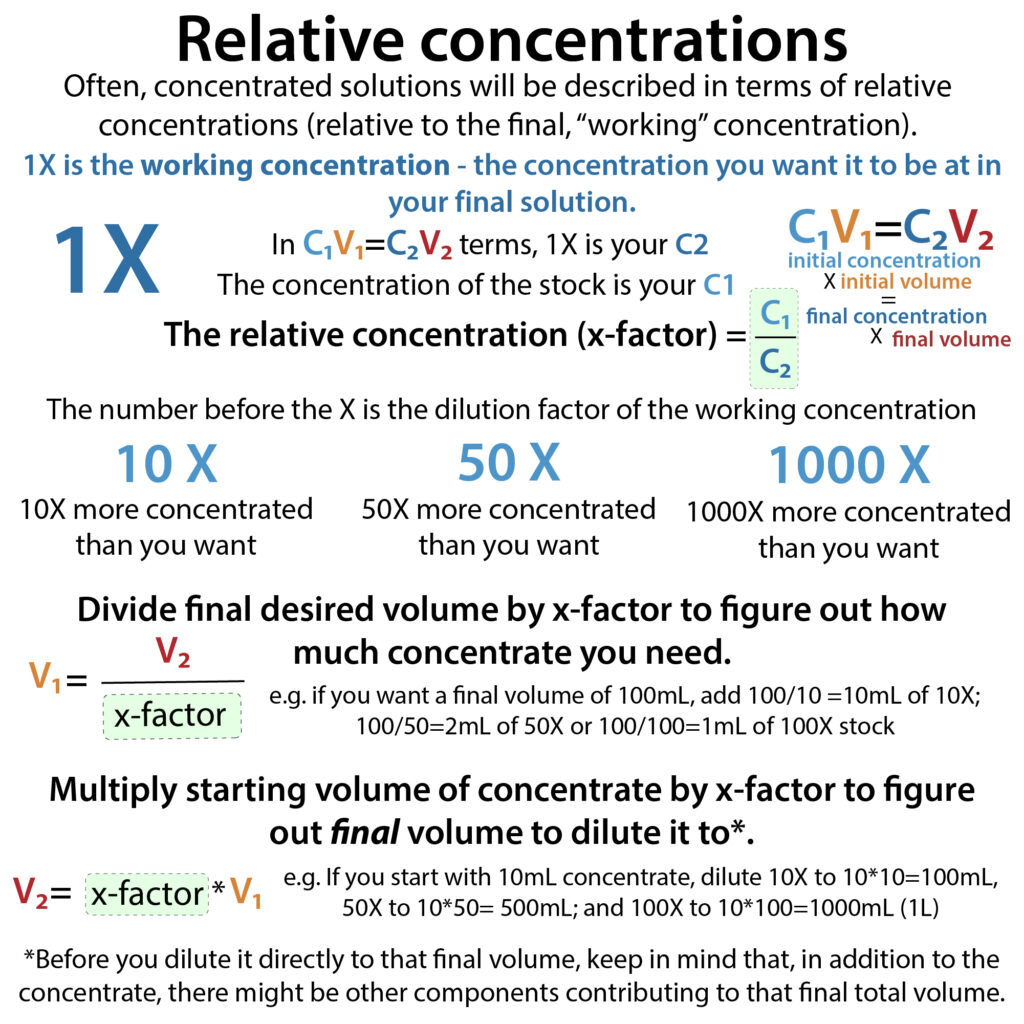
there are also relative concentrations of stock solutions – much more here: http://bit.ly/sciencestocksolutions ; YouTube: https://youtu.be/wC623-AGBOs
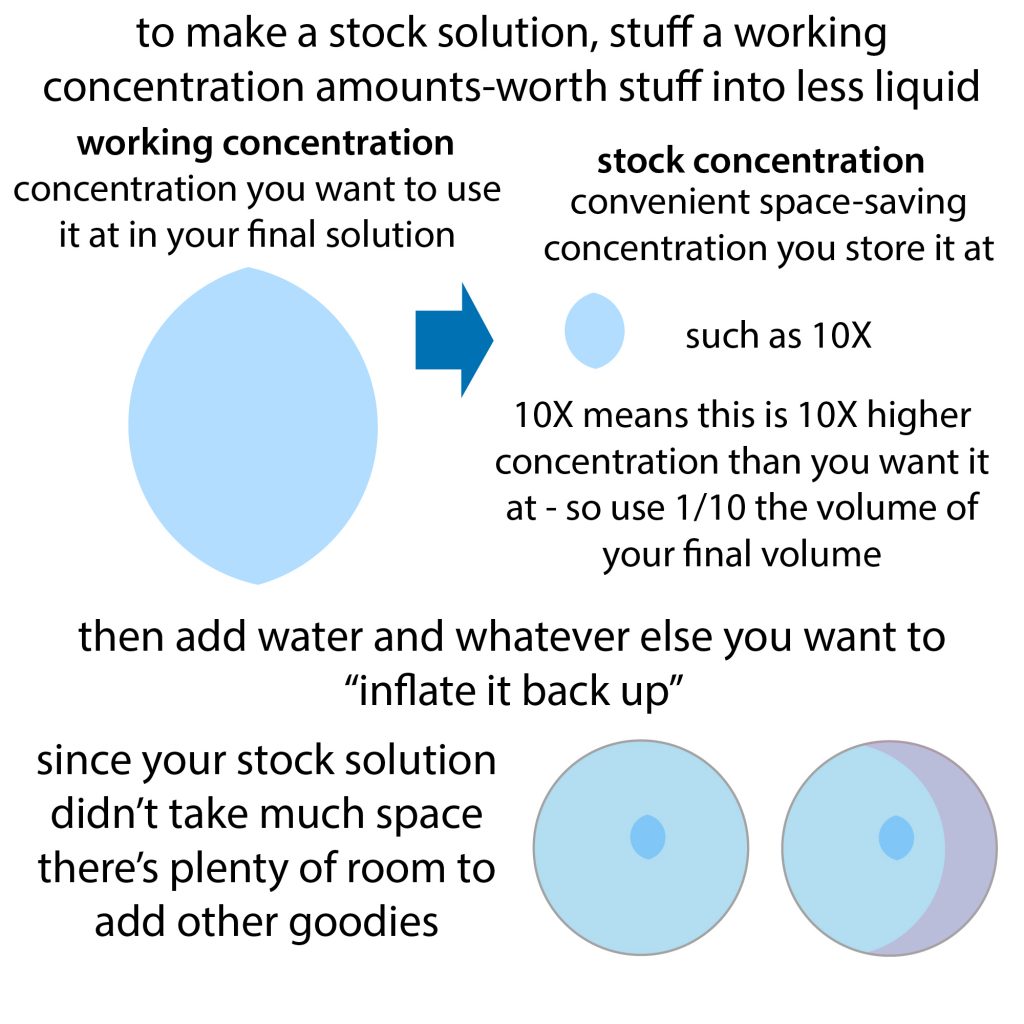
Stock solutions are just where you make a solution of something at a higher concentration than you’ll actually want to use it at (more solute molecules stuffed into that volume) – and then you add however much of it you want to get to your desired final concentration – we call the desired final concentration the “Working concentration” because it’s the one you actually want to be working with when you’re doing the experiment work not just the prep
We often make 10X or 50X versions of things we use a lot, then dilute when we’re ready to use them. 10X means the stock is 10 times more concentrated than you want to use it at. So to figure out how much of it to add, you need to reverse the X which means you need to divide. So if you want to make 1L (1000mL) you divide that 1000mL by 10, so you need 100mL of the stock solution. Just dilute that to 1L with water and voila – 1X!
sorry for the mismatch of text – hope the visuals and video speak for themselves!
cheat sheets: