When it comes to terms for talking small, biochemists are the rebels of them all! We use a couple of non-standard terms for describing lengths and distances: the angstrom (Å) and the micron (μm) which is officially a “micrometer” or “micrometre.”
link to video in case embed isn’t working: https://youtu.be/-byu5MvrTCo
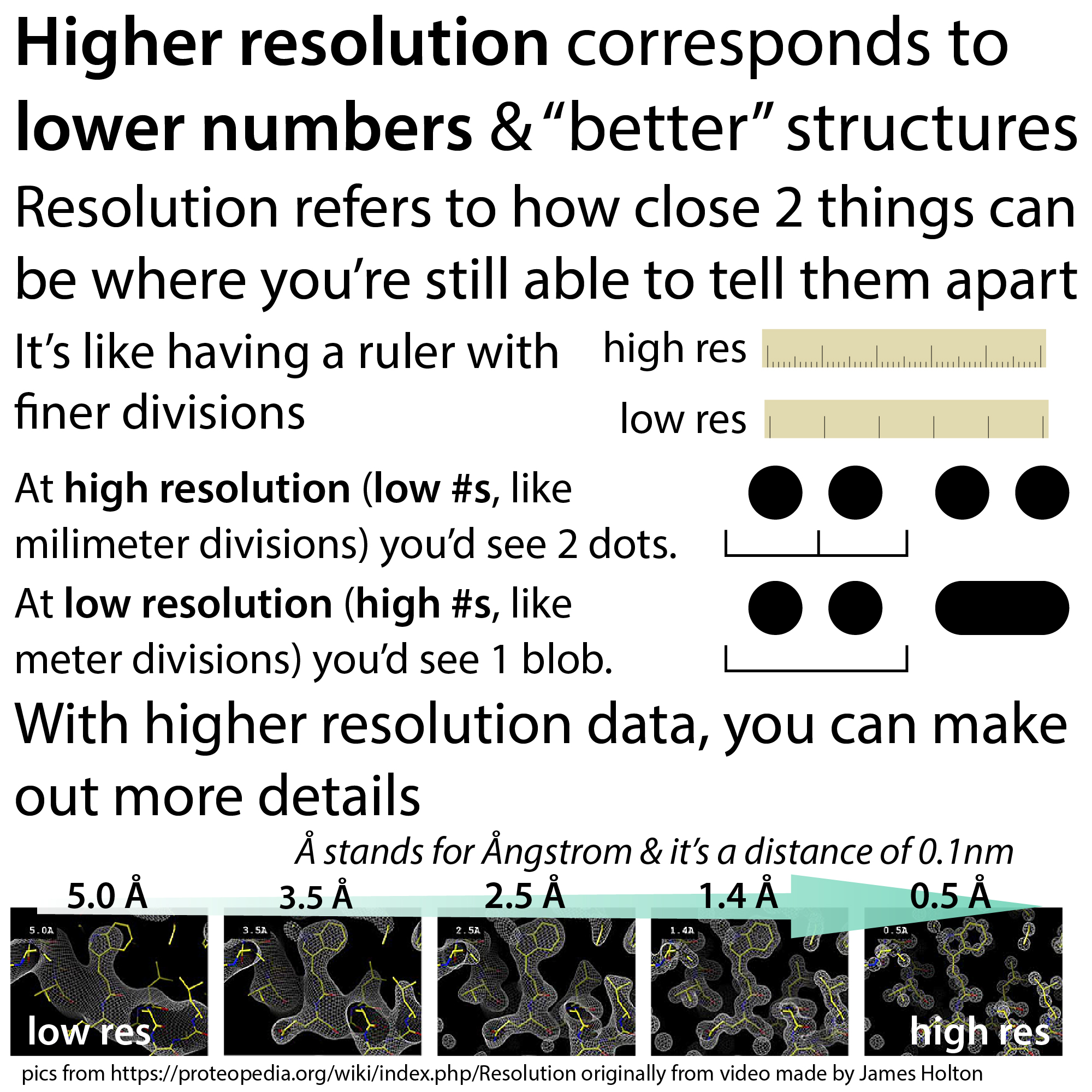
An Angstrom (Å) is 10⁻¹⁰ meter, which we can also write as 0.1 nanometers (nm) or 100 pm. It’s less than a billionth of a meter, so really small, and we often use it instead of the official, “SI” unit of the nanometer because biochemical atoms and bond lengths are on the order of angstroms. The length of an average carbon-carbon single bond is ~1.54Å and the length of an average carbon-hydrogen bond is ~1.09Å. So if we want “atomic-level” resolution in a structure (e.g. a structure of a protein solved by x-ray crystallography or cryo-EM), we need to get to a resolution of around 1.5Å. note: resolution is the closest 2 things can be where you can still tell that there are 2 things and not just one blog. Much more about it here: blog: https://bit.ly/structure_resolution ; YouTube: https://youtu.be/t5WeMkY0skU
So, angstroms are good for talking about atoms and bonds. But when we start putting all those together we end up in that nm range, so you often see things like protein diameter expressed in nm. The average protein has a diameter of ~5nm, so 50Å (but proteins aren’t spherical and their shape & size vary greatly so take this with a grain of salt!).
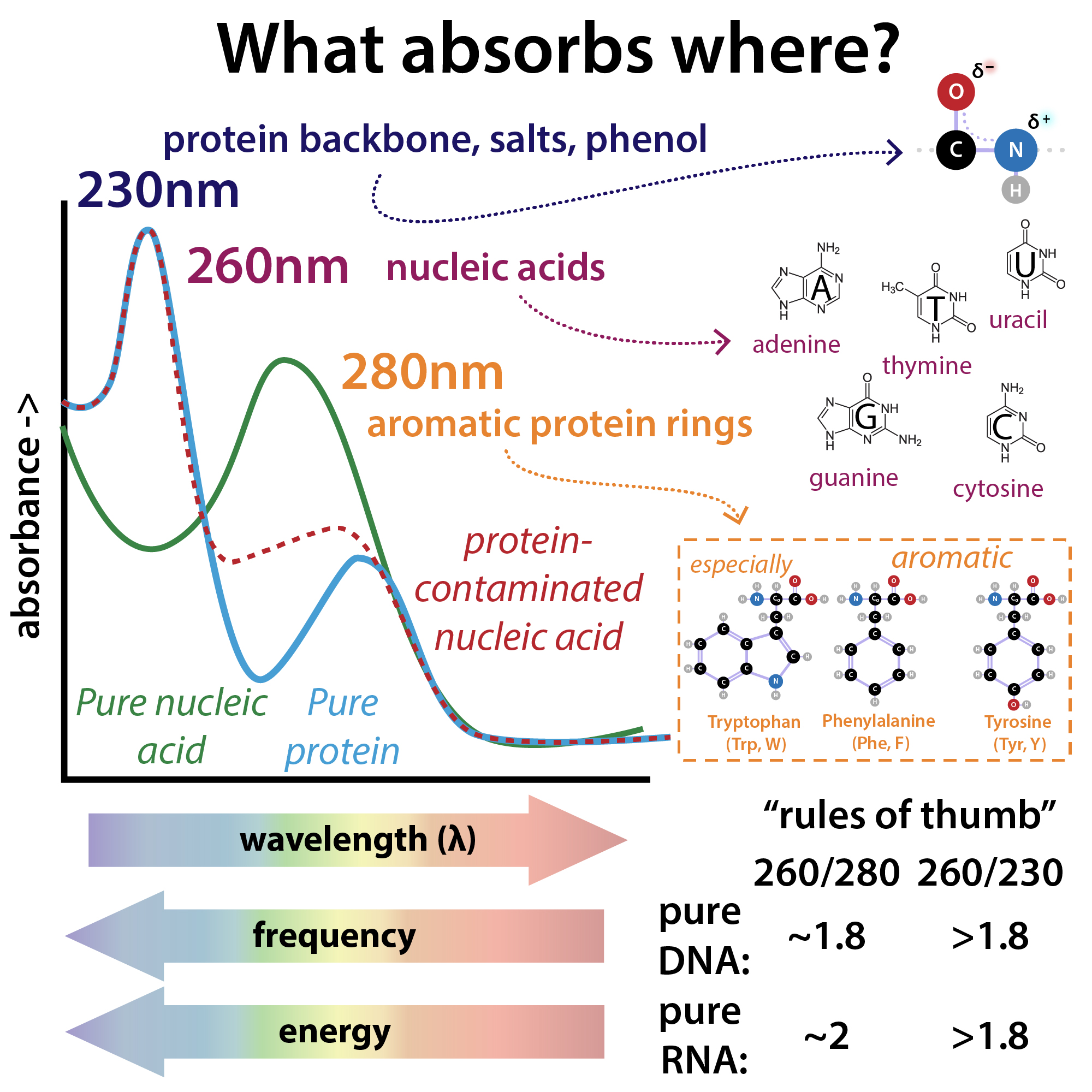
nm is also good for talking about the wavelength of light. Visible light has wavelengths of 380-740 nanometers. And UV is shorter – we commonly use 280 and 260 nm UV light to detect proteins and nucleic acids, respectively. More here: http://bit.ly/dnauvbeer & https://youtu.be/cUxh2DCqYBo
Going even bigger (but still really small!) we get into the micron range. This unit is good for talking about things like cells sizes. Bacterial cells are ~1 μm and human cells are ~10-100 μm (but can vary greatly!). In the lab we often describe the pore size of filters in microns. We frequently use 0.2 or 0.22 μm filters to sterilize solutions because these filters won’t let through bacteria, fungi, spores, etc. But they can let through some viruses because viruses are sometimes smaller than that. More on filtration here: https://youtu.be/ft0Vs9VyOnE
If you want to get a better intuitive sense of the relative sizes of things, I highly recommend the book Cell Biology by the Numbers by Rob Phillips and Ron Milo. I got to take a short course by Rob Phillips in grad school and it was amazing. What’s also amazing is that they have a free online version of their book: http://book.bionumbers.org/
I also recently discovered that Ron Milo has a whole course on it on YouTube as well: https://youtube.com/playlist?list=PLnW9-ausEh9GDI5e728mPN1LXnO0deocP
Speaking of resources, I have some content on unit conversions, etc. here: blog: https://bit.ly/metric_calcs ; YouTube: https://youtu.be/A-J7kdLNb8c
And, closing with some fun facts (well, fun unless you’re a micron…) – the inspiration for this post was when I was trying to figure out what size filter to use for an experiment and the filter sizes were given in microns which got me wondering why we call it a micron and not a microm – turns out micron comes from the Greek mikros (small) and metron (measurement). And people have been using the term for a long time – as well as μ as a symbol for it – officially sanctioned in 1879. But then, in 1967, the International System of Units (SI) governing folks demoted it from that role because they adopted μ as a prefix for 10^-10. And didn’t want confusion. But people kept using it. And they also added some confusion because a micrometer is also a kind of measuring device! https://www.bipm.org/en/committees/cg/cgpm/13-1967/resolution-7
and final note – at least on my computer, you can use shift option A for angstrom symbol (Å). I’ve also set up custom keyboard shortcuts so I can press control+space to switch to a Greek keyboard for μ and other Greek letters which show up frequently. But also frequently, scientists get lazy and just put a lowercase u instead of a mu! (so you’ll see um a lot – and not just because we’re fumbling for words!).