Think like a molecule! But what kind? This past week I’ve been learning lots of *nu* skills and phile-ing them away in my bumbled-up brain. It’s quite *electr*ifying (though tiring!) So today I thought I’d revisit a biochemistry concept which is key – nucleophilicity! And that “other” (Lewis) definition of a base… This post isn’t meant as a substitution for class and it won’t eliminate all difficulty, but hopefully it helps explain differences between basicity & nucleophilicity!
note: refreshed & video added 11/27/21
When it comes to trying to figure out what’s going on in chemical/biochemical dramas, my main piece of advice is try to think like a molecule. Chemistry is all about atoms and molecules going from place to place and changing who they hang out with. So, instead of focusing on memorizing equations and reactions, I find it much more useful to try to think in more fundamental terms that I can apply to “any” reaction; I like to think about why molecules would want to go certain places and why they’d want to hang out with different friends. Instead of being attracted to someone’s wit or smile, molecules are often attracted to other molecules due to opposite charges.
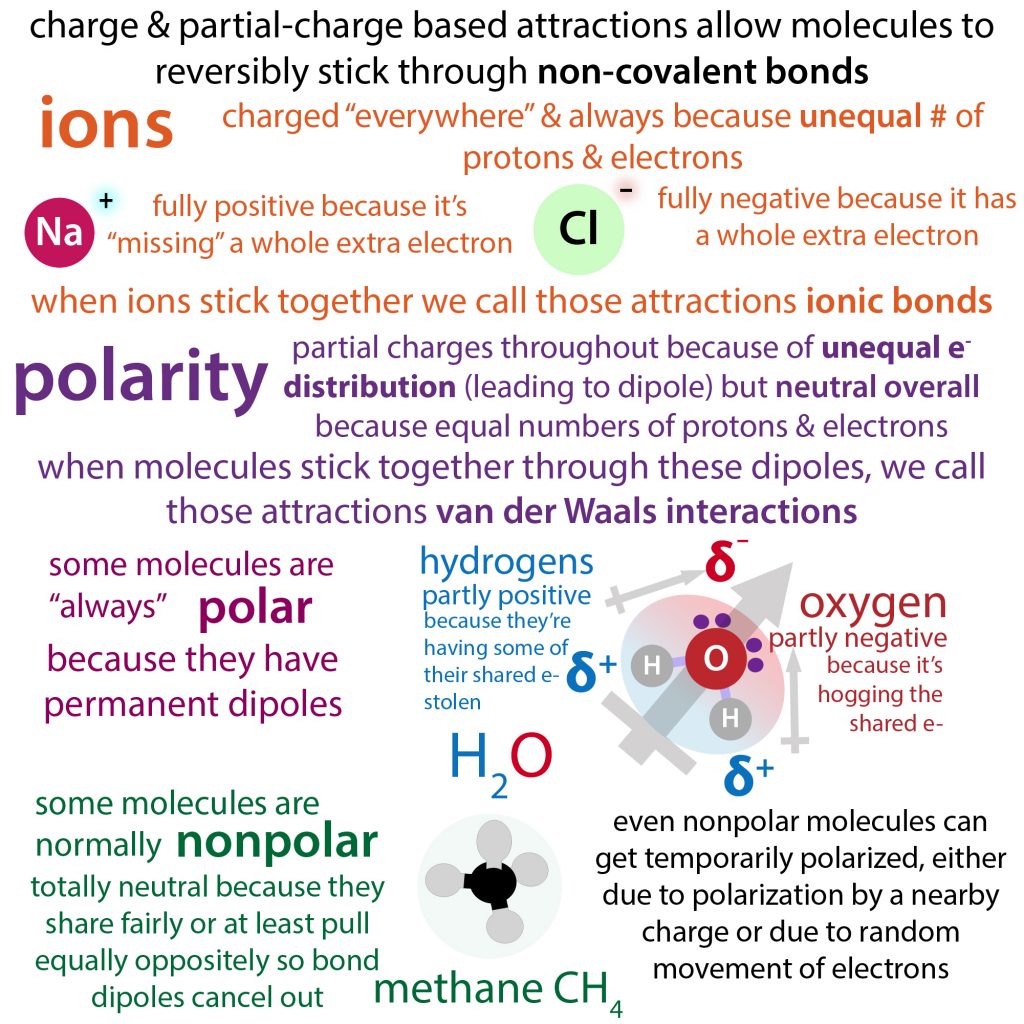
Atoms are made up of protons (+ charged) & neutrons (neutral) clustered together in a dense central atomic nucleus & electrons (- charged) whizzing around them in an “electron cloud.” The electrons are the only shareable part and atoms can share them to form a strong type of bond called a covalent bond. We call atoms that are connected by covalent bonds “molecules
(eg. H₂ (molecular hydrogen) or H₂O (water)).
Electrons can shift around so that they hang out more in certain areas of the molecule than others (they like to hang out with atoms that are electronegative (electron-hogging)). As a result, you can get uneven charge distribution (we call such molecules “polar”). But as long as the total # of electrons = total # of protons, the molecule is neutral overall because they have equal but opposite charges. More on this stuff: http://bit.ly/2rAK3Vc
You can think about electrons as being housed in “shells” like layers of an onion. This is *not* really how things are, but this simplified version is often used because it’s quite helpful for explaining a lot of general chemistry. In this shell model, the outermost shell is the “valence shell” & atoms want it to be full, meaning they have the “ideal” #s of electrons they’d like to have there (often 8, hence the “octet rule”). more here: http://bit.ly/2Aajn2S
In order to try to get to that happy place number, atoms can share electrons with one another, give up electrons, or take on electrons. But molecules also like to be neutral, which only happens when #protons = # neutrons, so sometimes the quest for a full shell and the quest for neutrality “clash” because electrons have that negative charge. As a result, you can end up with NUCLEOPHILES & ELECTROPHILES
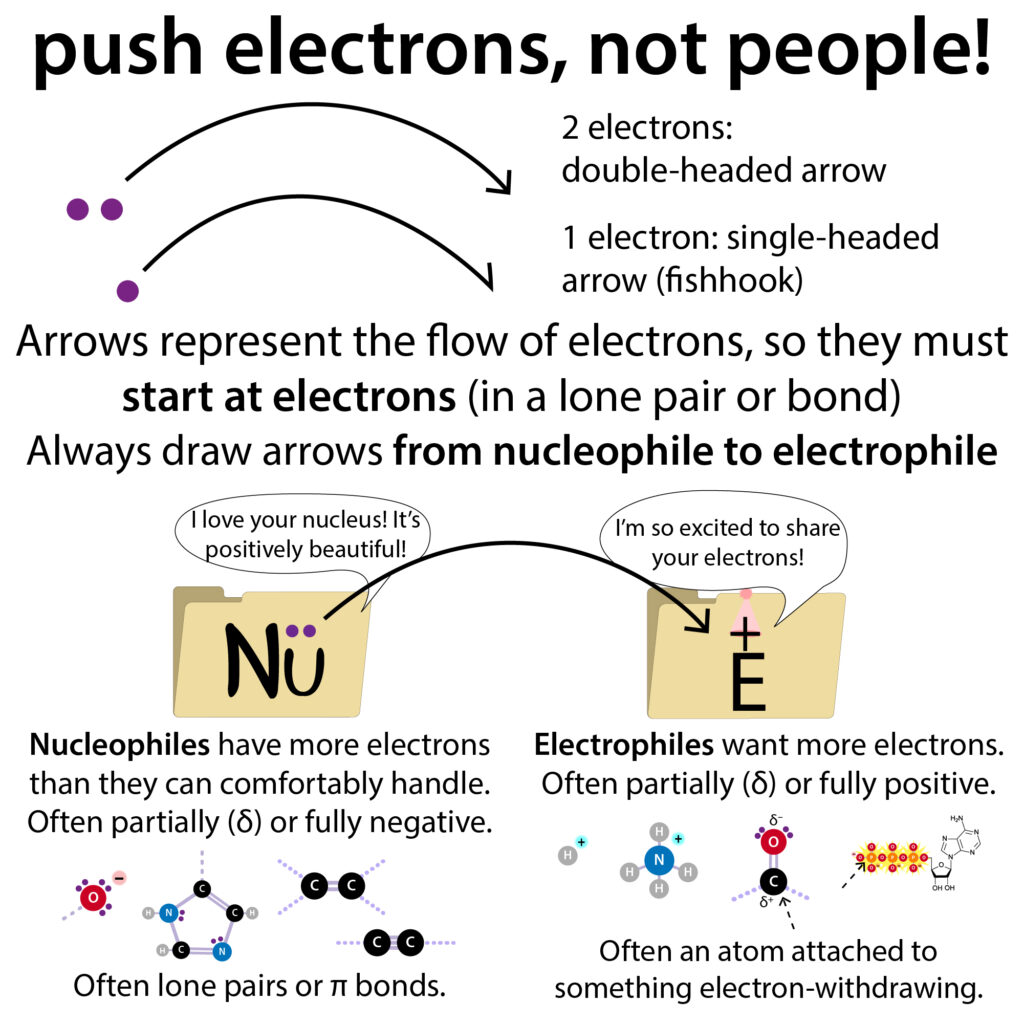
NUCLEOPHILES (Nü) have “extra electrons (e⁻)” which gives them more negativity than they can handle. They “love nuclei” because opposites attract & the nucleus is where the positive protons are
ELECTROPHILES are also “unhappy” with the amount of e⁻ they have, BUT they want more, more more! (they “love” e⁻)
It’s a match made in #ochem heaven – nucleophiles can share an e⁻ pair with an electrophile to form a new covalent bond.
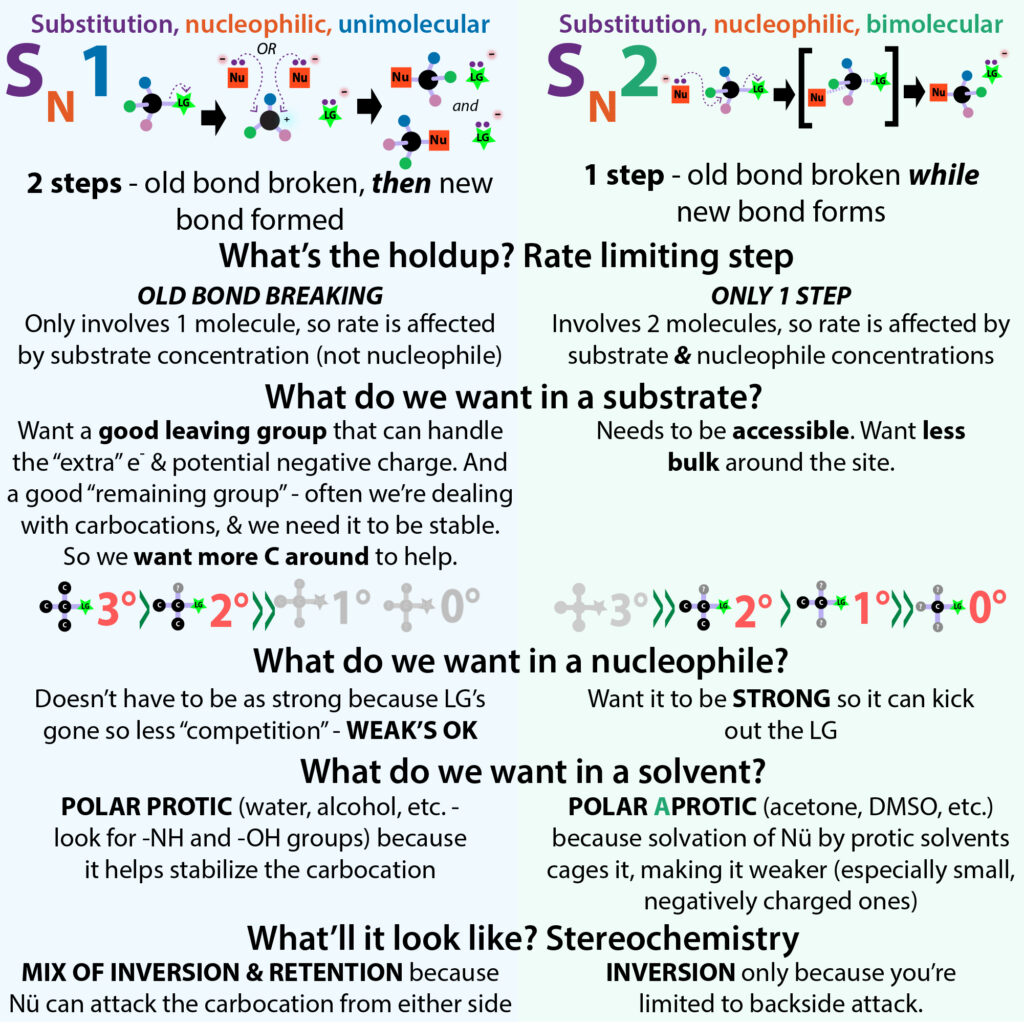
BUT each atom can only form a limited number of bonds at once – kinda like LEGO pieces where there are a set number of bumps and holes. So In order for the new nucleophile to add on, you might have to kick out another group: in nucleophilic substitution you go from A + B-C -> A-B + C where we call C the leaving group (LG)
Much more on this in yesterday’s post. http://bit.ly/sn1vssn2
Nucleophiles are often negatively charged (anionic) but they don’t have to be. They just have to have a pair of e⁻ available they can use to form a bond (you can remember this by thinking of the u in Nü as a smiley face. You need 2 e⁻ to form a single bond – “normally” we think of each partner sharing a single electron (1 + 1 = 2). But 2 + 0 also = 2. So, one pair’s enough to form a bond even if the other group doesn’t have any to spare; you can make a new bond from a lone pair or by “splitting” a double bond into 2 single bonds (or a triple bond into a single & a double). (a double bond is 2 shared pairs of electrons and a triple bond is 3 shared pairs).
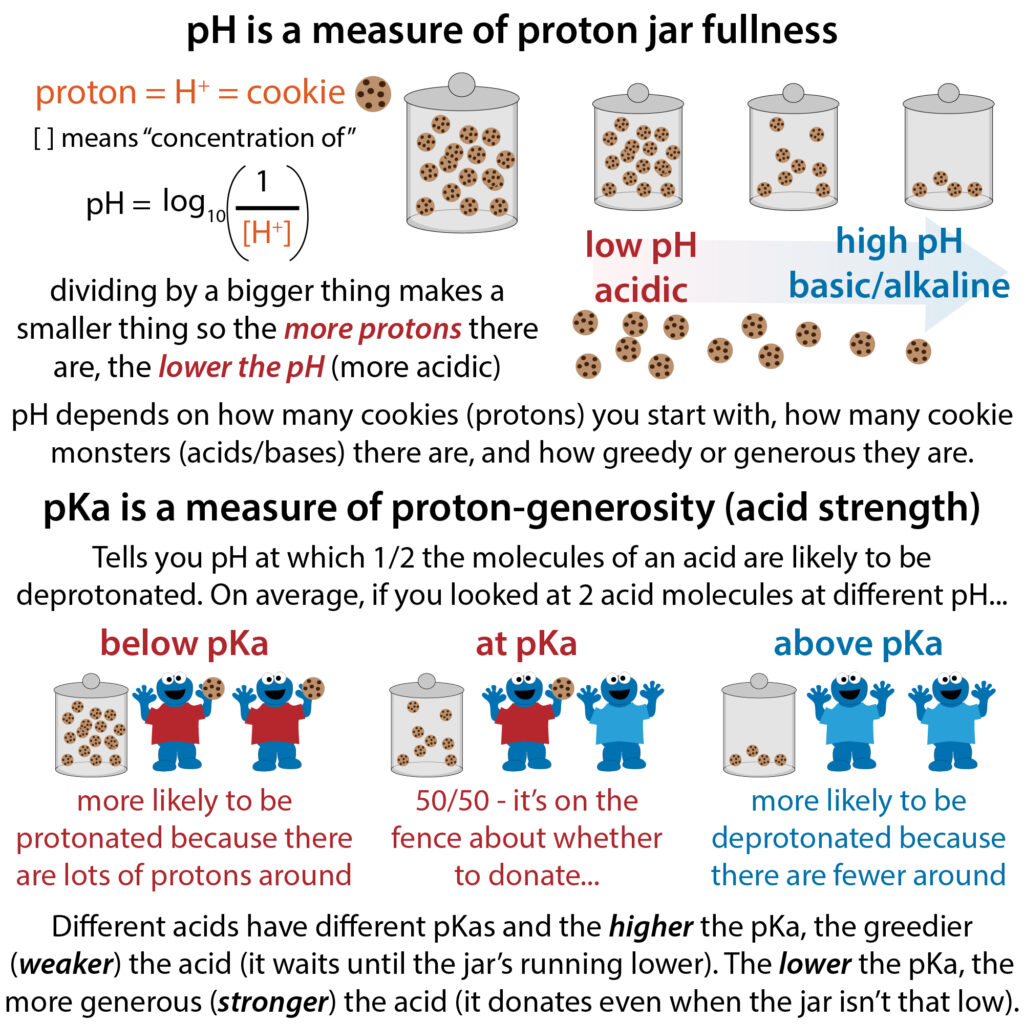
Now here’s where the terminology can get a bit confusing… the other day we talked about how pH is an measure of proton concentration. Before we were talking about protons in terms of subatomic particles, but we can also talk about protons as “H⁺.” Neutral hydrogen only has 1 electron and 1 proton. So if it loses the electron, it’s basically just a proton, so we often use H⁺ and “proton” interchangeably when it comes to talking about things like pH.
Somewhat confusingly, pH is an inverse log of proton concentration, so the lower the pH, the higher the proton concentration and the more acidic a solution. The higher the pH, the lower the proton concentration and the more basic/alkaline a solution. pH is determined by how many acids and bases you have in a solution and how strong they are. In this case, we’re talking in terms of the Bronsted definitions of acids and bases: acids, according to Bronsted, are things that donate protons and bases are things that accept them. So the more/stronger the acid molecules in a solution, the lower the pH and vice versa. http://bit.ly/phacidbase
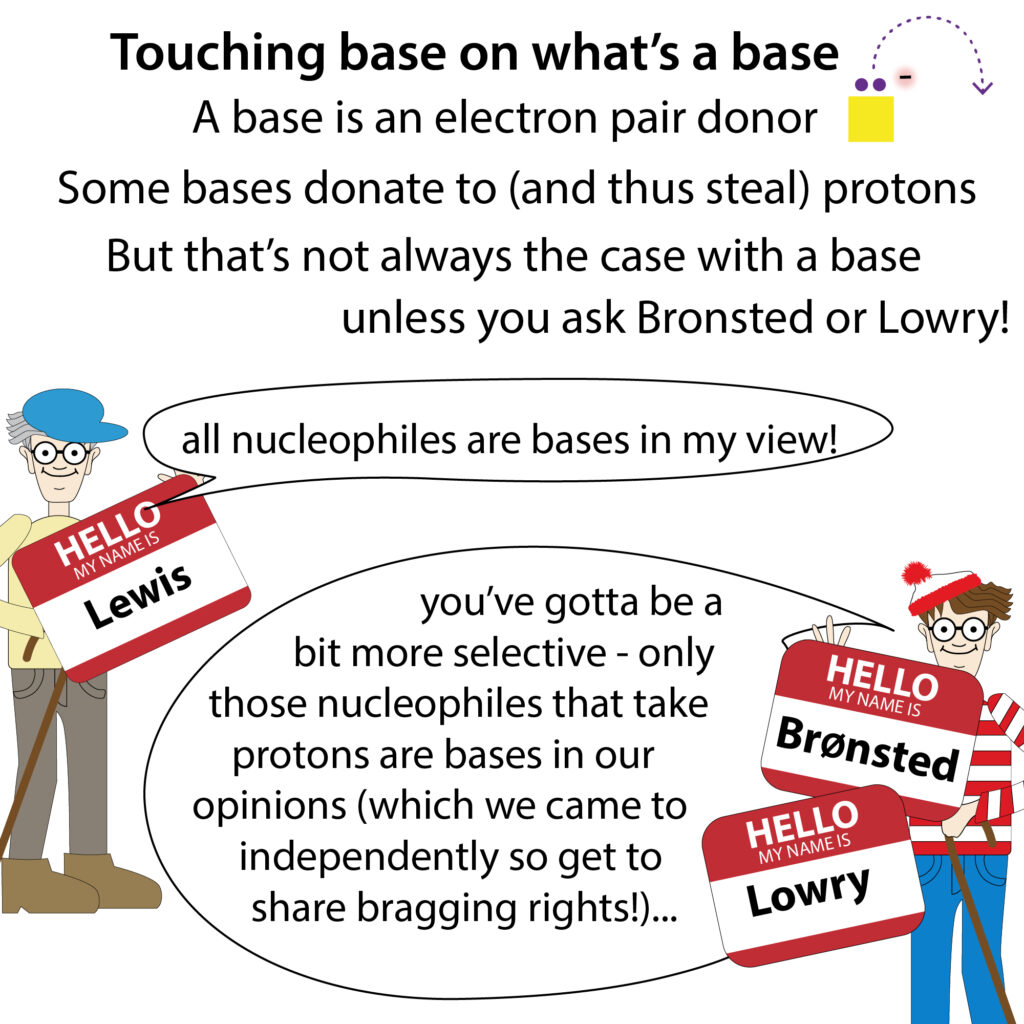
Turns out a guy named Lewis didn’t quite agree regarding what the definitions of acid & base should be! In Lewis’ mind, an acid is something that accepts a pair of electrons and a base is something that donates a pair of electrons. Sound familiar? This is what were were just talking about with our 2 + 0 = 2 binding scenario!
Lewis bases donate e⁻ pairs and so do nucleophiles. And Lewis acids accept e⁻ pairs, and so do electrophiles. So electrophiles are Lewis acids. And “acids” and “bases” in the Bronsted sense are just a special case where the electrophile involved is a proton (H⁺).
*If an atom donates a pair of ⁻ to form a new bond to an H call it a “base” but link onto anything else (often carbon(C)) & we call it a nucleophile.*
The same thing can act as a “nucleophile” in some cases & as a “base” in other cases. More of the nitty-gritty deets on this later because it gets kinda jargon-y but I want to provide the info for those who might want it… But for now, back to the overview
Basic-ally, “basicity” in the Bronsted sense is a special type of “nucleophilicity” but there are a few key “differences” because the “LEGOs” we’re adding to are different:
H can only form 1 bond but C can form up to 4. So if the electrophile still has “openings” (as is the case with carbocations (+ charged carbons), the nucleophile can latch on to “grow the chain.” If the electrophile’s “full,” it will have to kick something off (leaving group) but the electrophile can still be bound to other things, so it’s like losing one branch of a tree but gaining a new one and your branches still have a chance to grow.
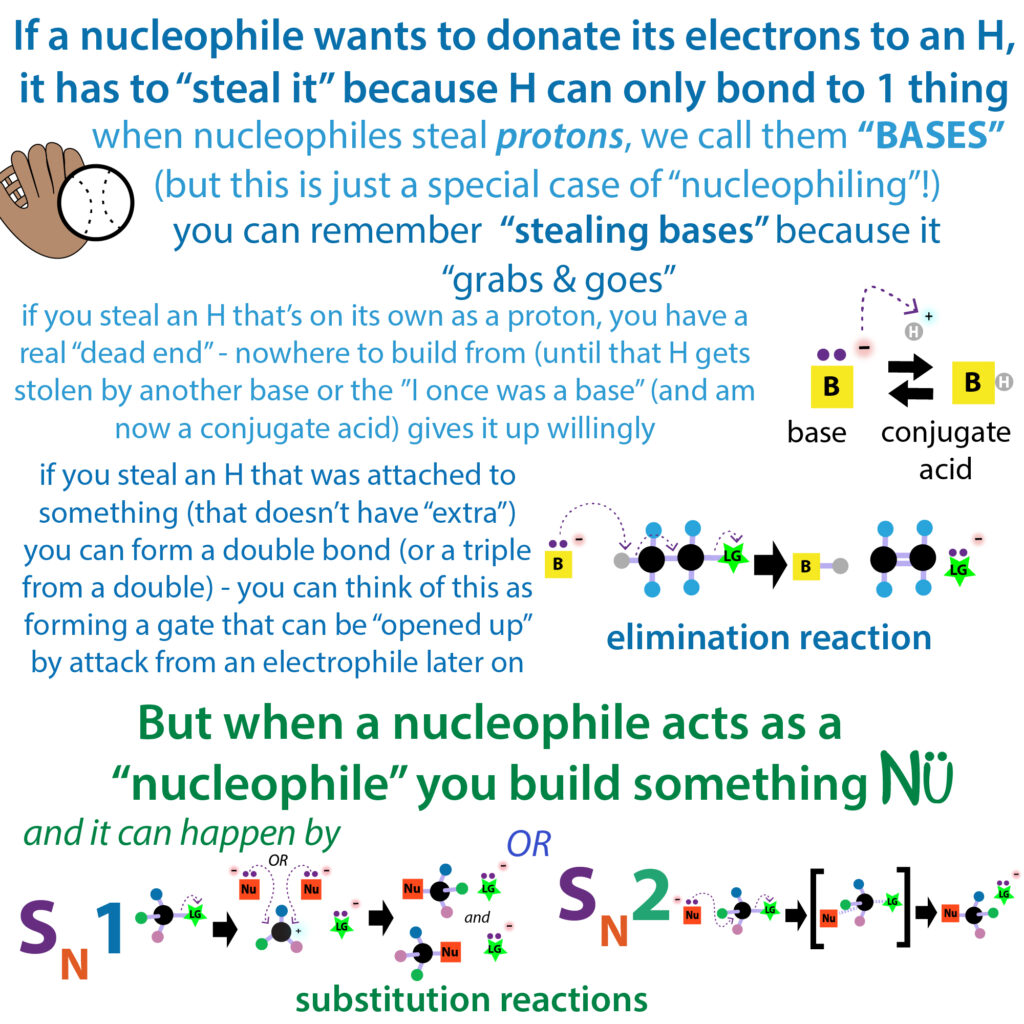
However, forming a bond with H is a dead end because H can only form 1 bond. So, when a nucleophile acts as a base, going after a proton, the nucleophile can only snatch the one atom and the tree branch stops there. At least temporarily… you can often u-turn – give up an H⁺ (act as a Bronsted acid) and we can use this as a way to measure BASICITY, which brings up a subtle difference:
Nucleophilicity is a *kinetic* parameter that looks at reaction *rate* (“how fast” ). BUT Basicity measures is a *thermodynamic* parameter that looks at “how far” the reaction goes (how much reactant is converted to product). Therefore, things that slow down a reaction could lower nucleophilicity without affecting basicity because you’ll get the same amount of product eventually.
H’s come and go much easier than other things because they are *not* very electronegative (that lone proton doesn’t have much pulling power over electrons it tries to reign in), so you get an equilibrium between protonated & deprotonated forms. Basicity tells you about which form it prefers. So kinetics – how quickly it gets there. Thermodynamics – how happy it is once it’s there (if it’s not happy, it’ll come back so you’ll reach an equilibrium with a lower concentration of the reacted form)
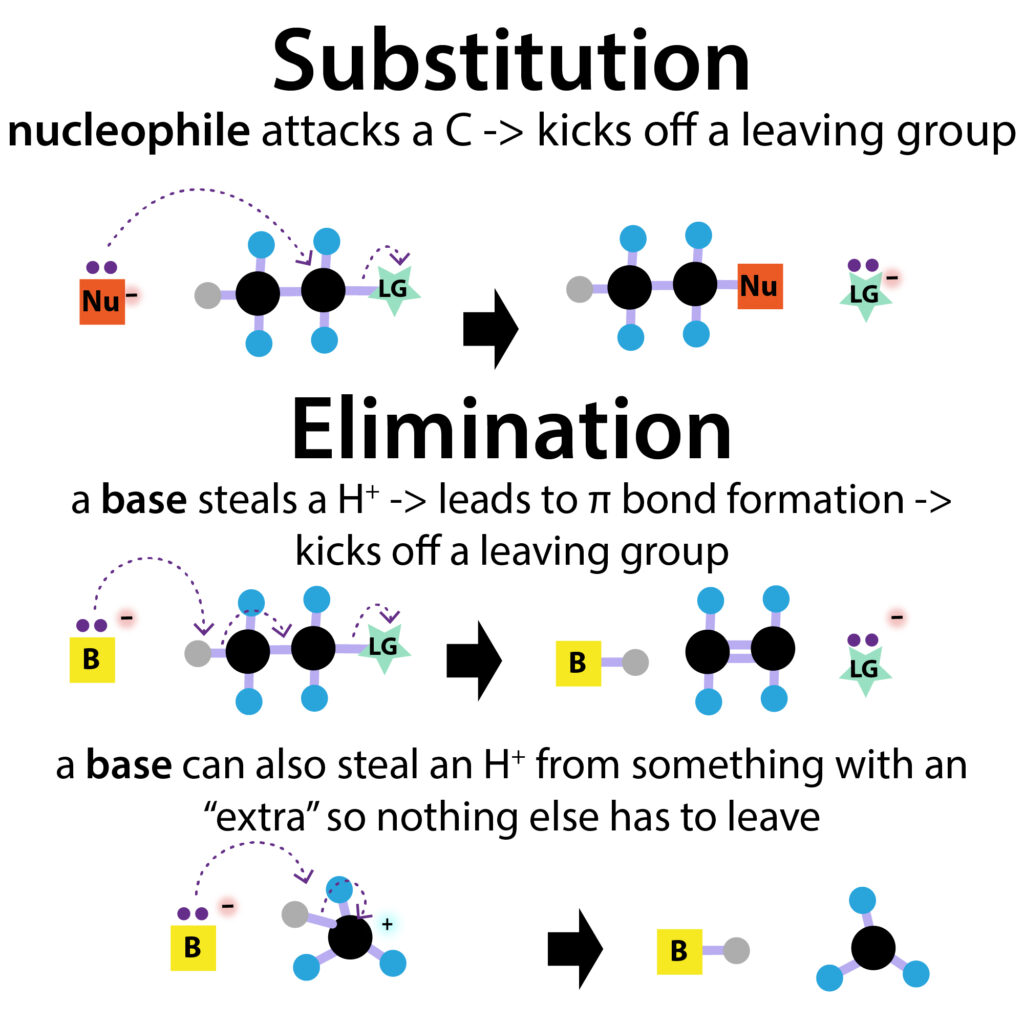
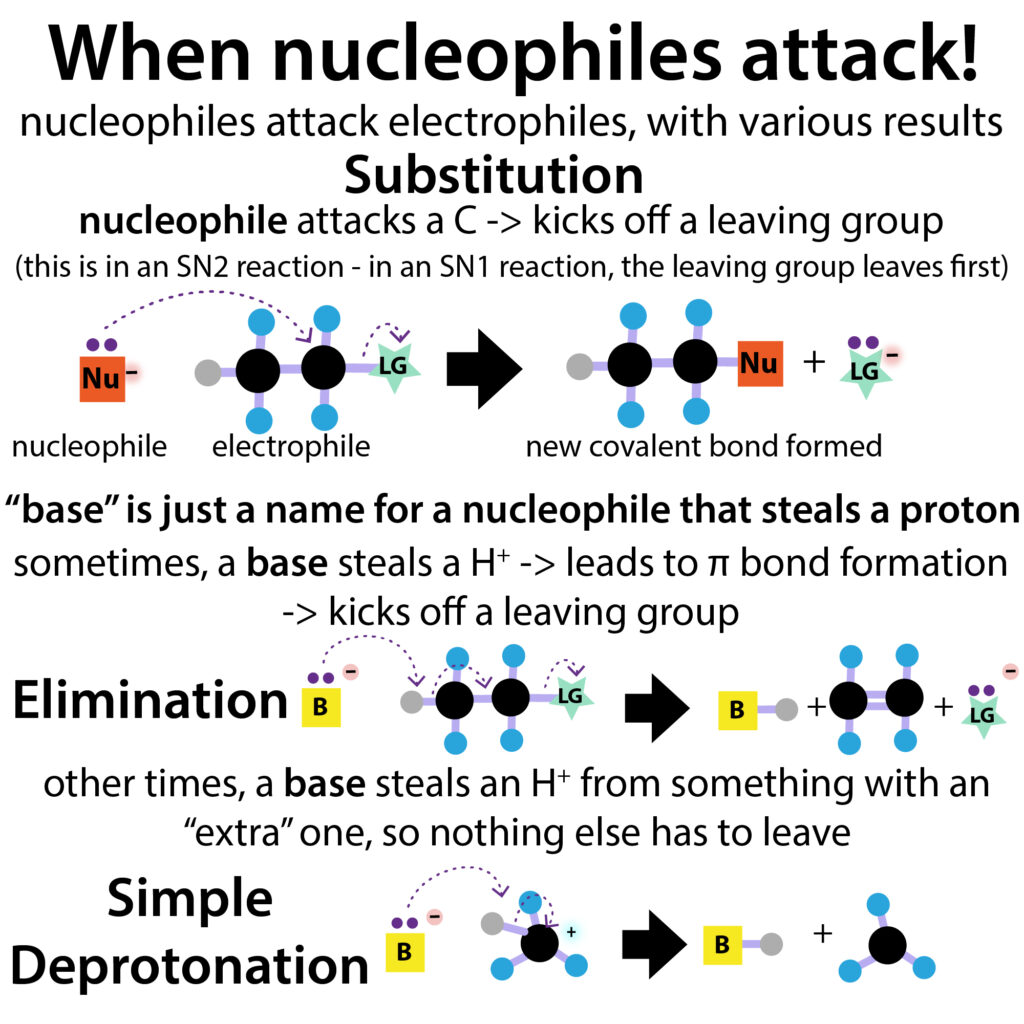
Because the base steals a proton *without electrons.* the thing the H was previously bound to is now left with “extra electrons” – if it’s connected to something else, it can share this excess to turn a single bond into a double bond or a double bond into a triple bond -> we call this an ELIMINATION PRODUCT (as opposed to a SUBSTITUTION PRODUCT)
SUBSTITUTION: nucleophile attacks the CARBON in C-LG -> forms Nu-C bond -> R-LG bond breaks -> left w/ Nu-C & LG (C can form up to 4 bonds & the LG is just one “branch” so there are still 3 “branches”
ELIMINATION: base (B) attacks the HYDROGEN in H-C-C-LG -> forms B-H bond & breaks H-C bond -> the C “panics” because it’s left with extra electrons -> uses those electrons to form an even stronger bond with the carbon next to it -> C=C-LG now that 2nd carbon has too many bonds -> kicks off a LG -> C=C + LG + BH
A couple memory helpers:
I often think of “bases” as snatchers – if you’re a baseball fan, you can think of “Stealing bases” ⚾️ they grab an H – & “nucleophiles” as more of builders – you’re usually connecting “bigger pieces” to build something “Nu”
A “base” will give you an “elimination” product instead of a substitution product. You can remember it as reaching a dead end and “building a gate”
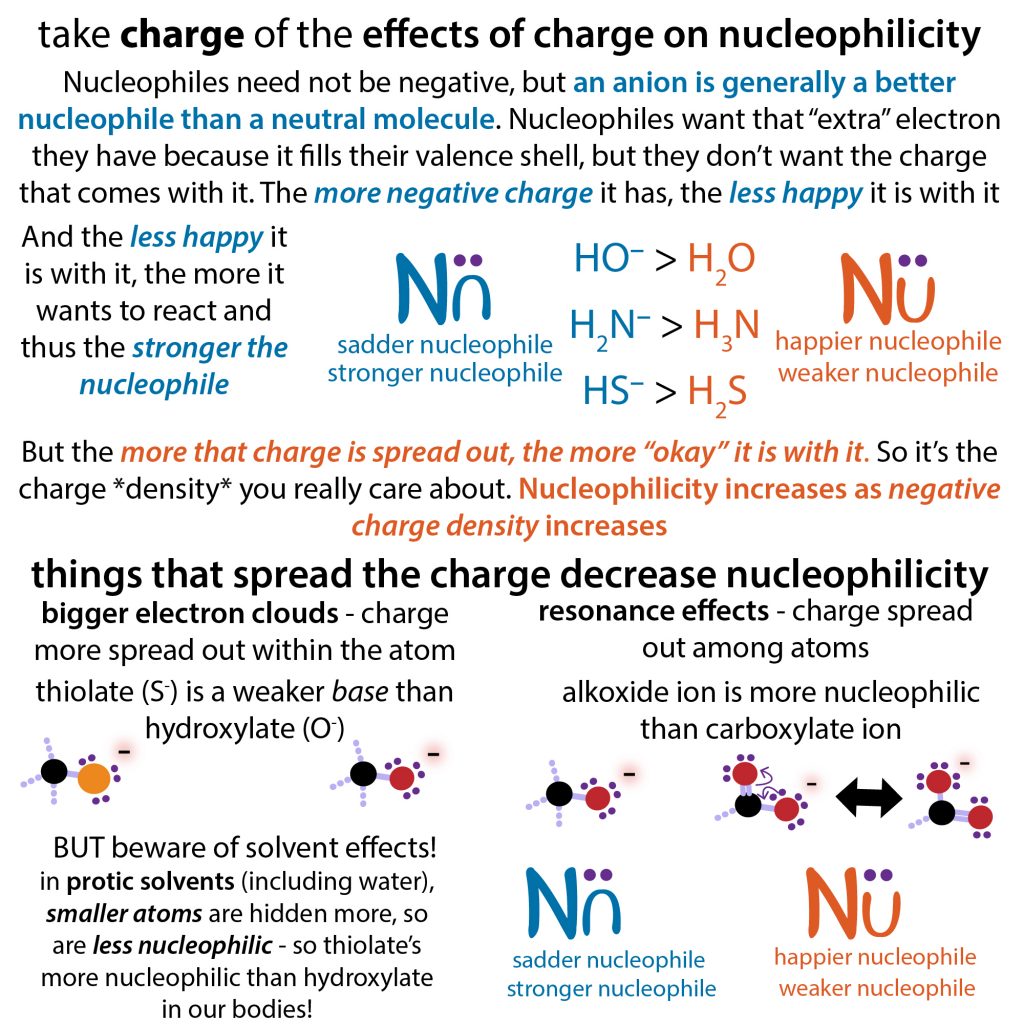
Things that *generally* increase nucleophilicity are things that make it harder to deal with extra negative charge. Some signs:
- Negative charge – indicates “excess” e⁻ available to share
- Small atom size – less able to spread out the extra charge
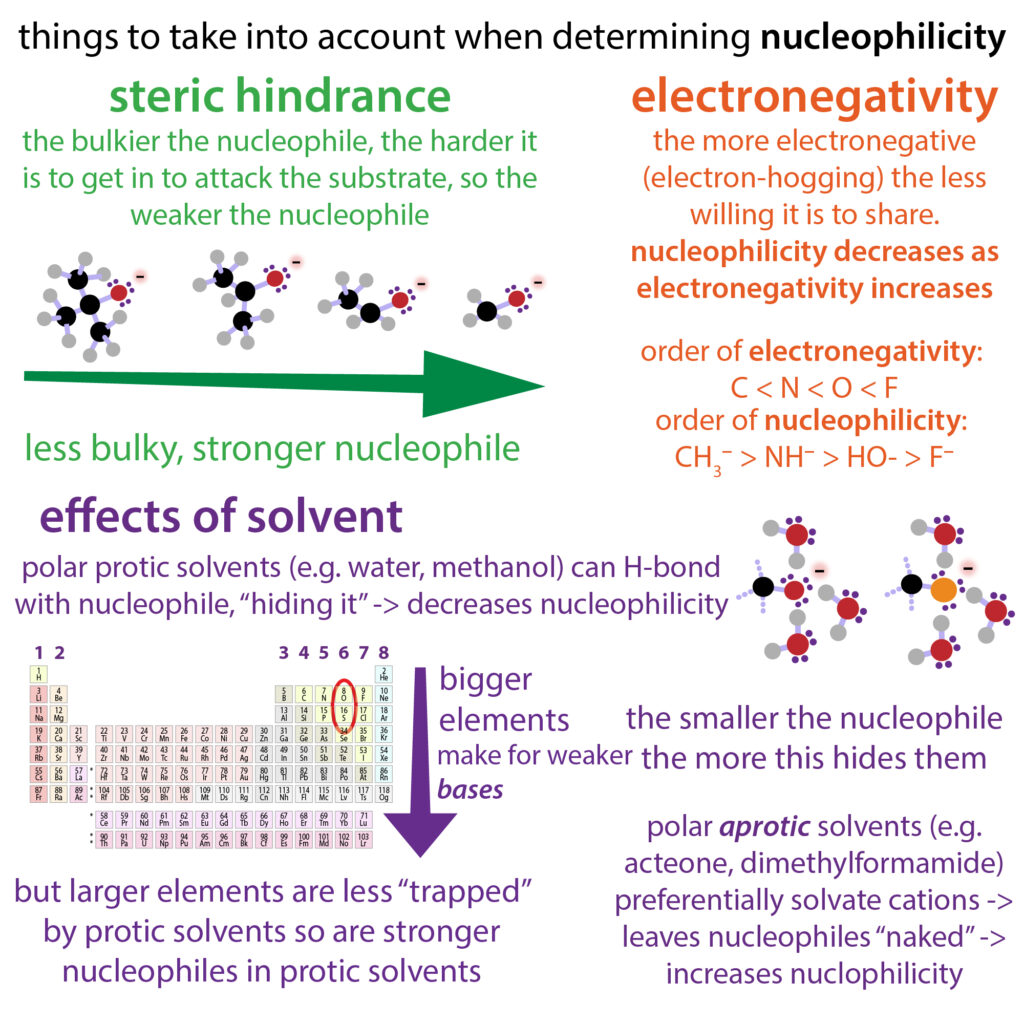
- Low electronegativity – less of a pull on the e⁻ held more loosely
- NOT Next to something electronegative – an electronegative neighbor can hog some of the extra charge, stabilizing it and making the electrons less “available” to form new bonds
Now for the more in depth details…
More on nucleophilicity vs basicity:
A lot of times the difference between whether something acts as a nucleophile or a base is simply whether there are H⁺ around to take. In a PROTIC solvent (like water or alcohols) there *are* because H⁺ can “come and go” relatively easily from O because O’s really electron-hogging (electronegative) so H “gives up” & leaves its electron with the O, leaving as H⁺. But in an Aprotic (non-protic) solution (like some organic solvents like acetone, acetonitrile, dimethylformamide (DMF), & dimethylsulfoxide (DMSO)) there aren’t any protons available to be taken, so an atom couldn’t act as a “base” even if it wanted to! But it *can* still act as a nucleophile.
In a protic solution, however, where an atom has a choice of acting as a nucleophile OR a base things get more complicated. There are a couple things that can “tip the scale” towards favoring one or the other
accessibility
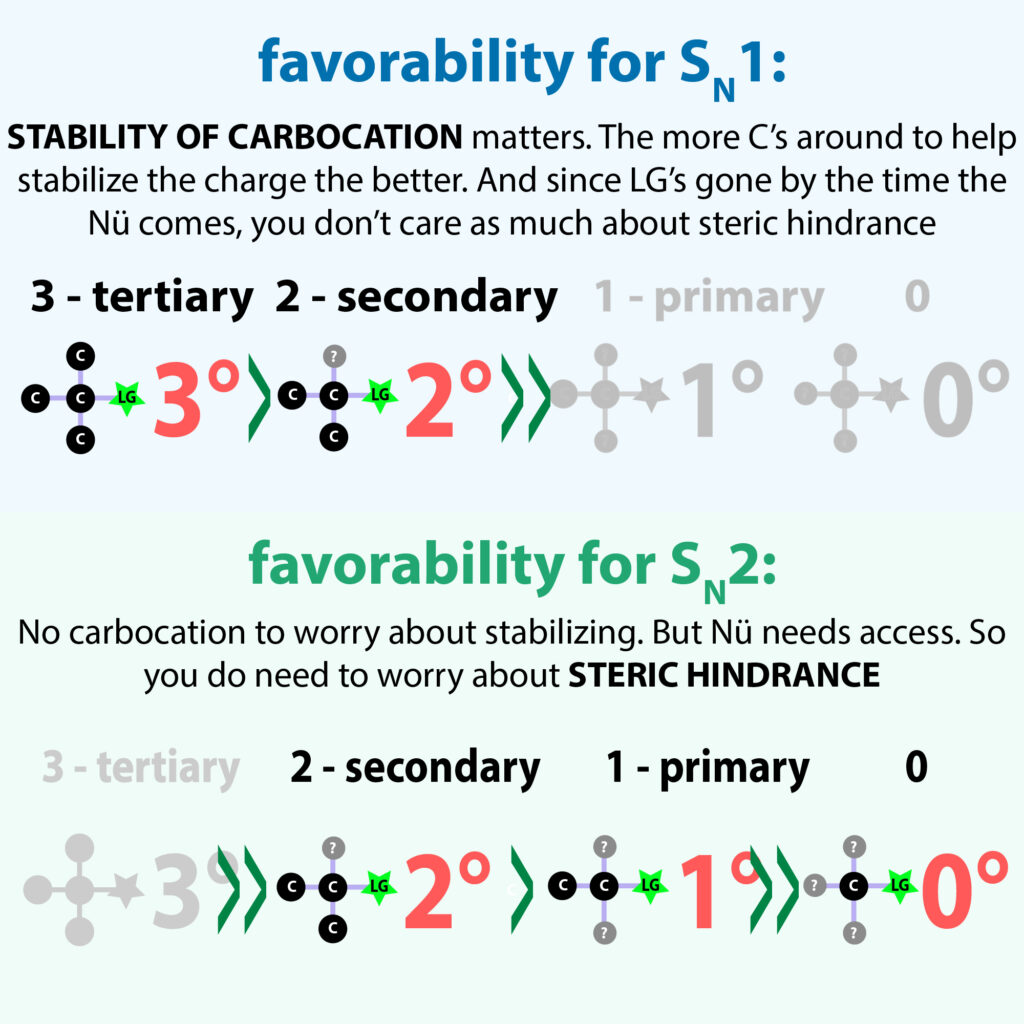
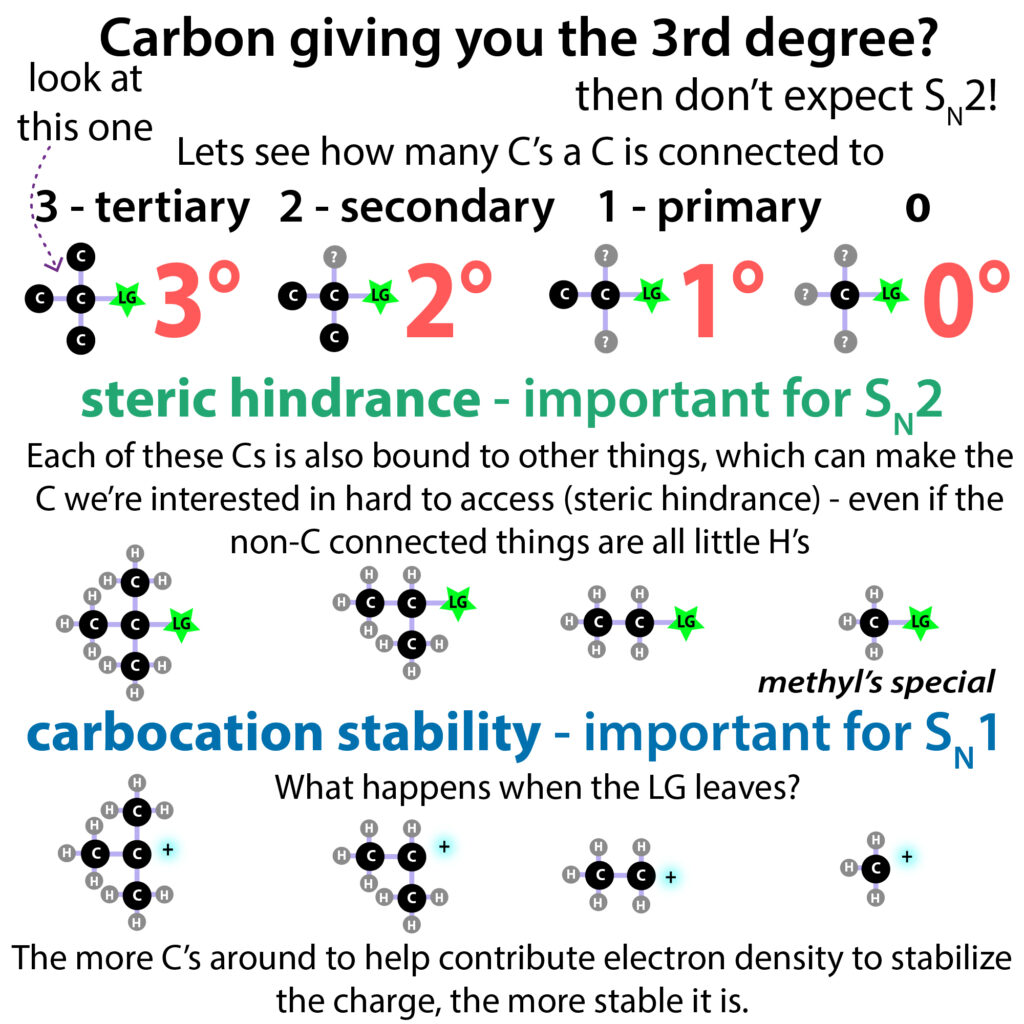
- of electrophile (if the electrophile is “hidden” by bulky neighbors it can be hard to get in)
- similarly, you can have accessibility issues with the nucleophile. The bulkier the region around the nucleophilic site, the harder it is for the electrophile to reach it. It’s easier for little protons to get in than bigger molecules, so this “problem” favors acting as a base. And helps explain why the amino acid threonine (a secondary alcohol) is a weaker nucleophile than serine (a primary alcohol)
But serine’s not as good of a nucleophile as cysteine which has a thiol (SH) functional group instead of an alcohol (OH) functional group) – at least in our bodies – because of solvent effects.
O is smaller than S. This makes the deprotonated form of the alcohol group (the alkoxide) more *basic* than that thiol group’s deprotonated form (thiolate) because the S has a bigger electron cloud it can spread out it’s negative charge in so it’s less “bothersome,” so basicity decreases as you go down the periodic table and atom size increases.
BUT for nucleophilicity you have to consider the solvent because smaller atoms get hidden more by the solvent they’re surrounded in) – even if it hasn’t fully stolen an H from the solvent it can still H-bond to it, leading to getting caged by solvent. In our bodies, where our solvent is water, which is protic, the bigger the atom the less tied up in the solvent cage it is, so the stronger the nucleophile -> this is why thiolates (RS⁻) are more electronegative than carboxylates (RO⁻) so cysteine is a better nucleophile than serine
And, in fact, you find cysteines involved in lots of nucleophilic attack reactions in our bodies, such as cysteine proteases, which use a cysteine to attack peptide bonds and cut up proteins!
A little more about substitution reactions:
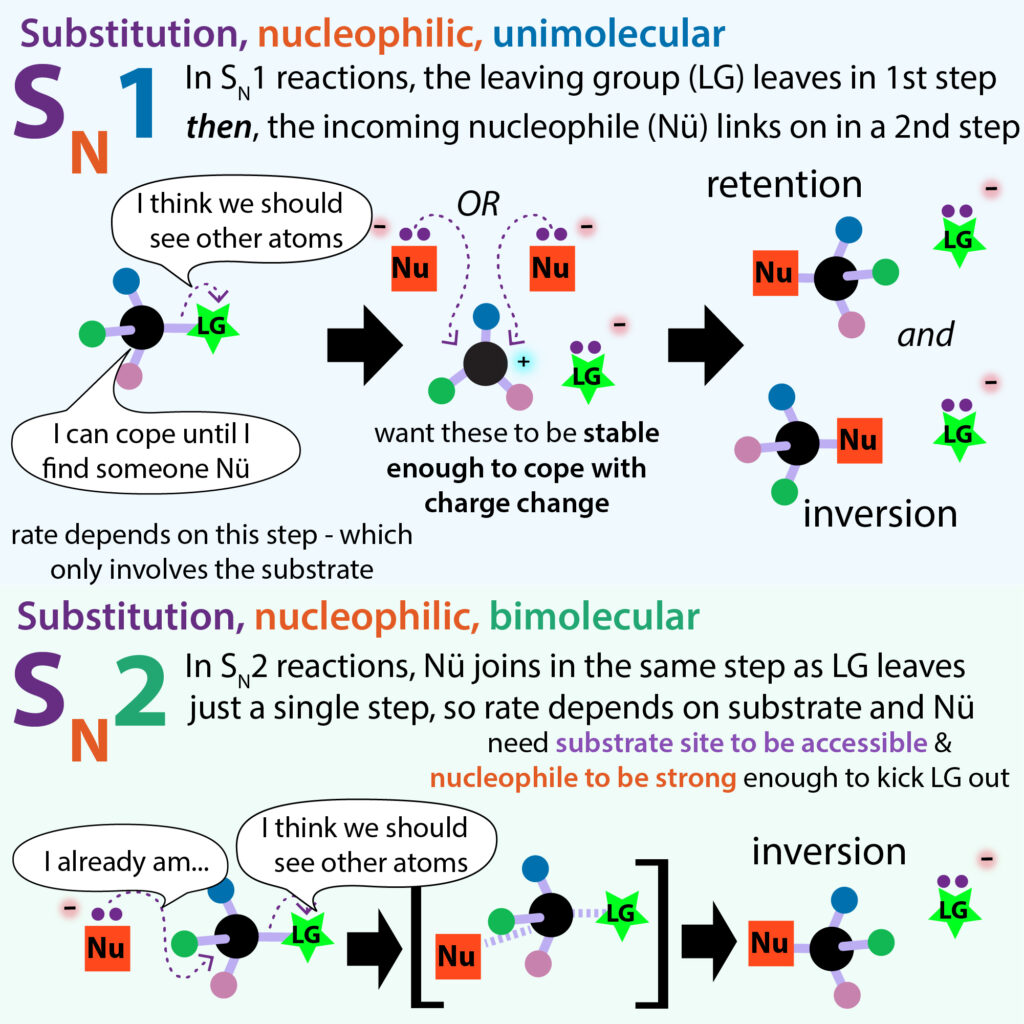
You can do this “all at once” (one attacks while the other leaves) (i.e. A + B-C -> A + B + C- -> AB + C) or stepwise – one attacks and makes things so uncomfortable and crowded that the original “housemate” leaves (i.e. A + B-C -> [A- – B – -C] -> A-B + C). The former (all at once way) is called SN2 and the latter (one at a time) SN1.
I often had a hard time remembering which is which, but it helps if you can remember what the numbers stand for – they tell you the # of molecules in the rate-limiting (slowest) step in the reaction. (This also means that the reaction rate will depend on the concentration(s) of those molecules.
For an SN1 reaction, the slowest step is “creating the electrophile” – getting something to want to be attacked. In o-chem-y reactions this often involves carbocation formation (a carbocation is a carbon with a + charge, which is weird, and carbon thinks so too, so it doesn’t want to stay like that, so is happy to accept electrons from nucleophiles that offer to attack. Since this electrophile formation only includes a single molecule, we say the rate limiting step is “unimolecular” making this a “Substitution, Nucleophilic, unimolecular (1)”
For an SN2 reaction, there’s only 1 step, so it’s rate-limiting “by default” – and the step involves 2 molecules, so it’s bimolecular (so you get to write a 2). more on SN1 vs SN2 here: http://bit.ly/sn1vssn2