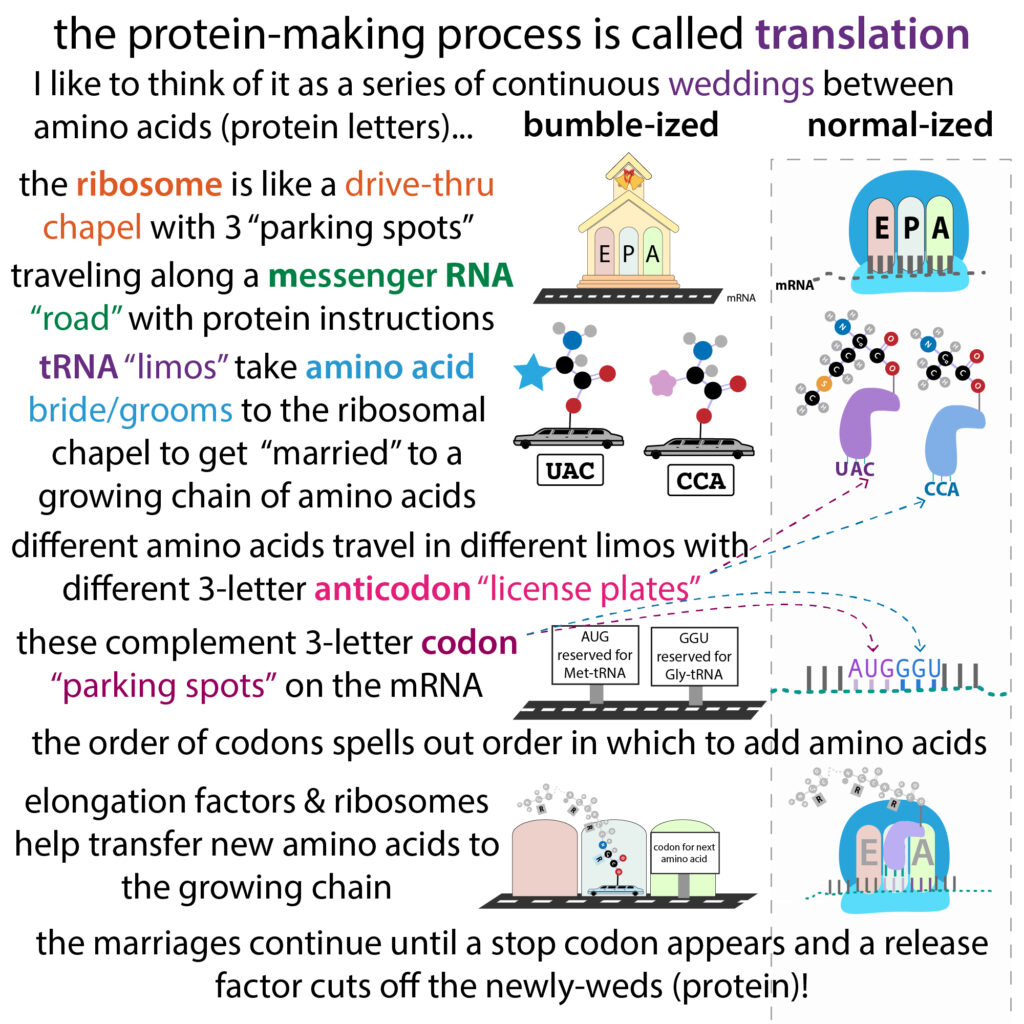
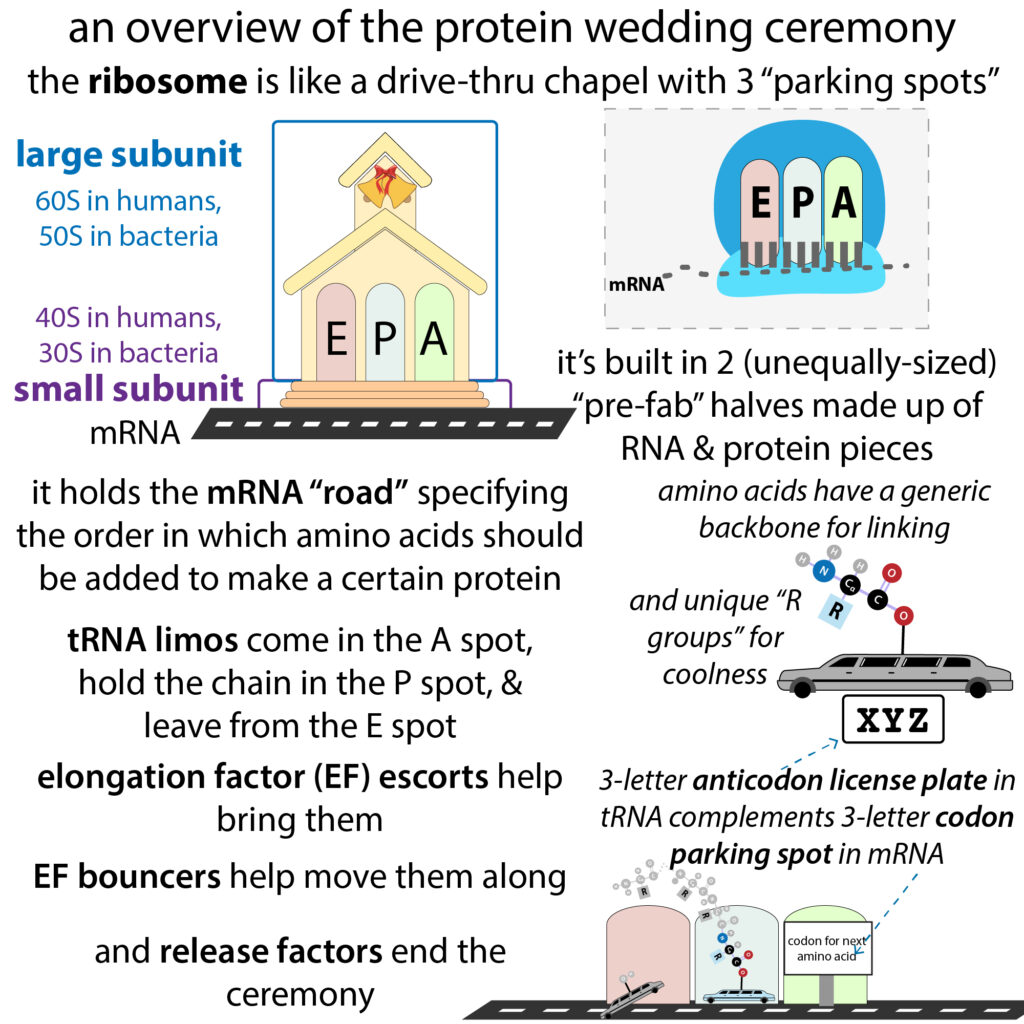
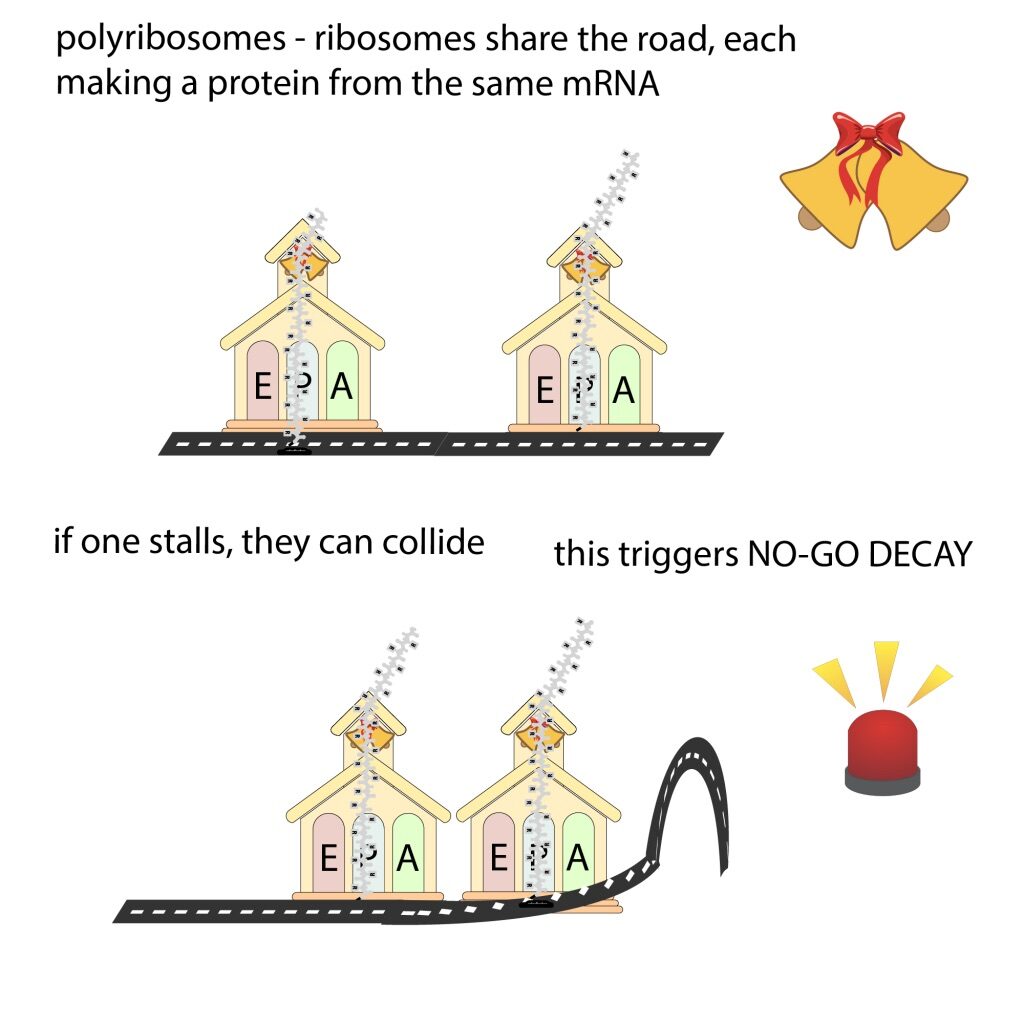
In each of your billions of cells, millions of ribosomes are traveling along hundreds of thousands of messenger RNAs (mRNAs), using the mRNA’s instructions to piece together the correct amino acids to form desired proteins (in a process called translation). Perhaps even more amazing is that all goes well most of the time – but not always! If there is a problem with the mRNA, the ribosome can get stuck (stall) when trying to translate it. This stalling is actually a good thing, though, because it alerts to cells that something’s wrong with the mRNA, and allows them to come in with their destruction machinery to degrade the faulty mRNA before other ribosomes reach the same fate and before more messed-up proteins or partial proteins get made.
link to video in case embed isn’t working: https://youtu.be/Z6_ny9DE9Yw
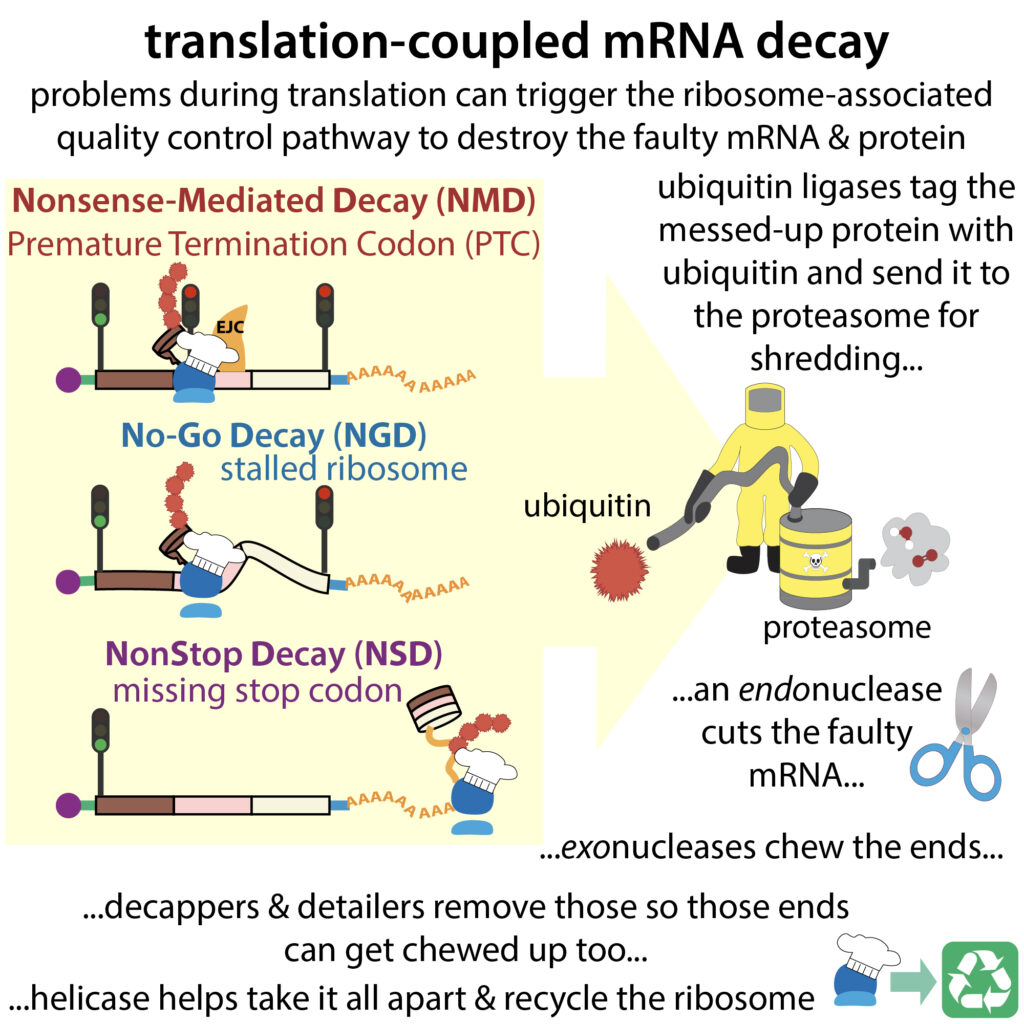
There are 3 main forms of mRNA surveillance that take place, which differ in what kinds of faulty mRNA they detect and what molecular machinery is involved. These 3 pathways are:
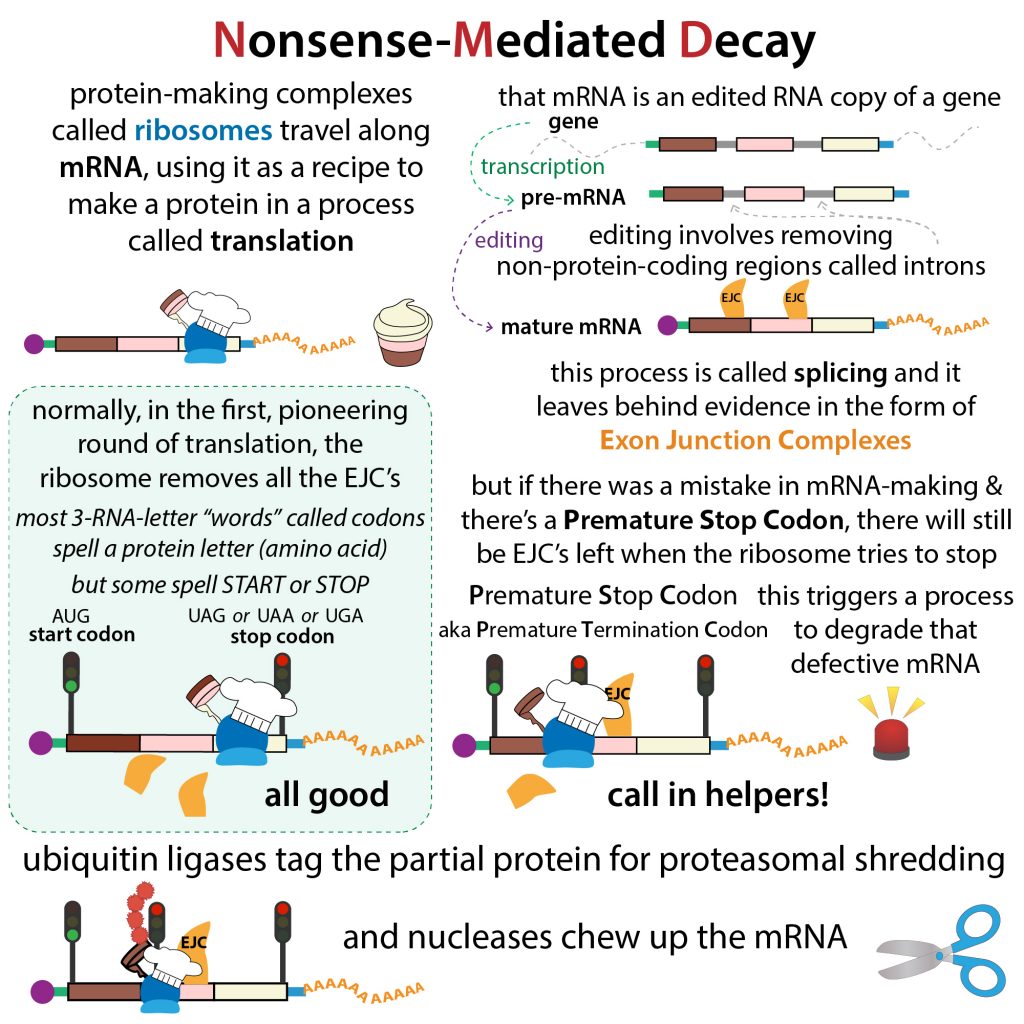
- Nonsense-Mediated Decay (NMD) – deals with mRNA transcripts that have premature stop/termination codons (PTCs) so the ribosome stops making a protein midway through
- NonStop Decay (NSD) – deals with the sort of opposite situation, transcripts that are missing stop codons, so the ribosome plows on through to the end end of the transcript, polyA tail and all, and still can’t recruit the termination machinery needed to let it off
- NoGo Decay (NGD) – deals with ribosomes that stall for some other reason (weird secondary structure, etc.) and cause traffic jams (ribosome collisions)
They may use different players but the end result is usually the same:
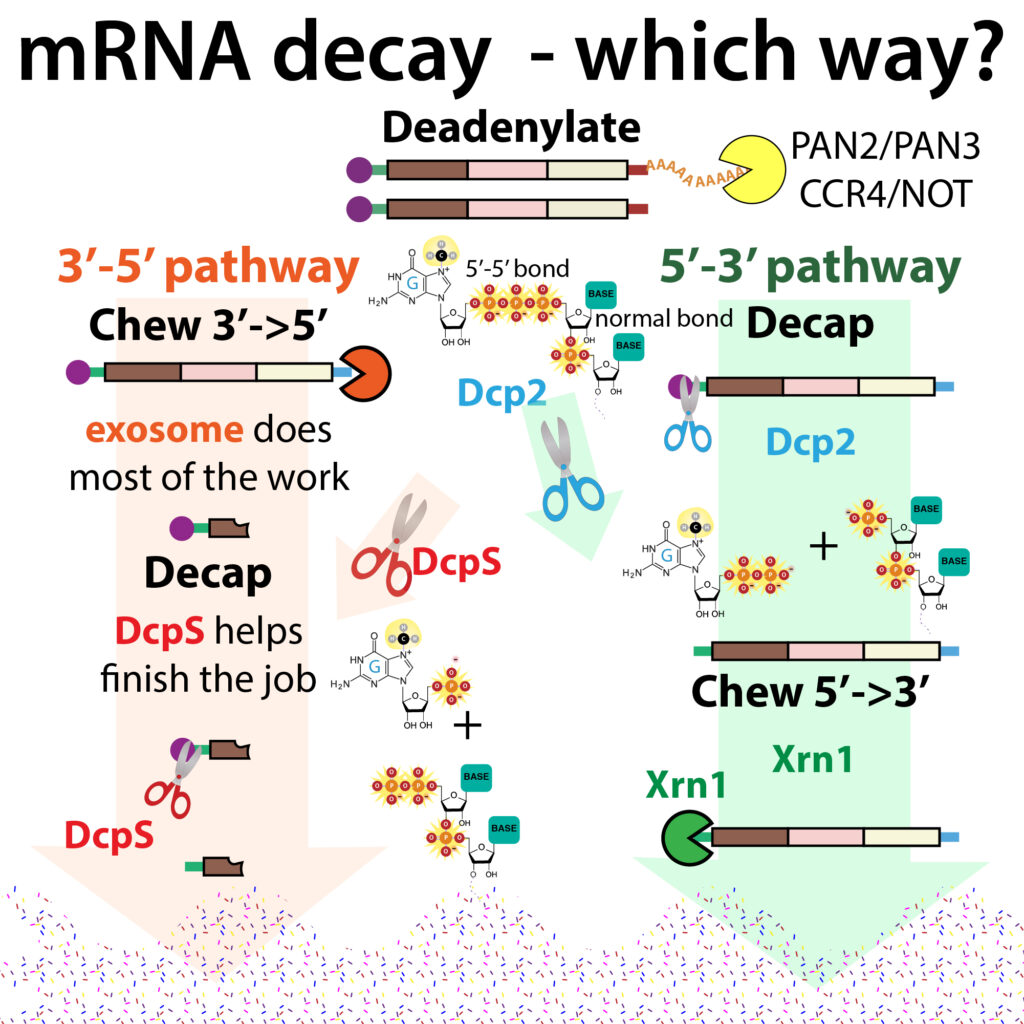
- Degrade the mRNA so other ribosomes don’t try to use it: cut the mRNA near the stalled ribosome, exposing unprotected ends to RNA chewers (exonucleases) that can finish the job
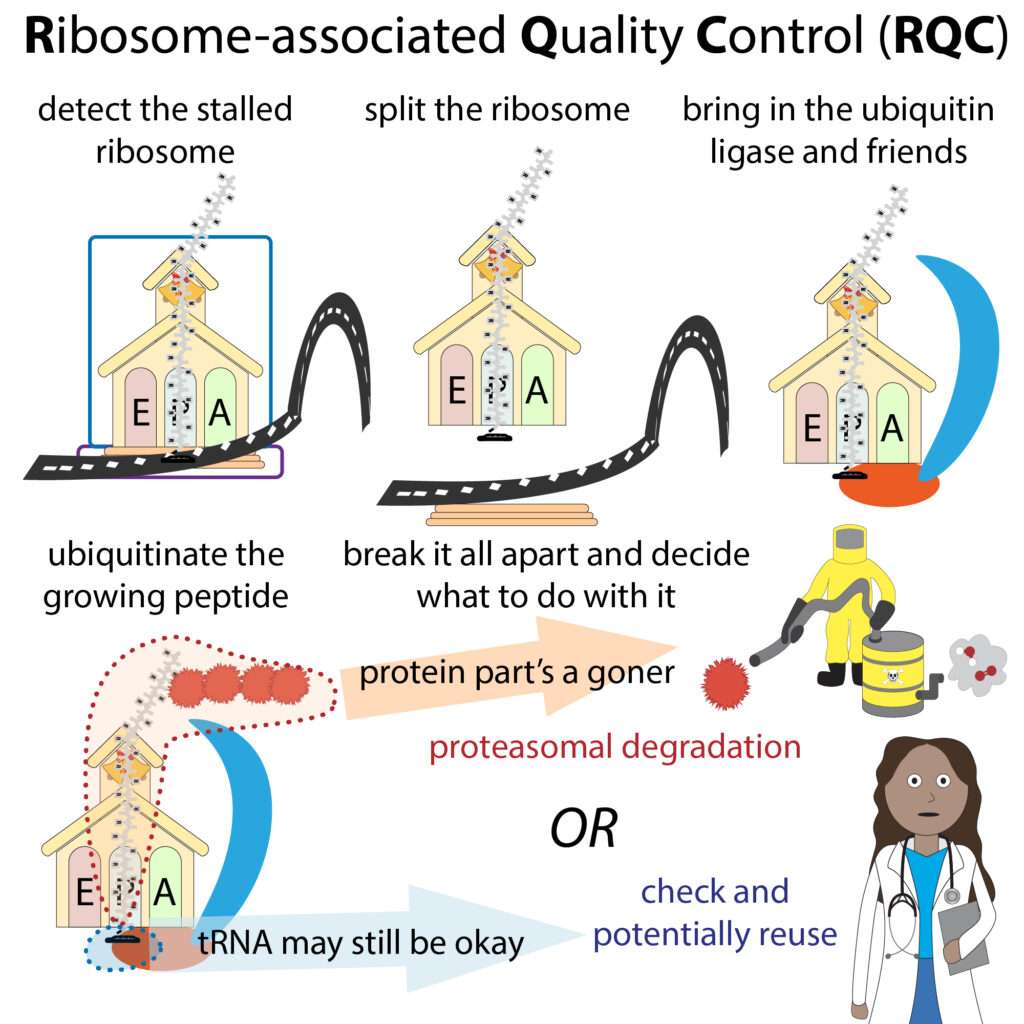
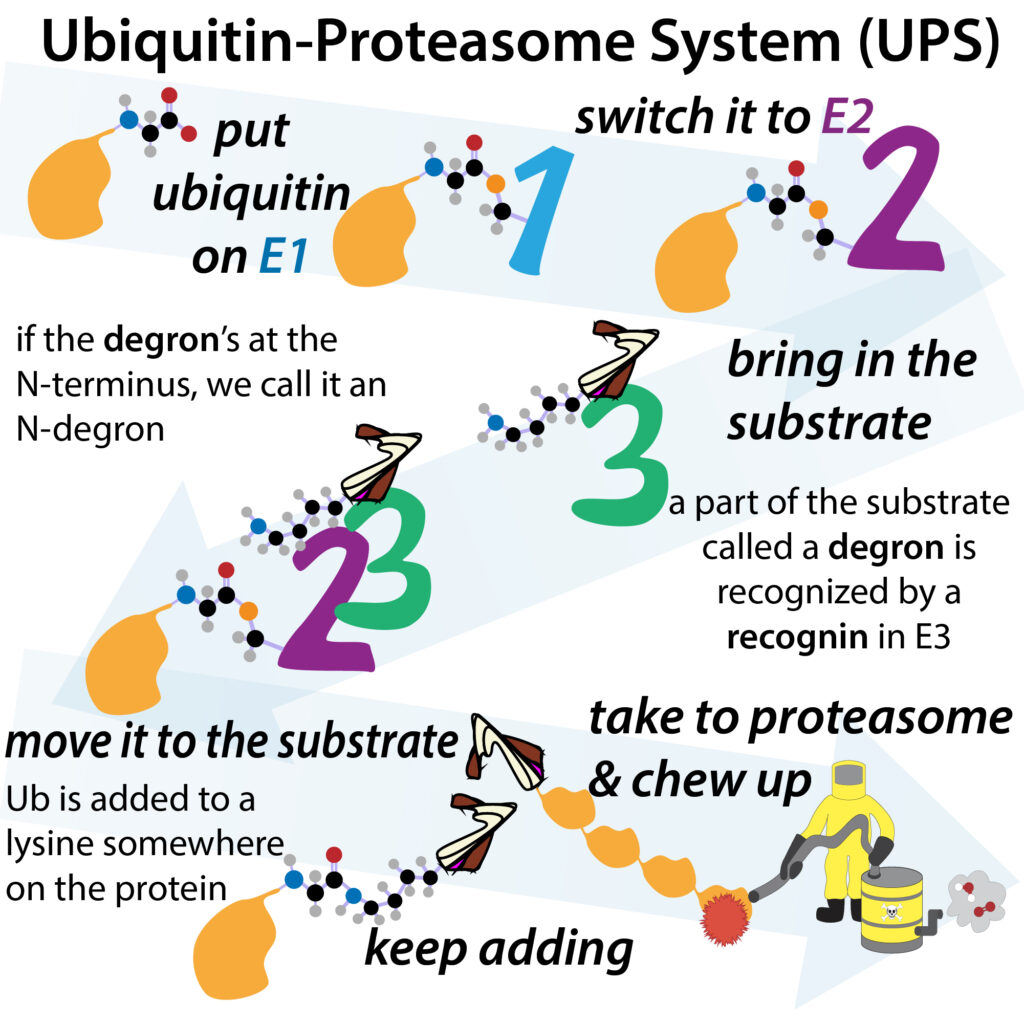
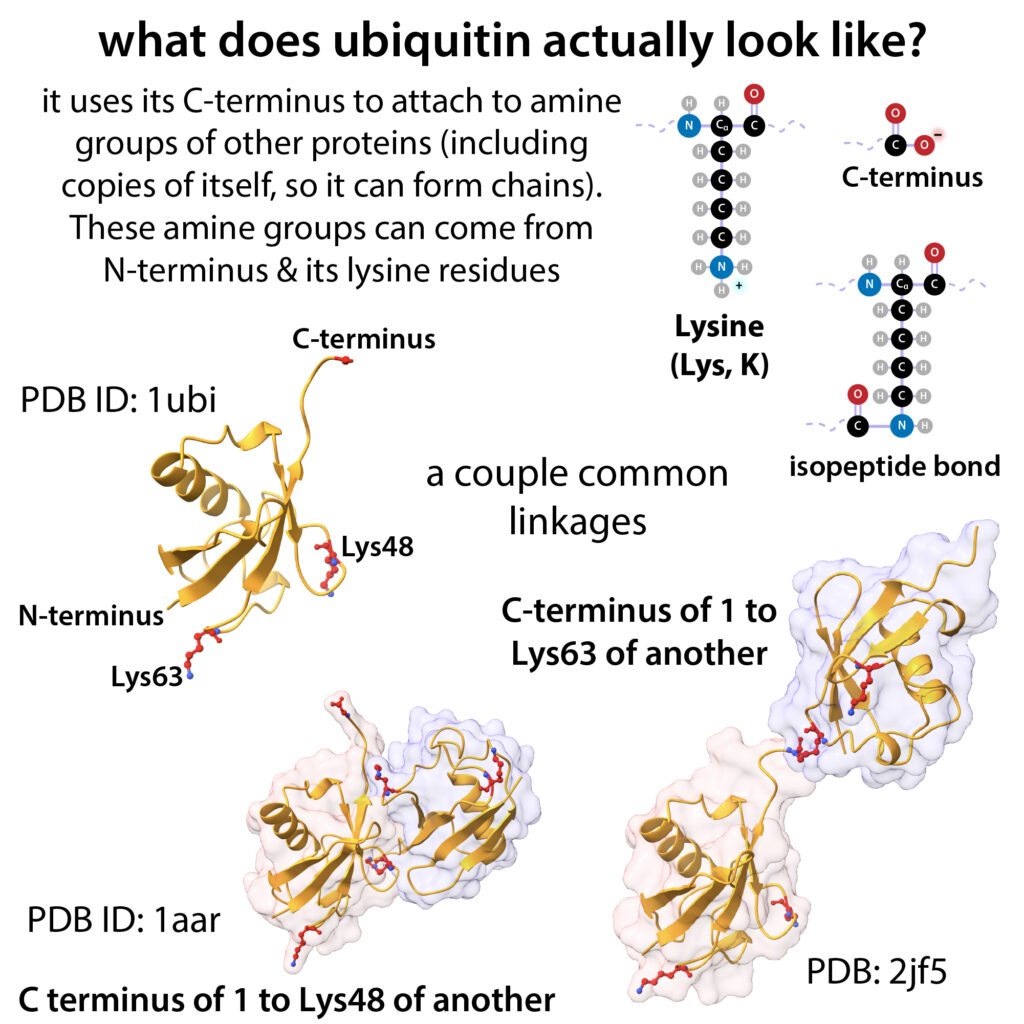
- Degrade the nascent (newly-formed) peptide (the probably messed-up protein that was getting made) before it can go around wrecking havoc in the cell: ubiquitinate it (attach a little protein called ubiquitin to it) to give it a ticket to the protein shredder (proteasome)
- Free the ribosome – it wasn’t its fault and a lot of work and energy, lots of protein and RNA parts, went into making it so you want to use it as much as possible!: proteins called helicases spend energy to kinda pry things apart
- Check the tRNA and reuse if all’s okay: the tRNA gets cut in the ribosome associated quality control pathway (RQC) and the cut leaves a characteristic signature that allows it to be flagged for a check-up and repair before being released into circulation
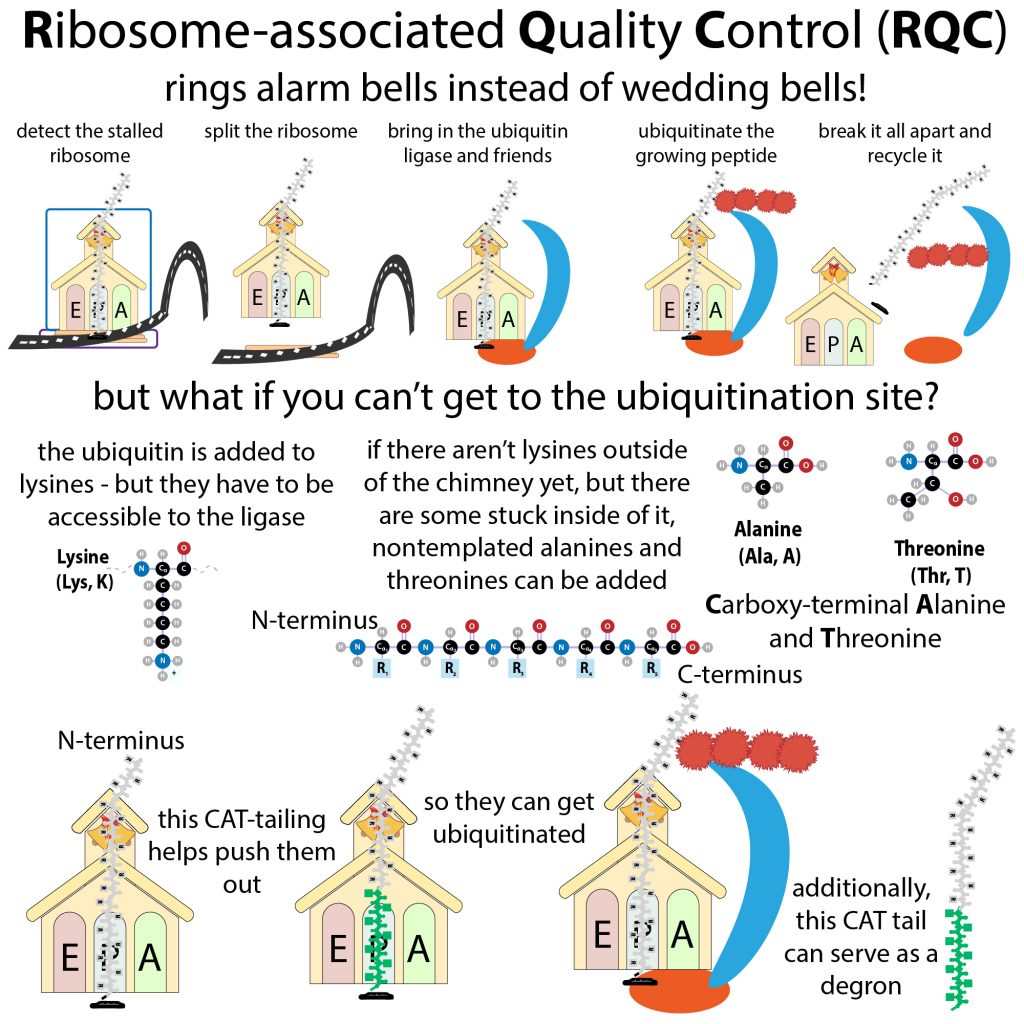
The terminology gets kinda muddled and aspects of the specific pathways overlap, but NSD and NGD have more in common with each other than with NMD. And from my best understanding, these two are said to follow a ribosome associated quality control pathway (RQC). In these pathways, stalled ribosomes are detected (such as by sensing collisions) and tagged by ubiquitin. Instead of targeting them to the proteasome like ubiquitin often does, these ubiquitination makes them the target of proteins that will split the ribosome into its large and small subunits. It’s kinda like prying open a jammed stapler – opening it up makes it easier to get out the peptide – and it provides access to sites for a different ubiquitin ligase (called Listerin) to come in and ubiquitinate that chain.
Although Listerin binds at the base of the large subunit, it wraps around to the top, kinda like the handle of a coffee mug, and does the actual ubiquitination up top, where the chain’s exited the tunnel already. It can’t ubiquitinate just any old place on that chain however. It needs there to be a readily-accessible lysine (one of the amino acids). If there’s not a lysine that fits the bill, the cell tries to make one. In a process called CAT tailing (seriously!), a complex adds a Carboxy Terminal tail to the growing end of the peptide. This tail consists of untemplated adenines and threonines (other amino acids). Adding them to the growing end pushes the amino acids hidden in the peptide exit tunnel out of the tunnel. If there was a lysine, now that lysine can be seen!
In the case of NonStop Decay, if the ribosome has traveled into the polyA tail it will start putting in lysines because AAA codes for lysine (when the ribosome encounters AAA it incorporates a lysine into the growing chain). So lysine shouldn’t be a problem (but the messed up transcript is!)
How about the tRNA? It needs to get cut apart from that peptide. And checked. Here’s some more detail on how that’s done, adapted from a longer past post I will link to:
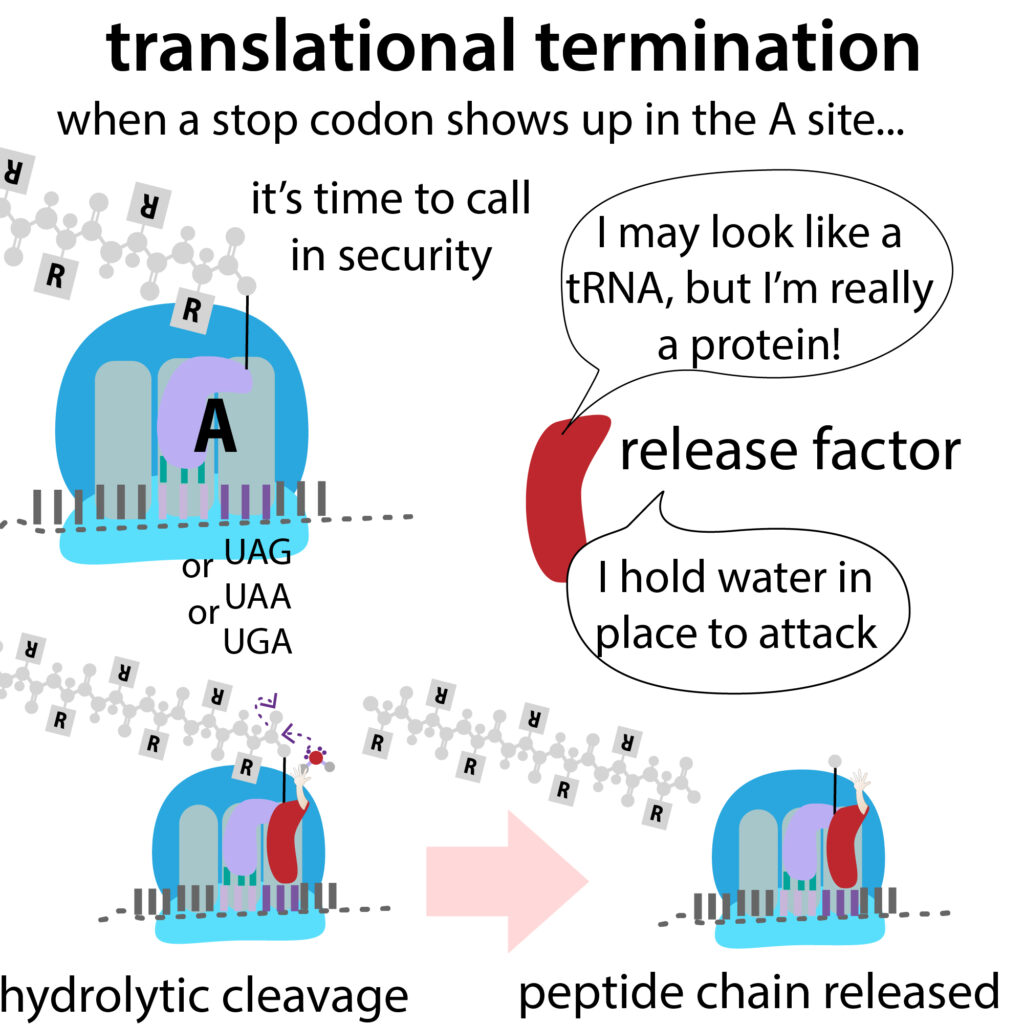
There’s another time tRNA & peptide chain have to be separated – when the chain is finished (a stop codon recruits a termination factor protein (eRF-1 in humans) that hydrolytically cleaves the peptide-tRNA bond.
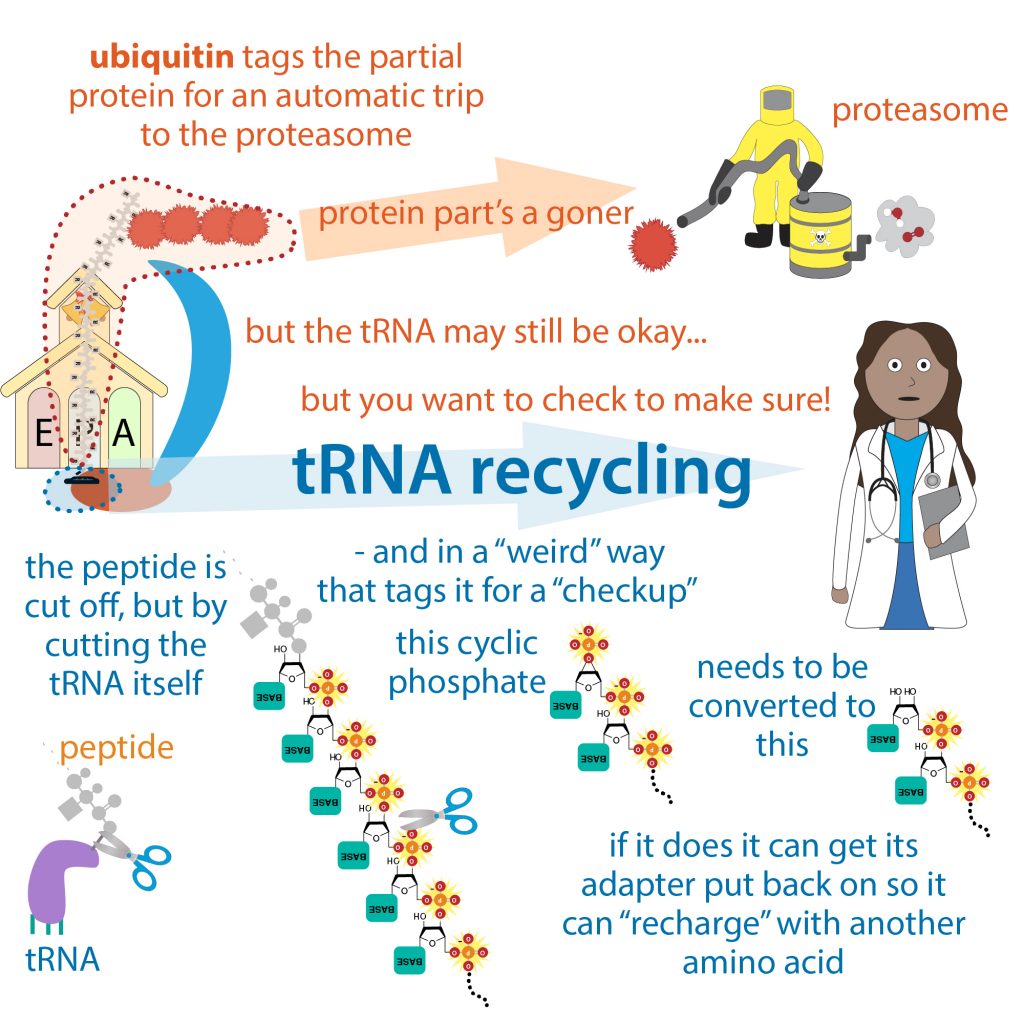
But something different happens in this stalled-ribosome case. The peptide is tagged for degradation, but the tRNA isn’t because it might still be usable – but you want to check. If you were to just separate the 2 the tRNA wouldn’t have any evidence of having been involved in any problems. But what if the tRNA had some problem that contributed to the problem in the first place? You don’t want to just stick it back into circulation.
So it gets “tagged” by removing its end. All tRNA has the same end – a “CCA” adaptor that allows it to bind to an amino acid. After a crash, the peptide chain gets removed by cutting the tRNA, NOT the peptide-tRNA bond. And, since tRNA is a a nucleic acid, you need a nuclease. Nucleases are like DNA/RNA scissors. Some chew from the ends (exonuclease) while others cut in the middle (endonuclease). We need an endonuclease here, and the one that’s involved is named ANKZF1 (Vms1 in yeast)
It cuts off that 3 nucleotide adapter. When it does so it leaves a mark in the form of a 2’-3’ cyclic phosphate. Which your cell thinks is weird – linking between RNA letters usually involves the 2’ “leg” so you’ve got to free it up if you want to add that adapter back on (which you have to do in order for it to get reused.
Because all tRNAs have this same adapter, the same enzyme (TRNT1) can add it back once it gets doctor’s clearance. If there is a problem with the tRNA’s folding, TRNT1 will add a double-tag “2 CCA” which targets it for degradation.
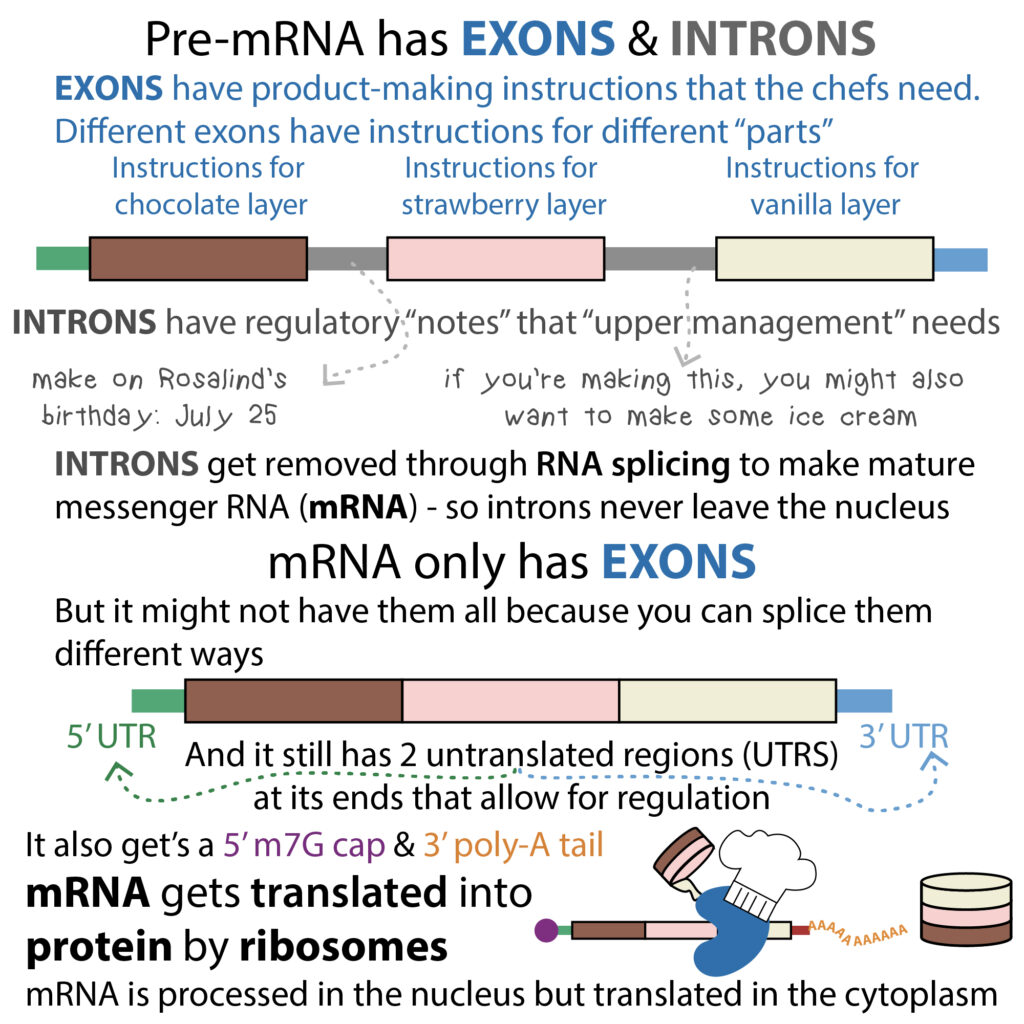
What about Nonsense Mediated Decay? In this case what happens is that when the ribosome reaches the premature termination codon, the release factor comes in as usual, but termination can’t occur “as usual” because instead of interacting with other termination machinery (which is too far away because it interacts with the tail), the release factor interacts with a protein called Upf1 and it’s NMD-y friends. This interaction is often facilitated through interactions with an Exon Junction Complex, left over at the scene of splicing. These EJCs are groups of proteins left ~20-24 letters upstream of the place where exons were joined. The first time a ribosome travels along a transcript (the pioneering round of translation) the EJCs get shoved off. But if the ribosome stops early, there can be EJCs that haven’t been plowed-into yet and which can therefore help with the NMD process.
It used to be thought that EJCs were *needed* but know we know they’re just helpful and it’s the distance from the tail that matters more. This is because that Upf1 protein kinda binds weakly along the mRNA even without it. If the ribosome stops near the tail, the termination machinery will bind the release factor machinery before Upf1 can get to it. But, the further you are from the end of the transcript, the more Upf1 will likely be present and therefore able to interact with that release factor. So you can actually even get NMD happening at normal stop codons if the transcript has a long 3’ UTR (regulatory region between the stop codon and the tail!).
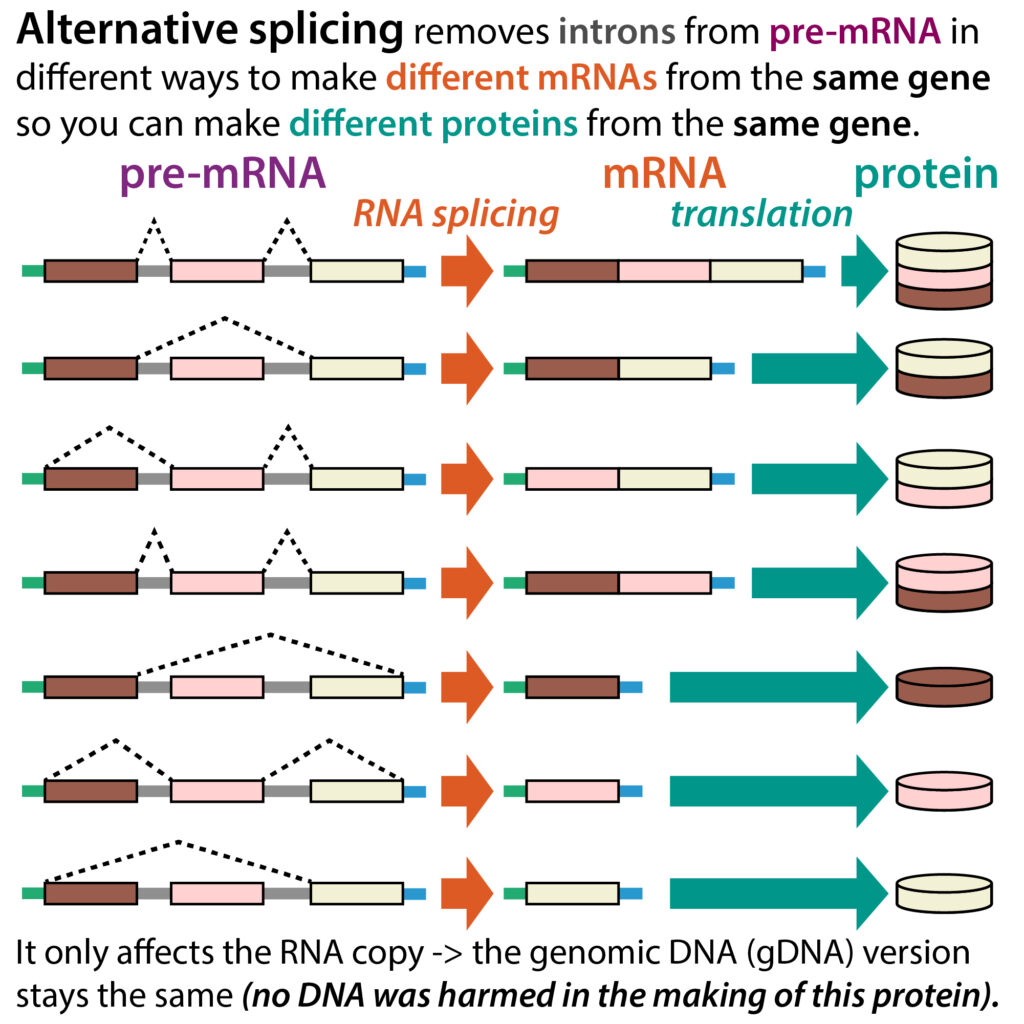
In addition to mutations triggering NMD, the process can kind of be triggered “on purpose,” such as through alternative splicing in order to regulate various transcripts in response to cellular cues. This is a really active area of research and I will direct you to the review article at the bottom of the page if you want to learn more.
Speaking of wanting to learn more, here’s some more detail on the actual NMD mechanism adapted from a past post I will link to:
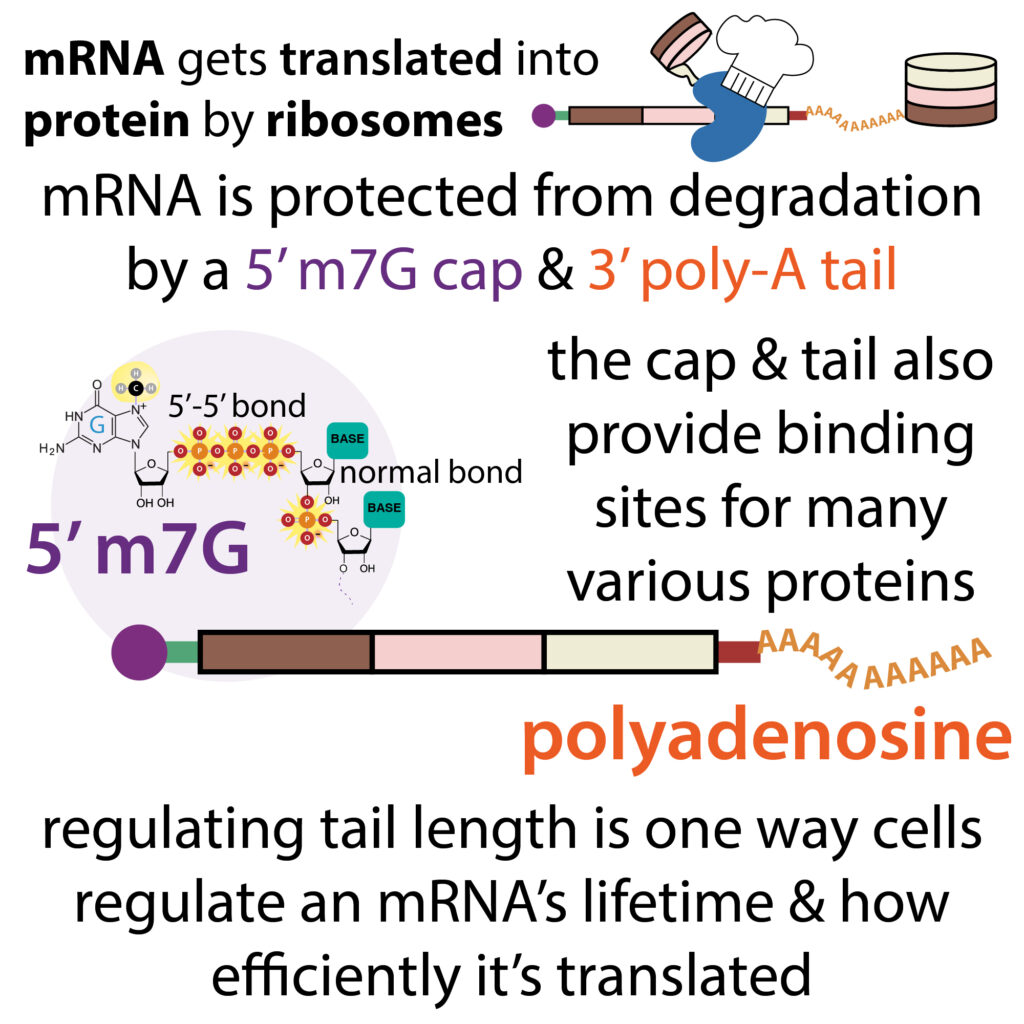
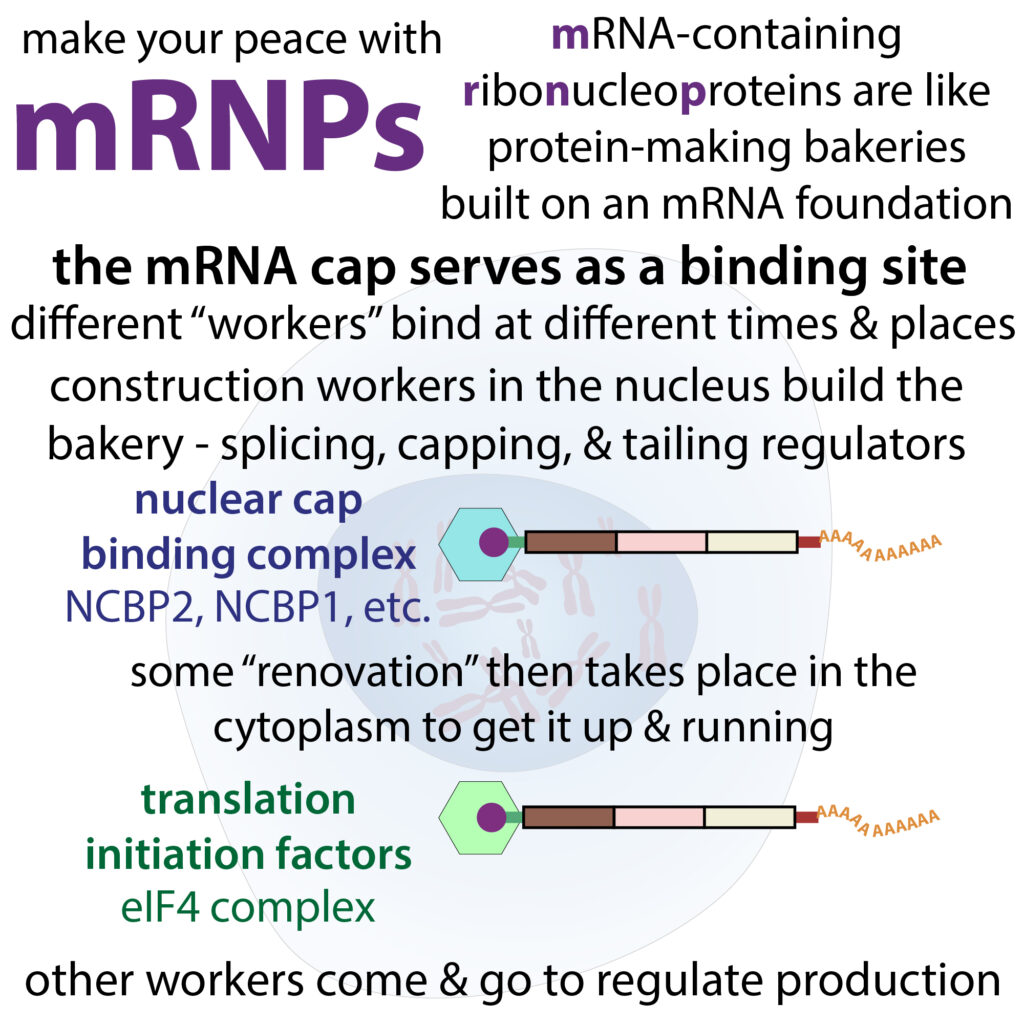
The cap and tail are recognized by various cap and tail binding proteins. And some of these help promote proper termination. But when you have a PTC, the helpers are too far away to help the ribosome out, so NMD happens instead. Termination factors are called in as usual (since there is a stop codon there), forming a so-called “SURF” complex (SMG1, UPF1, eRF1 & eRF3) that’s associated with the terminating ribosome. but instead of interacting with the proteins on the tail, SURF interacts with the proteins at the EJC and this forms a “DECID” complex that gets to work.
The key player is an RNA helicase called UPF1. It changes the mRNA’s shape, making it harder for stuff to stay on. And its friends egg it on (in ways like binding it or phosphorylating it (adding a negatively-charged phosphate group) in a way that causes it to adopt a more active shape.
There are a lot of friends involved because you have to take care of the mRNA, the partial protein, and the ribosome. One of the friends it calls in is a pair of “RNA scissors” (an endonuclease) called SMG6 which cuts the mRNA. This exposes naked ends which get chewed up by RNA end-chewers (exonucleases).
You also want to get rid of the partial protein, so ubiquitin ligases tag it with a chain of the small protein ubiquitin. The release factors help kick it out of the ribosome, and it gets sent the proteasome to get shredded.
The ribosome’s still useful though, and UPF1 and the release factors help take it apart and recycle it.
This all is a really active area of research and this is my best understanding of where things stand currently. I recommend keeping your eye on it – Rachel Green’s lab at Hopkins is one of the major pioneers in this field so she’s a good one to watch (and an awesome scientist). I will also link to some good review articles below.
But first, a note about why it’s such a hot topic. Well, in large part because of its role in various diseases. If you think about how you can get faulty transcripts, one way is if there is a mutation in the actual gene – this will mess up all the mRNA copies – and another way is if there’s a sort of one-off boo-boo during transcription of splicing. The gene mutation is gonna be more of an issue because it can prevent cells from making functional proteins they need.
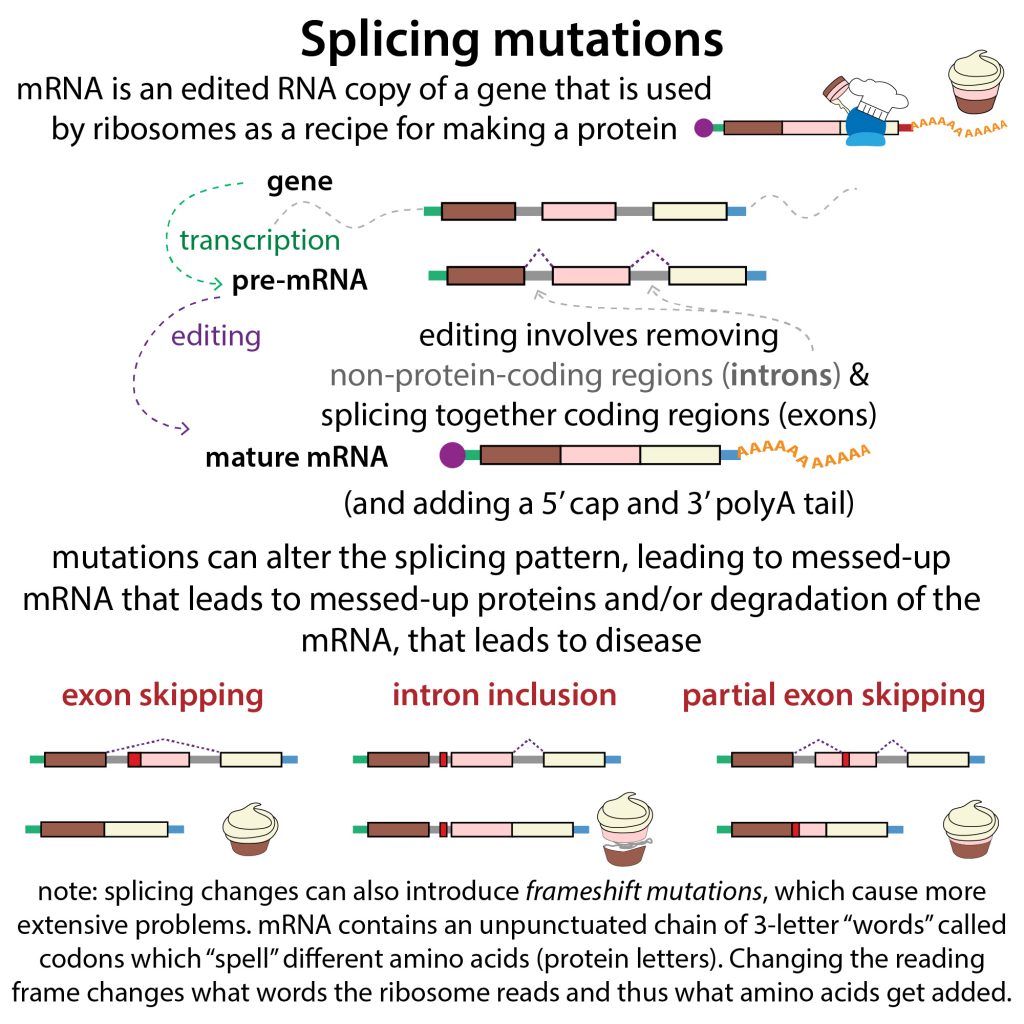
Point mutations (single DNA letter changes) can turn a protein-coding codon into a stop codon. Or turn a stop codon into a protein-coding one. This can lead to NMD or NSD, respectively. Additionally insertion or deletion mutations or splicing problems can cause frameshift mutations that introduce premature stop codons. Or the inclusion of an intron containing a “stop codon” can introduce one as well. So NMD is pretty “easy” to trigger through a variety of problems and can cause a variety of problems.
For example, an Israeli molecular geneticist named Batsheva Kerem discovered that a nonsense mutation in CFTR, the “gene behind” Cystic Fibrosis (CF) is one of the most common CFTR mutations in Israeli CF patients and triggers NMD. http://bit.ly/batshevakerem
Some therapies in development, including for CF, actually try to get cells to bypass quality control mechanisms like NMD in certain cases in order to allow (only slightly faulty) proteins to still get made (such as when there’s just a point mutation). These compounds are referred to as PTC read through compounds. (You might be wondering why this doesn’t mess up all the normal stop signals, but the read-through compounds aren’t fully efficient and it turns out that most genes have multiple stop codons at their end so if the first one gets read-through there’s still back-up!)
some references:
- Joazeiro, C.A.P. Mechanisms and functions of ribosome-associated protein quality control. Nat Rev Mol Cell Biol 20, 368–383 (2019). https://doi.org/10.1038/s41580-019-0118-2
- Lykke-Andersen, S., Jensen, T. Nonsense-mediated mRNA decay: an intricate machinery that shapes transcriptomes. Nat Rev Mol Cell Biol 16, 665–677 (2015). https://doi.org/10.1038/nrm4063
- Petr Tesina, Shuhei Ebine, Robert Buschauer, Matthias Thoms, Yoshitaka Matsuo, Toshifumi Inada, Roland Beckmann. Molecular basis of eIF5A-dependent CAT tailing in eukaryotic ribosome-associated quality control. Mol Cell (2023)https://doi.org/10.1016/j.molcel.2023.01.020
- Sitron, C.S., Brandman, O. CAT tails drive degradation of stalled polypeptides on and off the ribosome. Nat Struct Mol Biol 26, 450–459 (2019). https://doi.org/10.1038/s41594-019-0230-1
- Inada, T. tRNA recycling on stalled ribosomes. Nat Struct Mol Biol 26, 340–342 (2019). https://doi.org/10.1038/s41594-019-0222-1
more about translation: https://bit.ly/proteintranslationwedding & https://youtu.be/XFNg6OlKWvw
more about splicing: https://bit.ly/altsplicing ; https://youtu.be/lKl87g66Rrk
More about mRNA caps, tails, and decay: https://bit.ly/mrnalife ; YouTube: https://youtu.be/DCoVp_8zM-M
more about RQC: https://bit.ly/rqcontrol
more about NMD: https://bit.ly/nmdecay
more about translational reading frames & indels (insertion & deletion mutations): https://bit.ly/reading_frames & https://youtu.be/QBs9QSZaDbg
more about all sorts of things: #365DaysOfScience All (with topics listed) 👉 http://bit.ly/2OllAB0 or search blog: https://thebumblingbiochemist.com