Instant cold packs are a great way to feel thermodynamics in action!
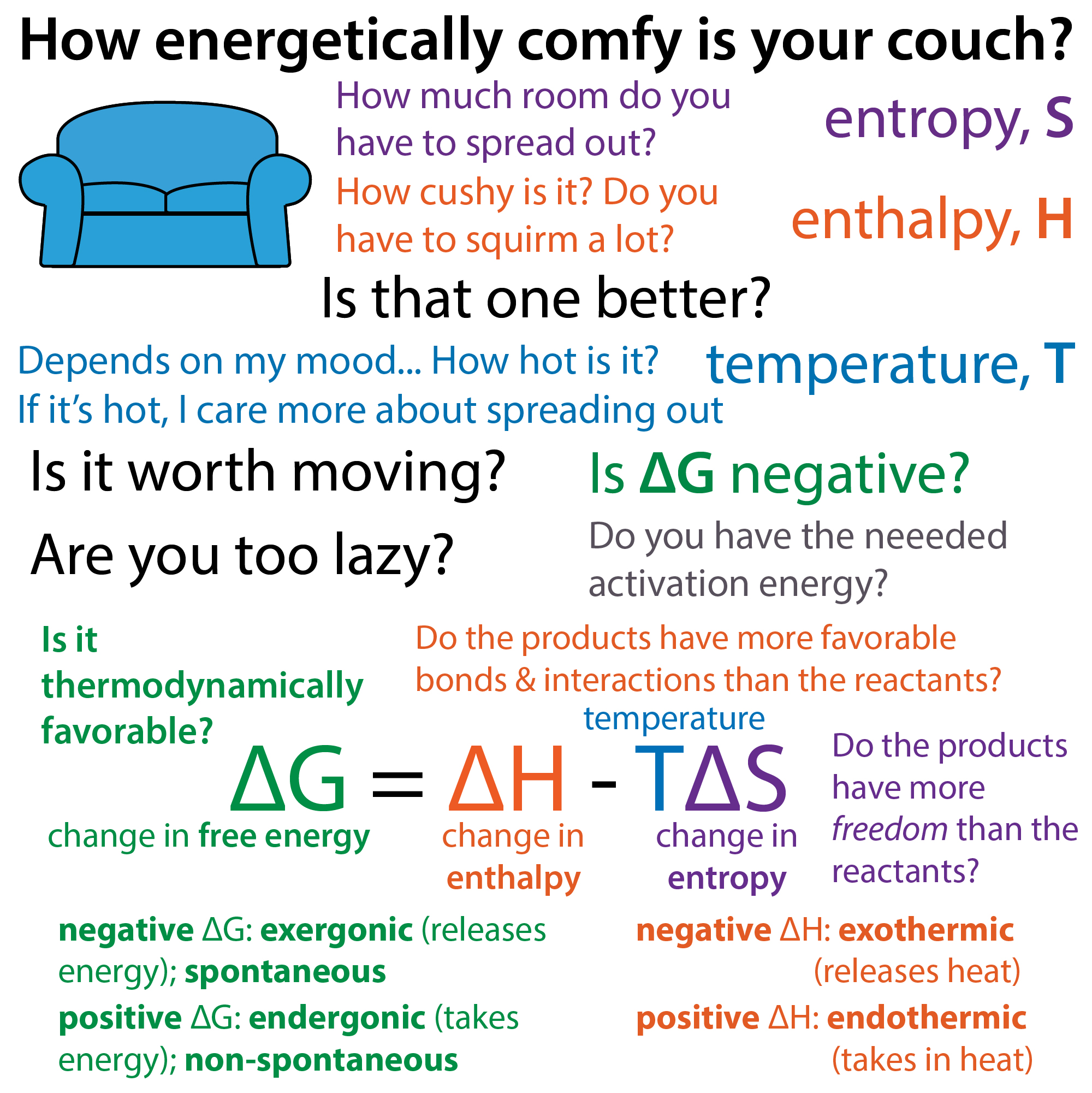
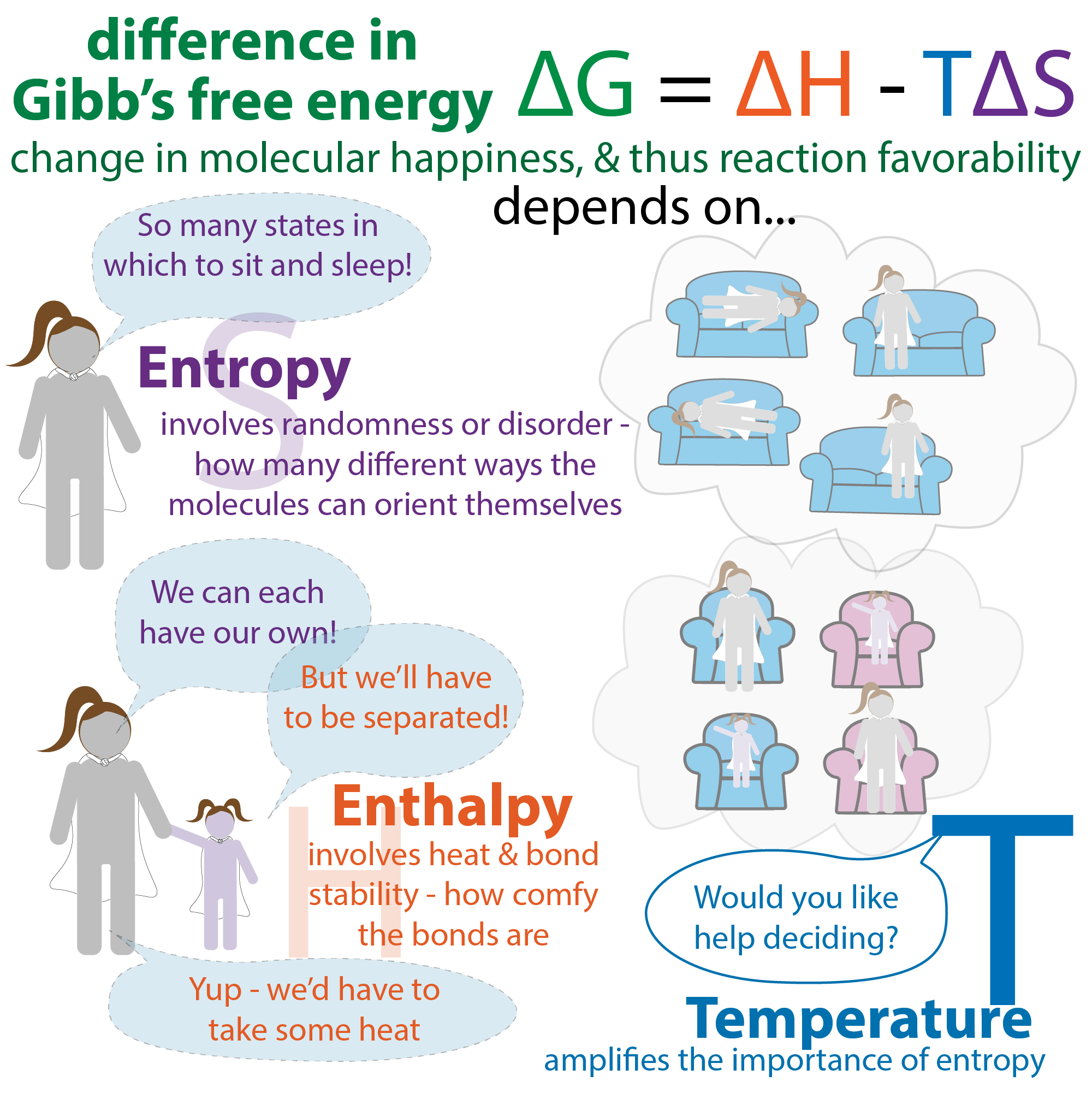
First, a brief refresher on thermodynamics and free energy(feel free to skip ahead if this is review or visit this post if you want more: https://bit.ly/thermodynamicstalk )… I like to think of free energy as a sort of “couch shopping.” Say you’re sitting on a couch. It’s not a very comfortable couch; it’s cramped & hard so you’re squirming around a bit trying to get comfortable. There’s a more comfortable couch across the room, and when you’re in that couch you sink right in & can relax & stop squirming. Aaahhh…
BUT in order to get to the comfy couch you have to overcome your laziness & get up off the 1st couch. Whether it’s “worth it” depends on how much comfier the 2nd couch & this depends on how much less squirmy you’ll be there & how much you’ll be able to spread out.
Similarly, whether a reaction will occur SPONTANEOUSLY depends on whether the products have more or less “free energy” than the reactants. We can think of this “free energy” (aka Gibbs free energy (G)) as a sort of overall “comfiness.” It takes into account squirminess (kinetic energy aka HEAT) in the ENTHALPY term (H) & spread-out-ability (randomness/freedom/disorder) in the ENTROPY term (S).
ΔG = ΔH-TΔS
Δ (delta) means “change in” so this equation looks at DIFFERENCES in H & S between reactants (couch 1) & products (couch 2).
Where’d that T come from? It stands for temperature & it takes into account the “mood.” ΔH & ΔS are “constant” because they’re calculated based on the reactants & products. But just like couch 1 & couch 2 don’t change, but when it’s hot, you care more about spreading out, at higher temps, ENTROPY becomes more & more important. (molecules want to spread out when they’re hot just like you!)
NEGATIVE ΔG means products have LESS FREE ENERGY than reactants, so the “2nd couch is comfier” & the reaction is likely to proceed spontaneously. We call such reactions EXERGONIC.
POSITIVE ΔG means products have MORE FREE ENERGY than reactants, so you’ll have to really bribe it to go… We call such reactions ENDERGONIC
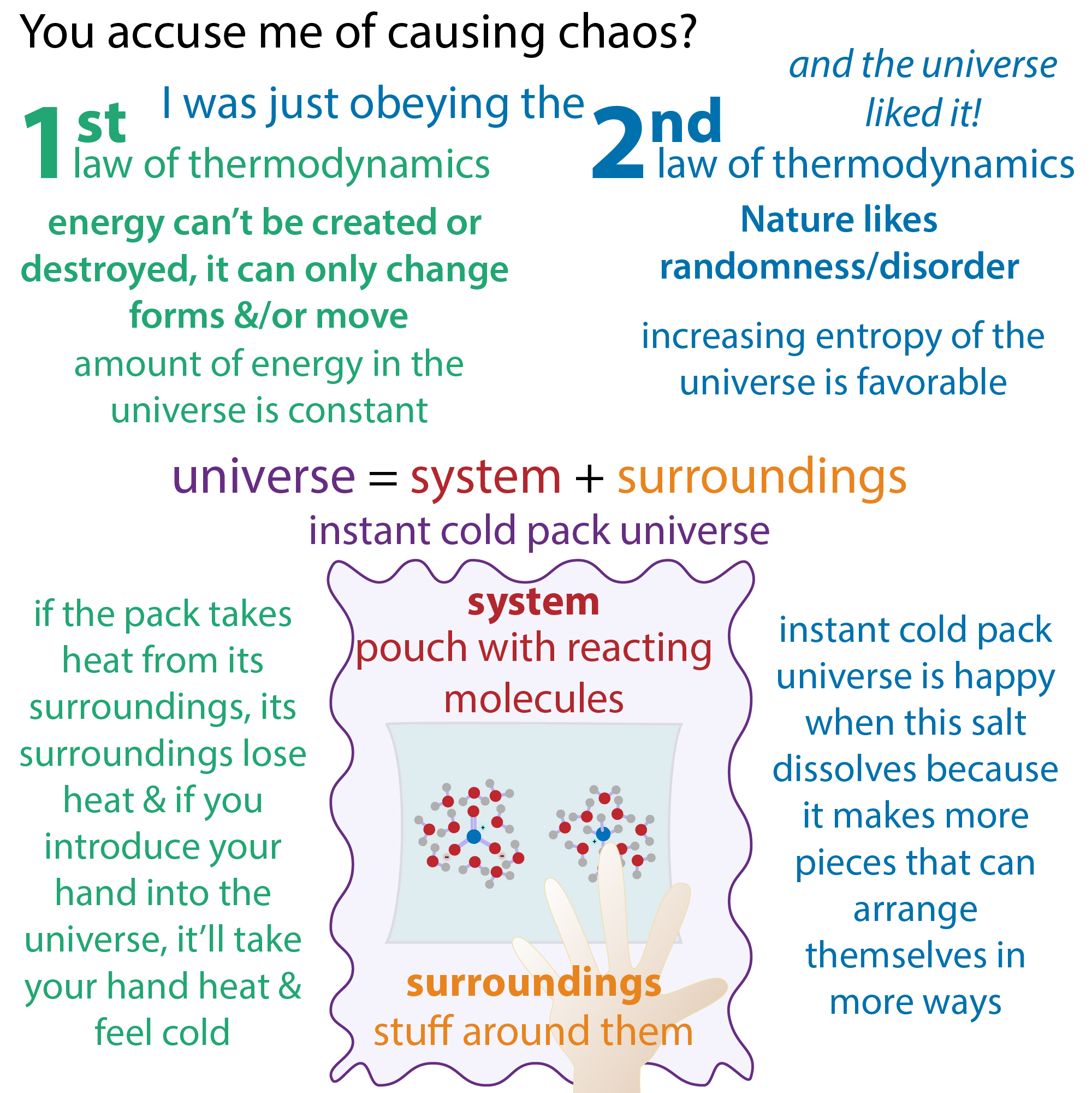
NEGATIVE ΔH means products have LESS HEAT than reactants. This can only happen if reactants give up heat to the “surroundings,” and such heat-releasing reactions are called EXOTHERMIC
POSITIVE ΔH means products have MORE HEAT than reactants. Which basically means reactants “stole” heat from “surroundings.” Such heat-absorbing reactions are called ENDOTHERMIC
NEGATIVE ΔS means the products have LESS FREEDOM/RANDOMNESS. This can come from having more and/or stronger bonds tethering the molecules together.
POSITIVE ΔS means the products have MORE FREEDOM/RANDOMNESS. This can come from having fewer and/or weaker bonds tethering the molecules together, allowing them to move around more, which molecules like, remember. What they really like (you get a large positive ΔS from) is if you can go from a liquid to a gas &/or break up a big thing (which has limited motion bc it has to move as a group) into lots of smaller things which can move separately.
So, to summarize this thermodynamic mumbo-jumbo, reactions are more favorable if they let off heat (have a ➕ ΔH) &/or give the molecules more freedom/randomness (have a ➕ ΔS). BUT it’s the combination of those 2 (& temp) that’s the ultimate decider of whether a reaction will occur spontaneously (have a ➖ ΔG).
Now that we’ve had this thermodynamic refresher, let’s get back to those instant cold packs with those concepts in mind: ΔG = ΔH – TΔS where ΔH is change in enthalpy (heat), T is temperature, & ΔS is change in entropy (disorder/randomness).
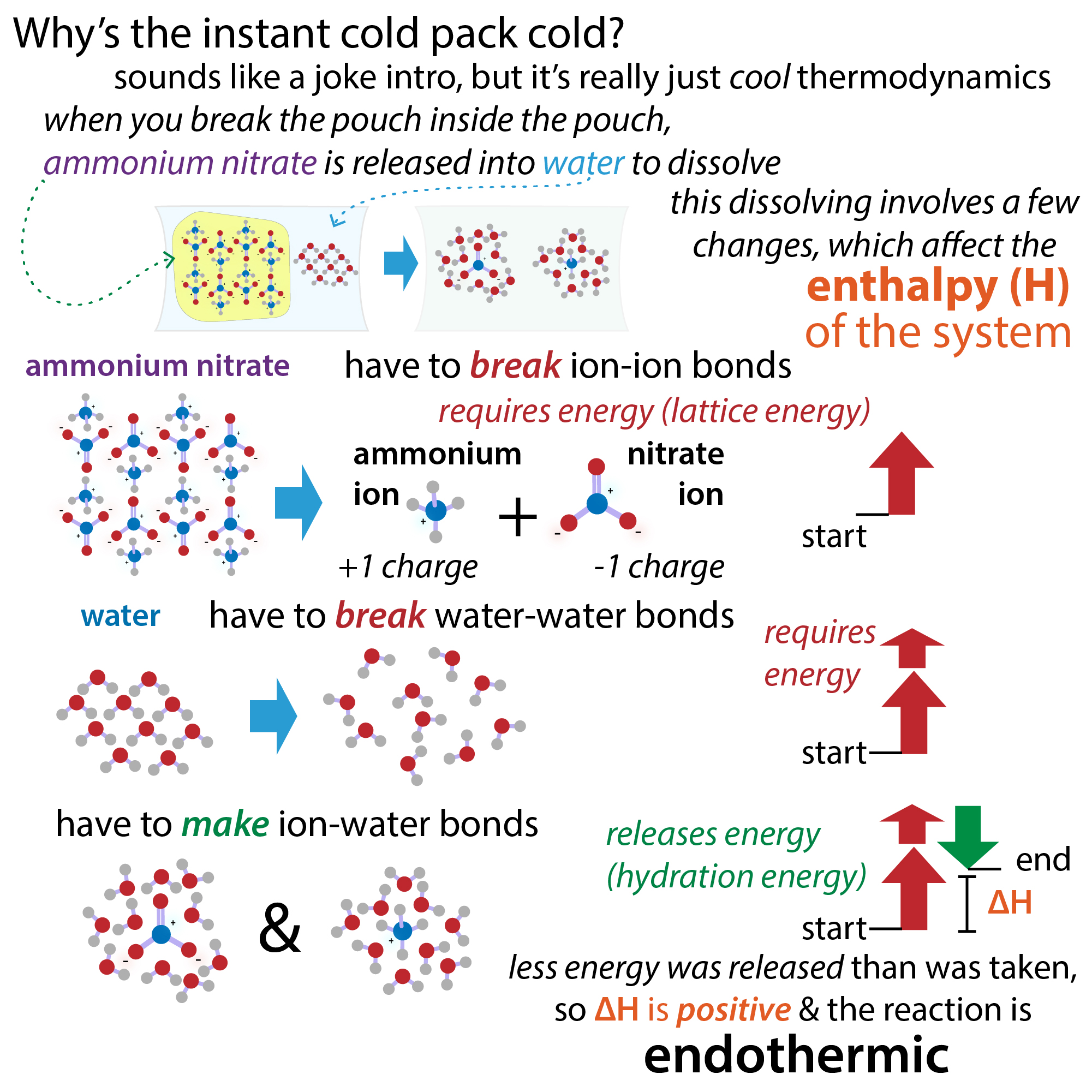
Instant cold packs only need 2 ingredients: solid ammonium nitrate (NH₄NO₃) & liquid water (H₂O). The “coldness” they produce comes from the endothermic dissolution of NH₄NO₃ (NH₄NO₃ dissolving in the water and breaking into its component ions, NH₄⁺ & NO₃⁻) (these ones actually have calcium ammonium nitrate, but it works the same).
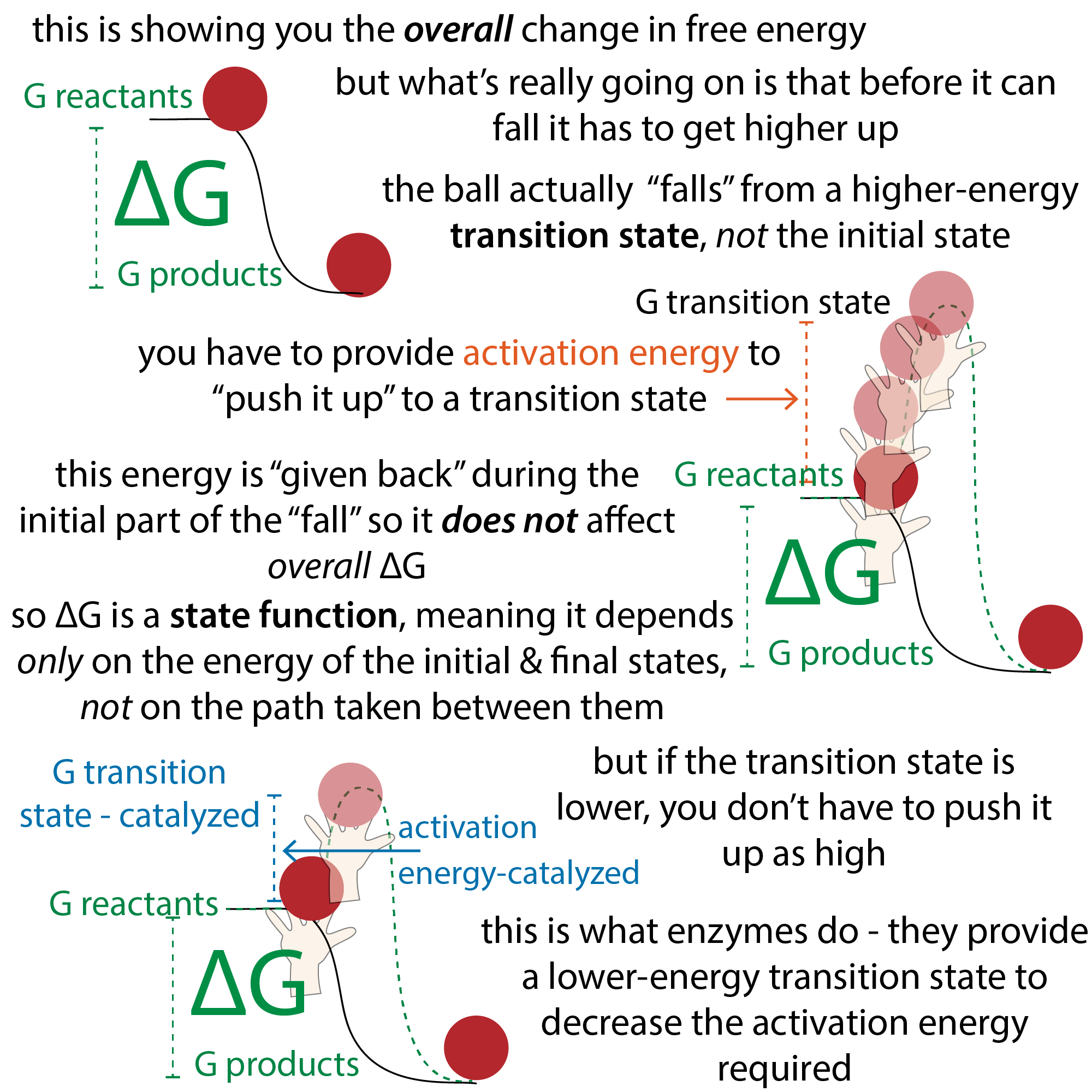
This dissolution process has a low activation barrier, so the reaction can start easily. i.e it’s highly reactive. So, in order to control when it starts, the H₂O & NH₄NO₃ are originally kept separate. The H₂O’s held in a pouch inside the pouch & you have to squeeze it to break the inner pouch & let the ingredients mix.
NH₄NO₃ is an electrolyte, which means that, when it dissolves it breaks into smaller, charged (ionic) pieces. In this case, NH₄NO₃ splits into ammonium (NH₄⁺) & nitrate (NO₃⁻) ions & each of these gets surrounded by water (hydrate).
Because NH₄NO₃ gets broken up, you get more pieces than you started with & you’re breaking up the water network as well, so more entropy (➕ ΔS) which is great for overall free energy’s sake
BUT, it took a bunch of energy to do all that breaking (energy which comes from stealing heat from the environment). Breaking bonds (even non-covalent ones) is always endothermic (requires energy input). But when you form new bonds, you give some of that energy back (this part’s exothermic). Whether the *overall* process is endothermic or exothermic depends on the NET change.
In this case, because the bonds between NH₄⁺ & NO₃⁻ (based on attraction between full charges), were stronger than the new bonds between them & water (which only has a partial charge), the energy released when the new ion-water bonds formed didn’t “pay off” – overall the reaction still stole more heat than it gave back (➖ enthalpy of solution), so the reaction is endothermic & the “surroundings” feel cold
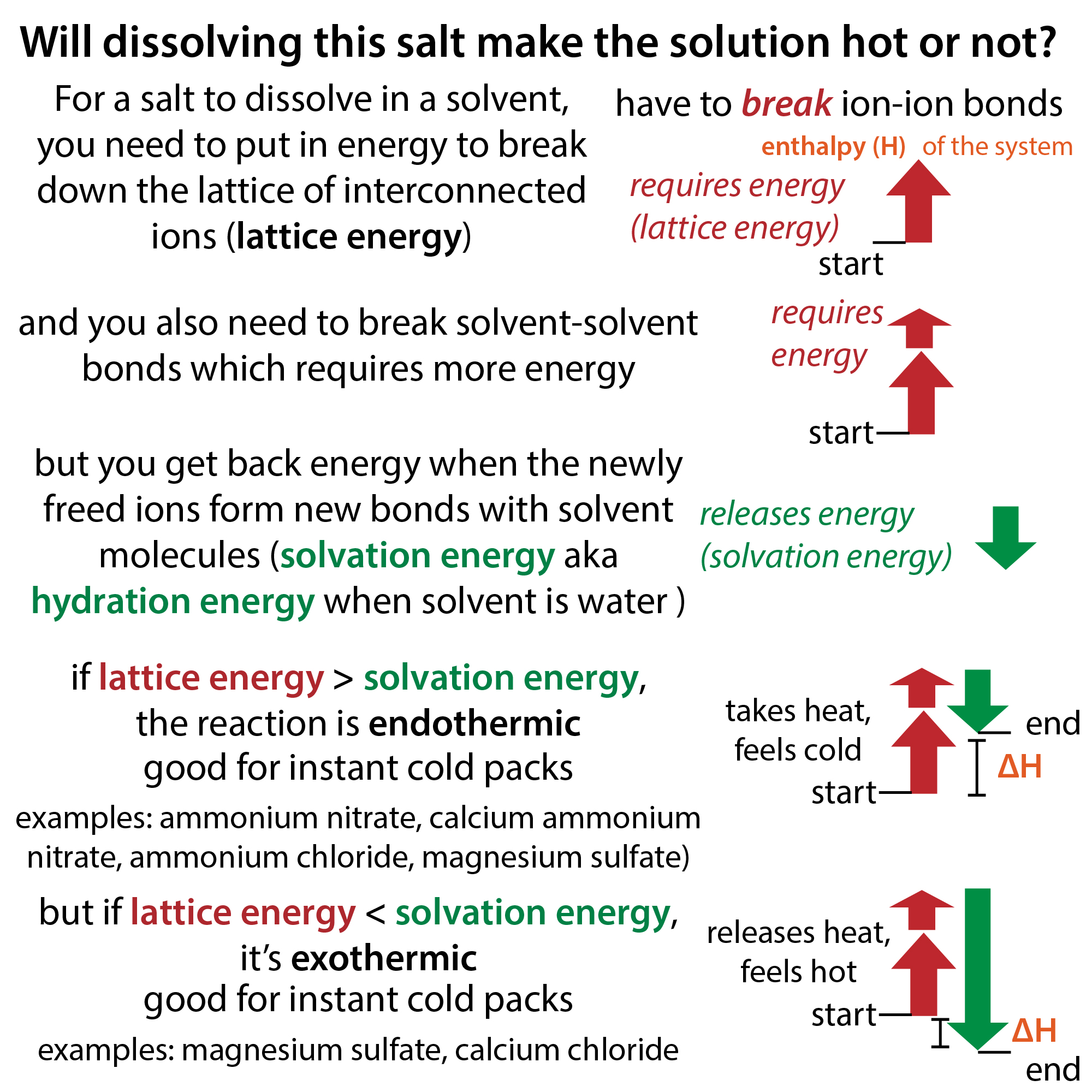
⚠️ Not all dissolution reactions are endothermic. For a salt to dissolve, you need to put in energy to break down the lattice of interconnected ions (lattice energy) but you get back energy when the newly freed ions form new bonds w/water molecules (hydration energy aka salvation energy). If lattice energy > hydration energy, the reaction is endothermic, but if lattice energy < hydration energy, it’s exothermic.
For NH₄NO₃ (& some other salts sometimes used in cold packs like calcium ammonium nitrate or ammonium chloride or magnesium sulfate), the lattice energy is greater, so they take more heat than they give, and are thus endothermic, which is good for cold packs.
For other salts, like magnesium sulfate or calcium chloride, the solvation energy’s greater, so they give back more heat than they took, and are thus exothermic, which is good good for heat packs