You can get DNA or RNA to precipitate (undissolve) with a combo of salt & alcohol. But which alcohol? Which salt? And how do you find it?
this is just some text adapted from a past post. I will have a more formal version once I have a little time… Just wanted to share the video and graphics and links at the end.
- salts neutralize the DNA or RNA
- alcohol gets water out of the way (so the salt can find the backbone)
- with neutral stuff, water doesn’t want to to play – so that nucleic acid will precipitate out
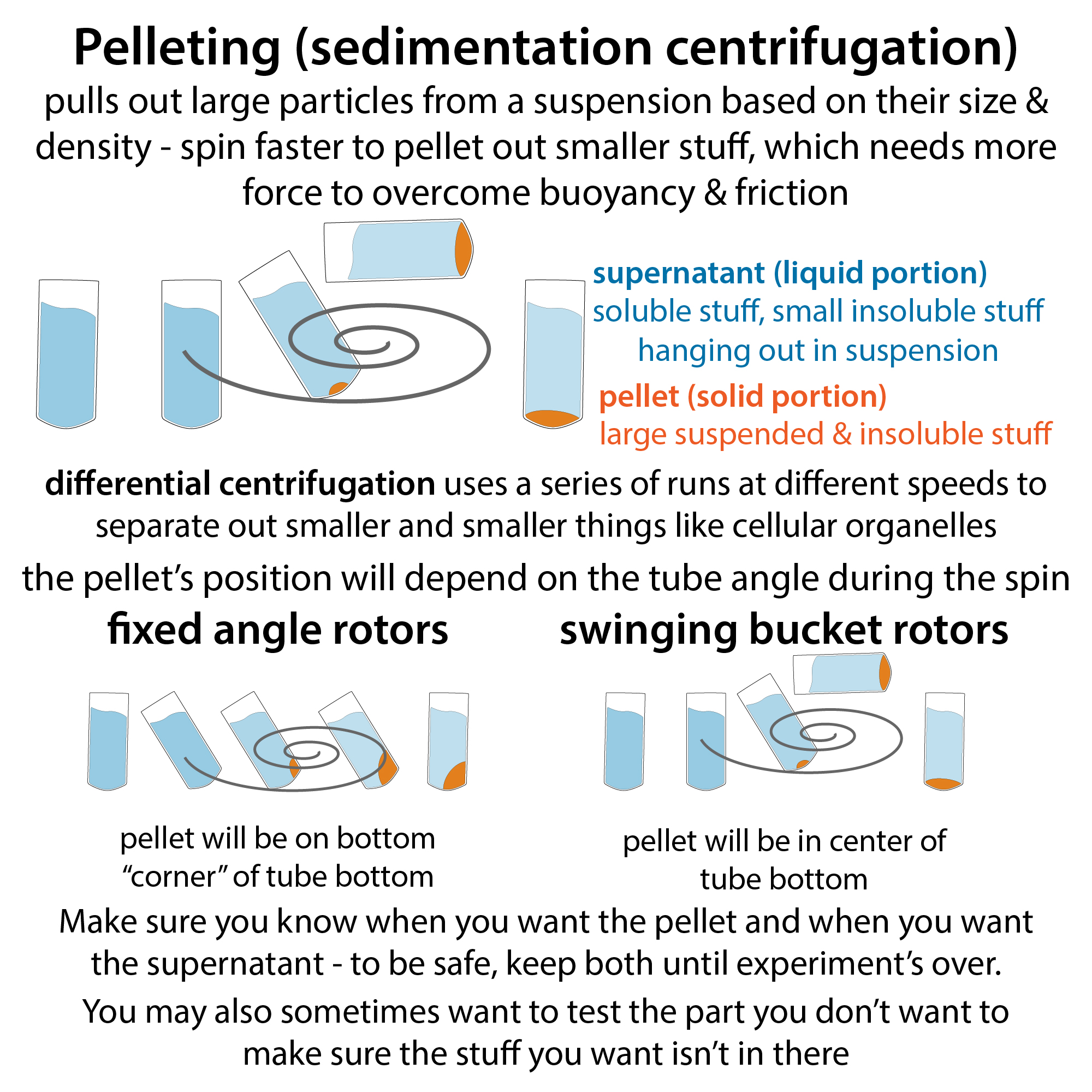
- co-precipitants like GlycoBlue help you spin it all out!
- then wash with 70-80% ethanol to dissolve those salts away
- resuspend in a clean solution & go about your day!
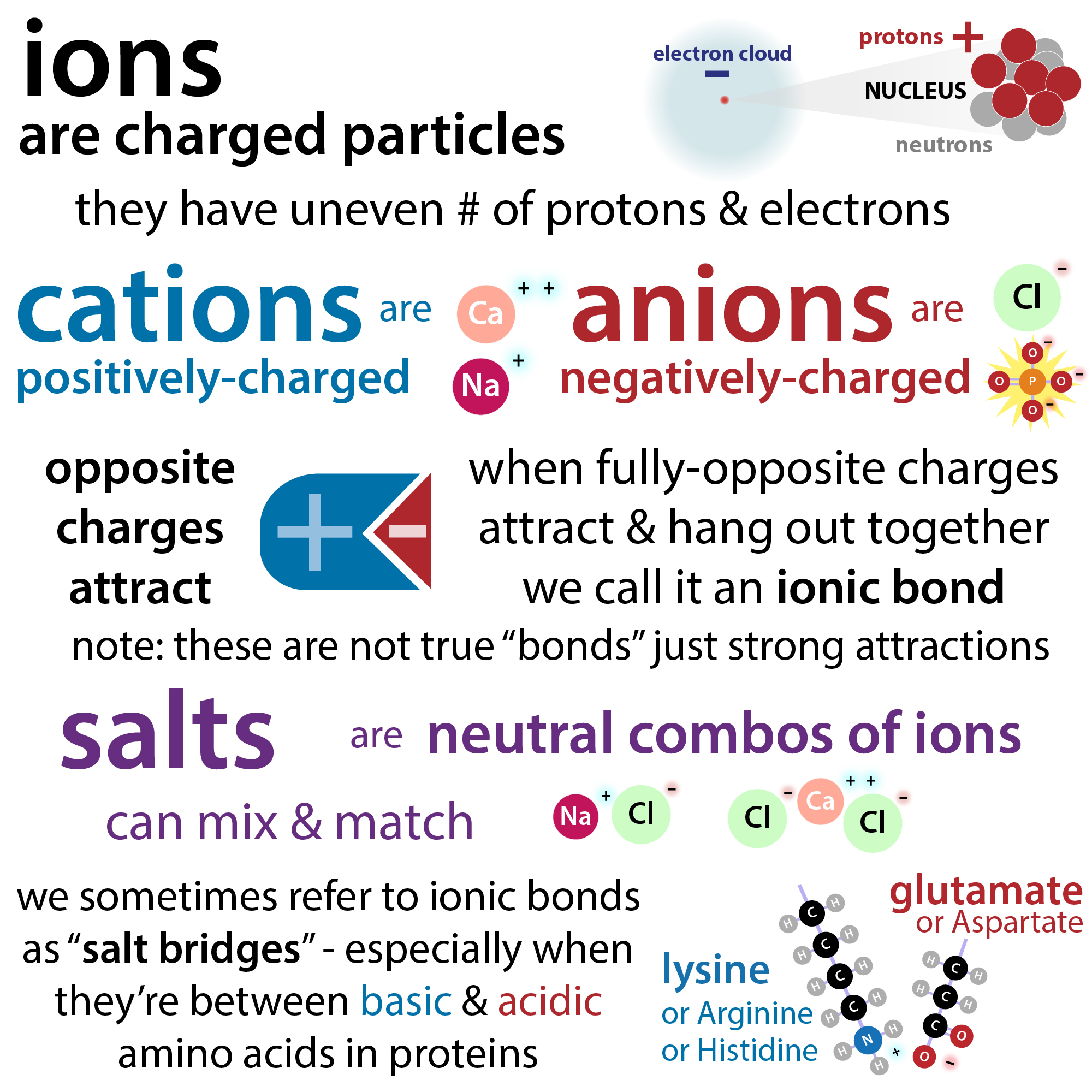
So, you start by mixing your DNA or RNA solution with ethanol (EtOH) or isopropanol (IsOH) & salt. If you’re using table salt, this means adding sodium chloride (NaCl). When this dissolves it “dissociates” into a positively-charged Na+ cation and a negatively-charged Cl⁻ anion.
The salt is really important for a couple of reasons. One is that it helps destick any stuck on proteins – basically the salt gives the proteins more options – instead of just having to choose between the solvent (e.g. water molecules) and the protein, there are now a bunch of ions hanging around they can hang out with.
Another is that it helps keeps the DNA strands stuck to each other. DNA has a negatively-charged backbone, and like charges repel each other, so if you tried to get DNA strands to hang out together without salt, they’d say “no way” – but when you add salt, the positively-charged component of the salt (the cation) can coat the negatively-charged backbone, neutralizing it so that the strands can stay together – and so that the DNA is less soluble, causing it to precipitate.
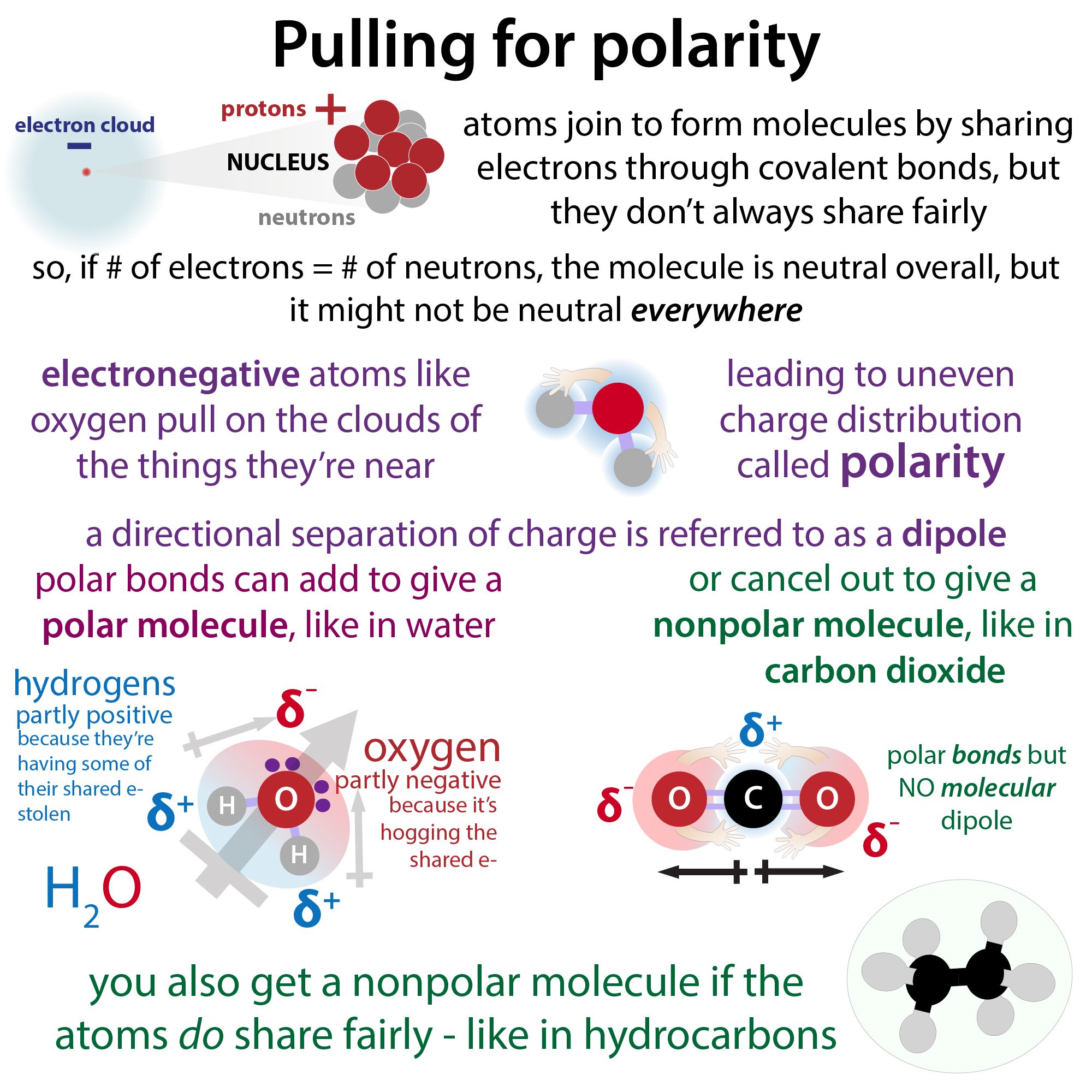
BUT this precipitation doesn’t happen until you add alcohol. Without the alcohol, the salt ions can’t find the DNA because the DNA’s coated in a layer of tightly-bound water molecules. And the salt ions are too. This is because water’s really polar – it has partly-negative and partly positive parts because of unequal electron sharing between the oxygen & the hydrogens. Opposite charges attract, so water is attracted to the charged parts of the DNA & the ions – and to other water molecules, thereby forming “solvation shells” – tight networks of water molecules around the DNA & ions that hide their charges.
But, the alcohol helps break down this shell by lowering the “dielectric constant” of the solvent – it’s less polar so it forms “looser” networks than water, therbey reducing shielding around charges so the + salts can see the negative phosphates and bind to them -> neutralize charge -> nucleic acids become less soluble & they don’t have a better solvent alternative to flee to, so they cling to each other -> precipitates
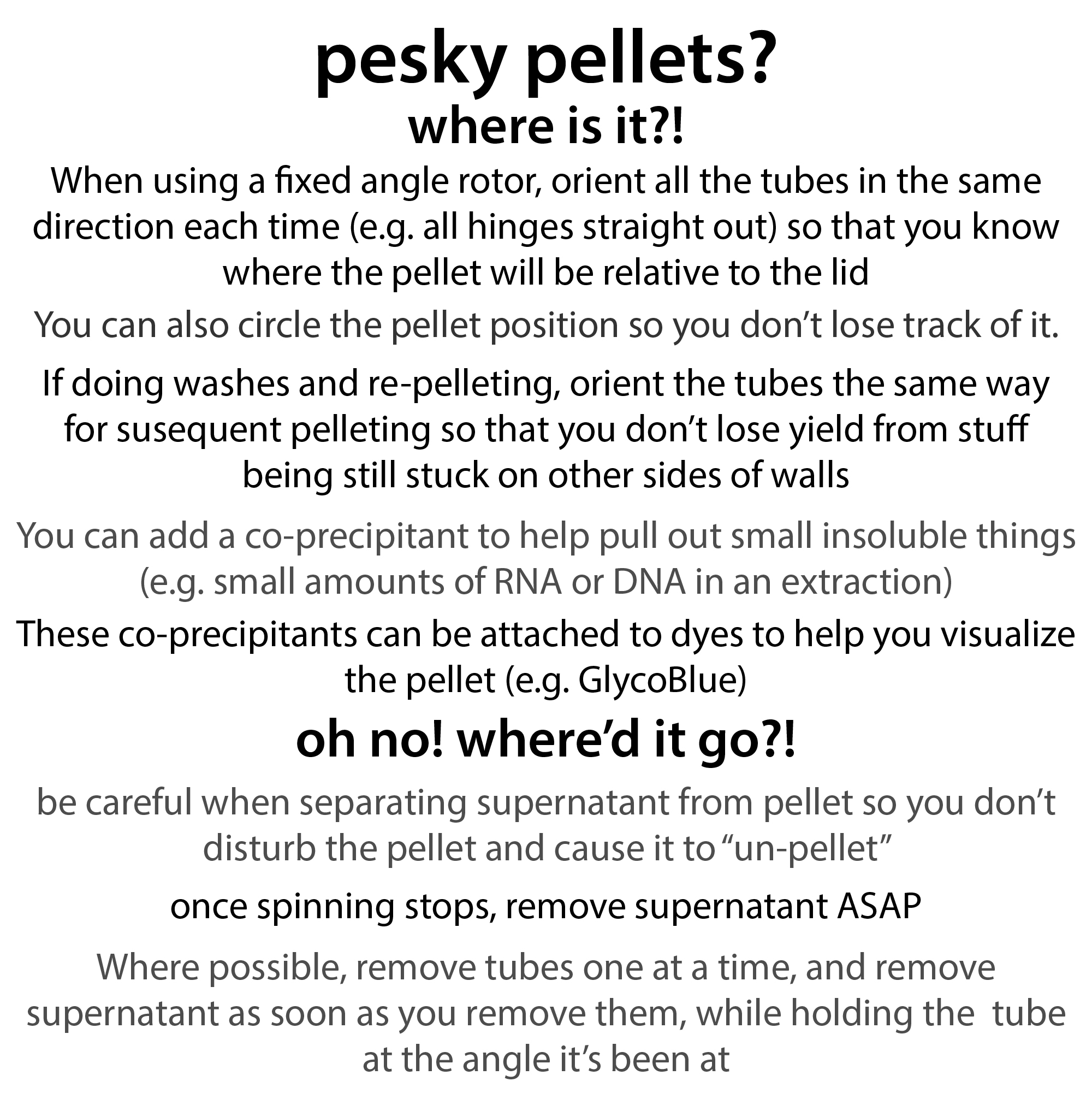
In order to have enough stuff to precipitate, you can add a co-precipitant like glycogen or LPA (linear polyacrylamide) which will glob onto it and help pull it out when you spin it out. If you want to be able to better see tiny pellets you can use GlycoBlue which has a blue dye conjugated to the glycogen.
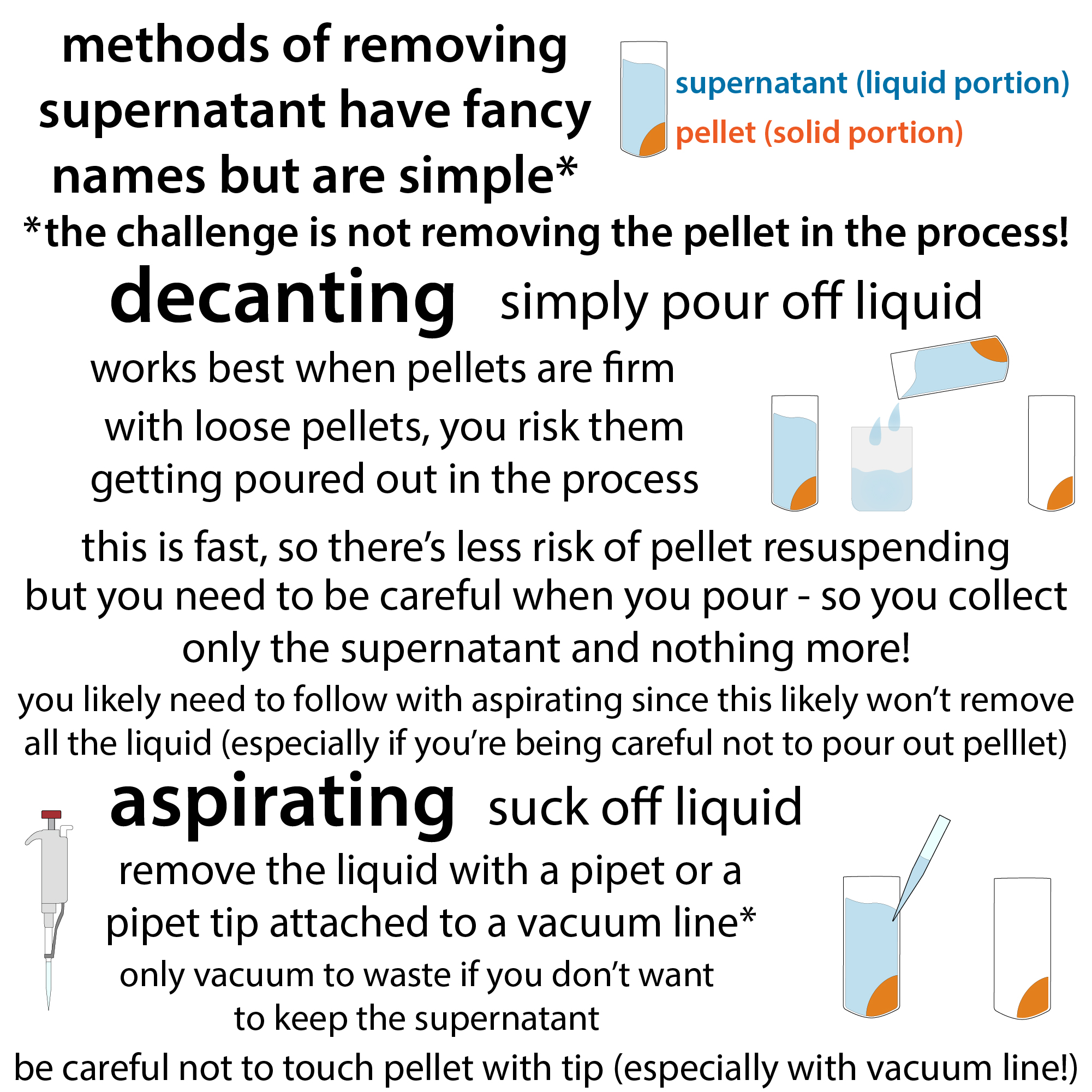
more about working with pellets (carefully!): blog form: https://bit.ly/pelleting_practical ; YouTube: https://youtu.be/OpQAEl_J2dQ
great resources:
- bitesizebio, Ethanol Precipitation of DNA and RNA: How it Works, Dr. Nick Oswald, March 2021 https://bitesizebio.com/253/the-basics-how-ethanol-precipitation-of-dna-and-rna-works/
- bitesizebio, DNA Precipitation: Ethanol vs. Isopropanol, Dr. Nick Oswald, August 2021 https://bitesizebio.com/2839/dna-precipitation-ethanol-vs-isopropanol/
- A systematic investigation of key factors of nucleic acid precipitation toward optimized DNA/RNA isolation Yalin Li, Suxiang Chen, Nan Liu, Lixia Ma, Tao Wang, Rakesh N Veedu, Tao Li, Fengqiu Zhang, Huiyue Zhou, Xiang Cheng, and Xumiao Jing . BioTechniques 2020 68:4, 191-199 https://doi.org/10.2144/btn-2019-0109