The DH5-alpha-bet soup of recombinant protein engineering often starts with sticking an engineered plasmid containing the gene for that protein into DH5 alpha bacterial cells. We’ve talked a lot about different ways we can get DNA into bacteria through transformation. But what’s already in the cells we’re trying to get it into?
note: text adapted & expanded from past post
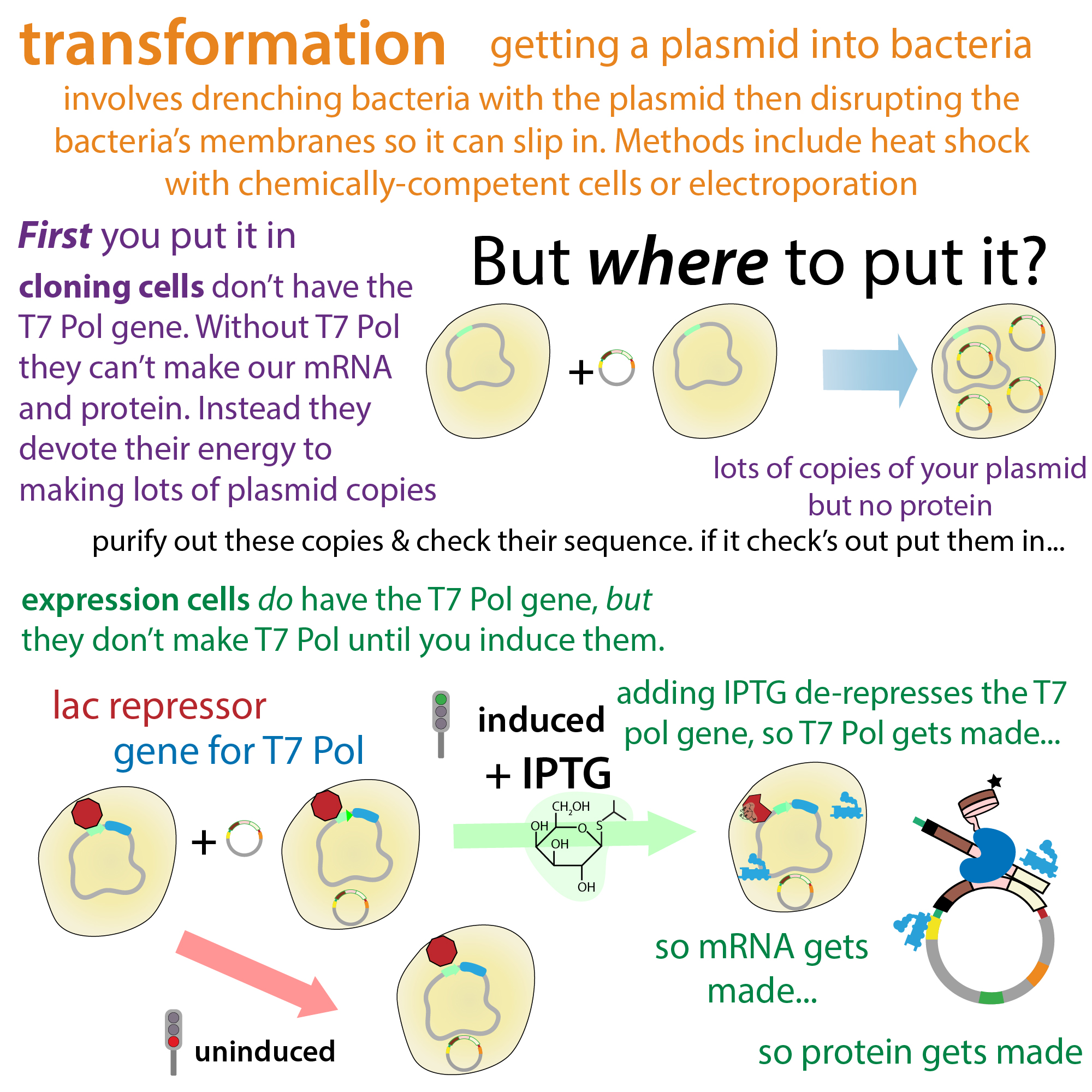
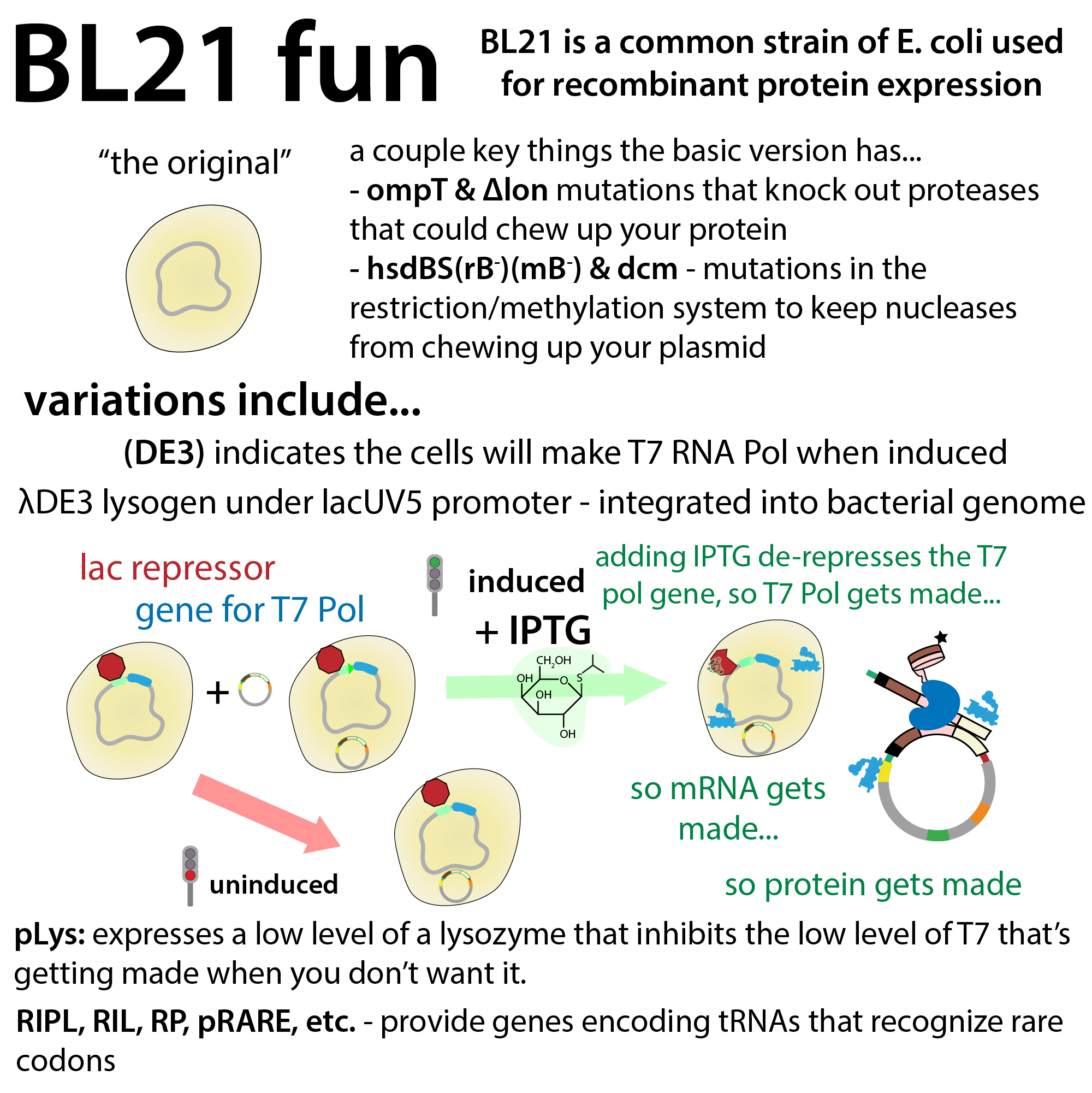
We can transform different types of cells depending on what our goals are. Broadly speaking, there are “cloning cells” and “expression cells” – we use “cloning cells” when we want to get lots of copies of the DNA (not the protein) and “expression cells” when we care more about getting protein than DNA.
In the molecular cloning stage, you’re often engineering circular pieces of DNA called plasmid vectors to contain a gene you want to study, then you stick that plasmid into bacteria. At this stage, you want the bacteria to 1) fill in any gaps that are left over (if you’re using SLIC cloning) 2) make more copies WIHOUT CHANGING IT AT ALL. You already did the changing you want and you don’t want the bacteria adding changes you don’t want. Your key concern is stability – so you want cells that have disabled “changing machinery.” And, ideally, we’d like them to be “easy to get into.” Turns out DH5α fits the bill!
DH5α is a type of e. coli. In their bacterial lineage, the first ancestor we have records of for these guys is “K-12” which came from the “wild” – it was isolated from a diphtheria patient’s poop in 1922 at Stanford. We call such naturally-occurring strains “wild-type”
Leave them alone and over time, bacteria develop mutations randomly, but scientists can “speed things up” by blasting them with radiation or adding chemicals call mutagens that do things like make breaks in the DNA and/or keep the bacteria’s fixing machinery from working.
And scientists have done this to K-12 lots because, even though it came from a patient, it lacks virulence genes so it “can’t” hurt us – it’s considered nonpathogenic.
So you take K-12, then mutate, mutate, mutate, and you get to another important ancestor, MG1655, which gave rise to DH5α and its cousin DH10b (aka TOP10 if you want to get all commercial)
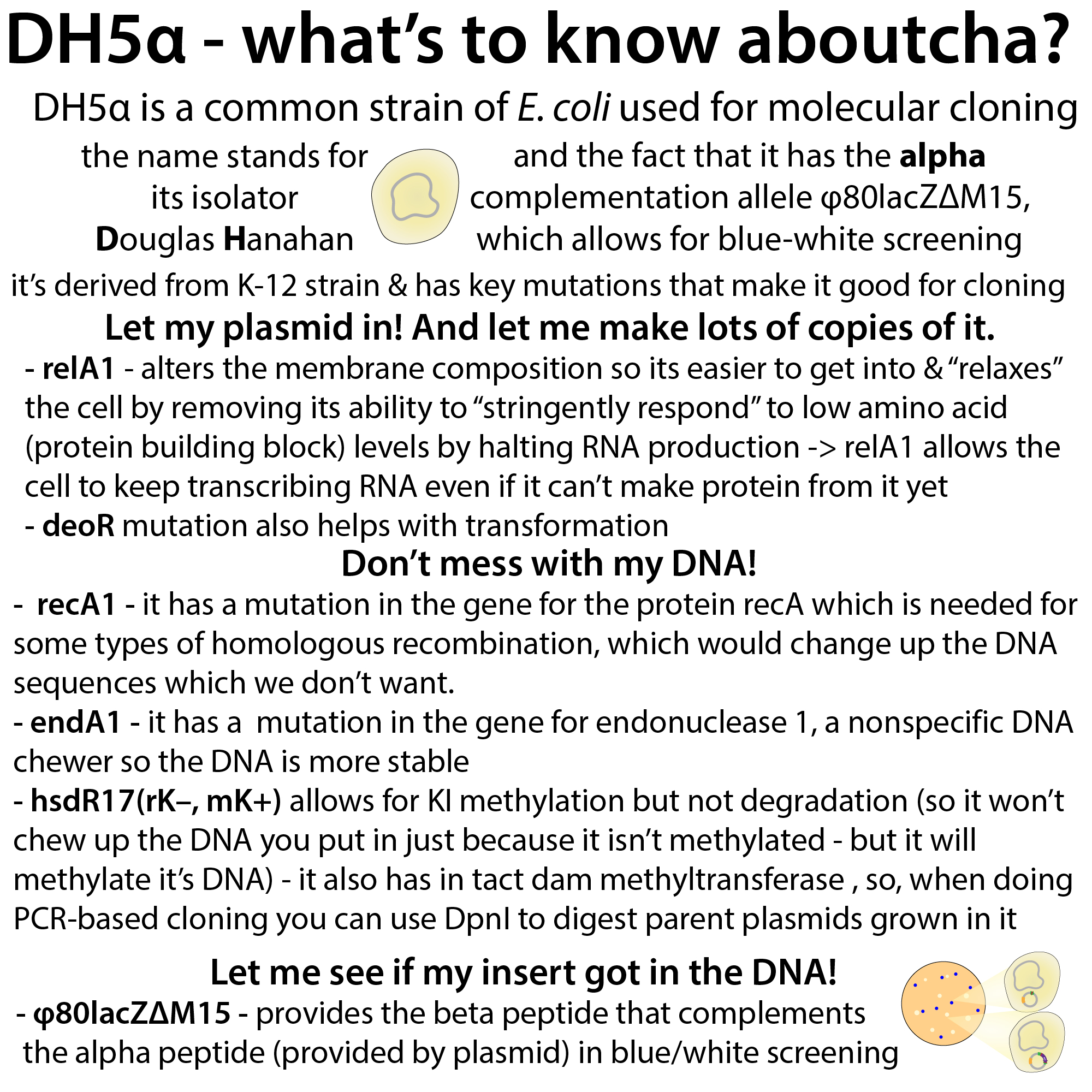
The “DH” comes from the name of its isolator, Douglas Hanahan. I’m guessing the 5’s cuz he isolated a bunch of different strains and this happened to be the “5th” in some experiment. And the alpha’s cuz it has the alpha complementation allele φ80lacZΔM15, which allows for blue-white screening (more here https://bit.ly/bluewhitescreening )
There are lots of strains with many names – remembering them all can be a pain. Especially since the name’s not really what we care about, we care about what they can do for us. And what they can do for us depends on what their “genotype” is – what genes does it have? are they functional? We can use a sort of “shorthand notation” to describe the key genetic features of a particular strain.
Genes usually have 3 letter abbreviations, often followed by a number. We use a delta (Δ) if some gene’s been deleted; And a +/- if it has or doesn’t have some trait; and an “r” for resistance (e.g. to some antibiotic).
The mutations that make DH5α great for us are:
- recA1 – it has a mutation in the gene for the protein recA which is needed for some types of homologous recombination, which would change up the DNA sequences which we don’t want. (Thankfully there are other recombination mechanisms that will finish our SLICs but won’t mess up other stuff)
- endA1 – it has a mutation in the gene for endonuclease 1, a nonspecific DNA chewer so the DNA is more stable
- endA1 strains come thanks to Hoffman-Berling, who took a bunch of bacteria and added a chemical mutagen to speed up mutations, then he tested the mutated cell’s nucleic-acid chewing activity and isolated some strains that had lost their generic DNA chewingness
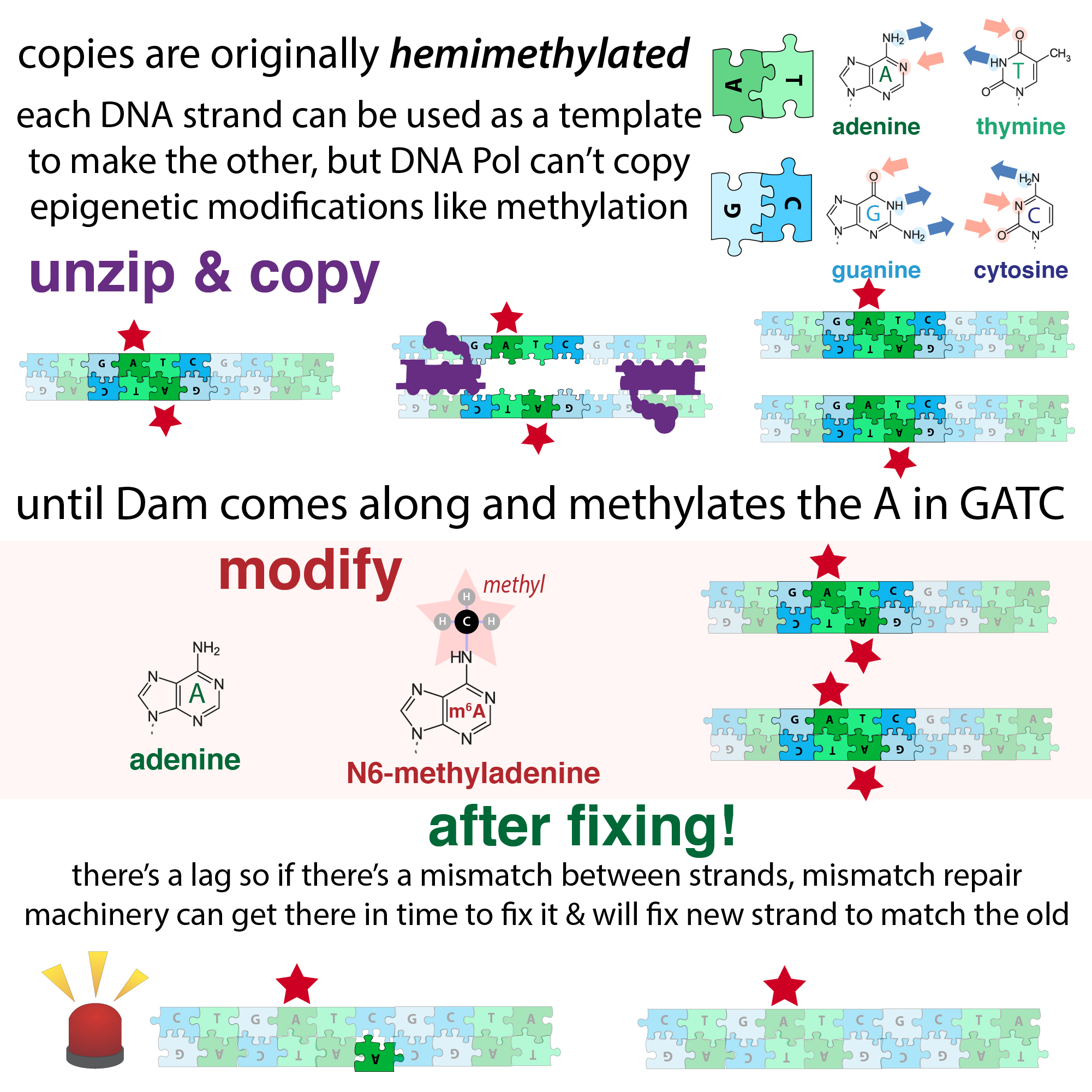
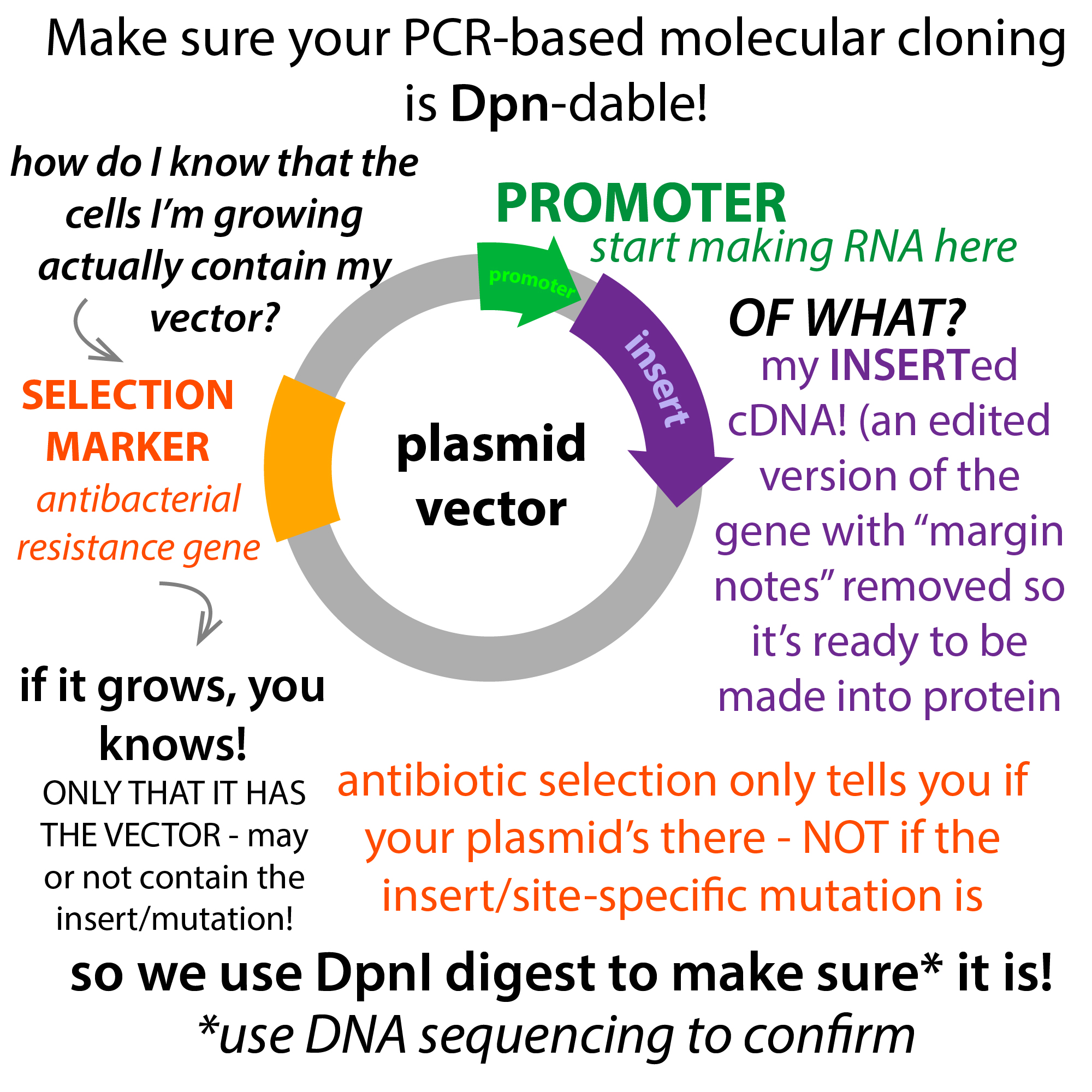
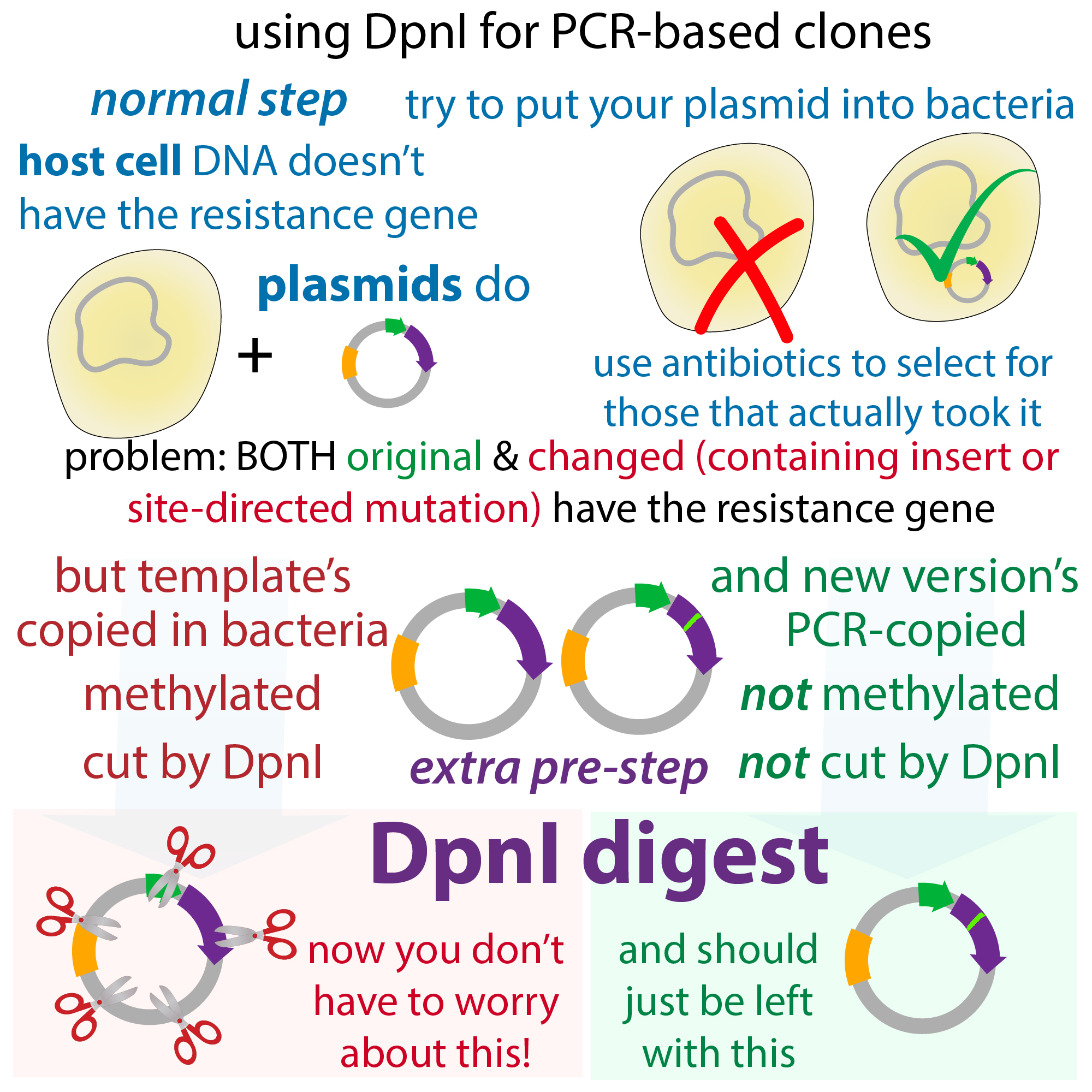
- hsdR17(rK–, mK+) which allows for KI methylation but not degradation (so it won’t chew up the DNA you put in just because it isn’t methylated – but it will methylate the DNA copies it makes – it also has its dam methyltransferase in tact, so, when doing PCR-based cloning you can use DpnI to digest parent plasmids grown in it
- relA1 – alters the membrane composition so its easier to get into & “relaxes” the cell by removing its ability to “stringently respond” to low amino acid (protein building block) levels by halting RNA production -> relA1 allows the cell to keep transcribing RNA even if it can’t make protein from it yet
- deoR mutation also helps with transformation efficiency
- φ80lacZΔM15 – provides the beta peptide that complements the alpha peptide in blue/white screening (if your plasmid has the alpha peptide, it can complement this and make a functional B-galactosidase gene that can make a white lactose mimic blue)
There are other mutations too, gyrA96, which gives it nalidixic acid resistance; thi-1 which makes it a thiamine auxotroph (can’t make its own thiamine); Δ(lacZYA-argF)U169 – a deletion that leads to increased hydrogen peroxide resistance; and others
It’s not that we need *all* of these mutation, but as long as they don’t get in the way, we’ll let them stay!
And, after all the mutagenesis these cells have gone through, there are tons more that just haven’t shown to be “interesting” yet – but a lot of mutations are only discovered under conditions when that protein’s needed – like, you wouldn’t know that there’s a mutation in the thiamine metabolism gene if you always grew them with plenty of thiamine. So a lot of the “new” mutations scientists discover have likely been there (or something close) for quite a while.
All this is housed in a single, circular chromosome with ~4.6million DNA letters & ~4 and a half thousand genes.
for more info:
- addgene Plasmids 101: Common Lab E. coli Strains, Matthew Ference, 2014: https://blog.addgene.org/plasmids-101-common-lab-e-coli-strains
- DH5α strain info on the CGSC (Coli Genetic Stock Center) website: https://cgsc.biology.yale.edu/Strain.php?ID=150015
- Open WetWare E. coli genotypes Wiki: https://openwetware.org/wiki/E._coli_genotypes#DH5%CE%B1
- Genetic backgrounds of each Escherichia coli strain used in The ST2OOL Project, 2014 iGem: https://2014.igem.org/wiki/images/5/58/Genetic_backgrounds_of_each_Escherichia_coli_strain_used_in_The_ST2OOL_Project.pdf
- the RelA1 mutation: Shokri, A., Veide, A. & Larsson, G. RelA1 gene control of Escherichia coli lipid structure and cell performance during glucose limited fed-batch conditions. Appl Microbiol Biotechnol 73, 464–473 (2006). https://doi.org/10.1007/s00253-006-0480-9
- the deor mutation: Gene Cloning and Manipulation – Page 61, Christopher Howe, 2007: https://books.google.com/books?id=OWXM4Q3-ieEC&pg=PA61&lpg=PA61&dq=deor+mutation&source=bl&ots=xtwaKleNQ-&sig=ACfU3U0K9_6ZQv_of8dR5jFD6D6CQjgjgg&hl=en&sa=X&ved=2ahUKEwj2uui-5uf3AhWWFjQIHVThC5IQ6AF6BAgZEAM
- Doug Hanahan biography, DNA Learning center: https://dnalc.cshl.edu/view/16722-Biography-34-Doug-Hanahan-1951-.html
past posts on related topics:
- more on BL-21 & other expression strains: https://bit.ly/bl21_rare_codons
- more on transformation: http://bit.ly/transformheatshock
- more on blue-white screening: https://bit.ly/bluewhitescreening
- more on DNA sequencing: http://bit.ly/DNAsequencingmethods & http://bit.ly/sequenceclones & http://bit.ly/sequencetermstools
A potential word of caution about using some of the rare codon plasmids: Søgaard, K. M., & Nørholm, M. H. (2016). Side effects of extra tRNA supplied in a typical bacterial protein production scenario. Protein science : a publication of the Protein Society, 25(11), 2102–2108. https://doi.org/10.1002/pro.3011