« Back to Glossary Index
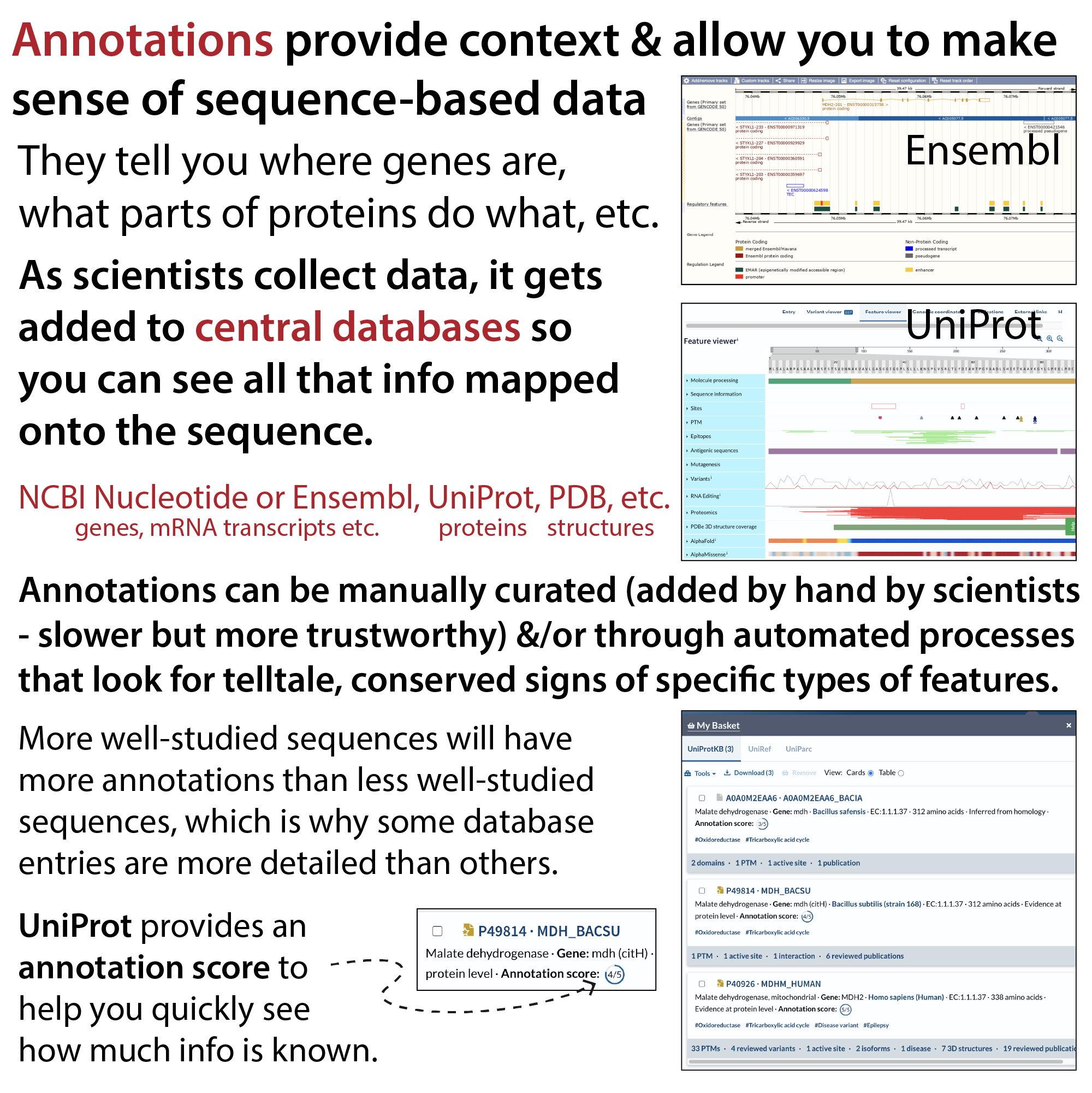
Annotations provide context & allow you to make sense of sequence-based data. They tell you where genes are, what parts of proteins do what, etc. As scientists collect that data, it gets added to annotation databases so we can see all that info mapped onto the raw sequence data. Annotations can be manually curated (added by hand by scientists) and/or through automated processes that look for telltale, conserved signs of specific types of features. More well-studied sequences will have more annotations than less well-studied sequences, which is why some entries in UniProt, etc. are a lot more detailed than others. UniProt even provides an annotation score to help you quickly see how much info is known.