Metric prefixes and scientific notation are great for helping us work with tiny & huge numbers and convert between units, but if you’re not careful you can easily get off by factors of 10 in your calculations
for these and other cheat sheets: https://bit.ly/bumbling_uploads
Metric prefixes let us work with large numbers of tiny things. You can stick these prefixes in front of any base unit (g, mol, M, etc.) and you can multiply by factors of 10 to easily convert between units with different metric prefixes. For example, there are 1000 mg in 1 g; 1000 ug in 1 mg; 1000 ng in 1 ug, etc.
e.g.: 50 ng = 50/10^6 = 0.00005 mg (can also be written as 5x 10^5 mg)
5x 10^-9 g = 5 ng
0.00005 g = 0.00005 x 10^6 = 50ug
think small! – some mental shortcuts
Often in biochemistry we’re dealing with solutions at the uL scale, so lots of conversions.
To make sure you’re on the right track when doing them…
- when converting to thinking in terms of less stuff (e.g. a smaller volume or mass), the number should get smaller (e.g. there are fewer molecules in a uL or a ug than there are in a L or a g)
- but when you’re converting to thinking of same amount of stuff, just in terms of smaller units, the number should be bigger (e.g. there are more ug in a g than there are mg in a g and more uL in a L than mL in a L)
Often concentrations are given in mg/mL. This is the same as ug/uL. Recognize that when the prefixes are the same and you’re dividing them by the same factor of 10, they’ll still be the same! In fact, this is also the same as ng/nL, or g/L!
Using similar reasoning to remember, M (mol/L) is the same as umol/uL, and mmol/mL.
& mol/uL is the same as mM – since nano is one thousandth of u, we need to use the one thousandth prefix with M, hence “mM”
It can be easy to get lost in scientific notation…
- With scientific notation, you’re multiplying* some number by a factor of 10 (so # x 10^n). If n is negative, it’s the same as dividing by 10 to the positive form of n (e.g. when n = 3, we divide by 10^3)
- the superscript is hard to type so it’s often signified with a carrot (^)
- e.g. 9.43 x 10ª can be written 9.43 x 10^3 & 9.43 x 10^-3 written 9.43 x 10^-3
- n tells you the number of 0’s after the 1 and since decimal places represent factors of 10, n tells you how many places to move your decimal point.
- if n is positive, your number is going to qet bigger – move decimal point y places to the right
- e.g. 9.43× 10^3 = 9430 and 9.43 × 10^9 = 9430000
- if n is negative, your number is going to get smaller – move decimal point y places to the left
- e.g. 9.43 x 10^-3 = 0.00943 and 9.43 × 10^-6 = 0.00000943
- if n is positive, your number is going to qet bigger – move decimal point y places to the right
- we typically only put one digit before the decimal place
- e.g. we write 9.43 x 10^3 instead of 94.3 x 10^2
- another way to represent this is with E notation, where E stands for “10^”, so you write “#En”
- e.g. 9.43 × 10^3 can be written 9.43E3 and 9.43 x 10⁻³ can be written 9.43E-3
- warning – remember that E includes the 10, so don’t write 9.43 x 10E3, which would give you an extra 0!
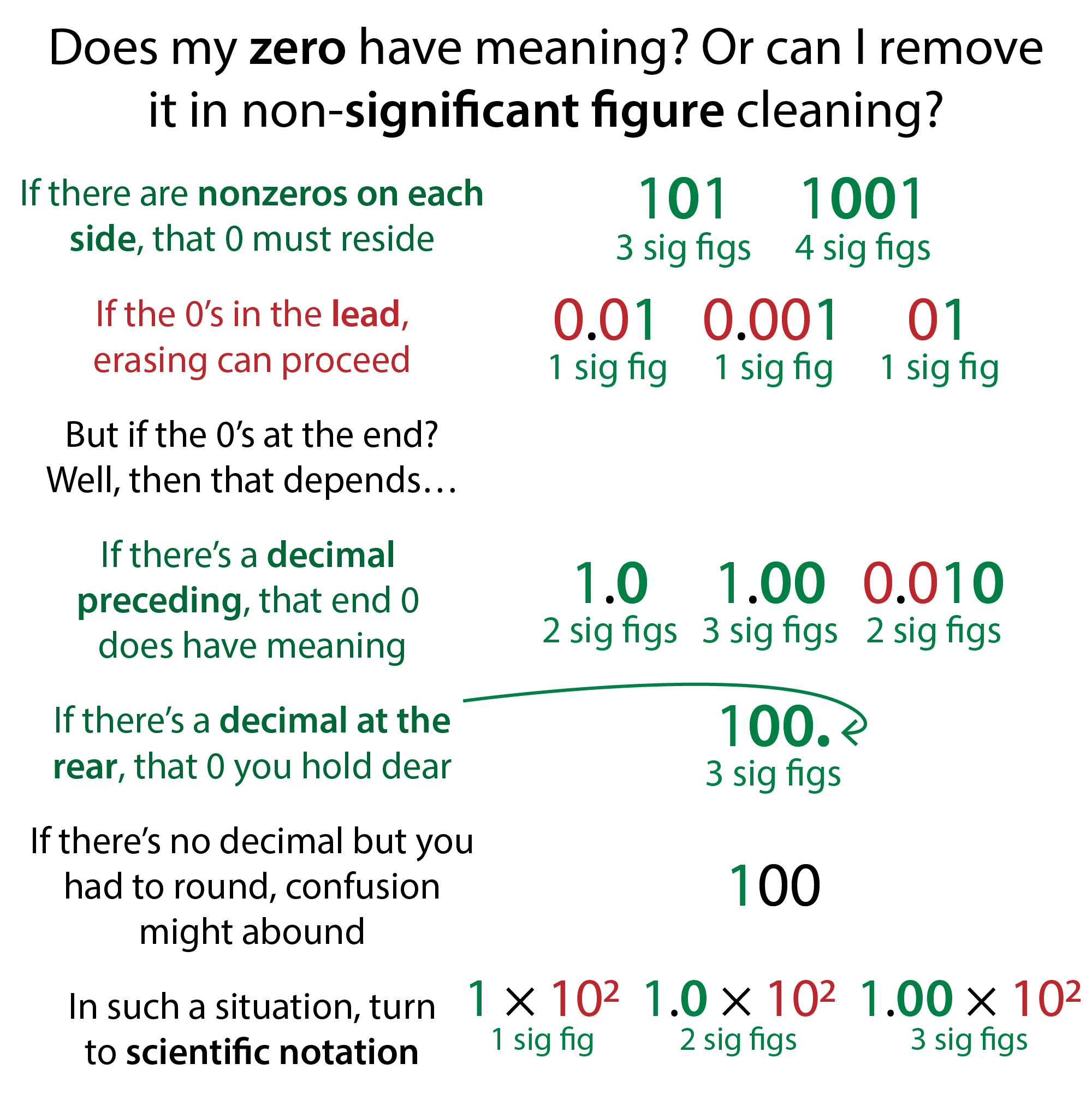
Scientific notation also helps us clearly show how many significant figures (sig figs) we have when we have trailing zeros. more here: http://bit.ly/significantfiguress & https://youtu.be/q29Cv5i5PuI
more on dimensional analysis: http://bit.ly/dimensionalanalysising & https://youtu.be/KQMA0aAGfP4
more about concentrations: http://bit.ly/sciencestocksolutions ; YouTube: https://youtu.be/RjXYvOiLh2w & https://youtu.be/wC623-AGBOs
and a couple cheat sheets for molecular weights: https://drive.google.com/file/d/1TqCRh23TO8s5T23DjBcJeCUWl23ps9sI/view?usp=sharing and concentrations: https://drive.google.com/file/d/1v7pff7cEpJTvr-IADLwdwwFOlEDdz8Ny/view?usp=sharing
more about all sorts of things: #365DaysOfScience All (with topics listed) 👉 http://bit.ly/2OllAB0 or search blog: https://thebumblingbiochemist.com